

Strategy & Transformation
How to Calculate ROI for AI and Software Modernization
A practical, finance-ready framework for comparing AI and modernization investment with the current-state cost, realistic benefits, delivery risk and time to value.
operationalwrocław--:-- cet
∕ insights / what-is-hbbtv.md
What Is Hbbtv
Discover what is HbbTV, how hybrid broadcast broadband TV works, and why it matters for product teams building scalable, interactive television experiences.
>_article.meta

HbbTV is a hybrid broadcast-broadband standard that combines DVB-compliant linear video with HTML5-based broadband interactivity. It reached 100 million European households in 2025, making it a mainstream TV platform rather than a niche experiment.
That scale changes the business question. Product leaders aren't deciding whether HbbTV is interesting. They're deciding whether their connected-TV strategy can tolerate fragmented device runtimes, inconsistent feature support, evolving DRM requirements, and market-by-market measurement rules. A service that works beautifully on one television can still fail commercially if startup behavior, signaling, playback rights, or audience reporting breaks elsewhere.
The right approach is senior-level ownership of the complete result. Engineering teams must connect architecture decisions to faster launches, lower operational risk, better quality, and stronger monetization, while using AI to accelerate delivery without lowering standards.
HbbTV, or Hybrid Broadcast Broadband TV, combines a DVB-compliant broadcast channel with an internet connection. The broadcast path carries the linear programme and signaling. The broadband path delivers the interactive application, typically built with web technologies and rendered by the TV or set-top box.
That division solves a practical commercial problem. Broadcasters can keep using an established linear delivery pipeline for live television while adding electronic programme guides, catch-up services, voting, interactive overlays, and companion experiences through software. They don't need to turn every linear channel into a pure OTT stream just to add digital functionality.
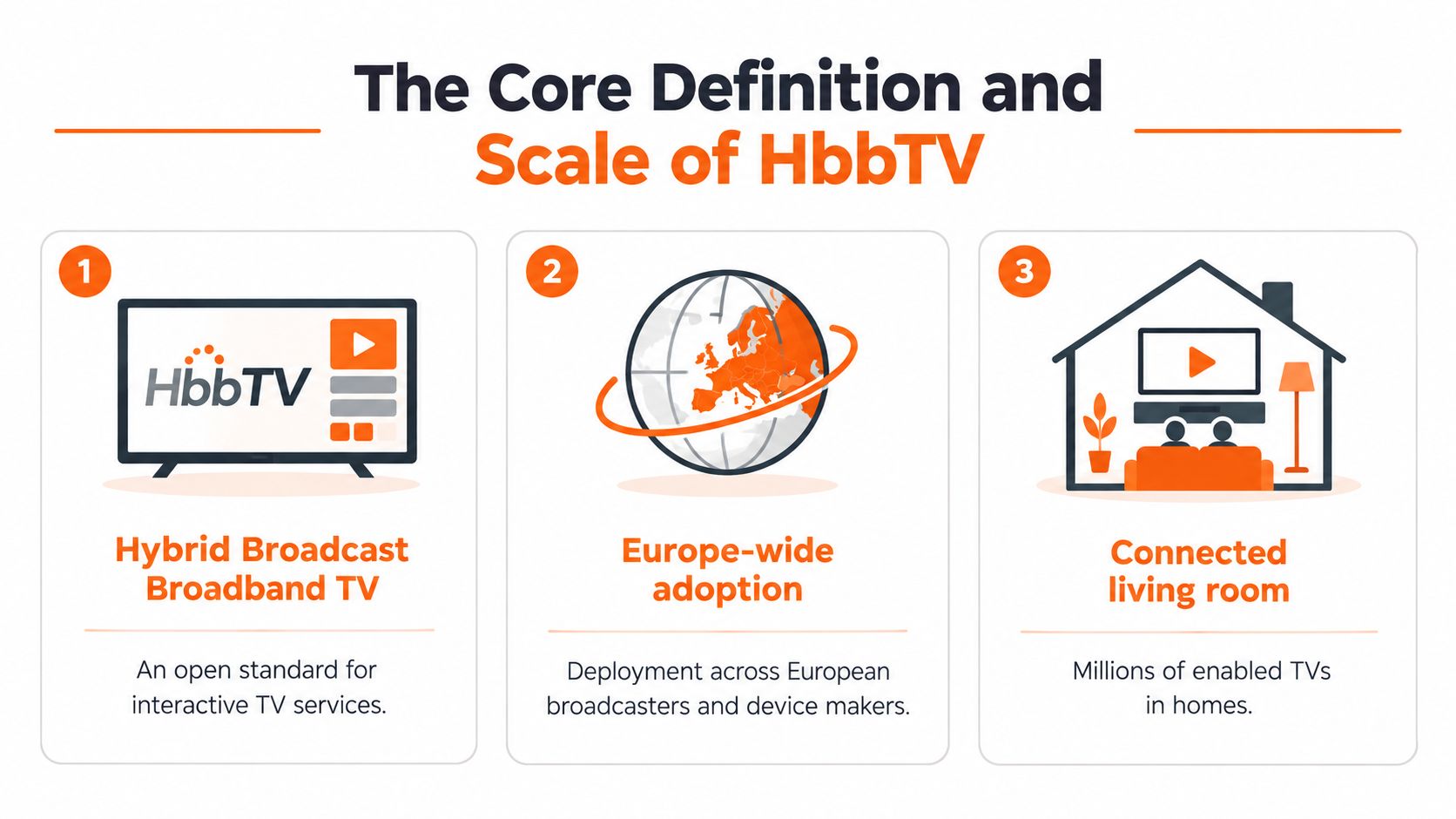
The standard was formed from earlier French and German hybrid-TV initiatives after the HbbTV Association was created in 2009. It was standardized in June 2010 as ETSI TS 102 796, with HbbTV 1.0 providing the foundational specification for interactive broadcast-broadband services, as documented in the HbbTV standard overview.
HbbTV reached 100 million European households in 2025. The HbbTV Association reported 60 million households in 2020, representing 25.9% penetration out of 231 million total households, and 97 million households with 41.3% penetration by 2024. It projects penetration to pass 50% by 2026, reaching about 120 million households, according to the European adoption milestone.
Those figures create a clear architectural obligation. A broadcaster, platform operator, advertiser, or analytics provider targeting European television can't treat HbbTV as an optional red-button add-on. The installed base is large enough that inconsistent implementation becomes a commercial reach problem, not merely a developer inconvenience.
My recommendation is direct: define HbbTV as a supported platform in the product portfolio, then document the exact markets, device classes, specifications, playback modes, and commercial capabilities you intend to support. Don't approve a roadmap that says “HbbTV compatible” without defining what compatibility means.
HbbTV works by separating delivery of linear video from delivery of interactive software. The DVB-compliant broadcast signal carries the programme and signaling that tells a compatible television or set-top box an application is available. The device then uses its broadband connection to retrieve the HTML-based application and present it alongside, or in coordination with, the broadcast service.
The broadcast channel acts like a reliable shared highway for live video. Broadband acts like a flexible return route for software, on-demand media, user actions, and frequently updated data. That division lets a broadcaster preserve the strengths of broadcast delivery while adding services that would be cumbersome or inefficient to distribute through the broadcast stream itself.
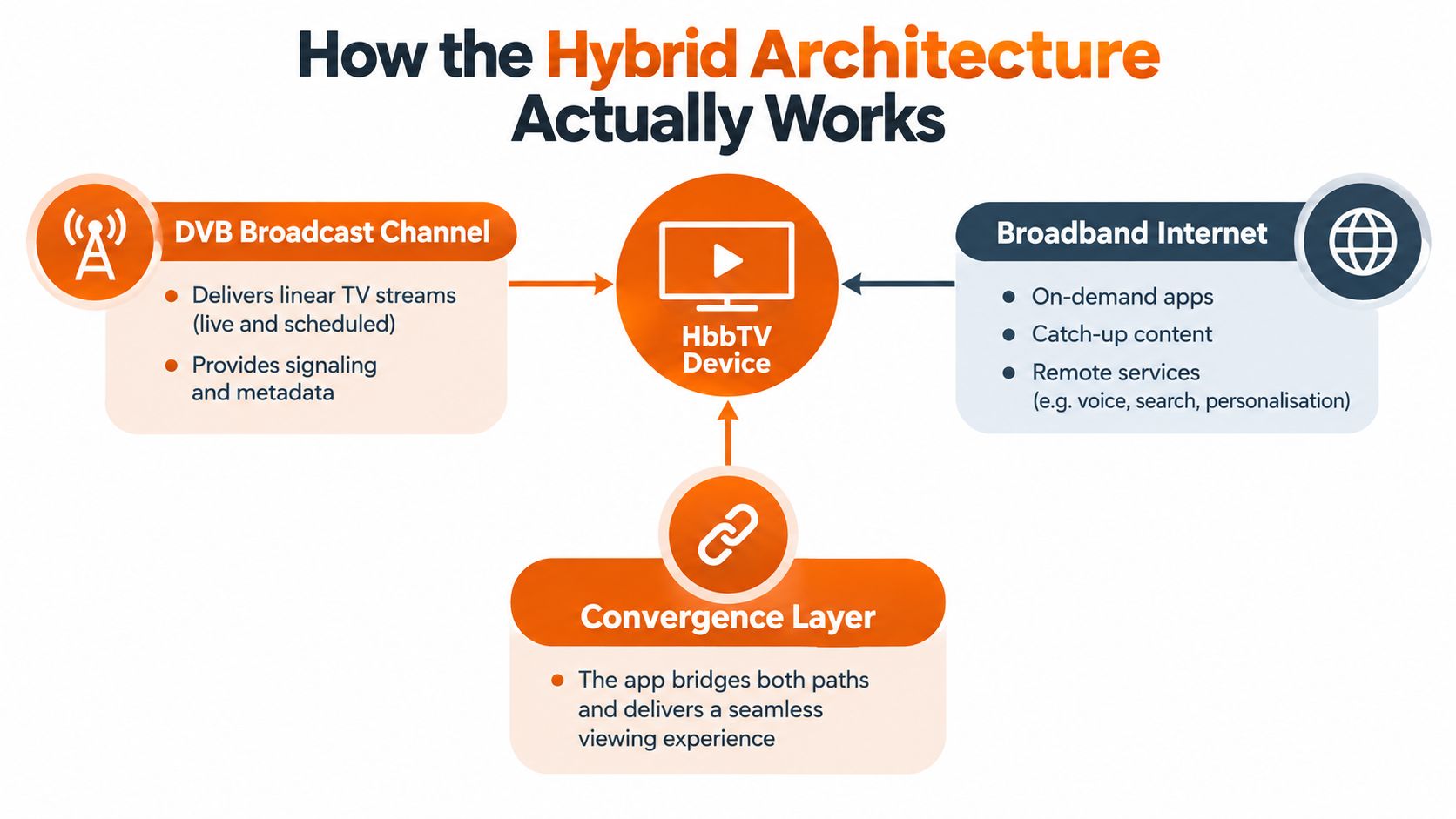
The signaling doesn't usually contain the complete interactive experience. It provides the information needed for the device to discover and launch the application. The application then loads over broadband, where it can request catalogues, authentication services, catch-up assets, advertising decisions, subtitles, analytics events, and other remote resources.
That design is why HbbTV is best understood as an application and presentation layer, not a transport standard. It doesn't replace DVB delivery, broadband networks, or content platforms. It coordinates them at the user experience layer.
For engineering teams, the separation creates four responsibilities:
A catch-up service illustrates the model. A viewer watches a linear programme, presses the red button, and the television launches an application associated with that broadcast service. The application can display an electronic programme guide or catalogue, then fetch the selected content over broadband without disrupting the broadcast pipeline.
Teams planning this kind of platform should review their application boundaries, integration contracts, and operational ownership through a disciplined digital platform development approach. The key question isn't whether the app can render. It's whether the broadcast signal, application backend, entitlement layer, media delivery, and support process behave as one product.
Practical rule: Treat broadcast signaling as a production dependency. If it fails, a perfectly engineered broadband application may never become visible to the viewer.
HbbTV 2.0 expanded the browser-based environment with HTML5, CSS3 modules, DOM Level 3, WebSockets, Web Workers, Server-Sent Events, and Web Storage. It also added capabilities related to HEVC over broadband, TTML subtitles, and synchronized broadcast-broadband playback, enabling richer audio, UHD, and coordinated media experiences through the HbbTV 2.0 specification.
Early HbbTV thinking often centers on the red button. That image is useful, but incomplete. A red-button prompt is only the entry point. The platform evolved into a browser-based middleware layer capable of supporting richer applications, media catalogues, synchronized playback, accessibility features, and protected content.
The major shift came from adopting modern web capabilities. HTML5, CSS3, JavaScript APIs, WebSockets, Web Workers, Server-Sent Events, and Web Storage gave application teams a broader toolkit than static broadcast overlays. These technologies support interactive navigation, live data updates, remote service calls, and responsive application behavior, although television runtimes still impose stricter constraints than desktop browsers.
HbbTV 2.0 added support for HEVC over broadband, TTML subtitles, and synchronized broadcast-broadband playback. Those capabilities matter because product teams can design services that combine linear programming with richer media experiences, extra audio channels, subtitles, and UHD delivery rather than treating the television as a passive display.
HbbTV 2.0.4 added integration for accessibility, DVB-I, and voice assistants, together with improvements and bug fixes, according to the HbbTV specifications resource library. Its DVB-I integration allows a red-button application connected to a traditional broadcast service to link with a linear service delivered through DVB-DASH, as explained by the DVB-I and HbbTV specification update.
The most important recent change for platform strategy is DRM. The HbbTV 2.0.5 core specification, published in March 2026, formally integrated DRM into the standard for the first time and updated accessibility and DVB-I features, as reported in the HbbTV 2.0.5 announcement. DRM is not a minor implementation detail. It affects entitlement flows, device support, content licensing, failure handling, and the number of fallback paths an engineering team must maintain.
Teams working on interactive media should also examine AI-powered interactive media insights from Faberwork LLC for broader ideas about applying AI to content and experience workflows. The strategic lesson is simple: AI can accelerate analysis, prototyping, testing, and content operations, but it doesn't remove responsibility for architecture, security, rights management, or production behavior.
The platform's evolution creates a decision rule. Don't build against the newest specification just because it's newest. Map every desired feature to the target device fleet, market, broadcaster environment, DRM requirement, accessibility expectation, and fallback experience.
A connected television isn't a desktop browser attached to a large screen. It may have limited memory, an older processor, inconsistent firmware behavior, a slow broadband connection, or a remote control that makes complex navigation frustrating. HbbTV services succeed when product teams design for those constraints from the first architectural decision.
Startup behavior deserves product-level ownership. A viewer should understand that the service is responding, even when the application is still loading remote data. Keep the initial payload small, render the first useful screen early, and defer nonessential catalogue, analytics, and personalization requests.
A strong implementation sequence looks like this:
Codec support, subtitle format, memory use, and JavaScript execution directly influence perceived quality. A video player that works on a current television may consume too much memory on an older set-top box. A subtitle implementation that looks correct in one runtime may fail or become unreadable in another.
Use progressive enhancement, but define a supported baseline. Don't allow every device-specific exception to leak into product code. Put capability detection, media selection, and fallback decisions behind clear interfaces so the rest of the application remains understandable and testable.
The best HbbTV experience is not the one with the most features. It's the one that reaches the widest supported fleet with predictable behavior.
Broadband failure also needs a designed response. If the service depends entirely on a remote API before showing anything, a temporary network problem becomes a blank screen. Cache safe, non-sensitive presentation assets, establish explicit timeouts, and distinguish between unavailable content, expired entitlement, unsupported playback, and temporary connectivity failure.
AI-native delivery can help teams move faster through test generation, log analysis, compatibility triage, and documentation. It can't decide the acceptable fallback for a paid service or approve a DRM architecture. Senior engineers still own those decisions, the data flows, the security controls, and the production quality.
The most dangerous HbbTV assumption is that a standard guarantees identical behavior. It doesn't. Broadcasters and platform operators target mixed fleets of televisions, operator set-top boxes, regional deployments, firmware versions, and browser runtimes with different support profiles.
The commercial risk is easy to understand. A service can pass a happy-path test in an emulator and still fail when a real viewer launches it through a particular manufacturer runtime, operator configuration, or broadcast signaling chain. That failure can block a market launch, interrupt a campaign, or create support costs that product teams didn't budget.
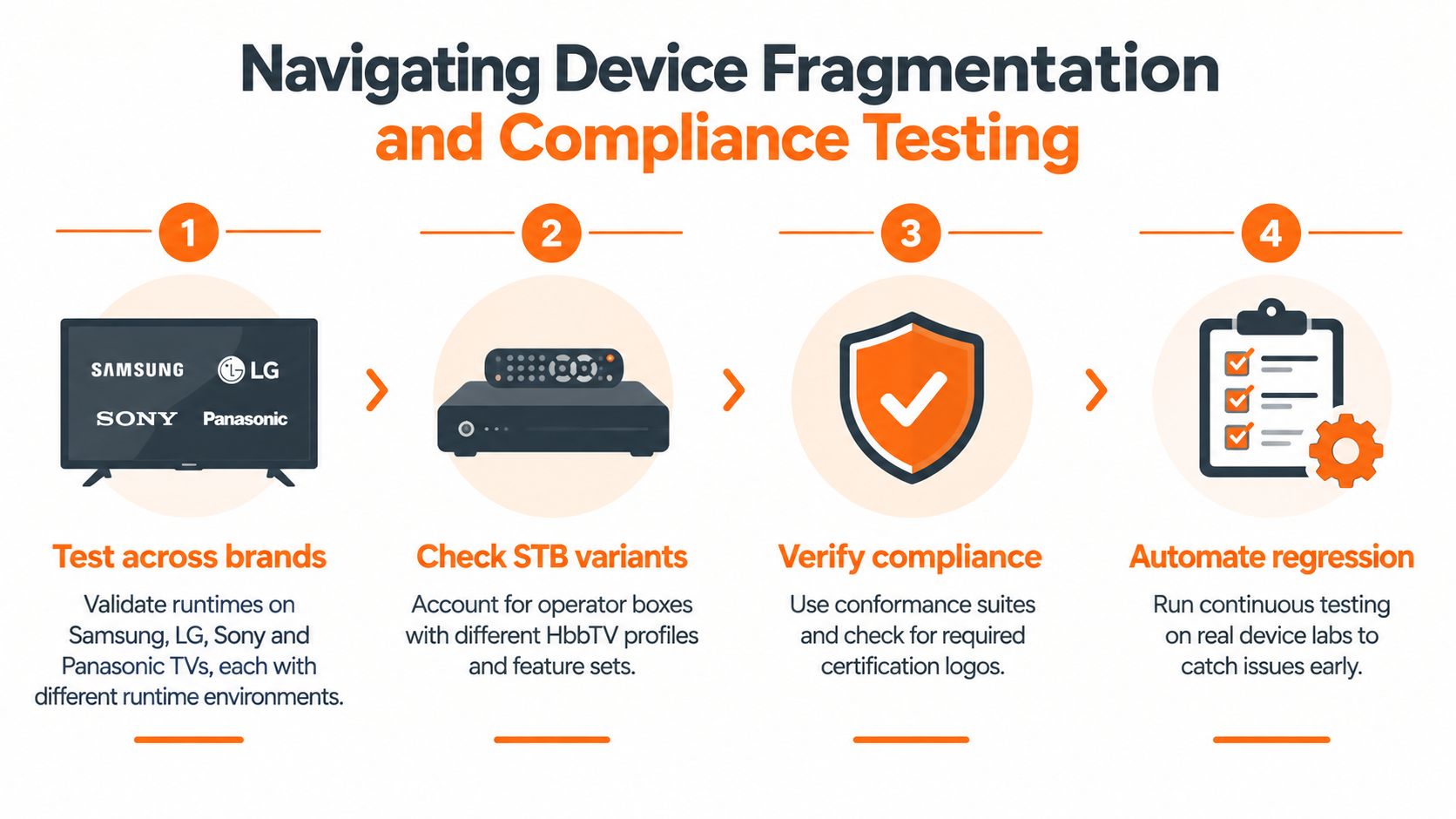
Build a device matrix before implementation starts. It should record manufacturer and model groups, set-top box variants, operator environments, HbbTV profiles, media capabilities, DRM support, subtitle behavior, input handling, memory characteristics, and known firmware constraints.
A practical test strategy has four layers:
Don't treat certification as a release-stage ceremony. Bring conformance checks into continuous delivery, alongside functional, security, performance, and accessibility testing. Teams can use dedicated test harnesses, automated device control, screen capture, and real-device laboratories to detect issues before certification or market deployment. The software quality assurance playbook provides a useful broader framework for shifting quality work earlier in the lifecycle.
The HbbTV ecosystem is moving toward more formal operational assurance. A 2026 conformance test suite update and a new application showcase for real-world deployments indicate that implementation quality and certification are becoming more important as services expand, according to the HbbTV Association's current platform information at hbbtv.org.
A compliance programme should assign one accountable owner for evidence, defects, waivers, and release decisions. Engineering teams should also maintain a known-limitations register that product and commercial stakeholders can read. Transparency prevents sales or programming teams from promising a feature that only works on a narrow slice of the installed base.
Accountability test: If nobody owns the device matrix after launch, nobody owns interoperability.
Avoid device-specific patches as the first response to every failure. First isolate whether the defect comes from signaling, the HbbTV profile, the browser runtime, the media stack, DRM, backend timing, or network conditions. Then place the fix at the correct boundary. This reduces technical debt and keeps future specification upgrades manageable.
HbbTV's next major battleground is monetization and measurement, not basic interactivity. The platform already provides a bridge between broadcast distribution and broadband software. That bridge can support audience data, advertising workflows, return-channel signals, and more targeted television experiences, but only if the ecosystem can produce trustworthy and comparable measurement.
AGF Videoforschung is integrating HbbTV-based return-channel data into Germany's national TV measurement system in 2026, a move that places HbbTV inside audience measurement infrastructure rather than leaving it as an application mechanism, according to the HbbTV Association platform information. That development matters to advertisers and analytics providers because measurement determines whether inventory can be valued, compared, and optimized.
The opportunity is substantial, but the architecture remains fragmented. National markets use different broadcasters, operators, regulations, identity practices, measurement methods, legacy chains, and device fleets. A campaign may have a technically addressable delivery path without having consistent definitions for reach, frequency, completion, conversion, or incremental audience.
Product leaders building ad-tech or analytics systems should separate four layers:
| Layer | Decision to make |
|---|---|
| Eligibility | Which devices, markets, services, and content contexts can receive the experience? |
| Decisioning | Which ad or interactive asset should the platform select, and under what rights and policy rules? |
| Delivery | Did the device receive and render the selected asset under real network and runtime conditions? |
| Measurement | Which events can be validated, deduplicated, aggregated, and reported across markets? |
A return channel can improve visibility into device behavior, but it doesn't automatically solve identity or cross-market comparability. Teams must define data minimization, consent, retention, event semantics, fraud controls, and reporting ownership before selling measurement outcomes.
The installed base also includes uneven readiness for advanced features. Industry commentary associated with the HbbTV ecosystem expects 15 to 20 million compliant devices in the market in 2026, while the association's broader household projection points to 120 million European households by the end of 2026. Those figures describe different dimensions of scale, and they reinforce the need to distinguish enabled homes from devices that support a specific advanced advertising or DRM capability.
My recommendation is to treat addressable TV as a measurement product first and an advertising product second. Establish reliable event contracts, device capability rules, market-specific governance, and independent validation before promising cross-market performance. Commercial confidence follows technical consistency.
Start with a decision, not a prototype. Decide whether HbbTV will support a broadcaster experience, extend an operator platform, deliver protected on-demand content, provide measurement infrastructure, or enable addressable advertising. Each goal creates different requirements for signaling, backend integration, DRM, analytics, compliance, and ownership.
Use this readiness checklist:
Teams assessing delivery workflows can also review software delivery tools and practices, but tools won't compensate for unclear ownership. The winning HbbTV programme is the one that makes trade-offs early, tests the full fleet, communicates limitations plainly, and remains accountable after launch.
Rite NRG helps product and engineering leaders plan, build, modernize, test, and operate HbbTV-connected platforms with senior architecture ownership and AI-native delivery practices. Visit Rite NRG to discuss your device strategy, compliance risks, DRM integration, measurement architecture, or next production release.
/ about the author
Written by the RITE NRG editorial team — the architects, engineers and delivery leads who build and operate AI-era software for our clients.
Strategy & Transformation
A practical, finance-ready framework for comparing AI and modernization investment with the current-state cost, realistic benefits, delivery risk and time to value.
AI Consulting & Automation
A practical framework for choosing and deploying transport or logistics AI agents around real exceptions, reliable data and controlled operational authority.
Industry Solutions
A practical roadmap for improving manufacturing systems and introducing AI without destabilising production, data integrity or operational control.
More guidance: all insights articles
We can help you apply this thinking to the systems and teams you actually have.