

Strategy & Transformation
How to Calculate ROI for AI and Software Modernization
A practical, finance-ready framework for comparing AI and modernization investment with the current-state cost, realistic benefits, delivery risk and time to value.
operationalwrocław--:-- cet
∕ insights / digital-platform-development.md
Digital Platform Development
Master digital platform development with a practical guide on architecture, MVP to scale, team models, and migration patterns for SaaS founders and CTOs.
>_article.meta
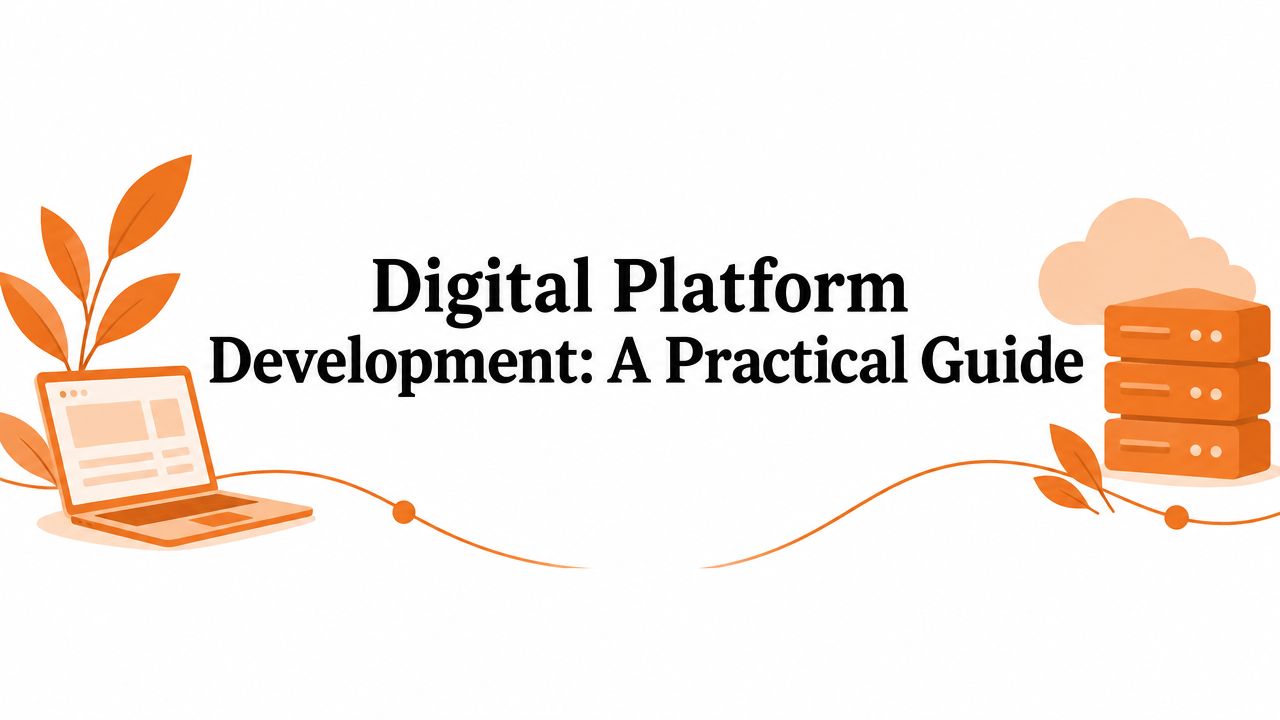
A SaaS founder is preparing for a Series A pitch. The product works, customers use it, and the roadmap is full. Yet the team can't explain which platform investments improve delivery speed, reduce operating cost, or protect retention. The CTO of a larger company faces the opposite problem, a legacy stack fails regularly, engineers spend their time managing dependencies, and every modernization proposal sounds like an expensive rewrite.
That's digital platform development problem. It isn't a shortage of frameworks, cloud services, or AI coding tools. It's the inability to connect a business constraint to an architectural decision and then prove that the decision produced a better outcome.
The opportunity is substantial. The World Bank's Digital Progress and Trends Report records 1.5 billion new internet users between 2018 and 2022, while the International Telecommunication Union's connectivity data estimates that about 6 billion people, or 74% of the world's population, used the internet in 2025. Platforms now serve a broader market, but uneven connectivity, device access, and adoption maturity still shape sound architecture.
A product can have working code, active users, and a full roadmap while its leaders still cannot explain which platform investments improve delivery speed, operating cost, reliability, or adoption. Digital platform development addresses that accountability gap through product strategy, architecture, delivery practice, and team ownership. Code supports the result. The result must appear in business measures such as shorter time to market, lower operating effort, stronger reliability, reduced delivery risk, or better customer adoption.
Start with the constraint, not the stack. Kubernetes, microservices, event streaming, and a new database are implementation choices, not business outcomes. Ask which measurable problem is blocking growth or quality. Then choose the smallest architecture and operating model that can change that result. Senior engineering accountability matters here: one technical owner must connect the decision to evidence instead of treating platform work as an open-ended infrastructure project.
Global connectivity adds practical constraints. By 2022, more than 90% of people in high-income countries were online, while only one in four people in low-income countries used the internet, according to the World Bank report. Connection speeds in low-income countries were also typically a small fraction of those available in wealthier countries. Products serving these markets need lightweight interfaces, mobile-first workflows, offline tolerance, and modular services. Those decisions should follow user conditions and measured outcomes, not a generic global-scale blueprint.
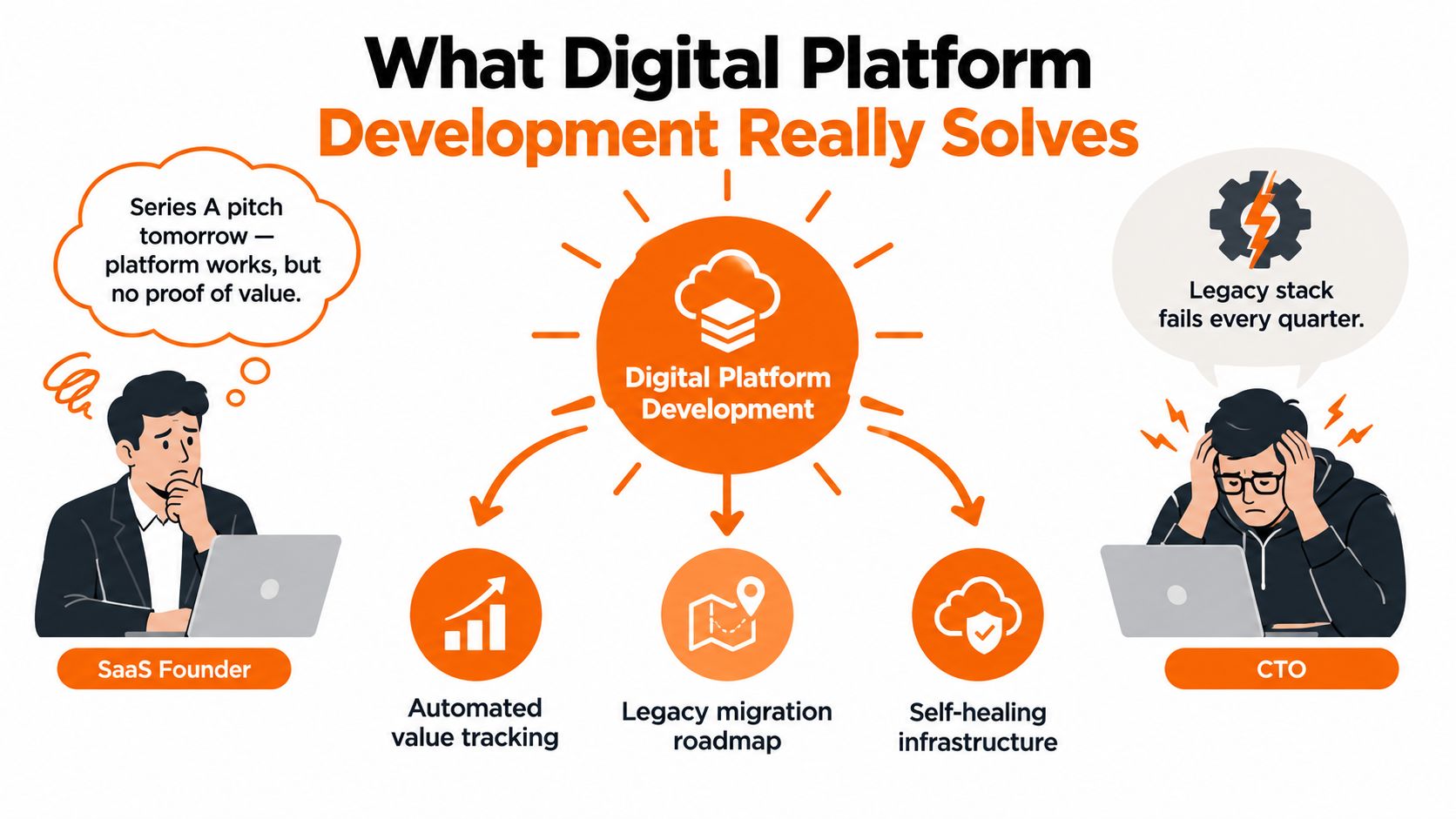
Use this sequence before approving a platform initiative:
Practical rule: If a platform investment cannot connect to a customer, delivery, reliability, or cost outcome, it is not ready for approval.
The #riteway methodology reinforces this standard. Extreme Ownership makes the team responsible for the complete result, not only assigned tickets. High-energy delivery keeps decisions progressing. Transparent communication keeps risks, trade-offs, and unfinished work visible. Proactive problem-solving identifies failure modes before production exposes them.
AI-native delivery can shorten implementation time, but it does not replace this ownership. Engineers still need to define the outcome, review generated work, and verify that the platform changes the intended measure. A platform succeeds when the business ships with greater confidence, serves users under real infrastructure conditions, and can prove what improved.
A platform architecture should be judged by outcomes, not by how modern its stack appears. Set boundaries where they protect delivery speed, reliability, customer workflows, or future operating cost. Keep other decisions reversible until product evidence justifies greater precision.
Domain boundaries define ownership of business capabilities and their rules. A modular monolith can enforce those boundaries within one deployable application. Microservices enforce them across networks, while adding deployment, observability, testing, and operational work. At the MVP stage, choose a modular monolith when the domain is changing quickly and there is no demonstrated need for independent scaling or deployment.
Data contracts control how modules exchange information and how safely teams can change schemas. Treat database access, event payloads, and API responses as contracts. Prevent every feature team from reaching directly into every table. That shortcut saves time only until one migration disrupts several workflows.
Identity and access belong in the early design. Authorization mistakes become expensive when roles and permissions spread through the product. Decide whether roles belong to the product, the tenant, or both. Define audit requirements before enterprise buyers turn missing controls into a sales blocker.
Integration surfaces require versioning and clear ownership. An API serving one internal screen can become a dependency for billing, analytics, partners, or customers. Keep interfaces narrow, document them, and assign a team to maintain compatibility.
Observability links technical behavior to user experience. Logs, traces, metrics, and explicit service-level objectives help engineers distinguish a slow dependency from a broken workflow. Google's cloud reliability guidance covers redundancy, horizontal scalability, observability, graceful degradation, and recovery testing. Apply those practices only after defining the user experience the platform must protect.
The discussion of product engineering market size and trends provides broader context for product engineering. The practical requirement is straightforward: connect technical capability to a product the team can learn from, operate, and improve. Measure whether architecture reduces time to a useful release or lowers the risk of operating it.
Greenfield teams can establish boundaries cleanly. Modernization teams inherit coupled services, undocumented integrations, inconsistent data models, and operational knowledge held by a small number of people. Treat those constraints as inputs to the product plan. Map dependencies, identify the workflows that create value, and make the migration sequence explicit.
A sound architecture review separates expensive-to-reverse decisions from choices that can wait.
| Decision | Cost to Reverse | When to Decide |
|---|---|---|
| Core domain ownership | High | Before multiple teams build on the same capability |
| Tenant and authorization model | High | Before enterprise workflows or external integrations |
| Primary data model | High | Before reporting, billing, and migration work depend on it |
| API and event contracts | Medium to high | Before partners or separate teams consume them |
| Cloud deployment pattern | Medium | After reliability and operating requirements are clear |
| UI framework and component library | Medium | When product workflows stabilize |
| Internal tooling preferences | Low | Defer until repeated friction is visible |
Use the cloud-native architecture guidance to connect architecture choices with deployment, resilience, and operating responsibilities. Senior engineers should own decisions with high reversal cost and document the assumptions behind them. Defer low-cost choices until repeated friction or measurable product evidence appears.
The team model determines how quickly decisions move and who owns the consequences. Price alone won't answer that question. Compare every option by total cost of ownership, accountability for outcomes, and speed to the first measurable result.
| Model | Cost | Accountability | Speed to Outcome |
|---|---|---|---|
| In-house product team | Higher ongoing employment and management commitment | Strong when product and engineering leadership are aligned | Fast after domain context is established |
| Nearshore dedicated squad | Variable, based on team composition and engagement model | Strong when one accountable lead owns delivery | Fast for a defined scope |
| Partner-managed delivery | Includes external delivery and technical leadership | Clear if the partner owns an agreed result | Fast when decisions and access are ready |
| Hybrid core team | Balances internal ownership with external capacity | Strong when the internal core retains product authority | Fast for specialist gaps and modernization work |
In-house teams win when the platform contains proprietary domain knowledge, sensitive operational processes, or a long-lived product advantage. They retain context and build institutional capability, but founders must budget for hiring, management, onboarding, retention, and periods when the team needs skills it doesn't yet have.
Dedicated nearshore squads work best when scope is stable. They can add capacity without forcing every role into permanent employment. The hidden risk is context switching. A squad split across unrelated priorities will deliver slower than a focused team, even when its individual engineers are capable.
Partner-managed delivery suits leaders who need a complete result, including architecture, implementation, testing, and operational readiness. Demand explicit ownership, decision rights, documentation, and a transfer plan. Otherwise, the company may receive working software but remain dependent on the partner to explain it.
Hybrid setups suit founders who need senior architecture ownership without carrying the full salary load. A small internal core should own product direction, domain decisions, and long-term operating standards. Distributed engineers can then execute against clear boundaries rather than making foundational decisions in isolation.
Use this rubric:
Watch for vendor lock-in, undocumented decisions, duplicated management layers, and a provider that reports completed tasks instead of business outcomes. #riteway teams use senior engineering accountability to surface risks early, challenge assumptions, and remain responsible for the complete delivery result.
An MVP should prove one measurable outcome, not demonstrate every capability the final platform might eventually need. Start with one primary user workflow and accept manual backstops where they reduce risk. The mistake is not technical debt itself. The mistake is taking on debt without naming the condition that will require repayment.
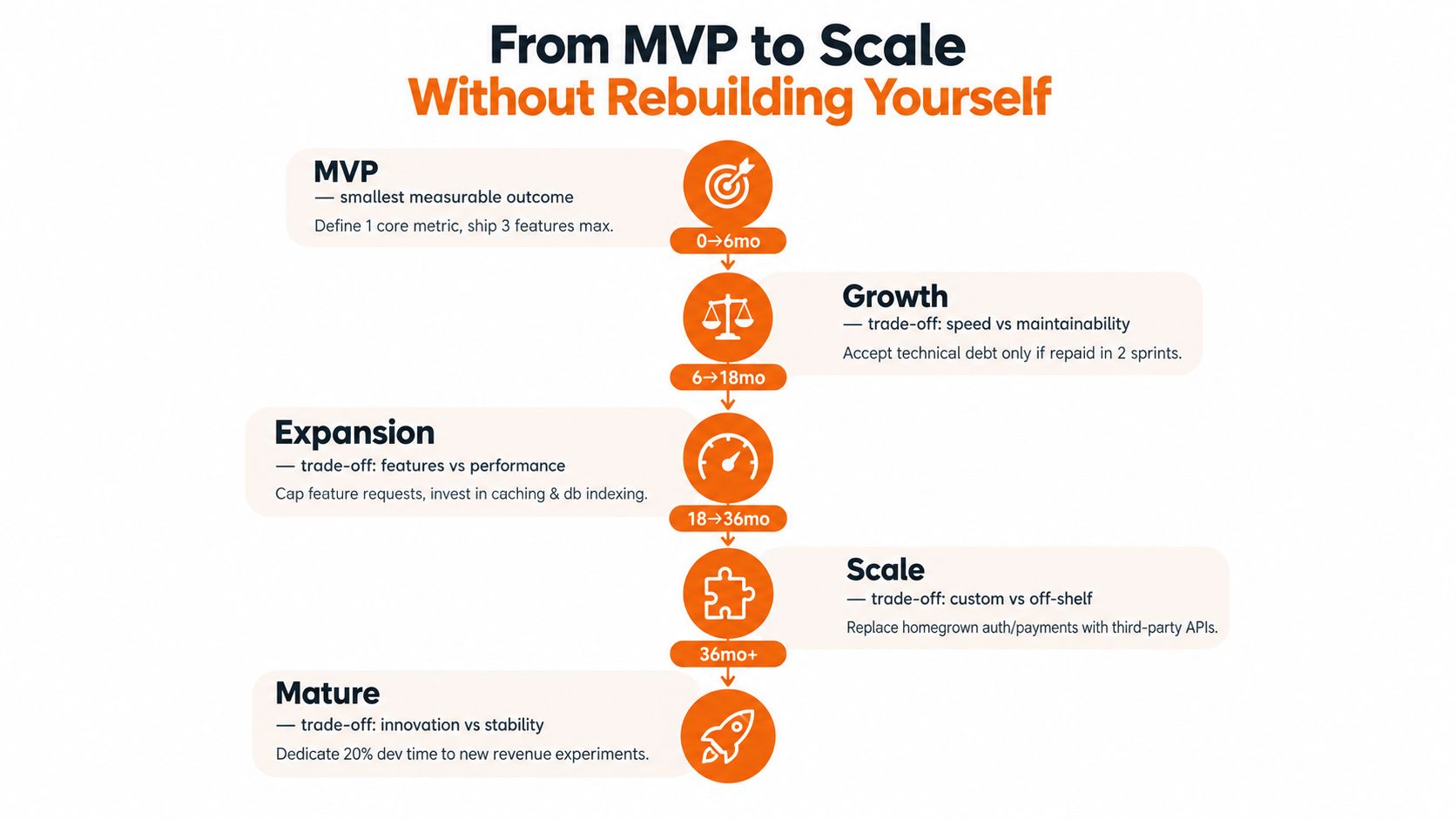
Validation MVP, weeks 4 to 8. Ship the smallest workflow that tests demand. Manual support, operational scripts, and limited automation are acceptable if the team records where they create risk. The gate to productization is evidence that users complete the workflow and that the business knows which part of the experience deserves investment.
Productization, months 2 to 4. Add multi-tenancy, billing, and role-based access without discarding the core. Introduce clear ownership boundaries and automated tests around revenue and authorization paths. A rise in support work, recurring manual intervention, or customer-specific branching should trigger this investment.
Growth scale, months 4 to 9. Add queues, read replicas, and feature flags when measured workload or rollout risk demands them. Don't add distributed infrastructure because a competitor uses it. A persistent p95 latency problem, dependency saturation, or unsafe releases is a better trigger.
Enterprise readiness, months 9 to 18. Add SSO, audit logs, regional data residency, and deeper observability when customers or regulatory obligations require them. A deal blocker is a valid trigger. A speculative checklist is not.
The data product framework from Querio offers a useful reminder that data capabilities need users, ownership, and an operating purpose, not just pipelines and storage. Treat analytics and reporting as product surfaces with defined consumers and quality expectations.
Pause when the team can't explain the architecture, when deployment requires tribal knowledge, or when feature work repeatedly causes regressions. Consolidation might mean removing a service, simplifying a schema, replacing a custom component, or documenting an operational path. The minimum viable product guidance reinforces the discipline of proving value before broadening scope.
The next architectural shift should follow evidence. If the trigger isn't visible in product usage, reliability data, customer requirements, or operating cost, keep the design simpler.
AI-native delivery changes the economics of engineering work, but it doesn't remove accountability. Model-assisted code generation can accelerate analysis, implementation, testing, documentation, and migration. It can also produce insecure dependencies, incorrect assumptions, brittle abstractions, and code that passes a narrow test while violating the architecture.
The operating model must make speed safe.
Start with scoped tickets, repository conventions, dependency rules, test expectations, and clear acceptance criteria. AI-generated code must enter the same review and release process as human-written code. A human reviewer owns the merge, and a senior engineer owns the architectural consequences.
Use three gates:
The DORA research frames platform engineering as a sociotechnical discipline built around automation, self-service, and repeatability. Internal developer platforms and golden paths can standardize secure delivery, but they only help when teams measure whether developers move faster with less friction.
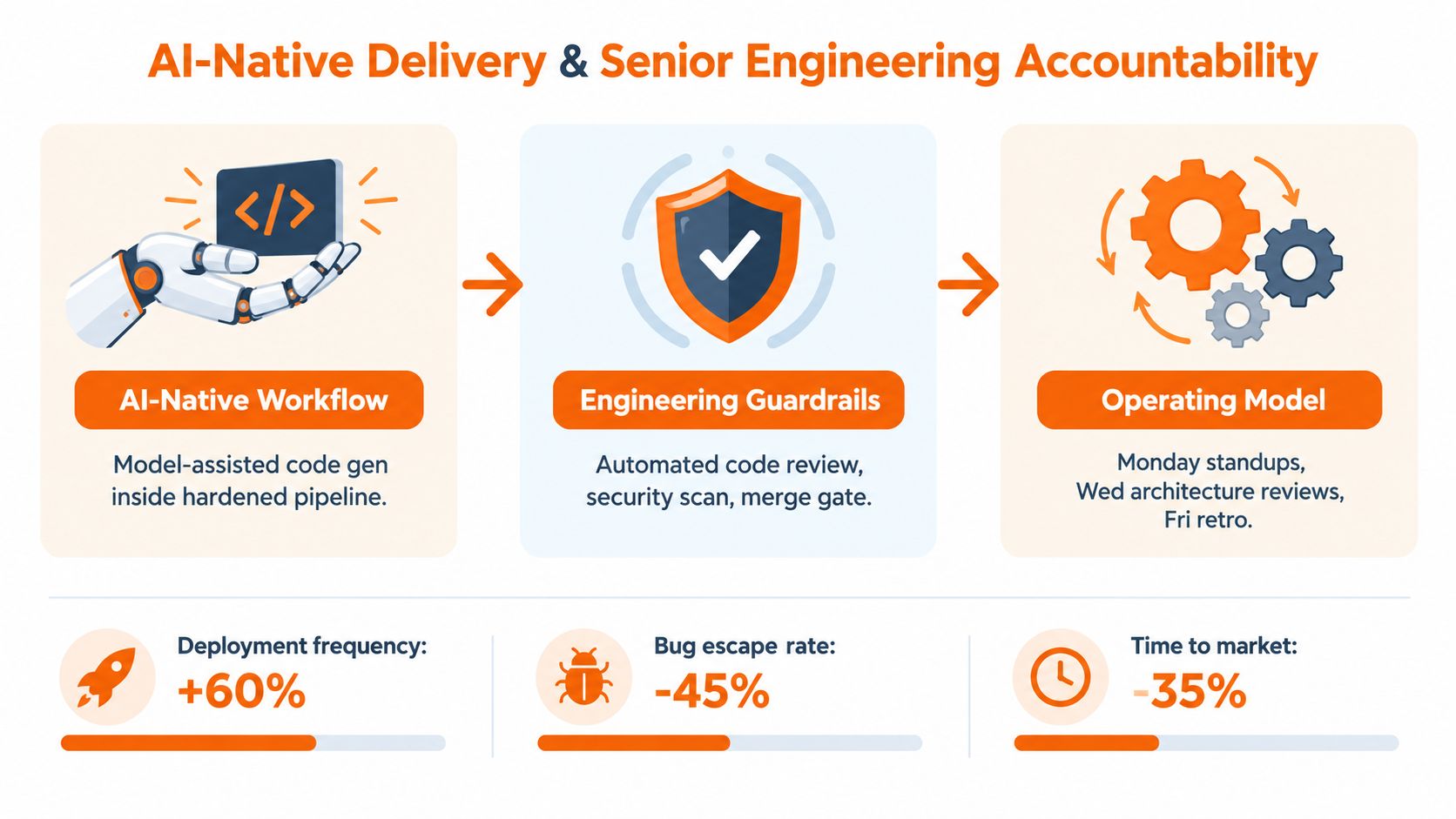
Monday: Plan with AI-augmented sizing, identify dependencies, and choose the smallest releasable slice.
Wednesday: Hold architecture office hours. Senior engineers resolve design questions before they become rework.
Friday: Run a ship-or-defer review. Release work that meets quality gates. Defer work that creates unpriced risk.
Agentic workflows require explicit human oversight at architecture sign-off, security validation, and production deployment. Research on agentic AI warns about an “accountability collapse” when autonomous pipelines operate without clear ownership, and recommends measuring decision velocity, orchestration efficiency, system reliability, and business outcomes (research on agentic AI governance).
Use AI to increase throughput, not to lower standards. Senior architects still protect data design, security, testing, technical debt, and production quality. That combination creates a faster delivery system without turning the platform into an uncontrolled experiment.
A greenfield rewrite is usually the most emotionally appealing modernization plan and one of the riskiest. It creates a long period in which the old platform still runs, the new platform remains incomplete, and both systems require attention. The AI Readiness and Enterprise Modernization Report notes that 36% of organizations prioritize emerging trends such as AI and edge computing, while 34% want platforms capable of delivering industry-specific outcomes. Neither priority justifies disrupting business-critical workflows without a migration sequence.
| Pattern | Best Trigger | Risk Profile | Typical Duration |
|---|---|---|---|
| Strangler fig | A slow-moving monolith creates release pain | Lower when traffic can shift incrementally | Defined by capability slices |
| Branch by abstraction | Integrations depend on stable interfaces | Moderate, because the abstraction must remain compatible | Defined by implementation swaps |
| Data-first migration | Reporting, compliance, or data quality is the bottleneck | Moderate, with strong rollback requirements | Defined by data domains |
| Parallel run | Safety-critical workflows need comparison | Higher operating complexity, lower cutover surprise | Defined evaluation window |
The strangler fig pattern routes new capabilities to a new service and retires old endpoints as traffic falls. Use it when the team needs release independence but can isolate workflows.
Branch by abstraction introduces an interface before replacing the implementation behind it. This works when external systems depend on a stable contract and the internal technology needs to change.
Data-first migration replatforms the data tier while the application remains in place. Choose it when reporting, compliance, or data integrity limits the business more than application structure does.
Parallel run lets old and new systems serve or evaluate the same workflow during a defined window. It suits safety-critical processes, provided the team can reconcile differences and define a cutover decision.
Never migrate more than one layer at a time. Define the legacy exit criterion before the replacement ships.
Recovery planning belongs in the design, not the emergency folder. Teams responsible for infrastructure transitions can use these bare metal recovery best practices as a reference for thinking about restoration, dependencies, and operational readiness. For a broader CTO-oriented view, the legacy system modernisation guide provides a useful companion to migration planning.
The best migration is the one that keeps revenue workflows live while producing evidence at every step. If the team can't explain how it will roll back, reconcile data, and retire the old path, the plan isn't ready.
A platform review should begin with outcomes, not the technology stack. Ask three questions: Are we delivering faster? Are users receiving a reliable service? Are engineers spending less effort fighting the system? Set outcome bands instead of vanity targets. Thresholds should reflect the product, risk profile, and customer promise.
Delivery throughput starts with DORA metrics: deployment frequency, lead time, change failure rate, and mean time to restore service. Add Time-to-First-Deployment, Golden Path adoption, and Platform NPS where they expose internal friction. Together, these measures show whether platform tooling helps teams ship or gives them another portal to maintain.
Reliability should cover uptime, SLO performance, MTTR, error-budget consumption, recovery-test results, and failures in critical dependencies. Evaluate graceful degradation and recovery behavior, because uptime alone misses the user impact of partial failure. Treat reliability as an operating outcome that senior engineers own, not a dashboard that another team maintains.
Developer experience includes build duration, onboarding effort, documentation usefulness, failed pipeline causes, and signs of cognitive load. Ask engineers which steps depend on tribal knowledge. Fix the highest-friction path before adding another general-purpose tool.
Run a weekly platform health review, a monthly architecture review, and a quarterly technology-stack audit. Each review should require current delivery metrics, incident themes, dependency ownership, cost drivers, and a short list of decisions needing senior approval. AI-native delivery can shorten feedback loops, but senior engineers must still set guardrails, review high-risk changes, and connect activity to business outcomes.
The State of Platform Engineering 2025 report reports that elite performers deploy 12 times more frequently, recover from failures 96 times faster, and have change failure rates 5 times lower. It also reports that Backstage adoption tripled in 12 months and that 94% of organizations view AI as critical to the future of platform engineering. These figures do not justify copying another company's stack. They support evaluating platform work through delivery, reliability, and developer experience outcomes.
Digital platform development earns its place when customers and operators can feel the difference. If the only visible result is a more elaborate diagram, the team optimized the wrong outcome.
Rite NRG helps SaaS founders and enterprise leaders plan, build, modernize, and operate business-critical platforms through AI-native delivery with senior engineering accountability. Visit Rite NRG to discuss platform constraints, migration risks, and the measurable outcome to achieve.
/ about the author
Written by the RITE NRG editorial team — the architects, engineers and delivery leads who build and operate AI-era software for our clients.
Strategy & Transformation
A practical, finance-ready framework for comparing AI and modernization investment with the current-state cost, realistic benefits, delivery risk and time to value.
AI Consulting & Automation
A practical framework for choosing and deploying transport or logistics AI agents around real exceptions, reliable data and controlled operational authority.
Industry Solutions
A practical roadmap for improving manufacturing systems and introducing AI without destabilising production, data integrity or operational control.
More guidance: all insights articles
We can help you apply this thinking to the systems and teams you actually have.