

Strategy & Transformation
How to Calculate ROI for AI and Software Modernization
A practical, finance-ready framework for comparing AI and modernization investment with the current-state cost, realistic benefits, delivery risk and time to value.
operationalwrocław--:-- cet
∕ insights / building-a-minimum-viable-product.md
MVP Guide
Building a Minimum Viable Product. Learn how to plan, build, test and launch a SaaS MVP with a senior delivery team. A practical guide for founders and CTOs
>_article.meta
Most founders think building a minimum viable product means moving quickly from an idea to a working application. That advice is incomplete. Speed matters only after you know what you're testing, who needs the result, and which behaviour will prove that the product creates value.
An MVP isn't a smaller version of the finished product. It's a controlled business experiment with enough quality to produce trustworthy evidence. The UK government defines an MVP as the most basic market version of a business with essential features, designed to test demand, gather feedback, and improve the plan before a fuller investment. Its product-delivery guidance also puts prototypes, early user feedback, and scope definition ahead of MVP decisions, as described in the UK government guidance on testing and validating a business idea.
My recommendation is direct. Prove the problem before you polish the product, define the learning metric before the first sprint, and keep one accountable team responsible for the outcome after launch. That's the #riteway methodology in practice, built around Extreme Ownership, high energy, and proactive delivery rather than a hand-off between strategy, engineering, and support.
The popular advice says an MVP should be fast and scrappy. The useful advice says it should be small, testable, and tied to a business decision. A fast build that answers nothing is just expensive guessing.
UK startup data makes the risk concrete. A UK business guide citing Office for National Statistics business demography figures reports that 18.1% of UK startups fail in their first year and 60% fail within three years, with lack of market need identified as a leading cause. That's why an MVP should reduce uncertainty before it increases scope, as explained in this UK analysis of MVPs and startup validation.
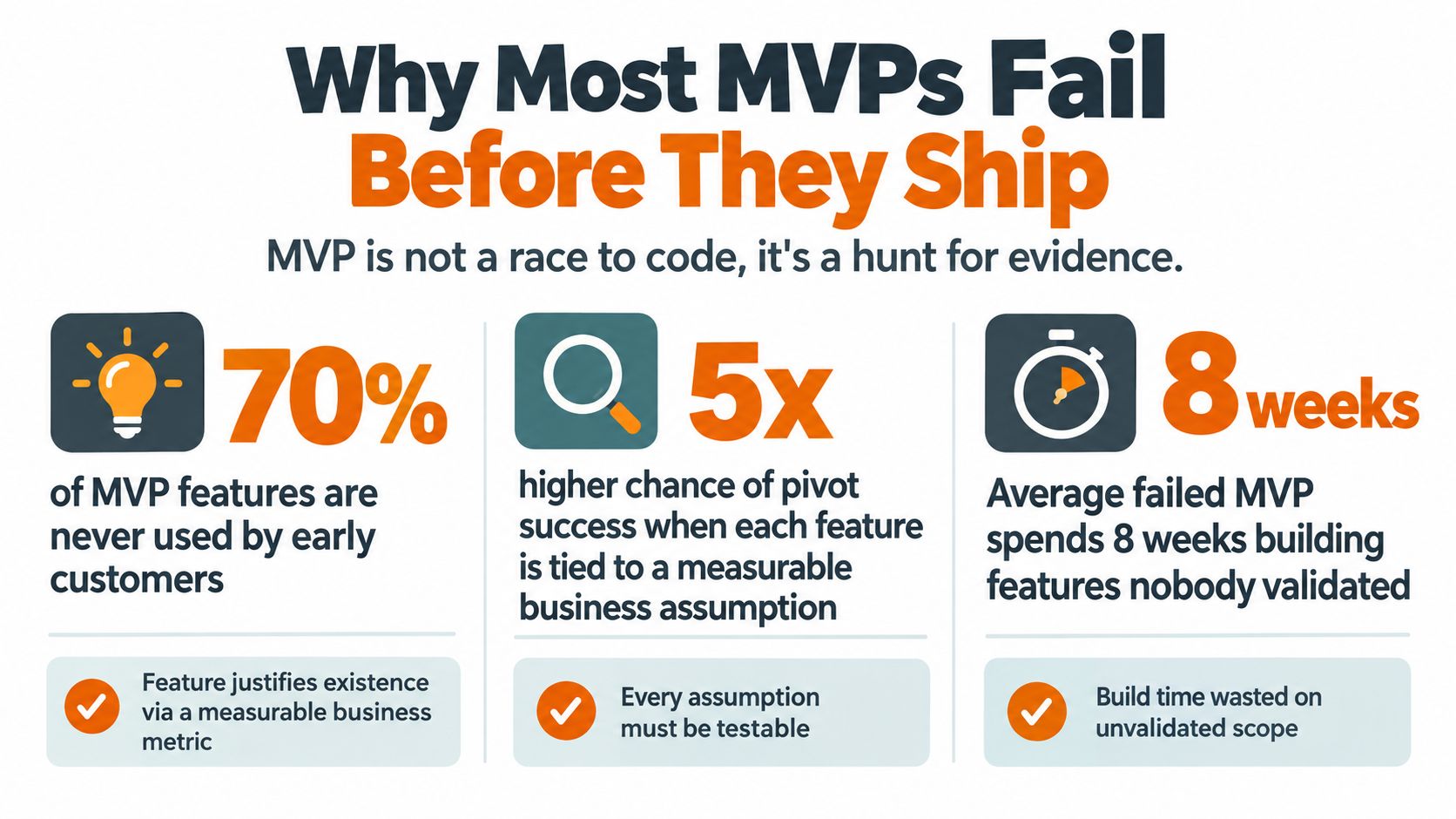
First, teams build for hypothetical users. Founders describe a broad market, collect opinions from friendly contacts, and then design workflows for people who haven't agreed to change their behaviour. The product may function perfectly, but no real customer has confirmed the pain, urgency, or buying context.
Second, teams confuse a prototype with an MVP. A clickable Figma journey can test whether an interface makes sense. A technical proof of concept can test whether an integration works. Neither proves that a customer will repeatedly use or pay for the resulting product.
Third, teams ship without a learning hypothesis. They release a bundle of features, watch sign-ups, and call the result inconclusive. Without a defined question, such as whether a specific persona can complete a valuable workflow and return to repeat it, feedback becomes a pile of opinions.
Practical rule: Every feature needs a measurable reason to exist. If the team can't state which customer behaviour or business outcome it supports, cut it.
These patterns consume runway because they delay the first meaningful signal. The team spends months debating edge cases, expanding the backlog, and polishing screens before it learns whether the central problem matters. A UK-focused delivery guide reports that an industry analysis of 125 projects found 68% of MVPs failed after launch, with wrong-user targeting, absent learning loops, and feature bloat among the dominant causes. Its recommended five-stage process starts with a locked target user and one learning metric, as set out in this UK MVP development guide.
The fastest teams don't sprint blindly. They write success criteria before development, slice work into short delivery cycles, and use each demo to decide whether to persevere, pivot, or stop.
Start with conversations, not tickets. Choose one narrow persona, such as an operations lead at a 50 to 200 person logistics firm, and speak with people who handle the problem. Ask what happened the last time the issue occurred, what workaround they used, what the workaround costs, and who controls the budget.
Run 8 to 12 problem interviews as a working discovery target, not as a vanity exercise. Listen for repeated behaviour rather than enthusiastic predictions. “That sounds useful” is weak evidence. A customer showing you spreadsheets, forwarding an internal process, or agreeing to a paid pilot is much stronger.
Write a one-page problem statement with five fields:
A useful hypothesis is specific enough to fail. For example, “Operations leads at regional logistics firms will use a shared exception workflow to resolve shipment issues faster and return to it during the same operating week” gives the team something observable to instrument.
Use RICE when reach and confidence can be estimated, or MoSCoW when the decision needs to be simple and collaborative. Don't let the framework pretend to create precision. Its job is to expose trade-offs and make the cut visible.
| Feature | Reach | Impact | Confidence | Effort | RICE Score | Priority |
|---|---|---|---|---|---|---|
| Exception intake | High | High | High | Medium | High | Must have |
| Customer notifications | Medium | High | Medium | Medium | Medium | Should have |
| Advanced reporting | Low | Medium | Low | High | Low | Won't have |
| Custom workflow rules | Low | Medium | Medium | High | Low | Later |
A founder may start with 25 ideas and finish discovery with three core flows. That isn't underbuilding. It's protecting the one path that must work.
Write user stories with explicit acceptance criteria. Define what happens when data is missing, a payment fails, a user lacks permission, or an external service is unavailable. Then freeze the backlog. New requests need a named decision-maker, a stated business reason, and a trade-off against existing scope.
A frozen backlog doesn't eliminate change. It prevents casual change from destroying delivery predictability. The product lead owns the priority, the engineering lead owns technical consequences, and the delivery partner surfaces the cost before anyone promises an unplanned feature.
For most SaaS MVPs, a well-structured modular monolith beats premature microservices. A small product team needs fast feedback, simple deployments, and clear ownership. It doesn't need a distributed system that introduces network failure, service coordination, data consistency, and multiple operational surfaces before the business has proved its demand.
A modular monolith still demands discipline. Separate modules by business capability, enforce boundaries in code, keep data access deliberate, and record the seams that might later become services. Billing, identity, notifications, and the core domain often make sensible boundaries, but extraction should follow evidence such as scaling pressure, team ownership, or reliability requirements.
For a team of 3 to 6 engineers, the stack should match the people who will maintain it. Next.js can support product velocity for a JavaScript-focused team. Rails remains a strong choice when conventions and rapid business workflow development matter. Postgres is the default relational choice when transactional integrity and flexible querying matter. Redis earns its place for queueing, short-lived state, and background work.
Managed providers such as Supabase or Firebase can remove infrastructure work when speed matters more than deep custom control. They aren't automatically cheaper or simpler forever. Check data portability, access patterns, authentication limits, operational visibility, and the exit path before committing.
Managed AI services from OpenAI or Anthropic, alongside vector databases, can accelerate an AI-enabled MVP when the product's value depends on summarisation, classification, search, or assisted workflows. They become a liability when the team adds them because they sound modern, without knowing which user action or commercial outcome they improve.
The UK government's AI sector study reports that 69% of dedicated AI companies were primarily developing AI products in 2023, while the share offering AI-related services rose from 16% in 2022 to 31% in 2023. The same study identifies access to growth capital as the foremost barrier, with over half reporting limited equity investment as a constraint. That supports a service-assisted approach: use a managed model or human review while demand, accuracy requirements, and unit economics are still being tested.
Before selecting the stack, answer these questions:
An MVP is only as fast as the decisions around it. A large team doesn't compensate for unclear ownership, weak product discovery, or slow review cycles. I favour a senior cross-functional pod that can take a business outcome from definition to production without waiting for five vendors to coordinate.
A practical pod includes a product lead, one to two full-stack engineers, QA, DevOps, and a designer, with a fractional CTO available for architecture decisions. The founder should retain product ownership and customer access. The delivery team should own the path from accepted story to reliable release.
Keep founder-facing work, sensitive intellectual property, and core commercial relationships close to the founder or internal leadership. Nearshore the execution-heavy work that benefits from a stable, time-zone-aligned team, including product engineering, automated testing, platform work, and release operations.
Nearshore delivery sits between two weak extremes. Freelancers can be capable but often operate as isolated specialists, with accountability ending at an individual task. Pure offshore models may offer access to talent, but time-zone gaps and communication delays can make discovery, review, and correction expensive. A senior nearshore team works inside the client's cadence and shares responsibility for the result.
| Dimension | In-House | Nearshore Dedicated Team | Freelancers |
|---|---|---|---|
| Product context | Strong internal access | Strong when embedded in workflows | Often fragmented |
| Communication | Immediate | Frequent and time-zone aligned | Depends on availability |
| Accountability | Internal ownership | Shared delivery ownership | Usually task-based |
| Scaling | Hiring takes time | Team composition can change quickly | Individual availability varies |
| Technical continuity | High | High with a stable pod | Can fall away at handover |
| Cost control | Predictable but fixed | Flexible with senior capability | Variable and difficult to coordinate |
A Dedicated Team should use shared Slack and Jira, attend daily stand-ups, join weekly demos, and follow the same code review and release standards as the internal team. The founder shouldn't receive a polished status report after problems have grown. Extreme Ownership means the team raises risks early, proposes options, and stays accountable through resolution.
The UK public sector provides a sobering reason to insist on that behaviour. The National Audit Office reports that 37 of 106 major projects were rated red or amber-red in the cited portfolio summary. A Long Finance review of public-sector IT project failure reports 13% fully successful projects, 58% partial failures, almost 33% outright failures, and 80% exceeding initial schedules. Those figures make proactive risk management a delivery requirement, not a motivational slogan.
Fast delivery has a shape. A two-week sprint should produce a visible, testable slice of customer value, not a collection of disconnected technical tasks.
On days 1 and 2, the team refines discovery findings, confirms acceptance criteria, and slices tickets vertically. A vertical slice crosses the database, API, interface, and operational path. It gives stakeholders something real to judge.
Days 3 to 6 focus on the first end-to-end flow, including login, core create-read-update-delete behaviour, and billing where payment validation is part of the hypothesis. The team doesn't build every variation. It proves that the central journey can work in a controlled environment.
Days 7 to 9 bring UI refinement, edge cases, and integrations. Day 10 is hardening and QA on staging. Day 11 is the stakeholder demo and acceptance gate. Days 12 to 14 triage feedback, record learning, and shape the next sprint.
The demo should show the product behaving like a customer would use it. It should also expose what isn't ready. A Friday demonstration kills scope creep because unfinished work can't hide behind a progress percentage.
The operating rules are simple:
A senior delivery partner doesn't report that a ticket is “nearly done”. They show the completed workflow, name the risk, and explain the decision required. That's high energy with control, not frantic activity.
Sign-ups are a starting signal, not proof of value. A large acquisition number can conceal a broken onboarding journey, unclear positioning, or a product that users don't need after the first visit.
The metrics that matter are activation, retention, and revenue. A UK-focused MVP guide identifies activation and retention as stronger evidence than sign-ups or downloads, with healthy early signals described as activation above 40%, Day-7 retention above 20% to 25%, and Day-30 retention above 10% to 15%. It also cites the Sean Ellis benchmark of 40% or more of active users saying they would be “very disappointed” to lose the product as an early product-market-fit signal, in this guide to MVP metrics.
Acquisition source shows where qualified users come from. Don't just count visitors. Record the source, persona, and commercial context so the team can distinguish curiosity from relevant demand.
Activation funnel measures whether a new user reaches the core value event. Define that event in product terms, such as completing the first exception workflow, inviting a colleague, or producing a useful result.
Retention cohort shows whether activated users return within a defined period. Segment by use case and acquisition source, because an average can hide one strong customer segment and several weak ones.
Revenue per active account connects usage to willingness to pay. Track paid conversion, account expansion, and the amount of support required to keep an account active.
The thresholds in the delivery brief, 40% activation within 24 hours, 25% week-one retention, and 5% free-to-paid conversion inside the trial window, should be treated as defendable operating targets only where they match the product's usage cycle. The cited UK guide provides different healthy retention ranges by day and stresses that activation and retention matter more than raw acquisition, so your team must define the event and time window before interpreting the dashboard.
If a threshold misses by more than half after a meaningful sample, stop blaming marketing automatically. The product may be failing to communicate value, deliver the promised outcome, or support repeat usage. The next sprint should target the weakest evidence directly.
Launch is where ownership becomes visible. The first 90 days should run as a deliberate learning loop, not as a support queue followed by random feature requests.
Fix defects that block the core workflow, verify instrumentation, review support conversations, and make sure the team can see activation and retention without manual reporting. Keep the original hypothesis visible. If the dashboard can't answer whether users reach value and return, the product isn't ready for confident prioritisation.
Use weekly triage to connect customer evidence to backlog decisions. Improve the workflow that drives repeat usage before adding adjacent capabilities. A founder who hears a request from one prospect shouldn't automatically turn it into roadmap scope. The team should test whether the request reflects a repeatable segment need, a pricing objection, or a missing implementation detail.
Repay the debt created by speed deliberately. Add missing automated coverage, clarify architecture boundaries, document operational procedures, strengthen access controls, and remove instrumentation gaps. The right improvements depend on what customers are doing, not on an abstract desire to rewrite the system.
Public-sector delivery evidence shows why this discipline matters. UK Parliament material cites a survey where only 13% of IT projects were successful and fewer than 1% of development projects succeeded, as recorded in this UK Parliament briefing on government IT projects. The lesson for a SaaS team isn't to avoid ambition. It's to keep delivery connected to measurable value, visible risk, budget, time, and specification.
Ownership means staying with the outcome. The team that discovers the problem should help ship the first release, interpret the evidence, and improve the product after launch.
The nearshore pod shouldn't disappear after handover. It should remain accountable while the founder shifts attention from building to selling, interviewing customers, and developing the market. That continuity protects context, reduces rework, and gives the product a fair chance to become a durable platform rather than a rushed demonstration.
An MVP isn't a one-time project. It's a learning engine. The first 90 days determine whether the team turns evidence into a product, or turns a plausible idea into an expensive cautionary tale.
Rite NRG provides senior nearshore Dedicated Teams, MVP delivery, platform development, and technology and delivery consulting for SaaS founders and product leaders. The team can help define the evidence, shape the architecture, build the core workflow, and stay accountable through post-launch iteration. Visit Rite NRG to discuss an MVP plan built around measurable outcomes and Extreme Ownership.
/ about the author
Written by the RITE NRG editorial team — the architects, engineers and delivery leads who build and operate AI-era software for our clients.
Strategy & Transformation
A practical, finance-ready framework for comparing AI and modernization investment with the current-state cost, realistic benefits, delivery risk and time to value.
AI Consulting & Automation
A practical framework for choosing and deploying transport or logistics AI agents around real exceptions, reliable data and controlled operational authority.
Industry Solutions
A practical roadmap for improving manufacturing systems and introducing AI without destabilising production, data integrity or operational control.
More guidance: all insights articles
We can help you apply this thinking to the systems and teams you actually have.