

Strategy & Transformation
How to Calculate ROI for AI and Software Modernization
A practical, finance-ready framework for comparing AI and modernization investment with the current-state cost, realistic benefits, delivery risk and time to value.
operationalwrocław--:-- cet
∕ insights / cloud-native-architecture.md
Cloud-native Architecture
Master cloud-native architecture with proven patterns, migration strategies, and nearshore delivery frameworks that accelerate SaaS scaling and ROI.
>_article.meta

Most advice on cloud-native architecture is too narrow. It tells you to pick Kubernetes, split the monolith, add CI/CD, and call it transformation. That's not transformation. That's tooling.
Cloud-native architecture is an operating model decision first and a technology decision second. If your teams still wait on central approvals, hand work across silos, and optimise for risk avoidance over delivery speed, you can run the latest stack and still move like a legacy organisation. The architecture won't save you from the org chart.
I've seen the opposite work repeatedly. Teams that tie architecture choices to lead time, operational overhead, resilience, and product autonomy get value quickly because they treat delivery as a business system. That's the core of the #riteway approach: Extreme Ownership, high energy, and proactive execution. The team doesn't just build what was asked. It takes responsibility for outcomes, flags risks early, and keeps momentum high.
That mindset matters more in the UK market than many leaders realise. Cloud adoption is already broad, but broad adoption doesn't equal operating maturity. The gap between “we use cloud” and “we can run cloud-native well” is where cost overruns, vendor confusion, and fragile delivery pipelines show up. If you ignore that gap, you'll spend heavily and still struggle to ship.
Treating cloud-native architecture as a container strategy is a category error. Containers are one tool. The change is moving from project delivery to continuous product operations, where teams own services end to end and improve them constantly.
The UK public sector is a useful reality check. The government's Cloud Challenge Book 2026 says 60% of government digital services had already migrated to cloud, but the journey had already taken 13 years, and 28% of the estate remained legacy according to this UK cloud migration milestone summary. That timeline matters because it kills the fantasy that cloud-native is a fast platform swap. It's a long operating shift.
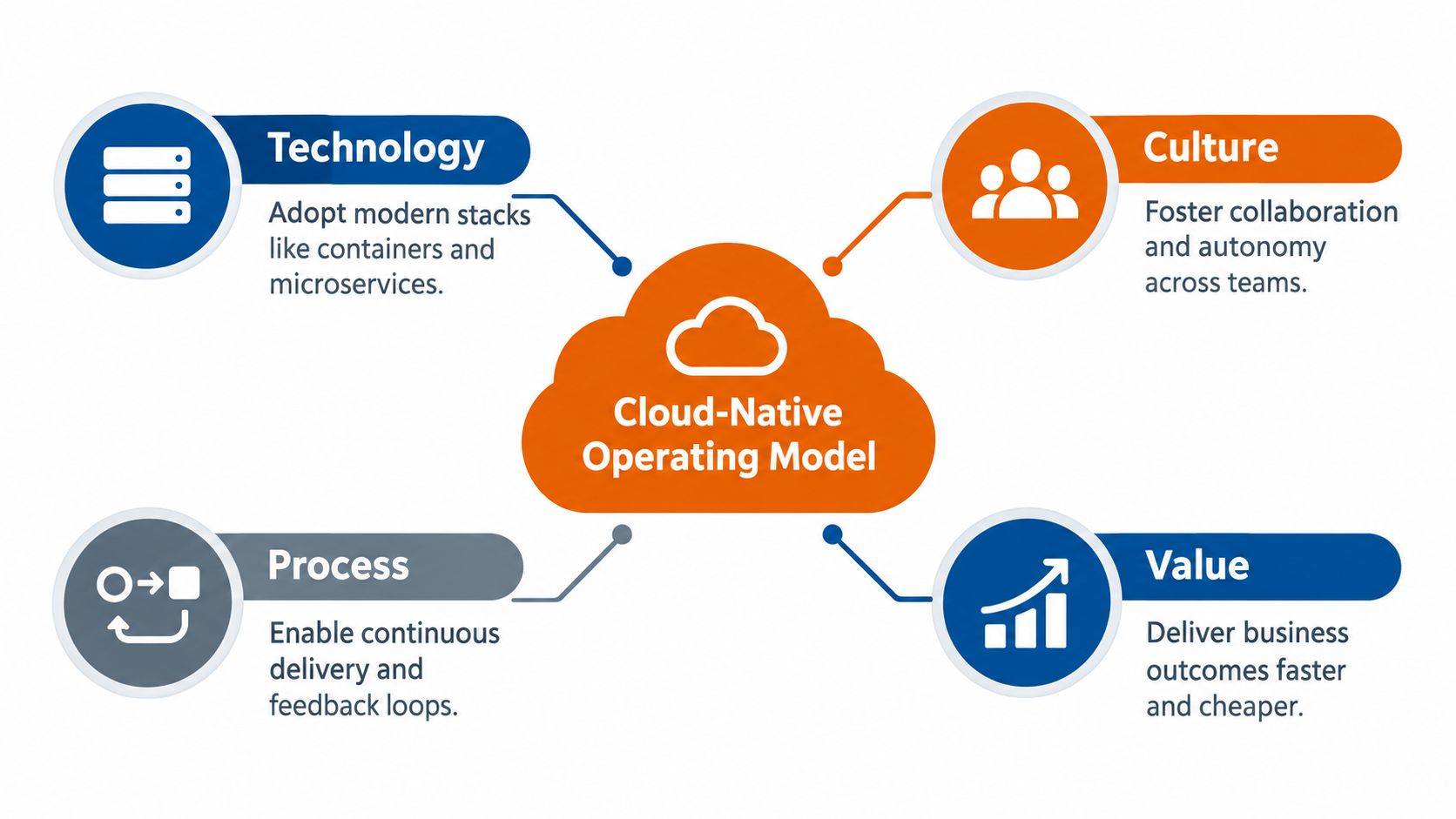
A cloud-native operating model changes four things at once:
The National Cyber Security Centre reinforces the right design bias in its cloud shared responsibility guidance. The UK public-sector view is clear: prefer SaaS and serverless over IaaS when they fit, lean into API-centric design, and use native cloud capabilities instead of rebuilding them yourself. That isn't just security advice. It's operating model advice.
Practical rule: If your team is recreating cloud provider capabilities just to feel “in control”, you're usually increasing cost and slowing delivery.
Most migrations wobble. Leaders approve a technical roadmap, but nobody owns the organisational consequences. The platform team waits for app teams. App teams wait for security. Security waits for evidence. Procurement waits for certainty. Delivery slows to a crawl.
The better model is aggressive clarity. Who owns service reliability? Who owns deployment safety? Who owns cost visibility? Who can say no to unnecessary complexity? Extreme Ownership isn't branding. It's the discipline that stops cloud-native architecture from becoming an expensive diagram with no commercial payoff.
When teams adopt that posture, architecture becomes a business accelerator. When they don't, it becomes another modernisation programme that burns time and patience.
A pattern is only useful if it changes business performance. If it doesn't improve speed, cost control, resilience, or team autonomy, it's architectural theatre.
Leaders often ask whether they need microservices, Kubernetes, or serverless. Wrong first question. Ask what you need to improve:
If you're designing a SaaS platform, this broader view of SaaS platform architecture helps anchor cloud-native decisions in product and delivery outcomes rather than isolated infrastructure choices.
| Pattern | Primary Business Outcome | Best Suited For |
|---|---|---|
| Microservices | Faster change in targeted parts of the product | Products with distinct domains, multiple delivery teams, and uneven release pressure |
| Containers | Consistent packaging and deployment across environments | Teams that need repeatable delivery and environment portability |
| Serverless | Lower operational overhead and pay-for-use execution | Event-driven workloads, bursty demand, background processing, lightweight APIs |
| Service mesh | Better control of service-to-service communication and policy | Larger distributed systems where traffic control, observability, and security need standardisation |
Microservices work when team boundaries map cleanly to business capabilities. They reduce coupling, which can reduce release friction, but only if teams can own services fully. Split a monolith without fixing ownership and you just create distributed confusion.
Containers are operationally valuable because they standardise how software moves from laptop to test to production. That consistency matters in hybrid estates and supplier-heavy environments. Containers aren't the goal. They're the packaging layer that makes delivery less fragile.
Serverless is often underused because teams assume it's only for simple workloads. That's lazy thinking. For the right workloads, it cuts operational chores sharply because your team isn't babysitting servers, patch windows, or idle capacity. It's especially strong for asynchronous tasks, integrations, APIs with variable demand, and internal automation.
Service meshes are worth it only when the complexity already exists. Don't install one to look mature. Install one when managing east-west traffic, identity, and policy manually has become the bigger burden.
Service mesh can help standardise resilience controls, traffic routing, and observability across many services. But it introduces its own operational tax. If your system is still small, that tax usually outweighs the gain.
The point isn't technical purity. The point is measurable improvement in how quickly and safely your organisation can deliver value.
Not every workload deserves a distributed architecture. Some need it. Many don't.
| Factor | Microservices | Serverless | Containers |
|---|---|---|---|
| Business domain complexity | Strong fit when domains are distinct and evolve at different speeds | Good for isolated workflows and event-driven capabilities | Good baseline when complexity is moderate and packaging consistency matters |
| Team maturity | Needs disciplined ownership, automation, and observability | Needs strong operational thinking around events, permissions, and failure handling | More forgiving than microservices, but still benefits from standard pipelines |
| Regulatory constraints | Useful when services need separate controls or release paths | Useful when managed controls reduce infrastructure burden | Useful where repeatable deployment across environments is required |
| Cost model preference | Better when service autonomy outweighs coordination overhead | Better when variable usage justifies pay-per-execution | Better when predictable runtime and packaging matter more than execution elasticity |
| Operational overhead tolerance | Higher overhead | Lower infrastructure overhead, but architectural discipline still required | Moderate overhead |
If your product is still proving market fit, don't begin with a grand microservices programme. Start simpler. A modular monolith in containers is often the smartest commercial choice because it keeps delivery fast without locking you into a brittle structure.
If demand is unpredictable or event-heavy, serverless deserves serious consideration. It's often the cleanest way to avoid paying your engineers to manage machinery that adds no product differentiation.
If you operate across multiple environments, suppliers, or compliance boundaries, containers usually earn their place early. They create deployment consistency even before you go deep into orchestration.
Buy complexity only when the business case is stronger than the operational burden.
That one rule filters out most bad cloud-native decisions.
The UK market already tells a more interesting story than the usual cloud-native playbook. Cloud adoption is mainstream, but operating confidence still lags, and the infrastructure mix is far from public-cloud-only.
The Office for National Statistics data, cited in OpenUK's State of Open The UK in 2024, reported that 69% of UK firms used cloud-based computing systems and applications, 61% used specialised software, and 9% used AI by 2023. That tells you the cloud foundation is already broad. The harder question is whether organisations can operate modern platforms well.
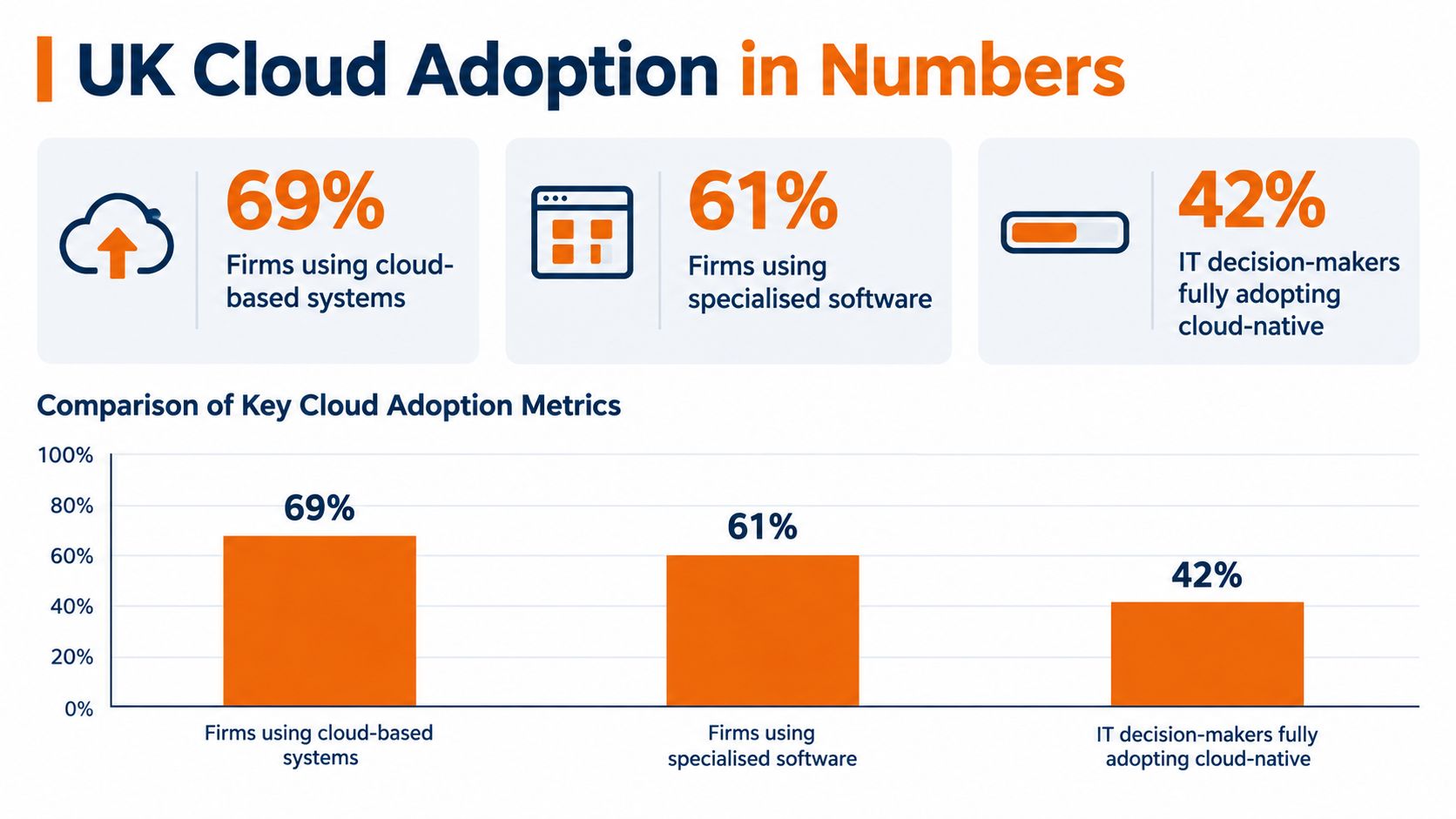
A UK survey reported by Nutanix found that more than 90% of organisations are at least containerising applications, yet only 42% of IT leaders feel confident their teams can support cloud-native adoption, and 59% are hiring for container or cloud-native expertise according to this UK containerisation survey summary. That gap is where programmes stall.
This is the hidden cost most articles skip. Buying tools is easier than building an operating capability. You can procure Kubernetes skills, platform engineering support, and migration help. You can't shortcut team habits, accountability, or delivery discipline.
The market has also moved past the assumption that public cloud is always the destination. The UK Business Data Survey 2026 found that businesses handling digitised data used a mix of 27% on-premises, 31% public cloud, and 19% private cloud according to the UK business data survey. That's not hesitation. That's portfolio thinking.
The same pattern shows up in planning discussions. A 2025 UK enterprise survey found 73% of firms were rethinking public cloud use, with private cloud gaining weight for AI, compliance, and cost control according to the CNCF 2025 annual survey overview. If you're evaluating vendor contracts or operational sequencing, these migration tips for procurement cloud are useful because procurement choices often hard-code architectural constraints long before engineering gets room to push back.
For leaders shaping a mixed estate, a practical hybrid cloud strategy matters more than ideology. Hybrid isn't old thinking. In many UK organisations, it's the most commercially rational answer.
The strongest cloud-native architecture in a regulated business is often the one that accepts hybrid reality early instead of treating it as failure.
Most failed cloud-native migrations don't fail in Terraform, Azure, or Kubernetes. They fail in meetings, dependencies, and unclear ownership.

A common migration story goes like this. A company decides its legacy platform is slowing releases and limiting scale. Leadership funds a modernisation effort. Architects design a target platform with containers, APIs, managed databases, observability, and automated pipelines. The roadmap looks sensible.
Then reality steps in. The legacy system still carries awkward business logic nobody wants to touch. Security reviews happen late. Product managers still plan big releases. Operations still owns production while engineers throw changes over the wall. The cloud estate grows, but delivery doesn't get much better because the organisation copied its old habits into a new environment.
The UK government's State of Digital Government Review says around 55% of central government organisations reported that more than 60% of their estate is now on the cloud, but most of those migrations involved replicating systems in the cloud with minimal reengineering. The same review notes that cloud adoption was accelerated by dedicated budgets amounting to £1.3 billion, alongside policy and security guidance. Money helped. It didn't eliminate the need for deeper change.
That's the lesson private-sector teams should take seriously. Rehosting can reduce some infrastructure pain. It doesn't automatically create better delivery economics.
This short talk captures the mindset shift teams need during modernisation, especially around engineering discipline and execution.
The migration teams that succeed act differently. They reorganise around services, push decision-making closer to delivery, and insist on Extreme Ownership from engineering through operations. They don't celebrate infrastructure movement. They measure whether releases got easier, safer, and faster.
The UK skills gap is real. Waiting for local hiring to solve it is usually the slowest and most expensive option.
Cloud-native architecture demands more than generic engineering capacity. You need people who've already worked through platform standardisation, CI/CD hardening, observability design, migration sequencing, and the messy trade-offs between speed and control. Those people are hard to hire one by one.
That's where nearshore delivery can become an execution advantage instead of a resourcing patch. Rite NRG reports integrating dedicated nearshore teams within 1-2 weeks, shipping up to 50% faster than traditional models while maintaining full transparency and outcome-oriented decision-making. The point isn't cheaper headcount. The point is compressing the time between strategy and productive delivery.

Nearshore only helps if the engagement model supports ownership and visibility. I'd look for three things:
If you're exploring this route, a structured nearshore service model is more useful than ad hoc staff augmentation because cloud-native work touches architecture, operations, delivery process, and team design at the same time.
There are several practical patterns:
For support-heavy operating models, companies sometimes also combine engineering teams with distributed operations support such as Hire Latin American virtual assistants for workflow coordination, customer operations, or back-office process load. That doesn't replace senior engineering. It can reduce non-engineering drag around it.
Strong nearshore partnerships don't remove control from the client. They remove waiting time, hiring lag, and blind spots.
The wrong outsourcing model creates distance. The right one increases momentum because the team brings energy, proactivity, and ownership from day one.
Plenty of vendors say “cloud-native” when they really mean “hosted” or “moved to someone else's infrastructure”. Don't buy the label. Verify the capability.
A 2025 survey of 150 UK banking leaders found that 39% said they had bought systems marketed as cloud that later lacked genuine cloud features, and 23% said they struggled to tell whether a solution was cloud-native according to the CNCF 2025 annual survey overview. In regulated sectors, that confusion turns into real delivery and compliance risk.
Ask vendors these questions before you commit:
A vendor gets my attention for the wrong reasons when they avoid technical specifics, blur the line between cloud hosting and cloud-native design, or push “lift and shift now, modernise later” as a default answer.
The strongest suppliers are comfortable discussing trade-offs. Sometimes private cloud is the better fit. Sometimes hybrid is the better fit. A credible partner doesn't force every problem into one deployment model because the brochure says so.
Cloud-native architecture works when you run it as a business discipline.
Cloud-native architecture isn't a destination badge. It's a way of organising teams, platforms, and decisions so the business can move faster without losing control.
Rite NRG helps SaaS companies and modernising enterprises turn cloud-native plans into predictable delivery through senior nearshore engineering teams, consulting on architecture and delivery, and operating models built around ownership and transparency. If you need to modernise a platform, close a skills gap, or speed up product delivery without creating chaos, visit Rite NRG.
/ about the author
Written by the RITE NRG editorial team — the architects, engineers and delivery leads who build and operate AI-era software for our clients.
Strategy & Transformation
A practical, finance-ready framework for comparing AI and modernization investment with the current-state cost, realistic benefits, delivery risk and time to value.
AI Consulting & Automation
A practical framework for choosing and deploying transport or logistics AI agents around real exceptions, reliable data and controlled operational authority.
Industry Solutions
A practical roadmap for improving manufacturing systems and introducing AI without destabilising production, data integrity or operational control.
More guidance: all insights articles
We can help you apply this thinking to the systems and teams you actually have.