

Strategy & Transformation
How to Calculate ROI for AI and Software Modernization
A practical, finance-ready framework for comparing AI and modernization investment with the current-state cost, realistic benefits, delivery risk and time to value.
operationalwrocław--:-- cet
∕ insights / software-quality-assurance.md
Software Quality Assurance
Learn how software quality assurance drives growth for SaaS companies. Practical strategies, testing frameworks, and nearshore models that ship faster
>_article.meta
You're probably balancing the same tension most SaaS teams face. Product wants to ship this sprint, engineering wants fewer surprises in production, and leadership wants proof that speed isn't creating tomorrow's outage. On paper, everyone agrees quality matters. In practice, quality often gets treated like a final check before release.
That's where teams lose momentum.
The strongest software organisations don't use software quality assurance as a brake pedal. They use it as a way to protect shipping speed, keep customer trust intact, and give founders, CTOs, and investors confidence that growth won't collapse under avoidable defects. That's also where the Riteway methodology matters. Extreme Ownership, high energy, and proactive delivery change QA from a hand-off into a business discipline. The question stops being “did testing happen?” and becomes “did we create enough confidence to move fast without creating hidden risk?”
A founder ships an MVP three weeks early. The demo lands well, sign-ups look healthy, and the team celebrates because they beat the roadmap.
Then a login bug hits in production. Not a dramatic system-wide collapse. Just one broken path in the flow that matters most. New users can't reliably get in, support tickets climb, engineers stop building roadmap features, and the next stretch of work turns into triage, patches, and awkward investor updates. Shipping early didn't create advantage. It brought the failure forward.

That pattern is common because teams still frame QA as overhead instead of protection for revenue and reputation. The UK data is blunt. A BCS and ITLF policy paper on software risk and resilience says that after testing is completed, software still typically contains 25 defects per 1,000 lines of code, that this error rate has not significantly changed over the last 20 years, and that software failure costs the UK economy around £12 billion per year.
Quality failures rarely show up as one neat line item. They appear as:
Practical rule: If a defect breaks acquisition, activation, billing, or data integrity, it's not a QA problem. It's a business problem.
The teams that scale well aren't always the first to launch. They're the ones that can release with confidence, recover quickly when something slips through, and keep building without turning every sprint into a clean-up operation. That's the real value of software quality assurance. It protects forward motion.
Software quality assurance used to get boxed into a department. That model no longer holds up. Modern delivery is too fast, too integrated, and too dependent on third-party services for quality to sit at the end of the line.
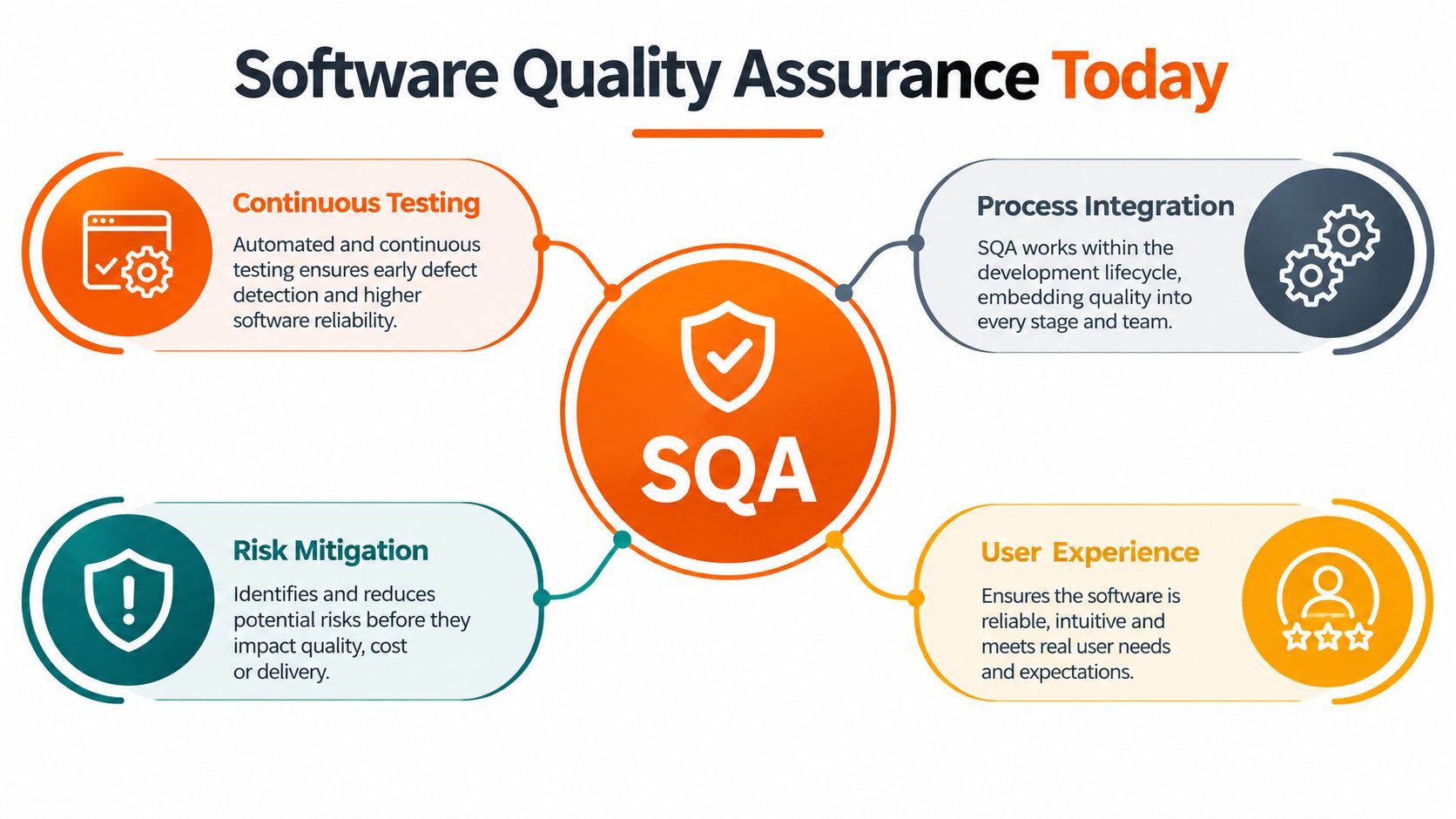
Today, software quality assurance is the operating system for delivery confidence. It starts when requirements are written, shapes architecture decisions, influences test design, and continues through release and monitoring. If your team waits until a feature is “done” before quality enters the conversation, you're already paying for rework.
This isn't a trendy reinterpretation. UK software QA became more formalised because weak quality created real economic pain. A WIT Press paper on software quality management notes that the UK government's Department of Trade and Industry commissioned investigations in the late 1980s into whether quality procedures and standards could improve software quality, leading to the 1990 publication of the TickIT Guide for software quality management system construction and certification using EN 29001.
That history matters because it shows what many teams still miss. Quality frameworks didn't emerge from theory. They emerged because ad hoc delivery wasn't enough.
The strongest teams work with shift-left quality. That means they ask testing questions before code exists.
A few examples:
If you want a useful reference point on how teams organise this work, it helps to browse QA metrics and team structures and compare them against your current operating model.
Good QA doesn't ask whether testing happened. It asks whether the team created enough confidence to release without gambling.
An MVP doesn't need the same rigour as a regulated platform with complex integrations. That's where pragmatic leadership matters.
For an MVP, quality assurance should focus on the critical user journey, obvious failure points, and fast feedback loops. For a scaling SaaS platform, the emphasis shifts toward regression control, release predictability, integration safety, security depth, and evidence that the system can handle growth. Same discipline, different depth.
Teams often talk about “doing more testing” as if testing were one bucket. It isn't. Different test types catch different classes of failure, and each one belongs at a different point in the delivery flow.
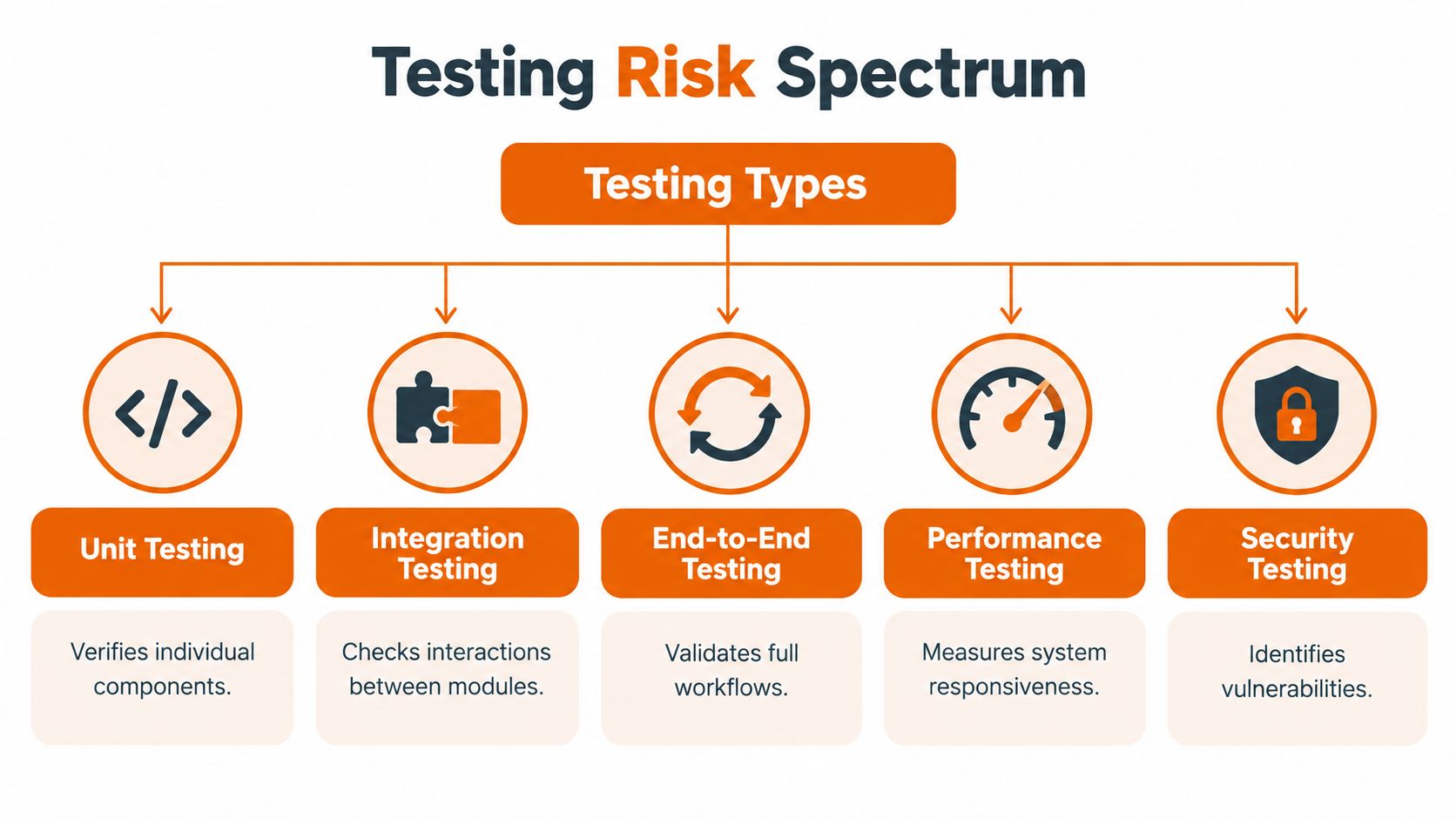
Unit testing sits closest to the code. It catches logic errors early, keeps refactoring safer, and gives developers fast feedback. When teams skip unit tests, every small change becomes more expensive because confidence drops.
Integration testing checks whether services, APIs, queues, and databases behave correctly together. A lot of painful SaaS bugs live here. The code works in isolation, but the system breaks at the seams.
End-to-end testing validates full workflows such as signup, login, checkout, or subscription change. These tests map directly to revenue and retention paths, which is why they deserve care even if they're slower and more brittle than lower-level tests.
A simple way to frame test depth is to combine internal logic checks with user-facing validation. That's the same distinction behind white-box and black-box testing approaches, and most serious products need both.
The next set of tests doesn't just protect functionality. It protects the business.
The security piece is especially clear in UK public sector guidance. The GOV.UK vulnerability and penetration testing guidance requires penetration tests and vulnerability assessments to be performed frequently during development, not as a one-off check, and to cover the whole system, including third-party components.
Before going deeper, this walkthrough is useful background for teams aligning terminology and practice:
| Testing type | Best used for | What happens when it's missing |
|---|---|---|
| Unit | Core logic and fast developer feedback | Small defects spread into larger regressions |
| Integration | Service contracts and data flow | Systems fail at API and dependency boundaries |
| End-to-end | Revenue-critical user journeys | Broken flows reach real customers |
| Performance | Load, latency, and scalability limits | Launches expose bottlenecks in production |
| Security | Vulnerabilities and unsafe integrations | Trust erodes fast after preventable exposure |
| Accessibility | Inclusive, usable interfaces | Teams ship barriers that shrink usable reach |
No product needs maximal coverage everywhere on day one. Every product does need deliberate coverage where failure would cost the most.
Most delivery problems don't come from a lack of effort. They come from a pipeline that still treats quality as a sequence of approvals instead of a continuous loop.
That's why manual-heavy QA slows down even capable teams. A 2026 UK survey of about 500 IT leaders found that 76% of organisations still rely heavily on manual testing, that developers lose 14 to 16 hours per week waiting on tests and pipelines, and that 46% worry about reputational damage from poor testing. That's not just a testing issue. It's lost engineering capacity and delayed decision-making.
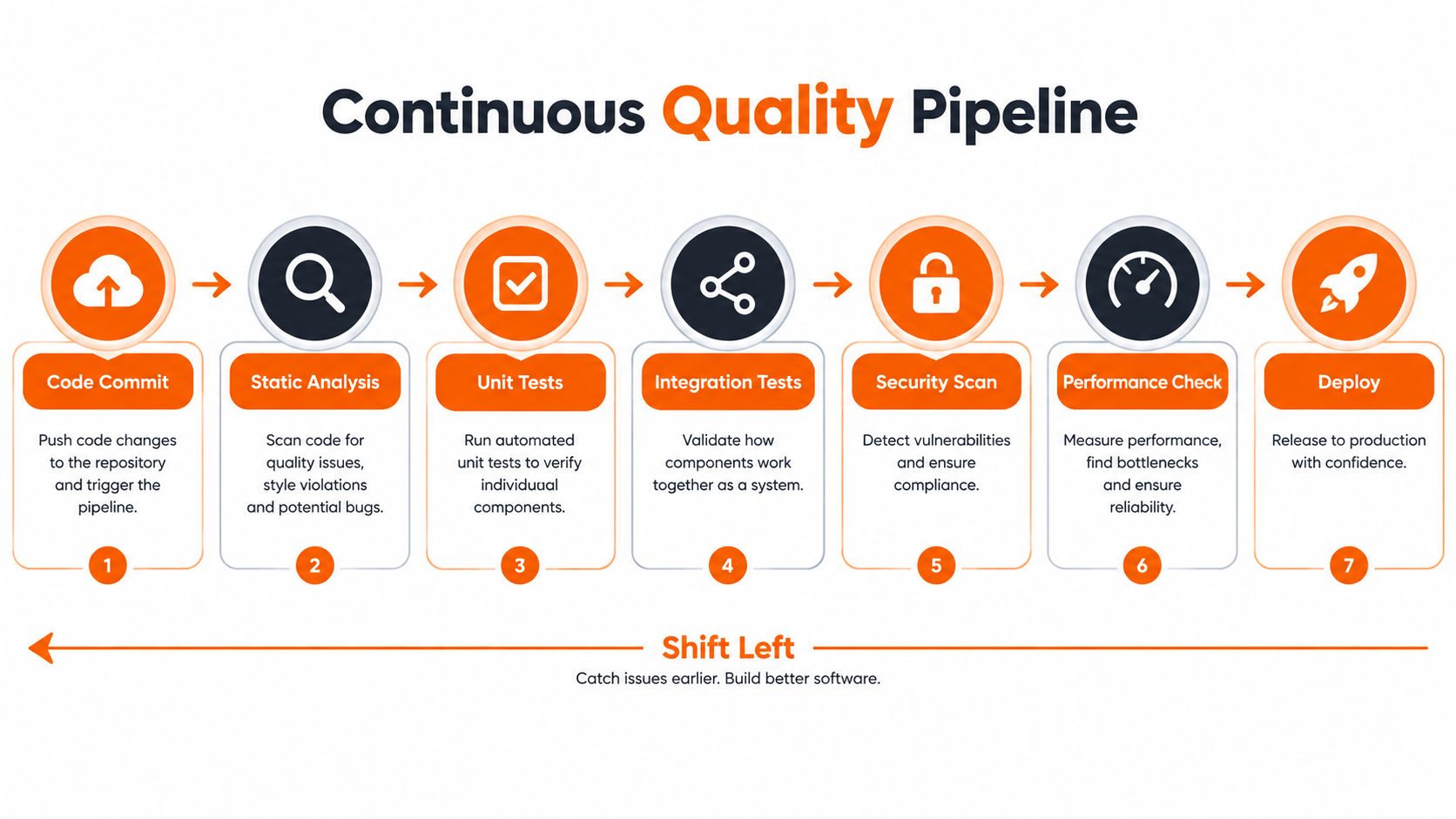
A strong quality pipeline pushes feedback as far left as possible and keeps signal fast enough to support daily delivery.
That flow doesn't need to be heavyweight. It needs to be reliable.
AI can help generate test cases, identify flaky tests, cluster failures, and highlight high-risk changes. Used well, it shortens the path to useful coverage. Used badly, it creates more noise and a false sense of confidence.
The bottleneck is usually workflow design. Teams get stuck when they automate the wrong layers, keep unstable test suites, or let pipeline runtime grow until people stop trusting the results. If you're refining this part of the stack, it helps to compare approaches to performance testing automation as part of the wider pipeline, not as a separate specialist exercise.
Operating principle: Automate the checks that protect release confidence most often, and keep manual effort for exploratory work, judgement calls, and new risk.
Extreme Ownership changes how the pipeline gets managed. Developers own testability. QA owns risk visibility. Product owns release intent. Delivery leadership owns flow efficiency. Nobody gets to say “testing is someone else's problem”.
For teams shaping or rebuilding their release workflow, a practical CI/CD foundation starts with a well-structured delivery pipeline that treats quality signals as part of engineering, not as a final ceremony.
A team can run hundreds of tests and still have no idea whether release risk is rising or falling. That's why metrics matter, but only if they help leaders make shipping decisions.
Vanity metrics don't help much. Raw test count is one example. A larger suite can mean better coverage, or it can mean duplicated checks, longer pipelines, and more false confidence. The better question is whether your metrics predict business outcomes.
This is the shortlist I'd use with a product team that wants QA tied directly to delivery confidence:
| KPI | What It Measures | Target Threshold |
|---|---|---|
| Escape defect rate | Defects found after release | As low as your business can sustain, with special focus on critical user journeys |
| Mean time to detection | How quickly the team notices a failure | Fast enough to respond before customer impact spreads |
| Test automation coverage | How much of the priority risk area is protected by automated checks | High on core workflows, selective elsewhere |
| Release failure rate | How often releases cause rollback, incident, or urgent hotfix work | Low enough that release remains routine, not stressful |
Those thresholds shouldn't be copied from another company. They should reflect your product, customer expectations, and risk appetite.
The harder question isn't “what can we test?” It's “what must we test before we ship?”
The answer sits inside a simple matrix:
That discipline matters even more when release speed increases. The 2026 Quality Transformation Report found that 49% of UK respondents said they still regularly ship untested code to production. In 2025 UK manufacturing, 72% admitted releasing untested code, 81% had delayed releases because they lacked confidence in test coverage, and 20% said they did not know what to test at all.
Teams rarely fail because they ran too few total tests. They fail because they didn't test the right risks with enough confidence.
AI can accelerate coding and even parts of test creation. It can't define acceptable risk on your behalf.
That still requires human judgement. Product decides what business impact is tolerable. Engineering defines technical risk boundaries. QA turns both into execution rules. Senior leadership needs the evidence to say yes to release with open eyes.
Most leaders don't struggle with whether QA matters. They struggle with how to organise quality capability without slowing delivery or bloating overhead.
The right answer depends on your stage, your level of internal maturity, and how much ownership you want a delivery partner to hold. That's where a consulting mindset beats a staffing mindset. You're not buying test execution. You're designing a delivery model that keeps quality aligned with growth.
| Model | Best For | Quality Integration |
|---|---|---|
| Dedicated Teams | Startups and scale-ups that want embedded specialists inside their product workflow | QA integrates directly into sprint planning, refinement, release checks, and team rituals |
| Platform Development | Companies that need end-to-end product delivery from architecture through launch | Quality gets built into delivery from day one across security, performance, accessibility, and acceptance |
| Build-Operate-Transfer | Enterprises building a long-term nearshore capability | QA becomes part of a durable operating model and an internal centre of excellence over time |
The market expectation is already moving in this direction. In Capgemini's UK edition of the World Quality Report, 87% of UK respondents rated QA's contribution to business growth as essential, compared with a survey average of 74%.
If you already have a product team and need stronger execution, Dedicated Teams usually work well. Quality becomes shared ownership, not a service desk queue.
If you're launching a new platform, rebuilding a legacy product, or need one accountable partner across design, engineering, and release, Platform Development gives you tighter control over quality consistency.
If you're thinking beyond one product cycle and want a strategic nearshore footprint, Build-Operate-Transfer makes sense. It lets you start with external operating support and grow toward internal control.
For companies comparing global hiring and capability options, it can be useful to look at adjacent talent market perspectives such as software testing jobs Brazil, especially when evaluating how distributed QA skills map to timezone coverage and collaboration habits.
The biggest difference between mediocre and effective QA models isn't geography. It's ownership.
That's why one option some SaaS teams use is a nearshore service model built around integrated delivery teams, where engineers and QA specialists work inside the same cadence and are accountable for release outcomes together. That structure supports the Riteway methodology well because Extreme Ownership only works when quality, delivery pace, and business goals sit in the same operating system.
If your team is moving quickly and still feeling release anxiety, don't start by trying to test everything. Start by deciding what failure would cost you most over the next quarter.
That founder with the broken login flow doesn't need a giant QA programme to recover. They need a sharper one. The right software quality assurance approach removes rework, clarifies release confidence, and gives leaders a cleaner view of delivery risk.
The discipline here lines up with UK public service expectations. GOV.UK's Service Standard says teams must define what success looks like and publish performance data, and the Digital, Data and Technology Playbook says assurance should provide confidence to senior leaders that work supports efficient and successful delivery of policy, strategy, and objectives.
Quality isn't the enemy of speed. Uncontrolled rework is.
Predictable quality delivery comes from making risk visible early, assigning clear ownership, and building a pipeline that tells the truth before production does.
Rite NRG helps SaaS teams build that kind of delivery engine through senior nearshore engineering, advisory on technology and delivery, and product teams that treat quality as part of speed rather than a separate phase. If you want a partner that can shape your QA approach around investor confidence, release predictability, and sustainable growth, visit Rite NRG.
/ about the author
Written by the RITE NRG editorial team — the architects, engineers and delivery leads who build and operate AI-era software for our clients.
Strategy & Transformation
A practical, finance-ready framework for comparing AI and modernization investment with the current-state cost, realistic benefits, delivery risk and time to value.
AI Consulting & Automation
A practical framework for choosing and deploying transport or logistics AI agents around real exceptions, reliable data and controlled operational authority.
Industry Solutions
A practical roadmap for improving manufacturing systems and introducing AI without destabilising production, data integrity or operational control.
More guidance: all insights articles
We can help you apply this thinking to the systems and teams you actually have.