
Strategy & Transformation
How to Calculate ROI for AI and Software Modernization
A practical, finance-ready framework for comparing AI and modernization investment with the current-state cost, realistic benefits, delivery risk and time to value.
operationalwrocław--:-- cet
∕ insights / software-delivery-tools.md
Software Delivery Tools
Compare 10 software delivery tools across CI/CD, GitOps, testing, and releases, with practical guidance for nearshore and SaaS teams.
>_article.meta
Disconnected delivery systems cost more than engineering time. They create handoffs, unclear ownership, brittle releases, and operational work that rarely appears in the project plan. Teams may ship code, yet still lose speed, capacity, confidence, and commercial momentum because nobody owns the full path from idea to production.
The popular advice says to choose the tool with the longest feature list or the strongest adoption. That's the wrong starting point. The right choice depends on your repository, cloud architecture, governance requirements, delivery maturity, and the people who'll own the system after implementation. A nearshore SaaS team needs a different operating model from an enterprise protecting regulated workloads or modernizing a legacy platform.
This comparison evaluates software delivery tools by the problems they solve, the ownership burden they create, their cloud and governance fit, their effect on release risk, and their suitability for SaaS and distributed teams. The list covers platform CI/CD, self-managed automation, cloud-native delivery, GitOps, release orchestration, and progressive delivery.
Tools accelerate engineering. They don't replace architectural judgment, security, testing, or production accountability. The right team still needs to make hard decisions early, communicate risks clearly, and own the complete result.
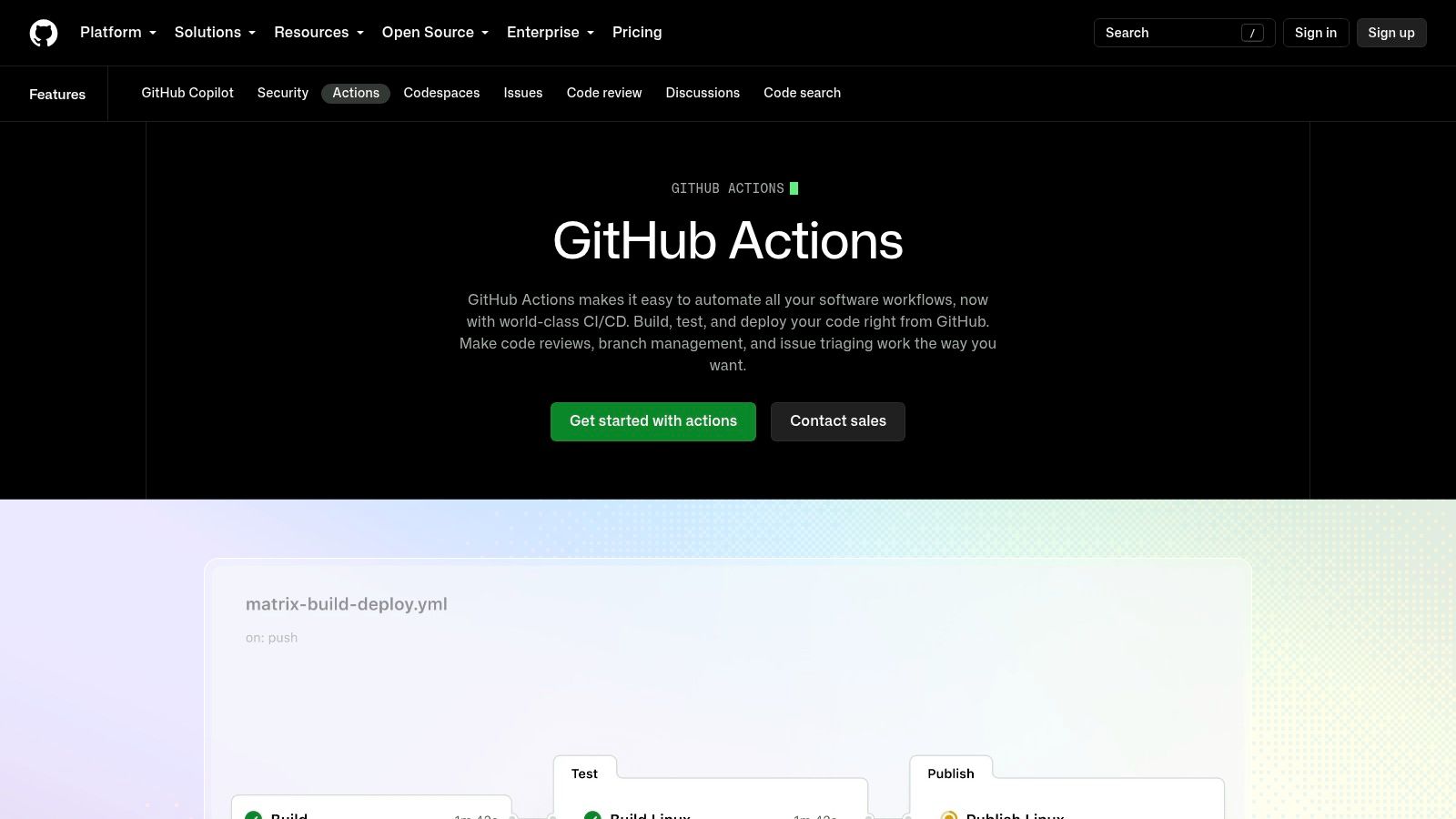
GitHub Actions is the strongest default for teams that already keep their code in GitHub. It places CI/CD inside the repository workflow, so pull requests, reviews, checks, packages, and deployments can share one operating context. That reduces glue work for an MVP and gives a SaaS team a practical route from prototype to production.
Workflows use YAML, reusable composites, matrix builds, environments, protection rules, secrets, and OIDC. The Actions marketplace adds ready-made integrations, while GitHub-hosted or self-hosted runners support different build environments. Tight integration with pull request checks, GitHub Packages, code scanning, and Dependabot makes it easier to connect delivery with security and review.
The trade-off is ownership at scale. Usage-based billing for minutes and storage can surprise teams with heavy workloads. Self-hosted runners give more control, but they also create responsibility for patching, isolation, capacity, and failure recovery.
Practical rule: Choose GitHub Actions when repository proximity matters more than platform independence.
For a product team, start with reusable workflow templates instead of copying YAML between repositories. Define approved actions, environment permissions, artifact retention, security checks, and deployment ownership early. That turns a convenient tool into a governed delivery foundation.
Use this prototype-to-production software delivery checklist before production launch, and consult this GitHub Actions documentation for the platform's current capabilities. Teams comparing pipeline patterns can also review this guide to CI/CD pipelines.
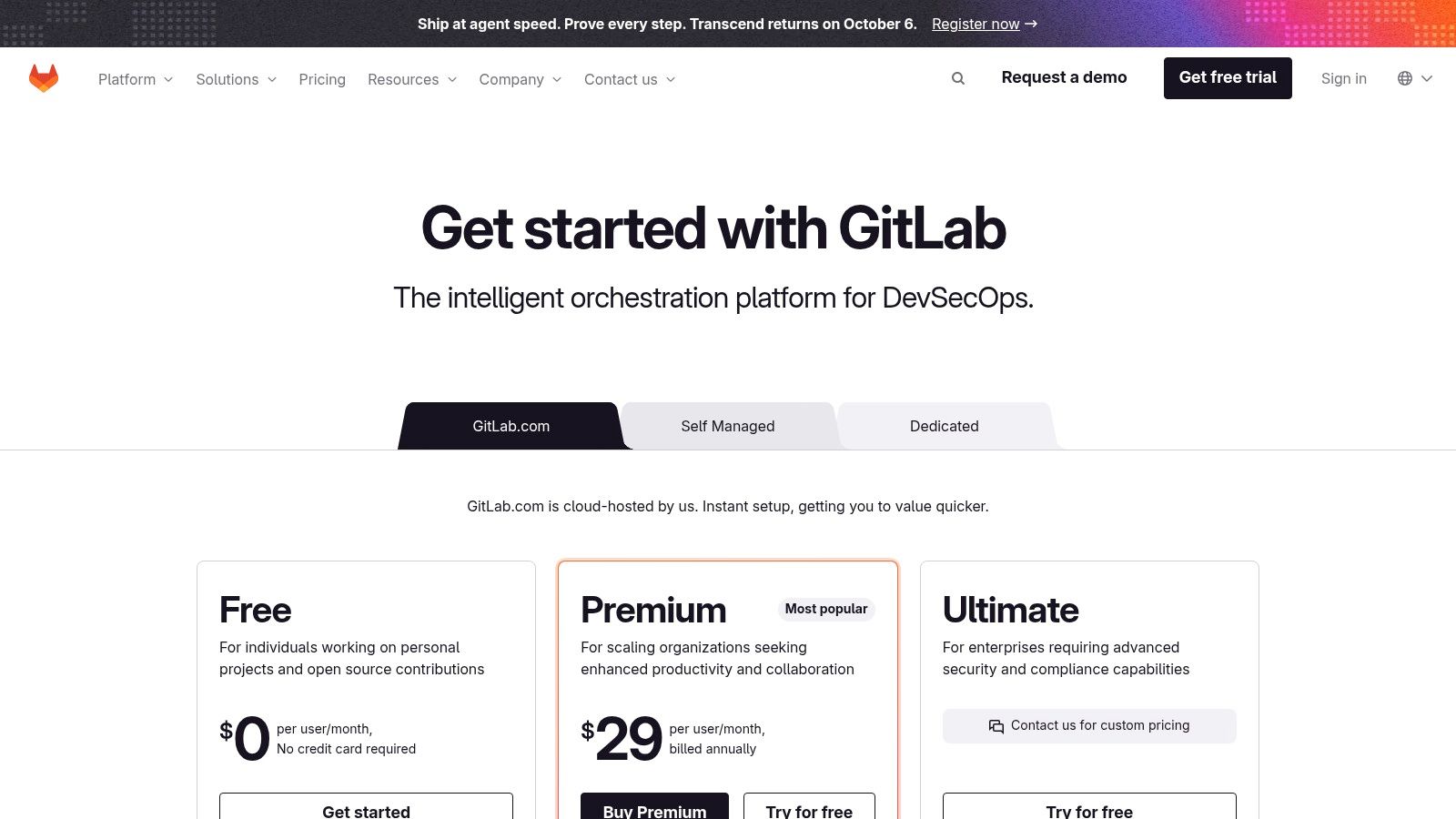
GitLab CI/CD is the best choice when you want delivery to sit inside a broader DevSecOps platform. GitLab combines repositories, issues, pipelines, registries, security testing, environments, approvals, and release workflows. That integrated model can reduce tool sprawl and make ownership clearer for organizations that are prepared to standardize.
GitLab Pipelines uses YAML configuration, templates, and Auto DevOps patterns. Built-in container and package registries keep artifacts close to the delivery system. Security capabilities include integrated SAST, DAST, and dependency scanning, while environments and approvals support controlled promotion across stages.
The platform is particularly strong for regulated organizations that need a self-managed option. Running the platform yourself increases control over infrastructure and data location, but it also makes upgrades, availability, backups, and internal support your responsibility.
Senior decision: Don't buy an all-in-one platform unless leadership is ready to change the operating model around it.
Migration from separate repositories, issue systems, scanners, and deployment tools can require process changes, not just configuration work. Seat-based licensing combined with CI minutes or credits also demands careful usage modeling. For a growing SaaS company, GitLab can simplify the stack, but only if the team actually adopts the shared templates and governance model.
Review the current GitLab pricing and plan details before committing to a platform-wide rollout. Evaluate the migration effort alongside license costs, developer onboarding, security ownership, and the long-term burden of maintaining exceptions.
Jenkins remains the right tool when maximum control matters more than minimum maintenance. It supports declarative and scripted pipelines, shared libraries, distributed agents, self-hosted installations, and highly specialized build environments. That makes it valuable for air-gapped systems, bespoke hardware, legacy estates, and organizations with strict infrastructure constraints.
The open-source model removes license fees for the tool itself, but it doesn't remove the cost of ownership. Your team manages the controller, agents, scaling, high availability, plugin compatibility, upgrades, secrets, access controls, backups, and incident response. A pipeline that works today can become a liability when only one engineer understands its plugins and deployment topology.
Jenkins is flexible enough to connect almost anything, which is both its strength and its danger. Plugin choice needs governance. Shared libraries need versioning. Pipeline patterns need documentation. Security updates need an accountable owner with time to maintain them.
Jenkins makes commercial sense when your environment has requirements that managed services can't satisfy. It can run across major operating systems and container platforms, support custom agents, and preserve control over sensitive build infrastructure.
Read the Jenkins project documentation and calculate total ownership using engineering hours, not just the absence of a license invoice. Nearshore teams can operate Jenkins successfully, but only when ownership, escalation, and documentation remain explicit across time zones.
Azure DevOps Services fits enterprises that already rely on Microsoft identity, infrastructure, and governance. It combines Azure Pipelines, Boards, Test Plans, Artifacts, Repos, and work tracking in one managed suite. For Windows and .NET estates, that integration can reduce friction across planning, testing, packaging, and deployment.
Azure Pipelines supports Linux, Windows, and macOS agents, containers, multi-cloud targets, and on-premises environments. Teams can deploy to Azure, AWS, Google Cloud, or private infrastructure while keeping work tracking and test management in the same platform. Azure AD integration also gives enterprise administrators a familiar route to identity and access governance.
The main challenge is strategic overlap. GitHub and Azure DevOps can both sit inside a Microsoft-centric organization, and the resulting split can create duplicate repositories, pipelines, permissions, and reporting. Hosted versus self-hosted agents and parallel job limits also affect forecasting, so procurement needs a realistic workload model.
Choose Azure DevOps when the organization values integrated planning and governance as much as pipeline execution. It's especially useful when product managers, testers, developers, and operations teams need one structured system for work items, test plans, artifacts, and releases.
Check the Azure DevOps Services pricing details before selecting hosted or self-hosted agents. Assign a senior owner to the consolidation decision. Tool duplication becomes expensive when no one is accountable for the final platform architecture.
AWS CodePipeline, CodeBuild, and CodeDeploy form a sensible stack for teams whose applications already live primarily in AWS. CodePipeline orchestrates stages, CodeBuild handles builds and tests, and CodeDeploy delivers applications to EC2, Auto Scaling groups, ECS, Lambda, on-premises instances, and other targets.
The commercial value comes from integration. IAM controls access, CloudWatch provides operational signals, VPC controls shape network placement, and AWS services such as ECR, CloudFormation, and SAM can participate directly in the pipeline. The managed model removes the need to run CI/CD servers, while pay-as-you-go billing connects spend to usage.
The weakness is experience and portability. The services can feel fragmented compared with a unified third-party platform. Teams operating across multiple clouds may need additional abstractions, and deep AWS integration can increase vendor lock-in.
Control the platform boundary: Native cloud tools work best when they reinforce your architecture, not when they conceal it.
Use this stack when AWS is a deliberate strategic choice and the team understands IAM, networking, artifact management, observability, and rollback. Don't select it because the account already exists. A pipeline can be technically native and still produce poor delivery outcomes if developers struggle to understand failures or operators lack release visibility.
Review the AWS CodePipeline pricing information alongside CodeBuild and CodeDeploy usage. Model build duration, artifact storage, data transfer, approvals, and operational support as one delivery cost.
Google Cloud Build and Cloud Deploy suit teams that want managed delivery closely aligned with GKE, Cloud Run, Artifact Registry, IAM, and VPC controls. Cloud Build provides serverless build execution, triggers, cached steps, and YAML definitions. Cloud Deploy manages release pipelines, targets, approvals, and promotion across environments.
This separation between build and delivery is useful. It lets engineering teams optimize compilation and tests without mixing every deployment rule into the build system. Platform teams can define delivery targets, approvals, and environment controls while application teams own service-specific build logic.
The strongest fit is a GCP-native organization with cloud skills already in place. Multi-cloud or hybrid delivery is possible, but it requires extra integration and governance work. Cost planning also depends on understanding build and deployment usage rather than treating the platform as a fixed subscription.
A nearshore SaaS team can move quickly with these managed services if it standardizes project structure, service accounts, artifact promotion, and environment ownership. Without those decisions, separate GCP projects and permissions can produce the same handoffs the toolchain was meant to remove.
Check Google Cloud Build pricing and include deployment controls in the evaluation. The right architecture makes the managed service boring, observable, and repeatable.
Argo CD is the clear choice for Kubernetes teams adopting GitOps. It watches Git-stored desired state and reconciles live clusters against it. That makes application configuration reviewable, auditable, and recoverable through the same change process used for source code.
The platform supports automated synchronization, health checks, drift detection, role-based access, SSO, app-of-apps patterns, and multi-cluster delivery. Integrations such as Argo Rollouts add progressive delivery capabilities. Argo CD is now running in nearly 60% of Kubernetes clusters for application delivery, according to recent industry reporting. Adoption shows that GitOps standardization is advancing, but it doesn't remove the need for sound governance and workflow design.
Kubernetes is also the boundary. Argo CD is Kubernetes-focused, so non-Kubernetes targets need other delivery mechanisms. Operating high availability, SSO, RBAC, repositories, and cluster access requires real Kubernetes expertise.
GitOps works when teams define ownership clearly. Developers need a safe way to propose changes. Platform engineers need to manage cluster policies and shared components. Security teams need traceability. Product leaders need release communication that translates technical changes into customer and business impact.
Use cloud-native architecture guidance to test whether Kubernetes and GitOps serve the product, rather than forcing the product to serve the platform. Argo CD is powerful, but a powerful control plane won't compensate for unclear architecture or weak operational ownership.
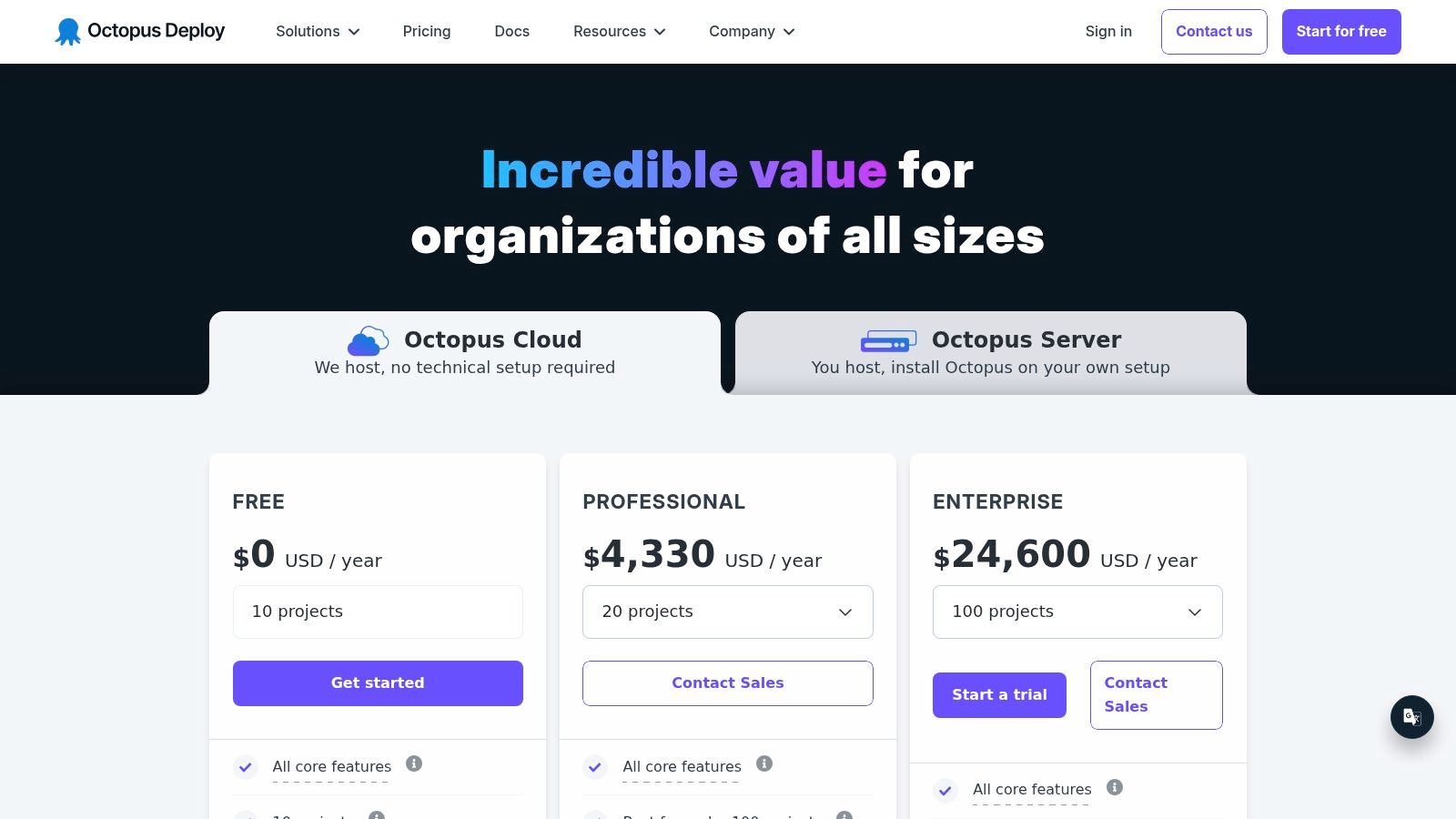
Octopus Deploy is built for teams that need release orchestration across mixed environments. It separates build from deployment, then adds releases, lifecycles, environment scoping, approvals, runbooks, and deployment steps for Windows, Linux, Kubernetes, cloud PaaS, and infrastructure.
That separation makes Octopus especially useful during gradual modernization. A company can keep Jenkins, GitHub Actions, Azure DevOps, or another CI system for build and test while using Octopus to govern promotion into shared, staging, and production environments. This approach avoids a risky big-bang migration and gives operations teams a clearer release control plane.
The cost is another system to operate. Teams must plan integrations, permissions, deployment targets, licensing, and ownership across large fleets. If the existing CI platform already handles release governance well, Octopus may add duplication instead of clarity.
Review the Octopus Deploy pricing overview and compare its control-plane value with the cost of retaining release scripts and manual approvals. For a distributed SaaS team, clear deployment ownership is often more valuable than another dashboard.
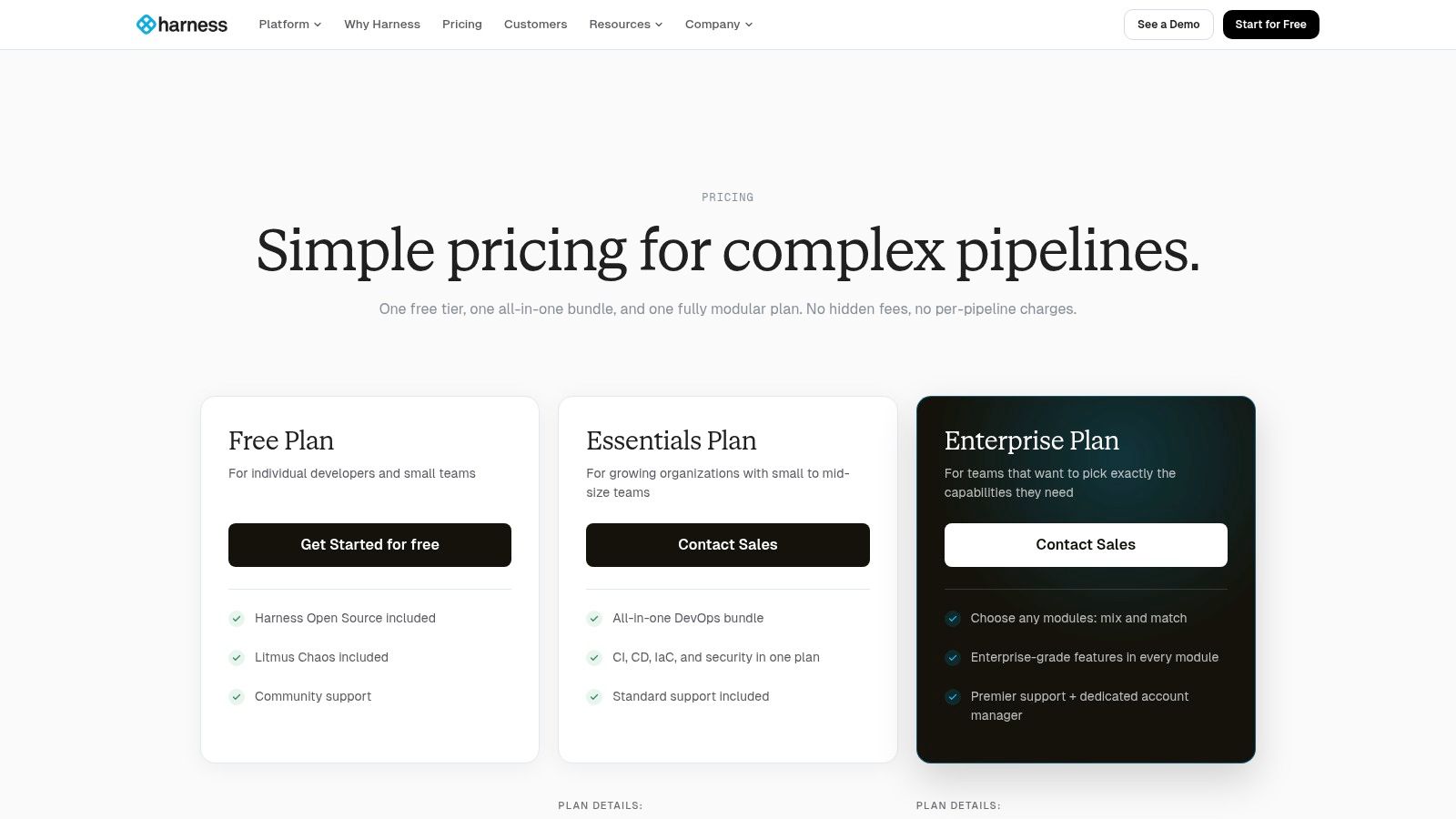
Harness is the strongest fit for organizations that treat release safety and governance as first-class business controls. Its platform combines continuous delivery, GitOps, CI, feature flags, policy, security, cloud cost, and SRE-related capabilities through separate modules. That breadth can reduce vendor sprawl when the organization is ready to standardize.
Harness supports automated verification, rollback, canary delivery, governance, policy as code, and cloud-hosted or self-managed deployment options. The value isn't the number of modules. It's the ability to connect deployment decisions with health signals, approval rules, audit trails, and operational accountability.
The platform needs disciplined procurement. Enterprise-oriented pricing and module selection can become complex. Its proprietary approach also means migration planning matters, particularly when the organization already depends on Jenkins, GitLab, Argo CD, or custom release tooling.
Harness is particularly relevant to the post-AI delivery problem. In a 2025 survey of 500 engineering leaders and developers, 78% said developers spend at least 30% of their time on manual, repetitive tasks, 92% said AI increases the blast radius of bad code reaching production, 67% spent more time debugging AI-generated code, and 68% spent more time resolving AI-related security vulnerabilities, according to Harness's State of Software Delivery report.
Those findings support a direct conclusion. AI-generated output needs stronger validation, security gates, approval controls, and production verification. Harness can support that control model, but architects and engineers remain responsible for deciding what the gates must prove.
LaunchDarkly solves a release problem that CI/CD alone can't solve. It separates deployment from customer release, allowing teams to put code into production while controlling who sees a capability and when. Feature flags, targeting, kill switches, approvals, experimentation, and flag health tooling support safer product decisions.
That makes LaunchDarkly valuable for SaaS companies with frequent releases, multiple customer segments, or high commercial risk. A team can limit exposure, disable a problematic feature, and coordinate a rollout with product, support, security, and operations. The tool complements CI/CD instead of replacing it.
Feature management introduces its own ownership burden. Flags need names, owners, expiry rules, documentation, and cleanup. Without discipline, flag debt makes behavior harder to understand and increases test complexity. Cost can also become significant at high MAU or seat counts, so product and engineering leaders should model usage before broad adoption.
Release safely, then remove the control: Every flag needs an owner, a purpose, and a cleanup decision.
Use LaunchDarkly when progressive delivery reduces business risk, not merely because experimentation sounds attractive. Define production observability before rollout. A kill switch without reliable health signals only gives the team a faster way to react without knowing what happened.
Read the LaunchDarkly pricing information and align the implementation with a broader delivery management approach. The platform becomes most valuable when product managers and engineers share release ownership.
| Tool | Core Focus / Features | Key Strengths / ✨ | Quality / UX ★ | Best For 👥 | Price / Value 💰 |
|---|---|---|---|---|---|
| GitHub Actions | Native CI/CD, YAML workflows, actions marketplace, runners | Tight GitHub integration, security tooling, reusable workflows ✨ | ★★★★ | Developers & teams already on GitHub 👥 | 💰 Usage-based minutes/storage; scales (watch costs) |
| GitLab CI/CD | End-to-end DevSecOps: pipelines, registry, security scans | Single-platform plan→prod, strong self‑managed option ✨ | ★★★★ | Orgs wanting one platform / regulated environments 👥 | 💰 Seat + CI minutes; forecasting can be complex |
| Jenkins | Open‑source automation server, 1,800+ plugins, scripted pipelines | Max control, air‑gapped installs, extreme extensibility 🏆 | ★★★ | Teams needing bespoke on‑prem CI and full ownership 👥 | 💰 Free OSS; higher ops/maintenance cost |
| Azure DevOps Services | Managed suite: Pipelines, Repos, Boards, Artifacts, Test Plans | Azure AD integration, Windows/.NET support, enterprise governance ✨ | ★★★★ | Microsoft‑aligned enterprises and .NET teams 👥 | 💰 Flexible billing; hosted vs self‑hosted affects cost |
| AWS CodePipeline / Build / Deploy | Native AWS CI/CD: build, orchestrate, deploy to AWS targets | Deep IAM/VPC/CloudWatch integration, serverless scaling ✨ | ★★★★ | AWS‑centric stacks requiring native security controls 👥 | 💰 Pay‑as‑you‑go; granular metering |
| Google Cloud Build & Deploy | Managed CI/CD for GCP (Cloud Build + Cloud Deploy) | GKE/Cloud Run/Anthos integration, IAM/artifact ties ✨ | ★★★★ | GCP‑native workloads and Kubernetes teams 👥 | 💰 Per‑build billing; optimized for GCP |
| Argo CD | Declarative GitOps CD for Kubernetes; sync, drift, multi‑cluster | GitOps-first, multi‑cluster app patterns, CNCF ecosystem 🏆 | ★★★★ | Platform teams standardizing GitOps on Kubernetes 👥 | 💰 OSS; K8s ops cost for HA/SSO |
| Octopus Deploy | Release orchestration, lifecycles, runbooks, multi‑tenant deploys | Strong release governance, runbooks, mixed‑fleet support ✨ | ★★★★ | Ops teams managing mixed Windows/Linux/K8s fleets 👥 | 💰 Commercial licensing; additional control plane cost |
| Harness | CD+CI+GitOps+Feature Flags with ML verification | Automated verification/rollback, consolidated modules 🏆 | ★★★★ | Enterprises prioritizing deployment safety & consolidation 👥 | 💰 Enterprise pricing; can be costly but reduces toil |
| LaunchDarkly | Feature management & progressive delivery (flags, experiments) | Flag targeting, SDKs, governance & experimentation 🏆 | ★★★★ | Product teams doing gradual rollouts and experiments 👥 | 💰 Pricing scales with MAU/seats; strong ROI for risk reduction |
Start with the business bottleneck, not the product category. Map how an idea moves through planning, design, code, review, build, test, security, environment provisioning, deployment, release, observation, and learning. Mark every manual handoff, unclear approval, repeated data entry, and failure that requires a specialist to recover.
Then choose the narrowest toolchain that solves the core constraint. GitHub Actions is the practical default for GitHub-centered teams. GitLab CI/CD is stronger when one platform should cover planning through production. Jenkins earns its place when infrastructure control, air-gapped delivery, or bespoke execution matters. Azure DevOps fits Microsoft-led enterprises. AWS and Google Cloud services make sense when cloud-native integration outweighs portability. Argo CD is for Kubernetes GitOps. Octopus Deploy governs mixed fleets. Harness targets release safety and platform consolidation. LaunchDarkly manages progressive exposure rather than builds.
Define repository and cloud constraints before you shortlist products. Decide where source code lives, where artifacts are stored, which environments need private connectivity, and how identity, secrets, audit logs, and approvals must work. Don't let a pipeline choice quietly determine your architecture or create a cloud dependency the business hasn't approved.
Capacity matters as much as functionality. A managed service reduces platform maintenance, but it may introduce usage-based costs, proprietary workflows, or data-location constraints. A self-managed system gives control, but your team owns patching, scaling, backups, security, and recovery. Calculate total ownership in engineering time, incident response, compliance work, and onboarding effort.
Test the delivery model with a representative service. Include a normal release, a failed test, a secret rotation, a rollback, an approval, an infrastructure change, and a production incident. Check whether a new engineer can understand the pipeline and whether a senior engineer can trace responsibility from commit to customer impact.
Measure outcomes rather than activity. Track lead time, release frequency, failed-release risk, recovery effort, developer capacity, and operational toil. Use postrelease defect rate as defects in production divided by releases, as described in this review of software delivery in the age of AI. Don't set arbitrary targets before you understand the baseline.
AI changes the economics of delivery, but it doesn't change engineering standards. AI can accelerate analysis, implementation, testing, documentation, and migration. Agentic systems can also introduce architectural drift, knowledge atrophy, access-control weaknesses, and compliance exposure without clear audit trails, as outlined in Deloitte's analysis of agentic AI and software engineering. Senior architects and engineers remain accountable for architecture, data, security, testing, and production quality.
The #riteway approach makes that accountability operational. Teams identify risks early, challenge weak assumptions respectfully, communicate status and trade-offs transparently, and take ownership of the complete result rather than one assigned task. AI should make delivery faster and more efficient, not provide cover for uncontrolled code generation or deferred decisions.
Use a practical technology stack diagram guide to document the boundaries, owners, integrations, and operational dependencies before you commit. Then assign a named post-launch owner with authority to improve the system. A toolchain without ownership is just another source of operational risk.
Rite NRG helps companies plan, build, modernize, scale, and operate business-critical software with senior architects, engineers, AI specialists, data experts, and delivery leaders. If you need a governed delivery workflow, nearshore engineering capacity, or controlled AI-native modernization, visit Rite NRG to discuss a toolchain and delivery model your team can own.
/ about the author
Written by the RITE NRG editorial team — the architects, engineers and delivery leads who build and operate AI-era software for our clients.
Strategy & Transformation
A practical, finance-ready framework for comparing AI and modernization investment with the current-state cost, realistic benefits, delivery risk and time to value.
AI Consulting & Automation
A practical framework for choosing and deploying transport or logistics AI agents around real exceptions, reliable data and controlled operational authority.
Industry Solutions
A practical roadmap for improving manufacturing systems and introducing AI without destabilising production, data integrity or operational control.
More guidance: all insights articles
We can help you apply this thinking to the systems and teams you actually have.