

Strategy & Transformation
How to Calculate ROI for AI and Software Modernization
A practical, finance-ready framework for comparing AI and modernization investment with the current-state cost, realistic benefits, delivery risk and time to value.
operationalwrocław--:-- cet
∕ insights / delivery-management.md
Delivery Management
Learn delivery management principles, workflows, KPIs, and nearshore team integration to ship SaaS products up to 50% faster without losing control.
>_article.meta
The UK handled roughly 5 billion parcels in 2024, equivalent to about 96 million parcels each week, according to Delivery News' analysis of UK last-mile scale. That volume makes delivery management a business capability, not a dispatch function. SaaS companies face the same pressure in a different form. Customers expect more product value, investors expect sharper execution, and AI-assisted development is compressing the time available for teams to make good decisions.
A roadmap that produces plenty of code but little customer value is still failing. The senior teams I've seen rescue stalled SaaS products don't start by adding ceremonies or buying another dashboard. They establish ownership, remove decision friction, expose risk early, and measure whether valuable changes reach production safely.

Delivery management turns committed business outcomes into customer value in production, on a cadence leaders can predict. It gives senior nearshore teams a sharper mandate than tracking tickets or running ceremonies: own the decisions, dependencies, and risks that determine whether a SaaS roadmap produces results. At any point, a delivery manager should answer three questions: What value shipped? How long did it take to reach production? How much escaped into the customer experience as a defect?
The UK parcel market shows how higher throughput changes management. Annual parcel volume rose from about 1.7 billion in 2013 to 4.2 billion in 2021 and roughly 5 billion in 2024, nearly three times the 2013 level, as noted earlier. At that scale, dispatch planning, depot coordination, and last-mile exceptions become strategic disciplines. SaaS teams face the same operating pressure in another form. A delayed dependency, approval, or release decision can affect revenue, retention, and confidence in the roadmap.
Shipped revenue connects product work to commercial impact. A completed ticket has no inherent business value. A released capability that helps customers convert, expand, renew, or operate more effectively does.
Cycle time measures the path from meaningful commitment to production. It exposes waiting, rework, unclear acceptance criteria, approval queues, and overloaded specialists. Nearshore teams with clear ownership use this measure to remove friction instead of rewarding activity.
Defect escape rate shows whether faster delivery is creating customer pain. A team that ships quickly while repeatedly breaking trust has pushed failure closer to the customer, not improved delivery.
Project management usually controls scope, budget, and timeline. Program management coordinates related projects and dependencies. Delivery management connects both to business outcomes and holds the team accountable for making and executing decisions quickly enough to support the roadmap.
AI-assisted coding is shortening build cycles, but implementation speed does not remove decision latency. In 2026, prioritisation, dependency hygiene, test confidence, and release ownership often constrain progress. The operating model below treats workflows, roles, and metrics as levers for shipped revenue, cycle time, and defect escape rate.
The #riteway methodology takes its energy from the Extreme Operating Model associated with Jocko Willink and Leif Babin, then applies the underlying ideas to SaaS delivery. The useful translation isn't military language. It's the refusal to let responsibility disappear between product, engineering, quality, and stakeholders.
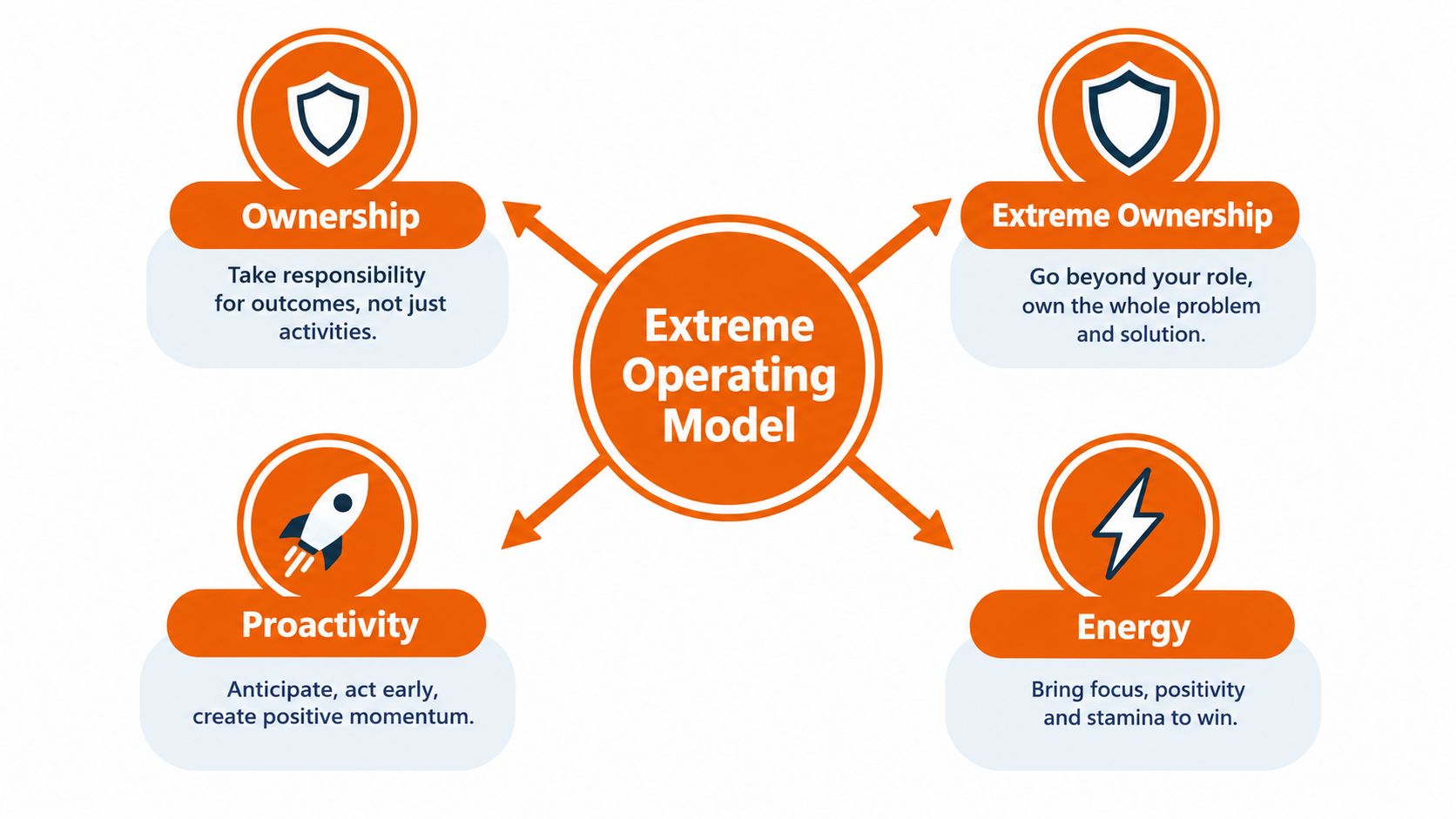
Ownership means someone owns the customer and business result, not merely a backlog. The product manager is accountable for the outcome behind the work. Roadmap completion is a weak signal. Shipped adoption, revenue contribution, customer retention, or reduced operational effort is much harder to fake.
Extreme Ownership gives delivery leads responsibility for the conditions around execution. A blocked environment, unresolved cross-team dependency, late decision, or recurring incident isn't someone else's problem because another team caused it. The delivery lead surfaces it, names the impact, brings mitigation options, and drives the decision.
Proactivity moves risk forward in time. A credible team raises a likely problem while there's still room to change scope, sequence work, add capacity, or alter the design. Risk raised during a retrospective may produce a useful lesson, but risk raised early can still protect the commitment.
Energy is the standard for how the team finishes. It means communicating clearly when a commitment is threatened, staying engaged through release and verification, and treating stakeholder trust as a limited asset. High energy isn't noisy optimism. It's visible momentum, honest escalation, and a bias towards solving the next real constraint.
Practical rule: If a ceremony, document, or approval doesn't strengthen ownership, proactivity, energy, or outcome clarity, remove it or redesign it.
That test gives delivery management a backbone. A weekly review should expose decisions and risks. A demo should prove usable value. A handoff should transfer explicit ownership. A post-mortem should assign action owners, not produce a polished explanation that changes nothing.
The result is a team that behaves like a partner, whether its members sit together or work across borders. Seniority matters because experienced people don't wait for perfect instructions before protecting the outcome.
Agile and CI/CD solve different bottlenecks. Agile addresses what the team should do, in what order, and with what feedback. CI/CD addresses how safely and repeatedly the team can move a change from commit to production. Treating them as alternatives creates a false choice.
| Dimension | Agile Workflow | CI/CD Workflow |
|---|---|---|
| Primary problem | Prioritisation, scope, and feedback | Build, test, release, and deployment friction |
| Useful mechanisms | Scrum, Kanban, Shape Up, reviews, demos, retrospectives | GitHub Actions, GitLab CI, CircleCI, Argo, automated gates |
| Main outcome | A team aligned to valuable work | A repeatable path to production |
| Failure when used alone | Strong planning with a slow or risky release process | Fast delivery of work that may not matter |
| Delivery signal | Clarity of commitment and learning | Lead time, release safety, and recovery readiness |
Agile without CI/CD produces polished sprint demos and a release queue. Manual handoffs accumulate, testing happens late, and teams become cautious about deployment. CI/CD without Agile creates an efficient pipeline pointed at the wrong problem. The code moves quickly, but customer value doesn't.
Start with an appetite or outcome, not a fully specified solution. A Shape Up-style framing can establish the problem boundary and the amount of investment the team is prepared to make. Weekly cycle check-ins then focus on risk, decisions, and evidence rather than status theatre.
Engineering should use trunk-based development where it fits the product and risk profile. Feature flags allow incomplete work to merge without exposing it prematurely. Automated test suites built with tools such as Playwright or Cypress create repeatable quality gates, while progressive rollout limits the blast radius of a release.
After deployment, monitoring must confirm the intended behaviour. A feature isn't finished when the pipeline turns green. The product team needs to inspect usage, support signals, conversion behaviour, and customer feedback, then decide whether to expand, adjust, or remove the change.
Agile chooses the right work. CI/CD makes the chosen work easier to ship safely.
Choose an Agile cadence that matches your release appetite. Choose CI/CD maturity that matches your tolerance for batched risk. A small product may accept a simpler pipeline with strong manual review. A high-change SaaS platform needs automated verification, observable releases, and a tested rollback path.
Delivery slows when accountability is described as collaboration without a named owner. Everyone attends the meeting, everyone has an opinion, and nobody can explain why the release missed its commercial objective.
Pair the product manager and engineering lead on roadmap ownership. The product manager owns the customer problem, priority, and value hypothesis. The engineering lead owns technical feasibility, sequencing, and engineering trade-offs. Together, they decide what deserves commitment and what must wait.
The tech lead and squad leads own the build. Their accountability isn't limited to code quality. They must turn an agreed problem into a workable slice, manage dependencies, keep technical risk visible, and make sure the team can demonstrate meaningful progress.
A dedicated QA lead or embedded test engineer owns quality confidence and holds a release veto when the evidence doesn't support deployment. That veto should be specific. It should identify the failed acceptance condition, the customer risk, and the evidence required to proceed.
The delivery manager owns delivery risk. A weekly red-amber-green review should cover dependencies, scope, quality, environments, decisions, and external constraints. The role isn't to collect updates. It's to force clarity and escalation before a risk becomes a missed commitment.
| Role | Owns | Accountability Signal |
|---|---|---|
| Product manager and engineering lead | Roadmap value and feasibility | Written outcomes, acceptance criteria, and priority decisions |
| Tech lead and squad leads | Build execution and technical trade-offs | Demonstrable increments and recorded decisions |
| QA or test engineer | Release confidence and quality veto | Test evidence, known-risk register, and release recommendation |
| Delivery manager | Risk, cadence, and escalation | Weekly red-amber-green review with named mitigations |
| Engagement manager | Nearshore integration and coordination flow | Clear communication rhythm, dependency ownership, and client alignment |
The handoffs should be explicit: discovery to scoping, scoping to commitment, commitment to release, and release to post-launch learning. Each transition needs an owner and an artefact, such as acceptance criteria, a demo recording, rollback instructions, or a post-mortem with action owners.
Nearshore teams benefit from an engagement manager who absorbs time-zone friction and protects the client squad from coordination tax. That person keeps decisions moving without turning every question into another meeting.
The common failure is shared ownership of everything. It sounds collaborative, but it creates accountability fog. If everyone owns the roadmap, build, quality, and risk, no one owns the result.
On-time delivery can be a misleading comfort. UK parcel benchmark data for Q2 2025 reported an average transit time of 1.32 days, an on-time delivery ratio of 98.64%, and first-attempt success improving from 96.65% to 97.24% quarter-on-quarter. Yet the same benchmark recorded an issue ratio of 4.75%, including recipient-side problems at 3.11% and carrier-driven issues at 1.64%, as reported by Parcel Perform's UK delivery performance benchmark. Delivery management therefore has to inspect exceptions and failed handovers, not just headline speed.
SaaS teams need four flow metrics that connect directly to execution health.
Lead time for changes runs from commit to production. Break it into waiting and active work. A long lead time usually points to review queues, test bottlenecks, environment friction, or excessive batch size.
Deployment frequency shows whether the team can release in small, controlled increments. It isn't a target to inflate blindly. Frequent releases only help when quality gates and monitoring make the risk acceptable.
Change failure rate captures the proportion of releases that cause a rollback, incident, hotfix, or other material failure. It protects the organisation from celebrating speed while pushing rework onto customers and operations.
Time to restore service measures how quickly the team recovers when a release or system failure causes harm. A capable delivery organisation plans for recovery, not just successful paths.
| Metric Type | What It Measures | Why It Misleads or Helps |
|---|---|---|
| Story points completed | Estimated work units | Encourages estimation games and volume over value |
| Velocity trend | Planned team throughput | Can reward larger estimates or stable-looking output |
| Utilisation rate | Occupancy of people or capacity | Penalises slack and makes urgent work harder to absorb |
| Lead time for changes | Commit-to-production flow | Reveals queues, handoffs, and rework |
| Deployment frequency | Release cadence | Shows whether delivery happens in controlled increments |
| Change failure rate | Safety of released changes | Connects speed to customer and operational risk |
| Time to restore service | Recovery capability | Tests resilience when the happy path fails |
Instrument these metrics using existing source-control, CI/CD, deployment, and incident records. Make the first dashboard simple. A founder or product leader should see where work waits, whether releases fail, and how quickly the team recovers.
Set targets by maturity rather than copying another company's numbers. An early-stage SaaS team needs visibility and a reliable baseline. A scaling team needs to reduce queues and batch size. A mature team needs to optimise flow without weakening resilience.
A metric you can't act on within a sprint is decoration, not a KPI.
Buying a delivery platform won't fix unclear ownership. If nobody can decide what belongs in the next release, another workflow tool gives indecision a more attractive interface.
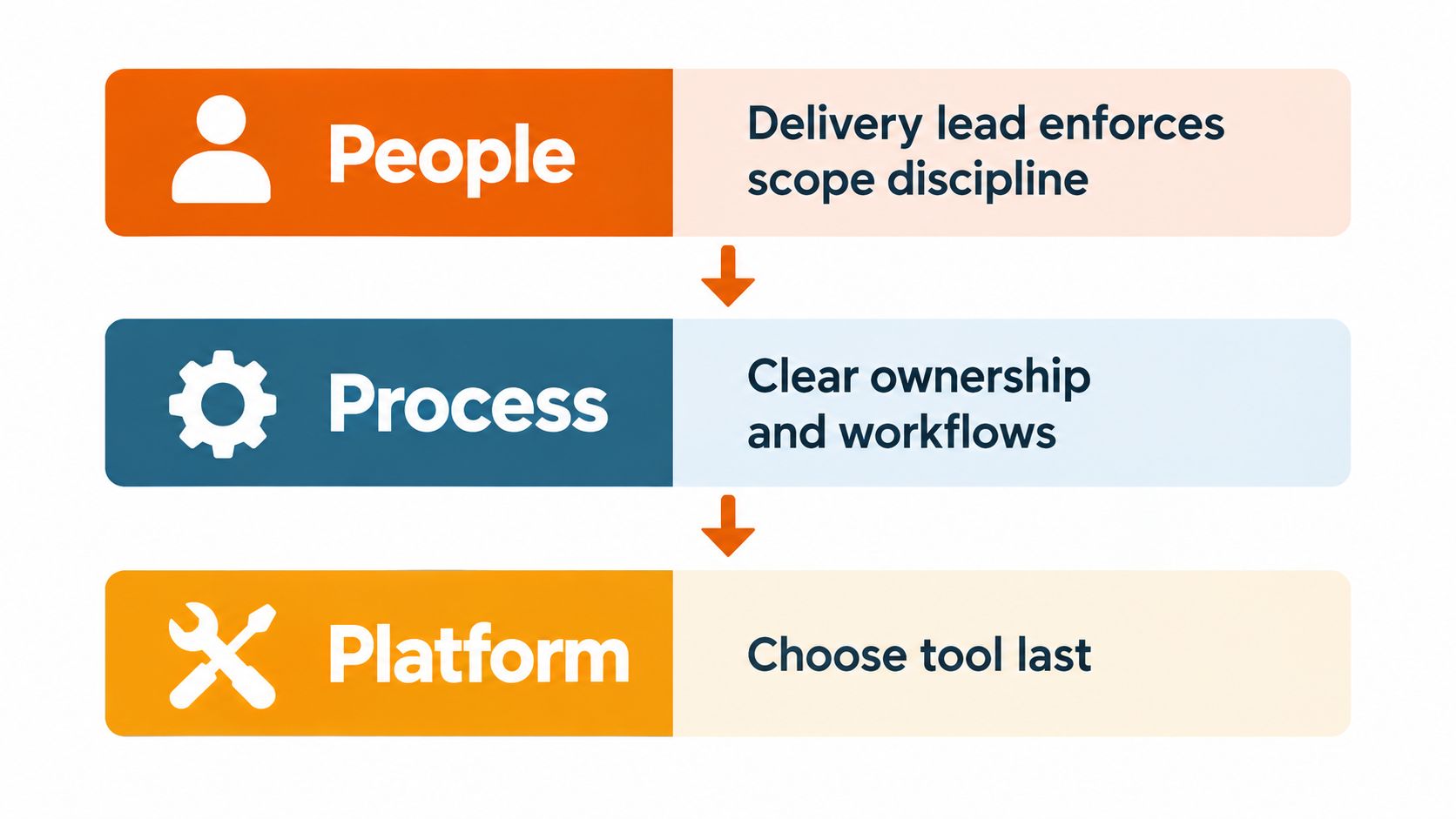
Use this order: people, process, platform. First appoint a delivery lead who enforces scope discipline and owns escalation. Then define how work enters a commitment, how quality is verified, how releases happen, and how decisions are recorded. Only then choose tools that reduce friction in that operating model.
For planning, Linear or Jira can hold priorities, acceptance criteria, dependencies, and release views. GitHub Actions or GitLab CI can handle source control automation and deployment gates. Playwright or Cypress can support browser-level verification, while Datadog or Grafana can provide observability for application and infrastructure behaviour.
PagerDuty or incident.io can structure incident response, escalation, and learning. Nearshore squads also need async-first collaboration. Loom makes a short demo or technical explanation easier to consume across working hours. Notion can hold product context and operating agreements. A shared decision log prevents the same question returning in a different meeting.
The platform should make ownership visible, not hide it behind dashboards. A useful board tells the team who is deciding, what is blocked, what evidence exists, and what happens next.
Rite NRG is one example of a nearshore software delivery partner combining dedicated teams, platform development, technology and delivery consulting, and Build-Operate-Transfer support. The relevant question isn't whether a provider has a long tool list. Ask whether its operating model gives your team clearer ownership and faster, safer movement to production.
A stalled SaaS release needs a senior pod that understands the product, makes decisions, and owns a meaningful delivery slice without adding another management layer. Nearshore integration succeeds when accountability arrives before the first sprint.
Start with cultural-fit signals during the two-week integration. Use case-style interviews to examine how candidates handled ambiguity, missed commitments, production incidents, and disagreement. AI-assisted vetting can filter for evidence of ownership history instead of keyword matches, but a human delivery leader must still test judgement and communication.
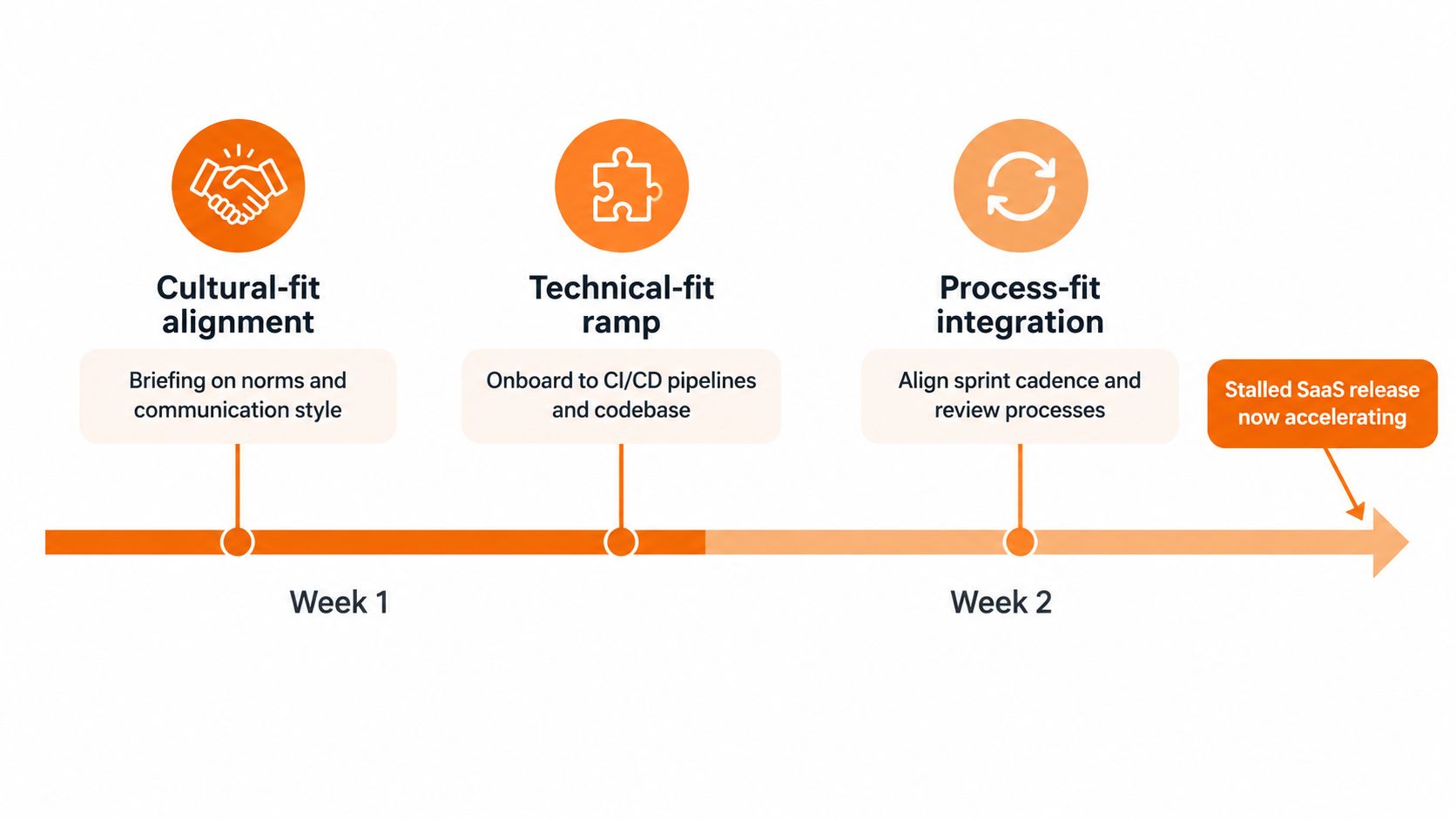
Use a demo-led kickoff in the first days. The pod should explain the product problem, current release state, known risks, and its first proposed slice back to the client. Assign a named delivery lead with end-to-end accountability, including commercial responsibility for the engagement. That ownership signal carries more weight than a generic introduction deck.
Technical ramp-up follows quickly. Provide repository access, architecture context, CI/CD conventions, observability access, and the release definition. The pod should ship a small, safe change or produce evidence that the next change is ready. Process integration then sets backlog ownership, review expectations, escalation routes, and decision documentation.
Nearshore delivery trades some cost arbitrage for closer working overlap and easier collaboration than a more distant offshore model. Do not promise a standard lift. Measure the cycle-time delta before and after integration, compare it with the pre-integration baseline, and report the result to the client.
Nearshore doesn't remove coordination work. It makes disciplined coordination easier to sustain.
Use shared documentation rituals and one backlog owner. Time-zone overlap creates value only when the team records decisions, leaves clear handoff notes, and knows who can make the next call. From week three, run a daily stand-up, weekly roadmap review, and monthly retrospective. Keep the pod aligned with the same evidence and expectations as an internal team.
The hard part is not adding headcount. Integration discipline determines whether the release accelerates or becomes another queue.
Start next Monday by making delivery ownership visible. Choose one release, define the business outcome, and name the person accountable for moving both. A 90-day plan works when it changes decisions and delivery behaviour, not when it produces another transformation document.
Name a delivery owner with authority to escalate, adjust scope, and change the plan. Audit the dashboard against lead time for changes, deployment frequency, change failure rate, and time to restore service. Remove metrics that cannot be connected to a customer or business result.
Outcome check: the team can state what it is shipping, who owns the result, where work is waiting, and which risks require a decision.
Run one squad through a tight Agile loop supported by CI/CD gates. Set clear acceptance criteria, split work into small slices, automate checks, use feature flags where appropriate, and review releases through evidence. Instrument lead time and change failure rate. Cancel meetings that do not produce a decision, remove a blocker, or change the commitment.
The founder should see a smaller commitment, a clearer release path, and fewer unresolved dependencies. The standard is useful work finished predictably, not a process that merely appears mature.
Pilot a nearshore pod against the hardest release on the roadmap. Test cultural fit through real delivery scenarios, use AI-assisted vetting to support evidence-based selection, and give the pod a named owner from its first day. Compare cycle time with the previous operating pattern, then document the practices that improved delivery.
Outcome check: the organisation has a repeatable delivery playbook, a tested team model, and a release path that can handle its next difficult commitment.
Use the operating cadence deliberately:
The UK government's delivery guidance supports measurable baselines. The Digital, Data and Technology Playbook calls for benchmarking deliverables such as cost, schedule, emissions, and agreed outcomes during business-case development. The lesson applies to SaaS teams: compare forecasts with actual performance, then use the difference to change a decision.
Public-sector evidence also shows why risk governance requires more than status tracking. The IPA defines a Delivery Confidence Assessment as the likelihood that a project will deliver its objectives to time and cost. In the 2019-20 assessment, projects in the Government Major Projects Portfolio received green, amber, and red ratings, with amber representing the largest group, as reported in the IPA major projects assessment. The practical point is clear: delivery owners need active risk management, not passive reporting.
Pick one number on the dashboard, own it, and move it inside 90 days.
/ about the author
Written by the RITE NRG editorial team — the architects, engineers and delivery leads who build and operate AI-era software for our clients.
Strategy & Transformation
A practical, finance-ready framework for comparing AI and modernization investment with the current-state cost, realistic benefits, delivery risk and time to value.
AI Consulting & Automation
A practical framework for choosing and deploying transport or logistics AI agents around real exceptions, reliable data and controlled operational authority.
Industry Solutions
A practical roadmap for improving manufacturing systems and introducing AI without destabilising production, data integrity or operational control.
More guidance: all insights articles
We can help you apply this thinking to the systems and teams you actually have.