

Strategy & Transformation
How to Calculate ROI for AI and Software Modernization
A practical, finance-ready framework for comparing AI and modernization investment with the current-state cost, realistic benefits, delivery risk and time to value.
operationalwrocław--:-- cet
∕ insights / system-integration-challenges.md
System Integration Challenges
Cut through the noise on system integration challenges. Learn root causes, real patterns, and how senior-led teams ship integrations that actually work
>_article.meta
Two hours before a customer portal launch, the CTO learns that orders are reaching the new ERP, but the CRM has no matching record for a large share of customer accounts. Both systems contain a customer identifier. Both teams insist their data is correct. The launch plan says “integration complete,” yet nobody can explain which system owns identity, what happens when records conflict, or who approves a schema change.
That isn't a small defect waiting for a developer to patch. It's a business problem. Sales may lose account history, finance may process orders against incomplete records, support may see a different customer than the portal, and leadership may discover the issue only after customers report it. The cost appears as delayed launch decisions, manual reconciliation, operational risk, and engineering capacity pulled away from product work.
Most system integration challenges surface as disagreement before they surface as errors. A request can succeed technically while the receiving system interprets the payload differently. A field can exist in both platforms while its ownership remains undefined. A vendor can maintain an API that passes basic tests while changing the behavior your workflow depends on.
The practical question isn't whether two systems can exchange data. It's whether the business can prove that the exchange is complete, trusted, observable, and owned.
The CTO calls the engineering lead. The engineering lead checks the message queue and finds no obvious outage. Requests are returning successful responses, records are being created, and the dashboards are green. The problem appears only when someone compares the portal's account list with the CRM's account list.
The mismatch comes from identity rules. The portal accepts a customer created during checkout. The CRM requires an account created through a sales workflow. One system treats an email address as sufficient. The other combines email, company name, and an internal account number. The integration didn't fail at the transport layer. It failed at the meaning layer.

Practical rule: A successful API response proves delivery. It doesn't prove that the receiving system accepted the business meaning.
This pattern repeats across orders, suppliers, products, employees, and payments. A finance team may treat a tax code as authoritative while an e-commerce team overwrites it from a catalog feed. A warehouse may publish inventory in batches while the storefront assumes every update is immediate. A legacy platform may truncate a value that a modern service considers mandatory.
The failure usually started months earlier, during a design meeting where each team described its own workflow but nobody wrote the shared contract. The integration team translated fields, the product team approved a happy-path demo, and operations inherited the unresolved exceptions. By launch day, the technical connection is visible, but the operating agreement is missing.
That's why leaders should measure integration as an operating capability, not a completed ticket. Real-time synchronization, manual-work reduction, data-quality exceptions, contract coverage, and named ownership tell you more than the number of endpoints connected. SAPinsider's 2025 survey found that only 18% of organizations reported fully integrated systems with real-time data flow, while 40% still used manual processes and 9% remained heavily siloed (SAPinsider's enterprise integration research).
The CTO in this scenario doesn't need another connector. They need a decision on customer identity, an accountable owner, an observable contract, and a release process that catches disagreement before the portal opens.
A leadership team needs a shared vocabulary before it can make good trade-offs. I use five categories to triage blockers. The categories overlap, but they point to different decisions, owners, and remedies.
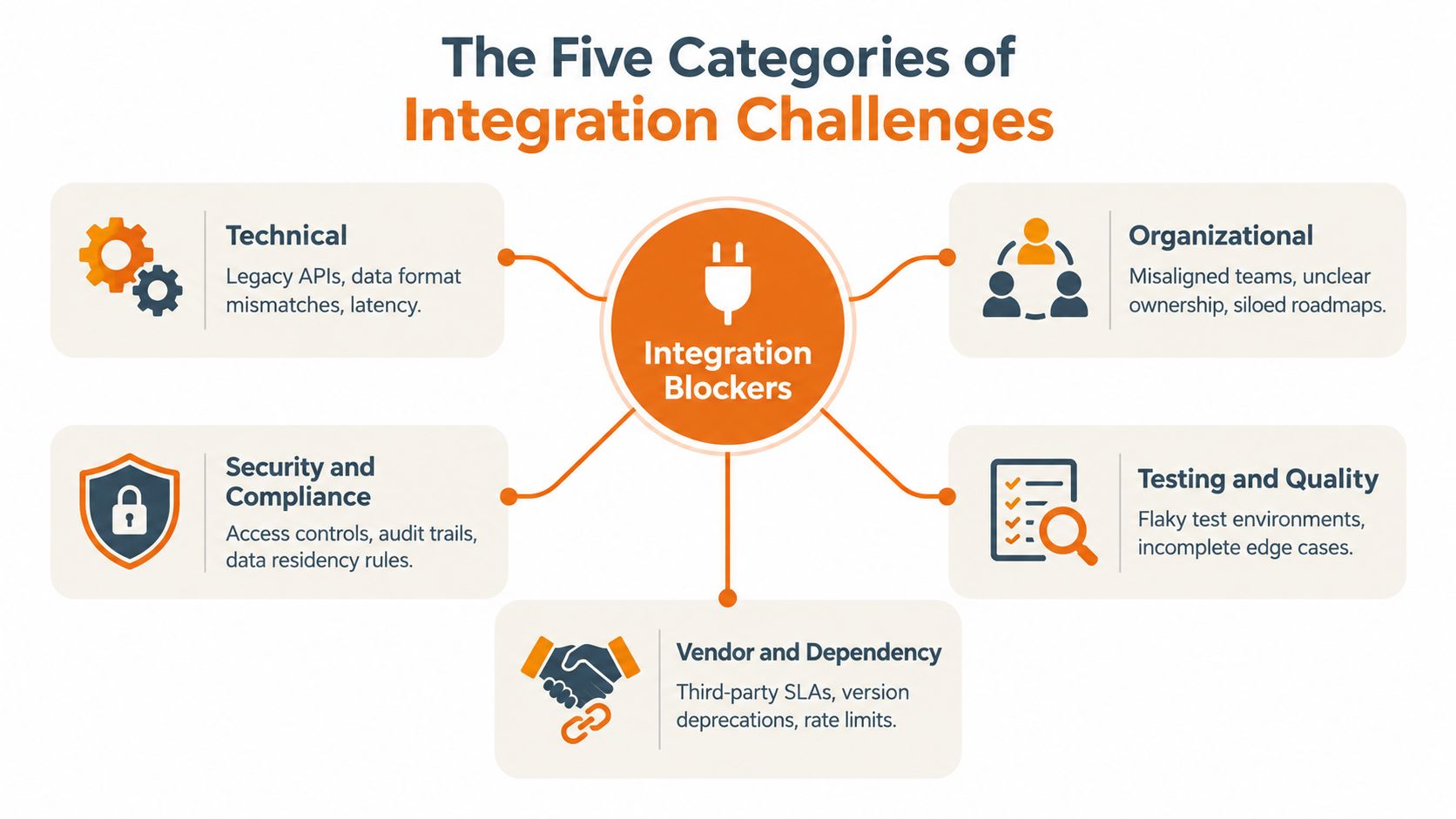
Technical challenges concern interfaces, protocols, data models, latency, resilience, and compatibility. The common production failure is partial or corrupted synchronization. For example, a legacy order service may expose a flat file while the new platform expects nested JSON, leaving engineers to build transformation logic that silently drops optional fields.
A data-format mismatch isn't cosmetic. Older platforms often require transformation, mapping, normalization, and validation before their data can safely enter modern schemas (legacy data integration strategies).
Organizational challenges arise when teams share a workflow but not ownership, priorities, or definitions. The failure mode is drift. A CRM team changes the meaning of “active customer,” finance updates its validation rules, and neither team tells the integration owner.
A concrete example is undocumented field ownership between CRM and finance. Both teams edit the same value, and the last write wins. The code behaves exactly as designed, but the business process becomes unreliable.
This category covers identity, authorization, data handling, auditability, retention, and regulatory constraints. The production failure is usually excessive access or invisible exposure. A service account receives broad permissions because the first implementation needed speed, then keeps those permissions long after the workflow expands.
Treating security as a launch review creates predictable rework. The boundary should be designed with the data flow, not inspected after the build.
Testing challenges appear when teams test isolated requests instead of business contracts and failure paths. The failure mode is a green pipeline followed by a broken workflow. A missing contract test between two vendor APIs won't necessarily stop deployment, but it can break order confirmation when a response field changes.
The test question is simple: can the team prove behavior when records are duplicated, delayed, malformed, rejected, replayed, or processed out of order?
Delivery challenges involve sequencing, staffing, vendor handoffs, release coordination, and external dependencies. The failure mode is late discovery. One team finishes its component, another is still waiting for access, and a third has already committed to a launch date.
Vendor and dependency risk deserves explicit attention. Third-party SLAs, version deprecations, rate limits, and unclear escalation paths can turn a local issue into a company-wide incident. When a blocker appears, name the category first. Then assign the person who can remove it, not merely the person who first reported it.
Technical design still matters. It just isn't the whole problem. The most expensive failures usually come from a small set of recurring root causes that teams keep treating as surprising exceptions.
Legacy platforms often don't expose standard APIs, and enterprise integration programs may need a large collection of ETL jobs to move data into a target application. IBM describes additional failure sources, including missing source metadata and inconsistent supplier or customer reference data across ERP, CRM, and SRM systems (IBM's integration challenges overview).
| Root Cause | Production Failure Mode | Fix That Holds Up |
|---|---|---|
| Undocumented API changes | A provider changes a response field or validation rule, and downstream processing fails without a clear deployment event. | Pin schemas and API versions, validate compatibility in CI, and require a published change-intake process. |
| Implicit type coercion | A string, number, date, or null value converts differently across platforms, producing rejected or misleading records. | Define explicit schemas, reject invalid payloads early, and test boundary values rather than relying on runtime conversion. |
| Batch and event-driven mismatch | One system expects periodic complete files while another emits small real-time events, causing stale or duplicated state. | Define freshness requirements first, then use reconciliation jobs alongside events where completeness matters. |
| Synchronous calls over slow systems | A customer-facing request waits on a legacy dependency that can't absorb modern latency or traffic patterns. | Move noncritical work to asynchronous queues, set timeouts, use idempotency keys, and design backpressure-aware consumers. |
| Shared transformation logic | Several integrations implement slightly different versions of the same mapping, creating inconsistent business outcomes. | Centralize canonical models and transformation rules where reuse is real, while keeping system-specific adapters at the edge. |
Canonical data models are worth the investment when several systems exchange the same business objects. They create a stable internal language for customers, orders, products, or suppliers. They don't mean every system must adopt one universal schema. They mean the integration layer stops copying one platform's quirks into every other platform.
For legacy replacement, the strangler pattern remains useful. Put a controlled interface around the old capability, route one workflow at a time to the new service, and keep rollback possible. A full rewrite is rarely a virtue when the business can't tolerate a big-bang cutover.
Don't build a platform abstraction for a problem you haven't observed. A small point-to-point connection can be appropriate for a low-risk, isolated workflow. It becomes technical debt when teams add more connections without ownership, observability, or a migration path. For architecture decisions, pair these patterns with a broader cloud-native architecture perspective, especially when deciding where state, events, and compatibility boundaries should live.
Performance deserves the same discipline. A queue doesn't fix an overloaded consumer by itself. Retries don't fix non-idempotent writes. Caching doesn't fix unclear ownership. Every resilience mechanism must answer what happens to the record, who can replay it, and how operations knows whether the business state is correct.
Better APIs won't rescue an integration that nobody owns. They can make the connection cleaner, but they can't decide which system is authoritative, approve a breaking change, or resolve a dispute between product and finance.
Enterprise estates make this problem visible. One benchmark reports an average of 897 applications per organization, with only about 28% to 29% connected, leaving roughly 71% disconnected (Oneio's state of integration benchmark). At that scale, every undocumented assumption becomes a future dependency.
First, the system of record is undefined. Teams copy data between platforms without stating where the authoritative value originates. When a customer changes an address, nobody knows whether the CRM, billing platform, commerce system, or master-data service should win.
Second, schema change has no contract. Developers discover field changes through failing tests or production alerts. A contract should specify ownership, compatibility expectations, deprecation notice, validation rules, and the person authorized to approve exceptions.
Third, no single architect owns the seam. Each vendor delivers its assigned component, while the client assumes someone else is checking the complete workflow. That gap is where integration quality disappears.
Name one accountable integration owner. Give that person authority to reject an unsafe release, demand test evidence, and escalate unresolved decisions. Publish an intake process for API and schema changes. Create an escalation path that works without personal favors or a late-night phone call to the one engineer who knows the history.
The accountable owner must own the outcome, not just the integration repository.
The political failure mode is familiar. A vendor ships its product first because its contract rewards feature delivery. The client then discovers that integration requires undocumented behavior, custom mapping, or a separate commercial decision. “The endpoint works” becomes the defense, even though the business workflow doesn't.
Use a weekly integration sync during active delivery, with system owners, product, security, operations, and external partners present. Review contract changes, failed messages, unresolved mapping decisions, and upcoming releases. That cadence is boring by design. It catches drift while the cost of correction is still manageable.
A senior partner should challenge the plan when ownership is vague. Extreme Ownership means the team doesn't hide behind the statement “that belongs to the vendor.” It identifies the dependency, assigns the decision, communicates the risk plainly, and stays accountable until the full workflow works in production.
Security, compliance, and QA should form one verification loop. Separating them into three checklists invites gaps because each team validates its own artifact while nobody validates the complete data journey.
Start at the integration boundary. Threat-model the systems, queues, APIs, files, identities, and operational tools involved. Then classify the data crossing the boundary. A payload containing customer details needs different handling from an event containing only an internal status, and logs, traces, dead-letter queues, and test fixtures must follow the classification.
Three failure patterns deserve immediate attention:
A test that runs only in staging isn't enough if production has different permissions, data volume, network paths, or vendor behavior. Use representative fixtures, controlled production checks, and clear rollback procedures. The team must know not only that an integration failed, but whether the business state remains trustworthy.
That is the standard behind software quality assurance practices. Compliance isn't paperwork stored for an auditor. It's a test the organization should be able to pass on demand, with evidence that controls work when the workflow is under pressure.
Two teams can face the same schema change and produce completely different outcomes. The deciding factor is usually not the programming language or integration platform. It's the operating model around the handoff.
A US product team sends an integration package to an offshore body shop. The package contains an old API specification, a few sample payloads, and a deadline. No client architect joins the design sessions, no shared contract is reviewed, and the vendor's success metric is code completion.
The vendor implements the stale specification. The provider changes a field before launch, and the client's monitoring catches only transport errors. Schema drift reaches production, records stop matching, and the client discovers the problem through operations. Engineers rewrite a large portion of the integration while the product team spends the quarter on recovery instead of roadmap delivery.
The failure wasn't caused by geography. It was caused by fragmented accountability, weak context transfer, and incentives that rewarded delivery of a component rather than a working business outcome.
A nearshore partner joins during discovery. Client and partner architects review identity, ownership, failure handling, security, and release sequencing together. They publish a versioned contract, add compatibility tests, and review vendor changes in a weekly integration sync.
When a provider alters a response shape, the team sees the contract failure before release. The partner raises the risk, proposes a compatible adapter, documents the decision, and coordinates the rollout with the client owner. The same technical problem becomes a controlled change instead of a production incident.
For teams evaluating external capacity, a practical resource such as hire developers in brazil can help compare hiring models, but location alone won't solve integration risk. Ask how the partner handles architecture decisions, documentation, escalation, testing ownership, and post-launch operations.
A nearshore model works when the partner is embedded early enough to understand the business and senior enough to challenge unsafe assumptions. The partner should own delivery responsibilities while the client retains clear business authority. Both sides need access to the same decisions, environments, contracts, and operating metrics.
Use nearshore software development guidance to assess collaboration structure, but judge any partner by evidence. Can it show how it records decisions? Who responds when a vendor changes an API? Who owns the runbook after launch? Who stays engaged when the integration is technically deployed but operationally wrong?
That is the difference between outsourcing tasks and extending accountability.
Run the next quarter as an operating reset, not a broad “modernization” initiative. The aim is to expose risk, stabilize the flows that matter, and create evidence for the next investment decision.
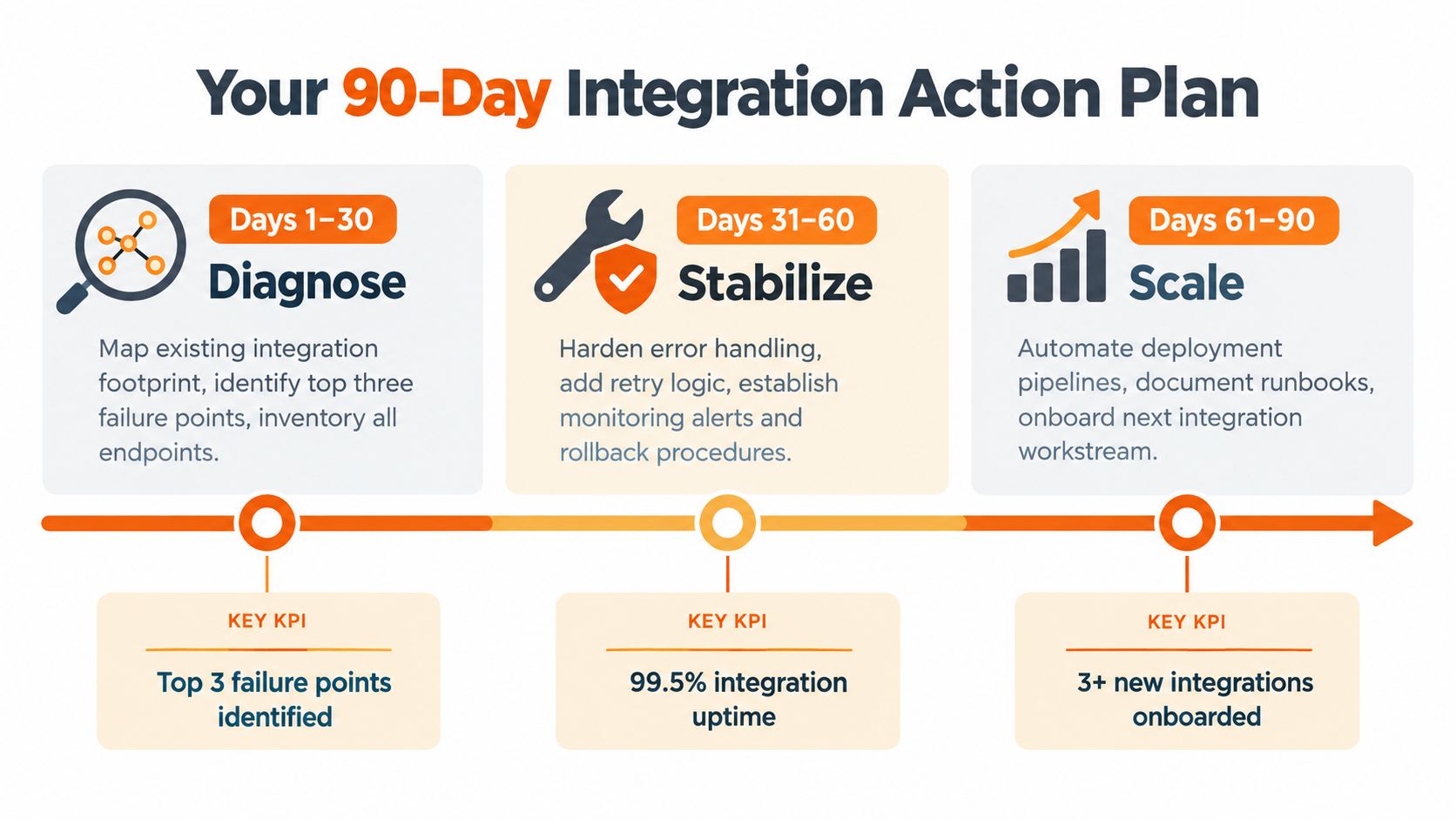
Map applications, endpoints, data owners, contracts, queues, batch jobs, manual workarounds, and vendor dependencies. Don't trust the architecture diagram alone. Compare it with production traffic, deployment repositories, support tickets, and the spreadsheets people use to repair failed records.
Identify the top three failure risks by business impact. Assign one accountable owner to every integration, even if that owner delegates implementation. Record the system of record for each critical data object and flag every flow where the answer is disputed.
Retire zombie endpoints, remove shadow integrations, document unsupported contracts, and fix the highest-risk failure paths. Add explicit schemas, idempotency, retry limits, dead-letter handling, alerts, and rollback procedures where they are missing.
Ship one canonical fix per challenge category. That might mean an ownership decision, a least-privilege identity change, a contract test suite, a vendor escalation rule, or a delivery checkpoint. Don't launch a grand platform program before proving that focused controls improve the flows people depend on.
Track maturity monthly using signals that leadership can understand:
Use this scorecard to make the hard decision. Keep strategic, differentiating integrations in-house when the business needs direct control and has the capability to operate them. Move integration work to a partner such as Rite NRG when senior architecture, delivery capacity, or modernization expertise is the constraint. Retire integrations that duplicate capability, lack a legitimate owner, or preserve a workflow the business no longer needs.
Leadership should put these questions on the next planning slate:
A useful discussion of AI-native production environments makes the standard explicit: AI acceleration still requires prompt standards, testing standards, quality gates, agent governance, and broader product and runtime controls (AI-native production standards). Agentic AI can speed analysis, mapping, test generation, documentation, and migration work. It doesn't own architecture, data decisions, security, or production quality. Senior engineers still do.
Your next step is practical: bring the integration owners, product leaders, security, operations, and key vendors into one working session, map the top three risks, and assign decisions before another launch depends on undocumented contracts.
Rite NRG helps companies assess architecture, data, integrations, security, testing, observability, and delivery risk, then build and operate the resulting systems with senior engineering accountability and AI-assisted execution. If your system integration challenges are delaying launches or consuming product capacity, visit Rite NRG to start a focused conversation about the next 90 days.
/ about the author
Written by the RITE NRG editorial team — the architects, engineers and delivery leads who build and operate AI-era software for our clients.
Strategy & Transformation
A practical, finance-ready framework for comparing AI and modernization investment with the current-state cost, realistic benefits, delivery risk and time to value.
AI Consulting & Automation
A practical framework for choosing and deploying transport or logistics AI agents around real exceptions, reliable data and controlled operational authority.
Industry Solutions
A practical roadmap for improving manufacturing systems and introducing AI without destabilising production, data integrity or operational control.
More guidance: all insights articles
Tell us about the system or idea behind this article. We tell you honestly if it is a fit — and what a fixed-scope delivery could look like.