
Strategy & Transformation
How to Calculate ROI for AI and Software Modernization
A practical, finance-ready framework for comparing AI and modernization investment with the current-state cost, realistic benefits, delivery risk and time to value.
operationalwrocław--:-- cet
∕ insights / nearshore-software-development.md
Nearshore Software Development
Discover how nearshore software development accelerates SaaS delivery. Compare costs, evaluate AI-native partners, and build predictable engineering teams.
>_article.meta
A SaaS roadmap rarely fails because engineers can't write code. It fails because the team can't make decisions quickly enough, feedback arrives too late, quality problems surface after release, or critical specialists aren't available when the product needs them. Founders then pay twice, first for development, and again for delay, rework, lost momentum, and technical debt.
The popular advice says to choose the cheapest outsourcing destination and compare hourly rates. That's incomplete. Nearshore software development should be evaluated as a delivery system, not a labor marketplace. The right team gives you overlapping working hours, senior technical judgment, faster feedback, and clear accountability. AI can increase that advantage, but only when experienced engineers remain responsible for the result.
Most SaaS leaders still approach outsourcing with a cost-cutting question: How cheaply can we add developers? That question produces the wrong shortlist. A lower rate means little if every product decision takes a day to resolve, every sprint requires clarification, and rushed code creates a maintenance burden for your internal team.
Nearshore software development is more useful when you treat it as a capacity and velocity multiplier. A nearby team can join discovery, challenge an unclear requirement, review a design with your product manager, and fix a release issue while your own team is still working. That operating proximity helps solve the business problems that hold SaaS companies back, including local talent shortages, uneven sprint velocity, and the cost of building an entire internal R&D function before product-market fit is secure.
A useful introduction to the model is this nearshore development guide 2023, particularly for founders who need to understand the difference between geographic proximity and simple offshore staffing. The distinction matters because the engagement model determines how much management work stays with you.
Software development represents 64% of outsourced services worldwide, according to the industry compilation from HatchWorks on nearshore software development statistics. That scale reflects a real business need, but it doesn't prove that every outsourced team delivers value. You still need people who understand your commercial priorities, not just your backlog.
A nearshore partner earns its place by taking responsibility for outcomes. That means identifying an architectural risk before implementation, escalating a dependency before it blocks a sprint, and explaining what a proposed shortcut will cost later. The team doesn't wait for a ticket to become a crisis.
Practical rule: Buy reduced decision latency, not merely reduced engineering cost.
Your internal team should remain focused on product strategy, customer insight, and the decisions only your company can make. A capable nearshore group can expand execution capacity while preserving architectural integrity, provided you define ownership from the start. Your outsourced web development strategy should therefore connect delivery work to business outcomes such as launch readiness, customer adoption, operational resilience, or revenue-critical capability.
The three sourcing models solve different problems. Onshore delivery places the team in the same country, often with the easiest communication and strongest proximity, but it usually carries the highest employment and delivery cost. Offshore delivery can access a broad global talent pool and lower hourly rates, yet large time-zone gaps can slow decisions and make collaboration more sequential.
Nearshore delivery sits between those models. It means working with a geographically close country or region that shares most of the client's working day. For U.S. buyers, Latin America is a common nearshore region, with often one to three hours of time-zone overlap and stronger English communication than far-shore models, as described in FullStack Labs' comparison of nearshore and offshore outsourcing.
| Model | Cost Profile | Time-Zone Overlap | Best Use Case |
|---|---|---|---|
| Onshore | Highest local delivery cost | Usually complete overlap | Sensitive work requiring close proximity, direct hiring, or intensive stakeholder access |
| Offshore | Lowest potential hourly cost | Often limited | Clearly specified work that can progress asynchronously with fewer live decisions |
| Nearshore | Lower than comparable onshore delivery, with proximity benefits | Europe commonly provides 4 to 8 hours of overlap, according to Intelvision's European nearshore guide | Product development, modernization, discovery, and work requiring frequent collaboration |
The operational difference appears inside the sprint. A product manager can clarify acceptance criteria during the team's working day. A designer and engineer can review an interaction before implementation hardens around the wrong assumption. A production bug found during testing can be investigated without automatically waiting for the next morning.
A discovery-heavy MVP usually benefits from nearshore or onshore collaboration because requirements are still forming. The team needs rapid conversation, not a rigid handoff process. Nearshore is often the strongest balance when the SaaS founder needs product judgment and execution capacity without creating a full local engineering center.
A legacy modernization program requires deeper technical governance. The buyer should prioritize architecture, migration sequencing, security, and knowledge transfer over the lowest rate. Nearshore works well when internal stakeholders must make frequent decisions about risk, dependencies, and acceptable service disruption.
An independent, well-documented component can fit offshore delivery if interfaces, quality standards, and ownership are explicit. Don't use that model for a product area that changes every week and depends on constant input from customers, product leaders, and operations.
The right question isn't “Which region is cheapest?” It's “Which operating model lets this workload move without expensive waiting?”
Hourly rates are only the visible line on the budget. The actual cost includes coordination, product management time, architectural correction, defects, turnover, onboarding, and the cost of postponing a commercial decision. A team that charges less per hour can still produce a more expensive release if it needs repeated clarification or hands work back with hidden quality problems.
Independent reporting places mid-to-senior engineering rates in Poland and Romania at roughly €40 to €80 per hour, while estimating nearshore defect rates at 20% to 30% lower than offshore equivalents in the cited comparison from SectorPunk's European nearshore ranking. The same report estimates that total cost can remain around 50% to 65% of onshore cost when quality-related rework is included. Those figures don't create a universal price card. They show why output value matters more than the first rate a vendor presents.
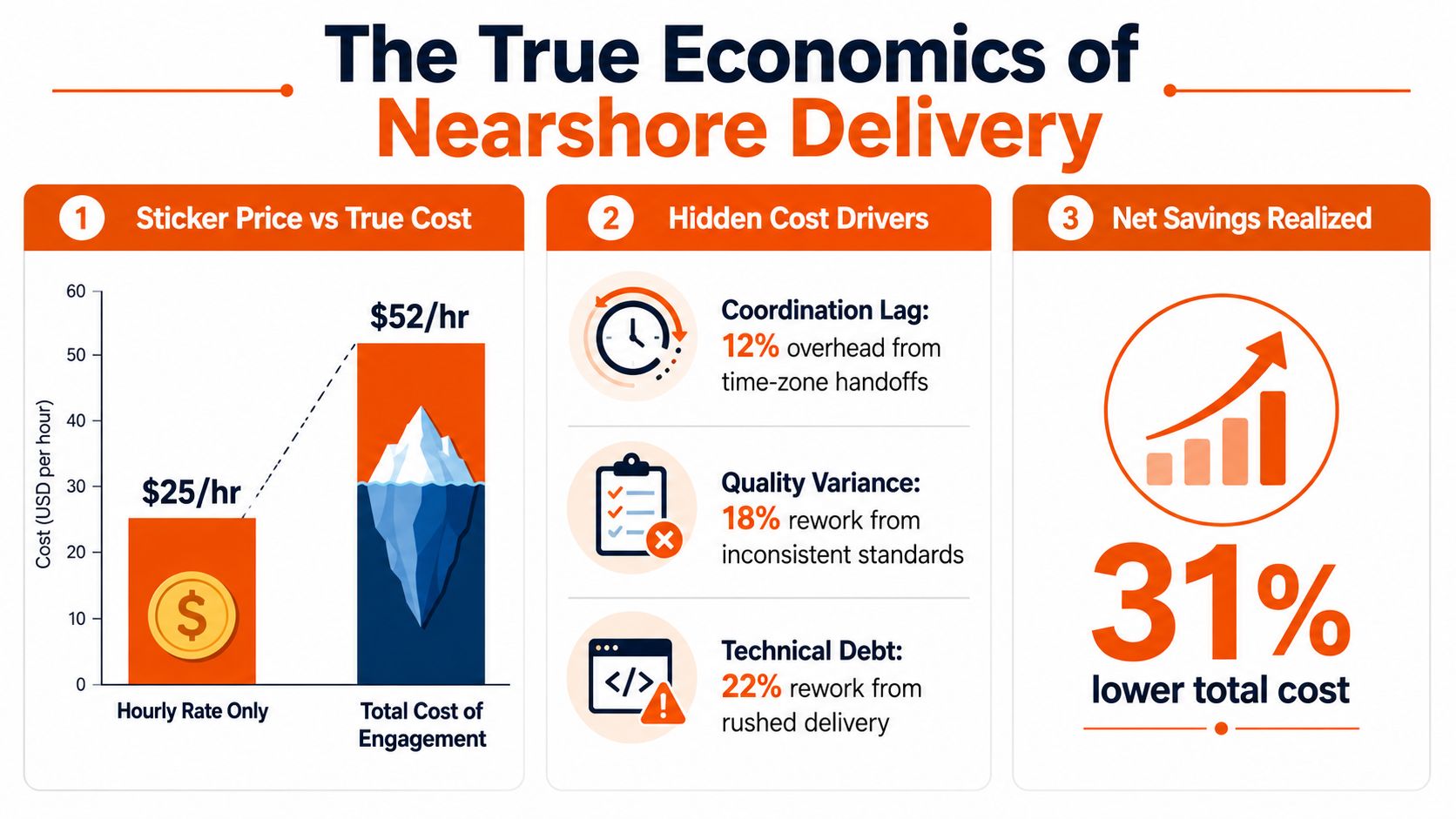
Start with the delivery baseline. Add the time your product manager, CTO, designer, and security lead spend clarifying work or correcting decisions. Then account for rework, delayed releases, production incidents, and the cost of carrying an unfinished capability on the roadmap.
A practical comparison asks four questions:
Nearshore can be slightly more expensive than offshore on an hourly basis and still win on total engagement cost when the work requires tight feedback loops. That applies especially to discovery-heavy MVPs, modernization programs, and products where stakeholders frequently refine requirements. The nearshore development guide from HatchWorks makes this distinction directly, shifting the buying decision from “cheap or expensive” to the operating model that minimizes delivery risk.
For U.S. buyers, one 2026 economics guide estimates fully loaded nearshore engineering cost in Latin America at USD 65,000 to USD 72,000 per year, compared with USD 165,000 to USD 175,000 for a comparable U.S. hire. It also lists nearshore architecture rates around USD 72 to USD 96 per hour, versus USD 140 to USD 190 onshore, in FullStack Labs' nearshore engineering economics analysis. Treat those figures as market reference points, not as a substitute for a workload-specific financial model.
AI changes the economics of technology delivery. It can accelerate code exploration, test generation, documentation, migration analysis, and repetitive implementation. It doesn't remove the engineering obligations that determine whether a SaaS product remains secure, maintainable, and commercially dependable.
A nearshore team using agentic AI should still put named senior engineers in charge of architecture, data design, integrations, security, testing, observability, and production quality. AI agents can propose an implementation. They can't own the consequences of a poor data boundary, an unsafe permission model, an unreviewed dependency, or a migration that damages customer trust.
The risk isn't AI itself. The risk is using AI to hide weak engineering governance. A partner that celebrates generated code but can't explain its review controls is offering speed without stewardship. The practical discipline described in AI coding tools and AI-native software delivery is to use AI throughout the lifecycle while keeping senior accountability human and explicit.

Ask a prospective partner to demonstrate its delivery controls, not just its preferred AI tools. You need to see how the team records architectural decisions, protects sensitive data, reviews generated code, tests agent-produced changes, and prevents unapproved access to production systems.
Look for these behaviors:
The #riteway method starts with Extreme Ownership, high energy, proactive problem-solving, transparent communication, and senior engineering accountability. In practice, that means the team raises a risk while it can still be managed, moves a blocked decision to the right person, and stays responsible for the complete result instead of claiming that a problem belongs to another role.
That mindset prevents “vibe coding” from becoming the delivery strategy. Agentic AI should make a disciplined team faster and more efficient. It shouldn't make an undisciplined process harder to inspect.
A vendor can show you resumes. A strategic partner can explain how it will protect your product when requirements change, a migration exposes hidden dependencies, or a release threatens a commercial commitment. Evaluate the second capability, not just the first.
Use interviews to test behavior under pressure. Don't ask only which frameworks the team knows. Ask who makes architecture decisions, who speaks to the client when delivery slips, how the partner handles an inherited codebase, and what the client owns when the engagement ends.
Technical depth comes first. Ask to meet the delivery architect who would work on the product. Request a discussion about your hardest constraint, whether that's multi-tenant data, legacy integration, regulated information, reliability, or a difficult migration.
Ownership mindset appears in the questions the partner asks you. Strong leaders challenge an unrealistic date, identify missing decisions, and propose a path forward. Order takers accept an ambiguous backlog and wait for instructions.
Communication cadence should be visible before signing. Request a sample status report that covers progress, risks, decisions, dependencies, and changes. A polished progress percentage isn't enough if it doesn't tell you what needs executive attention.
Process maturity means the partner can show its software development lifecycle, quality standards, release controls, documentation practice, and knowledge-transfer plan. Fixed-scope work needs especially clear assumptions and change control.
Cultural fit isn't about casual conversation. It means your teams can disagree productively, make decisions without politics, and remain aligned on long-term ownership. Use this guide to choosing a modern software development partner to structure the evaluation around delivery capability rather than sales language.
Ask for references that resemble your situation. A company that has built greenfield applications may not be the right choice for a vendor transition. A team skilled in staff augmentation may not know how to take outcome accountability for a fixed-scope release. The partner should explain its boundaries clearly instead of promising every capability.
A strong evaluation ends with a small, well-defined working exercise. Give the team a real product constraint and ask for a delivery approach, risk register, technical outline, and decision log. You'll learn more from how they reason than from a generic capabilities deck.
Nearshore teams don't integrate through goodwill alone. They integrate through clear authority, repeatable communication, and a shared definition of done. Without those mechanisms, the client becomes the unofficial project manager, and senior engineers spend their time translating status instead of improving the product.
Start by deciding whether you need staff augmentation or outcome-based consulting. Augmentation adds people under your management. Consulting assigns responsibility for architectural decisions, delivery execution, and knowledge transfer, as described in Keyhole Software's guide to software development consulting. Neither model is automatically better, but confusing them creates accountability gaps.
Name an executive sponsor who can resolve commercial and priority conflicts. Create a technical steering group with the authority to decide architecture, security, platform, and operational matters. Keep the group small enough to act.
Use a weekly or bi-weekly outcome review to discuss what changed in business terms, what threatens the target, and which decisions need action. Separate that meeting from daily delivery coordination. Engineers need a working channel for implementation questions, while executives need a concise view of outcomes and risk.
A practical governance design includes:
Use Jira, Linear, or an equivalent tracker for commitments, not as a substitute for judgment. Keep architectural decisions in a searchable system such as Confluence or a repository decision log. Record important demonstrations and technical explanations so new contributors don't depend on private conversations.
Nearshore proximity gives you live collaboration, but don't fill every overlapping hour with meetings. Combine focused workshops with concise written updates covering completed work, next decisions, risks, and requests. That rhythm creates transparency without turning the team into a calendar-management exercise.
Knowledge transfer should happen continuously. Pair internal and external engineers on important decisions, document deployment and recovery procedures, and make repository and infrastructure ownership explicit. Your company should be able to operate the product after the engagement changes, whether you continue with the partner, bring work in-house, or build a new R&D center.
Start with the bottleneck, not the staffing request. Write down the business outcome that delivery must support, the decisions that currently cause delay, the technical constraints that can't move, and the ownership your internal team will retain.
Then choose the engagement shape:
Run discovery before committing to a large build. Confirm the target users, measurable business outcome, architecture direction, delivery risks, quality gates, release plan, and knowledge-transfer requirements. Start with the smallest engagement that proves the team can make decisions, surface risk, and deliver production-quality work.
Nearshore software development becomes a strategic asset when the partner owns more than assigned tasks. It gives SaaS leaders access to capacity, proximity, and senior judgment while AI agents accelerate the work under controlled engineering standards. Audit your current delivery bottlenecks, identify the cost of delay, and define the first outcome a partner must own.
Rite NRG provides AI-native software consulting, senior nearshore engineering teams, modernization, fixed-scope delivery, and managed technology services for SaaS companies and other businesses with business-critical platforms. Visit Rite NRG to discuss your delivery bottleneck and choose a practical path toward faster, more accountable engineering.
/ about the author
Written by the RITE NRG editorial team — the architects, engineers and delivery leads who build and operate AI-era software for our clients.
Strategy & Transformation
A practical, finance-ready framework for comparing AI and modernization investment with the current-state cost, realistic benefits, delivery risk and time to value.
AI Consulting & Automation
A practical framework for choosing and deploying transport or logistics AI agents around real exceptions, reliable data and controlled operational authority.
Industry Solutions
A practical roadmap for improving manufacturing systems and introducing AI without destabilising production, data integrity or operational control.
More guidance: all insights articles
We can help you apply this thinking to the systems and teams you actually have.