

Strategy & Transformation
How to Calculate ROI for AI and Software Modernization
A practical, finance-ready framework for comparing AI and modernization investment with the current-state cost, realistic benefits, delivery risk and time to value.
operationalwrocław--:-- cet
∕ insights / outsourced-web-development.md
Outsourced Web Development
Master outsourced web development with proven strategies for faster delivery and predictable outcomes. Learn models, vendor selection, and nearshore advantages.
>_article.meta
Your SaaS roadmap is probably already under pressure. Product opportunities keep arriving, investors want visible progress, customers expect a reliable experience, and your internal team is trying to ship without compromising quality. The obvious answer seems to be hiring more engineers, but recruiting takes time, senior talent is scarce, and a rushed hire can create more coordination work than delivery capacity.
Outsourced web development can solve that problem, but only when you treat it as an engineering partnership rather than a cheaper pair of hands. The right partner increases delivery capacity, shortens feedback loops, protects production quality, and helps you make better technical decisions. The wrong one creates rework, dependency, and a second management problem.
A founder facing an MVP deadline usually has two uncomfortable choices. Build with a small internal team and risk missing the market window, or bring in external engineers and risk losing control over product quality. Neither choice is guaranteed safe. The outcome depends on whether the external team is accountable for a complete business result or merely assigned a backlog of tickets.
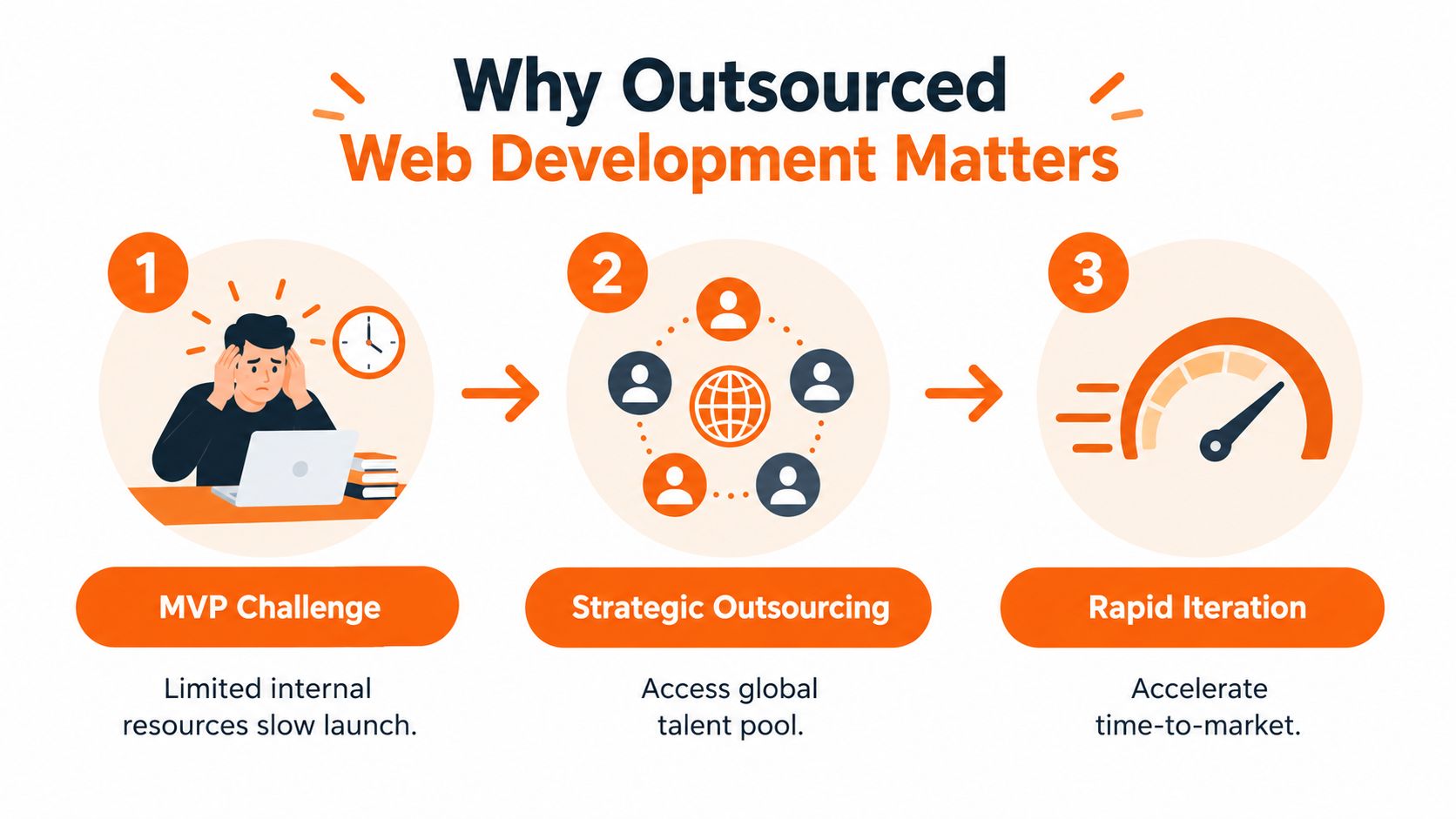
A strategic partner changes the equation. Your product manager can focus on customer priorities, your founder can focus on distribution and fundraising, and senior engineers can establish the architecture, delivery process, and quality controls needed to make the product commercially usable. The external team doesn't replace internal ownership. It extends your capacity while preserving a clear line of responsibility.
The market context supports this shift. The global web development market is projected to grow from USD 61.2 billion in 2025 to about USD 150.5 billion by 2035, according to Market.us's web development market estimate. The same estimate places North America's 2025 share above 40.8%, equivalent to roughly USD 24.95 billion in revenue. Demand is substantial, but access to capable engineering capacity remains a practical constraint for many SaaS companies.
Outsourcing is expanding alongside that demand. The outsourced web development services market is forecast to rise from USD 1.6 billion in 2025 to about USD 3.0 billion by 2035, a projected 6.3% CAGR and an absolute increase of roughly USD 1.4 billion, as reported by Future Market Insights. That forecast also describes monthly outsourced workloads increasing from 1.6 million to 2.2 million service hours by 2030, indicating growth in delivery volume as well as spending.
Fast delivery only matters if the release can support real users, changing requirements, and future product investment. A partner that produces a demo quickly but leaves weak testing, unclear ownership, or fragile integrations behind hasn't accelerated your business. They've transferred the cost into the next quarter.
The #riteway approach starts with Extreme Ownership. Architects and engineers identify risks early, communicate constraints directly, and take responsibility for the complete result. High energy matters too, but it must be paired with disciplined decisions, transparent status reporting, and proactive problem-solving. The team should tell you when a requested feature threatens the release, not quietly accept the work and explain the delay later.
Practical rule: outsource execution capacity, not accountability.
Treat outsourced web development as a growth lever when the partner can connect engineering decisions to business outcomes. That means faster validated releases, increased capacity for roadmap work, improved quality, and lower delivery risk. Coding is the means. The value is a product that reaches customers sooner and remains safe to evolve.
The best outsourcing model depends on how clearly you can define the work, how much control you need, and whether you want external capacity temporarily or as a durable part of your operating model. Founders often select based on price or availability. That's backwards. Start with the ownership model your SaaS business needs.
| Model | Best fit | Main strength | Main risk |
|---|---|---|---|
| Agency partnership | A defined MVP, feature set, or modernization initiative | Clear scope and concentrated delivery ownership | Scope changes can create friction |
| Dedicated team | An evolving product roadmap with sustained engineering demand | Flexible capacity and deeper product context | Requires strong product and technical governance |
| Build-Operate-Transfer | A long-term plan to establish internal engineering capability | Creates a team that can eventually become yours | Transition planning must begin early |
An agency is the right choice when the outcome can be described clearly. Examples include a new web application, a customer portal, a fixed modernization phase, or a production release with agreed acceptance criteria. The agency should own planning, implementation, testing, documentation, and handover, not just provide developers.
This model works well when your internal team can make product decisions but doesn't have enough bandwidth to execute a defined initiative. It works poorly when you expect a fixed price for an uncertain research project or keep changing priorities without revisiting scope.
A dedicated team fits SaaS companies with a continuing roadmap and a need for accumulated product knowledge. The team can include a delivery lead, architect, frontend and backend engineers, QA, and specialist support as the product demands. You gain flexibility, but you also inherit responsibility for prioritization, decision speed, access to stakeholders, and architectural direction.
If you're comparing team extension with broader delivery ownership, this guide to comparing staff augmentation and outsourcing offers useful terminology. For a more detailed distinction between capacity models, review staff augmentation, dedicated teams, and project delivery.
BOT is the strongest option when you want external help establishing a long-term engineering center. The partner recruits, structures, and operates the team while your processes, leadership, and ownership model mature. Later, the team can transfer into your organization under an agreed plan.
BOT isn't a shortcut around governance. Define the future organization, leadership responsibilities, intellectual property ownership, hiring standards, and transition conditions before delivery begins. If you wait until the handover is close, you'll discover that the team depends on vendor-specific processes or undocumented knowledge.
My recommendation is direct. Choose an agency for a bounded outcome, a dedicated team for an evolving roadmap, and BOT when internal capability is the strategic destination. Don't combine models accidentally. A project that becomes staff augmentation by accident often loses accountability, while a dedicated team without product access becomes an expensive ticket queue.
Hourly rates are a procurement metric, not a business case. What matters is the total cost to build, operate, change, secure, and eventually hand over. A lower rate can lose its advantage when unclear requirements create rework, senior people spend their time chasing status, or a departing vendor engineer takes critical context with them.
A study of 26 outsourced projects found hidden costs averaging 190% of total development cost, as documented in the AMCIS project study. That figure is a warning against treating the headline quote as the total investment. It doesn't mean every engagement will carry the same burden. It does mean your evaluation must account for coordination, transition, process fit, and rework before you sign.
Management overhead starts when nobody owns decisions. Your product manager translates requirements, the vendor interprets them, developers make assumptions, and QA discovers mismatches late. Each handoff consumes attention, and the internal team may end up supervising implementation instead of advancing the product.
Rework is more expensive than visible development time because it arrives after a decision has already travelled through design, code, review, and testing. Knowledge transfer creates another bill when documentation is incomplete or team composition changes. Security reviews, production support, release coordination, and vendor replacement also belong in the total cost of ownership.
A useful evaluation includes these questions:
Quality deserves particular attention. A systematic snapshot of software outsourcing challenges identified lack of quality as the second-most significant challenge, with a 33% recurrence rate, according to the software outsourcing challenges study. The practical response is senior engineering governance, explicit acceptance criteria, automated testing, code review standards, security controls, and SLA-driven transition management.
Senior oversight is not overhead. It is the mechanism that keeps outsourced capacity from becoming outsourced risk.
AI changes the economics of delivery by accelerating analysis, code production, testing, documentation, and migration work. It doesn't remove architectural responsibility. Deloitte recommends a prompt engineering center of excellence with reusable prompts, personas, and test libraries in its guidance on software quality in the age of generative AI. That principle applies to outsourced web development too. Agentic AI can make a disciplined team faster, but uncontrolled generation can make technical debt arrive sooner.
Vendor selection should test how a team thinks under pressure, not how polished its sales presentation looks. Ask for evidence of engineering ownership, inspect the proposed delivery process, and make the commercial agreement reflect the quality you expect.
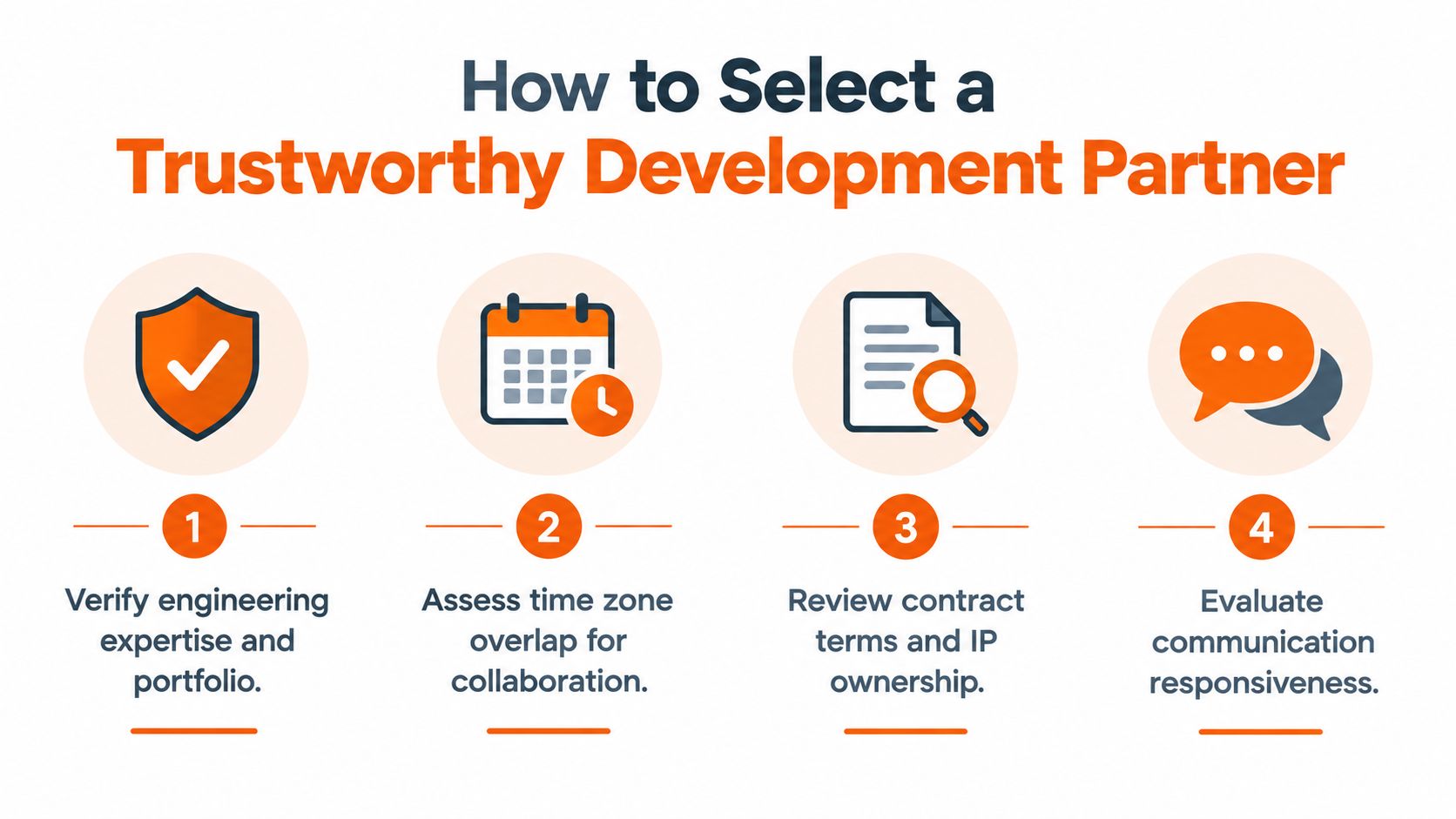
Request a conversation with the architect and delivery lead who would handle your product. Ask them to review a simplified version of your architecture, identify likely risks, and explain what they would validate before writing production code. A trustworthy partner won't pretend every requirement is straightforward.
Review how the team handles:
A portfolio helps, but it isn't enough. Ask what the team personally delivered, what went wrong, how risks were escalated, and what changed after launch. Vague answers usually indicate that the vendor is selling access to a resource pool rather than offering accountable delivery.
Communication problems rarely stay limited to communication. They become delayed decisions, incorrect implementation, weak QA triage, and missed release commitments. Evaluate the actual working relationship through a technical workshop or a small discovery phase. Observe whether the team asks precise questions, records decisions, challenges assumptions respectfully, and follows up without prompting.
Time-zone overlap matters because web development requires frequent clarification, code review, and release coordination. Industry analysis citing research reports that each additional hour of time-zone distance reduces synchronous communication by about 11%, as explained in this analysis of nearshore outsourcing benefits. Nearshore teams aren't automatically better, but practical overlap can preserve the feedback loop your product depends on.
Your agreement should define deliverables, acceptance criteria, service levels, escalation paths, intellectual property ownership, confidentiality, documentation, staffing expectations, and transition support. Don't accept a contract that describes effort while leaving the production outcome ambiguous.
For a broader evaluation framework covering technical fit, delivery structure, and partner alignment, use this guide to choosing a modern software development partner. The final test is simple. Can the partner explain how you'll know the engagement is healthy before a missed release forces the conversation?
Nearshore delivery is valuable because SaaS teams need decisions made while the product context is still fresh. A product manager can clarify an acceptance criterion, an engineer can adjust the implementation, and QA can validate the change without waiting through a long communication gap. That rhythm supports faster iteration and gives senior stakeholders more visibility into risk.
The productivity case is stronger than the usual “similar culture” argument. Time-zone distance changes the number of live conversations a team can have, and the cited research links each additional hour of distance with an approximate 11% reduction in synchronous communication. For product discovery, technical design, code review, and QA triage, that lost overlap creates more waiting and more handoffs. A nearshore team can protect the shared working window without requiring everyone to work unreasonable hours.
Don't choose a nearshore team just because the geography is convenient. Choose it when your product needs sustained interaction. Complex workflows, customer-facing SaaS features, integrations, and platform modernization all benefit from rapid clarification. The partner should still provide strong engineering standards, reliable documentation, and transparent delivery reporting.
Measure the collaboration rather than assuming it works. Track decision age, unresolved blockers, escaped defects, review turnaround, release readiness, and whether the roadmap moves without constant founder intervention. The engineering efficiency guidance can help frame that measurement around delivery flow instead of raw activity.
A nearshore team also gives you a practical middle path. You can keep product strategy, critical architecture, and commercial priorities close to the internal leadership team while using external capacity for implementation, testing, migration, and operational improvement.
Build-Operate-Transfer makes nearshore delivery more strategic. The partner establishes and runs a dedicated team, embeds delivery practices, and helps create the organizational foundation your company will eventually own. This is useful when you want internal engineering capability but aren't ready to recruit, manage, and operationalize the entire function immediately.
The transition plan should include leadership succession, recruitment criteria, documentation standards, access ownership, architecture stewardship, and operational responsibilities. Your future team must own the system, not merely inherit a vendor's backlog. Start transferring decision-making gradually, while the partner's senior engineers continue to protect quality and delivery continuity.
The following video provides another perspective on building effective engineering capacity and delivery partnerships.
Nearshore and BOT models work best when the buyer retains strategic ownership and the partner accepts delivery accountability. The team should be energetic and proactive, but it must also be willing to surface uncomfortable trade-offs. Faster work is valuable only when it leaves you with a product and an organization you can operate confidently.
A successful outsourced web development engagement becomes predictable when both sides manage it as an operating relationship. Trust doesn't replace controls. It grows from clear commitments, visible evidence, rapid escalation, and consistent follow-through.
Set the relationship up around a small measurement model. Choose metrics that each party can influence, establish baseline and target values, and keep the set manageable. Outsourcing performance guidance recommends that approach, along with effective handoffs, overlapping shifts, and explicit communication plans in the Software Product Outsourcing Guide.
Your weekly review should cover product decisions, delivery progress, quality signals, risks, dependencies, and upcoming releases. Don't use it as a ceremonial status meeting. Ask what changed, what is blocked, what the team learned, and which decision needs executive attention.
Use a shared decision log and an issue register. Assign one owner to each decision, record the date and rationale, and link the decision to the relevant requirement or technical artifact. This prevents old assumptions from resurfacing and gives new team members a reliable path into the product.
The partner's responsibility shouldn't end when a feature passes a demo. Agree on release readiness, monitoring, incident response, maintenance, security work, documentation, and continuous improvement. A production-grade team considers data, architecture, integrations, testing, and operational resilience together.
The #riteway methodology applies Extreme Ownership, high energy, proactive problem-solving, transparent communication, and senior engineering accountability to that lifecycle. AI-native delivery can accelerate analysis, implementation, testing, and documentation, while architects and engineers remain responsible for the final system. That balance is essential. Agentic AI improves delivery economics, but it doesn't excuse weak review or unclear accountability.
Before the next planning cycle, confirm that:
Outsourcing should give a SaaS company more capacity and better decision quality, not less visibility. Select a partner that challenges weak assumptions, explains trade-offs plainly, and accepts responsibility for the production result. That's how an external team becomes a durable advantage instead of another dependency to manage.
Rite NRG provides web application development, dedicated engineering teams, AI-native delivery, modernization, and managed technology services for SaaS companies that need senior accountability and predictable execution. Discuss your roadmap, delivery risks, or nearshore team requirements with Rite NRG and define a practical path from current constraints to production-ready software.
/ about the author
Written by the RITE NRG editorial team — the architects, engineers and delivery leads who build and operate AI-era software for our clients.
Strategy & Transformation
A practical, finance-ready framework for comparing AI and modernization investment with the current-state cost, realistic benefits, delivery risk and time to value.
AI Consulting & Automation
A practical framework for choosing and deploying transport or logistics AI agents around real exceptions, reliable data and controlled operational authority.
Industry Solutions
A practical roadmap for improving manufacturing systems and introducing AI without destabilising production, data integrity or operational control.
More guidance: all insights articles
We can help you apply this thinking to the systems and teams you actually have.