

Strategy & Transformation
How to Calculate ROI for AI and Software Modernization
A practical, finance-ready framework for comparing AI and modernization investment with the current-state cost, realistic benefits, delivery risk and time to value.
operationalwrocław--:-- cet
∕ insights / engineering-efficiency.md
Engineering Efficiency
Learn what engineering efficiency really means, how to measure it with DORA metrics, and how to scale delivery with AI, process and nearshore teams.
>_article.meta
Your roadmap is slipping, release risk is rising, and adding engineers hasn't restored throughput. Product keeps asking for a launch date, while engineers spend their days searching for context, waiting on reviews, untangling dependencies, and fixing work that should have been right the first time. The team is busy, but the business still waits.
That's an engineering efficiency problem, not a typing-speed problem. Efficient engineering means turning investment in people, tools, and time into valuable software that reaches customers faster, at controlled cost, with reliable quality and manageable risk. The outcomes matter: shorter time to market, more delivery capacity, lower coordination overhead, fewer production failures, and stronger revenue opportunities.
#riteway approaches that problem through Extreme Ownership. Architects and engineers don't stop at their assigned tickets. They identify risks early, force unresolved decisions into the open, communicate clearly, and take responsibility for the complete result from discovery through production. AI can accelerate analysis, implementation, testing, documentation, and release work, but senior engineers remain accountable for architecture, data, security, testing, and production quality.
The practical question is simple: what is preventing valuable work from becoming a safe release? The answer usually sits somewhere in the delivery system, between planning, coding, review, integration, and operations. This guide gives you a way to find that constraint, measure it without vanity metrics, improve it in controlled stages, and scale the practices that produce predictable delivery.
A SaaS company can have a capable product team, a full backlog, and a healthy hiring budget yet still miss the market window. A feature starts with clear commercial value, then slows as requirements change, reviewers become overloaded, test environments drift, and several teams wait for one architectural decision. By the time the release is ready, sales has adjusted its promise and customers have moved on.
The common response is to hire. That can add capacity, but it can also add handoffs, onboarding work, communication paths, and inconsistent decisions. If the constraint is review capacity or unclear ownership, more developers may increase work in progress without increasing completed releases.
Practical rule: Measure the path from customer need to reliable production outcome, not the amount of activity inside the engineering department.
Engineering efficiency has to serve a business result. For a founder, that may mean getting an MVP into market while preserving a credible path to scale. For a CTO, it may mean modernizing a legacy platform without destabilizing revenue-critical workflows. For a product manager, it means turning a validated priority into a release that customers can use, support can understand, and operations can run.
A useful operating definition is:
Engineering efficiency is the ability to deliver valuable, reliable software with the least avoidable delay, rework, coordination friction, and risk.
That definition changes leadership behavior. You stop rewarding large output that sits in review and start improving flow. You stop treating AI-generated code as finished work and start measuring whether it survives testing, integration, approval, and release. You stop asking whether a team looks busy and start asking whether the business can trust its delivery commitments.
The rest of the operating model follows from that choice. Establish a baseline, identify the bottleneck, improve the workflow, assign senior accountability, and measure whether the change improves end-to-end throughput without degrading quality.
The industrial roots are straightforward. Frederick Taylor presented Shop Management in 1903 and formalized time-and-motion thinking in The Principles of Scientific Management in 1911, helping establish productivity as output per unit of input in industrial engineering. Later practice developed this logic through time study, work measurement, and methods engineering, which became foundational to efficiency programs across manufacturing and large-scale operations worldwide. The historical context is documented in The Story of Industrial Engineering.pdf).
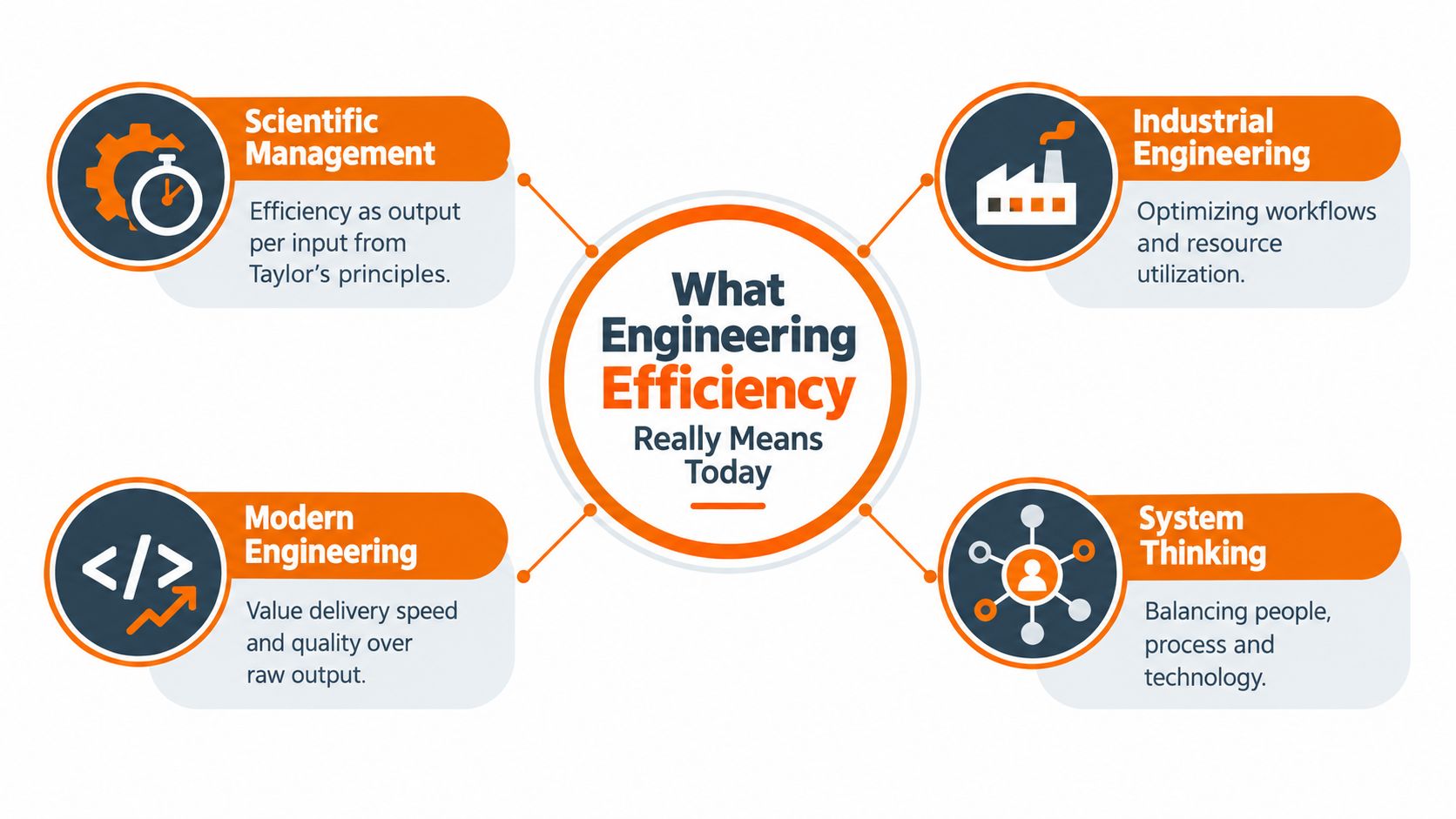
Software inherited the output-per-input instinct, but the old proxies fail when applied to product engineering. Lines of code can increase because a system is poorly designed. Story points can rise because estimates are inflated. Tickets can close while customers still wait for an integrated, tested, deployable capability.
Think of a product team as a factory with an unusual production line. The raw material is a customer problem. The stages include discovery, design, implementation, review, testing, release, and operation. A faster worker at one station won't improve the factory if finished work queues at another station.
That's why small batches, short feedback loops, and low rework matter. A small change is easier to review, test, roll back, and understand. A large change hides defects and creates more coordination work. Efficient teams optimize the movement of valuable work through the whole system, not the visible activity of one specialist.
Use this definition with both executives and engineers:
Engineering efficiency is the reliable flow of valuable software from decision to production, balancing speed, quality, cost, and risk.
The balance matters. Faster delivery that creates incidents isn't efficient. Lower cost that slows learning isn't efficient. More AI-generated code that expands review queues isn't efficient. The standard is more useful outcomes with less avoidable friction, while senior people remain accountable for the decisions that affect customers and the business.
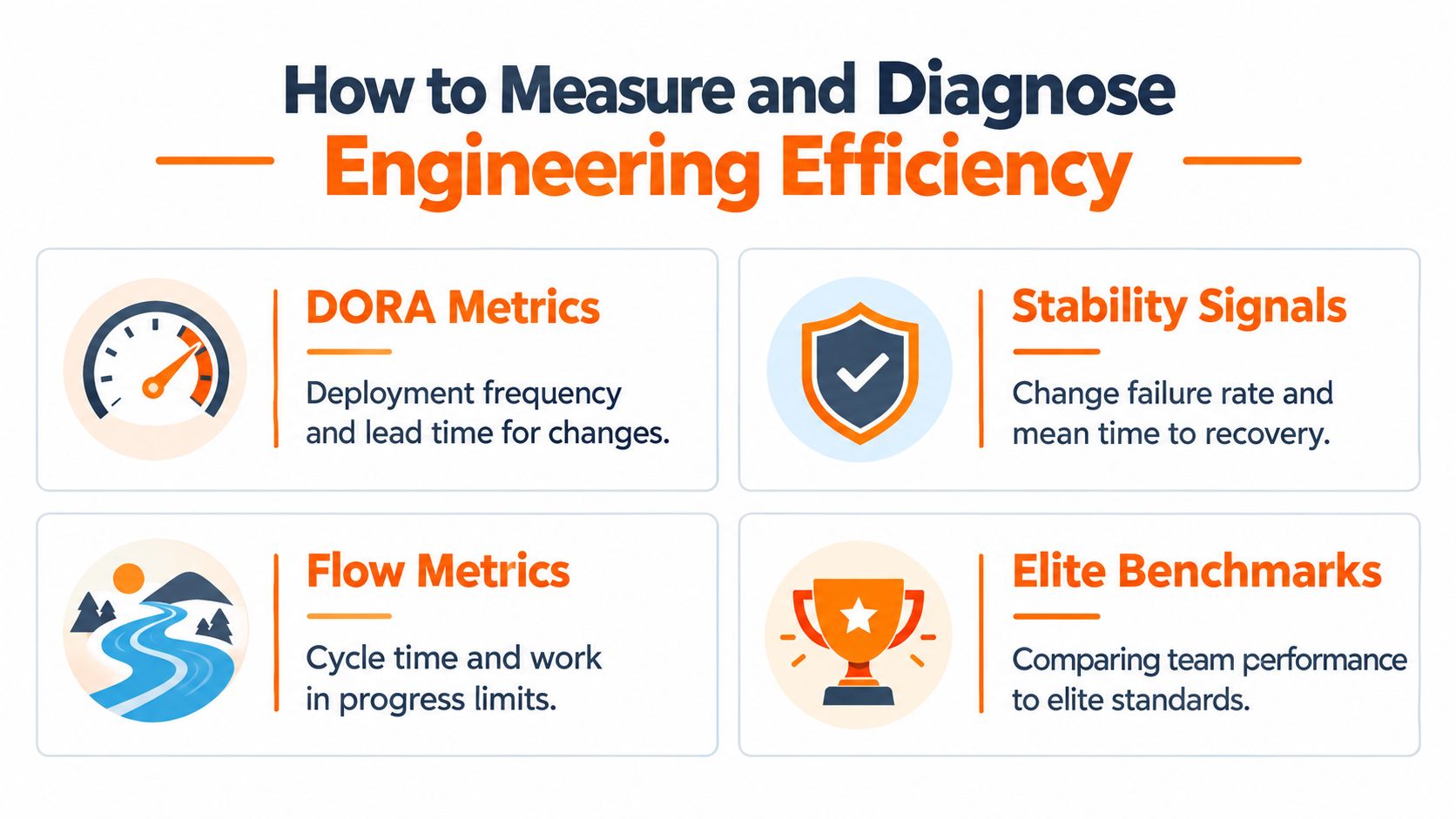
Start with a compact measurement system, not a dashboard filled with every available event. The 2021 State of DevOps benchmark summary reported that high-performing teams deployed code 46 times more frequently, had lead times 2,555 times faster, and showed change failure rates seven times lower than low-performing teams. Those gaps point to system design, automation, testing, and workflow quality, not larger teams.
DORA gives leaders a shared language for speed and stability. Elite performers achieve lead time for changes under one hour, mean time to recovery under one hour, and change failure rates of 0 to 15%, according to IBM's explanation of DORA metrics. Treat these as diagnostic reference points, not quotas. A team that chases deployment frequency while ignoring failed releases is optimizing the wrong outcome.
Add flow signals that explain why delivery is slow. LinearB's engineering benchmarks describe elite teams completing coding tasks in under 30 minutes, deploying daily, keeping pull requests below 105 code changes, maintaining rework below 2%, and reaching planning accuracy of at least 80% in its 2023 Engineering Benchmarks Report.
Track:
The diagnostic question is always causal. If cycle time is long and pull requests are large, reduce batch size. If merge time is long but coding is fast, improve review ownership and queue management. If deployments are frequent but change failure is high, strengthen automated testing and release controls.
Non-coding friction deserves equal attention. Atlassian reports that 99% of developers save time with AI, while 90% still lose six or more hours per week to organizational inefficiencies such as information search, adapting to new technology, and context switching, as described in its 2025 Developer Experience Report. That is why documentation, decision records, service ownership, and accessible system context belong in an efficiency program.
Use the table to choose a starting point rather than measuring everything at once.
| Business Pain | Primary Metrics to Track | What Improvement Signals |
|---|---|---|
| Releases arrive late | Lead time, cycle time, merge time | Work moves through review and release with fewer waits |
| Production incidents consume capacity | Change failure rate, mean time to recovery, rework rate | Teams recover faster and repeat failures less often |
| Engineers feel overloaded | Work in progress, context switching, PR size | Fewer simultaneous priorities and smaller reviewable changes |
| Planning feels unreliable | Planning accuracy, cycle time, deployment frequency | Commitments align more closely with actual flow |
| AI adoption isn't improving outcomes | Completed releases, review time, rework, change failure rate | Coding acceleration survives integration and production controls |
For an operating model that connects delivery governance with these measurements, see delivery management practices.
A visual explanation of the measurement model is useful when aligning executives and engineering leaders:
Measurement tells you where the system loses time. It doesn't fix the loss. Efficiency improves when team design, process, tooling, AI, and collaboration reinforce one another.
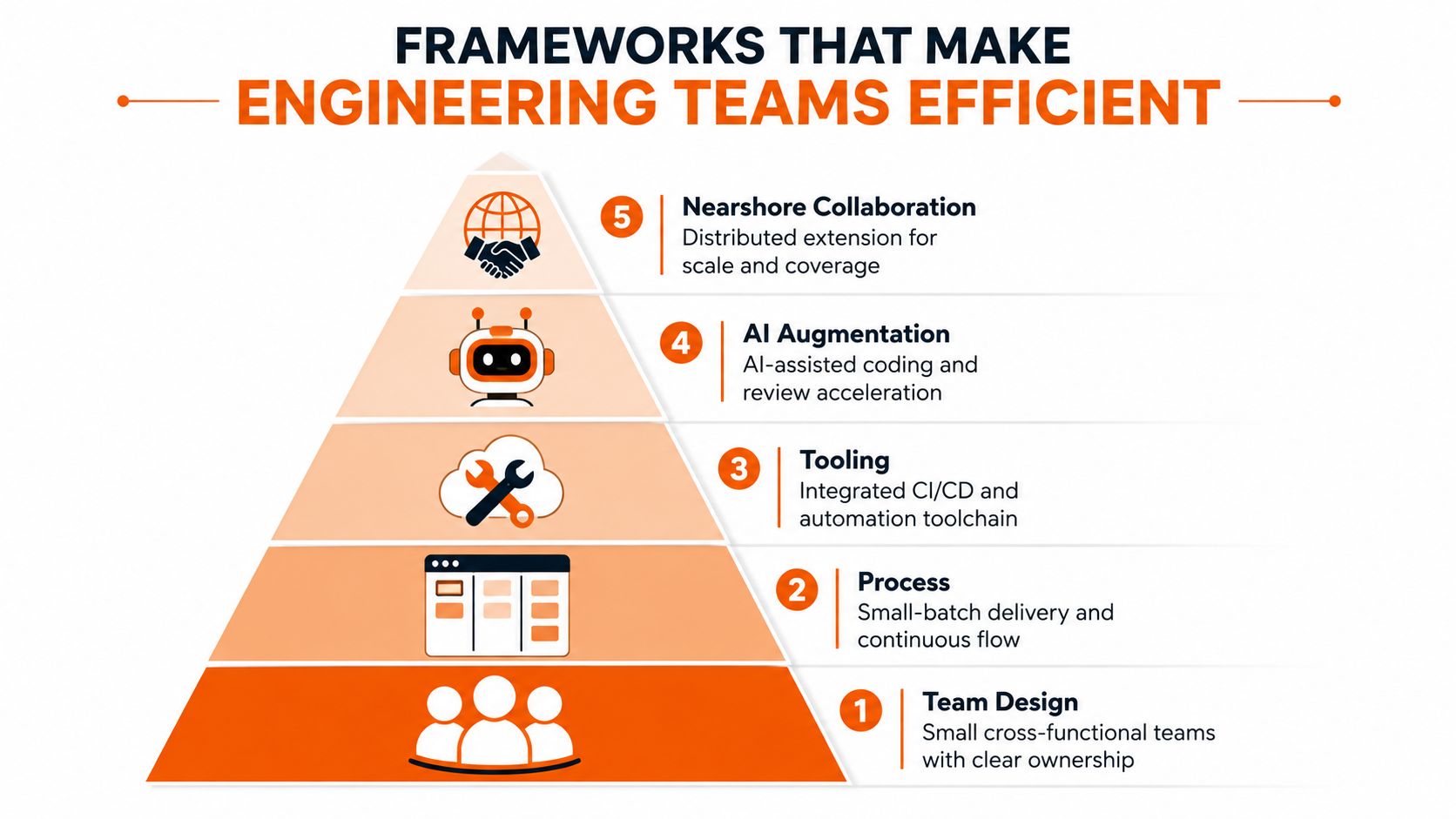
Give a small cross-functional team a clear outcome, decision rights, and responsibility for the production result. Senior engineers should own architecture, data design, integrations, security, testing strategy, and release quality. Product leadership should own the commercial priority, while delivery leaders expose risks early instead of allowing uncertainty to become late-stage surprise.
#riteway practices high energy and transparent communication. That means escalating a blocked dependency when it appears, documenting a decision while context is fresh, and telling stakeholders what changed, why it changed, and what action follows. Ownership isn't a slogan. It's a mechanism for reducing waiting.
Use trunk-based development or an equally disciplined integration model, automated checks on every change, short-lived branches, and pull requests that reviewers can understand in one sitting. Define a clear “ready for review” standard and make the reviewer accountable for response time.
Tooling should remove handoffs. Connect issue tracking, source control, CI/CD, test reporting, observability, and incident records so engineers don't reconstruct system context manually. Documentation should answer practical questions: who owns this service, what depends on it, how do we test it, and what happens when it fails?
AI changes the economics of implementation, but it doesn't change engineering standards. In a randomized controlled trial involving 4,867 developers, AI usage increased completed tasks by 26.08%, while the same research found 30% more actual releases versus 240% more commits when autonomous coding agents were used, as reported in the MIT economics research paper. The difference is the delivery system. Code can arrive faster than review, integration, testing, and release capacity.
The benefit also varies by experience. The Microsoft and GitHub Copilot rollout summarized by MIT Sloan found overall output rose 26%, with junior developers gaining 27% to 39% and senior developers gaining 8% to 13%. Use AI to expand execution capacity, but keep senior accountability at the points where architecture and risk are decided.
An IEEE Computer Society randomized controlled trial with 96 full-time Google engineers found AI reduced time on a complex enterprise task by about 21%. That supports targeted adoption with evaluation, tests, secure access, and clear acceptance criteria. It doesn't support uncontrolled “vibe coding.”
Nearshore collaboration works when it increases focused capacity and extends ownership, not when it merely adds remote hands. Define the boundary clearly: which team owns product decisions, which engineers own components, how reviews work, how incidents escalate, and how knowledge transfers back into the organization.
Use this decision test:
For formal ways to identify and rank delivery exposure, use a risk assessment framework.
Efficiency programs fail when leaders launch broad process change before identifying the constraint. Use a controlled sequence, with one accountable owner and an explicit exit condition at every stage.
The CTO or engineering leader should select one product stream and map the path from approved work to production. Capture lead time, cycle time, PR size, merge time, deployment frequency, rework, change failure, and recovery. Interview engineers about information search, context switching, waiting, unclear ownership, and recurring manual work.
Don't average away the bottleneck. Separate planned work, urgent work, defects, and platform dependencies. The exit condition is a short list of the two or three constraints that most directly delay valuable releases.
The delivery lead should pilot practical changes with one team:
The exit condition is evidence that the chosen constraint is improving without a deterioration in stability signals. Pause if rework rises, reviewers approve changes they don't understand, or teams report that the process adds ceremony without removing waiting.
The CTO should decide whether to expand the pilot, redesign it, or stop it. Scale only the practices that produced a better delivery outcome. Introduce AI agents where the workflow has stable inputs, testable outputs, and clear escalation rules. Agents can support discovery, specifications, implementation, testing, documentation, and release, but senior engineers must approve architecture and production changes.
Use nearshore capacity when the bottleneck is sustained delivery capability, not when the problem is an unresolved product decision. For qualifying releases, a fixed-scope and fixed-price model can create useful commercial discipline, provided the scope, acceptance criteria, dependencies, and ownership are explicit.
By the end of the roadmap, leadership should have a repeatable review cadence. Inspect flow weekly, stability regularly, and business outcomes at every release review. Predictability comes from disciplined feedback, not from one transformation workshop.
A sprint can show more code and deliver less value. Large AI-generated diffs often increase review time, integration risk, and rework. Set smaller change boundaries, require automated validation and clear acceptance criteria, and assign a human owner who understands the complete diff.
AI assistance also leaves coordination work intact. As covered in the measurement section, information search, handoffs, and context switching can continue to consume capacity. Track waiting time, search effort, handoffs, and decision latency alongside coding activity. Delivery throughput depends on how quickly work moves through those queues, not only on how fast engineers write code.
AI results vary by task and seniority. DX's review of Microsoft, Google, and GitHub research describes broad adoption, with about 90% of developers using AI tools at least monthly and over 40% daily. Reported effects range from modest to negative in some settings. One controlled experiment found a 19% slowdown in early 2025, later updated to an 18% speedup for a subset of participants. Treat that variation as a workflow-design warning. Match AI use to task clarity, verification strength, and senior review capacity.
For practical guardrails on rapid delivery and technical debt, review building software fast without technical debt. Senior engineers should own the conditions that turn AI output into reliable production delivery.
A SaaS founder preparing an MVP doesn't need a bigger backlog. The founder needs a narrow release boundary, senior architecture decisions, AI-assisted implementation, automated tests, and one accountable delivery owner. That combination turns a commercial priority into a controlled launch plan.
A company modernizing a legacy platform should avoid a wholesale rewrite unless it can prove the business case and control the transition. Slice the work around customer and operational outcomes, add observability, test critical integrations, and migrate in increments that preserve production quality.
A scale-up with unpredictable releases should start with smaller batches and senior-led review. The aim isn't to make engineers type faster. It's to stop valuable work from waiting in queues or returning as rework.
Use this checklist over the next two weeks:
Keep the cadence simple. Inspect flow weekly, review reliability after releases, and connect every engineering change to time to market, capacity, cost, quality, risk, or revenue.
Rite NRG provides AI-native software consulting, senior engineering teams, modernization, fixed-scope delivery, and managed technology services for companies that need more predictable delivery. Visit Rite NRG to assess your delivery constraints, define the right operating model, and move a priority release from planning to production with accountable engineering ownership.
/ about the author
Written by the RITE NRG editorial team — the architects, engineers and delivery leads who build and operate AI-era software for our clients.
Strategy & Transformation
A practical, finance-ready framework for comparing AI and modernization investment with the current-state cost, realistic benefits, delivery risk and time to value.
AI Consulting & Automation
A practical framework for choosing and deploying transport or logistics AI agents around real exceptions, reliable data and controlled operational authority.
Industry Solutions
A practical roadmap for improving manufacturing systems and introducing AI without destabilising production, data integrity or operational control.
More guidance: all insights articles
We can help you apply this thinking to the systems and teams you actually have.