

Strategy & Transformation
How to Calculate ROI for AI and Software Modernization
A practical, finance-ready framework for comparing AI and modernization investment with the current-state cost, realistic benefits, delivery risk and time to value.
operationalwrocław--:-- cet
∕ insights / risk-assessment-frameworks.md
Risk Assessment Frameworks
Compare risk assessment frameworks for SaaS, startups and nearshore delivery. Learn decision criteria, matrices, KPIs and AI tooling to ship faster.
>_article.meta
Your MVP is two sprints from launch. The roadmap looks clean, the demo environment works, and everyone says the handover from the previous vendor is “mostly documented”. Then a senior engineer finds an access gap in production. Product realises one core workflow depends on a brittle integration no one had properly mapped. Legal asks who approved the data flow. Launch week turns into a holding pattern.
That's the moment teams finally talk about risk.
The problem is that many founders and delivery leads still treat risk assessment frameworks as compliance paperwork. They bring them in late, make them too heavy, or keep them in a spreadsheet no one owns. In practice, a good framework does the opposite. It speeds up delivery because it gives the team a shared way to spot what could block value before that blockage hits build, test, handover, or release.
When we scale SaaS products, the business outcome is what matters. Faster time-to-market. Cleaner vendor transitions. Fewer surprises in production. Stronger control when investors, enterprise buyers, or regulators start asking better questions. That's where the #riteway mindset matters. Extreme Ownership means surfacing risk early, naming an owner, and acting while options are still cheap.
Risk management isn't about slowing down a fast team. It's about helping a serious team move quickly without losing control.
A lot of delivery delays don't start as engineering problems. They start as unclear ownership, hidden dependencies, untested assumptions, or missing decision thresholds.
Take a common SaaS scenario. A startup hires a nearshore team to accelerate a fast MVP. The first sprint goes well. By sprint three, the team discovers the analytics plan conflicts with customer data commitments, the outgoing vendor never clarified release responsibility, and nobody agreed what level of uptime risk is acceptable for launch. The work doesn't stop because the code is hard. It stops because the team lacks a common language for judging trade-offs.
When risk is informal, people use different standards at the same time.
A framework aligns those views. It helps the team identify risks, assess them consistently, decide what's within tolerance, and act before blockers become delays.
Practical rule: If your team only discusses risk when something slips, you don't have a framework. You have an incident pattern.
The right risk assessment frameworks protect the outcomes that SaaS leaders care about.
They help teams launch MVPs with fewer late-stage surprises. They make vendor handovers more predictable because responsibilities, dependencies, and tolerances are visible earlier. They also support better board and investor conversations because the team can explain not only what it's building, but what it's watching and why.
This is the difference between a supplier and a strategic delivery partner. A vendor says, “we'll build what's in the ticket.” A consulting partner asks, “what could stop this shipping cleanly, and who owns that now?”
That ownership-first approach sits at the heart of the #riteway methodology. High energy matters. Proactivity matters more.
At their best, risk assessment frameworks work like a weather system for your product roadmap.
A roadmap tells you where you want to go. A risk framework helps you read the pressure changes around that route. It won't stop the storm. It will help you decide whether to change direction, reinforce the system, or accept the turbulence because the opportunity is worth it.
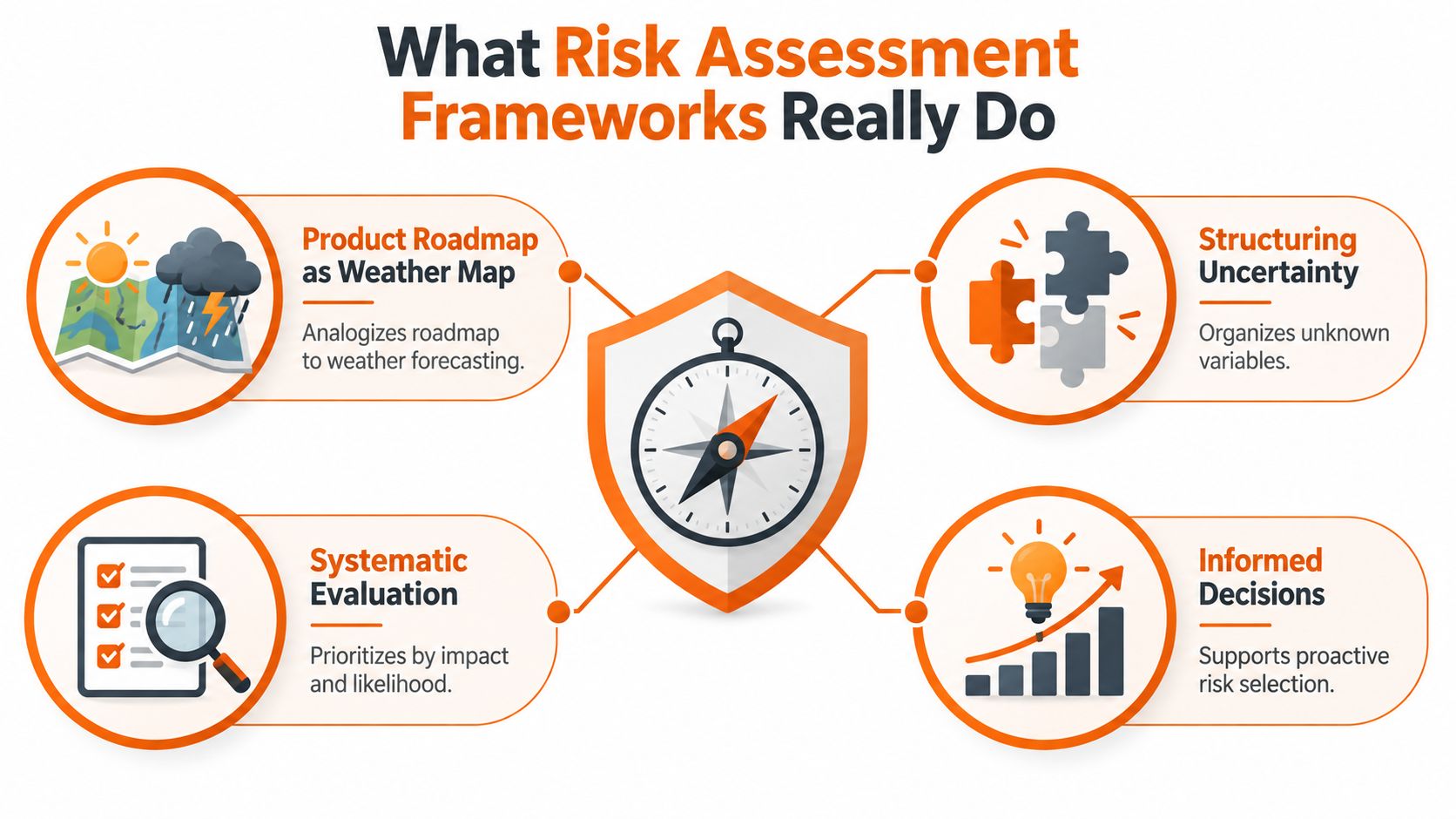
Many teams think a framework is just a likelihood and impact grid. That's part of the picture, but it's not the engine.
A stronger model follows a structured cycle of identification, analysis, and evaluation, with risk criteria defined around cause types, consequence types, likelihood definition, time horizon, tolerability thresholds, stakeholder views, and whether combined risks should be considered, as described in ISO 31000 risk management guidelines. That calibration step matters because teams often get into trouble long before scoring. They use the same words, but they don't mean the same thing by “high risk”.
For example, one team may define “high impact” as reputational annoyance. Another may mean lost revenue, contractual breach, or customer downtime. If you rank before you calibrate, you create false certainty.
A useful framework also answers three operational questions:
In UK central government, the Orange Book provides a common model for managing risk across departments and boards. It's built around four lenses, three main elements, and defined roles and responsibilities, with routine activities including identifying risks, assessing tolerance, addressing risks, reviewing and monitoring them, and reporting on them, as set out in the Orange Book.
That's why mature risk assessment frameworks don't live only in PM tooling. They connect daily delivery decisions to leadership tolerance.
A one-off matrix helps you rank issues. A governance-linked framework helps you decide what to do next, who decides, and what must be reported.
For a SaaS team, the practical shift is straightforward.
The best frameworks create shared judgement. That shared judgement is what keeps speed real rather than chaotic.
Not every framework fits every delivery context. A regulated enterprise modernising a legacy platform needs more structure than a startup validating a first release. A Build-Operate-Transfer model needs stronger handover discipline than a short-lived experiment. The mistake is choosing one model because it sounds official, then forcing it onto work it wasn't built for.
The Orange Book is governance-heavy. It's strong when leadership needs a formal view of risk appetite, tolerance, reporting lines, and board visibility.
ISO 31000 is valuable when you want a broad decision model for risk criteria and evaluation without turning the whole process into a compliance ritual. It helps teams think properly before they rank.
The HSE approach is very practical. The UK Health and Safety Executive says a legal risk assessment must identify what could cause injury or illness, judge how likely harm is and how serious it could be, then eliminate the hazard or control the risk. If an employer has 5 or more people, it must also record the significant findings, including the hazards and who may be harmed, according to HSE guidance on risk assessment. Even outside workplace safety, that sequence is useful because it forces action rather than endless discussion.
The NCSC Cyber Assessment Framework is especially relevant when cyber resilience affects essential functions. The NCSC says CAF provides a systematic approach to assessing how well cyber risks to essential functions are being managed, and in version 4.0 it is positioned as an outcomes-based framework used by UK cyber regulators and oversight bodies rather than a prescriptive checklist, as explained in the Cyber Assessment Framework v4.0.
| Framework | Primary Purpose | Best Fit for SaaS and Nearshore | Trade-off to Consider |
|---|---|---|---|
| Orange Book | Governance, appetite, tolerance, reporting | Scale-ups, enterprise SaaS, complex vendor handovers, board-level oversight | Can feel heavy if a small MVP team copies it too literally |
| ISO 31000 | Structured risk thinking and calibration | Founders, CTOs, product and engineering teams aligning decision criteria | Needs tailoring. It won't assign accountability for you |
| HSE 5-step approach | Simple operational action model | MVP teams, delivery squads, transition work needing clear owners and deadlines | Less suited on its own for strategic governance |
| NCSC CAF | Outcomes-based cyber resilience for essential functions | SaaS handling critical services, regulated environments, resilience-sensitive operations | More cyber-specific than general delivery risk |
A lot of teams also borrow concepts from adjacent models. If you're trying to apply NIST framework to IT services, that can be useful when you want stronger governance language around operations, dependencies, and service continuity beyond pure security.
For broader delivery operating models, it also helps to compare your risk model with the execution model already in use. This guide to project management frameworks is a good companion when you're deciding how governance and delivery cadence should work together.
The strongest setup usually isn't one framework used rigidly. It's a clear primary model, then a few borrowed mechanics that solve actual delivery friction.
Choosing between risk assessment frameworks isn't about picking the most complete option. It's about choosing the lightest model that still protects the outcome.
A fast MVP, a vendor replacement, and a regulated platform migration may all need risk management. They don't need the same degree of ceremony.
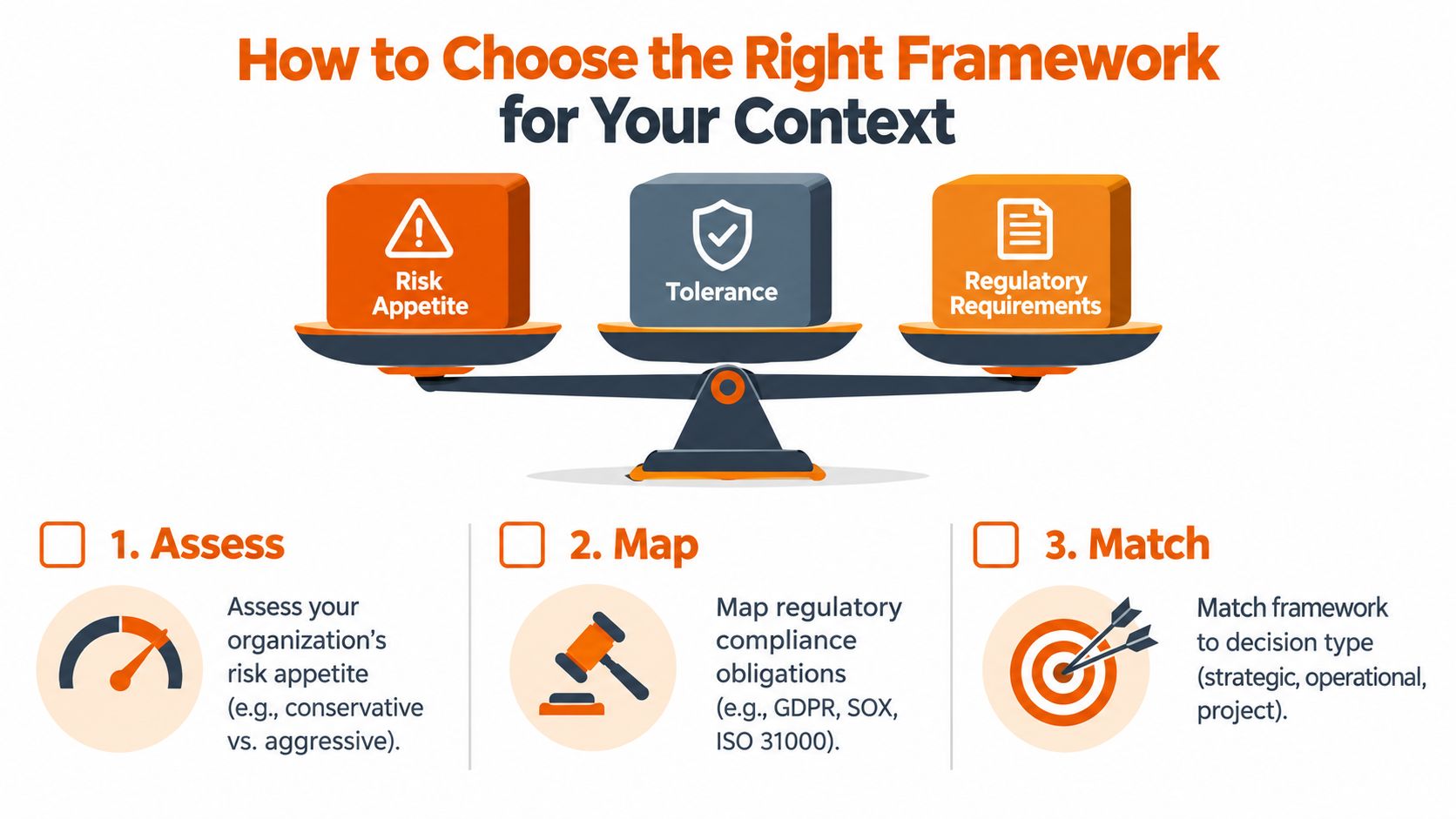
Teams often jump straight into templates. Start higher up.
Ask these questions first:
Many frameworks break in practice. The team jumps to red, amber, green without agreeing the scoring model.
Use a short calibration checklist:
If your organisation is adding AI across finance, support, or product operations, governance choices get harder because cost, autonomy, and data sensitivity move together. A useful companion read is how to govern LLM costs, especially if your risk model needs to connect technical choices with spend control.
Here's the selection test I use with leadership teams:
| Decision factor | Lightweight framework is enough when | More formal framework is needed when |
|---|---|---|
| Delivery speed | Team needs quick visibility and action | Decisions affect multiple teams or external stakeholders |
| Compliance exposure | Customer expectations are manageable | Buyers, boards, or regulators need evidence and traceability |
| Team maturity | Senior team already acts on ownership | Ownership is fragmented or escalations are unclear |
| Handover complexity | Context is already well documented | Multiple vendors, systems, and responsibilities overlap |
A good framework should make collaboration cleaner. If it makes basic decisions slower without improving control, it's too heavy for the context.
Choosing a framework is the easy part. Operating it every week is where delivery discipline shows up.
In the UK public-sector model, risk management is iterative and governance-linked. The Cabinet Office framework sets routine processes for identifying owners, assessing risks and establishing tolerance, addressing risks through contingency arrangements, reviewing and monitoring them with deep dives, and reporting upward to the board, as described in the Framework for the Management of Risk in Government. That cycle maps surprisingly well to SaaS delivery when you strip away the bureaucracy and keep the ownership.
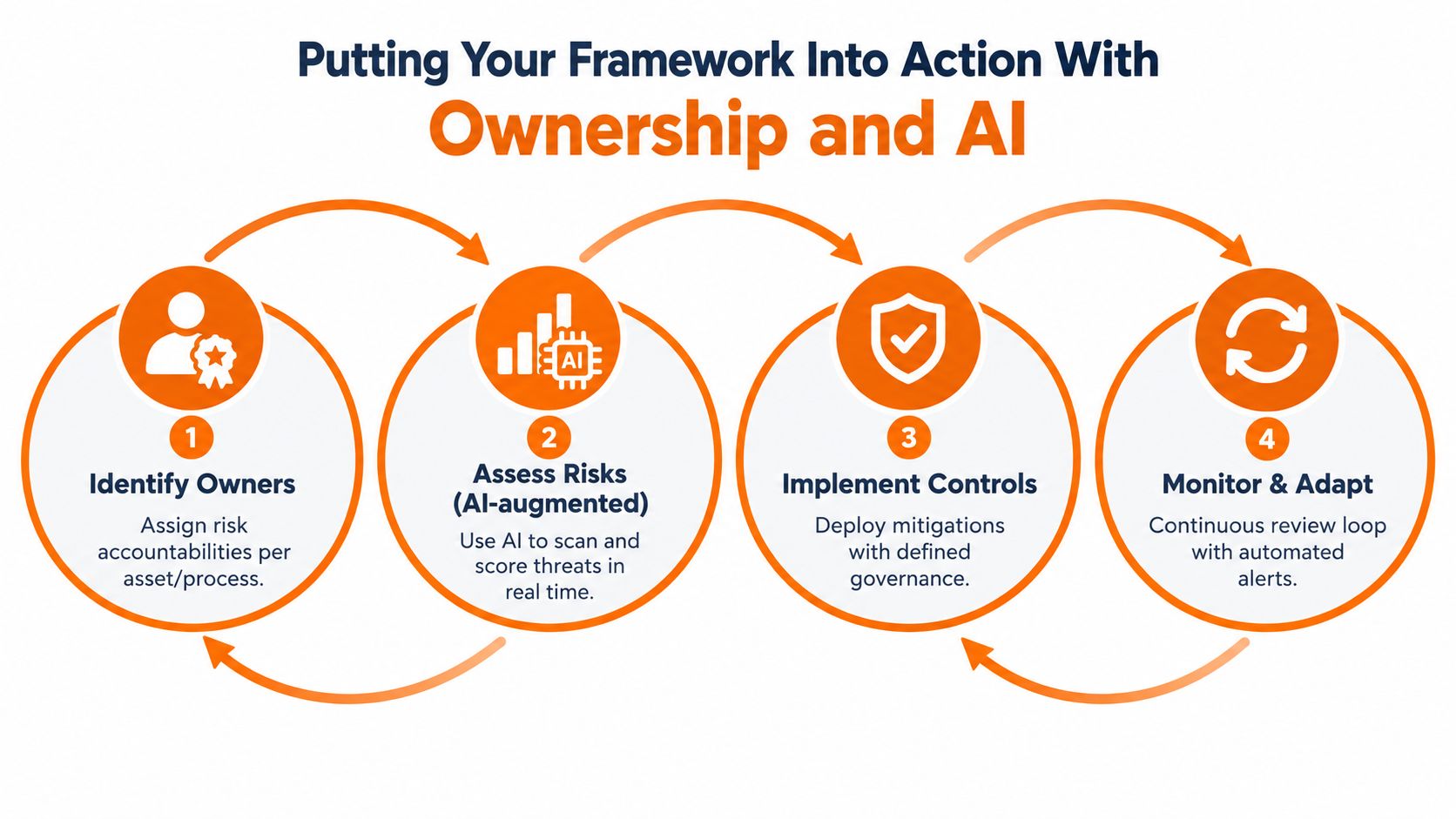
Use a four-part loop.
Every material risk needs a named owner. Not a team. A person.
That owner doesn't have to fix the issue personally. They do need to make sure the issue is visible, decision-ready, and moving.
Don't stop at “this is high”. Record why it is high, what threshold matters, and what would move the score. Founders and CTOs need to be explicit about what the business will tolerate during MVP, scale-up, or handover.
The HSE's approach is strong here because its 5-step method includes who needs to carry out each action and by when, as shown in the HSE step-by-step risk method. That small detail is what turns a framework from description into execution.
Hold regular deep dives on the risks that can change release timing, customer impact, or transfer control. Then report upward in a format leadership can act on.
Use prompts like these in sprint planning, handover discovery, or platform reviews:
Risk statement
What could happen, and what outcome would it threaten?
Owner
Who is accountable for moving this risk to decision or mitigation?
Tolerance decision
Is this acceptable for now, acceptable with conditions, or outside tolerance?
Action and deadline
What must be done, by whom, and by when?
Trigger to re-open
What event changes the score or needs escalation?
Field advice: If a risk has no owner and no deadline, it isn't being managed. It's being observed.
AI is useful when it strengthens early warning, not when it pretends to remove uncertainty.
It can help scan delivery signals, detect access drift, flag gaps in documentation, cluster recurring incidents, and surface unusual patterns in handover work. In delivery operations, teams can use AI to spot slowing cycle times, repeated QA failure themes, or missing release approvals earlier than manual review would.
For organisations building governance into their delivery model, AI risk management is worth treating as a core operating capability rather than a side policy.
A short walkthrough helps make that practical:
One example in the market is Rite NRG, which embeds AI across recruitment, delivery, and operations to automate workflows and surface risks earlier during scaling and handover work. That's useful when speed matters, but only if the ownership model is already clear.
A framework becomes real when the team can use it on a Monday morning without debate about format. That usually means three things. A scoring model. A small set of operating indicators. A refresh rhythm.
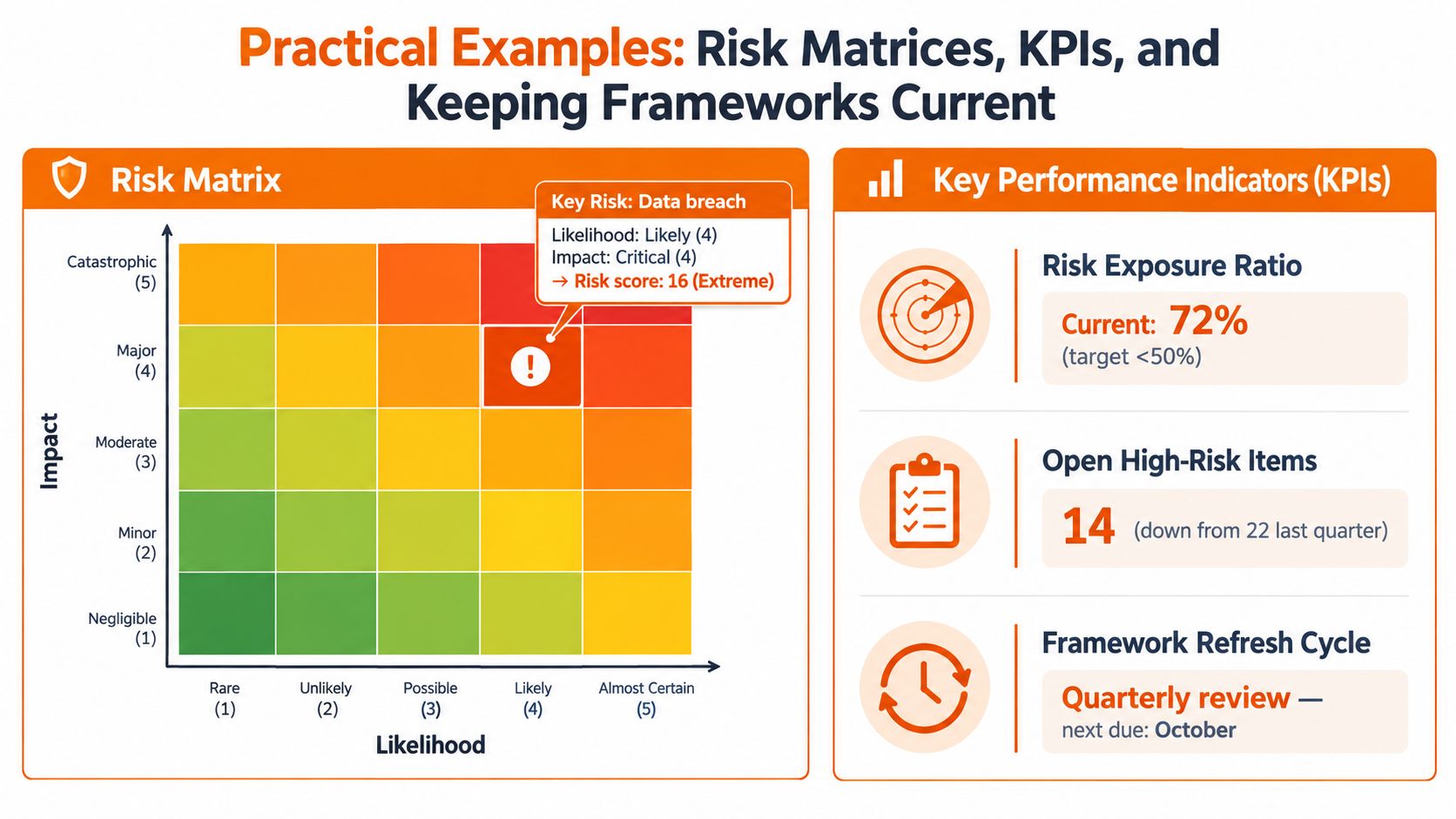
A 5x5 risk matrix is still useful if the criteria are calibrated and the scores trigger action.
For SaaS delivery, you might define likelihood from rare to almost certain, and impact from negligible to catastrophic. The important part isn't the colours. It's what happens when a risk lands in a given zone.
A lightweight operating rule might look like this:
That's enough structure for an MVP team without turning every concern into governance theatre.
Risk KPIs should tell you whether exposure is becoming more manageable or less manageable. They should not become a vanity dashboard.
Good examples include:
| KPI | What it tells you | Why it matters |
|---|---|---|
| Risk exposure trend | Whether overall delivery exposure is rising or falling | Helps leadership see if mitigation is working |
| Time to mitigate | How quickly the team closes meaningful issues | Shows execution strength, not just identification quality |
| Overdue risk actions | Whether ownership is real | Exposes stalled decisions and hidden delivery drag |
| Escaped defects linked to known risks | Whether the framework is changing outcomes | Connects risk process to production reality |
For teams trying to connect these indicators with broader execution discipline, these software delivery metrics are useful alongside the risk view.
Many frameworks fail. They are built once and then treated like policy furniture.
The UK government's resilience work points in a different direction. The government's 2023 Resilience Framework says the National Security Risk Assessment has been transitioned to a dynamic risk assessment process, and the public-facing National Risk Register was published in 2025 and again in 2026 as the external version of that internal assessment, according to the UK Government Resilience Framework 2023 implementation update. The 2026 implementation report also says the assessment is updated on a rolling basis, the register was refreshed alongside the action plan, and a methodology review is under way with an updated method due to be implemented in 2027, as set out in the Government Resilience Action Plan 2026 implementation report.
That's the lesson for SaaS teams. Don't ask only “which framework should we choose?” Ask “how will we keep it alive without losing comparability?”
Some risks can't be quantified cleanly. That doesn't mean the framework is broken.
UK institutional evidence makes this point clearly. The Bank of England said data gaps can materially hamper quantitative risk assessment, and some gaps can only be addressed through exploratory work while others will remain. The UK Food Standards Agency's 2025/26 performance report also showed risk assessment evidence components were 87% timely and that one package scored poorly because of evidence gaps rather than a weak method, as summarised in the Bank of England review of the analytical framework supporting financial policy.
Strong frameworks don't fake precision. They document assumptions, show uncertainty, and separate thin evidence from poor judgement.
In delivery terms, that means defining re-score triggers, maintaining a scenario library, and logging where the evidence is incomplete. That's how you keep the system decision-useful when the threat picture moves fast.
The teams that ship cleanly don't avoid risk. They operationalise it.
That's the shift worth making. Stop treating risk assessment frameworks as a governance tax added after the roadmap is set. Use them as delivery accelerators. They help founders launch with clearer trade-offs, CTOs manage handovers without losing control, and product leaders protect speed without inviting chaos.
Three moves will get you started quickly:
The #riteway mentality earns its place. Extreme Ownership means you don't wait for risk to become an incident before acting. You surface it, frame it, and drive it to decision while the team still has room to move.
For fast-moving SaaS businesses, that discipline creates real business value. Better release confidence. Cleaner scale-up decisions. Smoother nearshore collaboration. Stronger resilience when AI, data, security, and delivery all intersect.
And yes, with the right operating model, senior nearshore teams, and AI-supported early warning, moving fast while keeping control is achievable. Done consistently, it becomes repeatable.
Rite NRG helps SaaS companies build and scale products with senior nearshore teams, consulting-led delivery, and AI-supported workflows that surface risks early during MVP builds, vendor handovers, and platform growth. If you want a practical framework that protects speed without adding bureaucracy, visit Rite NRG and see how their team approaches predictable software delivery.
/ about the author
Written by the RITE NRG editorial team — the architects, engineers and delivery leads who build and operate AI-era software for our clients.
Strategy & Transformation
A practical, finance-ready framework for comparing AI and modernization investment with the current-state cost, realistic benefits, delivery risk and time to value.
AI Consulting & Automation
A practical framework for choosing and deploying transport or logistics AI agents around real exceptions, reliable data and controlled operational authority.
Industry Solutions
A practical roadmap for improving manufacturing systems and introducing AI without destabilising production, data integrity or operational control.
More guidance: all insights articles
We can help you apply this thinking to the systems and teams you actually have.