

Strategy & Transformation
How to Calculate ROI for AI and Software Modernization
A practical, finance-ready framework for comparing AI and modernization investment with the current-state cost, realistic benefits, delivery risk and time to value.
operationalwrocław--:-- cet
∕ insights / proof-of-value.md
Proof Of Value
Learn what a proof of value is, how it differs from a PoC or pilot, and how to structure one that ties technology to measurable business outcomes.
>_article.meta
Your release backlog is growing, operating costs are rising, and someone recommends building a prototype to prove the investment makes sense. Challenge that advice. A working demo can show that the technology functions without telling you whether customers will use it, your team can operate it, or finance should fund it.
Proof of value is an investment decision, not a presentation. Buy enough evidence to decide whether to scale, redesign, or stop. Use technology and AI to gather that evidence faster, but don't confuse faster coding with a better business result.
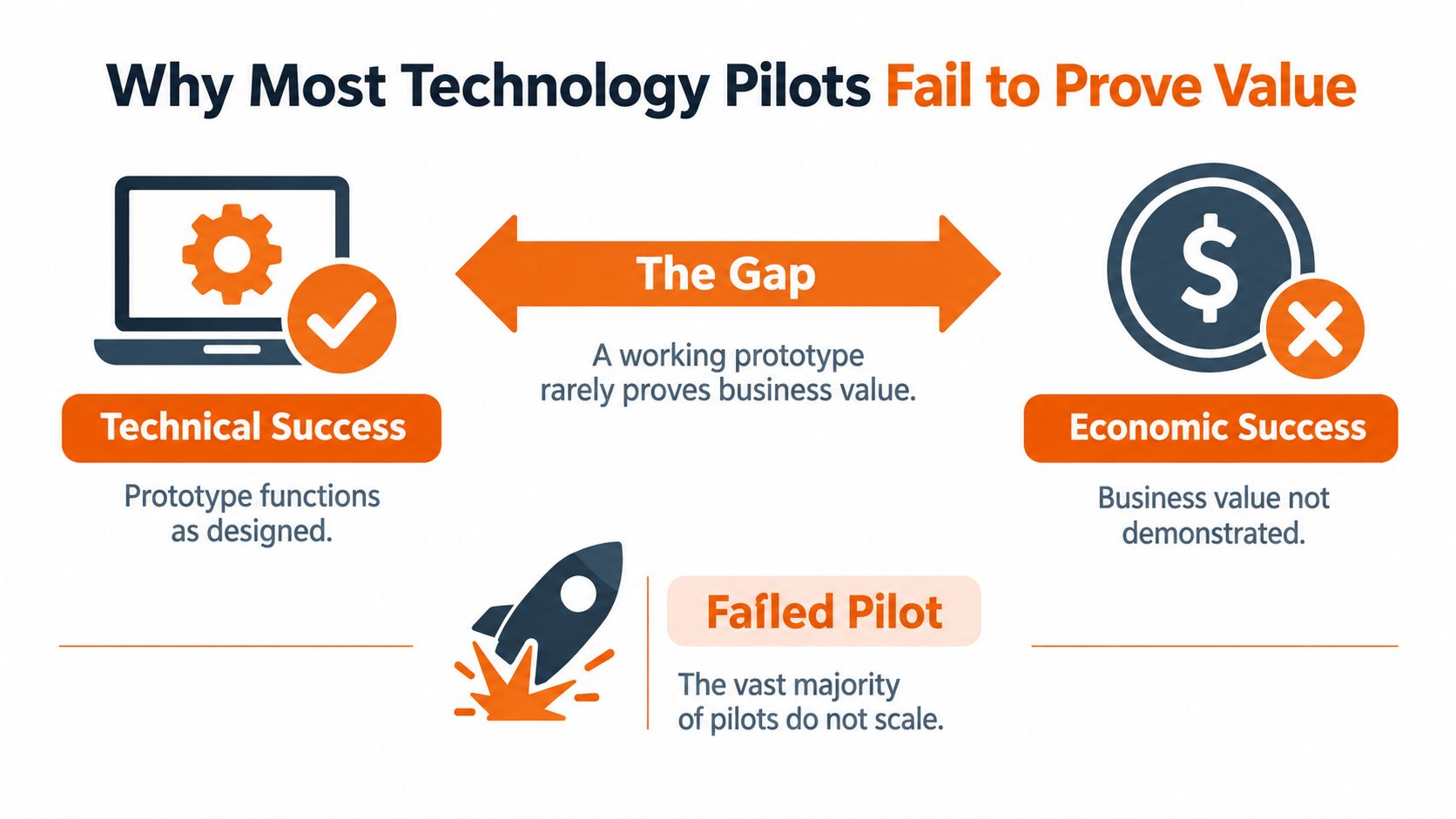
A prototype that produces accurate answers can still leave the business worse off. Employees might spend longer checking those answers than they previously spent completing the task. Integration, support, and model consumption can erase the apparent benefit.
A 2025 analysis reported that 95% of enterprise generative-AI pilots produced no measurable profit-and-loss impact, as summarized in this enterprise AI measurement framework. That's the distinction leadership needs to understand: technical success isn't economic success.
My recommendation is simple: investigate the awkward constraints before polishing the interface. Can the application access approved data? What happens when an integration fails? Who reviews exceptions, and what does that work cost?
Treat risk assessment frameworks as part of investment preparation, not paperwork added before launch. A restricted dataset or an unavailable security owner can change the decision more than another round of prompt tuning.
Three Engagement Types at a Glance
| Dimension | Proof of Concept | Pilot | Proof of Value |
|---|---|---|---|
| Main question | Can the technology perform the task? | Can it operate in our environment? | Is the business improvement worth scaling? |
| Core evidence | Technical feasibility | Operational behavior | Incremental outcomes and full costs |
| Typical blind spot | Real workflow constraints | Economic justification | Benefits that won't persist at scale |
| Decision supported | Continue technical exploration | Refine deployment approach | Scale, redesign, or stop |
These are useful working definitions, not a reason to argue about labels. What matters is the evidence your engagement will produce.
Practical rule: If the team can't describe what evidence would make it recommend stopping, it's selling a demo rather than testing an investment.
A reversible engagement preserves options. Keep the scope narrow, cap the commitment, and avoid architecture decisions that lock you into a production platform before the business case is credible. The upside isn't merely finding a promising solution. It's rejecting an expensive mistake while rejection is still affordable.
Choose the engagement according to the uncertainty you need to remove. If your team doesn't know whether a legacy system exposes the required data, start with a proof of concept. If feasibility is established but users haven't worked with the integration, run a pilot.
A proof of value belongs where leadership needs evidence for a funding decision. It may contain technical experiments and a limited operational release, but its deliverable is a defensible recommendation, not merely software.
A PoC needs a technical owner who can verify feasibility and document limitations. A pilot needs an operational owner who can judge workflow fit, support requirements, and user behavior. A PoV needs a business owner with authority to accept the outcome and decide whether further investment is justified.
Set duration according to the evidence required. A compatibility test can finish when the technical question is resolved. Adoption and recurring workload need an observation period that reflects how people work.
The same distinction matters when choosing what to build. AppLighter's MVP vs prototype debate is a useful companion resource when deciding whether you need an exploratory artifact or a product users can meaningfully try. Don't commission a broad MVP when a narrow workflow test would answer the investment question.
The ERC's Proof of Concept programme provides a historical example. An independent assessment found patent applications in more than 42% of PoC projects, compared with 17% in the control group, while additional development funding was obtained by 38.7% versus 35.6%, according to the ERC assessment response.
Those outcomes illustrate why feasibility work can be useful without guaranteeing financing or market adoption. Don't treat research commercialization results as a forecast for your SaaS project.
Skipping from feasibility to production means accepting unanswered operational and economic questions. That may be an intentional risk, but it shouldn't be an accidental one.
Write an objective that finance and engineering can both challenge. Replace “introduce an AI assistant” with “reduce the cost of completing an accepted support resolution while preserving quality and security.”
Select a primary outcome metric, then define guardrails. A cost objective needs quality limits. A capacity objective needs evidence that the extra capacity can be used. A speed objective needs a check that the team hasn't moved work into review or remediation.
For delivery improvements, DORA's software-delivery metrics separate throughput, measured through deployment frequency and change lead time, from stability, measured through change failure rate and failed-deployment recovery time. Use that distinction to challenge claims that generating code faster automatically improves time to market.
For product behavior, keep event definitions consistent with your outcome model. PlotStudio AI's analytics playbook for product teams is a relevant companion resource for that planning conversation.
PoV Objective Template
| Field | Example | Why it matters |
|---|---|---|
| Business problem | Support specialists spend too much effort resolving routine requests | Defines the operational constraint |
| Primary outcome | Cost per accepted resolution | Connects activity to economics |
| Baseline | Current workflow, segmented by request difficulty | Makes comparison credible |
| Guardrails | Critical errors, review burden, escalation, security | Prevents harmful optimization |
| Scale threshold | Agreed cost improvement with every guardrail met | Defines acceptable evidence |
| Redesign threshold | Benefit exists, but a fixable constraint blocks acceptance | Limits further experimentation |
| Stop threshold | No credible net benefit or unacceptable residual risk | Protects the remaining budget |
| Outcome owner | Support leader, with finance validation | Makes acceptance accountable |
In an illustrative AI-assisted support workflow, record elapsed resolution time, active labor, correction work, and whether the final resolution was accepted. Include model consumption, infrastructure, integration, training, monitoring, and oversight in the cost calculation.
NIST's AI evaluation and user-impact material supports assessing system behavior alongside human impacts, with evaluation that goes beyond a single accuracy score. Segment easy requests from difficult cases so a favorable average doesn't conceal serious failures.
Don't call saved labor hours cash savings unless the business redeploys capacity or changes its costs. Compare equivalent workloads and document differences in case mix.
A faster first draft isn't the outcome. An acceptable completed task at a lower total cost might be.
Use an explicit project-success measurement approach to connect the baseline, target, and acceptance decision. Agree the thresholds before implementation, not after everyone has become attached to the prototype.
Run the PoV as a sequence of evidence gates. Each phase should leave behind something another person can inspect, reproduce, or approve.
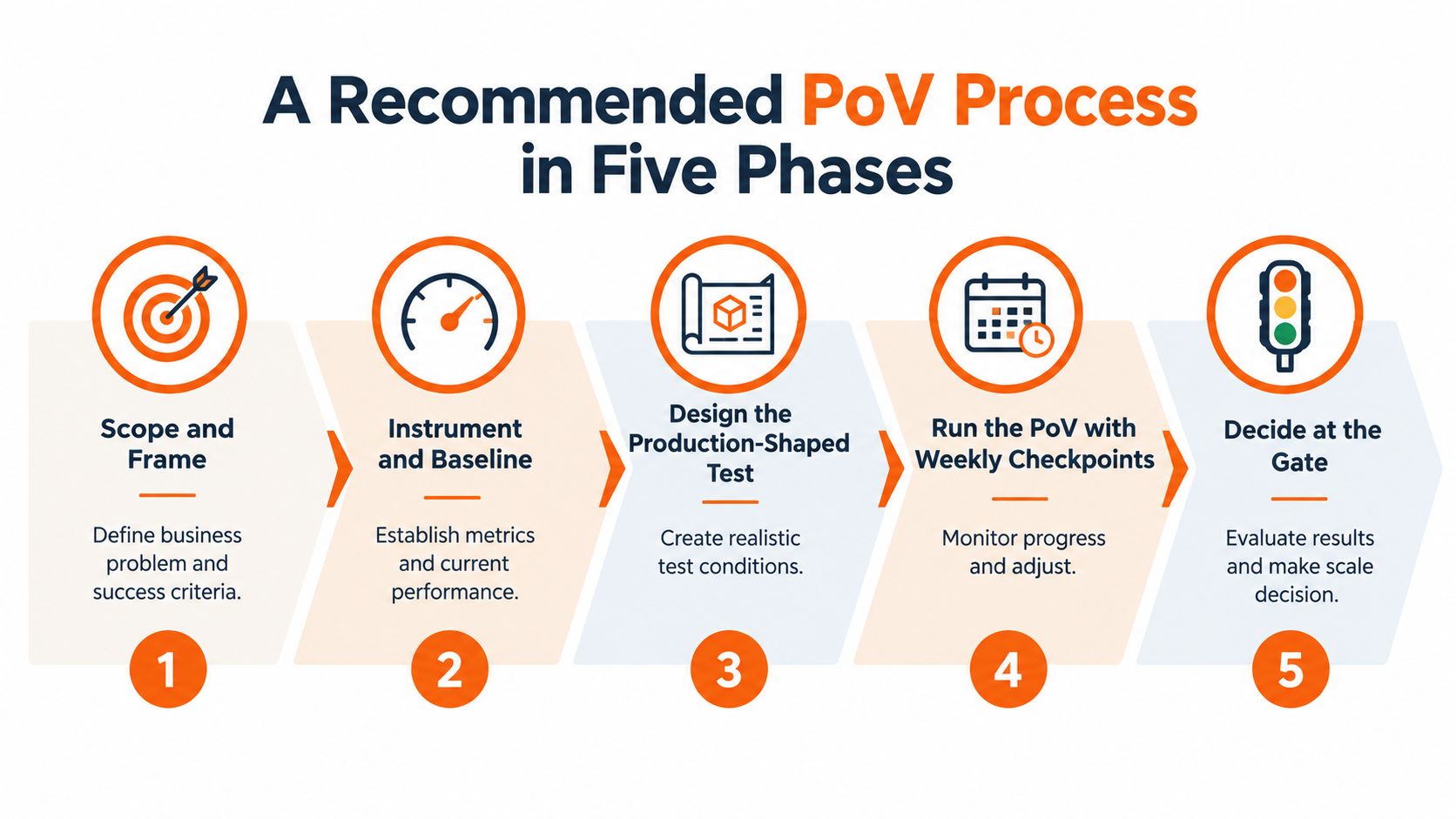
Phase 1. Scope and frame. The business owner defines the problem, intended users, exclusions, and investment question. The delivery lead turns that into a bounded engagement with an agreed budget and decision date. Exit only when stakeholders accept the objective and decision rules.
Phase 2. Instrument and baseline. The measurement owner validates event definitions, captures current performance, and establishes a historical benchmark or control where feasible. Deliver a baseline dataset and explain its limitations. Don't proceed if you can't reliably measure the primary outcome.
Phase 3. Design the production-shaped test. The senior architect specifies representative data, integration boundaries, access controls, latency expectations, failure handling, and human review. Test sets and acceptance methods should be documented: the NIST AI Risk Management Framework calls for documented evaluation methods and performance evidence under conditions similar to deployment.
IDC's Asia-Pacific findings reinforce the need for that realism: about 34% of generative-AI projects moved from pilot to production, and around 37% of those production projects achieved their key objectives, according to the IDC pilot-to-production spotlight paper.
Phase 4. Run with weekly checkpoints. The delivery lead reviews observed outcomes with business and technical owners. Keep the meeting focused:
Log scope changes rather than improving the test without record until it looks successful. If you change the workflow or target users, explain how that affects comparability.
Phase 5. Decide at the gate. Deliver an evidence pack containing results, costs, unresolved risks, operational requirements, and a recommendation. The business owner approves the investment decision; engineering accepts the technical conditions.
Don't jump from design into execution because the build looks ready. Without instrumentation, you'll finish with anecdotes instead of evidence. After an approved release, assign monitoring and reassessment so the team can detect whether value deteriorates during normal operation.
Unclear ownership makes a PoV difficult to evaluate. The client assumes the partner will obtain data; the partner assumes the client has approved access. Meanwhile, engineers build against samples that don't represent the workload.
Separate execution responsibility from approval authority. A partner can produce the measurement system, but the client must validate whether it represents the business.
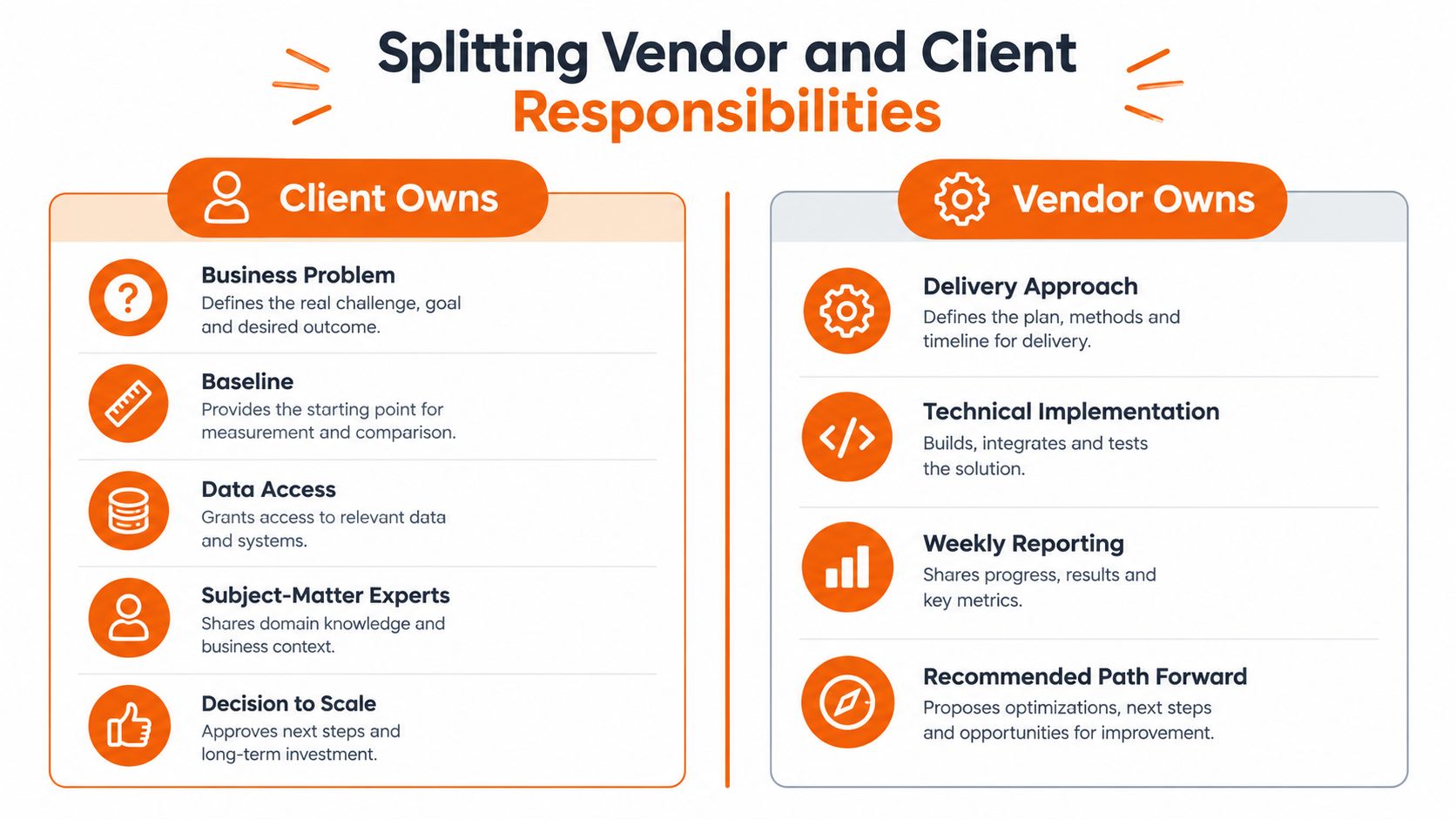
| Responsibility | Client accountability | Partner accountability |
|---|---|---|
| Business outcome | Define and approve relevance | Challenge assumptions and scope |
| Baseline and data | Validate records and authorize access | Instrument, inspect, and document limitations |
| Architecture and integration | Supply system owners and constraints | Design and implement the technical approach |
| Security and quality | Approve organizational requirements | Implement controls and provide test evidence |
| Decision and handover | Authorize investment and operational ownership | Recommend a path and document residual risks |
NIST's AI accountability crosswalk calls for responsibility to be assigned to appropriate teams and individuals, with risks mapped across system components, including third-party software and data. Don't evaluate only the application screen while ignoring the model, libraries, datasets, and integrations behind it.
The #riteway methodology combines Extreme Ownership, high energy, proactive problem-solving, transparent communication, and senior engineering accountability. In practice, that means surfacing a blocked integration early, bringing viable alternatives, and moving the decision forward. It doesn't mean absorbing every new request without changing scope.
AI changes delivery economics, but not engineering standards. Agents can assist analysis, implementation, testing, documentation, and migration; identifiable architects and engineers remain responsible for architecture, data, security, testing, and production quality.
Ownership test: A blocked task still needs an owner who will pursue a resolution, not simply report that someone else hasn't responded.
Attach these checks to the statement of work:
Weekly reviews should resolve decisions, not reward busy status reporting.
The following are illustrative engagement designs, not reported customer results. They show how to apply the framework without inventing savings, traction, or delivery claims.

An enterprise wants to help analysts locate approved information across a legacy document estate. The objective is lower effort per accepted research task, not a more impressive chatbot.
The baseline records search, synthesis, review, and correction work. Deliverables include a permission-aware retrieval workflow, an evaluation dataset, an instrumented user trial, and a cost model.
Agentic delivery can help shorten the build window by assisting repository analysis, implementation, test preparation, and documentation in parallel. Aim for a weeks-shaped investigation rather than a months-long platform build, but treat that as a scoped delivery ambition, not a guaranteed performance claim.
The senior architect still approves access boundaries, retrieval design, model evaluation, security controls, and release criteria. Engineers inspect generated changes and verify the evidence.
For a separate delivery reference, explore this concept-to-pilot case study). Don't transfer another engagement's results or schedule into your own business case.
A founder proposes automating a specialist reporting workflow. Before funding a broad product, test whether target users will repeatedly complete the core task and whether serving them can support viable unit economics.
The baseline is their existing manual process. Build a thin end-to-end product slice, instrument completion and repeat use, and record onboarding, support, infrastructure, and exception costs. Keep investor-facing evidence traceable to observed behavior rather than expressions of interest.
The gate requires meaningful use, acceptable delivery cost, and a credible operating model. If users need extensive bespoke assistance, the founder should challenge whether this is a scalable SaaS product or a service business.
A stop recommendation can be the correct outcome. Preserve the learning, document what would justify reopening the bet, and avoid funding a larger application merely because the prototype received compliments.
Before signing, ask whether the proposed engagement will produce a decision you can defend. A polished interface, a backlog of completed tickets, and enthusiastic feedback don't substitute for measured outcomes.
S&P Global reported that organizations abandoning most AI initiatives increased from 17% in 2024 to 42% in 2025, while the average organization abandoned 46% of proof-of-concept projects before production, in its research on mixed generative-AI results. Stopping isn't automatically a failure. The useful question is whether the evidence arrived before a much larger commitment.
Check that the team is testing representative cases rather than selecting favorable examples. Ask to see exception handling, unresolved defects, operating costs, and user friction alongside the success screenshots.
Require an explanation whenever the target, population, or measurement method changes. That isn't bureaucracy; it prevents the team from changing the question after seeing the answer.
| Decision | Required conclusion |
|---|---|
| Proceed | Outcome and operational-readiness conditions are met |
| Redesign | A bounded, testable change could resolve the shortfall |
| Stop | Further commitment lacks credible justification |
Watch for proposals that guarantee ROI before inspecting your data, exclude human review from costs, or describe success only as deploying the software. Those are warning signs that you're buying a PoC or pilot under a different label.
Your next step is a scoping conversation with the business owner, finance representative, and senior engineering lead. Bring a real workflow, available baseline records, and the decision you need to make. Agree a fixed-scope investigation that respects the time and budget of the people who would eventually operate it.
Rite NRG offers AI-native consulting and software engineering for bounded proof-of-value engagements, with senior engineers accountable for delivery and production readiness. Visit Rite NRG to book a 45-minute scoping call, agree a business outcome and baseline, and define a fixed-scope PoV with explicit scale, redesign, and stop criteria.
/ about the author
Written by the RITE NRG editorial team — the architects, engineers and delivery leads who build and operate AI-era software for our clients.
Strategy & Transformation
A practical, finance-ready framework for comparing AI and modernization investment with the current-state cost, realistic benefits, delivery risk and time to value.
Technology Talent & Teams
A decision-maker's guide to IT partnership models: what each model actually transfers to the partner, what it costs beyond the rate card, and how to match the model to your situation.
AI Consulting & Automation
A practical framework for choosing and deploying transport or logistics AI agents around real exceptions, reliable data and controlled operational authority.
More guidance: all insights articles
Tell us about the system or idea behind this article. We tell you honestly if it is a fit — and what a fixed-scope delivery could look like.