

Strategy & Transformation
How to Calculate ROI for AI and Software Modernization
A practical, finance-ready framework for comparing AI and modernization investment with the current-state cost, realistic benefits, delivery risk and time to value.
operationalwrocław--:-- cet
∕ insights / payment-processing-integration.md
Payment Processing Integration
Plan payment processing integration for SaaS: architecture, PCI, idempotent APIs, webhooks, failover, and a production next step.
>_article.meta
You launched checkout last week. The customer saw a success screen. By Monday, support had two tickets that should never arrive together: one buyer billed twice, and another fulfilled with no captured payment. Finance opened the order table, the processor portal, and the payout file. None of them told the same story.
That's a revenue problem, not a styling bug. Payment processing integration decides whether you can recognize cash, how expensive a refund becomes, and how exposed you are when a dispute lands. A faster demo doesn't fix a ledger that can't explain itself.
Teams get into this mess because they treat the success screen as the system of record. It isn't. Checkout can look finished while the processor times out, a retry creates a second charge, and fulfillment ships on a browser redirect. Ops then spends the week matching orders, payouts, and disputes while cash and trust both slip.
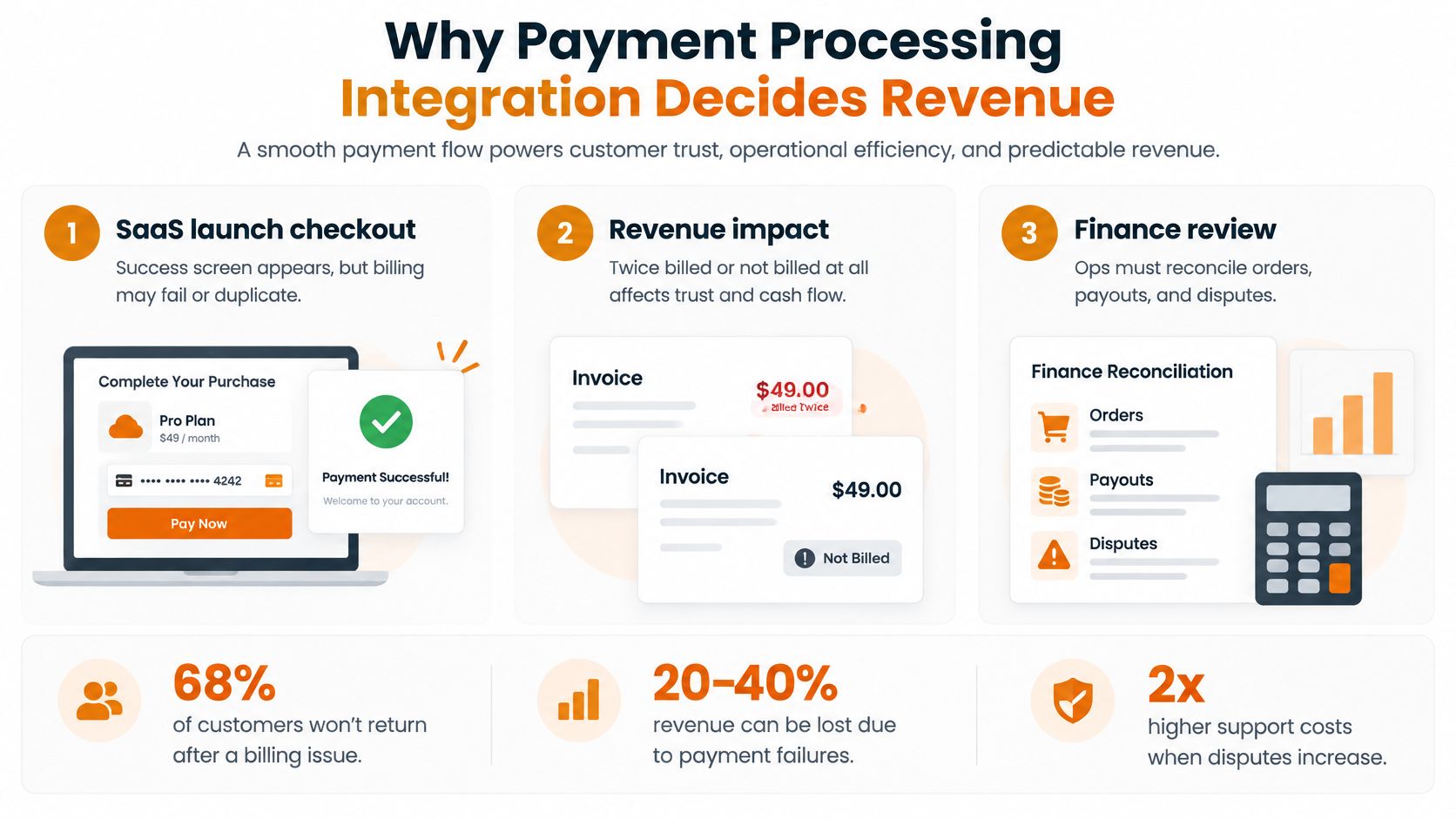
The outcomes worth managing are concrete. You want fewer duplicate charges, faster exception handling, settlement finance can trust, and lower compliance risk. Those results decide time to market in a new country, refund cost, dispute exposure, and whether revenue can be recognized without a side spreadsheet.
Cards alone are not the payment product. The World Bank's Global Findex 2021 found that 76% of adults worldwide held an account with a bank, a regulated institution, or a mobile-money provider in 2021, up from 51% in 2011 and 68% in 2017. 64% of adults globally, equal to 84% of account owners, made or received at least one digital payment that year.
The split by income is an architecture requirement, not a marketing footnote. 95% of adults in high-income economies made or received digital payments, compared with 57% in developing economies. That developing-economy share rose from 35% in 2014 to 57% in 2021. Excluding China, more than 40% of adults in developing economies who paid a merchant with a card, phone, or internet connection did so for the first time after the pandemic began.
Bank accounts, mobile money, and wallets change onboarding and routing by market. A card-only flow that converts in one country will drop orders, and create unreconciled exceptions, in another.
A correct integration protects cash you can explain, not a green button you can demo.
Set the decision order before you pick a vendor demo. Architecture first, then card-data boundaries, billing events, failure tests, and a delivery model where senior engineers stay accountable for live money.
A checkout widget that looks smooth in a sandbox can still trap you. The choice is among three shapes, scored on portability and what happens when the primary processor fails.
| Model | Customer experience | PCI and data scope | Failover and token portability | Best fit |
|---|---|---|---|---|
| Hosted or redirect checkout | Extra hop, lowest in-app card handling | Narrower app scope if the provider hosts the card form | Weak if tokens stay locked to that provider | First market, small team, simple catalog |
| Direct API in a tight card environment | Smoother in-app flow, more of your UI | Wider scope, you own more of the data path | Failover is hard if you stored raw credentials or provider-only tokens | High control, and a team that will run the control evidence |
| Orchestration across processors | One checkout, many local methods | Depends on who hosts the card form | Portable tokens and normalized states make routing real | Multi-market SaaS that can't stop on one outage |
Hosted or redirect checkout keeps raw card data off your servers, which is the right default for most SaaS teams. Friction goes up by a redirect or embedded frame. You move fast, then discover the token can't travel when you add a second processor.
A direct API feels like product control. It also pulls your app into a tighter card environment. Local payment methods still won't behave like cards, and a timeout still doesn't tell you whether money moved.
An orchestration layer normalizes states across processors. It costs more operational effort up front. It's the only shape that treats failover as a design, not a hope. A second PSP doesn't create resilience by itself. You still need portable tokens, shared states, and a tested route.
Recent enterprise-merchant research in The Payments Resilience Playbook found that 92% experienced a payment outage or disruption in the previous two years, yet only 32% had automated, real-time failover. Most still reroute by hand. Half of affected merchants reported losses between £1.1 million and £10 million per incident.
Adding a local method can lift conversion and still fragment error codes and settlement files. Reject any demo that can't move stored credentials without forcing the customer to retype them, and without breaking token ownership or the contract.
Practical rule: If you can't name the token owner and the failover path, you don't have an architecture. You have a checkout.
Rite NRG's architects in Poland map rails, data residency, and token portability, then challenge a single-processor plan and stay accountable for the production design. Qualifying fixed-scope work can target an agreed release in 45 working days. The same discipline shows up in how teams handle system integration challenges beyond payments. Don't accept a ticket that only wires the happy path.
Whichever model you picked, every attempt is a distributed transaction, not one synchronous call. A timeout doesn't tell you the processor finished the charge.
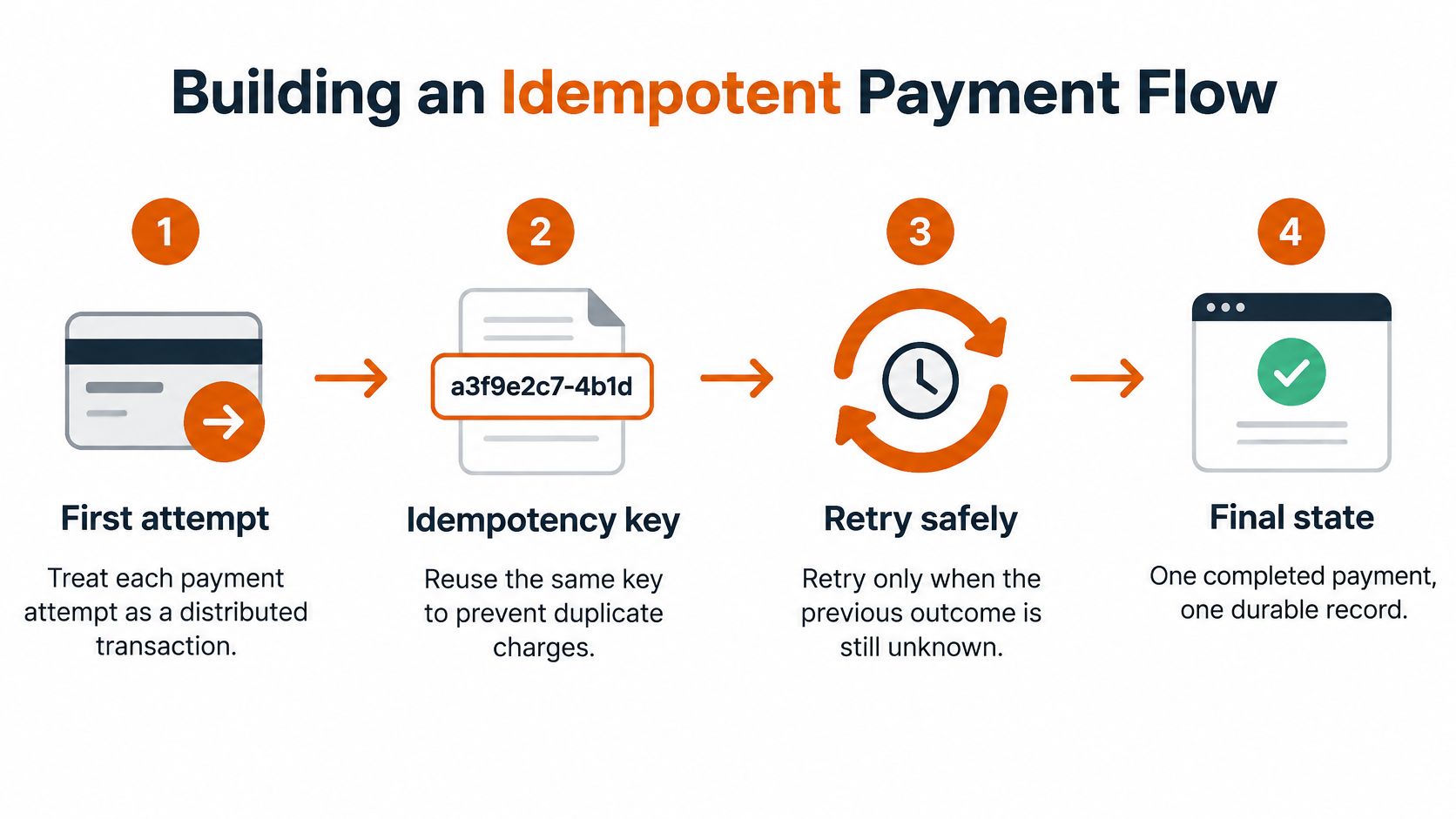
Run the attempt in this order.
order_id before you call anyone. If your database doesn't have the row, you don't have a payment to reason about.Stripe's idempotent request guidance states that repeating a request with the same key safely returns the original result, including certain server errors. Changing parameters on an existing key is rejected. For network failures, retry with the same key and the same parameters for up to 24 hours. After that, stop issuing new mutations and reconcile through object retrieval and webhook events.
Put a database uniqueness constraint on the business payment reference. Drive an explicit state machine: PENDING, then PROCESSING, then SUCCEEDED, FAILED, or UNKNOWN. Use exponential backoff with jitter, and bound the worker retries.
Measure four things from day one: duplicate-prevention hits, webhook lag, unknown outcomes, and reconciliation completion. If those gauges stay dark, you're guessing.
Minting a new key on every retry turns a transient unknown into duplicate-charge risk. Treating the browser redirect as proof of payment is the other trap. Fulfillment waits for verified server-to-server status.
The short walkthrough below shows why the same key has to survive the retry, not just the first POST.
Security fails in the boring places: a log line, a support export, an analytics payload, a cache you forgot. Payment processing integration and PCI DSS have to be designed on the same data-flow map.

Start by listing every place a primary account number could enter, cross a network, or land in logs, caches, analytics, error traces, or support tools. Prefer tokenization or hosted components so raw PANs stay outside the application whenever the business allows it.
PCI DSS guidance requires primary account numbers to be protected with strong cryptography when they cross easily accessed, untrusted, or public networks. HTTPS doesn't close the obligation. Certificate validation, script governance, and what you store still matter.
PCI DSS v4.0 staged the work: eleven requirements applied immediately, and nine additional requirements became applicable after 31 March 2025. Treat that date as a control calendar, not a press note.
Work the boundary in this order.
Run negative tests for altered amounts, wrong currencies, replayed events, expired tokens, authorization reversals, partial refunds, and provider outages. Ban ungoverned third-party scripts on payment pages. Storing full request bodies "just for debugging" is a common own goal.
Fulfillment still can't run until the server has verified payment state. That's the same gate as the runtime sequence, applied here as a release check rather than a retry rule.
If a support tool can reconstruct a card number, your scope is wider than your architecture slide.
The first capture is the easy money. Renewals, proration, dunning, and partial refunds are where finance loses the plot, because two processors rarely name the same business event the same way.
Build a canonical payment ledger that outlives any one provider.
European Central Bank payment-fraud guidance shows that strong customer authentication has reduced fraud while attackers keep adapting. Authentication, fraud controls, and customer experience stay a design problem, not a one-time checklist. For the subscription mechanics around proration and dunning, a billing integration guide for SaaS builders is a useful companion to the ledger rules here.
Token choice shows up on this ledger as portability, not as a slogan. Network tokens, processor vault tokens, and a merchant-controlled vault differ in who can move the credential, where data must reside, and what you can still charge if a provider exits a market. Pick the vault that still works on the day you switch, not the one that was fastest in the sandbox.
Verify signatures. Deduplicate. Tolerate replay. Rotate secrets on a schedule you have practiced. Never grant or extend access from the client return URL.
Product and finance ask three questions. Did the renewal capture? Did the refund reach the customer? Which failures are processor declines rather than your bug? If the ledger can't answer those without a Slack thread, it isn't canonical.
A short daily close keeps the queue honest.
A green authorization in sandbox is the wrong success metric. It proves one happy request. It doesn't prove timeouts, replays, disputes, or a dead processor.
Fraud pressure also moves by rail, so a generic card checkout test won't cover you. The Federal Reserve Financial Services 2024 risk survey found fraud attempts up 10% for checks, 9% for ACH, and 6% for debit cards versus 2023. ACH fraud attempts surpassed credit-card fraud attempts, while losses stayed steady, and institutions reporting debit-card monetary losses rose 6%. Instant and real-time payment fraud attempts and losses decreased by 3% in 2024. Pick controls from observed risk on that rail, not from a slide that says "payments are risky."
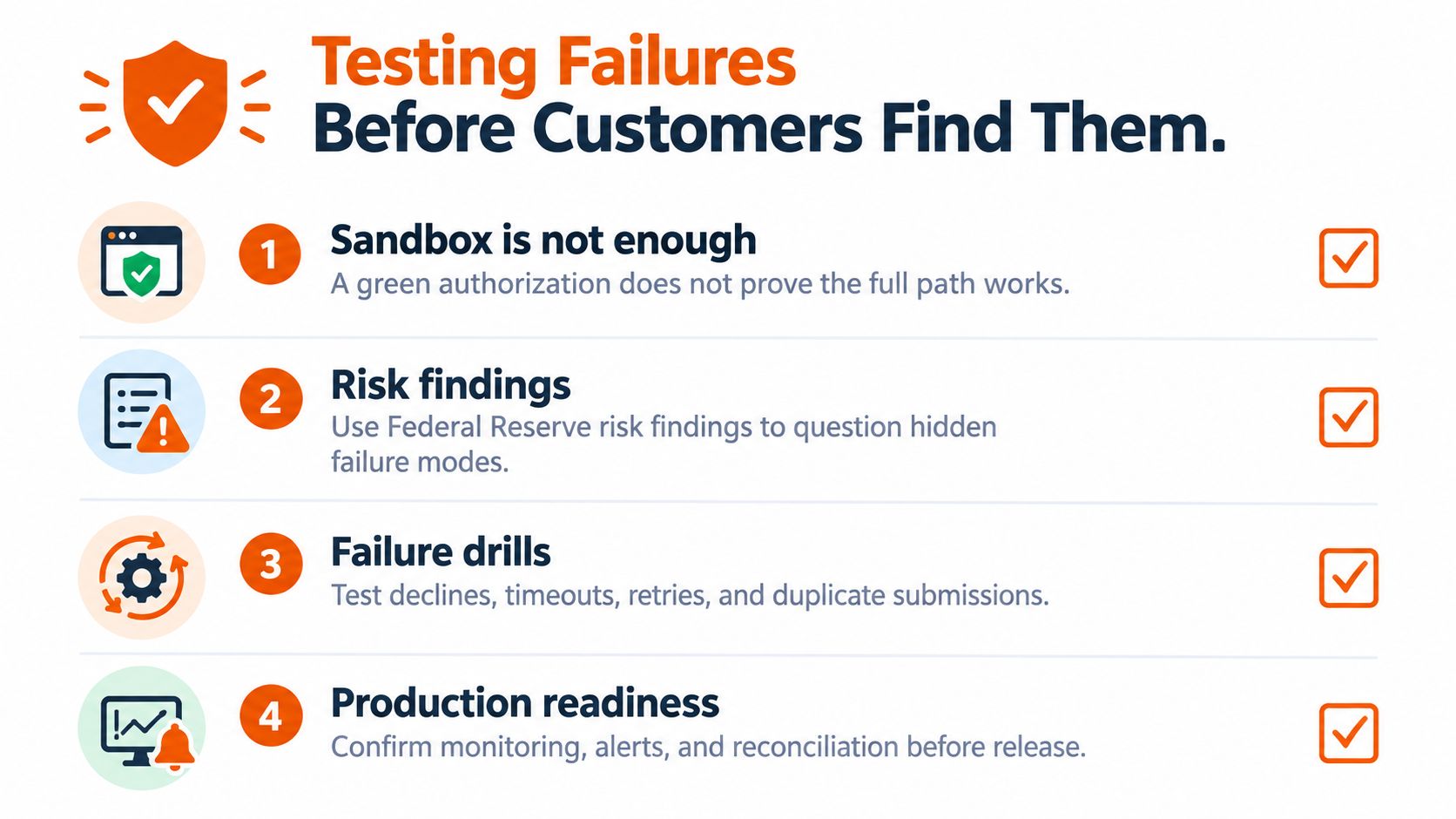
Run these before go-live and after every provider change. A second processor sitting idle in a config file is not resilience. You already know most merchants still reroute by hand. Manual rerouting during an outage is not a strategy.
Measure duplicate-charge rate, time to clear the exception queue, webhook lag, the share of unknown states reconciled, and recovery time against an agreed objective. Bound the workers. Jitter the retries. Alert when reconciliation gaps open. Keep audit logs with a named owner.
The same release bar belongs in your broader software quality assurance practice. A senior partner should reject a plan whose only passing test is "the authorization returned 200."
If you haven't failed the processor on purpose, your customers will do it for you.
AI changes the cost and speed of delivery. It doesn't change the engineering standard. Faster code that nobody owns is just a quicker way to ship a bad charge.
NIST's Secure Software Development Framework groups the work into four practices: prepare the organization, protect the software, produce well-secured software, and respond to vulnerabilities. On a payment system that means named owners for architecture and data flows, protection of code, secrets, dependencies, and transaction data, security tests before release, and a production path for defects that still escape. NIST's aim is fewer vulnerabilities in what you ship, less damage from what you miss, and fixes that stop the same bug returning.
NIST SP 800-218A adds generative-AI practices on top of that core framework, for people who build models, people who build systems that use them, and people who buy those systems. Agents can speed analysis, implementation, test generation, documentation, and migration. Senior architects still approve the design, the test evidence, the secrets, and the decision to process live money. Unreviewed code volume is not a delivery metric.
The #riteway stance is plain. Take extreme ownership, call risks early, say the status out loud, and stay accountable past the assigned ticket. Poland-based nearshore teams do this for startups, scale-ups, and enterprises, with a 4.9/5 client rating on Clutch and recognition in the Deloitte Technology Fast 50 Central Europe and Fast 500 EMEA rankings. Managed services after launch keep monitoring and fixes with the same partner. How that model works day to day is covered in nearshore software development.
Book a working session to map rails, token portability, PCI boundaries, and a fixed-scope production release. Don't ask for another API sample.
Rite NRG designs and builds payment processing integration as production infrastructure, with senior architects accountable for states, security, and the release that handles live money. If your checkout, ledger, and processor still disagree, start with a working session instead of another sandbox demo. Visit Rite NRG to map the rails and a fixed-scope path to production.
/ about the author
Written by the RITE NRG editorial team — the architects, engineers and delivery leads who build and operate AI-era software for our clients.
Strategy & Transformation
A practical, finance-ready framework for comparing AI and modernization investment with the current-state cost, realistic benefits, delivery risk and time to value.
Technology Talent & Teams
A decision-maker's guide to IT partnership models: what each model actually transfers to the partner, what it costs beyond the rate card, and how to match the model to your situation.
AI Consulting & Automation
A practical framework for choosing and deploying transport or logistics AI agents around real exceptions, reliable data and controlled operational authority.
More guidance: all insights articles
Tell us about the system or idea behind this article. We tell you honestly if it is a fit — and what a fixed-scope delivery could look like.