

Strategy & Transformation
How to Calculate ROI for AI and Software Modernization
A practical, finance-ready framework for comparing AI and modernization investment with the current-state cost, realistic benefits, delivery risk and time to value.
operationalwrocław--:-- cet
∕ insights / okrs-and-kpis.md
Okrs And Kpis
Master OKRs and KPIs for faster SaaS product delivery. Learn to align metrics, use AI-native engineering, and drive predictable outcomes.
>_article.meta
OKRs are time-bound change agendas, while KPIs are ongoing health monitors. They work best together: KPIs protect operational stability, and OKRs focus the organization on measurable strategic progress.
The counterintuitive problem in AI-assisted engineering is that faster output can coexist with weaker delivery. The 2025 DORA research found that 90% of respondents used AI at work and more than 80% believed it improved productivity, yet it also found a negative relationship between AI adoption and delivery stability (DORA's 2025 research). More generated code, more deployments, or more completed tickets can therefore create the appearance of progress while churn, security exposure, rework, or customer frustration gets worse.
For SaaS product teams, the distinction between activity metrics and business outcomes has never mattered more. Coding is a means to reach faster time to market, lower operating costs, greater platform capacity, improved quality, reduced risk, or revenue growth. A useful measurement system makes that connection visible and gives senior engineers the authority to protect the complete result.
Moving fast without moving forward is one of the most expensive habits in SaaS. A team can increase deployment activity while customers experience unreliable releases, confusing onboarding, unresolved defects, or security weaknesses. The technology is moving, but the business isn't necessarily gaining capacity, revenue, or trust.
The right question isn't “How much did we ship?” It's “What changed for the customer and the business because we shipped it?” That shift changes the conversation around engineering. Faster delivery matters when it shortens time to market, reduces operational effort, improves retention, enables more customers to use the platform, or lowers the risk attached to the next release.
Deployment frequency, story completion, lines of code, and AI-generated output can help teams understand workflow. None of them proves that the product created value. A leadership team that rewards those measures in isolation can encourage local optimization, where engineers maximize visible activity while product quality and commercial outcomes deteriorate.
Practical rule: Treat delivery metrics as evidence about a system, not as a complete definition of success.
A consulting mindset differs from order taking. A strategic technology partner challenges a request when the requested feature doesn't address the underlying business problem. The partner asks what outcome matters, identifies dependencies and risks early, moves unresolved decisions forward, and stays accountable for the production result rather than only completing an assigned ticket. Good delivery management makes that accountability visible through decisions, owners, risks, and outcomes.
AI changes the economics of delivery, but it doesn't lower engineering standards. Agentic tools can accelerate analysis, development, testing, documentation, and migration. Senior architects and engineers still own architecture, data integrity, security, test evidence, operational readiness, and production quality. Extreme Ownership means accepting responsibility for the full chain, including the consequences that appear after release.
The practical test is simple. If an initiative ships on schedule but increases support demand or creates technical debt that blocks the next product move, the team has delivered software, not necessarily business value. Strong OKRs and KPIs expose that difference before it becomes expensive.
An OKR, or Objective and Key Results, defines a time-bound change agenda. It combines a qualitative objective with measurable key results that show whether the intended shift is happening. A KPI, or Key Performance Indicator, monitors the ongoing health or efficiency of an operation. One pushes the organization toward a defined destination. The other tells leaders whether the vehicle remains safe and functional.
OKRs emerged from Intel's management practices in the 1970s and were later adopted by Google in the late 1990s. Formal organizational performance measurement rose in the late 1980s, helping establish the broader context in which recurring indicators such as uptime, churn, and defect rates became management tools (the history and distinction between OKRs and KPIs).
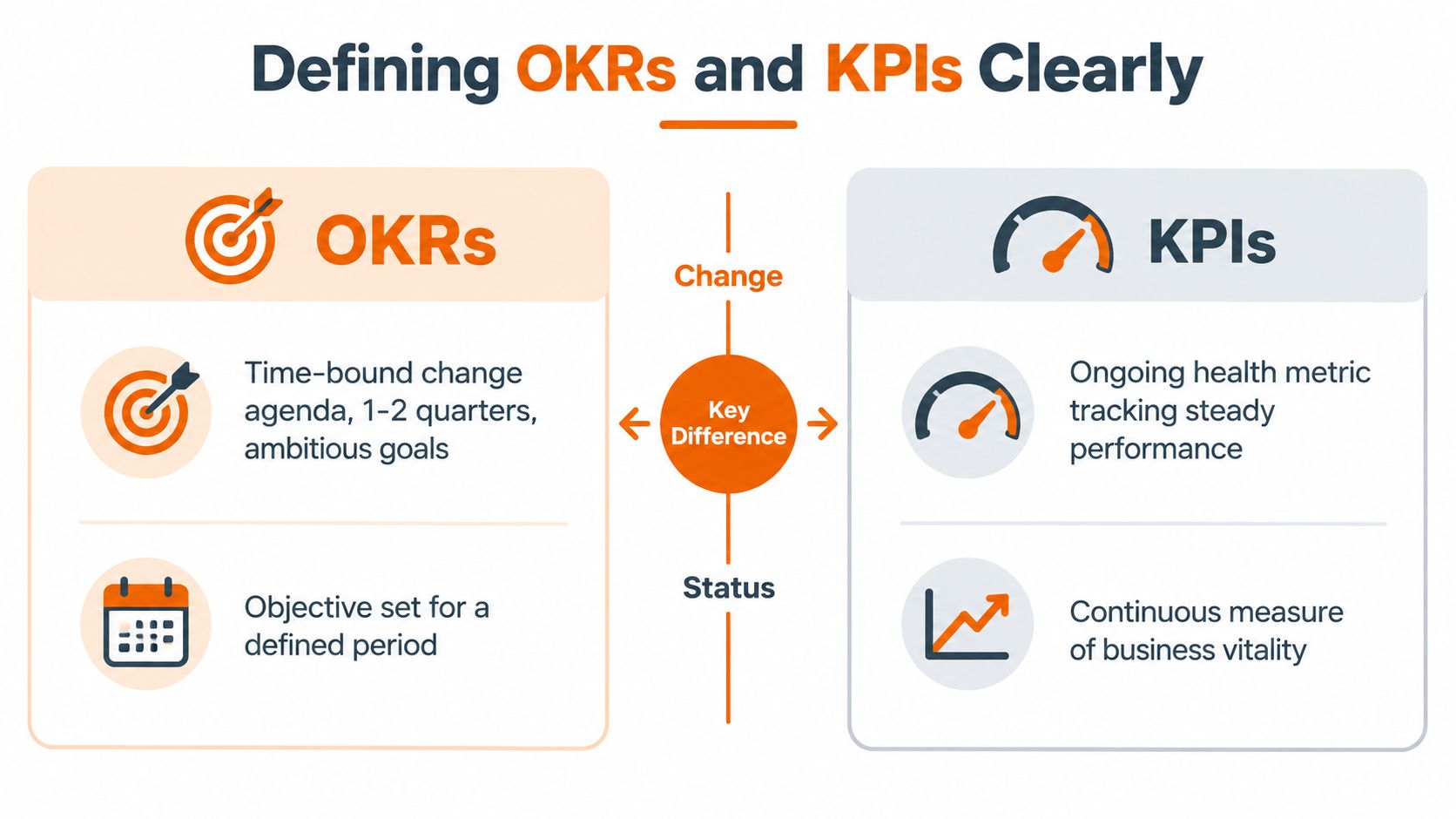
Think of KPIs as the dashboard. They show whether the engine, fuel, speed, and temperature remain within acceptable conditions. Think of OKRs as the GPS destination for the next leg of the journey. The dashboard keeps the journey safe, while the destination determines where the team directs its effort.
| Measurement layer | Primary question | Typical role |
|---|---|---|
| KPI | Is the ongoing operation healthy? | Monitor stability, efficiency, and risk |
| OKR | What strategic change must happen next? | Focus effort on a defined outcome |
| Key Result | What evidence will prove progress? | Make achievement testable |
Confusing the two produces predictable problems. If every KPI becomes a target, teams can optimize local numbers without making strategic progress. If every strategic ambition becomes a permanent KPI, the organization accumulates a crowded dashboard and loses the ability to distinguish urgent change from routine management.
A SaaS team might monitor service availability as a KPI because the business needs a stable baseline. It might then create an OKR focused on improving recovery from critical incidents within a defined cycle. The KPI protects the floor. The OKR funds and coordinates the improvement effort.
Teams looking for a broader explanation of how these layers support measurable growth through OKRs can use that comparison as a useful supplement. The operating principle remains practical: define the desired change first, then choose evidence that proves it. A disciplined approach to measuring project success keeps delivery activity connected to the business result.
OKRs and KPIs shouldn't compete for ownership of the same dashboard. They should form complementary measurement layers. KPIs monitor the health and stability of the operation, while OKRs define a time-bounded improvement agenda. This separation lets leaders pursue strategic change without losing sight of service quality, customer impact, or financial constraints (research on integrating OKRs and KPIs).
A useful architecture has three parts:
For example, a SaaS engineering team might retain 99.9% service availability as a KPI while setting an OKR to reduce average release lead time from 20 working days to 10. Those figures are examples of the architecture described in the source material, not universal targets. The point is the relationship: delivery speed becomes a strategic result only when availability remains protected.
The most common failure is turning every operational indicator into a goal. That approach encourages a team to improve what is easiest to count, even when the metric has drifted away from customer value. A deployment team might increase release volume while change failures and rollback effort rise. A product team might increase feature adoption while support demand reveals that customers are confused.
Use the KPI as a standing constraint, not as a substitute for strategy. Then write an OKR around the measurable improvement that matters now. Review the KR frequently enough to guide decisions, but keep the KPI visible so the team cannot claim success after damaging system health.
| Layer | Management purpose | Review behavior |
|---|---|---|
| KPI | Hold operational performance within an acceptable range | Monitor continuously or on its established reporting cadence |
| OKR | Move a strategic outcome during a defined cycle | Review progress, risks, and decisions during the cycle |
| Guardrail | Prevent harmful side effects | Escalate when quality, security, cost, or customer thresholds are breached |
A KPI can become a KR when leadership deliberately chooses to move it. Once the improvement cycle ends, it can return to routine monitoring with a new baseline. The label matters less than the job the metric performs.
AI makes software output cheaper to produce, so output alone says less about engineering performance. As noted earlier, DORA's 2025 research found that higher AI adoption correlated with lower delivery stability. The practical risk is straightforward: faster AI-assisted work can expose weak testing, shallow review, fragile architecture, and unclear release ownership.

An individual quota for AI-generated code creates the wrong incentive. Engineers gain a reason to maximize visible production, while review, threat modeling, test design, documentation, refactoring, and incident prevention become hidden costs. A team can ship more code and still leave customers with less reliable software.
Treat AI productivity as a team-level capability, not an individual KPI. Judge it through customer adoption, dependable releases, improved margin, lower delivery effort, or faster movement from a validated idea to production. A concrete failure pattern helps expose the trap: an agent generates a large change quickly, but engineers spend the saved time reviewing unsafe assumptions, repairing tests, and handling regressions. The activity metric improves while the business result worsens.
Leading indicators can explain that gap:
These indicators explain performance; they do not replace business outcomes. A dashboard that records faster reviews or higher code output without tracking rework can reward activity that increases operational cost. Use the indicators to locate the constraint, then judge the capability by the result customers and the business receive.
RITE NRG's Extreme Ownership framework sets the accountability boundary clearly. Engineers may use agents aggressively, while senior technical leaders remain responsible for architecture, data, security, testing, approvals, monitoring, and production quality. AI can accelerate delivery work. It cannot approve its own risk, define acceptable quality, or absorb the consequences of a bad release.
A Key Result should survive an audit by someone who wasn't in the planning meeting. “Improve onboarding” is an intention, not a measurable result. A verifiable KR defines exactly what counts, who owns the number, and where the evidence comes from.
The operational definition should include:
A concrete example is to increase activated accounts, defined as an account completing setup and performing one core action within seven days, from 42% to 55% by quarter-end, while keeping fraud loss below 0.5% of revenue (guidance on writing measurable KRs). That statement gives the team an outcome, a definition, a baseline, a target, a deadline, and a guardrail.
Manual progress tracking is a technical barrier. Spreadsheet updates arrive late, definitions drift, and teams spend review meetings debating the number instead of deciding what to do. A governed warehouse or product-analytics layer can automate collection, provided the underlying event instrumentation is reliable.
Version the metric definition. Validate that the relevant product events fire consistently. Record changes to the formula and preserve the historical context. If the team can't explain where a KR came from, how often it refreshes, or what changed its value, the metric isn't ready to drive decisions.
One to five measurable KRs per objective is a useful design boundary from established OKR guidance, but quantity isn't the main control. Each KR should represent evidence of progress toward the objective, not a list of tasks disguised as outcomes. “Deploy the new onboarding flow” is an initiative. “Increase activated accounts” is the result the initiative is meant to produce.
Speed creates business value only when it helps the company learn, launch, serve customers, and operate safely. DORA's software-delivery framework defines five measurable indicators: change lead time, deployment frequency, change fail rate, failed-deployment recovery time, and deployment rework rate (DORA's software-delivery metrics).
Each metric answers a different question:
The strength of this group is its balance. Deployment frequency alone can reward risky behavior. Change lead time alone can encourage rushed releases. The other indicators expose whether speed is creating operational instability or consuming capacity through repair.
A business-relevant objective might focus on shortening time to market while protecting service stability and limiting rework. The KRs can use DORA indicators as leading evidence, but leadership should still verify the customer and commercial result. Faster production movement matters when it enables a meaningful product improvement, not when it merely increases technical activity.
Quality also has multiple dimensions. The ISO/IEC 25010 model treats reliability, security, and maintainability as distinct product-quality characteristics (ISO/IEC 25010 quality characteristics). A team that improves release speed while reducing recoverability or increasing modification effort hasn't achieved a complete engineering win.
This is why engineering efficiency should be evaluated as a system property. Examine flow, quality, recovery, review effort, technical debt, and customer impact together. The best delivery teams don't choose between speed and responsibility. They design a release system in which speed remains useful because the surrounding controls make it dependable.
AI-assisted delivery needs explicit assurance thresholds, not informal confidence in generated output. NIST's Generative AI Risk Management Profile recommends setting minimum performance or assurance thresholds and incorporating them into deployment-approval policies and go or no-go decisions (NIST's Generative AI Risk Management Profile).
That means an AI-related OKR should pair a business result with guardrail KPIs. A team might pursue reduced delivery effort or faster release cycles while monitoring test evidence, unresolved risks, approval thresholds, security findings, and production incidents. If the business result improves but the guardrails fail, the initiative isn't ready to be called successful.
ISO/IEC 25010 identifies reliability, security, and maintainability as separate quality characteristics. Reliability includes faultlessness and availability. Security includes confidentiality and integrity. Maintainability includes modularity and analysability. These categories help leaders avoid reducing software quality to throughput or code volume.
A modernization objective aimed at increasing platform capacity should therefore track more than infrastructure output. It should include indicators for availability and recovery, access control and data integrity, and the effort required to modify the system safely over time. Those measures protect the business from an attractive short-term result that creates long-term operating cost.
A fixed-scope, fixed-price delivery model can work when governance starts early. The team must define scope, acceptance evidence, risks, ownership, and release thresholds before implementation accelerates. Agentic AI can compress analysis and delivery work inside that structure, while senior engineers remain accountable for the decisions that determine whether the result is safe to operate.
Start with the business outcome, not the dashboard. Decide whether the organization needs to protect an existing condition, create a measurable change, or do both. Then separate the measurements:
The final check is straightforward. Can the team explain what outcome it is pursuing, which KPIs must remain healthy, how each KR is calculated, who owns the decision, and what evidence permits release? If not, the organization isn't ready to scale delivery, regardless of how much activity its tools report.
For qualifying projects, a capable partner can deliver an agreed production release within 45 working days at a fixed scope and fixed price. The stronger promise is not speed alone. It is senior engineering accountability combined with structured agentic AI delivery, making complex technology faster, clearer, and more predictable.
Rite NRG helps SaaS companies and technology leaders plan, build, modernize, and operate business-critical software with senior engineering accountability and AI-native delivery. Visit Rite NRG to discuss how a disciplined OKR and KPI architecture can connect faster delivery with reliable production outcomes.
/ about the author
Written by the RITE NRG editorial team — the architects, engineers and delivery leads who build and operate AI-era software for our clients.
Strategy & Transformation
A practical, finance-ready framework for comparing AI and modernization investment with the current-state cost, realistic benefits, delivery risk and time to value.
AI Consulting & Automation
A practical framework for choosing and deploying transport or logistics AI agents around real exceptions, reliable data and controlled operational authority.
Industry Solutions
A practical roadmap for improving manufacturing systems and introducing AI without destabilising production, data integrity or operational control.
More guidance: all insights articles
Tell us about the system or idea behind this article. We tell you honestly if it is a fit — and what a fixed-scope delivery could look like.