

Strategy & Transformation
How to Calculate ROI for AI and Software Modernization
A practical, finance-ready framework for comparing AI and modernization investment with the current-state cost, realistic benefits, delivery risk and time to value.
operationalwrocław--:-- cet
∕ insights / micro-frontend-architecture.md
Micro Frontend Architecture
Micro frontend architecture explained: benefits, split strategies, deployment models, migration steps and trade-offs for SaaS teams and large web apps.
>_article.meta

Splitting your frontend won't automatically help you ship faster. If product decisions, reviews, and releases still require everyone's approval, micro frontends give you more applications to coordinate. Fix the delivery bottleneck, not the architecture diagram.
For SaaS founders and engineering leaders, the useful question is whether independent frontend delivery will get valuable changes to customers sooner without increasing operational cost or production risk beyond what the business can support.
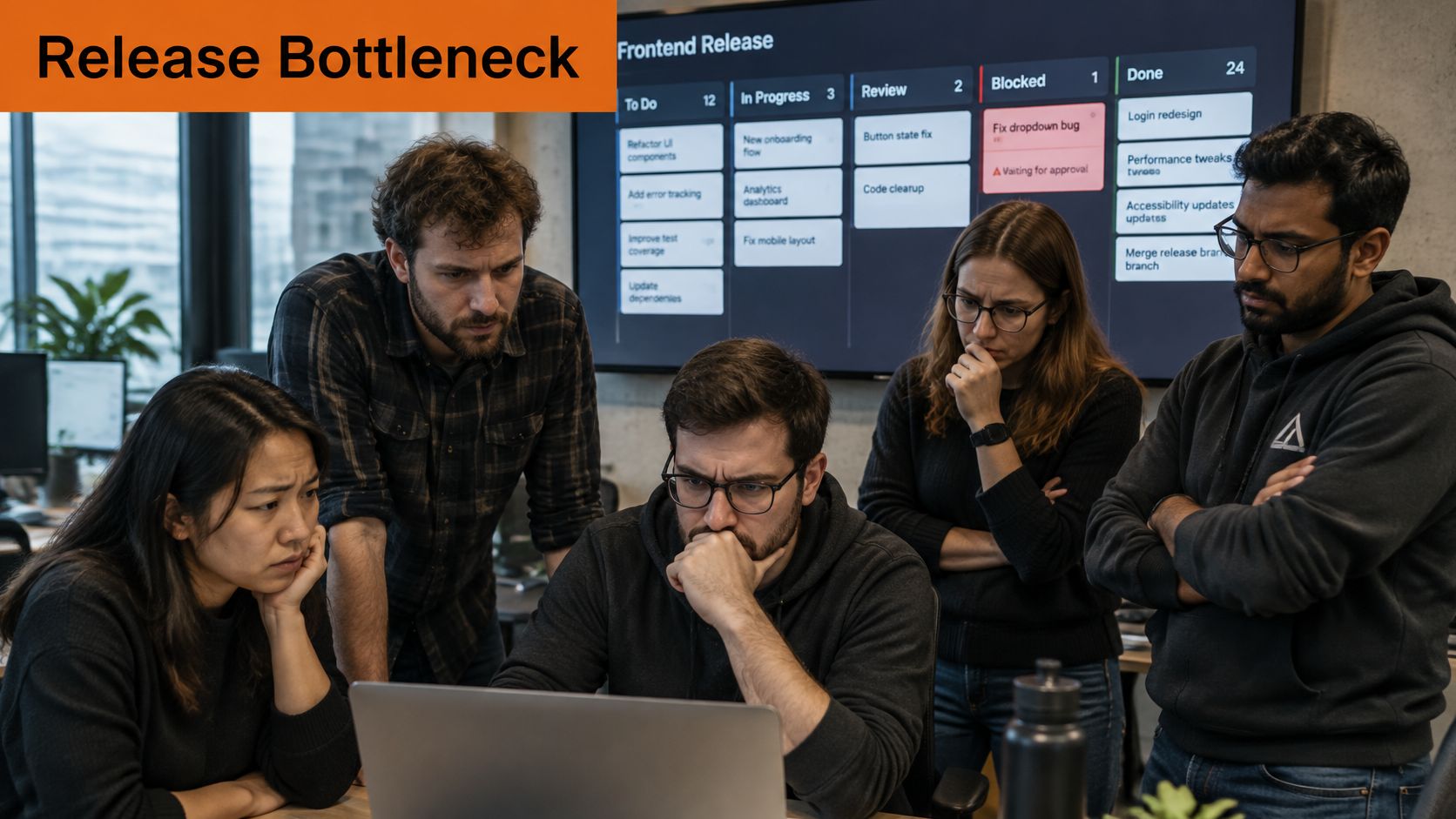
Consider a hypothetical product with one shared frontend, five teams, and one release train. A small fix waits a week behind unrelated work, developers repeatedly rebase branches, and a late bug sends completed features back through testing. The business pays through delayed launches, reduced engineering capacity, and rework on features it has already funded.
Micro frontend architecture divides that product into pages or business features that autonomous teams develop, test, and deploy independently. Customers still experience one product. Teams no longer need to coordinate every change through a single deployment.
The coordination problem becomes visible when teams inspect their shared delivery queue.
ThoughtWorks placed micro frontends on its Technology Radar in November 2016, in the Assess category, although independently owned page fragments and server-side composition predate the name. Treat the term as an architectural practice, not a new framework.
Those benefits require genuine team boundaries. If every feature still needs changes from every team, distributing the interface won't remove the dependency.
The decision should come down to clear evidence: whether your release patterns justify separation, whether meaningful ownership boundaries exist, and whether the resulting delivery improvement exceeds the ongoing integration cost.
| Option | Typical team count | Release independence | Duplicate JavaScript risk | Choose when |
|---|---|---|---|---|
| Modular monolith | 1-3 teams, as a planning guide | Shared release train | Low | Early product with one shared roadmap |
| Route-level composition | Several teams with separate page ownership | Independent releases per route | Medium | Distinct pages owned by different teams |
| Full runtime federation | Multiple autonomous domain teams with platform support | Fully independent releases per remote | High without strict version governance | Separate domains, release cadences and business owners |
Frontend architecture options compared by fit. These are advisory fit guides, not researched staffing limits. A team's release requirements matter more than its headcount.
Start with the cheapest architecture that removes your actual constraint. A modular monolith can provide strong code ownership, isolated feature modules, and straightforward testing without introducing runtime version negotiation.
Route-level composition is the sensible middle ground when different teams own distinct destinations. Full federation earns consideration when independently deployed modules must participate within the same application experience.
A 2025 study of 200 professionals found that 39% of startup respondents had implemented micro frontends; adopters reported parallel-development benefits at 74.35%, scalability at 66%, and modularity at 61%, while 53.84% identified architectural complexity as a significant barrier.
That's not an argument for a faster MVP. It's a reason to compare delivery benefits against platform work, integration testing, monitoring, and incident support.
Score these questions as low, medium, or high:
If most answers are low, keep the modular monolith. Only when independent team demand and domain volatility both score high should full federation become a serious candidate, with operational maturity acting as a readiness gate.
Set explicit acceptance thresholds for independently deployable teams, permitted duplicate JavaScript, and required rollback isolation. Choose those thresholds from your product's constraints, not someone else's benchmark.
Practical rule: Stay with a modular monolith until ownership and release boundaries are already complex enough to justify separating deployment.
For broader decision context, use this explanation of software architecture to connect structural choices to business requirements. When assessing incremental replacement, WebinOne on reducing migration risk offers useful context on composable architecture rather than treating modernization as an all-or-nothing rewrite.
Think of a food court: each stall runs its own kitchen and menu, but customers sit at one shared table with one bill. Your teams need comparable independence behind a coherent customer experience.
The useful boundaries follow customer journeys and business capabilities, not arbitrary component categories.
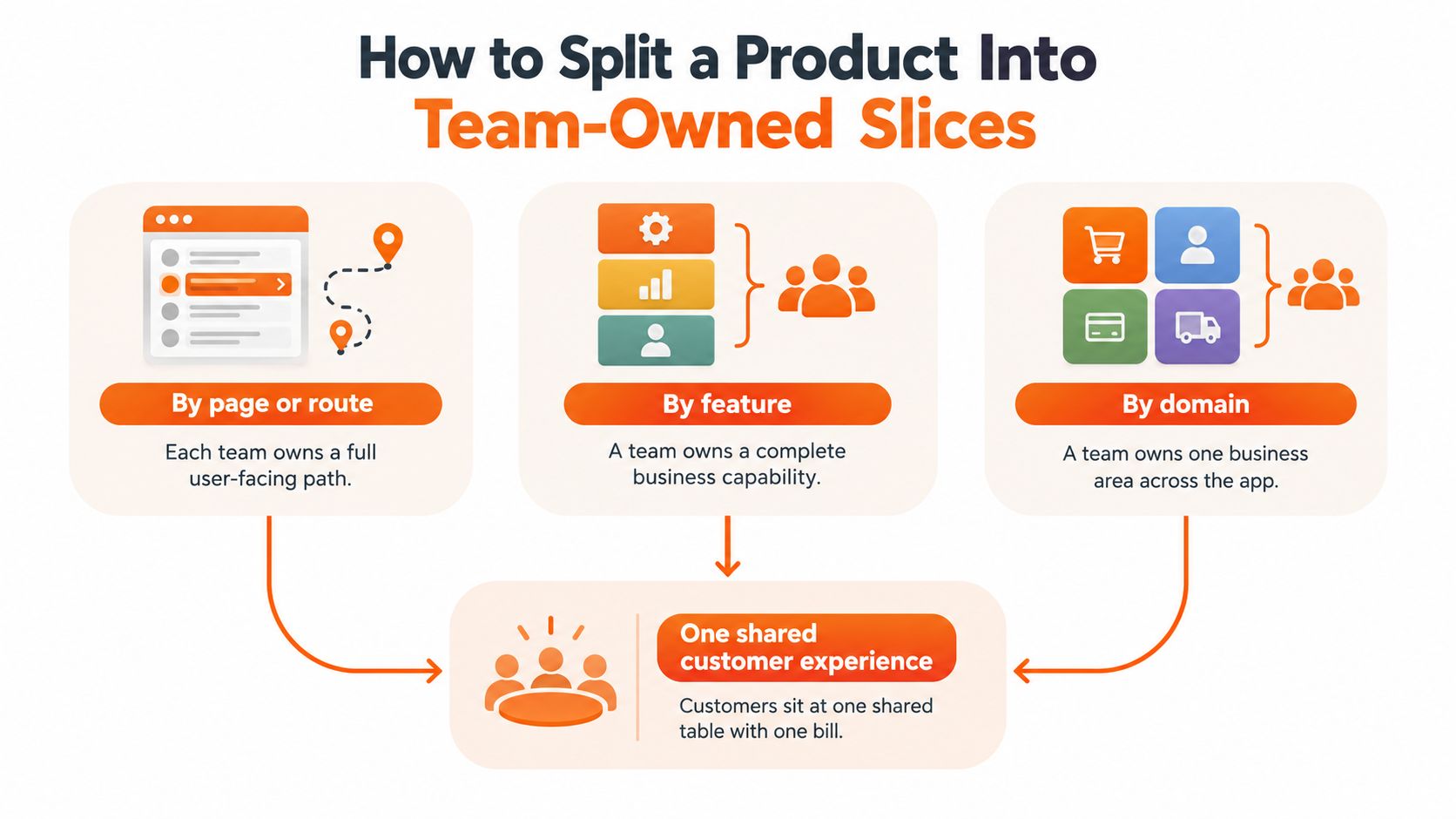
A 2025 technical study of micro frontends describes autonomous development and deployment as core mechanics of separately maintained interface modules. A folder with a team name isn't enough if that team still needs everyone else to release.
Use domain-driven design architecture to identify business language, ownership, and interfaces before deciding how many applications to create.
For a SaaS product, billing, onboarding, and reporting might be sensible slices. The billing team owns subscription screens and payment-related interface behavior; onboarding owns activation journeys; reporting owns report configuration and presentation.
Each team should own its UI, data contract, delivery pipeline, and on-call responsibility. Owning the data contract means taking responsibility for the interface the frontend consumes, not bypassing backend ownership or querying another domain's database.
The shell, design system, authentication integration, and routing rules remain shared. Give those assets named maintainers so shared ownership doesn't become nobody's responsibility.
Don't put headers in one team and forms in another. That split makes ordinary features cross organizational boundaries and creates handoffs rather than autonomy.
For a complementary walkthrough of micro frontend boundaries and composition, use this video.
Independence fails at the seams. Teams can build excellent modules individually and still deliver a fragile product if navigation, identity, and cross-application updates rely on undocumented assumptions.
Choose the smallest communication mechanism that fits the interaction:
Specify event names, payload schemas, versioned APIs, authentication behavior, and failure handling. Every remote, meaning an independently loaded frontend module, declares the shared-library versions it supports.
Breaking event or API changes require a new version. Keep the old version available until every consumer has migrated, with a named owner tracking that transition.
A micro frontend thesis evaluating runtime federation reported that scaling its prototype to ten business micro-apps didn't degrade measured performance. Its small increases in Total Blocking Time and Largest Contentful Paint were attributed to client-side composition and lazy loading, which makes representative composition testing more useful than assuming module count alone determines performance.
Validate your contract at the expected application scale, not just with a pair of demonstration apps. Test unavailable remotes, incompatible versions, expired sessions, and slow responses as deliberately as successful navigation.
A faulty remote must show a useful fallback, not prevent customers from using the rest of the product.
The shell team owns routing, fallback screens, and the product-wide incident bridge. Remote teams own errors within their slices, while the shell enforces compatibility checks and rollback behavior.
Set JavaScript and interaction budgets per remote and enforce them in its release pipeline. Treat these as system integration challenges with explicit owners, not last-minute frontend debugging.
Micro frontends do not make an application faster by default. Dependency sharing can reduce duplicated JavaScript and improve startup performance, but the result depends on what the browser loads and how teams coordinate releases. For smaller teams, the ongoing cost of shared-version decisions, runtime monitoring, and troubleshooting can outweigh the autonomy gained from independent deployments.
Build-time integration combines modules into a deployable artifact before release. Teams can validate the resolved dependency graph early, but updates usually require rebuilding and deploying the combined application.
Runtime federation loads independently published modules while the application runs. Teams gain separate deployment schedules, but must handle missing assets, incompatible versions, and failures that appear only when particular releases meet.
A hybrid can work well. Keep the shell and core experience predictable, and independently deliver only the areas with clearly different release needs. Choose runtime federation when the teams can own the coordination and monitoring it adds. Otherwise, build-time integration keeps more of that complexity out of production.
Poorly managed remotes can duplicate frameworks and create request waterfalls. A smaller entry bundle will not help much if the browser must discover, download, and initialize several modules before users can work.
Measure JavaScript transfer, request count, cache hit rate, memory use, and Core Web Vitals under representative mobile-network conditions. Include lower-powered devices and authenticated journeys, not just the public landing page.
Use time to interactive as one comparison measure, not as a substitute for ongoing user-experience monitoring. Track the cost of composing and observing the application alongside customer outcomes. The decision is whether customers can complete their work reliably, not whether one laboratory measurement looks impressive.
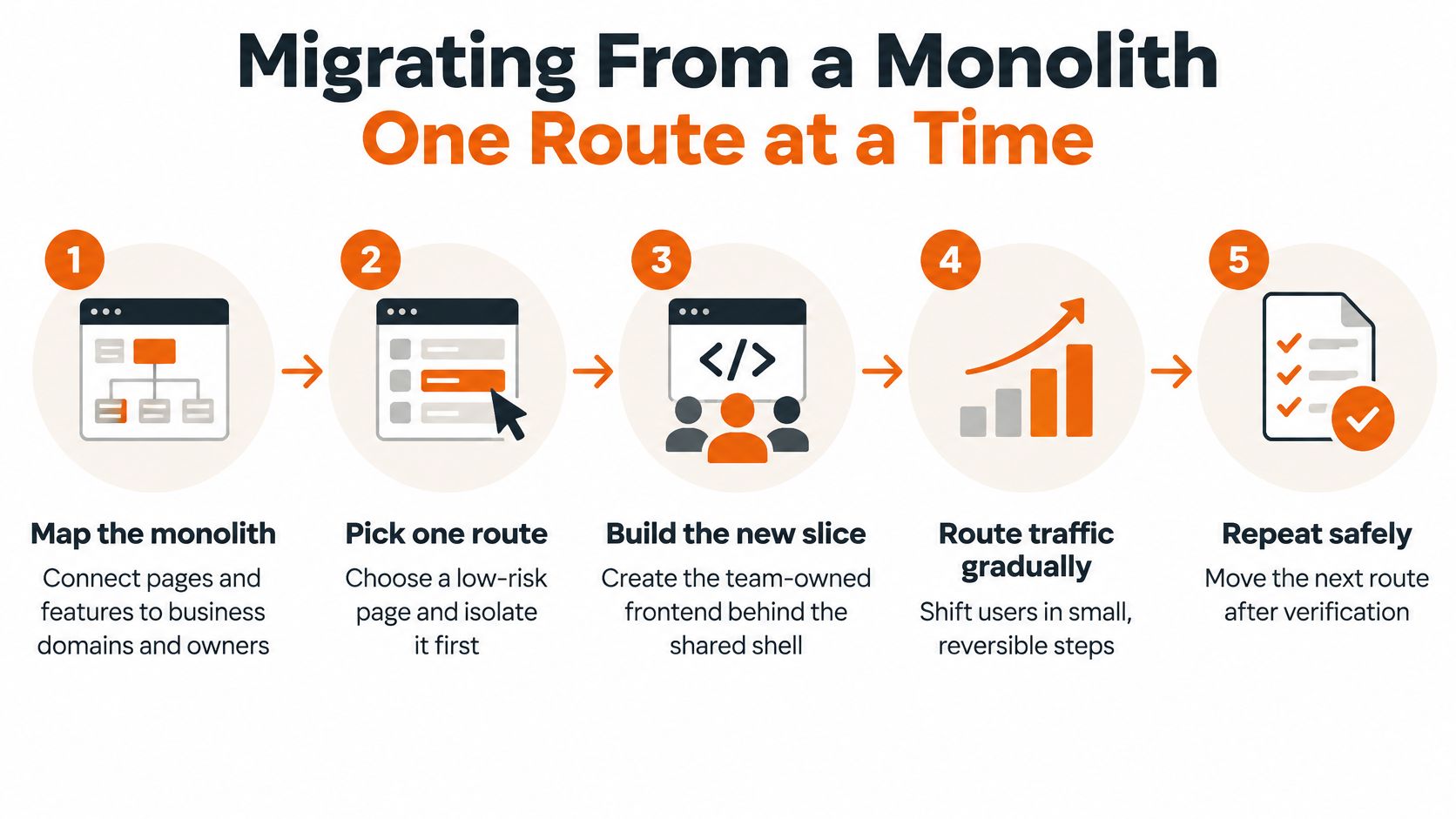
Treat migration as a sequence of reversible business decisions. Keep the existing product available while you prove that the new delivery model works.
The migration path should preserve a working route back to the monolith.
Agree on dependency allowlists, JavaScript and interaction budgets, incident responsibility, and an emergency remote-disable switch before extraction. A review of micro frontend implementation challenges identifies recurring integration, communication, dependency, performance, and user-experience problems that require product-wide governance.
The central enablement team owns the runtime contract, including trace correlation, source-map access, accessibility checks, and authentication integration. Backend services must still enforce authorization; loading a trusted frontend module doesn't authorize its requests.
Map the monolith. Connect pages and features to business domains and named owners. Keep the mapping separate from code changes so you can revise an incorrect boundary without disrupting production.
Pick a low-risk, high-change route. Choose a useful destination with limited dependencies, not the most commercially sensitive workflow. Leave the original route intact while the replacement is built.
Stand up the shell. Establish routing, authentication integration, and the shared design system. Keep existing pages reachable through the shell so its introduction doesn't force immediate extraction.
Move the route into a remote. Give it an independent pipeline and retain a fallback to the monolith. Route selected traffic to the new implementation while preserving the ability to restore the old destination.
Prove recovery. Add compatibility tests and a feature flag, then rehearse restoring the old path in minutes as an operational target. Keep versioned assets available so rollback doesn't depend on rebuilding old code.
Require stable releases before expanding. Verify support readiness, customer behavior, and incident diagnosis before selecting another slice. Pause migration or return traffic to the original implementation when evidence doesn't support expansion.
Define consolidation criteria. Recombine remotes that share an owner and release cadence without delivering useful isolation. Preserve their public interfaces during consolidation so you can reverse the change if necessary.
This is Extreme Ownership in the #riteway methodology: surface risks early, move blocked decisions forward, communicate trade-offs openly, and keep senior engineers accountable for the complete production result. Finishing an extraction isn't success if support teams inherit an application they can't diagnose.
| Metric | Definition | How to measure before and after |
|---|---|---|
| Change lead time | Time from code commit to successful production deployment | Compare the median for the same teams before decomposition and for several months after |
| Deployment frequency | How often changes reach production | Count production deployments per team per week |
| Change failure rate | Share of deployments needing intervention because of a production failure | Track the percentage of releases that need a fix, rollback or hotfix |
DORA metrics to track before and after the split. DORA's delivery metrics guide defines change lead time, deployment frequency, and change failure rate as measures of delivery speed and stability.
Record a baseline before extraction. Then compare the same teams over several months, annotating changes in staffing, release policy, and workload so you don't credit the architecture for an unrelated improvement.
Track incidents and rollbacks associated with independent releases separately. A deployment pipeline can report success even when customers encounter a broken combination of shell and remote versions.
More modules aren't evidence of progress. Neither are more repositories, more pipelines, or a successful federation demonstration.
Ask what engineers can now do that they couldn't do before:
Decision standard: Autonomy creates value only when teams increase useful throughput without unacceptable instability or operating cost.
Shorter lead time lets a completed improvement reach customers sooner. Higher deployment frequency gives teams more opportunities to release small, useful changes, but empty deployments don't create business value.
Pair delivery measurements with the slice's commercial purpose. For onboarding, examine activation behavior; for billing, examine successful subscription changes; for reporting, examine whether customers can complete their reporting tasks.
Revenue effects require their own evidence. Faster deployment creates an opportunity to improve customer outcomes, not proof that revenue increased.
Give an engineering leader responsibility for interpreting the complete picture. If delivery improves but platform work consumes the recovered capacity, the business hasn't yet captured the expected benefit. Adjust the boundaries, simplify the implementation, or stop expanding.
Use a go/no-go gate before approving architecture work. As a deliberately conservative advisory threshold, proceed only when at least three teams need their own release cadence, each domain has a business owner and measurable outcomes, a platform owner accepts responsibility for shared contracts, and responders can trace failures across remotes.
A single product team on one release train is a no-go. So are coordination delays that better planning, smaller changes, or faster reviews could solve.
Name the engineering leader who signs off that first measurement. Don't let an architecture enthusiast approve their own success criteria after migration.
Our AI-native delivery model uses agentic AI to accelerate analysis, implementation, testing, documentation, and migration. AI changes delivery economics, not engineering standards: senior architects and engineers remain accountable for architecture, data, security, testing, and production quality.
Choose an internal platform team, a specialist partner, or a combined delivery team according to your operating capacity. The final decision belongs to your business case, not a preferred framework.
Rite NRG offers senior engineering reviews and accountable delivery for frontend modernization, from boundary design and integration contracts to security and production readiness. Visit Rite NRG to book a review, bring your release bottleneck and proposed first route, and name the engineering leader who'll approve the baseline measurement.
/ about the author
Written by the RITE NRG editorial team — the architects, engineers and delivery leads who build and operate AI-era software for our clients.
Strategy & Transformation
A practical, finance-ready framework for comparing AI and modernization investment with the current-state cost, realistic benefits, delivery risk and time to value.
Technology Talent & Teams
A decision-maker's guide to IT partnership models: what each model actually transfers to the partner, what it costs beyond the rate card, and how to match the model to your situation.
AI Consulting & Automation
A practical framework for choosing and deploying transport or logistics AI agents around real exceptions, reliable data and controlled operational authority.
More guidance: all insights articles
Tell us about the system or idea behind this article. We tell you honestly if it is a fit — and what a fixed-scope delivery could look like.