

Strategy & Transformation
How to Calculate ROI for AI and Software Modernization
A practical, finance-ready framework for comparing AI and modernization investment with the current-state cost, realistic benefits, delivery risk and time to value.
operationalwrocław--:-- cet
∕ insights / domain-driven-design-architecture.md
Domain Driven Design Architecture
Master domain driven design architecture to model bounded contexts, aggregates and events for scalable SaaS. Practical guide for engineering teams.
>_article.meta
Your SaaS team has a roadmap full of valuable work, yet every meaningful change seems to touch several services, databases and teams. A pricing update reaches billing, entitlements, reporting and customer support. An apparently small compliance request becomes a release coordination exercise. Engineers spend more time translating inconsistent terms than improving the product customers pay for.
That pattern isn't a failure of effort. It usually means the architecture no longer reflects how the business operates. Domain driven design architecture gives teams a practical way to organise software around business capabilities, clarify ownership and protect delivery speed as the product grows.
The #riteway approach adds a delivery discipline to the architecture. Extreme Ownership means someone owns each outcome, not merely a ticket or a service. High energy means teams surface risks early, make decisions decisively and keep momentum. Proactivity means architecture evolves before boundary erosion becomes an expensive rewrite. Rite NRG applies this product-minded perspective to help SaaS teams ship up to 50% faster without sacrificing quality or control, as described in its company information.
A growing SaaS company often reaches the same uncomfortable moment. The product has found traction, new teams are joining, and customers expect more capability. But the codebase still treats every request as a change to one connected system. The team adds a new subscription rule, then discovers that “customer” means one thing in sales, another in billing and something else in support.
The immediate result is rework. Product managers wait for several teams to coordinate. Engineers hesitate because they can't see the full impact of a change. Operations teams inherit unclear ownership, while compliance work exposes data flows nobody has documented properly. The issue isn't only technical complexity. It's unclear business responsibility encoded in software.
A domain driven design architecture starts with the outcomes the organisation must deliver. Instead of asking which database table or framework should own a feature, the team asks which business capability owns the decision. That shift helps product and engineering leaders connect architecture to release flow, customer experience, operational control and risk.
Ownership principle: A boundary is useful only when a team can understand it, change it and answer for its behaviour.
The UK public sector offers a large-scale example of this way of thinking. GOV.UK was built and launched from 2010 onward as the UK government's single domain for content and services, while the Government Design Principles were published on 3 April 2012 to reinforce reuse over reinvention. The associated UK government guidance on platforms, components and business capabilities shows why this matters for DDD. Services are organised around capabilities and reusable components rather than isolated technical systems.
For founders, CTOs and product managers, the practical question is simple: can your teams release a business change without negotiating with the whole company? This guide builds towards that answer, from domain language and bounded contexts to integration, migration and governance. The focus stays on measurable delivery outcomes, including shorter feedback loops, clearer accountability, lower transformation risk and more predictable quality. For a broader view of the platform decisions behind scalable SaaS products, see SaaS platform architecture.
Start with the business, not the technology. Domain-driven design focuses on the system domain, while storage, frameworks and infrastructure remain secondary implementation details, a distinction made clearly in Oxford's software engineering material on DDD.
A useful analogy is a busy restaurant. The restaurant's domain includes taking orders, preparing dishes, managing tables and settling bills. The kitchen equipment, till system and delivery platform support those activities, but they don't define what “an order accepted” means. If the business changes its reservation rules, the team should be able to change that business decision without redesigning the entire kitchen.
DDD asks teams to make those business decisions explicit. First, identify the domain problem customers pay you to solve. Then work with people who understand that problem, including sales, operations, compliance and support. Finally, express the resulting model in code so the software reflects the rules the business follows.
Suppose one team uses “customer” for anyone with an account, while another uses it only for a paying organisation. A third team may call an individual user a customer even when the contract belongs to a company. Those differences create incorrect reports, brittle integrations and slow conversations.
Ubiquitous language gives each context precise terms that product, engineering and domain specialists use consistently. Standardising terms such as customer, invoice and product can reduce ambiguity, minimise misinterpretation and speed collaboration, as explained in this UK guide to data domains and business terminology.
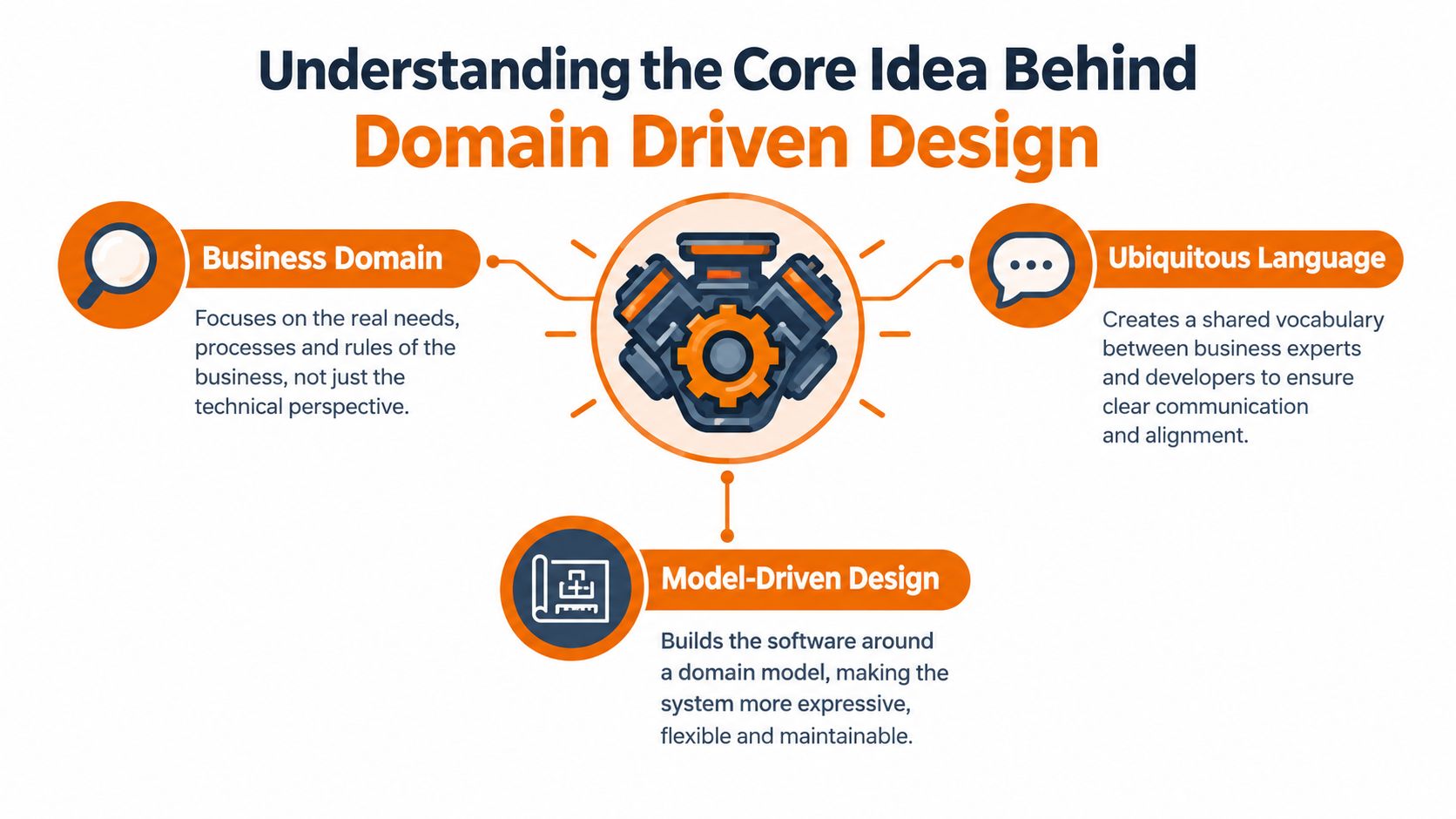
A strong model separates business rules from technical adapters. The billing domain shouldn't need to know whether data sits in PostgreSQL, a document store or a third-party platform. That separation reduces accidental complexity because a technology decision doesn't redefine a business concept.
DDD isn't a demand for elaborate diagrams or a particular programming language. It's a method for turning domain knowledge into architectural decisions. Research from St Andrews has identified the difficulty of generating architecture that remains consistent with domain knowledge, which supports the practical value of keeping domain concepts central rather than allowing technical structures to drive the model.
A bounded context is a deliberately defined area where a model and its language have a specific meaning. It prevents one universal model from carrying every interpretation of a business term.
Consider a SaaS platform with sales, support and inventory capabilities. Sales may treat a product as something offered to a prospect. Inventory may treat it as a stocked item with availability and fulfilment rules. Support may care about the product version attached to a customer issue. Each team needs relevant information, but forcing every meaning into one shared model creates noise and coupling.
Look for differences in responsibility, language, rules and change patterns. If two groups use the same word differently, that's a signal. If a feature repeatedly crosses team ownership, that's another. If one part of the product can evolve independently but is blocked by shared data structures, investigate the boundary rather than adding another integration shortcut.
GOV.UK demonstrates the value of capability-led organisation at national scale. Its platform direction treats reusable components and business capabilities as core architectural concerns, and the Government Digital and Data Profession's Enterprise Architect role requires professionals to take “a strategic view across all architectural domains” while recommending reuse, sustainability and scalability to reduce risk. The lesson for SaaS teams is direct: reuse should strengthen ownership, not erase it.
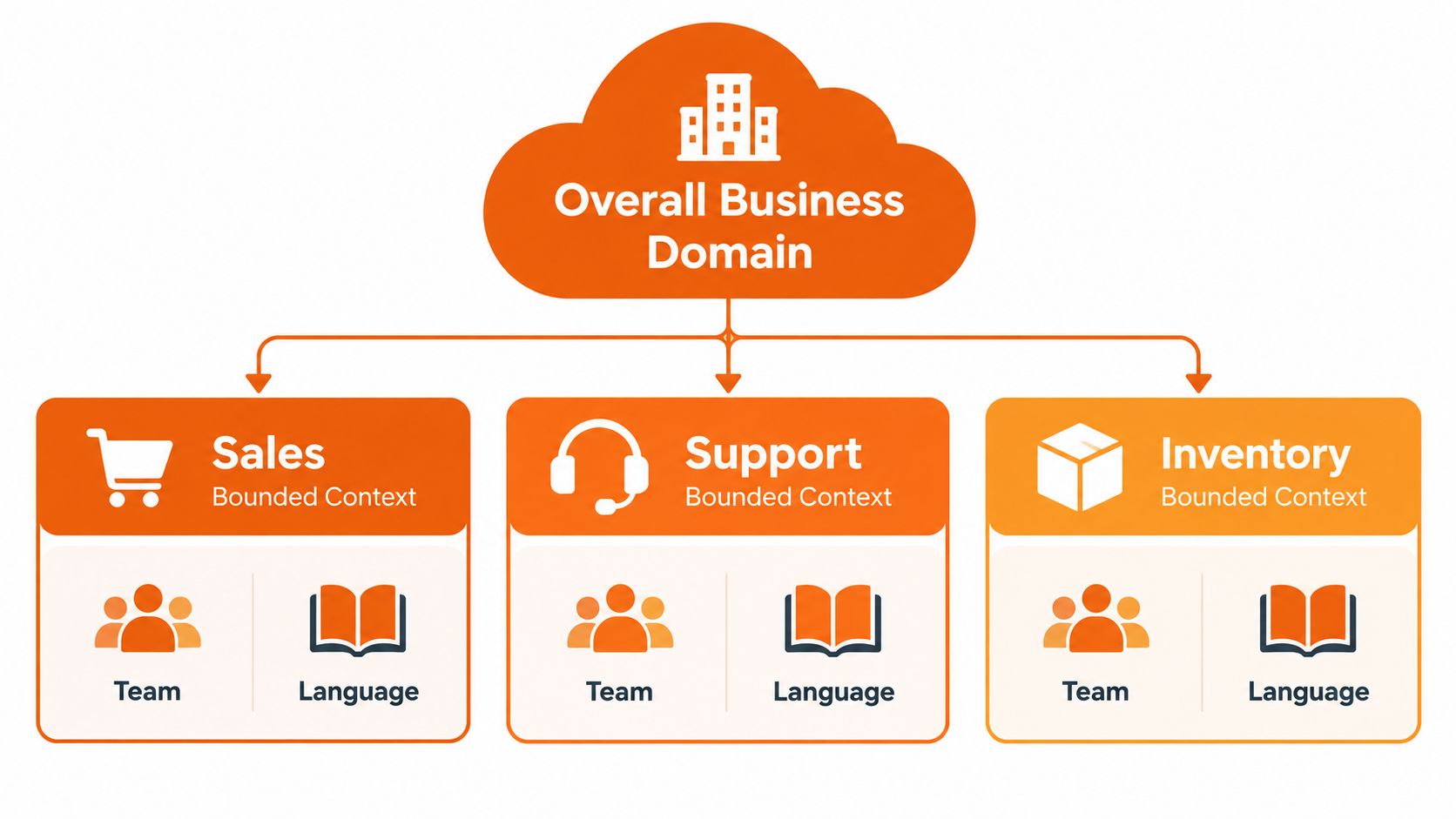
A bounded context needs more than a box on an architecture diagram. Assign a product owner, engineering owner and decision path. Define the language, supported capabilities, public contracts and data responsibilities. A team should know which decisions it can make without approval and which changes require collaboration.
A context map makes relationships visible. It should show who consumes whose capability, which model is authoritative and where translation happens. Avoid direct access to another context's internal database or repository. Expose a deliberate contract instead, even when both modules currently run in one application.
The result can be a modular monolith, a set of services or a combination. DDD doesn't prescribe deployment topology. It gives teams a way to decide whether a split will improve ownership and delivery, rather than creating distributed complexity for its own sake.
Inside a bounded context, tactical patterns help teams protect business rules. They aren't decorations for a class diagram. Each one answers a practical question about identity, change, consistency or communication.
An entity has continuity over time. A subscription remains the same subscription even when its plan or status changes. A value object describes something by its attributes rather than its identity, such as a currency amount, email address or postal address. Value objects are useful because they can enforce valid combinations and remove repeated validation from application code.
An aggregate groups related objects behind one entry point, called the aggregate root. It defines the consistency boundary for a business operation. If changing a subscription must also update its entitlement state under one business rule, those decisions may belong in the same aggregate. If two concepts can change independently, combining them creates unnecessary transaction scope and contention.
Start with the rule the business must protect. “A subscription can't activate without a valid payment authorisation” is more valuable than beginning with a subscriptions table. The aggregate should make invalid state difficult to create, while application services coordinate the use case around it.
Keep aggregates as small as the consistency requirement allows. A large aggregate may look convenient because it contains related data, but it can slow changes and encourage unrelated rules to depend on one object. Before choosing persistence, evaluate access patterns, consistency needs, operational constraints and team ownership through a deliberate database selection criteria process.
A domain event states that something important happened inside the domain, such as SubscriptionActivated or InvoiceIssued. It isn't merely a database trigger. It captures a business fact that other parts of the platform may consume without reaching into the originating context.
For example, the billing context can publish InvoiceIssued. Reporting can update its projection, notifications can prepare a message and customer support can expose the status. Each consumer can evolve independently, provided the event contract remains meaningful and managed.
Domain-specific stewardship also improves data quality, while mapping governance to domains makes privacy, security and regulatory controls easier to apply and audit, according to the UK data architecture guidance linked above. That makes tactical modelling an operational concern as well as a coding concern. Clear aggregates and events give compliance teams identifiable control points, while consistent terms help teams trace what data means and who owns it.
Boundaries only create value when integrations respect them. The common failure mode is a context that appears independent in diagrams but directly imports another context's database model, shares internal tables or copies undocumented assumptions into business logic.
Choose the integration pattern according to the relationship you need. An anti-corruption layer protects a core model from an external vocabulary. An open host service offers a deliberate protocol. A published language creates a shared contract for broader consumption. Event-driven integration adds temporal decoupling, but it also requires teams to manage delivery, replay, versioning and observability.
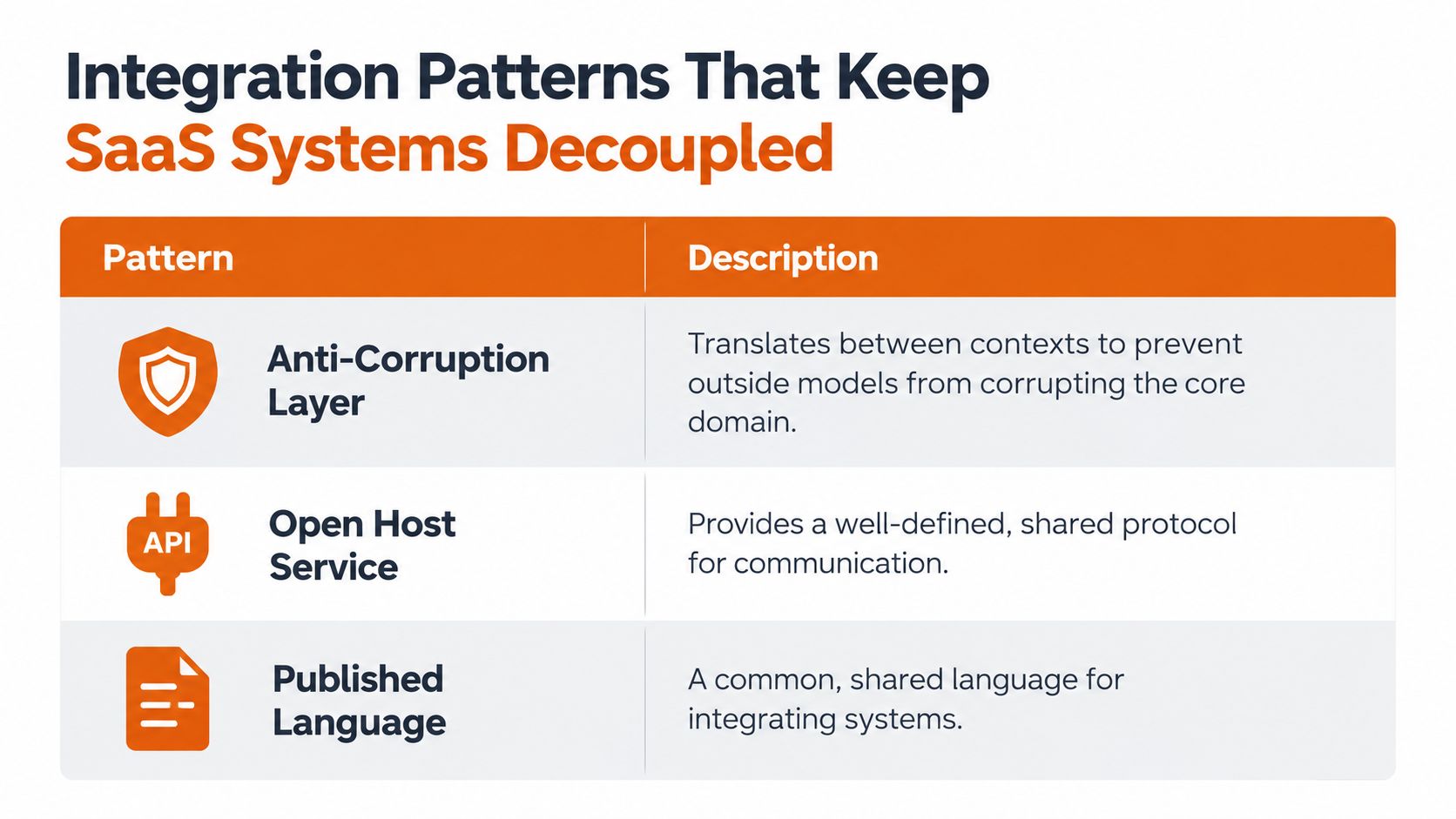
| Pattern | Best For | Trade-off to Manage |
|---|---|---|
| Anti-Corruption Layer | Protecting a core context from a legacy or external model | Translation code needs ownership and ongoing maintenance |
| Open Host Service | Offering stable capabilities through a well-defined API | The provider must manage compatibility and consumer expectations |
| Published Language | Integrating multiple consumers through a shared business contract | Governance is needed to evolve the contract without ambiguity |
An anti-corruption layer is especially useful when a legacy system uses terminology your product team can't allow into its core model. The translation belongs at the edge, so external change doesn't spread through the context. An open host service works when one context owns a capability that others need. Published language suits integration where several parties benefit from a common, explicit representation.
For teams assessing the broader integration environment, the resource on integrating 897 applications offers useful context for the coordination challenge. The exact pattern still depends on domain ownership, trust boundaries and the cost of operational support.
The UK National Cyber Security Centre describes Cross Domain Solutions as architectural techniques for secure end-to-end connectivity between systems with different levels of trust. Its Cross Domain Solutions guidance emphasises enabling information flow while mitigating cyber attacks and information leaks, with observability, manageability and end-to-end tracing designed in from the outset.
That guidance maps directly to DDD. A domain boundary defines more than code ownership. It can define trust, permitted data movement, audit points and operational control. The UK energy digitalisation framework also assigns domain coordinators responsibility for data standards, interoperability, simpler access and coherence across systems. SaaS leaders should apply the same discipline by naming contract owners, tracing important flows and documenting which context is authoritative for each business fact.
DDD adoption fails when a team treats it as a replacement programme. Rebuilding every service before delivering customer value creates risk, delays learning and gives architecture a reputation for slowing the business.
Start with one outcome that matters. Perhaps the team needs to change pricing safely, separate entitlement decisions from billing or expose a capability to a new channel. Map the current business flow with domain experts, identify conflicting language and mark the places where ownership changes. Event Storming can make those decisions visible without requiring a finished technical design.
A pragmatic sequence looks like this:
Legacy modernisation doesn't require abandoning useful systems. Deloitte UK describes DDD as a way to extend legacy system lifespans while enabling core functionality through standardised API endpoints, linking the approach to faster time-to-market, lower transformation risk, clearer regulatory compliance and greater customer-centricity in banking. Read its UK banking perspective on DDD and legacy modernisation for that business framing.
AI-assisted development increases the volume of proposed changes. That makes boundary discipline more important, not less. A generated feature can import another context's model, duplicate a rule or introduce a new meaning for an established term.
An evidence-based 2024 study reviewed 34 scientific studies and consulted 63 practitioners, identifying context identification, model consistency and integration across boundaries as major DDD challenges. The Oxford professional programme material on DDD reflects continued interest in the practice, including how teams keep models coherent as systems evolve.
Use architecture tests, dependency rules, contract tests and lightweight decision records. Require every AI-generated change to name its context, owner, business rule and integration contract. Under the #riteway mindset, Extreme Ownership means a human team remains accountable for the model, even when automation accelerates implementation.
A domain driven design architecture earns its place when it improves how the business delivers value. The architecture should help a team change a pricing rule without destabilising support workflows, add a channel without duplicating entitlement logic and demonstrate who controls sensitive data. Elegant aggregates matter only when they support those outcomes.
The UK public-sector examples point to three durable lessons. Organise around capabilities, reuse shared components deliberately and make governance part of the architecture. Secure integration guidance adds a fourth lesson: trace data flows end to end, especially where systems have different trust levels. These principles apply whether your SaaS platform is a modular monolith, a service ecosystem or a staged combination of both.
Ask your team:
A UK public-sector data architecture engagement reported the secure transition of more than 800 million classified records, achieved government security approvals and delivered a serverless platform designed for OFFICIAL-SENSITIVE hosting and resilience, according to this public-sector data architecture case study. The point isn't to copy that topology. It's to recognise that strategic architecture can connect domain ownership with real compliance and operational outcomes.
Architecture decisions still need context, trade-offs and disciplined execution. The practical guidance in how to design software architecture can help teams turn those decisions into an actionable system design.
Start with one capability, assign one accountable team and protect one meaningful boundary. Then measure whether the team can deliver change with less coordination, lower risk and clearer evidence. That is the #riteway standard: high energy in delivery, proactive risk management and Extreme Ownership of the outcome, not just the architecture diagram.
Rite NRG offers architecture advisory, end-to-end platform development and senior delivery teams for SaaS products that need clearer boundaries and more predictable execution. If your team is dealing with model drift, legacy constraints or integration risk, visit Rite NRG to discuss a practical domain-driven delivery plan.
/ about the author
Written by the RITE NRG editorial team — the architects, engineers and delivery leads who build and operate AI-era software for our clients.
Strategy & Transformation
A practical, finance-ready framework for comparing AI and modernization investment with the current-state cost, realistic benefits, delivery risk and time to value.
AI Consulting & Automation
A practical framework for choosing and deploying transport or logistics AI agents around real exceptions, reliable data and controlled operational authority.
Industry Solutions
A practical roadmap for improving manufacturing systems and introducing AI without destabilising production, data integrity or operational control.
More guidance: all insights articles
We can help you apply this thinking to the systems and teams you actually have.