When someone asks you how to design software architecture, what's the first thing that comes to mind? For many, it's about creating a strategic blueprint. It’s about aligning technology with business goals to build something that's scalable, maintainable, and actually delivers measurable business outcomes.
It really comes down to making those big, high-impact decisions—picking the right patterns, choosing the best tech—that shape how your application will deliver value before you even think about writing a single line of code.
Move Beyond Blueprints to Business Outcomes
Let’s be brutally honest for a moment. Most software architecture fails because it gets stuck in the weeds of being a purely technical exercise. I've seen it happen time and again: teams get completely lost in complex diagrams and chasing theoretical perfection, and they lose sight of why they're building the thing in the first place—to deliver real, tangible business outcomes.
The most elegant, technically perfect architecture on the planet is completely worthless if it doesn't help accelerate revenue, boost user engagement, or carve out a competitive advantage.
This guide is here to shatter that old way of thinking. We're going to reframe architecture from an abstract blueprint into the powerful engine that actually drives your entire business strategy forward. Every single decision, whether it's opting for a microservices pattern or selecting a database, has to be directly traceable back to a specific business objective. No exceptions.
Introducing the #riteway Methodology
This is exactly where our unique framework, the #riteway methodology, shines. It’s built on a foundation of high energy, proactive problem-solving, and a non-negotiable principle of "Extreme Ownership." We don't just tick off tasks on a list; we take complete, end-to-end ownership of the business outcome.
This means we’re not just another vendor. We become strategic partners, jumping in to offer advisory on technology, delivery, and the best path forward to achieve your goals.
"A great software architect doesn't just design systems; they design profitable, scalable businesses. The code is a consequence of strategic decisions, not the starting point."
This energetic approach completely transforms the design process. We move fast, we make bold decisions, and we maintain a relentless focus on what truly matters: delivering a product that customers love and investors want to back. This is absolutely critical for startups and scale-ups, where speed and finding market fit mean everything.
Designing for Value, Not Just Function
The moment you shift your focus from technical output to business impact is the moment you start winning. It's the secret to avoiding those soul-crushing rebuilds and mountains of technical debt down the line. When you align every architectural choice with a clear business goal, you create a system that isn't just functional, but genuinely valuable.
Here’s how this mindset shift pays off in the real world:
- Accelerated Time-to-Market: You stop debating minor technical details and start prioritising the features that deliver the biggest business punch first. Your MVP gets to market faster, generating revenue sooner.
- Strengthened Bottom Line: You naturally avoid over-engineering and "gold-plating" features nobody asked for. This keeps development costs under control and maximises your return on investment.
- Increased Customer Satisfaction: A system that’s designed around solving user problems and achieving business goals will always lead to a better, more intuitive product. It’s just that simple.
To truly move past mere blueprints and start achieving these kinds of business outcomes, mastering core System Design Principles is paramount for any software architect. That solid foundation is what allows you to build robust, scalable systems that are truly engineered for success from day one.
Define Your Goals and Constraints with a Strategic Mindset
Great software architecture never starts with a solution—it starts with asking the right questions. I’ve seen it time and time again: teams rush to the whiteboard, getting bogged down in tech stacks and design patterns before they've even figured out what success actually means for the business. Honestly, it’s a recipe for disaster.
This is where a proactive, consulting mindset completely changes the game. Our #riteway approach is built on a foundation of Extreme Ownership. We don't just sit back and take notes on requirements; we actively lead the discovery process to dig up what truly matters. We're not just order-takers; we're strategic partners, here to guide you from a vague idea to a crystal-clear vision that’s directly tied to business outcomes.
It’s all about shifting the conversation from "What features should we build?" to "What business problems are we solving, and for whom?" This subtle but powerful change ensures every single architectural decision we make down the line has a clear purpose and a direct link to delivering real value.
Go Beyond a Simple Feature List
Let's be clear: a feature list isn't a strategy. It's a wish list. If you want to design an architecture that delivers a genuine return on investment, you have to get to the heart of the non-functional requirements (NFRs). These are the qualities that make or break a product—the things that determine if it's usable, reliable, and scalable, or if it will just crumble under its own weight, costing you customers and revenue.
Leading energetic, focused workshops is our secret weapon for uncovering these hidden needs before they blow up into expensive emergencies. The whole point is to get everyone in the same room—stakeholders, engineers, you name it—and make sure we're all speaking the same language of business value.
Here’s a practical checklist we use to get us past the features and onto a solid, business-driven foundation:
- Scalability Targets: Let’s get real. How many concurrent users are we expecting at launch? What about in six months? Two years? A system built for 1,000 users is a completely different beast from one designed for 100,000. Getting this wrong means costly rebuilds later.
- Performance Benchmarks: What does "fast enough" actually mean for your key user actions? In e-commerce, a 200ms delay during checkout can kill your revenue. We need to define these metrics from day one to protect your bottom line.
- Security and Compliance: Are we dealing with GDPR? HIPAA? What specific data protection rules do we need to follow? Is single sign-on (SSO) a non-negotiable for landing those enterprise clients and unlocking new revenue streams?
- Availability Needs: Does this system need to be up 99.99% of the time, or can we live with a bit of planned downtime for maintenance? The answer has a huge impact on our infrastructure choices and operational costs.
Build a Strategic Decision Matrix
Once you’ve got this 360-degree view, you can build an incredibly powerful tool: the Decision Matrix. This isn't some dusty technical document. It's a living, breathing strategic framework that helps us make deliberate trade-offs between speed, cost, and quality. Every single project has constraints—budget, deadlines, the skills on your team. Pretending they don't exist is just naive.
Your Decision Matrix should weigh different architectural options against your business goals and constraints. For instance, a microservices architecture might sound great for scalability, but it brings a ton of operational complexity and cost. For a rapid MVP focused on market validation, it’s often the wrong tool for the job.
A great architecture is the result of a series of well-reasoned compromises. Your Decision Matrix makes those compromises transparent and intentional, ensuring everyone understands why certain paths were chosen to maximise business value.
This strategic alignment is the absolute core of effective software architecture. To see how this plays out in the real world, exploring the architectural decisions of Docsbot AI offers some fantastic, practical insights. Ultimately, it’s about creating a shared vision that guarantees your architecture directly serves your strategic goals, paving the way for a product that is not just built right, but is the right build for your business.
Deconstruct Complexity with the C4 Model
Complexity is the silent killer of speed and predictability. It doesn't matter how brilliant your business vision is if it's too tangled for your team to actually build and deliver. This is why we get aggressive about taming complexity from the very beginning. You absolutely need a way to break down those ambitious goals into clear, manageable, and actionable pieces.
Enter the C4 model. Forget those sprawling, incomprehensible diagrams that try to show everything at once and end up communicating nothing. The C4 model is our secret weapon for visualising your system at different, logical zoom levels: Context, Containers, Components, and Code.
This isn't just about drawing pretty boxes and arrows. It's about creating a shared language and a common understanding across your entire team. It’s how we make sure that everyone—from the CEO weighing up the strategic fit to a new developer writing their first line of code—can grasp the architecture in an instant, ensuring alignment and accelerating delivery.
The hierarchy diagram below shows how this strategic design process connects your high-level vision to tangible goals.
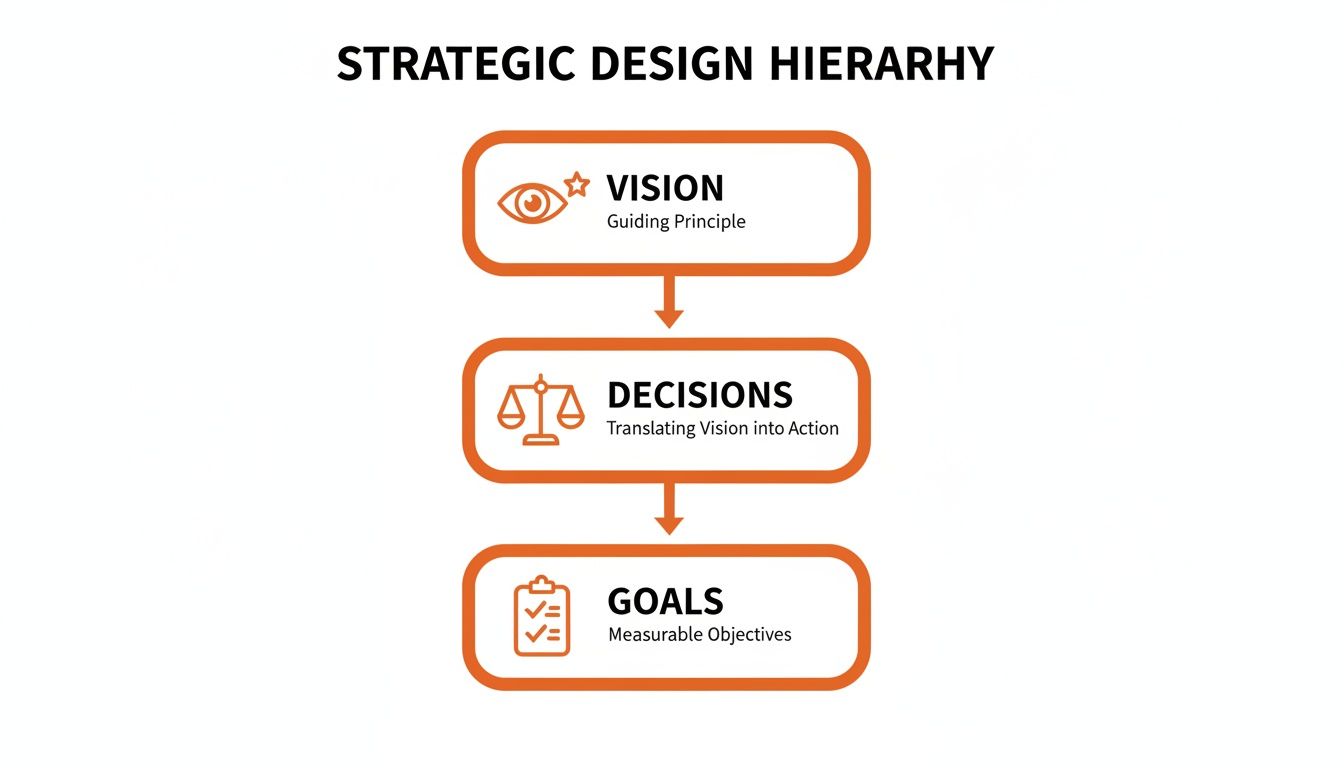
This visualisation makes it crystal clear: every single architectural decision must act as a bridge between your grand vision and the real-world business goals you need to hit.
From a Bird’s-Eye View to Ground Level
The real magic of C4 is its layered approach. Each level "zooms in" on a part of the one before it, giving you more detail without ever overwhelming the audience. Think of it like using Google Maps—you start with a view of the whole country, then zoom into a city, then a street, and finally a specific building.
This structured approach is particularly crucial in the UK software development scene, where robust architecture is a cornerstone for battling operational challenges. It's no secret that UK teams are facing steeper headwinds than their US counterparts, reporting more service disruptions and delivery delays. As a result, larger enterprises are embedding architecture much more deeply into their Software Development Life Cycle (SDLC), realising that as complexity scales, so does the need for mature design practices.
Getting architecture right early on can slash delivery delays by up to 50%, a business outcome we relentlessly pursue here at Rite NRG. You can dive deeper into these trends in this comprehensive software development report.
The Four Levels of Clarity
So, how does this actually work in practice? Let's walk through it with a real-world example, like a new B2B SaaS platform for project management.
Level 1: Context Diagram: This is your 10,000-foot view, the "big picture." It shows your entire system as a single black box, interacting with users and other external systems. For our project management app, this diagram would show the "Project Manager" user, the "Team Member" user, and any integrations with things like a payment gateway or an email service. It’s absolutely perfect for a quick pitch to stakeholders to secure buy-in.
Level 2: Container Diagram: Now, we zoom in. A "Container" here isn't just a Docker container; it's any single deployable unit. Think of a web application, a mobile app, a database, or a microservice. This diagram shows how these high-level pieces fit together. In our example, we'd see the Single-Page Application (SPA), the Backend API, the PostgreSQL Database, and the Notification Service. This view is essential for developers and ops teams to understand the overall structure and plan delivery.
The real power of the C4 model is its ability to create different diagrams for different audiences. You're not forcing a developer to sit through a high-level business pitch, and you're not boring an executive with low-level implementation details. Everyone gets the clarity they need.
Level 3: Component Diagram: Here, we dive into a single Container to see its main building blocks or "Components." A Component is just a logical grouping of related functionality, often mapping to a chunk of source code. Peeking inside our "Backend API" container, we might see components like a "User Management Service," a "Project Service," and a "Billing Service." This is the level where most of the day-to-day software design actually happens.
Level 4: Code Diagram (Optional): This final level is the most granular, showing how a single Component is implemented in code—think UML class diagrams. Honestly, this level is often generated on-demand by IDEs and isn't always manually drawn, as it can go out of date in a flash.
The official C4 model website offers a fantastic visual overview of these interconnected levels. By adopting this model, you transform your documentation from a static, forgotten relic into a living, valuable asset. It's a game-changer that speeds up development, improves onboarding, and guarantees everyone is aligned on the business mission.
Choose Your Architectural, Integration, and Deployment Patterns
Alright, you’ve used the C4 model to create a fantastic, deconstructed map of your system. Now comes the fun part—making the high-impact decisions that will truly define your product’s future.
This is where the rubber meets the road. How will your components actually talk to each other? How are you going to get them deployed and running? These choices have a massive, direct impact on your speed, scalability, and, crucially, your budget.
This isn’t about chasing the latest shiny object or just copying what you think the big tech giants are doing. A truly solid software architecture comes from making pragmatic, outcome-driven decisions. Our #riteway methodology, built on a foundation of Extreme Ownership, forces us to connect every pattern and technology choice back to a clear business case. We're not just building software; we're crafting a competitive advantage.
First Big Decision: Your Core Architectural Style
The first major fork in the road is deciding between a monolithic or microservices architecture. Let's be honest: the industry is completely infatuated with microservices, but they are absolutely not a silver bullet. Picking the wrong style for your current stage can cripple your MVP before it even sees the light of day.
Monoliths for Speed and Simplicity: A well-structured monolith is often the fastest way to get a validated MVP into the hands of users. With a single codebase and a straightforward deployment pipeline, you can iterate like lightning and test ideas without the operational nightmare of a distributed system. It’s simply easier to build, debug, and manage, which is a huge win when speed to market is everything.
Microservices for Scale and Independence: As a product matures and achieves market fit, certain domains inevitably become more complex or need to scale independently. This is when breaking them out into microservices starts to make a lot of business sense. It allows different teams to own and deploy their services on their own schedule, which can really accelerate feature delivery in larger organisations.
Our go-to consulting advice is almost always to "start with a modular monolith". This gives you the raw speed of a monolith but with clean internal boundaries, making it much, much easier to carve out microservices later on when the business case is undeniable.
Synchronous vs. Asynchronous Communication
So, you've got your components. Now, how will they communicate? This choice has profound implications for both the user experience and the resilience of your entire system.
Synchronous communication, like a direct API call, is simple and immediate. The client fires off a request and waits for a response. It’s perfect for actions where the user needs instant feedback—think validating a login form.
But, relying too heavily on synchronous calls can create a house of cards. If one service slows down or fails, it can trigger a domino effect, grinding the entire user experience to a halt and potentially losing you customers.
This is where asynchronous communication, often using a message queue like RabbitMQ or AWS SQS, becomes your superpower. It decouples your services. For example, when a user signs up, you can synchronously create their account but asynchronously send a welcome email and update your analytics service. The user gets an instant response, and the background tasks can happen reliably without making them wait.
Decoupling services with asynchronous patterns is a core principle for building resilient, scalable systems. It transforms potential system-wide failures into isolated, recoverable events, which is essential for maintaining high availability and customer trust.
Architectural Pattern Decision Matrix
Choosing the right architectural pattern isn't just a technical decision; it's a strategic business one. Different patterns serve different needs, from rapid prototyping to massive-scale operations. This matrix is designed to help you weigh the options against your specific business and technical drivers, ensuring you pick the style that sets you up for success.
| Pattern | Best For | Key Benefit | Main Trade-off |
|---|---|---|---|
| Modular Monolith | Early-stage products, MVPs, and small-to-medium teams needing rapid iteration. | Speed to Market. A single codebase and deployment pipeline dramatically simplify development and reduce initial operational overhead. | Tightly Coupled Scaling. The entire application must be scaled together, even if only one part is under heavy load. |
| Microservices | Complex, large-scale applications with multiple, independent teams. | Team Autonomy & Scalability. Teams can develop, deploy, and scale their services independently, leading to faster feature delivery in large organisations. | High Operational Complexity. Requires sophisticated DevOps practices for service discovery, monitoring, and managing distributed data. |
| Event-Driven | Systems requiring high resilience, scalability, and real-time responsiveness. | Decoupling & Resilience. Services communicate asynchronously, so the failure of one component doesn't cascade and bring down the entire system. | Complex Debugging. Tracing a single request through multiple asynchronous events can be incredibly challenging without proper observability tools. |
| Serverless | Sporadic, event-triggered workloads or APIs with unpredictable traffic patterns. | Ultimate Cost Efficiency. Pay-per-use model means you don't pay for idle servers, drastically cutting costs for bursty or low-traffic services. | Potential Vendor Lock-in. Code is often tied to a specific cloud provider’s ecosystem, which can make future migrations more difficult and costly. |
Ultimately, there's no single "best" pattern. The right choice is the one that aligns with your product roadmap, team skills, and business goals. A modular monolith might be perfect for your MVP, with a clear plan to evolve towards microservices or event-driven patterns as you grow.
Embrace Cloud-Native Deployment Strategies
How you deploy and run your application is just as critical as its internal design. This is where cloud-native patterns come into their own, offering incredible power to automate and scale.
Cloud-native architecture is completely reshaping UK software development, with 78% of enterprises now using cloud-native app development. This massive shift shows a clear move towards architectures built on microservices, containerisation, and serverless models to get the scalability and robustness modern SaaS products demand. What's more, cloud automation alone can slash IT management time by an incredible 45% in high-adoption organisations, directly speeding up time-to-market. You can dig into more of these key trends in this detailed UK cloud adoption report.
Here are the deployment patterns you absolutely need to consider:
Containerisation (Kubernetes/Docker): This is your go-to for standardising environments and scaling complex applications with lots of moving parts. Its key business outcome is Predictable Delivery. Using containers ensures your application runs the exact same way everywhere, from a developer's laptop to production, finally killing off those "but it works on my machine!" issues. The main trade-off? Operational Complexity. Kubernetes, in particular, has a steep learning curve and requires specialised skills to manage well.
Serverless (AWS Lambda/Azure Functions): Perfect for event-driven workloads, background jobs, or APIs with unpredictable traffic. The killer benefit here is Cost Efficiency. You only pay for the compute time you actually use, which can dramatically lower your infrastructure bill for spiky workloads. The catch is potential Vendor Lock-in. Your functions are often tied to a specific cloud provider's ecosystem, making future migrations a bit trickier.
Making the right call here is all about balancing your team's skills, budget, and future scaling needs. For example, we helped a client scale their decentralised exchange by building a powerful, containerised infrastructure. Take a look at how we approached scaling a decentralised exchange platform to see these principles in the wild.
The key is to pick the pattern that best serves your business goals today while giving you a clear path for growth tomorrow.
Build a System That’s Secure and Built to Last

Look, a great architecture is about more than just a successful launch. It’s about building something that operates like a well-oiled machine and can adapt gracefully for years. This is what separates a fragile MVP from a truly enterprise-grade platform. It all comes down to mastering the crucial "-ilities"—scalability, reliability, maintainability, and, above all, security.
All too often, these are treated as afterthoughts, patched on frantically just before go-live. Frankly, that’s a recipe for disaster, technical debt, and unhappy customers. Our #riteway methodology, which is rooted in Extreme Ownership, insists on weaving these qualities into the very fabric of your system from day one.
This proactive approach makes your architecture more than a static blueprint; it becomes a resilient, dynamic engine for growth. You’re not just building to launch; you’re building to endure and win.
From Security Checklists to a Secure-by-Design Culture
Security isn't a feature you can sprinkle on at the end. In today's threat landscape, a reactive, "tick-the-box" approach is just plain dangerous. We advocate for a fundamental shift in mindset: building a proactive, secure-by-design culture. This means security is baked into every single architectural decision we make, right from the start.
This is about more than just preventing breaches. It’s about earning customer trust and fiercely protecting your brand's reputation. A single major security incident can wipe out years of hard work and customer loyalty in an instant.
Here’s a glimpse into how we embed this culture into our software architecture design:
- Threat Modelling Workshops: Before a single line of code is written, we get aggressive. We actively hunt for potential vulnerabilities, asking tough questions like, "How could someone exploit this feature?" or "What’s the absolute worst-case scenario for the business here?"
- Principle of Least Privilege: Every component, every service, and every user gets the absolute minimum level of access they need to function. It's a simple concept, but it dramatically shrinks the "blast radius" if one part of the system is ever compromised, protecting critical data.
- Automated Security Scans: We integrate security scanning tools directly into our CI/CD pipeline. This means every single code change is automatically vetted for known vulnerabilities, catching potential issues long before they ever see the light of day in production and safeguarding the business.
By making security a shared responsibility, we empower the entire team to think like defenders. If you're curious to see how this approach works at scale, you can read about our experience in enabling SecureOps within a global media enterprise.
Implement Powerful Observability
You simply can't fix what you can't see. In a complex, distributed system, "hope" is not a strategy. What you need is powerful observability—the ability to truly understand what’s happening inside your system just by observing its external outputs. This goes way beyond basic monitoring.
It’s about proactively hunting down and fixing issues before your customers even notice something is wrong. A brilliant observability setup gives you the context to answer not just "What broke?" but, more importantly, "Why did it break, and what is the impact on our users?"
True observability is the difference between flying blind and having a full instrument panel in the cockpit. It allows you to navigate turbulence with confidence, ensuring a smooth and reliable journey for your users that protects your revenue and reputation.
The rise of low-code and no-code architectures is really shaking up UK software design, with a huge 63% of enterprises adopting these platforms in 2024. While this empowers founders to prototype MVPs faster, it also adds new layers of complexity. For enterprises wrestling with legacy systems, observability using tools like OpenTelemetry (which now has 64% adoption in the UK) is essential for navigating the integration headaches that come with scaling.
Modernise Legacy Systems and Plan Handovers
Let's be realistic: very few projects start with a completely blank canvas. Many businesses are built on legacy systems that are mission-critical but are now holding them back. Trying to modernise a legacy system without a rock-solid architectural strategy is like trying to change the engine on a plane while it's in mid-air. It's risky and incredibly difficult.
Our approach is both strategic and pragmatic, laser-focused on minimising business risk and disruption.
- Strangle the Monolith: Instead of a high-stakes "big bang" rewrite, we employ the Strangler Fig Pattern. We strategically build new, modern services around the edges of the old system, gradually peeling away traffic and functionality until the legacy application can be retired safely without impacting business operations.
- Isolate with Anti-Corruption Layers: We construct a translation layer that acts as a buffer, isolating the shiny new parts of your system from the old legacy code. This smart move prevents the design flaws and quirks of the old system from "leaking" into your new, clean architecture.
A smooth handover is just as important, especially when moving between vendors or bringing development in-house. We take Extreme Ownership of this transition, ensuring the new team isn't just thrown a repository of code. We deliver comprehensive documentation, detailed C4 model diagrams, and conduct hands-on knowledge transfer sessions to set them up for long-term success.
Your Top Software Architecture Questions, Answered
Diving into software architecture can feel like a minefield of high-stakes decisions. Let's cut through the noise and tackle the burning questions I hear most often from SaaS leaders and their dev teams, with some straight-talking, business-first advice.
Should I Go with a Monolith or Microservices for My MVP?
For a Minimum Viable Product (MVP), the game is all about speed and validation. That’s why, nine times out of ten, a well-structured monolith is the right call. It’s just fundamentally simpler to build, test, and deploy, which means you can get your idea in front of real users and start iterating in record time.
Microservices are fantastic for scaling complex systems, but they come with a hefty dose of operational overhead that can absolutely crush a startup’s momentum. That's why our #riteway philosophy leans heavily into the "modular monolith." We build it as a single unit but design it with clean, logical separation from day one. This gives you all the launch speed of a monolith with a clear, low-friction path to spin out services later—but only when the business case and user load actually justify it.
What's the Single Biggest Mistake I Can Make in Architecture Design?
Hands down, the most catastrophic mistake you can make is designing in a technical bubble, completely disconnected from your business goals. The aim isn't to build a technically perfect masterpiece; it’s to build something that makes money and solves a real problem for your customers. I’ve seen brilliant architects fall in love with a particular technology and build elegant, impressive systems that were ultimately dead on arrival because they ignored the real-world constraints of cost, timelines, and market fit.
A very close second is leaving non-functional requirements—things like security and scalability—as an afterthought. You can't just bolt them on at the end. Every single architectural decision we make has to be tied directly back to business value. This is non-negotiable. It’s how you ensure the final product is not only well-engineered but profitable and built to last.
How Much Documentation Is Really Necessary?
You need just enough documentation to provide total clarity, without drowning your team in red tape. The whole point is to create a living, breathing guide that helps people get work done, not a static encyclopaedia that sits on a digital shelf collecting dust. The C4 model is brilliant for this because it gives you different levels of detail for different people.
Your documentation should be a tool that makes you go faster. It needs to give a new developer, a product manager, or an executive the answers they need, right now. It’s all about creating a shared understanding, not just a paper trail.
At a minimum, your docs must cover the high-level structure, how the key components talk to each other, and the major design decisions you made—especially the why behind them. A great tip is to automate diagram generation wherever you can and keep the documentation right next to the code (in your Git repo, for instance). That way, it stays current and actually gets used.
How Do I Make Sure My Architecture Can Handle Future Changes?
Building an architecture that can evolve gracefully comes down to two principles you have to be relentless about: loose coupling and high cohesion. In plain English, this means designing your components to be as independent as possible, with each one having a single, crystal-clear job.
By using clean interfaces like APIs for all communication, you can swap out or totally rebuild one part of the system without setting off a chain reaction of failures everywhere else. It's also incredibly smart to choose technologies with vibrant communities and solid support. The last thing you want is to be stuck with a niche tool that becomes a dead end.
We also swear by creating an "Architectural Decision Record" (ADR) for every significant choice. Documenting the context and the trade-offs gives future teams the background they need to evolve the system intelligently and with confidence.
At Rite NRG, we don't just build software; we build strategic assets that fuel business growth. Our energetic, ownership-driven approach ensures your architecture is a powerful engine for your success, not a technical anchor. If you're ready to design a system that delivers real-world outcomes and slashes your time-to-market by up to 50%, let's talk. Discover how our senior nearshore teams can make your delivery predictable and powerful at https://ritenrg.com.
Built with the Outrank app