

Strategy & Transformation
How to Calculate ROI for AI and Software Modernization
A practical, finance-ready framework for comparing AI and modernization investment with the current-state cost, realistic benefits, delivery risk and time to value.
operationalwrocław--:-- cet
∕ insights / what-is-software-architecture.md
Software Architecture
Understand what is software architecture, why it decides release speed, security and cost of change, and how CTOs choose the right design.
>_article.meta
Your team ships the first release in weeks. Then every feature takes longer. A billing fix breaks onboarding, engineers spend more time coordinating releases, and the board wants to know why the roadmap slipped.
Hiring more developers won't necessarily solve it. If every change requires several teams to untangle shared logic and data, you're adding people to a structural problem.
The cause of a stalled roadmap is rarely a lack of effort. Often, your engineers are working hard inside a system that makes safe changes expensive. Before you approve a rewrite or another hiring round, inspect how the software is organized.
So, what is software architecture?
Software architecture is the set of structural decisions about a system's components, how they connect, where its data lives, and which qualities such as speed, security, reliability, and ease of change the system must guarantee.
Those decisions determine how many parts an engineer must understand before changing a feature. They also determine whether your team can release that change independently, recover when something fails, and operate the product within its budget.
Say onboarding reads billing tables directly. That shortcut saves implementation work initially, but a billing change now requires someone to check onboarding too. Add reporting and support tools using the same tables, and the coordination burden grows.
A deliberate boundary changes the economics. Billing owns its rules, and other parts of the product use a stable interface. You accept some interface-design work to reduce future release risk.
Architecture affects outcomes your leadership team already tracks:
The useful conversation connects components and quality requirements to production responsibilities, AI-assisted delivery, practical design choices, and delivery measurements. A diagram can support that conversation, but it can't substitute for it.
Architecture is a business lever you can measure and manage, not a document only architects read.
Code is the furniture and wiring. Architecture is the floor plan, load-bearing walls, utility routes, and fire exits. You decide the essential layout before construction, because moving a wall on a drawing is much cheaper than moving it through an occupied building.
Software has the same problem once customers and other teams depend on it. Changing an internal function is straightforward compared with changing a shared data model that supports checkout, finance, and reporting.
The analogy becomes useful when you separate the decisions:
These are structures and constraints, not a shopping list of technologies. Teams using PostgreSQL and the same application framework can build radically different systems because they assign ownership and dependencies differently.
The systematic review of software-quality attributes identifies reusability, flexibility, performance efficiency, scalability, and maintainability among the most frequently investigated attributes. Your architect's job is to translate the relevant qualities into decisions that engineers can test, rather than collect impressive-sounding requirements.
“Fast” isn't an acceptance criterion. For a hypothetical SaaS search endpoint, you might specify p95 response time under 300 ms at 2,000 concurrent users. That gives the team a workload, a measurement, and a pass-or-fail target rather than an argument about whether the interface feels responsive.
A complete architecture decision records the quality objective, the constraints, the trade-offs, and the validation method. If caching improves response time but allows stale results, say how stale results may be and which operations must bypass the cache.
Practical rule: If nobody can describe how to test an architecture decision, the team hasn't finished making it.
The building analogy has limits. Software evolves continuously, so you shouldn't attempt to settle every detail before implementation. Decide the expensive boundaries early, then use working software to challenge your assumptions.
Even a single-team application has architecture. It has data ownership, dependencies, and failure behavior whether anyone drew them or not.
Use this concept map to connect the structural choices with the qualities they must support.
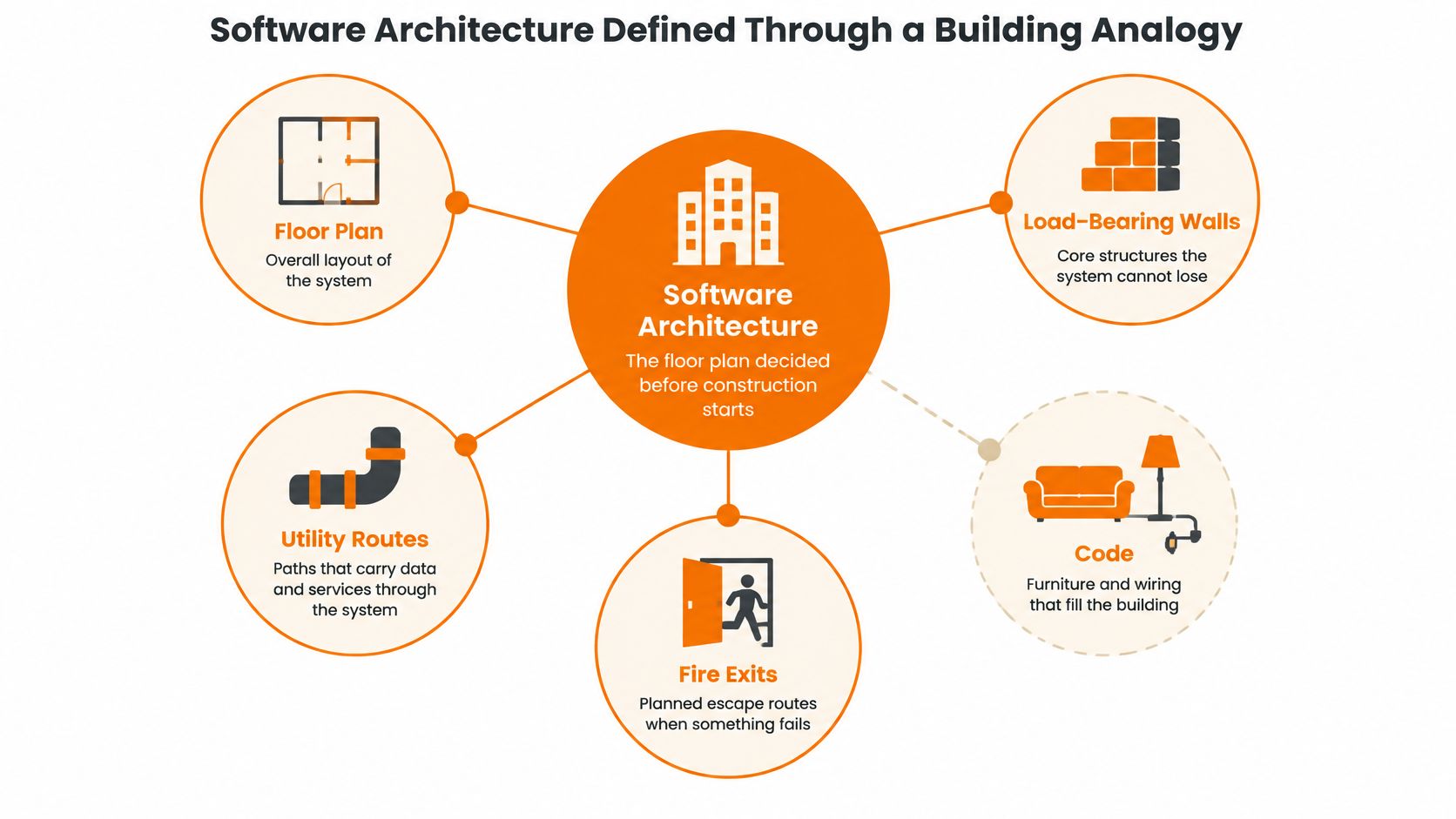
The working chain is simple: components → relationships → governing principles → testable quality attributes. If a component diagram doesn't help explain security, recovery, performance, or changeability, it's incomplete.
Every production architecture must answer questions about decomposition, integration, data and security, scalability, and maintainability. Leaving any of them implicit means someone will make the decision during implementation, often without seeing its effect on the business.
Five architecture responsibilities and what to watch for
| Responsibility | Core question | Typical decision | Warning sign |
|---|---|---|---|
| System decomposition | Where do the boundaries between parts go? | Modular monolith or services, one owning team per boundary | One change touches many folders or teams |
| Integration patterns | How do parts talk without breaking each other? | Synchronous APIs, events or batch files, with versioned contracts | Releases must be synchronized across teams |
| Data and security design | Who owns each piece of data, and who may access it? | Data ownership per service, role-based access, encryption, audit logs | Several services write the same tables, or no audit trail exists |
| Scalability | Which part grows first, and what happens when it does? | Horizontal scaling, caching, queues, read replicas | Peak traffic breaks unrelated features |
| Maintainability | How quickly can a new engineer change this safely? | Clear ownership, tests at boundaries, architecture decision records | Each fix takes longer than the last, and deployments feel risky |
Decompose around business capabilities, not just technical layers. An engineer changing shipment pricing should be able to locate the relevant rules without negotiating unrelated changes across the product. Touching many folders isn't proof of poor architecture, but it's a useful signal to investigate dependencies.
Integration choices determine how failures travel. Synchronous APIs suit requests that need an immediate answer. Events let consumers react asynchronously, while batch files remain useful for scheduled exchanges with older systems.
Versioned contracts and compatibility tests help teams release without synchronized deployments. Define timeouts, retry behavior, and duplicate handling too. An interface that works only when every dependency is healthy isn't ready for production.
Give each dataset an authoritative owner. Several services writing the same tables can bypass business rules and make access restrictions difficult to enforce. A reporting requirement doesn't justify unrestricted write access to operational data.
Use role-based access, encryption in transit and at rest, and audit trails for sensitive actions. Separate user permissions from service permissions, and make credential rotation part of the operating plan.
IBM's 2025 Cost of a Data Breach report reports a global average breach cost of USD 4.44 million, averages of USD 3.62 million for organizations extensively using AI and automation versus USD 5.52 million for those not using those capabilities, and breaches involving AI models or applications at 13% of surveyed organizations. Those comparisons aren't a guarantee of savings from automation; they reinforce the need to design identity, logging, and model access controls into the system.
Know which resource reaches its limit first. Adding application instances won't fix a saturated database connection pool. Load tests should reveal whether caching, queues, read replicas, or additional compute address the actual bottleneck.
For maintainability, give engineers clear ownership, tests at boundaries, and short decision records. Tools such as ArchUnit can enforce dependency rules before a developer merges a change.
Translate these responsibilities into testable non-functional requirements. Every important requirement needs an acceptance check and a named owner, not just a place in a document.
AI agents can speed up analysis, implementation, testing, documentation, and migration. They change the economics of delivery, not the engineering standards. The risk is architectural drift at generation speed: a locally sensible change can duplicate a pricing rule, bypass a domain interface, or add a hidden dependency. Local tests may pass while the system becomes harder to operate.
Stack Overflow survey reporting covered by VentureBeat found that 66% of more than 49,000 developers across 177 countries were frustrated by AI solutions that were almost correct, and 45% said debugging AI-generated code took more time than writing code themselves. For a CTO, the measure is not how quickly agents generate code. It is whether engineers can validate the resulting system without erasing the time saved.
What AI agents accelerate and what architects must own
| Task | AI agents can accelerate | Architect must own |
|---|---|---|
| Analysis | Summarizing codebases and mapping dependencies | Deciding which boundaries fit the business |
| Implementation | Drafting modules and repetitive code | Approving data flows and integration contracts |
| Testing | Generating test cases and regression checks | Defining failure modes and reliability targets |
| Documentation | Drafting API docs and decision records from code | Recording why each decision was made |
| Migration | Converting code and mapping old to new components | Choosing the target architecture and cutover plan |
| Security | Scanning dependencies and flagging risky patterns | Threat models, access rules, and production controls |
A generated explanation of existing code does not show that the code follows the intended design. Tests generated from an implementation can confirm its current behavior without testing the assumptions behind it. Architects must decide which trade-offs protect the business's priorities and future options. The strongest design is the smallest one that keeps those options open.
Put architecture guardrails in repositories and delivery pipelines. Enforce dependency rules, run contract tests, record decisions, and require human review for changes to permissions, schemas, public interfaces, and production infrastructure. These checks make drift visible before it reaches production.
NIST's AI Risk Management Framework and associated generative-AI guidance call for documented human oversight and monitoring when people or other systems override AI decisions. For software delivery, record approvals, exceptions, and the evidence behind high-impact changes. That creates a review trail without treating generated output as self-validating.
A practical operating model connects AI coding tools with AI-native software delivery, rather than treating code generation as an isolated productivity trick.
At RITE NRG, agentic AI speeds up delivery while senior architects remain accountable for architecture, data, security, testing, and production quality. AI can accelerate the work; it cannot take responsibility for the decisions that determine system risk, cost, and quality.
The most scalable design is often the wrong one. If your team can't afford to deploy, monitor, and recover it, theoretical capacity won't help you reach customers.
The study of developers' architecture information-seeking identifies comparing architectural advantages and disadvantages and deciding among alternatives as the two most common reasons developers seek architectural information. That's the right focus: compare decisions against your constraints, not fashionable labels.
Evaluate team size, operational maturity, latency needs, compliance obligations, budget, and expected change. Don't choose a distributed system without naming who will support it when dependencies fail.
Architecture options compared by fit and operating load
| Option | Best when | Main cost | Operational load |
|---|---|---|---|
| Modular monolith | One team or a few teams, uncertain domain, speed to market matters most | Discipline to keep module boundaries clean | Low: one deployment, one database |
| Microservices | Several autonomous teams, independent scaling needs, mature DevOps practice | Network failures, distributed data, observability work | High: many deployments, service contracts, monitoring |
| Event-driven system | Workflows across domains, asynchronous processing, high event volume | Harder debugging, eventual consistency, schema versioning | Medium to high: brokers, replay, versioned events |
| Managed services | Commodity needs such as authentication, search, email or payments | Vendor dependence and usage-based cost growth | Low: the provider runs the infrastructure |
These options aren't mutually exclusive. A modular monolith can publish events and use managed search. Its database arrangement is a design choice, not part of the definition.
Microservices add network failure modes and distributed data coordination. Event-driven designs require engineers to handle delayed and duplicate messages. Managed services remove infrastructure work, but your team still owns configuration, integration, data exposure, and exit planning.
Use domain-driven design to evaluate business boundaries before turning them into deployment boundaries.
Test the risky assumptions before approving a migration. Microservices performance experiments found that nonlinear growth models often described performance-violation behavior better than linear models. Put plainly, delays and failures can grow faster than traffic, so use realistic load and fault injection instead of extrapolating from a quiet environment.
This process keeps simplicity deliberate rather than accidental.
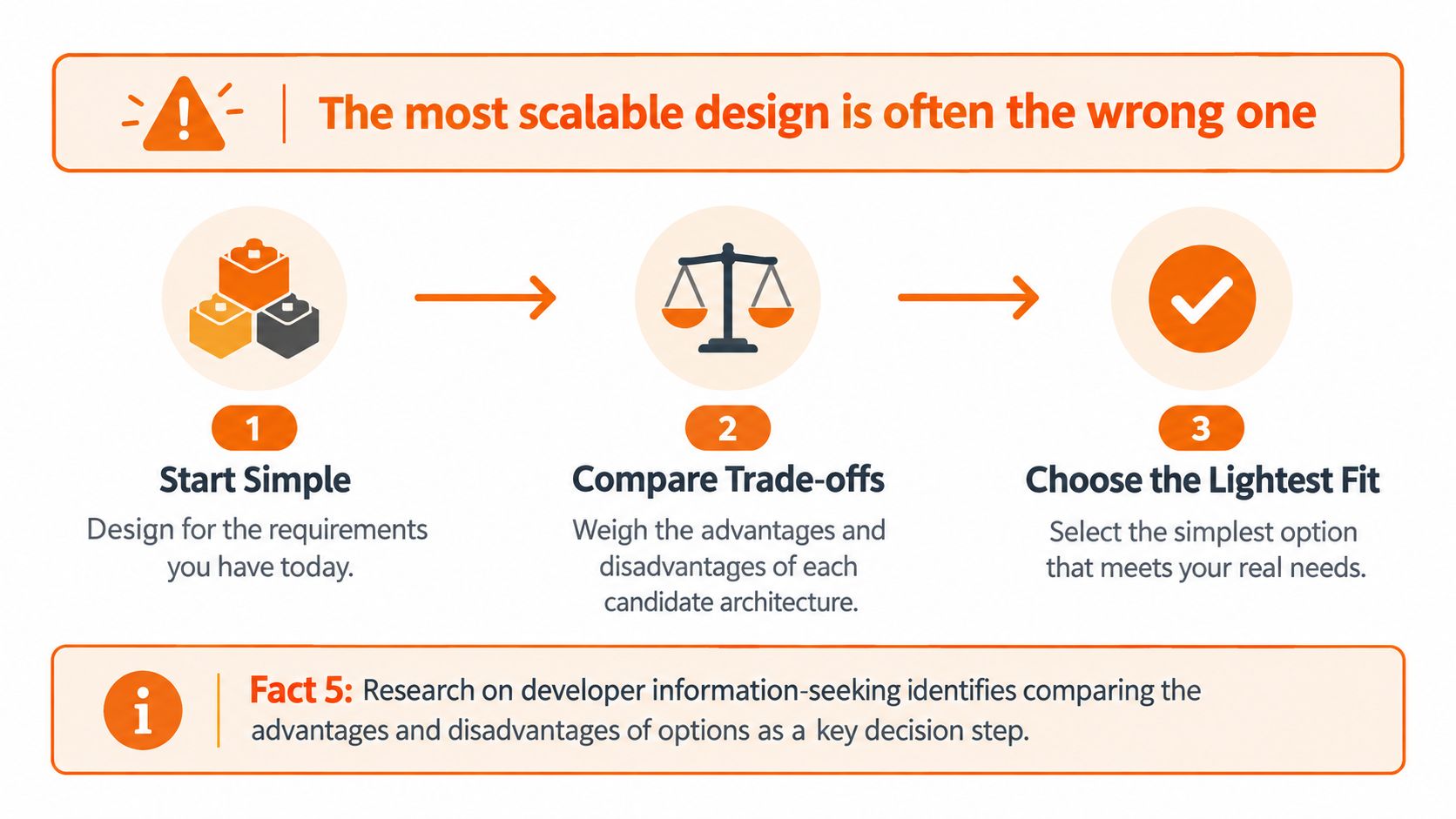
Good architecture is the smallest system that preserves the business's most important future options.
The right architecture depends on what the business must protect and what it can afford to delay. These illustrative composite scenarios, not client results, show how to keep the design small while preserving important future choices.

A SaaS founder with a three-month MVP budget can start with a modular monolith. Keep subscriptions, customer accounts, and reporting behind strict boundaries, but deploy them together. This avoids the cost and operational work of distributed services while retaining the option to separate a module later.
Measure time to a usable release and the effort needed to add features. Extract a service only when a module has a demonstrated need for independent scaling or ownership. Starting with services before that need exists adds work without a clear business return.
A mid-size logistics company cannot stop its legacy platform during replacement. Put shipment tracking behind a stable interface, migrate that capability incrementally, and keep a tested route back to the old implementation.
The trade-off is temporary duplication and reconciliation work. Track release lead time, tracking errors, and support interruptions. Rewritten code alone does not show whether the change reduced risk or improved delivery.
An e-commerce team can cache product pages, queue suitable order-processing work, use managed search, and scale checkout separately from the catalog. Keep payment and order-state checks explicit. A queued task is not a completed purchase.
This design accepts some cache staleness and asynchronous processing where the customer experience allows it. Track checkout success, order-processing delay, and operating cost under peak load. Add capacity where demand requires it, not across the whole system by default.
Use the accompanying video to discuss which structural choices your product needs.
Architectural technical debt is the gap between intended architecture and the structure that emerges in practice. Research has mapped how teams identify, measure, monitor, and repay this debt. A lifecycle analysis in the architectural-debt replication package found average class FAN-IN increased by 57% after repayment.
More incoming links to an average class can indicate greater centralization. Cleanup may remove one problem while creating a hub that many other classes depend on. Inspect dependency connections alongside code readability before deciding that repayment improved the architecture.
A new platform isn't an improvement just because its diagram looks cleaner. Establish a baseline before approving the investment, or you won't be able to demonstrate a delivery benefit.
The DORA delivery metrics guide defines change lead time, deployment frequency, failed-deployment recovery time, and change-fail rate as practical measures of delivery performance.
Four delivery metrics that test your architecture
| Metric | What it measures | Architecture question it tests |
|---|---|---|
| Change lead time | Time from code commit to successful production deployment | Can a change move through the pipeline without unnecessary manual gates? |
| Deployment frequency | How often changes reach production | Are boundaries small enough to release independently? |
| Failed-deployment recovery time | How quickly service is restored after a failed deployment | Can the system roll back or fail over without heroics? |
| Change-fail rate | Share of deployments that cause production failures | Do tests, contracts and monitoring catch breaks before users do? |
Record your current value beside each measure in the review document. The baseline matters more than an ambitious target: without it, a proposed platform may add infrastructure without improving release flow.
Act before another feature depends on a structure you already know needs attention. That's when you have the most freedom to change it safely.
Rite NRG offers senior-led architecture reviews for new products, scaling platforms, and legacy modernization, with senior engineers accountable for the production result as well as the design. Visit Rite NRG to examine your highest-risk boundaries, challenge migration assumptions, and turn the findings into an owned delivery plan.
/ about the author
Written by the RITE NRG editorial team — the architects, engineers and delivery leads who build and operate AI-era software for our clients.
Strategy & Transformation
A practical, finance-ready framework for comparing AI and modernization investment with the current-state cost, realistic benefits, delivery risk and time to value.
Technology Talent & Teams
A decision-maker's guide to IT partnership models: what each model actually transfers to the partner, what it costs beyond the rate card, and how to match the model to your situation.
AI Consulting & Automation
A practical framework for choosing and deploying transport or logistics AI agents around real exceptions, reliable data and controlled operational authority.
More guidance: all insights articles
Tell us about the system or idea behind this article. We tell you honestly if it is a fit — and what a fixed-scope delivery could look like.