

Strategy & Transformation
How to Calculate ROI for AI and Software Modernization
A practical, finance-ready framework for comparing AI and modernization investment with the current-state cost, realistic benefits, delivery risk and time to value.
operationalwrocław--:-- cet
∕ insights / how-to-improve-system-reliability.md
Improve System Reliability
Learn how to improve system reliability with SLOs, observability, tested recovery and better incident reviews for SaaS teams.
>_article.meta
Your team is trying to ship the next release, but checkout failures keep pulling engineers into support calls. Customers retry payments, product managers postpone launches, and the cloud dashboard still looks healthy. Say checkout stops working for 45 minutes on a busy Tuesday. The lost orders, reconciliation work and damaged trust can cost more than the engineering time needed to remove the failure point.
Learning how to improve system reliability starts with that business problem, not a shopping list of infrastructure tools. Treat reliability as a budget decision: fund the tests, alerts and recovery capabilities that protect valuable customer outcomes, then require evidence that they work.
Start by choosing how much interruption the business can tolerate. A customer-facing checkout and an internal reporting screen don't need identical targets. Giving them the same target either underprotects revenue or commits engineering capacity to work with little business value.
Availability targets and allowed downtime
| Availability target | Allowed downtime per 30 days | Typical fit |
|---|---|---|
| 99% | 7 hours 12 minutes | Internal tools and low-stakes features |
| 99.5% | 3 hours 36 minutes | Internal platforms and back-office tools |
| 99.9% | 43 minutes 12 seconds | Common starting SLO for customer-facing SaaS |
These are calculated allowances for a fixed window, not promises that an outage is acceptable whenever it happens. A short interruption during a major sales event can matter more than a longer interruption during quiet hours. Use the typical fits as starting points, then check them against your actual customer commitments.
An SLI, or service-level indicator, is the measurement. For an API, that might be successful requests divided by all eligible requests. Define success carefully: returning a response isn't success if the payment was never recorded.
An SLO, or service-level objective, is your internal target for that measurement over a fixed window. An SLA, or service-level agreement, is the customer promise with consequences attached. Keep the contractual promise looser than the internal target so engineers have room to intervene before a customer commitment is breached.
The arithmetic is straightforward: a 99.9% SLO leaves a 0.1% error budget, or 1,000 failed requests for every 1,000,000 requests, using the request-budget approach described in Google's error-budget policy. Don't confuse that request allowance with time-based downtime when traffic changes throughout the day.
Ask product, finance and engineering to agree on what failure costs. Include missed transactions, support effort, delayed operations and contractual exposure, while keeping uncertain estimates visibly separate from known costs.
Document the target alongside latency, data integrity and recovery expectations. These sample non-functional requirements provide a useful structure for turning broad expectations into testable commitments.
Practical rule: Choose the tightest target your team can staff, monitor and defend today.
For an initial operating policy, tighten the target only after two consecutive measurement windows stay green. That's a recommendation, not an industry threshold. A more ambitious number without operational capacity is a promise your team can't reliably keep.
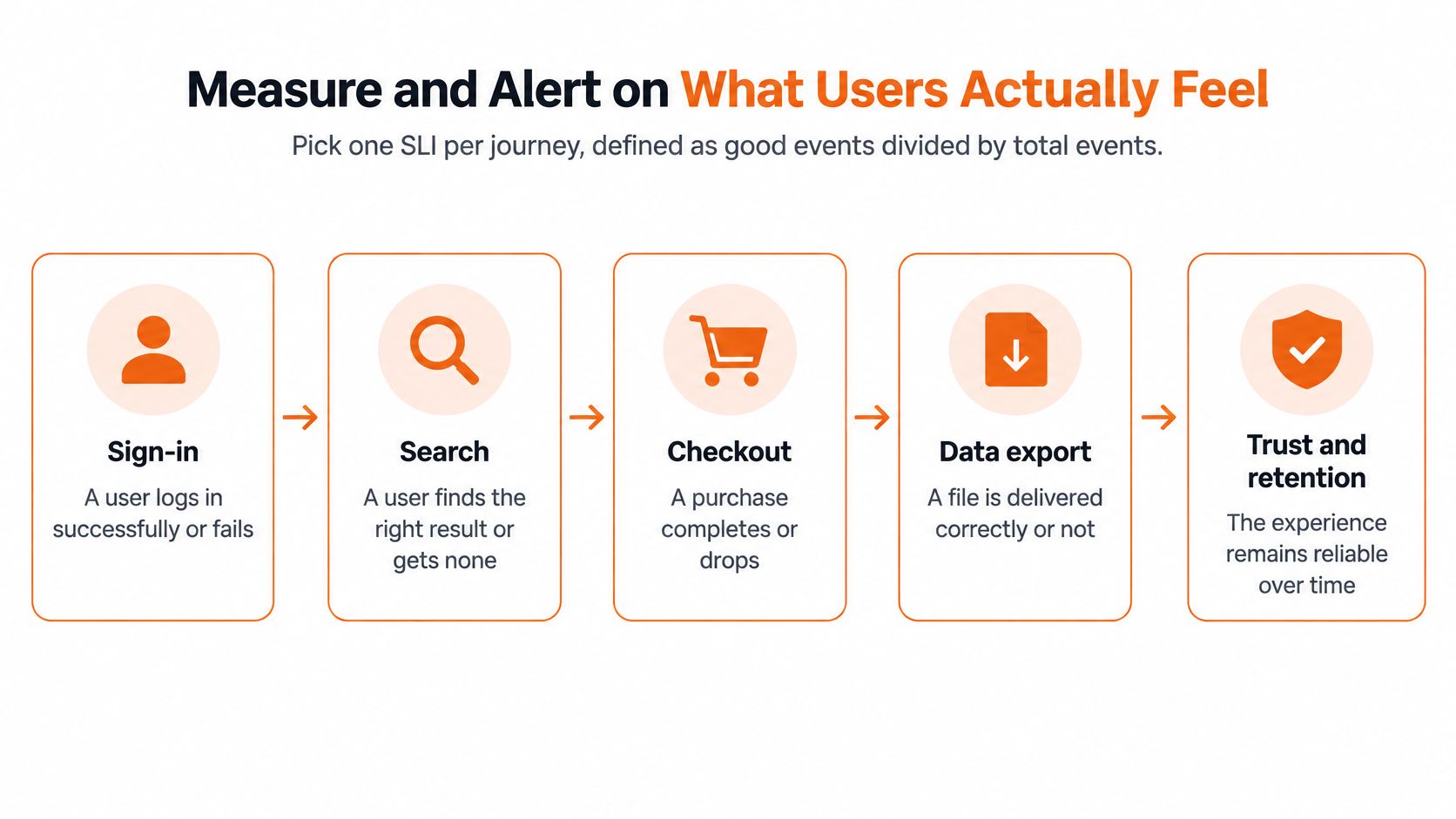
Start with the journeys that earn revenue or trust: sign-in, search, checkout, subscription renewal and data export. Keep the initial set small enough that engineers can explain exactly how each journey succeeds, fails and gets measured.
A healthy server doesn't prove that a customer can complete a purchase. Measure the outcome at the edge of the service, then use infrastructure telemetry to explain failures rather than substitute for user evidence.
Choose one primary SLI per journey. Define good events divided by total eligible events, including correctness and a useful completion deadline. For an export, success means the customer receives a complete, readable file, not merely that a background job started.
Establish a baseline before promising improvement. As a practical starting exercise, inspect 30 to 90 days of history where it's available, separating normal traffic from launches, scheduled jobs and incidents. If that history doesn't exist, instrument the journey first rather than guessing an SLO from a competitor's status page.
Watch delivery speed and stability together. DORA's delivery metrics cover deployment frequency, lead time for changes, change failure rate and failed-deployment recovery time. Track how often releases succeed, how long committed changes take to reach production, which deployments require intervention and how quickly engineers recover from failed deployments.
Use short and long alert windows. For a worked policy, let the short window flag an error rate of 0.1% over 10 minutes, while the longer window detects an incident consuming 5% of the monthly budget. With the request allowance above, that incident threshold is exactly 50 failed requests; the equivalent time-based calculation is 2 minutes 9.6 seconds, assuming a complete outage and uniform traffic.
Make every page actionable. Assign an owner, severity, escalation path and runbook to every paging rule. Move informational signals to dashboards or tickets, and remove pages that don't require a human decision.
The journey map should stay visible when the team chooses instrumentation.
External checks add a useful outside-in signal. Convot's uptime monitoring is a resource to consider when assessing that layer, but pair endpoint availability checks with synthetic transactions and application-level correctness checks.
Avoid three expensive mistakes: measuring infrastructure instead of customer outcomes, setting targets without history, and paging on every transient blip. An alert costs attention even when nothing is broken. Review whether recent pages led to useful action, whether important incidents escaped detection, and whether duplicate alerts slowed diagnosis.
Keep the baseline, alert cleanup and ownership work on the same operating checklist. Otherwise, teams finish the dashboard while leaving nobody responsible for acting on it.
A backup is an input to recovery, not proof of recovery. The business needs a working service with correct data, valid access and functioning integrations. Engineers need to demonstrate that outcome under conditions resembling a real disruption.
Begin with a business-impact analysis that sorts services by customer and operational criticality. For each tier, define an RTO, the maximum acceptable restoration time, and an RPO, the latest recoverable point in time before disruption. The NIST contingency planning guide provides a foundation for recovery planning, testing and recording exercise results.
For checkout, map the order database, payment API, identity provider, message queue, secrets, DNS and deployment tooling. Identify which dependencies must return first and which can remain unavailable while customers complete core transactions.
Document owners, escalation paths, manual fallbacks and data-integrity checks. If the recommendation service fails, checkout should continue without recommendations. If payment authorization times out, the system needs a safe reconciliation path rather than an uncontrolled retry that risks duplicate charges.
Recovery exercises from simple to severe
| Exercise | What it proves | Measure |
|---|---|---|
| Restore backups into an isolated environment | Data can actually be restored | Percentage of data restored successfully |
| Fail over to a secondary component | Traffic moves without manual rescue | Time to restore service |
| Inject a dependency failure | Degraded mode keeps core flows alive | Customer-impact duration |
| Simulate credential compromise | Access can be revoked and rebuilt | Time to contain |
| Run an end-to-end recovery drill | Team, runbooks and dependencies work together | Time to detect, contain and restore |
Run these exercises with explicit stop conditions and a bounded impact area. Capture what operators did, including undocumented permissions, missing credentials and manual steps. Those details determine whether another engineer could repeat the recovery.
Don't default to active-active architecture across every service. It introduces replication, routing and operational complexity that your team must also test and maintain. Automate a credible restoration path first, then add expensive redundancy where interruption carries measurable financial, safety or regulatory consequences.
Data movement deserves particular scrutiny. Use a documented data migration architecture to define validation, reconciliation and recovery boundaries before moving critical records.
Running servers aren't the finish line. Customers must be able to complete correct transactions.
Testing only backups misses configuration, permissions, external dependencies and staff availability. Declaring success before validating downstream behavior misses equally serious failures. Give every exercise gap an owner, severity, deadline and retest evidence, then repeat the relevant drill after architectural changes.
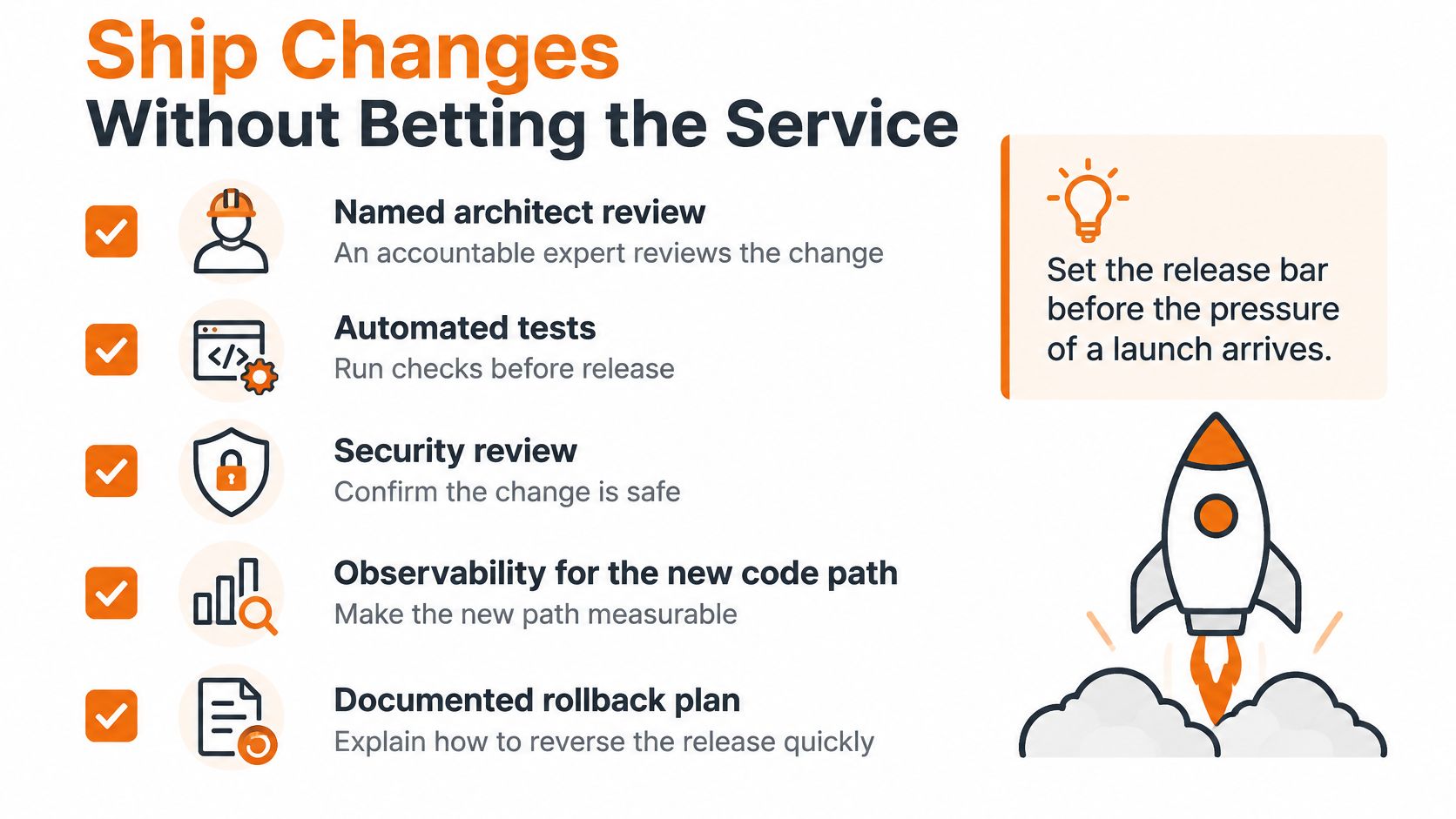
Set the release bar before launch pressure arrives. Otherwise, every missing test becomes an exception negotiated against a deadline, and engineers inherit risks nobody explicitly accepted.
At RITE NRG, every change must pass architecture review by a named architect, automated tests, a security review, observability, and a documented runbook and decision record. Apply the checklist proportionately, but don't confuse a lightweight review with an absent review.
The deployment checklist should be easy to inspect during a release decision.
Substantive peer inspections typically detect 60% to 90% of existing software defects, according to the NASA software reliability analysis. Apply structured inspection to requirements, plans, designs and test procedures as well as source code. Reviewing implementation can't reveal an omitted business requirement unless someone checks the intended behavior too.
Deploy behind a feature flag, expose a small canary group and compare its user-facing signals with the unchanged version. Define rollback triggers using error rate and latency, with enough traffic to make the comparison meaningful. Rehearse the reversal procedure before depending on it during an incident.
Database changes need a different level of caution. Use expand-then-contract migrations: add compatible structures, migrate behavior, verify data, and remove obsolete structures only after the previous application version no longer needs them. An application rollback isn't useful if the old code can no longer read the database.
For a practical test scenario, run expected peak load and then twice that load to explore capacity headroom. Add a bounded staging experiment against a dependency the team considers risky, with a clear hypothesis and stop condition.
The nexus IT group explanation of how DevOps enables faster releases offers useful context for connecting delivery automation with repeatable operations. Automation should reduce manual uncertainty, not automate an unsafe release process.
AI-generated code and tests pass the same gates. A generated suite isn't evidence until a senior engineer checks its assertions, missing cases and independence from the implementation. Review release-level failure and recovery trends so the team can tell whether faster delivery is creating avoidable operational work.
The incident is over, but the same failure can return if the team fixes only the trigger. A blameless postmortem should establish how a reasonable action led to customer harm, then assign changes that reduce the chance or impact of recurrence.
In Uptime Institute's 2023 survey, four in five respondents said their most recent serious outage could have been prevented through better management, processes and configuration, according to its annual outage analysis.
Assign an incident commander to coordinate decisions, a scribe to maintain the timeline, and a customer-communication owner. Set a regular update cadence, even when there is no new finding. Customers need to know whether their transactions or data are affected, not which internal team is investigating.
After service is restored, record the duration of customer impact and separate the initiating event from the missing safeguards. A configuration change might trigger an outage; absent validation and an untested rollback can explain why it lasted.
Error budget triggers and required actions
| Trigger | Required action |
|---|---|
| Error budget exhausted in the 30-day window | Pause nonessential changes and prioritize reliability work |
| One incident uses more than 5% of the 30-day budget, about 2 minutes of full outage at 99.9% | Hold a postmortem with at least one high-priority corrective action |
| Corrective actions past their due date | Escalate and re-plan them before new feature work starts |
Use this as a proposed team policy, including its strict threshold for incident reviews. Agree on the rules before an outage, so product and engineering are not negotiating while customers are affected.
A corrective action needs an owner, severity, deadline and observable completion condition. “Improve monitoring” is too vague to close responsibly. “Add a synthetic payment reconciliation check and demonstrate that it pages the on-call engineer” defines both the work and its proof.
RITE NRG's RiteWay approach keeps human accountability for important decisions. A named engineer remains responsible for what reaches production, with frequent production evidence to verify each correction. Closing a ticket is not enough if the failure remains possible.
For critical platforms, a 24/7 on-call system supports continuous performance monitoring. Keep the rotation workable, define backup escalation and give responders time to recover.
At shift changes, review open incidents, pending changes and known risks. Check that the runbook matches the deployed system, then test it in drills. An untested procedure is a hypothesis, not an operational guarantee.
AI assistance and distributed staffing don't automatically improve reliability. They change delivery capacity and economics, but they can also increase the volume of changes reaching a system before engineers understand their consequences.
AI monitoring must include output behavior, not just service health.
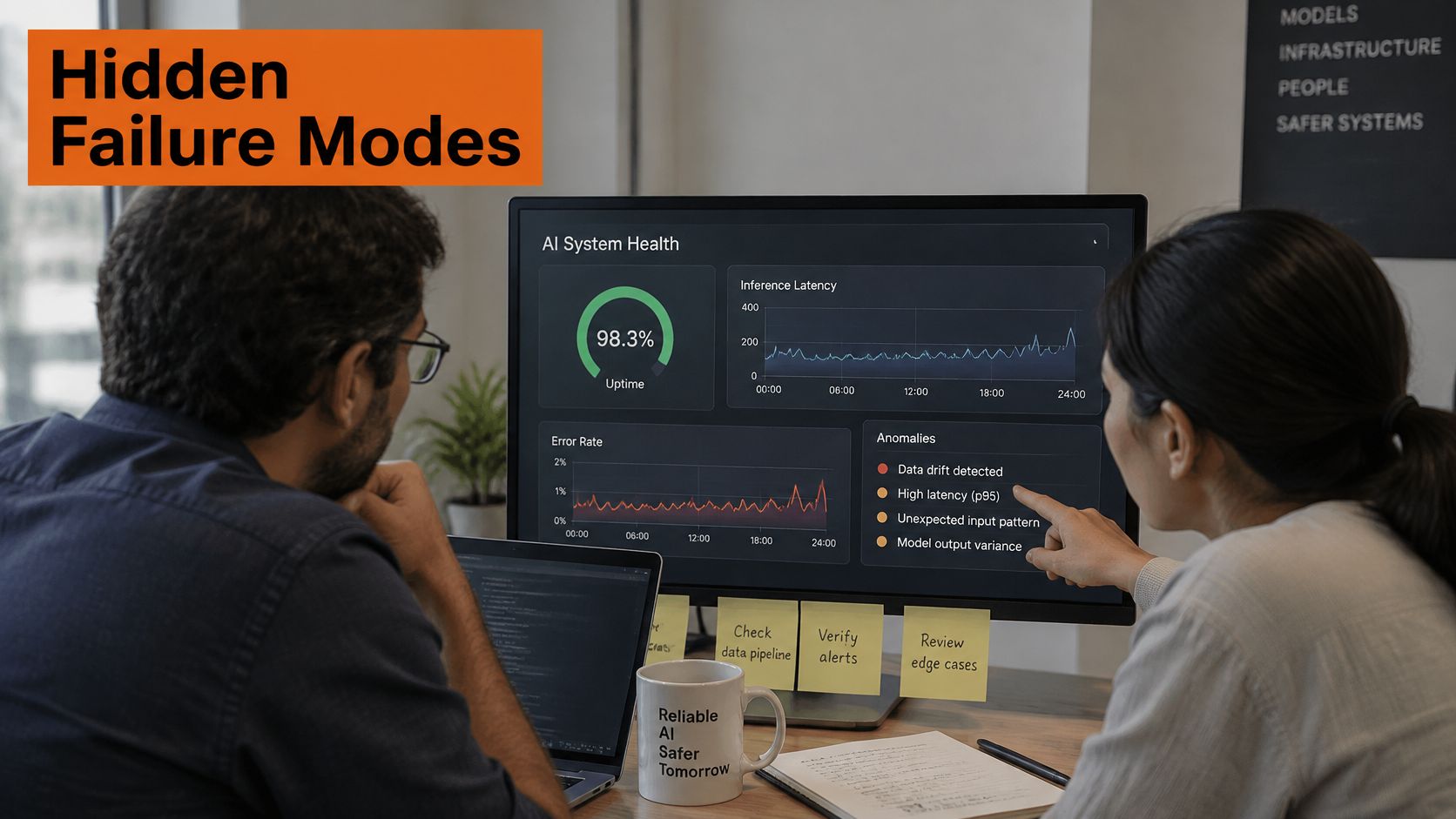
An empirical study of 156 high-severity production incidents found that approximately 60% involved inference-engine failures, with about 40% of those involving timeouts. That scope matters: it describes the incidents studied, not a universal failure rate for AI applications.
For an AI feature, combine availability with task-success rate, groundedness or quality checks, a maximum tolerated error rate and a cost ceiling. Evaluate representative tasks against expected outcomes, including cases where the correct behavior is to refuse an action or escalate to a person.
Test compound failures, such as provider degradation during a traffic spike while a tool API is unavailable. Bound retries and deadlines, restrict tool permissions, and require human approval for destructive production actions. Automated remediation must not have unlimited authority to worsen the original incident.
Our RiteWay approach means architecture before generation, frequent production evidence and human accountability for important decisions. Agentic AI can accelerate analysis, implementation, test generation, documentation and migration. Senior engineers remain accountable for data, security, integration and production quality.
Use that ownership lens when discussing AI-native delivery.
Geography isn't a production control. Whether you're comparing European partners or using HireDevelopers.com to hire developers from latin america, evaluate who owns the service when a release goes wrong.
Our approach to nearshore agile development keeps delivery coordination connected to operational ownership. The relevant question isn't how many people can write code. It's whether the team can explain, operate and recover what reaches production.
Choose one primary reliability move and name one owner before the meeting ends. A broad improvement program without a decision-maker becomes a backlog of worthwhile ideas competing with the next launch.
If you don't have SLOs, select your most valuable user journey and instrument its outcome. As an initial exercise, baseline it for 30 days before choosing a target. If recovery is the constraint, schedule a restore drill this month and record detection, containment and restoration.
For an inherited or hard-to-explain platform, we begin with a technical and operational assessment covering architecture, dependencies, security position, observability and operational risk. We then agree what must be corrected first. If neither the operating system nor the mission is clear, begin with discovery before committing to a long-term team.
Write down answers to these questions:
Book one hour with the team to close a proposed 30-day checklist: SLI defined, baseline captured, alerts reviewed, a recovery drill scheduled and a named owner for every open corrective action. Keep one priority improvement, even while completing these supporting basics.
Choose the next action by the customer outcome it protects, not by how impressive the architecture looks.
Rite NRG offers senior-led engineering and operational support to assess reliability risks, stabilize critical systems and establish a controlled improvement path. Visit Rite NRG to discuss your highest-risk customer journey; after qualifying the inquiry, we propose scope, accountable people and the first valuable release.
/ about the author
Written by the RITE NRG editorial team — the architects, engineers and delivery leads who build and operate AI-era software for our clients.
Strategy & Transformation
A practical, finance-ready framework for comparing AI and modernization investment with the current-state cost, realistic benefits, delivery risk and time to value.
Technology Talent & Teams
A decision-maker's guide to IT partnership models: what each model actually transfers to the partner, what it costs beyond the rate card, and how to match the model to your situation.
AI Consulting & Automation
A practical framework for choosing and deploying transport or logistics AI agents around real exceptions, reliable data and controlled operational authority.
More guidance: all insights articles
Tell us about the system or idea behind this article. We tell you honestly if it is a fit — and what a fixed-scope delivery could look like.