

Strategy & Transformation
How to Calculate ROI for AI and Software Modernization
A practical, finance-ready framework for comparing AI and modernization investment with the current-state cost, realistic benefits, delivery risk and time to value.
operationalwrocław--:-- cet
∕ insights / nearshore-agile-development.md
Nearshore Agile Development
A practical guide to nearshore agile development covering team structure, ceremonies, AI-assisted delivery, risk mitigation, and how
>_article.meta

Your roadmap is slipping, the next senior hires won't arrive in time, and you're already splitting your attention between architecture, recruitment, and production incidents. Adding developers may increase capacity, but it won't automatically make releases more predictable or reduce the decisions landing on your desk. The question isn't where to find cheaper developers. It's which delivery model helps your team ship useful work reliably while keeping ownership of architecture, security, and product quality.
Nearshore Agile development is an operating model, not a staffing shortcut. Judge it by business outcomes: time to first release, deployment frequency, change failures, rework, product quality, and the capacity your internal leaders regain. The practical test is whether the team can make decisions, resolve blockers, and deliver production-ready increments with clear accountability.
That means designing around six business levers: time to market, delivery throughput, release stability, coordination effort, engineering capacity, and long-term ownership. AI can improve the economics of delivery, but faster code generation only matters when senior engineers still own the result. The sections below lay out the decisions that make nearshore work a dependable part of your product organization.
A CTO with a crowded roadmap and limited hiring capacity doesn't need another supplier promising skilled developers. They need a delivery system that can absorb meaningful product work without creating a second management job or pushing architecture and quality decisions into a contractual gray area.
That pressure has made nearshore a strategic choice. The model combines distributed engineering with iterative delivery, giving product owners and engineers a chance to resolve questions in shared working hours. It also asks leadership to be more specific: which outcomes must improve, who owns decisions, and how will the team know when delivery is getting safer or slower?
Set a baseline before the team starts. DORA defines change lead time as the time from code commit to successful production deployment, deployment frequency as how often changes reach production, change failure rate as the share of deployments that cause production failures, and deployment rework rate as the share of deployments that become unplanned defect-fixing work. Those measures help a leadership team assess whether delivery is getting faster without trading away stability. DORA's delivery metrics guide provides the definitions.
Then add the commercial measures that fit your business problem. A SaaS company might track time to first release, features blocking revenue, or how much senior hiring pressure the team removes. A modernization program might care more about defects, incident ownership, and whether internal engineers can take over the system confidently.
Practical rule: If the proposed nearshore program can't name the business outcome it owns, it's capacity procurement, not a delivery strategy.
The historical evidence helps explain why the operating model is familiar to practitioners. The first State of Agile survey gathered 722 responses from 47 countries; the next survey cycle recorded 2,319 completed responses representing 80 countries. Early respondents cited accelerated time to market, higher productivity, and fewer defects among Agile's benefits. Those figures describe broad practitioner reports, not a controlled study proving nearshore delivery causes those outcomes. The early State of Agile survey history documents the convergence of distributed work and iterative methods.
Nearshore means a delivery team works in a region close enough to share useful working hours with the client. Agile means that a cross-functional team works from an ordered backlog, delivers in increments, and responds to feedback. Put together, nearshore Agile is a way to organize product work so people can clarify decisions in real time and own results across a delivery cycle.
The mechanics matter more than the label. Scrum, Kanban, or a hybrid can all work. A team that attends ceremonies but waits days for acceptance criteria, architecture decisions, or code-review feedback isn't operating effectively, even if its board is full of tickets.
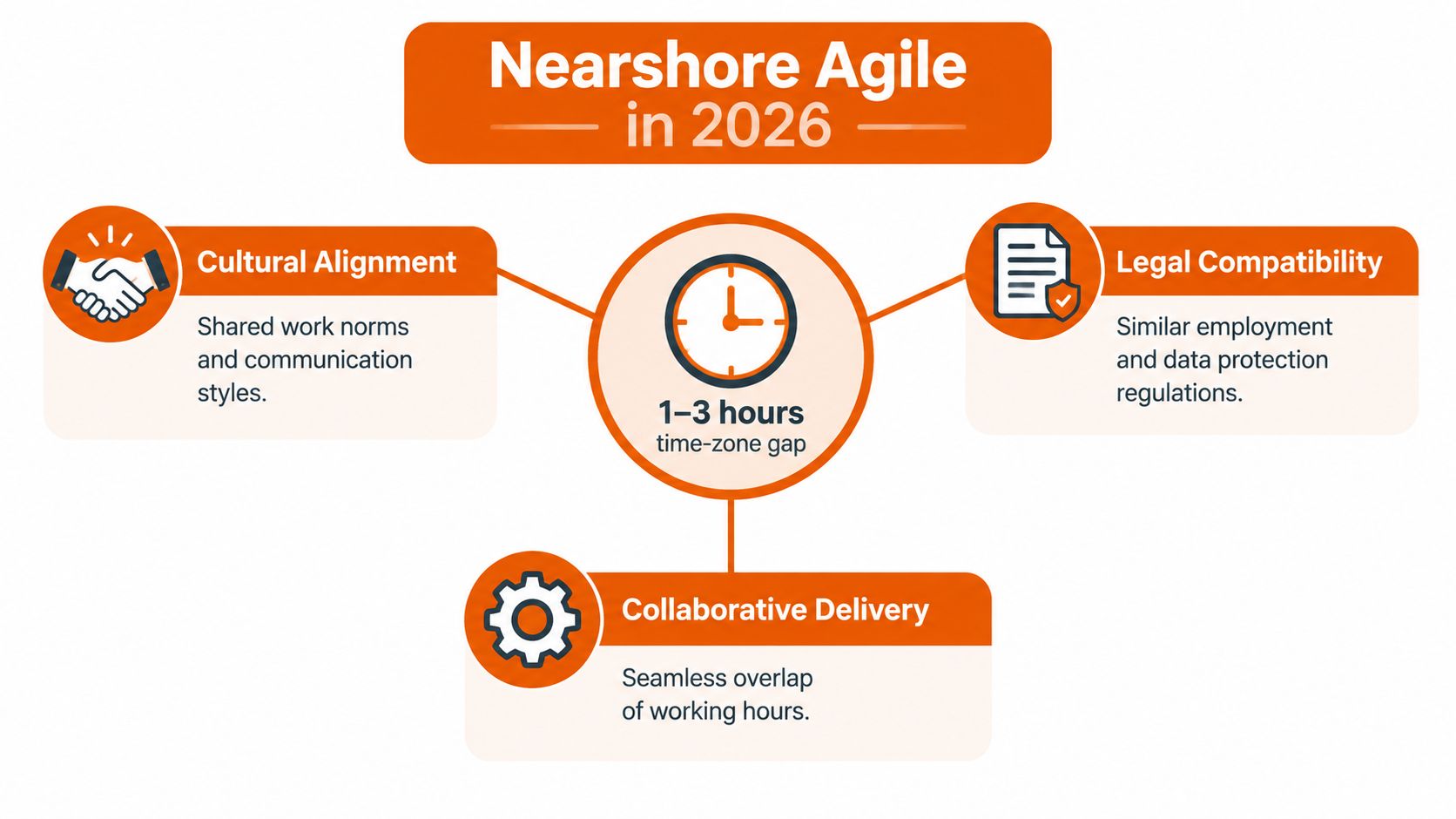
A serious program has one product backlog, an accountable product owner, named technical leadership, cross-functional skills, shared working agreements, visible delivery measures, and access to the people who can resolve product and technical questions. Those are operating conditions, not vendor talking points.
The shared-hours advantage only exists if people use it well. Reserve overlap for refinement, pairing, reviews, and decisions that would otherwise block work. Keep routine status updates asynchronous, and document decisions so the team doesn't need another meeting to rediscover them.
Agile has become a recognizable delivery model across markets, but organization-wide adoption doesn't guarantee mature execution. Digital.ai's 17th State of Agile survey, based on 788 software-development professionals, reported that 71% used Agile in their software development lifecycle. The same report's finding is adoption, not proof that every adopting organization has integrated external teams well. The 17th State of Agile survey announcement reinforces a basic point: a shared vocabulary helps, but governance still decides whether the work flows.
If a nearshore proposal leads with story points, ask how those points connect to production and commercial value. Story points can help a team plan its work. They don't tell a founder whether a release is reaching customers, whether production risk is rising, or whether a feature is unblocking revenue.
Start with the delivery measures that show whether engineering is moving work through the system. Add commercial outcomes that reflect your own constraints, such as time to first release, runway pressure, or delayed revenue opportunities. Don't promise a financial result before you've established what's currently happening.
| DORA outcome | Delivery lever inside the nearshore team | Leading signal |
|---|---|---|
| Change lead time | Keep decisions and reviews inside the shared working window; reduce handoffs between roles. | Time from commit to production, plus review and clarification latency. |
| Deployment frequency | Integrate small changes continuously and make release responsibility explicit. | Release cadence and the age of work waiting to ship. |
| Change failure rate | Make test evidence, risk review, and production checks part of the definition of done. | Failures associated with deployments and recurring defect patterns. |
| Deployment rework rate | Strengthen refinement, acceptance criteria, and feedback before implementation hardens. | Unplanned fix work and defect-driven changes after release. |
The team design determines whether those levers can work. A product owner who's available for clarification can shorten decision delays. A senior engineer who owns architecture can prevent conflicting implementations. Automated tests and frequent integration can expose problems before release, while AI-assisted analysis or test creation can help the team move routine work faster without transferring accountability to a tool.
Translate each measure into a sentence your leadership team can evaluate: “We'll shorten the path from accepted change to production by resolving review and product questions within the team's shared hours.” If you can't explain the mechanism, the target is a wish, not a plan. Use a project-success measurement framework to make the connection between delivery activity and business results explicit.
A team ships when the right people can make decisions and finish work without repeatedly handing it off. A practical setup combines product ownership, technical leadership, engineering, quality, and delivery coordination. Design and DevOps expertise should be available where the product needs them, not treated as a late-stage service desk.
For a Poland-based partner serving Western European clients, place the nearshore engineers and senior technical lead close enough to the client's working day to join decisions and resolve blockers. Keep product authority with the person accountable for the product. Don't outsource prioritization and then expect engineers to guess which customer problem matters most.
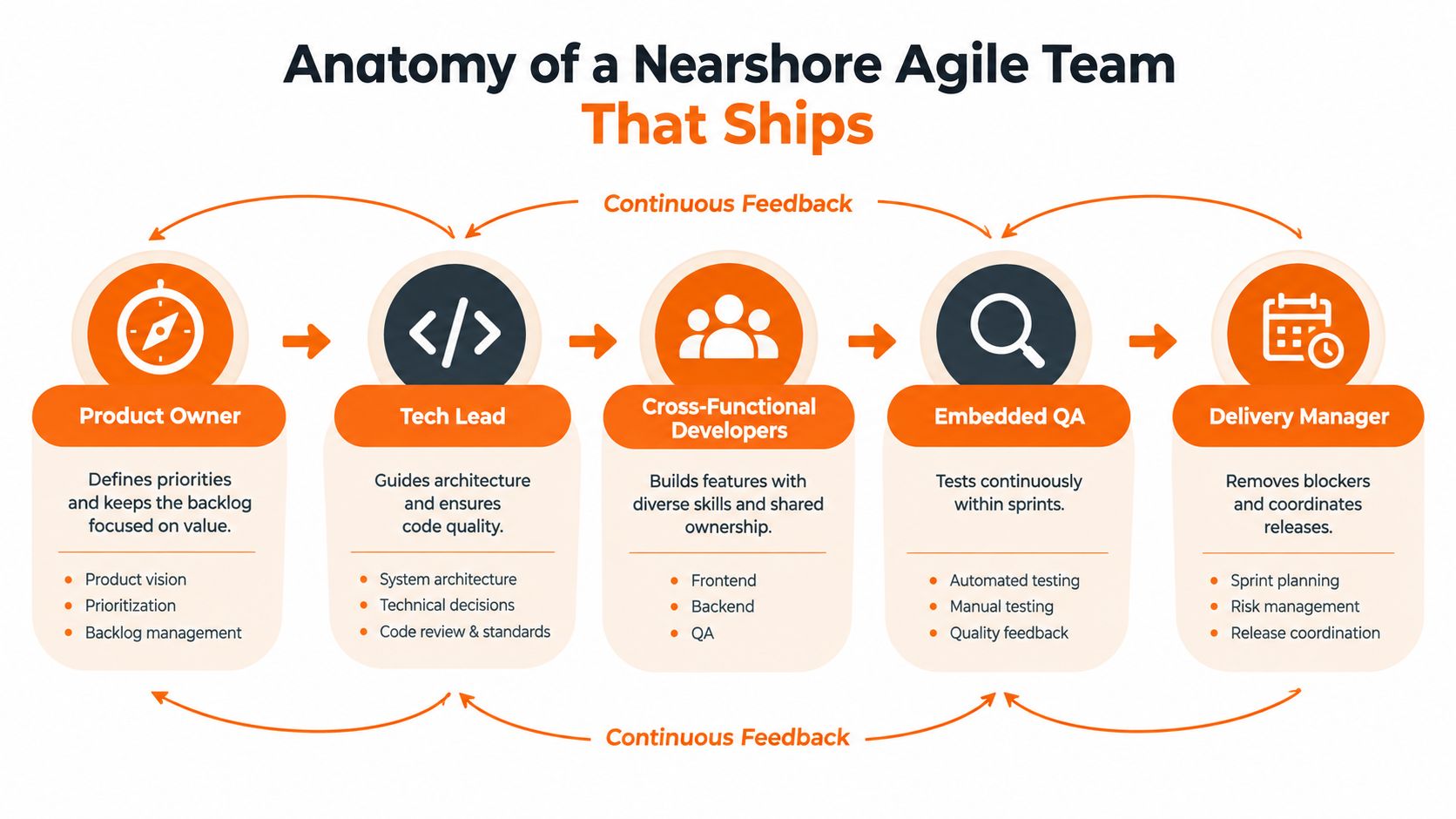
Use a single backlog and a shared definition of ready and done. Integrate changes continuously, protect the main branch with automated tests, and assign clear ownership for APIs and architecture. Use shared hours for pairing, technical review, refinement, and decisions, not a string of status meetings.
The product owner sets priorities and accepts outcomes. The tech lead makes architecture and engineering trade-offs visible. Developers build and integrate the work; QA tests continuously rather than waiting for a release handoff. A delivery lead surfaces blockers, keeps dependencies visible, and coordinates release readiness. Each role should leave evidence in the working system: clarified backlog items, reviewed code, test results, documented decisions, and release notes.
English as the working language is useful, but language alone doesn't create alignment. Agree on direct feedback, escalation, and decision-making norms. Strong engineers should challenge a risky product or architecture choice respectfully instead of agreeing in a meeting and raising the concern after implementation.
A strategic partner brings a recommendation with the trade-off attached. An order taker waits for a ticket.
For practical planning, keep refinement focused on whether work is understandable and testable, and use planning to make capacity, dependencies, and sprint goals explicit. This sprint-planning guide offers a useful reference for setting those expectations. If you're comparing hiring models, nearshore staffing services can help clarify how sourcing and team structure differ from a fully managed delivery arrangement.
There isn't a universally best location. The right choice depends on the work's communication intensity, the capability you need to retain internally, and whether your biggest constraint is coordination, hiring capacity, or cost.

Nearshore in Poland or a comparable region fits work that needs regular product and engineering decisions. Shared hours can reduce the wait for clarification, while a partner team can add capacity without asking the CTO to manage every implementation detail. That advantage disappears if product ownership, architecture, and security responsibilities remain vague.
Far-shore delivery can suit large, well-specified work where frequent synchronous decisions matter less. It may be a poor fit for a rapidly changing product slice if handoffs repeatedly block acceptance, design, or technical choices.
Local hiring works well for a small embedded team when people need to sit inside the product organization and own decisions continuously. It can also preserve close relationships with internal stakeholders. The trade-off is that the organization must carry the full hiring and team-building load itself.
A useful comparison goes beyond hourly price. Assess overlap for decisions, the speed of onboarding, access to senior engineers, retention, security responsibilities, integration effort, and who owns the system after delivery. Nearshore tends to fit the middle ground: communication-intensive product work that needs a cohesive team, but doesn't justify building every capability locally.
The European talent pool is substantial: Eurostat reported 10.45 million ICT specialists employed across the EU in 2025, equal to 5.0% of employment. That describes the broader labor market, not the availability or suitability of a particular partner. Eurostat's ICT specialist figures are context, not a hiring guarantee.
A Build-Operate-Transfer model becomes relevant when the company wants to graduate from partner-supported delivery to a durable client-owned capability. Treat readiness as a systems question: can the client's leaders own architecture, security, hiring, production incidents, and knowledge transfer? Compare staff augmentation, dedicated teams, and project delivery models before committing to a structure.
For a decision-maker weighing the practical trade-offs, this video offers an additional perspective on nearshore delivery:
Adding AI doesn't automatically make a distributed team faster. It can speed up analysis, code drafting, test creation, documentation, and migration work. It can also create more review and integration work if engineers accept outputs they don't understand.
The adoption figures deserve a careful reading: 84% of developers use or plan to use AI tools, while 45% say debugging AI-generated code is time-consuming, according to Stack Overflow's 2025 Developer Survey. Those numbers describe reported use and experience; they don't prove that AI improves a particular team's end-to-end delivery.
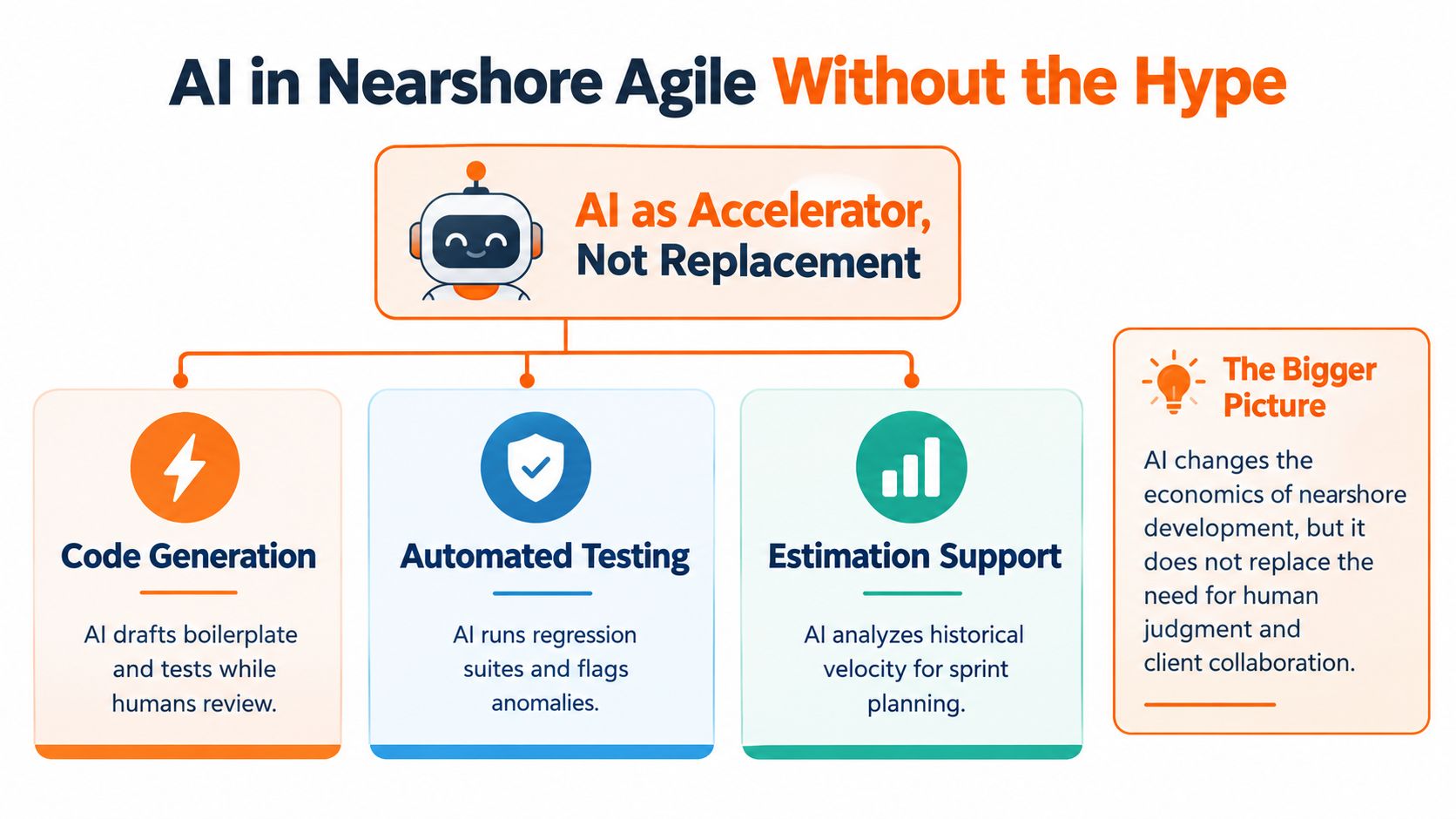
Give AI agents a defined role: accelerate work, don't own the outcome. A named architect remains accountable for system design and integrations. Engineers remain responsible for reviewing code and tests. The client and delivery team must agree how sensitive data is handled and which tools are approved.
NIST's AI Risk Management Framework supports this emphasis on human oversight. It says AI risk processes may require human intervention when a system can't detect or correct errors, and it calls for practitioner proficiency and testing evidence to be documented. The NIST AI Risk Management Framework is a useful foundation for setting those responsibilities.
Put the policy in the engagement agreement or engineering handbook:
The standard is simple: AI can change delivery economics, but it doesn't lower engineering standards. If a partner can't explain who approves AI-generated work and how the team catches errors, the operating model isn't ready.
Nearshore teams can inherit the same weaknesses as any distributed team. Time-zone overlap won't compensate for slow decisions, unclear architecture ownership, or a client that expects an external team to infer priorities. Track the conditions that reveal coordination debt before it becomes a release problem.
| Risk | Early warning | Practical control |
|---|---|---|
| Slow feedback | Clarification requests sit unresolved; work remains blocked. | Reserve product-owner overlap and review blocked items regularly. |
| Architecture drift | Engineers make competing assumptions or repeat rework. | Name an architecture owner and document decisions where the team works. |
| Quality decline | Defects escape or fixes dominate new delivery. | Enforce shared acceptance criteria, automated tests, and release checks. |
| Vendor dependency | Internal leaders can't explain system decisions or own incidents. | Transfer knowledge continuously and assign client counterparts to critical areas. |
| Security gaps | Access, data handling, or incident escalation is unclear. | Apply the client's security baseline and verify responsibility before onboarding. |
| AI governance gaps | Generated changes lack clear review or test evidence. | Define approved tools, human review, and testing requirements in writing. |
Record blocked-work hours, clarification cycle time, escaped defects per release, rework percentage, architecture decision latency, senior-engineer retention, and the share of production incidents the nearshore team owns end to end. Assign an owner to each measure and review the trend with the people who can act on it. Don't mistake a dashboard for control if nobody can stop work, change scope, or escalate a risk.
A delivery lead should make risks visible early and propose a path forward, rather than waiting for the client to discover them during a release. That's Extreme Ownership in practice: the team doesn't stop at completing assigned tickets; it follows the work through integration, release, and production feedback.
Be candid when evaluating a partner. If they won't discuss failure modes, show how they measure delivery, or let you meet the engineers who'll do the work, don't treat that as a minor concern. It's evidence about the accountability you can expect.
A first release starts with a business problem, not a technology backlog. Choose a product slice that can deliver visible value, name the person who can make product decisions, and agree how the team will judge the release. If the first milestone has no user or operational outcome attached, reduce the scope until it does.
For qualifying projects, RITE NRG offers an agreed production release within 45 working days at a fixed scope and fixed price. That applies when the scope can be defined, decisions are available, dependencies are understood, and the work can be delivered without waiting on unresolved external approvals. It isn't a promise that every product, modernization effort, or regulatory program fits that model.
Agree the overlap window, ceremony cadence, definition of done, security baseline, and AI policy. Instrument the delivery measures from the start, then use the first delivery cycle to expose dependencies and revise the plan. Sequence the early work around a deployable slice, not a long chain of tasks that leaves production feedback until the end.
Run this checklist before signing:
Ask any prospective partner these questions: Who will lead architecture and remain accountable for production quality? How will product decisions and blocked work be handled during shared hours? What security and data-handling rules will the team follow? Which AI tools may be used, and who reviews their output? Which delivery outcomes will you report beyond hours and story points? How will the client gain the knowledge and authority to own the system over time?
Choose the partner who can answer with named owners, working practices, and evidence the team can inspect. Then start with a bounded release and review the operating model against the results, not the promises.
Rite NRG helps companies build, modernize, and operate business-critical software with senior nearshore engineers and an AI-native delivery model that keeps engineering accountability with people. If you're deciding whether nearshore Agile can move a specific product outcome, talk with Rite NRG about the team design, delivery measures, and ownership model that fit your situation.
/ about the author
Written by the RITE NRG editorial team — the architects, engineers and delivery leads who build and operate AI-era software for our clients.
Strategy & Transformation
A practical, finance-ready framework for comparing AI and modernization investment with the current-state cost, realistic benefits, delivery risk and time to value.
Technology Talent & Teams
A decision-maker's guide to IT partnership models: what each model actually transfers to the partner, what it costs beyond the rate card, and how to match the model to your situation.
AI Consulting & Automation
A practical framework for choosing and deploying transport or logistics AI agents around real exceptions, reliable data and controlled operational authority.
More guidance: all insights articles
Tell us about the system or idea behind this article. We tell you honestly if it is a fit — and what a fixed-scope delivery could look like.