

Strategy & Transformation
How to Calculate ROI for AI and Software Modernization
A practical, finance-ready framework for comparing AI and modernization investment with the current-state cost, realistic benefits, delivery risk and time to value.
operationalwrocław--:-- cet
∕ insights / sprint-planning.md
Sprint Planning
Sprint planning done right helps teams set clear goals, size work honestly, and ship predictable business value every single sprint.
>_article.meta

Your sprint starts with a confident forecast and ends with unfinished work, deferred quality checks, and stakeholders asking why the promised business result never appeared. The backlog is full, the board looks active, and engineers have worked hard, yet the release still hasn't reduced operational risk, improved customer experience, or moved the product closer to revenue.
That pattern rarely comes from a lack of project-management software. It comes from weak decisions before execution begins. Effective sprint planning connects a measurable business problem to available capacity, technical reality, and a clear definition of done. It also makes ownership visible, especially when nearshore teams, production support, dependencies, and AI-assisted development are involved.
A sprint can appear well controlled. The Product Owner brings a polished backlog, the team selects attractive features, and everyone leaves with a sense of progress. By the review, the most important customer problem may remain untouched because the selected tickets measured activity rather than value.
Consider a team committing to an API refactor, a dashboard component, and several integration tasks. Each item sounds reasonable. If the business objective is faster customer onboarding, however, the work is incomplete unless those activities support that result and include the testing, integration, and release work required to make the change usable.

The 2020 Scrum Guide defines Sprint Planning as the event that initiates every Sprint, with the entire Scrum Team collaborating on the resulting plan. It is therefore more than a scheduling exercise. Product value, delivery capacity, and technical execution meet in this decision.
Strong planning starts with a business problem that someone can recognize and measure. Faster time to market, lower operational risk, improved quality, increased customer capacity, and reduced cost are useful directions. “Complete the next eight tickets” describes activity, not a business outcome.
The Sprint Goal should state why the Sprint matters. The Product Goal supplies longer-term direction, helping the team avoid optimizing isolated tasks while losing sight of the product's intended future state.
Practical rule: If the team cannot explain how the selected work advances a business outcome, the backlog is not ready for commitment.
Extreme Ownership changes the planning conversation. Engineers must question unclear tickets instead of waiting for clarification. Product leaders retain responsibility for value after handing work to the team. Together, the team identifies ambiguity, exposes dependencies, challenges unrealistic assumptions, and owns the complete result, including production quality.
AI-assisted development raises the standard further. AI can accelerate exploration, implementation, and test creation, but it does not own architectural judgment or release risk. A senior engineer must still review the result, confirm that it solves the intended problem, and make accountability visible.
That discipline matters in a Poland-based nearshore or distributed model. Time-zone handoffs can conceal unresolved decisions, while a local team may look productive while waiting for input from another region. Clear goals, named owners, written decisions, and visible risks keep distance from becoming an excuse for delay. The outcome remains the measure of progress, not the number of tickets moved across a board.
Sprint Planning has deep roots in Scrum's development. Ken Schwaber and Jeff Sutherland first co-presented Scrum at the OOPSLA conference in 1995, building on earlier practices and on ideas associated with Hirotaka Takeuchi and Ikujiro Nonaka's 1986 Harvard Business Review article on high-speed product development. The first Scrum Guide appeared in 2010, while the current reference model is the 2020 Scrum Guide. This history matters because Sprint Planning was designed as a mechanism for empirical delivery, not as a meeting for distributing tasks. (Scrum Guide history)
The event is organized around three questions:
The outputs are a Sprint Goal, selected Product Backlog items, and an initial Sprint Backlog. The Product Goal provides the longer-term commitment that keeps the Sprint connected to product direction.
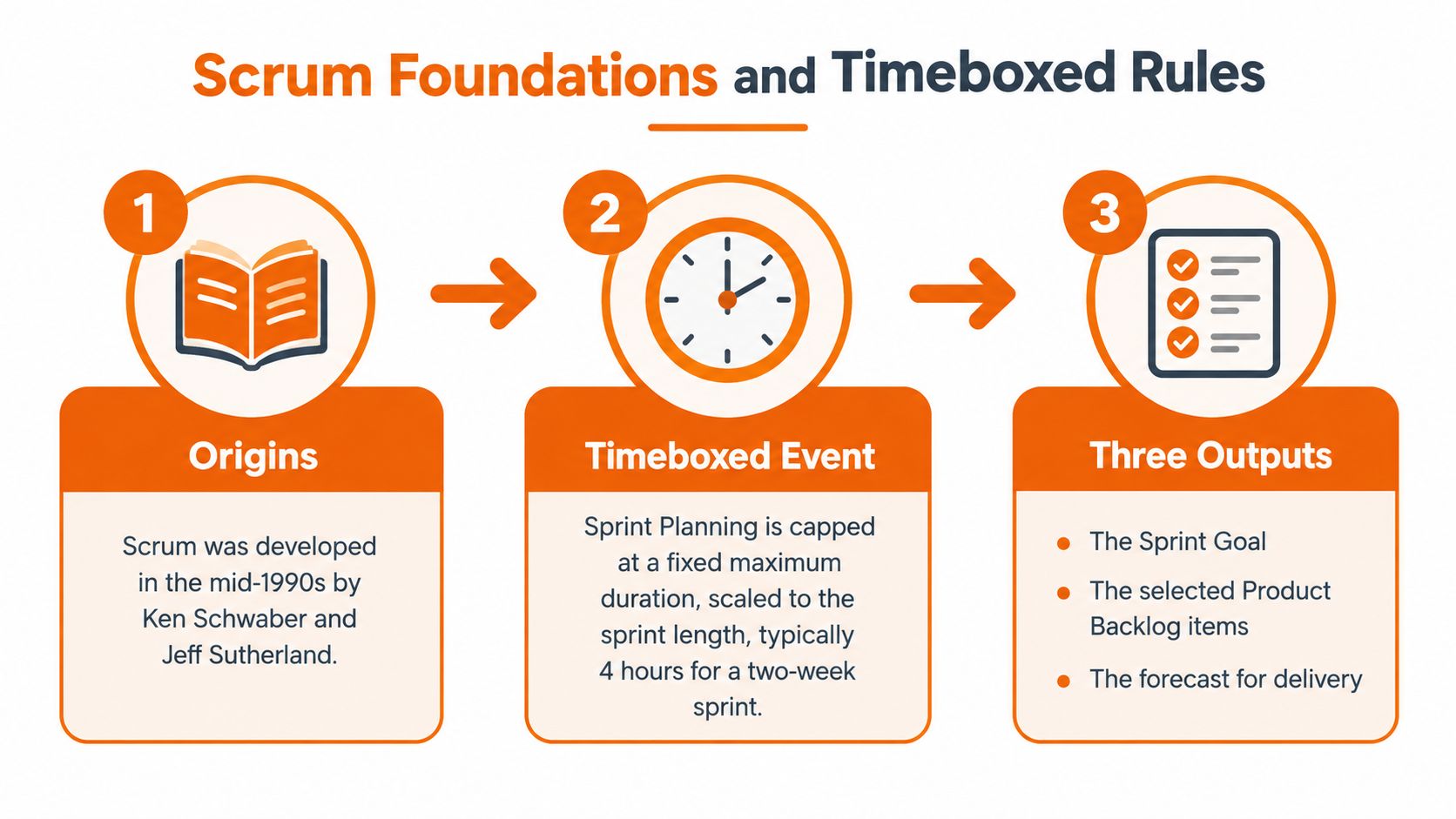
The 2020 Scrum Guide sets a maximum of eight hours for Sprint Planning when the Sprint lasts one month. Shorter Sprints generally need shorter planning. A widely used proportional rule is approximately two hours for every week of Sprint length, which gives a two-week Sprint a recommended maximum of four hours. (Scrum events and their purpose)
The timebox is a ceiling, not a target. If the team has a coherent goal, a credible forecast, and enough technical clarity to start, the meeting should end. Extending the session to resolve every architectural question usually produces fatigue rather than certainty.
A useful agenda keeps the meeting moving:
Teams that want broader context on connecting agile routines with organizational performance can also review agile performance management in azienda, particularly when delivery governance extends beyond the Scrum Team.
The meeting shouldn't become a requirements workshop. A field study based on 34 interviews and 18 observations across four Agile teams found that sprint-planning meetings commonly take place at the start of the Sprint, last about two hours, and require rapid decisions in teams working in two- or three-week cycles. (Field study of Agile sprint planning) Unresolved discovery and architecture work belongs upstream wherever possible. If uncertainty remains, plan a spike with a decision outcome rather than disguising exploration as a feature commitment.
Nominal capacity is easy to calculate and usually wrong. Multiplying team size by Sprint days and a standard workday ignores leave, holidays, recurring Scrum events, backlog refinement, support work, meetings, production incidents, and interruptions across products.
The 2020 Scrum Guide's empirical planning guidance.pdf/9) identifies historical performance, upcoming availability, and the Definition of Done as important inputs to forecast confidence. Those inputs only help when the team applies them with integrity.
Available focus time comes first. Calculate each person's actual working time for the Sprint, then subtract planned absence and recurring obligations. A part-time engineer supporting a legacy platform doesn't offer the same delivery capacity as a fully allocated engineer.
Interruption load deserves an explicit reserve. Production support, customer escalations, security response, and dependency coordination consume capacity whether the backlog acknowledges them or not. If the team doesn't reserve room for this work, the plan becomes a promise built on denial.
Completion cost is larger than implementation. A backlog item isn't complete when code exists. Acceptance validation, automated tests, integration, documentation, review, deployment preparation, and other Definition-of-Done activities belong in the forecast.
Uncertainty and risk affect both effort and sequence. New architecture, migrations, external dependencies, and discovery-heavy work can't be forecast with the same confidence as repeatable feature delivery. Historical completed work is useful evidence, but the team must interpret it alongside system complexity, team changes, and interrupt load.
A simple planning worksheet can expose the gap:
| Capacity question | What to include | What goes wrong when it's omitted |
|---|---|---|
| Who is available? | Leave, holidays, part-time allocation, shared responsibilities | The plan assumes people are present when they're not |
| What will interrupt us? | Support, incidents, refinement, recurring events, external dependencies | Unplanned work pushes committed work into the next Sprint |
| What does done require? | Review, testing, integration, documentation, production readiness | “Almost complete” items accumulate |
| What carries uncertainty? | Discovery, migrations, architecture, new integrations | Estimates look precise while risk remains invisible |
For AI-assisted delivery, the standard gets stricter. Generated code isn't completed work unless human review, architecture validation, security checks, testing, integration, documentation, and production-readiness activities fit inside the Sprint forecast.
Planning principle: AI output is an input to engineering work, not free throughput.
The direct cause and effect is clear. Omitted constraints create overcommitment. Overcommitment creates rollover. Rollover distorts historical performance and makes the next forecast less trustworthy. A short risk assessment framework can help teams make uncertainty visible before they select work, especially when a nearshore team shares responsibility with an internal platform or operations group.
A team enters Sprint Planning with an AI-generated scope, a neat dependency list, and confident estimates. Twenty minutes later, nobody can explain which assumptions are safe, who accepted the risks, or what evidence supports the Sprint Goal. The meeting has become faster, while accountability has become harder to see.
A 2025 systematic mapping review of 53 peer-reviewed studies found that AI research in Agile software development concentrates on Sprint Planning, testing, and requirements or design. 70% of the studies reported improved efficiency, while data quality, ethics, and integration remained persistent challenges. (Systematic mapping review of AI in Agile development)
The implication is practical: AI can compress analysis and preparation, but senior product and engineering leaders still own the decisions. Nearshore teams face the same rule across time zones and organizational boundaries. A generated recommendation may expose a dependency, yet it cannot decide whether an internal platform team can support the change or whether a release risk is acceptable.
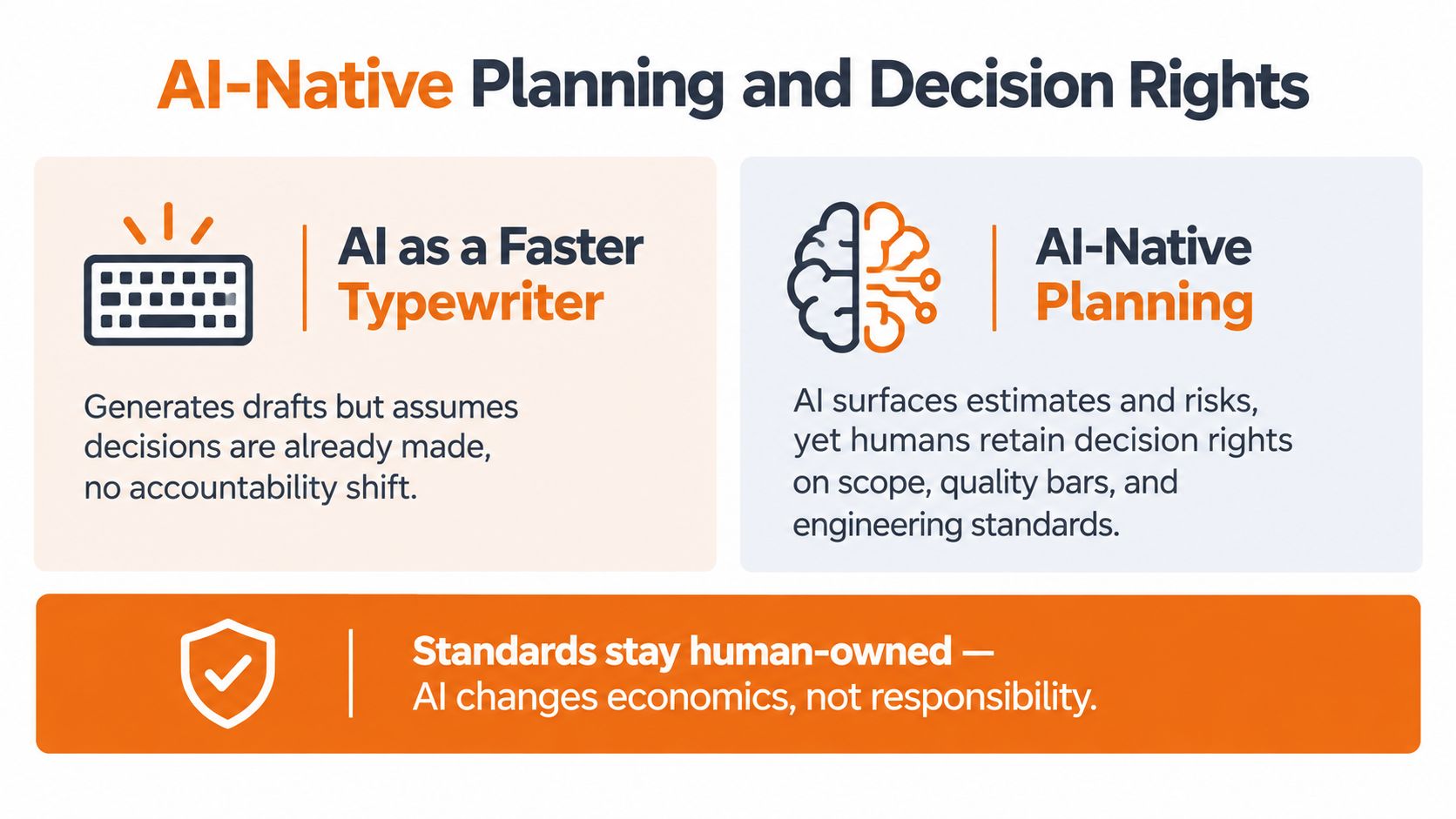
Use AI to improve the information entering the meeting:
Keep decision rights with named owners:
A 2025 survey of 73 Agile practitioners found that 40% did not use AI for planning and estimation, while 42% used it only as an assistant. Looking ahead, 41% expected AI to remain an assistant in planning and estimation, while only 24% saw it becoming a collaborator. The cited mapping review reports this practitioner evidence alongside its broader research findings, so the figures should not be treated as an independent source. The working rule is clear: accelerate preparation, retain judgment.
For each meaningful AI recommendation, record the data used, assumptions, confidence level, human decision, and rejected alternatives. A concise planning note is sufficient when another engineer can understand why the team accepted or rejected the recommendation. This record also supports Extreme Ownership when a decision later affects reliability, delivery speed, or rework.
Data boundaries matter when prompts include customer information, proprietary code, or regulated workflows. Define what may enter an AI system, who can access the output, and how provenance is retained. The SourceX data transaction layer gives technology leaders a reference point for controlled data movement and AI workflows.
Agentic tools can summarize a backlog, generate a risk matrix, and propose alternative Sprint scopes. They cannot own a security trade-off, confirm that the Sprint Goal reflects customer value, or declare a change safe to release. Teams applying AI-native software delivery practices should measure the result through delivery quality and operational outcomes, not the amount of generated code.
Bad Sprint Planning leaves recognizable fingerprints. The team discusses architecture for the first time in the meeting, treats velocity as a fixed promise, selects work because it is easy to count, and celebrates closure even when the release creates rework or operational instability.
The first correction is to move ambiguity upstream. Backlog items should enter planning with a clear user outcome, acceptance conditions, known dependencies, and enough technical context to expose integration and test risk. If discovery remains essential, define the decision the spike must produce. Don't call an unresolved investigation a feature.
Velocity is evidence, not a contract. When it becomes unreliable because work is dominated by incidents, discovery, migrations, dependencies, or AI-generated changes, use a range and explain the uncertainty rather than manufacturing precision.
After each Sprint, compare planned and completed work, then classify the variance:
This creates a feedback loop. The team can adjust refinement, reserves, sequencing, or ownership based on observed causes instead of blaming individual estimates. Metrics should support psychological safety and shared decisions, not become individual performance targets. A recent study reported that teams often preferred simple boards or spreadsheets despite having more detailed metrics, while managers or team leads used data the wider team didn't engage with. (Study of data use in Agile decision-making)
DORA's current framework uses five operational metrics:
| Metric | What it tells leaders |
|---|---|
| Change lead time | How long work takes to move from change initiation toward delivery |
| Deployment frequency | How often the team deploys changes |
| Failed-deployment recovery time | How quickly the team restores service after a failed deployment |
| Change-fail rate | The percentage of deployments that cause production failures |
| Deployment-rework rate | The percentage of deployments that are unplanned work to fix bugs |
These measures stop teams from confusing activity with value. A plan that closes more tickets while increasing production failures isn't better. A plan that reduces lead time while preserving recovery performance and stability is more valuable. (DORA metrics history)
Google's 2024 DORA findings reported that a 25% increase in AI adoption was associated with a 7.5% increase in documentation quality, a 3.4% increase in code quality, and a 3.1% increase in code-review speed. The same findings estimated a 1.5% decrease in delivery throughput and a 7.2% reduction in delivery stability as AI adoption increased. (Google Cloud's 2024 DORA report)
The trade-off reinforces senior engineering accountability. AI can accelerate analysis, documentation, implementation, and review, while architects and engineers remain responsible for architecture, data, security, testing, integration, and production quality. Use engineering efficiency guidance to connect planning decisions with operational performance rather than output volume.
Use this template before the next planning meeting. Keep it visible in the shared workspace and make one person accountable for updating each decision.
Compare planned and completed work. Classify variance as capacity, dependency, unclear scope, defect, or interruption, then change the next planning input accordingly.
For nearshore teams, document decisions asynchronously, name the owner for every handoff, and write the next required action before the working day ends in each location. A short written update beats a meeting that leaves the next region guessing.
Rite NRG helps SaaS companies, scaleups, and enterprises plan, build, modernize, and operate business-critical technology through senior engineering leadership and an AI-native delivery model. Visit Rite NRG to discuss a more predictable Sprint planning approach, nearshore engineering team, or complete R&D center in Poland.
/ about the author
Written by the RITE NRG editorial team — the architects, engineers and delivery leads who build and operate AI-era software for our clients.
Strategy & Transformation
A practical, finance-ready framework for comparing AI and modernization investment with the current-state cost, realistic benefits, delivery risk and time to value.
AI Consulting & Automation
A practical framework for choosing and deploying transport or logistics AI agents around real exceptions, reliable data and controlled operational authority.
Industry Solutions
A practical roadmap for improving manufacturing systems and introducing AI without destabilising production, data integrity or operational control.
More guidance: all insights articles
Tell us about the system or idea behind this article. We tell you honestly if it is a fit — and what a fixed-scope delivery could look like.