
Strategy & Transformation
How to Calculate ROI for AI and Software Modernization
A practical, finance-ready framework for comparing AI and modernization investment with the current-state cost, realistic benefits, delivery risk and time to value.
operationalwrocław--:-- cet
∕ insights / data-migration-architecture.md
Data Migration Architecture
Data migration architecture that controls downtime, validation, and rollback. Compare big-bang, incremental, ETL, and CDC before cutover.
>_article.meta
Monday morning, the billing cutover is marked complete. Then finance finds invoices with the wrong totals, customer support sees mismatched orders, and operations can't trust the stock balances. The copy job finished. The business still has a problem.
That's why data migration architecture should protect revenue and continuity, not just move records. A sound design aims to shorten the outage, reduce rework, preserve capacity while systems coexist, and give the business a release it can reverse. If you're weighing the application, infrastructure, and operating-model choices involved in moving Houston business applications to the cloud, start by defining those outcomes before choosing a tool.
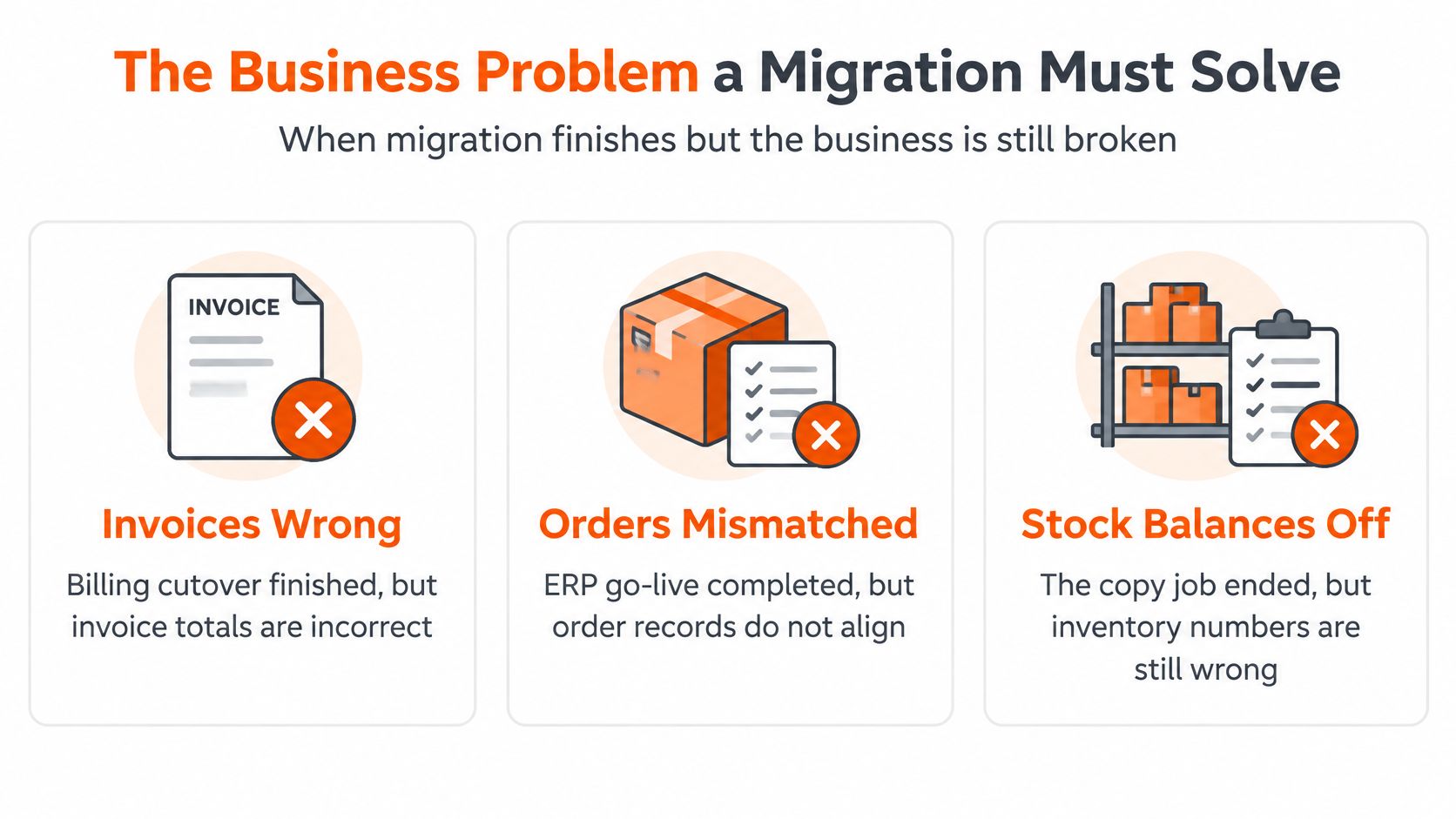
A migration can copy every row and still break the business. An invoice total may change because a transformation interpreted a discount differently. An order can lose its connection to a customer record. Inventory can be present in the target but calculated under a different unit or timing rule. These aren't transport failures. They're failures to preserve business meaning.
The risk is not theoretical. A frequently cited Bloor Research study from 2007 found that more than 60% of data-migration projects exceeded their planned time or budget. A 2021 McKinsey survey of 450 CIOs, as reported in industry coverage, found that 75% of cloud migrations exceeded budget, while only 15% finished on time within the original estimate. In that survey, 38% were delayed by more than one quarter, including 13% delayed by at least three quarters, as summarized in industry coverage of legacy data migration risks.
Migration architecture is a risk-control system for business meaning, operational continuity, and auditability. It's not a pipe between databases.
The design needs named layers: discovery, mapping, staging, transformation, loading, validation, cutover, and rollback. Each layer gives the team a place to find errors, make decisions, and keep the business informed before those errors become production incidents.
Extreme Ownership means the migration team owns the result, not just the pipeline task. A senior engineer should be accountable for the data rules, the release gates, and the route back to the source. The business should know what can go wrong, who can stop cutover, and which evidence will show that the new system is ready.
Start with the pattern comparison below, then decide which data belongs in the target. Copying every historical row is often the most expensive assumption in the migration plan.
Pick a pattern before choosing a product. The right choice depends on how much downtime the business can accept, how quickly the source changes, and how much proof you need before retiring the old system.
| Pattern | Best fit | Downtime shape | Consistency method | Rollback |
|---|---|---|---|---|
| Big-bang | Small, quiet dataset and a long approved window | Full outage for extract, load, and check | One-shot snapshot | Restore source and reverse routing; usually a full restart |
| Incremental waves | Large estate split by domain, region, or cohort | Short outage per wave | Batch extract plus reconciliation per wave | Reverse only the current wave |
| Online snapshot plus CDC | Live SaaS or other low-window systems | Write freeze, endpoint switch, and validation | Consistent snapshot then ordered log replay from that position | Keep source authoritative and reverse routing |
| ETL | Target model must be standardized before load | Batch window | Transform, then load | Reload curated tables from staging or source |
| ELT | Cloud analytics with cheap target compute | Read-only extract; little source outage | Load raw, then transform in the target | Drop and rebuild the transformed layer |
| Parallel run | High-stakes cutover needing side-by-side proof | Near zero if traffic can be split | Dual write or compare-and-reconcile | Stay on the source until acceptance |
Big-bang is a reasonable choice for a small dataset that changes little and can fit safely inside an approved outage. Its weakness is concentration of risk: if extraction, loading, or validation overruns, the team may have to restore the source and restart the full procedure. Incremental waves limit the blast radius by moving domains, regions, or cohorts separately. They take more coordination, but a failed wave doesn't need to pull every completed wave back.
Choose online snapshot plus CDC when the system must keep serving customers during bulk transfer. It reduces the final interruption, but only if change capture can keep pace with incoming writes. ETL fits batch-oriented targets that need standardized data before loading, while ELT fits analytics platforms where raw data can land first and transformation can happen in the destination. Parallel run gives a business owner side-by-side evidence before accepting the new system, at the cost of running and comparing both environments.
A 2023 survey of more than 300 IT leaders reported that only 6% completed their most challenging database migration on time, only 6% achieved zero downtime, and 46% experienced five or more hours of downtime, according to Caylent's report on database migration delays. Use that evidence to set a selection rule, not to declare one universal winner: a high source change rate and a short maintenance window rule out big-bang, and online cutover is unsafe if CDC can't apply changes faster than the source creates them.
For a smaller organization comparing support options, this overview of database migration services for Canadian SMBs can help frame the operational questions to ask providers. Teams planning broader cloud change can also use cloud migration consulting services as a starting point for discussing waves, ownership, and release risk.
There's no best pattern in isolation. Pick the one that fits the business window, the source's change rate, and the rollback the team can execute.
Think of the migration as a house move. Photograph every room before packing. Log every box that leaves after the photo. Don't hand over the keys until the photo and the log match what arrived at the new address.
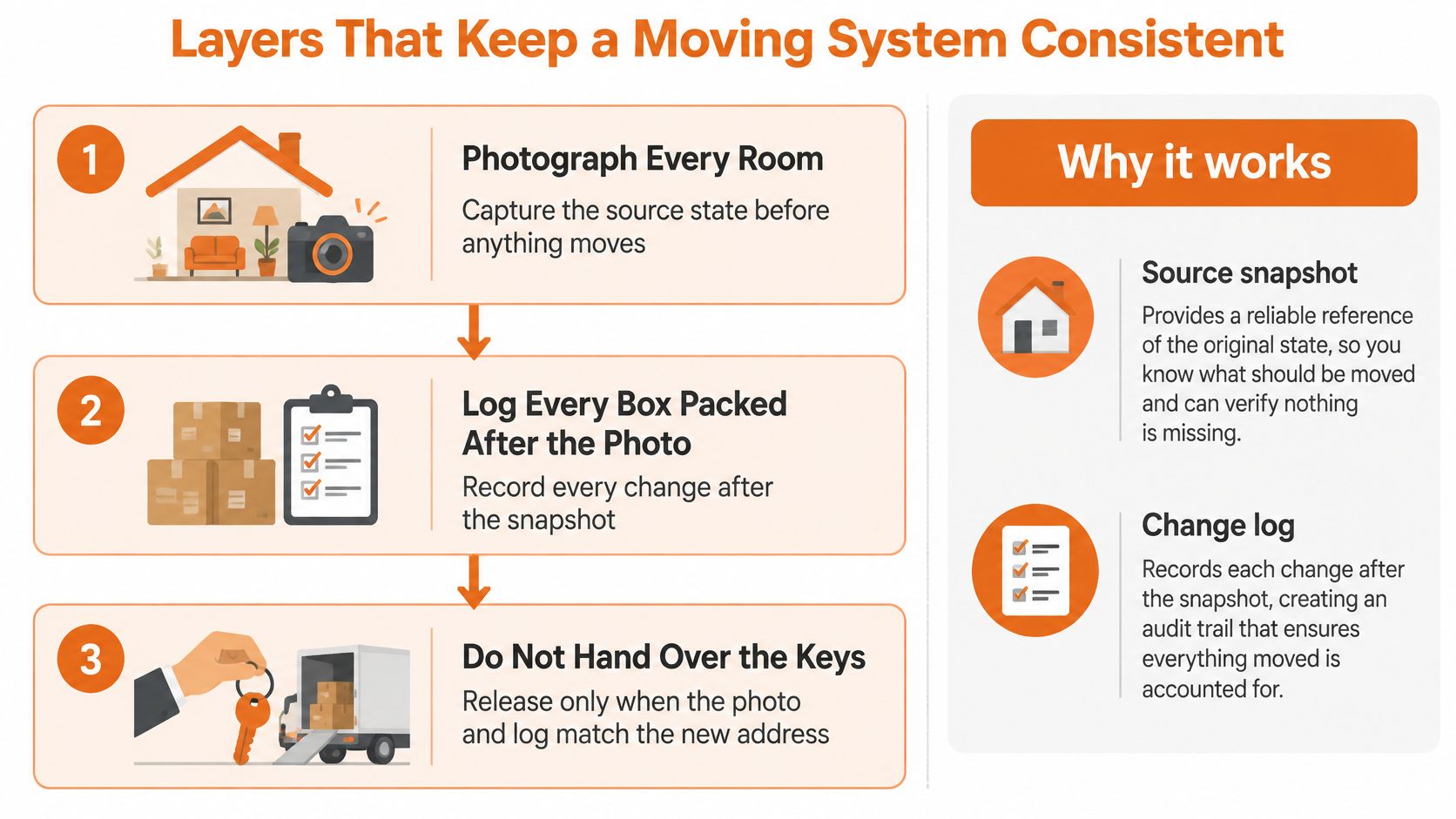
A database move needs the same discipline. Discovery and profiling establish what exists, how it is used, and where the quality risks are. Explicit source-to-target mapping records what each field means and how it changes. Extract from a stable view, keep staging separate from curated target tables, and apply transformation rules that have versions, owners, and tests. Then load, validate, and switch traffic through a reversible route.
For an online migration, the consistency core is a transactionally consistent snapshot plus log-based change data capture. The snapshot fixes a known source state. CDC starts from the exact transaction-log position associated with that snapshot and replays later committed changes in source order. Google's database migration architecture guidance describes the consistency bar as complete, duplicate-free, and ordered.
That combination blocks three common failures: updates missed while the bulk extract runs, duplicate records from loading the same row twice, and dependent changes applied out of order. Transaction logs are the preferred capture source because they expose committed changes in order with comparatively low application impact.
Build these controls into the pipeline:
If CDC can't outrun the source change rate, the backlog grows and a safe cutover never arrives. Treat capture capacity as a design constraint, not a tuning task for the last week.
If your team is mapping the wider pipeline, data pipeline architecture is a useful lens for separating ingestion, transformation, quality checks, and target responsibilities. Your one-page migration sketch should show the layers, keys, last processed log position, and error stream. If the team can't draw those clearly, it isn't ready to move production data.
Treat cutover as a release decision with evidence, not a calendar event. The team should know what must pass, who signs off, and what happens if a check fails.
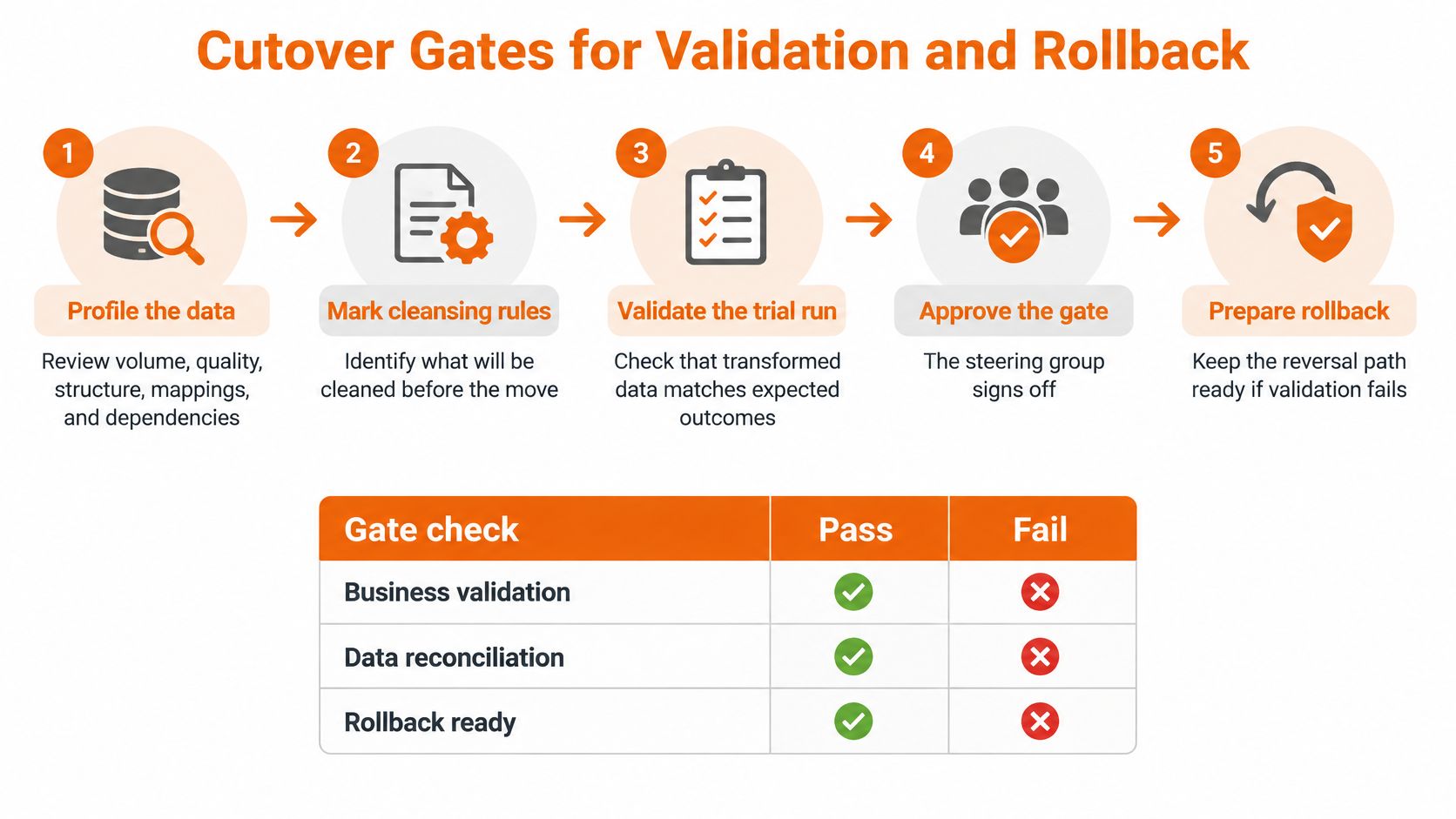
Profile the data. Inventory volume, quality, structure, field mappings, and dependencies. Mark what the team will cleanse, archive, or exclude before extraction begins.
Separate staging from curated data. Keep raw arrivals isolated from business-ready tables. Version transformation rules so the team can explain and reproduce how a target value was produced.
Measure the rates that set the schedule. Estimate bulk extraction throughput, target ingestion throughput, source change rate, and validation throughput. Don't promise a cutover date until the team knows whether the target can keep up with both initial load and ongoing changes.
Dry-run the final synchronization. Use a comparable data volume and measure the procedure against the approved maintenance window. The data left for final sync and the available throughput determine the outage, so include a contingency if the rehearsal doesn't fit.
Watch operational signals. Track replication lag, records and bytes per second, transaction-log retention, failed events, and reconciliation differences. Elapsed time alone can't tell you whether the target is converging or falling behind.
Reconcile before asking for approval. Compare record counts, critical aggregates, keys, and selected rows. Document how the team treats transformed and excluded records. Validation deserves its own workstream: AWS Database Migration Service validation guidance explains that the service can compare source rows with target rows, and can compare incremental changes during CDC tasks. That validation adds time beyond the data load.
Test the application around the data. Run read and write tests, confirm integrations and downstream reports, and check common workflows at production-like volume. A correct table is not enough if the application can't use it correctly.
Cut over only when the business accepts the evidence. Lag must be within the agreed threshold, remaining mismatches must have an owner and approval, and the reverse route must have been rehearsed.
Keep the legacy system available through stabilization. Monitor errors and performance before decommissioning. The old system stays available until the business and technical owners agree that the new one is stable.
| Gate | Measure | Pass condition |
|---|---|---|
| Catch-up | Replication lag | At or below the agreed threshold and still converging |
| Capacity | Apply rate versus source change rate | Sustained capture throughput exceeds the change rate |
| Totals | Row counts and critical aggregates | Differences inside the approved threshold |
| Row checks | Key fields and transformed values | Mismatches listed, with business sign-off on exceptions |
| Application | Read, write, integrations, and top workflows | Tests pass on production-like volume |
| Window | Final sync duration versus approved maintenance window | Dry-run fits the window and a contingency exists |
| Reversal | Routing, log retention, and source authority | Rollback rehearsed before cutover |
| Stability | Error rate and performance after cutover | Legacy stays available until the stability window is met |
Make the table a sign-off sheet. A business owner accepts the data, an application owner accepts the workflow, and an engineering owner confirms the rollback route. A data center relocation compliance checklist can also help teams review the operational and compliance items surrounding a move.
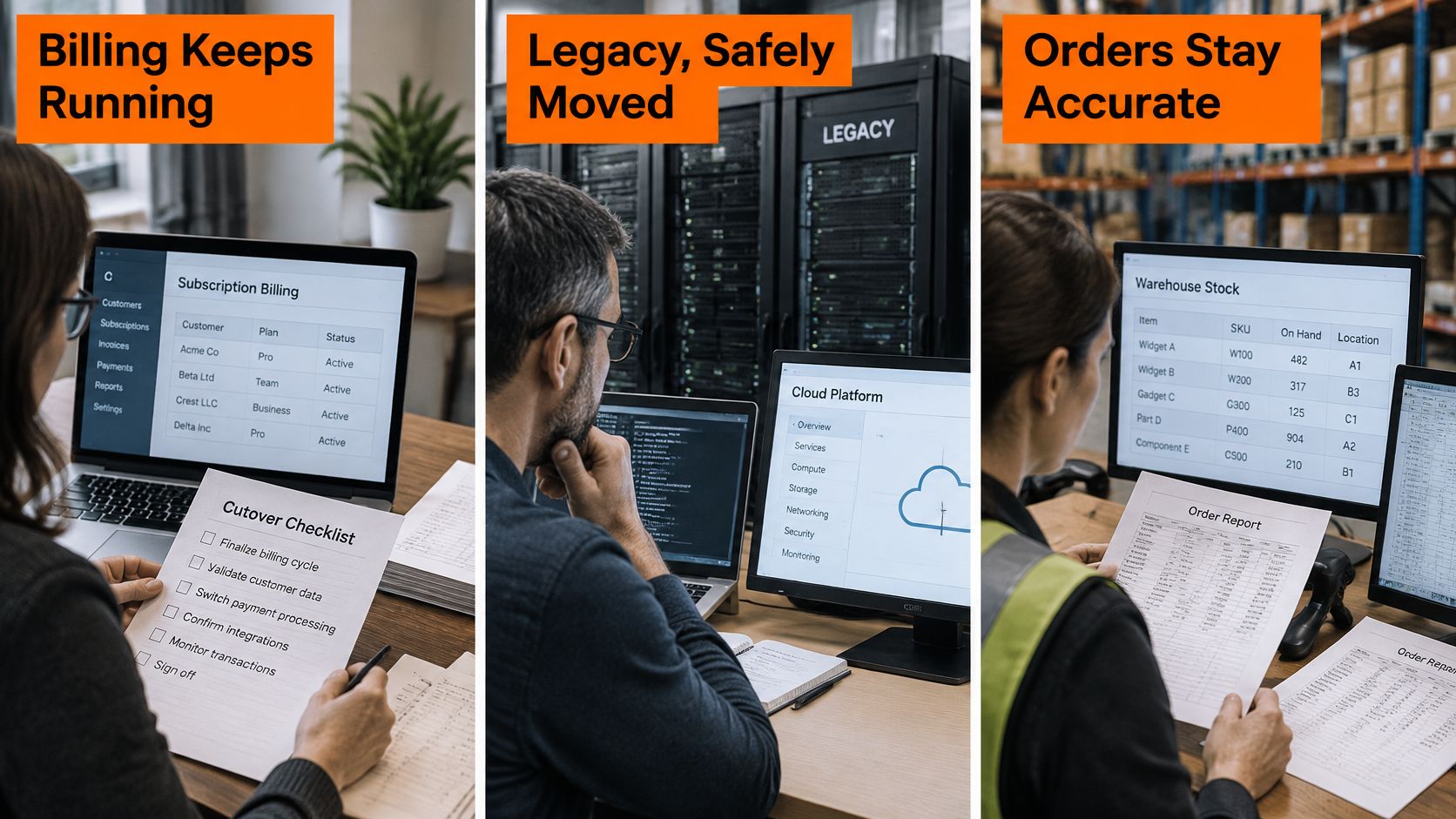
These illustrative composites show how to make a design choice that preserves proof or reversibility. They're examples, not customer results.
Subscription billing that keeps taking writes. Use an online snapshot plus CDC, with idempotent customer and invoice keys. At the release gate, freeze writes, switch the endpoint, and validate the key billing workflows. Keep the source available through the stability window. A wrong balance is a revenue and support incident, not a convenient reason to reload. The design choice that protects rollback is keeping the source authoritative until the business accepts the target.
A manufacturer moving ERP history into a cloud warehouse. Land raw extracts with ELT, then let finance and operations own the transformation rules for the figures they sign. Archive older years instead of loading every historical reading into the hot model. The key test is whether month-end close still ties without paying to transform history nobody queries. The design choice that makes proof possible is business ownership of each signed measure.
Application modernization planning can help teams decide whether a legacy application should move as-is or be modernized alongside its data.
A logistics firm leaving a monolith region by region. Give each region its own wave, reconciliation, and routing flag. If one region fails acceptance, return that region to the old system without reversing completed regions. Name the person who accepts the data and define the signal that closes the wave, such as approved totals and a clean stability period.
Global moves need regional checks for latency, data residency, encryption, and schema compatibility. Validate totals and critical records by region, especially when regions move on different nights.
A short walkthrough can help the team align on ownership and the release sequence before it rehearses the move:
A migration shouldn't be a one-way trip to a preferred platform. The target state matters, but so does the ability to switch, port, or exit if that target stops serving the business. The European Commission's policy work on cloud dependencies and portability recommends inventories of critical workloads and dependencies, documentation of data, model, API, and infrastructure links, and testing whether migration or porting is feasible.
Start with the dependency map. Include proprietary vector indexes, model APIs, orchestration layers, encryption-key controls, and region-specific services, not just databases and application servers. For AI workloads especially, the data can become coupled to embeddings and service-specific behavior that a basic export won't preserve.
What's the cheapest credible recovery or exit if the provider changes pricing, restricts a region, suffers an outage, or becomes legally unusable?
Answer that question with artifacts the team can test:
Then make the decision many migration plans avoid: which data should not move at all? Archive data that must be retained but rarely queried. Delete what has no continuing business or legal purpose. Federate information that should remain with its source. Rebuild a record when recreating it is safer than preserving a defective history. Retire data that no longer earns its place in the system.
Classify every dataset as move, archive, federate, rebuild, or retire, and record who approved the choice. Set domain ownership, quality thresholds, lineage, access boundaries, and business acceptance criteria before extraction. A technically perfect copy of unclear definitions still fails the business.
Leave the planning meeting with a written decision, not another research list. It should name the chosen pattern, the data moving, the data being archived, deleted, federated, or rebuilt, the maintenance window, and the person authorized to stop cutover.
Add the four throughput rates, the validation owner, the rehearsed rollback route, the stability window, and the exit path. Then review a practical measurement model weekly:
Agentic AI can speed schema profiling, mapping drafts, transformation code, and test generation. It changes the economics of delivery, not the engineering bar. NIST's AI Risk Management Framework guidance on roles, testing, and accountability supports documenting who manages AI risks and testing systems before deployment and during operation. Senior engineers still review outputs, approve the architecture, and decide whether the release is safe.
That's Extreme Ownership in practice: log risks before the first extract, make decisions visible to the business, and keep accountability through stabilization until decommissioning is justified. If you want a partner to help make the architecture decision and own data, security, testing, and production quality while AI accelerates analysis, make the meeting output specific: the pattern, the gate list, and the name of the person who can stop cutover.
Rite NRG helps teams design and deliver data migrations with senior engineering accountability for architecture, security, validation, and production readiness. Visit Rite NRG to discuss the right migration pattern, the data that shouldn't move, and the rollback route your business can trust.
/ about the author
Written by the RITE NRG editorial team — the architects, engineers and delivery leads who build and operate AI-era software for our clients.
Strategy & Transformation
A practical, finance-ready framework for comparing AI and modernization investment with the current-state cost, realistic benefits, delivery risk and time to value.
Technology Talent & Teams
A decision-maker's guide to IT partnership models: what each model actually transfers to the partner, what it costs beyond the rate card, and how to match the model to your situation.
AI Consulting & Automation
A practical framework for choosing and deploying transport or logistics AI agents around real exceptions, reliable data and controlled operational authority.
More guidance: all insights articles
Tell us about the system or idea behind this article. We tell you honestly if it is a fit — and what a fixed-scope delivery could look like.