

Strategy & Transformation
How to Calculate ROI for AI and Software Modernization
A practical, finance-ready framework for comparing AI and modernization investment with the current-state cost, realistic benefits, delivery risk and time to value.
operationalwrocław--:-- cet
∕ insights / data-pipeline-architecture.md
Data Pipeline Architecture
Build a scalable data pipeline architecture for SaaS. Compare batch and streaming patterns, governance, reliability, security, and modernization options.
>_article.meta
Your product team is ready to launch a new subscription tier, but nobody can agree whether customers are ready for it. Application events suggest strong adoption, billing records tell a different story, and product analytics hasn't caught up. Engineers start reconciling exports while leadership waits for a decision.
That's a data pipeline architecture problem, not a dashboard problem. The right architecture should help your team release confidently, explain operating costs, and recover without reconstructing the business from spreadsheets. Start with those outcomes, then choose the technology.
Buying a faster processing engine won't fix an undefined customer identifier or an unowned billing feed. Before approving infrastructure, ask which business decision the pipeline must support, who relies on it, and what happens when its output is late or wrong.
The architectural challenge extends beyond throughput. NIST's big-data framework identifies volume, velocity, variety, and variability as characteristics shaping system design. For a SaaS team, that means planning for changing event rates, incompatible source formats, evolving schemas, and growing datasets, not merely provisioning more compute.

Turn the launch problem into measurable operating expectations:
Choose targets with business owners rather than inventing technical thresholds in isolation. A finance reconciliation and an in-product recommendation don't need identical service levels. Your reporting and dashboards should expose those differences instead of hiding them behind a successful-job indicator.
Ownership principle: A pipeline isn't complete when the job finishes. It's complete when the intended consumer can safely use the result.
Our #riteway methodology applies Extreme Ownership to that complete result. Architects and delivery teams surface risks early, bring decision options rather than unexplained blockers, and communicate what remains unsafe.
Agentic AI can accelerate source analysis, implementation, and verification. It doesn't transfer responsibility away from senior engineers. Architecture, data integrity, security, testing, and production quality still need accountable human owners.
Follow a customer upgrading a subscription. The application emits an event, the billing system records a charge, and product analytics captures subsequent usage. Design the pipeline around connecting those records into a trustworthy customer journey.
Use this architecture map to locate responsibilities, not just technologies.
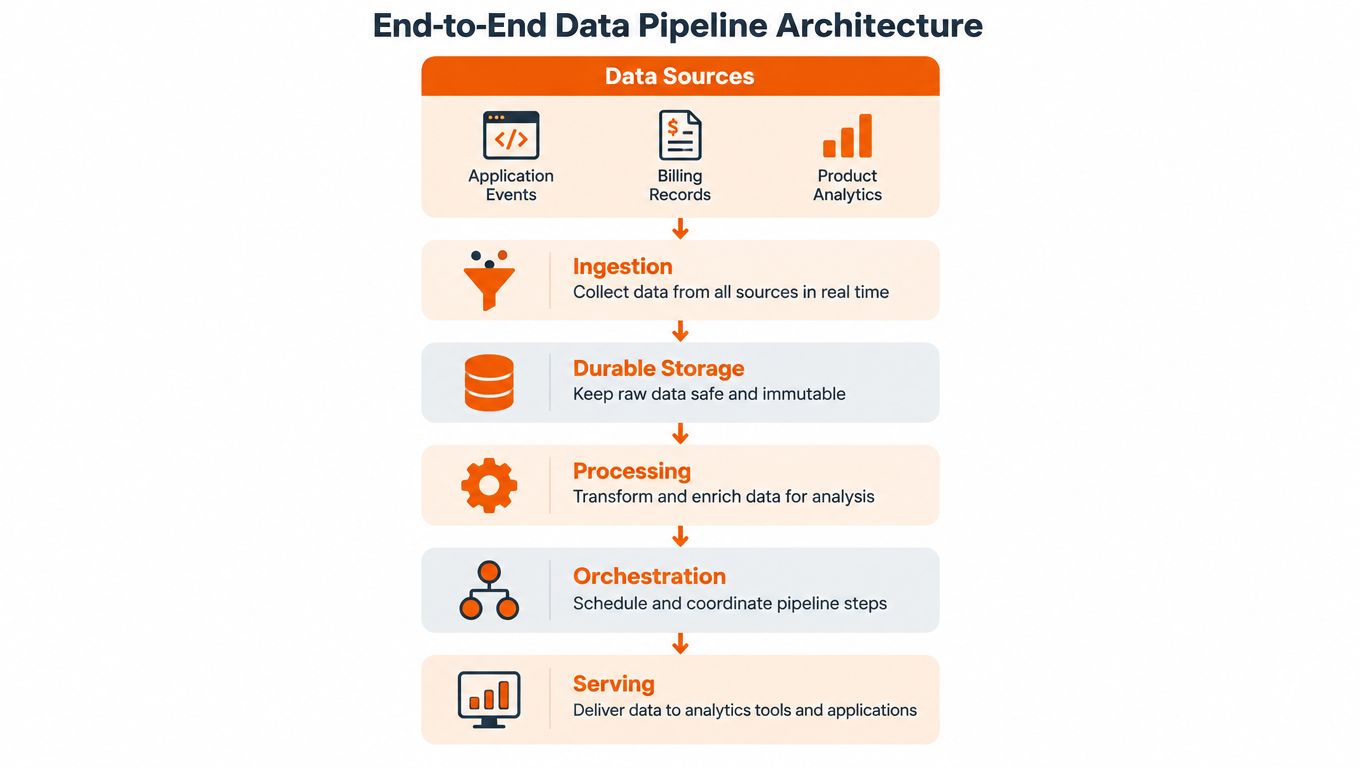
Ingestion owns the source boundary. Specify connector behavior, capture position, schema validation, and buffering when downstream services can't keep up. Record source identity and arrival metadata so operators can distinguish a missing event from a delayed one.
Durable storage owns recoverability. Preserve approved raw inputs with enough provenance to reconstruct processing decisions. Choose partitioning around expected reads and recovery operations, while defining retention and deletion obligations explicitly. Immutable history shouldn't mean unrestricted or permanent retention.
Processing owns business meaning. Resolve customer identities, apply subscription rules, and enrich records through versioned transformations. Decide deliberately whether transformations happen before loading, as in ETL, or after landing data, as in ELT. Sensitive-data exposure and recoverability should influence that choice.
Orchestration owns execution dependencies. A completed extraction isn't proof that billing data is complete enough for reconciliation. Require upstream readiness, validation results, retry policies, and release conditions before downstream work proceeds.
Serving owns the consumer promise. Publish governed data products through tables, dashboards, or APIs with explicit freshness, access, and compatibility expectations. When applications need live consumption interfaces, Fetchin's live data API architecture guide is a useful companion resource for evaluating that boundary.
Keep metadata alongside the flow: source versions, transformation versions, processing status, and ownership. Make sink writes idempotent where retries are possible, meaning repeated execution doesn't duplicate the intended business effect. Specify replay permissions and limits before operators need them.
| Boundary | Decision that must be explicit |
|---|---|
| Source to ingestion | What counts as captured and acknowledged |
| Storage to processing | Which input version can be reconstructed |
| Processing to serving | What makes output acceptable for consumption |
The architectural foundation is separation of concerns. Google's 2004 MapReduce paper separated map-and-reduce business logic from distributed execution and failure handling. Apply that principle without assuming every workload needs a cluster.
For fragmented estates, map system integration challenges onto these boundaries. If nobody owns the handoff, another connector won't solve the underlying risk.
Streaming isn't an upgrade from batch. It's a different operating commitment. Choose it when earlier information changes an action, not because continuous processing sounds more advanced.
For a subscription platform, scheduled reconciliation may be entirely appropriate for finance. Product teams may need fresher adoption signals during a rollout, while operational telemetry may require continuous evaluation. Don't force all these workloads into the same latency requirement.
The distinction starts with how inputs arrive.
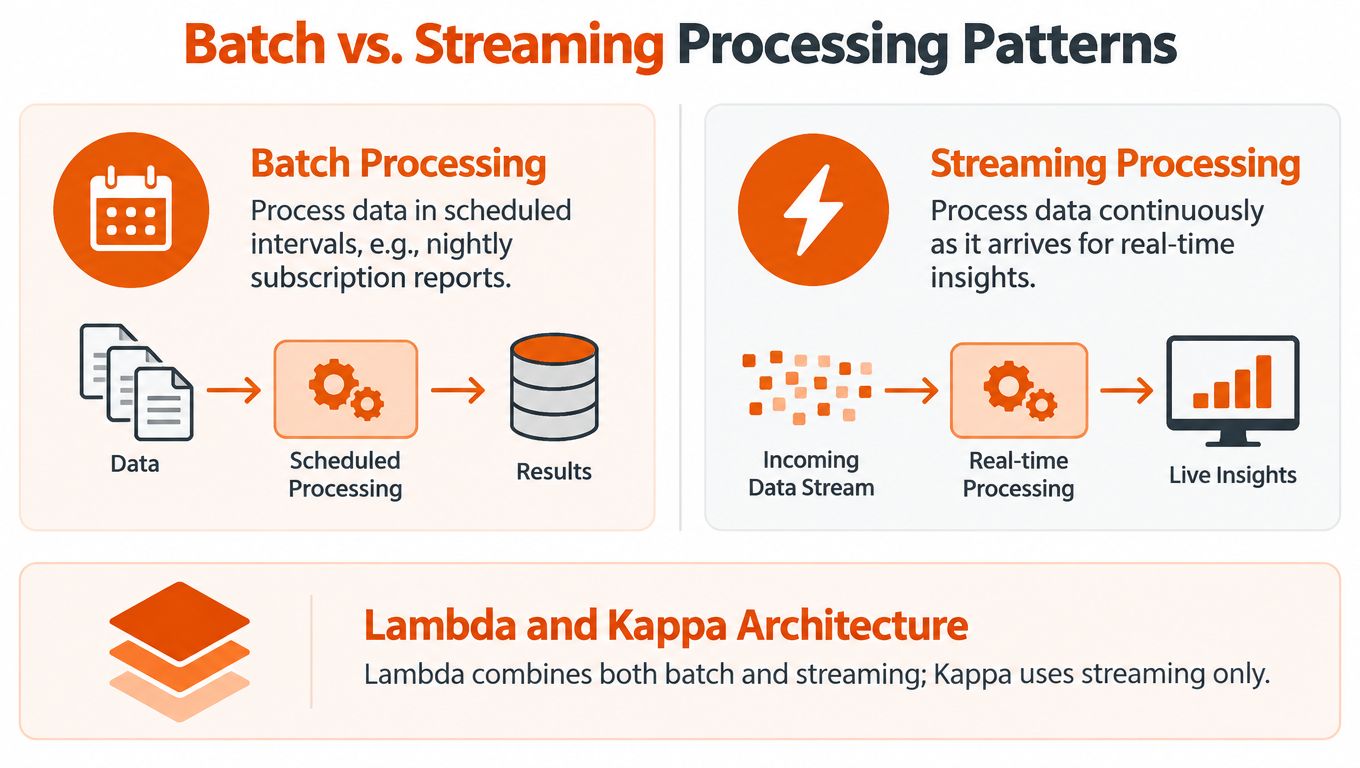
Apache Beam's programming model distinguishes bounded collections, which have a finite size, from unbounded collections, which continue arriving. It allows a shared logical dataflow to execute through different runners, including Flink, Spark, and Dataflow.
That's the useful starting point: preserve consistent validation, enrichment, and aggregation rules across historical and incremental processing. Don't maintain separate business definitions just because execution modes differ.
For continuous inputs, specify event-time windows so related events are grouped by when they occurred. Use watermarks to express progress toward completeness, then define allowed lateness and how late arrivals update or correct results. A watermark isn't a promise that every event has arrived.
Choose the slowest refresh rate that still supports the business decision. Spend the remaining engineering capacity on correctness and recovery.
Delivery guarantees need an end-to-end definition. A runner's processing guarantee doesn't automatically establish the behavior of every external sink. Test partial writes, retries, and deduplication against the actual connectors.
Use backfills to verify historical behavior, not merely load old records. Representative tests must cover runner-specific triggers, state handling, and connector semantics before you move a workload.
For a complementary visual explanation of processing patterns, use the video below.
The selection rule is straightforward: weigh decision value, latency, consistency, recovery, team capability, and total operating cost together. Reject any architecture whose operational demands exceed the team's ability to support it.
Average records processed per second won't tell you whether a pipeline can handle a dominant customer, a large historical correction, or a failed worker during peak demand. Test the expensive boundaries, not just the happy path.
Joins, grouped aggregations, and windows require related records to meet. Distributed workers may need to exchange those records through shuffle and retain state while waiting for matches or later events. Those requirements deserve explicit capacity planning.
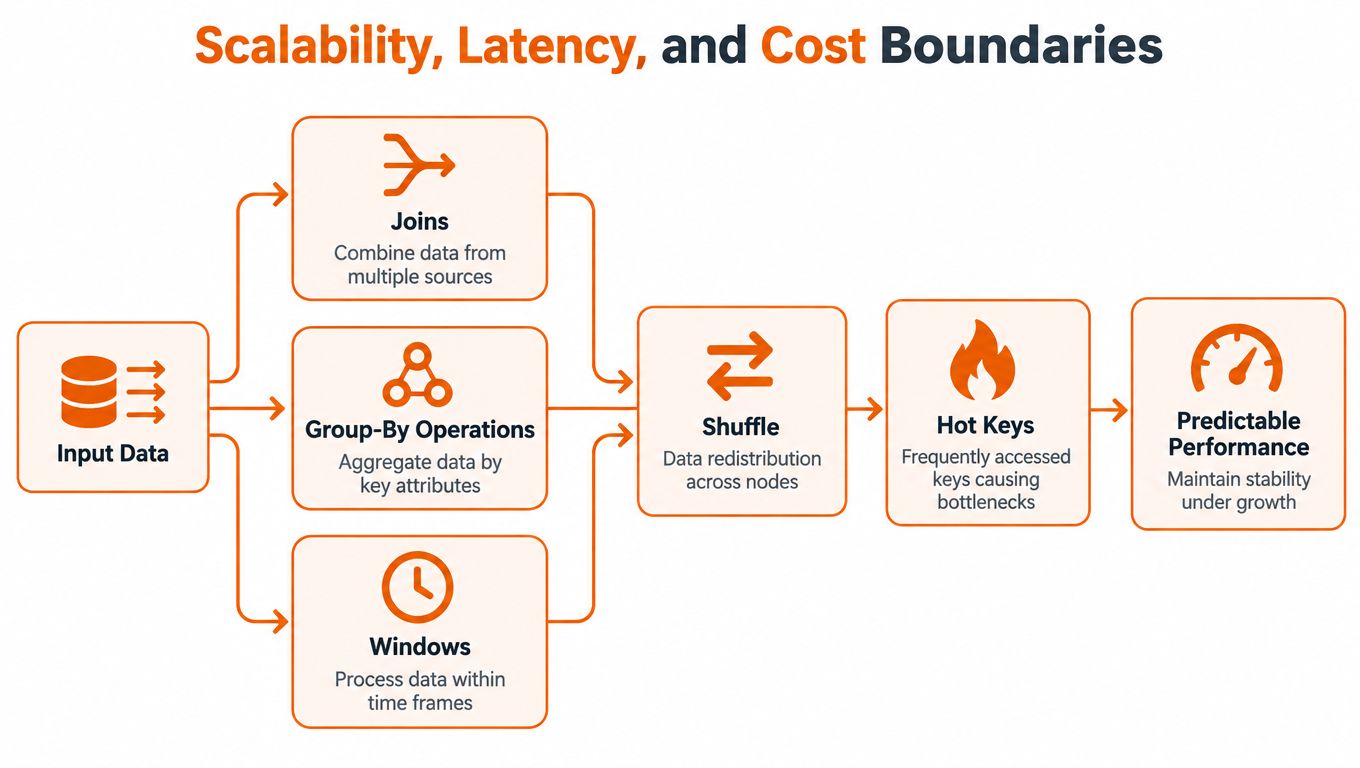
Dataflow's distributed shuffle architecture illustrates the distinction between worker-local intermediate data and durable state managed separately from compute. Decoupling them allows workers to scale or restart without carrying all intermediate state with them.
Don't interpret that as a universal product recommendation. Treat it as an architectural question: what must move or recover when a worker disappears? If the answer includes a large amount of local state, adding workers alone may not solve the bottleneck.
Checkpoint and commit-unit granularity also deserve deliberate testing. Smaller units can reduce replay work and latency but require more coordination. Larger units can favor throughput while increasing the amount of work repeated after failure.
Require capacity evidence across these dimensions:
Use pre-aggregation to reduce movement where business semantics permit. Consider key salting for concentrated keys, but account for the later recombination step. Bound state retention deliberately and apply backpressure before downstream overload becomes uncontrolled failure.
Caching is appropriate when reuse justifies invalidation complexity. Recompute when correctness and simplicity outweigh repeated processing costs. Likewise, colocate tightly coupled workloads where practical, and justify replication through explicit resilience requirements.
The commercial objective isn't maximum distribution. It's enough capacity, within the required latency and recovery envelope, at a cost leadership can understand.
A scalable pipeline can distribute incorrect data efficiently. Block that failure before an analytics dashboard or AI workflow turns unsuitable inputs into a confident business recommendation.
In research on scaling AI successfully, 54% of organizations with below-average AI project failure rates considered data availability when prioritizing use cases, compared with 42% among those with above-average failure rates. That's an association, not proof of causation, but it supports a practical recommendation: assess data readiness during use-case selection.
Define a data contract covering schema, meaning, freshness, completeness, ownership, and permitted use. Version it alongside pipeline changes, and classify schema changes by compatibility rather than assuming every additional field is harmless.
Then implement the contract through runtime behavior:
When evaluating external enrichment, review provenance, permitted use, refresh behavior, and identifier matching before comparing features. The top enrichment tool options from looot can support discovery, but selection should follow your acceptance contract, not replace it.
NIST's AI Risk Management Framework calls for responsible, trained people to map, measure, and manage AI risks. Translate that organizational responsibility into named owners for sources, transformations, permission models, quality checks, deployment approval, and incident response.
A silent schema change should trigger a defined compatibility response. An orphaned data product should lose its approved status until someone accepts ownership. A stale dashboard should display its condition rather than appear current.
Readiness gate: Approve consumption only when the data is suitable for the intended use, not merely available in storage.
Make exceptions visible, time-bounded, and approved by someone who understands the consequence. That preserves fast decisions without treating governance as optional paperwork.
Treat security, reliability, testing, and observability as a single production-readiness discipline. A pipeline that restores quickly but exposes sensitive records is not resilient. Neither is a secure workflow whose operators can't detect incomplete outputs.
The investment case should reflect that balance. In research on AI infrastructure strategies, security was a buying criterion for 55% of respondents, reliability and availability for 47%, and data privacy and governance for 45%. Those priorities belong in architecture decisions, not only procurement questionnaires.
Apply least-privilege access to service identities, operators, and AI-assisted tooling. Separate environments and restrict network paths according to the work each component performs. Define encryption boundaries for data in transit and at rest, including intermediate storage.
Keep credentials in managed secret stores rather than code, notebooks, or agent prompts. Mask or minimize sensitive fields in development fixtures and operational logs. Record administrative changes, data access, and exceptional interventions in audit trails that operators can't casually overwrite.
AI-assisted operations need approved tools, bounded permissions, and a human intervention path. IBM's 2025 breach research reported that extensive security AI and automation use was associated with an 80-day shorter average breach lifecycle and USD 1.9 million lower average breach costs than nonuse. The same research found 20% of organizations experienced breaches involving shadow-AI security incidents, reinforcing the need for controlled adoption.
Use unit tests for transformation rules, then expand outward. Validate schemas and contracts, exercise integration paths, and reconcile outputs against trusted examples. Include missing identifiers, duplicate delivery, source deletion, and partial downstream failure.
A release candidate should also demonstrate:
Observability must connect technical conditions to business impact. Monitor freshness, throughput, lag, failures, retries, quality violations, and cost. Map an alert to the affected data product and decision, not just the worker that emitted it.
AI agents can help draft tests, investigate logs, document dependencies, and review migration changes. However, DORA's 2024 research associated a 25% increase in AI adoption with a 3.1% increase in code-review speed, alongside a 1.5% decrease in delivery throughput and a 7.2% reduction in delivery stability. Faster implementation isn't a substitute for small changes, thorough tests, and senior release authority.
Data Pipeline Architecture Decision Matrix
| Architecture Approach | Best Fit | Primary Trade-off | Required Proof |
|---|---|---|---|
| Batch-centric | Scheduled decisions and well-defined reporting cutoffs | Simpler operating model, but delayed availability and concentrated processing windows | Completion within the business window, consistent snapshots, safe reruns, and affordable backfills |
| Streaming-first | Actions whose value depends on continuously arriving information | Lower latency with greater state, consistency, operational, and specialist ownership demands | Sustainable throughput, late-event handling, sink behavior, recovery, and retention economics |
| Unified-model | Shared business rules across historical and continuous workloads | Less semantic duplication, but runner-specific behavior remains | Equivalent accepted outputs, connector compatibility, governance enforcement, and operational competence |
| Staged modernization | Legacy estates with business-critical dependencies and migration constraints | Controlled change, with temporary coexistence and reconciliation costs | Source-of-truth boundaries, parallel validation, cutover controls, rollback, and named owners |
Don't score these options independently of the organization. Source volume determines capacity tests; delivery expectations determine latency; recovery needs determine retained inputs and restoration design. Regulatory exposure changes access and evidence requirements, while team capabilities determine what can be operated safely.
Warning signs include streaming for scheduled decisions, premature distribution, unbounded state without capacity evidence, and governance postponed until deployment. Ask proponents to show the operational benefit and the proof required. If they can't, simplify the design before committing.
Don't replace a fragmented estate with a larger, less understood estate. Modernization should reduce uncertainty in controlled increments while preserving the business's ability to operate.
Start by agreeing which decisions matter, which service levels apply, and where authoritative data resides. Inventory the existing dependencies, including manual corrections and spreadsheet handoffs. Those unofficial steps may contain business rules that never reached the documentation.
Choose a bounded business journey, such as subscription status moving from billing into a customer-facing entitlement view. Define its contracts, quality signals, lineage, access controls, and acceptance criteria before selecting the runtime.
Deliver that slice with production monitoring and operational ownership. Use shadow or parallel validation where the consequence of disagreement justifies the temporary cost. Compare business outcomes and records, not merely successful execution.
Then prove the transition:
Wrap a legacy component when its behavior is reliable but its interface prevents safe integration. Replace orchestration when dependency management and failure handling are the primary constraint. Change storage boundaries when retention, access, or recoverability can't support the required service.
Migrate processing incrementally when business rules need independent verification. Don't bundle database migration, application redesign, and metric redefinition merely because they're funded together. Evaluate database modernisation before an application rebuild when the existing data foundation constrains the wider program.
| Outcome | Evidence to review after launch |
|---|---|
| Delivery and adoption | Accepted changes and actual consumer use |
| Cost and capacity | Spending against workload and tested operating limits |
| Quality and recovery | Reconciliation results and restoration exercises |
| Risk and ownership | Open exceptions, access reviews, and assigned support |
Use agentic AI to accelerate dependency analysis, migration drafts, and comparison scripts. Keep architecture approval, data integrity, security validation, and release decisions under senior engineering accountability. After cutover, retire redundant paths deliberately so temporary coexistence doesn't become permanent operating cost.
Leadership doesn't need another inventory of connectors and databases. It needs a sequence of decisions with owners, evidence, and measurable exit criteria.
A useful architecture roadmap distinguishes activity from impact. Deploying infrastructure is activity. Enabling a product manager to make a trustworthy launch decision, within an understood cost and risk envelope, is impact.
Give each unresolved item a decision owner, an evidence owner, and a due point tied to delivery dependencies. These can be the same person, but they must not be an unnamed committee.
For a SaaS MVP, prioritize a narrow customer journey and the smallest architecture that can deliver trustworthy output. Avoid building a general-purpose platform before validating who will consume its data.
For a scale-up under pressure, investigate the current constraint before adding infrastructure. Determine whether delayed decisions originate in ingestion, processing, quality, ownership, or consumer access, then fund the intervention that addresses it.
For an enterprise modernization program, prioritize source-of-truth boundaries and migration sequencing. Insist on explicit coexistence costs and retirement criteria, not just a target-state diagram.
The final acceptance test is practical: can your team trust the output, explain its cost, restore it after failure, and use it to improve a real decision? If not, keep the remaining work visible. Confidence comes from evidence and accountability, not the number of deployed components.
Rite NRG offers architecture consulting, data and systems integration, and senior-led engineering for new platforms and legacy modernization. Visit Rite NRG to discuss a pipeline architecture review focused on your business decisions, recovery requirements, operating costs, and a controlled delivery roadmap.
/ about the author
Written by the RITE NRG editorial team — the architects, engineers and delivery leads who build and operate AI-era software for our clients.
Strategy & Transformation
A practical, finance-ready framework for comparing AI and modernization investment with the current-state cost, realistic benefits, delivery risk and time to value.
Technology Talent & Teams
A decision-maker's guide to IT partnership models: what each model actually transfers to the partner, what it costs beyond the rate card, and how to match the model to your situation.
AI Consulting & Automation
A practical framework for choosing and deploying transport or logistics AI agents around real exceptions, reliable data and controlled operational authority.
More guidance: all insights articles
Tell us about the system or idea behind this article. We tell you honestly if it is a fit — and what a fixed-scope delivery could look like.