

Strategy & Transformation
How to Calculate ROI for AI and Software Modernization
A practical, finance-ready framework for comparing AI and modernization investment with the current-state cost, realistic benefits, delivery risk and time to value.
operationalwrocław--:-- cet
∕ insights / cloud-migration-consulting-services.md
Cloud Migration Consulting Services
Choose cloud migration consulting services with a practical framework for strategies, risks, costs, testing, vendor selection, and nearshore delivery.
>_article.meta
Your team can move the servers. That part isn't the problem. The problem starts when product releases slip for two quarters, your best engineers spend their days babysitting two environments, security finds gaps a week before cutover, and nobody can explain why the cloud bill looks nothing like the business case. That's the moment most leaders realize migration isn't a technical relocation. It's a portfolio decision that trades engineering capacity, risk, and money for speed and growth. Treat it that way from day one, and cloud migration consulting services earn their fee. Treat it as lifting boxes, and you'll pay twice.
A SaaS leadership team approves a migration to escape a creaking data center contract. The engineering plan looks clean. Workloads move in waves, dashboards go green, and the program reports steady progress. Meanwhile, the roadmap freezes because the same senior engineers who build features are now running parallel systems, rewriting deployment scripts, and answering security questionnaires they didn't expect.
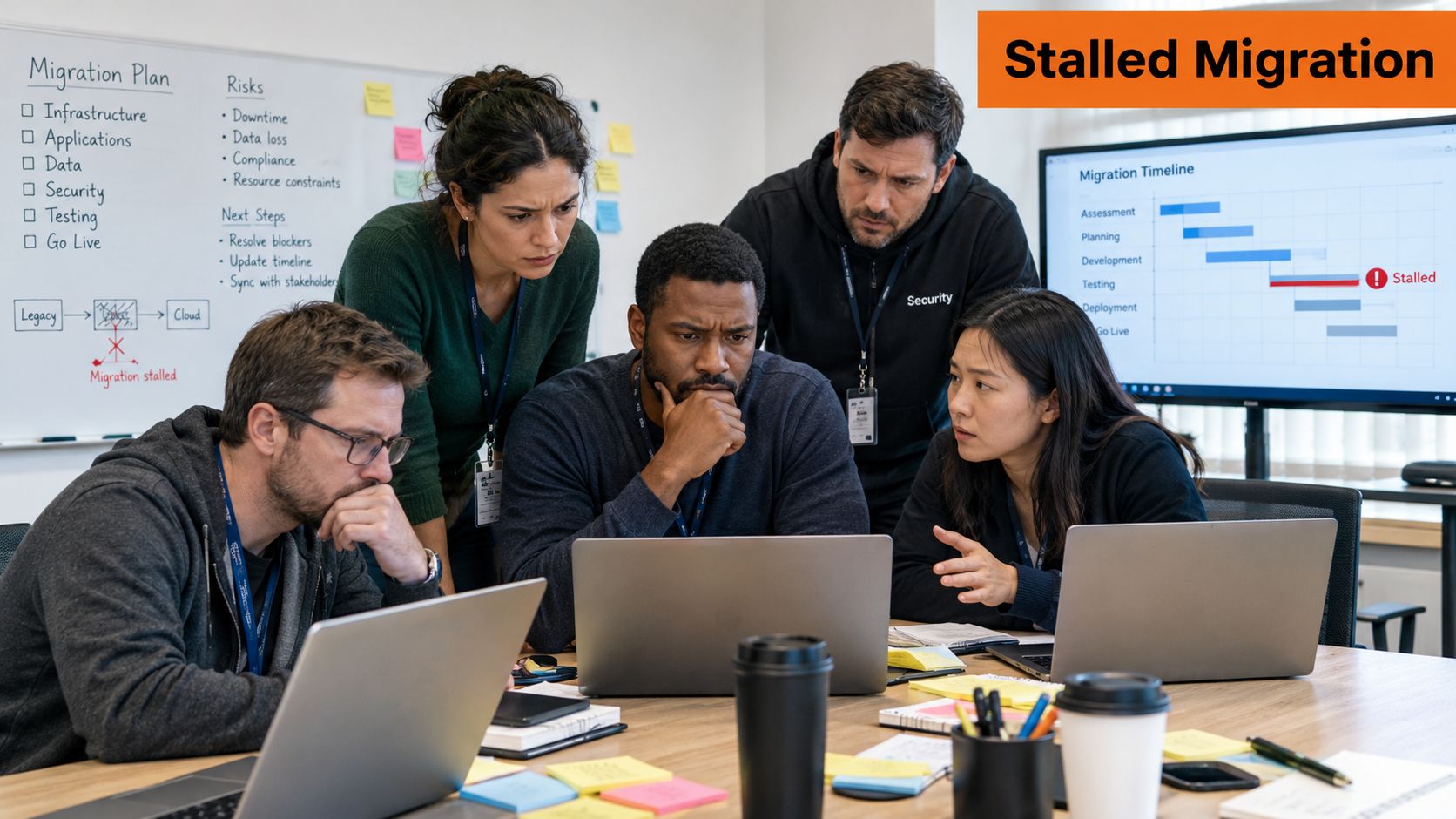
That's not a cloud technology failure. It's weak sequencing, unclear accountability, and goals that never connected to the business. A credible engagement should improve specific outcomes you can name in advance.
The human cost is documented, not anecdotal. In a 2025 survey of more than 300 enterprise technology leaders reporting migration cost and fatigue, 57% spent over $1 million on platform migrations, average cost overruns reached 18%, 61% experienced migration fatigue that caused delays of six months or more, and 70% reported developer burnout during migration programs.
A migration that finishes technically but burns out the team that has to run it hasn't finished. It's deferred the cost.
That lens also clarifies what you're buying. Consulting decides what should move, in what order, to what target, and under which controls. Implementation does the moving and rebuilding. Managed operations owns the result every day after launch. Strong partners can span all three, but don't let anyone blur them in a proposal. If a plan only counts migrated workloads and never names displaced product work, parallel running costs, retraining, or stabilization effort, it's not a business case. It's a moving checklist, and it will stall exactly where the scenario above stalled.
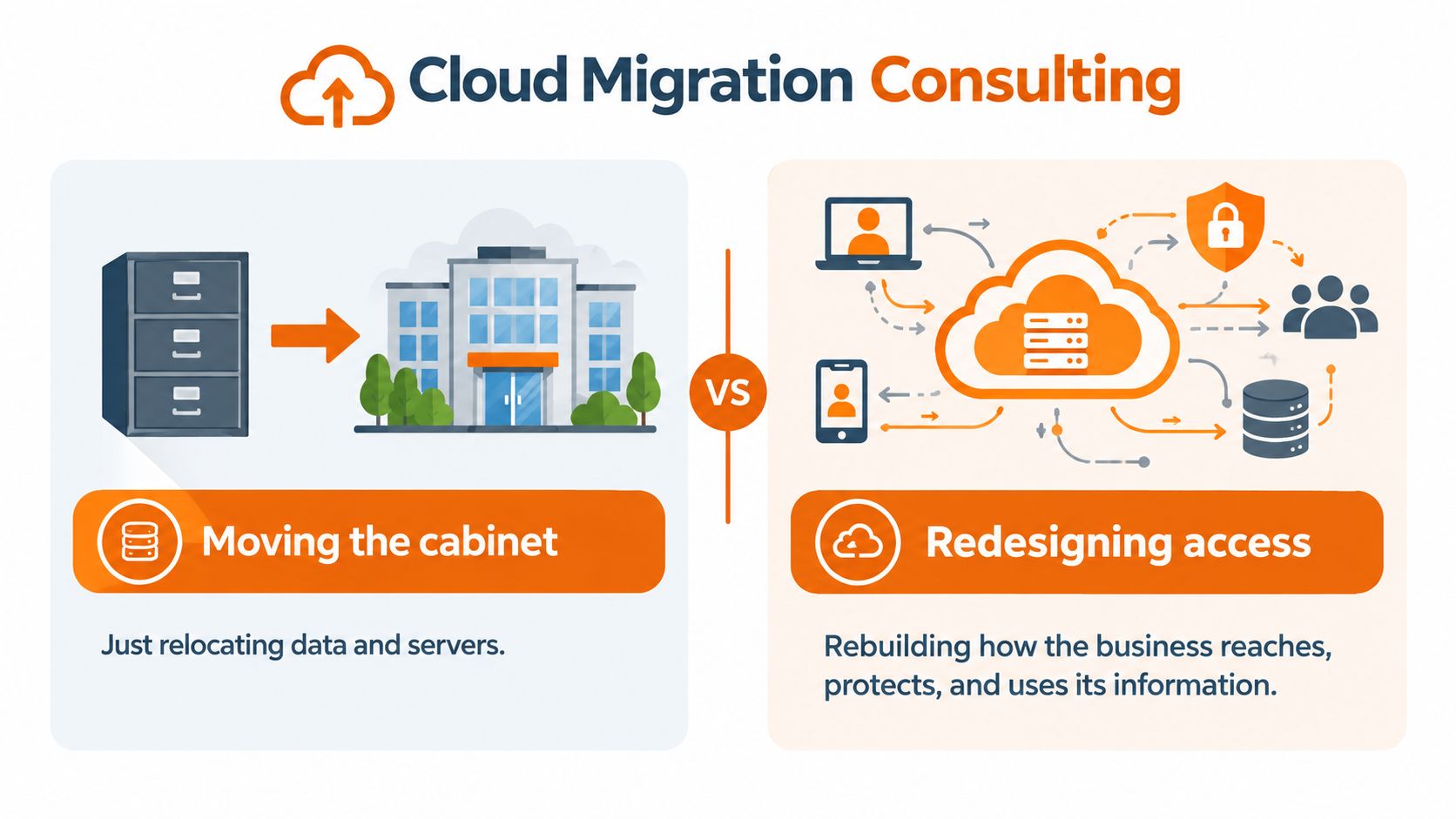
Moving a filing cabinet to a new office changes where the paper sits. It doesn't change who can open the drawers, how you prove nothing went missing, or whether five offices can search the same files at once. Cloud migration consulting services exist for the second problem. You're not relocating servers. You're redesigning how the business accesses, protects, governs, and pays for its systems.
The vocabulary for that redesign is older and more stable than most vendor marketing. NIST Special Publication 800-145 defining cloud computing characteristics and models defines cloud computing as on-demand network access to a shared pool of configurable resources and identifies five essential characteristics, three service models, and four deployment models that provide a foundation for migration assessments and target-architecture planning. Those five characteristics are on-demand self-service, broad network access, resource pooling, rapid elasticity, and measured service. The service models are Infrastructure as a Service, Platform as a Service, and Software as a Service, and the deployment models are private, community, public, and hybrid cloud.
Use that test ruthlessly. If a target design can't scale elastically, can't be provisioned through self-service, and can't be measured per unit of consumption, you've bought hosted infrastructure with a cloud label. Sometimes that's the right interim step. Just don't pay transformation prices for it.
A complete engagement connects the business case to workload and dependency assessment, target architecture, migration sequencing, provider selection, security design, testing strategy, cost governance, change management, and post-launch ownership. Service model choices drive that work. Replacing an application with SaaS removes operations but adds vendor and data questions. Building on PaaS speeds delivery but creates platform dependencies. Staying on IaaS preserves control and preserves your operational burden too.
Integration is where these choices meet reality, because identity, data flows, and existing tools have to work across old and new environments. If your team needs grounding in that layer, a practical cloud service integration guide is a useful companion to the architecture work, especially before you commit to sequencing.
Sort responsibilities early. Your partner should own assessment quality, architecture decisions, and migration engineering discipline. Your team must own product priorities, data knowledge, and acceptance decisions. Operations after go-live needs an explicit owner, whether that's your engineers, a managed provider, or a shared model. If nobody can draw those lines on one page, you're not ready to sign.
Start with intent, not tooling. A migration that begins with a provider console before you've agreed on service levels, data responsibilities, and measurable outcomes will produce motion without progress. Run it as an evidence-producing sequence, where each phase answers a question and earns the right to proceed.
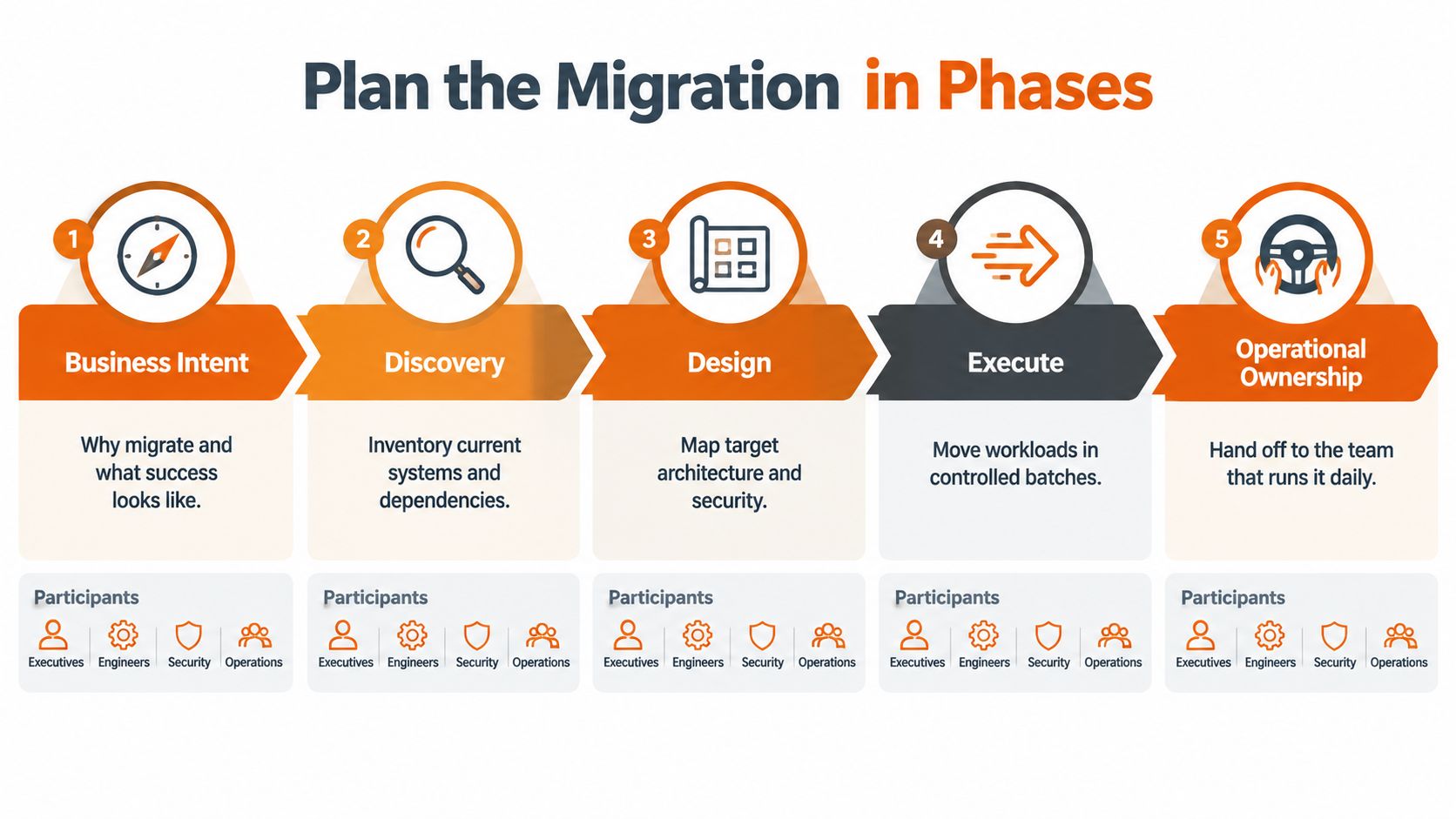
Phase one, business intent. Executives, product leaders, and finance agree why you're migrating and which outcomes matter most. The artifact is a one-page business case with non-negotiables, constraints, and a named accountable owner. The gate is simple. If leadership can't rank cost, speed, reliability, and risk against each other, stop and decide.
Phase two, discovery. Engineers, security, and application owners inventory workloads and map dependencies between applications, databases, integrations, and batch jobs. Produce a workload classification matrix and a dependency map, not a spreadsheet of server names. Teams that want a structured starting checklist for this groundwork can adapt the Indiana business cloud migration checklist to their own inventory and readiness questions, then replace generic items with their specific dependencies.
Phase three, target design and landing zone. Architects design the target architecture, identity model, network, security controls, and cost instrumentation. Deliverables include the target-state design, a readiness scorecard, and decision logs that record trade-offs while they're still cheap to revisit. Landing-zone readiness means accounts, guardrails, logging, and budgets exist before the first production workload arrives.
Phase four, pilot. Pick a workload that's real enough to hurt if it fails and bounded enough to reverse. The pilot produces a tested rollback plan, a runbook draft, and actual cost and performance data. Its gate is evidence, not optimism. If the pilot team needed heroics, your wave plan is fiction.
The walkthrough below shows how phased planning connects discovery evidence to execution decisions in practice.
Phase five, production waves and ownership. Move workloads in waves grouped by dependency and business criticality, then run cutover, stabilization, and handover as planned work with named owners. Finish each wave with an updated runbook, an outcome dashboard, and a wave retrospective that changes the next wave's plan. Continuous optimization starts here, not as an afterthought once the program team disbands.
Operating rule: No phase starts until the previous phase produced an artifact someone senior signed. Verbal readiness isn't readiness.
Watch how you measure all this. Flexera's 2025 State of the Cloud research surveying 759 global cloud decision-makers found the share measuring progress by workloads migrated rose from 36% in 2024 to 78% in 2025, while cost avoidance rose from 28% to 64%. Counting workloads is fine as a progress signal. It's dangerous as your definition of value. Pair every wave count with the business outcome that wave was supposed to improve, and review both at the same gate meeting. This is Extreme Ownership in practice. Senior people surface risks early, log decisions transparently, and stay accountable for the complete result, not just their assigned tasks.
Don't pick a strategy per program. Pick it per workload, because your billing engine, your internal reporting tool, and your customer API have nothing in common except a data center. Three routes dominate, and each one trades effort, risk, and future flexibility differently.
Rehost moves a workload with minimal architectural change. It's the familiar route for systems with a short remaining life, tight exit deadlines from a data center, or low change frequency. You keep the application's constraints, its scaling limits, and most of its operating habits. That's acceptable when the goal is exit speed, and wasteful when the goal is product velocity.
Replatform changes selected components during the move, such as shifting a self-managed database to a managed database service or moving onto managed container hosting. You gain operational relief and some elasticity without rewriting the application. You also take on adaptation and testing work that teams routinely underestimate, especially around drivers, connection handling, and backup behavior.
Refactor redesigns the application around cloud capabilities, including managed queues, autoscaling, and event-driven patterns. It carries the highest potential value for delivery speed and resilience, and the highest cost, skill demand, and execution risk. For teams weighing that route, a grounded view of cloud-native architecture principles and trade-offs helps separate genuine redesign benefits from fashionable rewrites.
| Strategy | Primary Change | Best-Fit Conditions | Main Trade-Offs | Decision Evidence |
|---|---|---|---|---|
| Rehost | Same architecture, new home | Short lifespan, low change rate, hard exit deadline | Retains technical debt and scaling limits | Confirmed remaining life and exit date |
| Replatform | Selected managed components | Stable app, painful infrastructure operations | Adaptation and regression testing effort | Component-level compatibility tests |
| Refactor | Redesign around cloud services | High change frequency, growth bottleneck, long life | Highest cost, skill needs, and delivery risk | Product roadmap and capacity commitment |
Score each workload on business criticality, technical debt, data complexity, change frequency, available skills, compliance obligations, expected life, and your team's willingness to operate the target. Regulated workloads deserve extra scrutiny on evidence and control ownership, and the discussion of a secure cloud transition for extension funds shows how seriously financial organizations treat that sequencing before any data moves.
Don't assume cloud-native automatically means portable. Proprietary databases, managed queues, and identity systems create lock-in that's sometimes worth buying deliberately. Classify each workload by portability level, name what would need rebuilding to leave, and estimate egress and parallel-operation costs before you commit. Accept lock-in where the productivity gain is measurable. Protect portability for critical data and core business capabilities. Write down what evidence would make you revisit the choice, because mid-program strategy changes without triggers are how budgets double.
Security failures in migration rarely come from exotic attacks. They come from a workload that moved successfully while its authentication, authorization, or data integrity controls stayed behind. Treat migration as a control and trust boundary problem spanning people, process, architecture, data, and operations, and design the boundaries before the first transfer.
NIST's Cloud Computing Security Reference Architecture on responsibility boundaries and access control recommends explicit provider-consumer responsibility boundaries, least-privilege role-based access, disabled unused services, monitored audit trails, and secure identity and data-transfer controls for hybrid or multicloud environments. Your provider doesn't assume your compliance obligations. You remain responsible for verifying the selected service enforces your security and regulatory requirements.
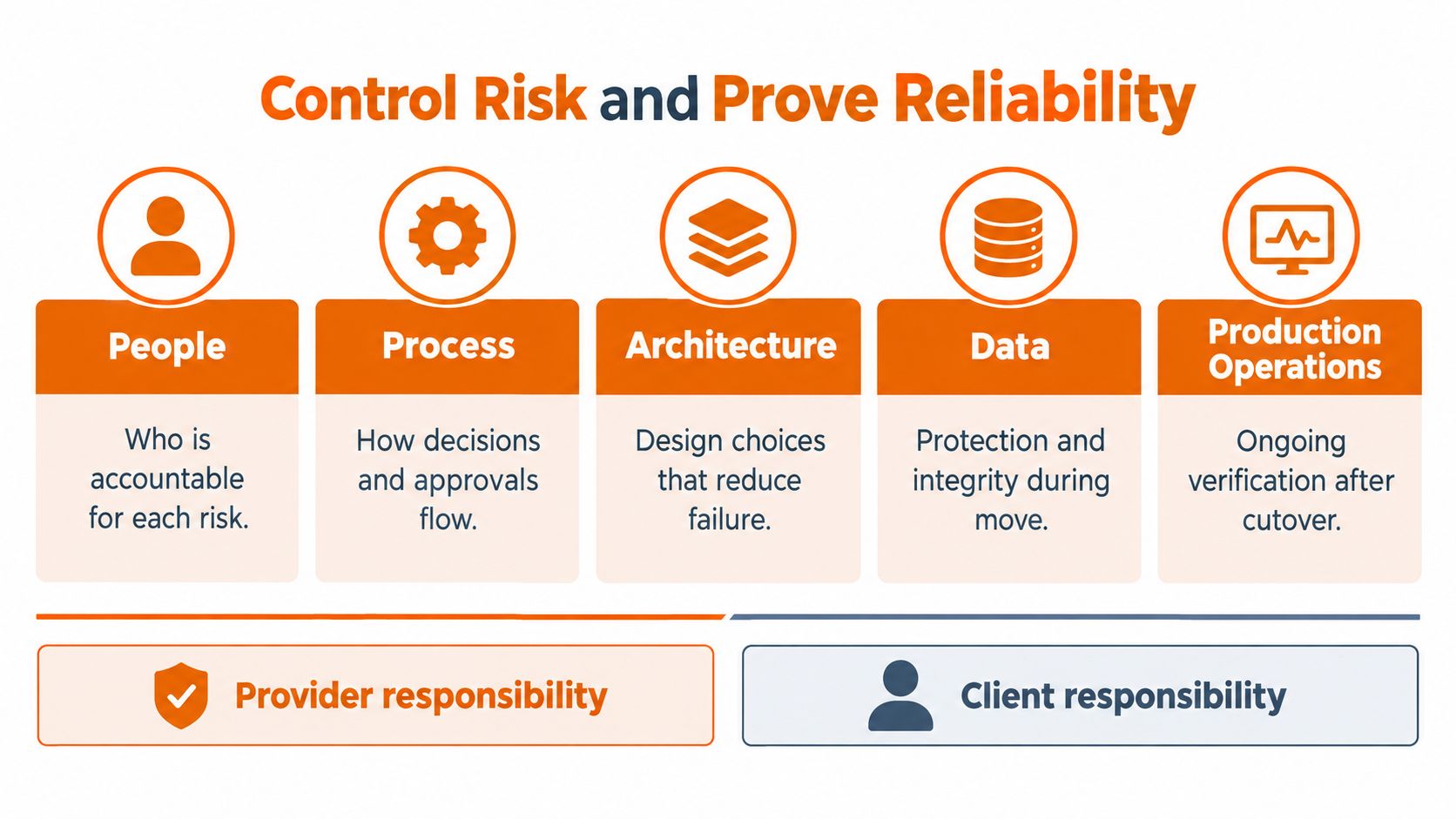
Turn that into artifacts your team can inspect. An assessment should produce a workload dependency map, data-classification matrix, identity-flow design, encryption and key-management requirements, and evidence that controls work during transfer and cutover. A structured business impact analysis approach for prioritizing critical functions gives you the downtime tolerance and recovery priorities those artifacts need, instead of generic severity labels nobody trusts during an incident.
Build a test pyramid that matches production reality.
Now picture the failure modes. An identity provider misconfiguration locks out support staff on launch morning. A data inconsistency surfaces three days after cutover, past the easy rollback window. The runbook lives in a departed contractor's drive. Each scenario is preventable, and each one has happened to careful teams that tested the application but not the operation.
If rollback hasn't been rehearsed by the people who'll execute it at 2 a.m., you don't have a rollback plan. You have a document.
Add exit readiness to the same checklist. Classify dependencies as directly portable, reconfigurable, or hard to reproduce elsewhere. Standardized APIs and portable descriptions reduce lock-in, but only if you choose them deliberately for the components that matter. Finally, set stop-or-replan thresholds in advance for failed rehearsals, unresolved critical dependencies, or control gaps. A partner with a consulting mindset will recommend pausing a wave when evidence says pause. A vendor chasing milestone payments won't.
Comparing cloud instance prices to server depreciation tells you almost nothing. Migration economics live in utilization, engineering capacity, release speed, and the cost of running two worlds at once. Build the business case from a baseline you'll still trust six months after launch.
Before anything moves, record current infrastructure spend, utilization, support effort, incident volume, deployment frequency, release lead time, and how many senior engineering hours go to keeping the platform alive. Without that baseline, every post-migration claim becomes an argument. With it, FinOps becomes a control loop instead of a monthly surprise.
Set up tagging standards, budgets, and anomaly alerts in the landing zone, not after the first shocking invoice. Then work the levers migration exposes. Rightsize compute and databases to actual demand. Delete idle non-production resources that nobody owned in the data center. Review commitment discounts against real utilization. Assign spend to products and business units so a cost increase can be judged against the revenue or growth it supports.
Published numbers need honest handling. A Google Cloud white paper analyzing 178 customer-reported FinOps data points found reported savings of 20% to 50% over 12 months were most common and average reported savings were 45%, and these figures are observational benchmarks, not guaranteed outcomes. Use them to sanity-check your model, never to promise your board a result. Your outcome depends on your starting waste, your architecture choices, and whether anyone keeps optimizing after the program ends.
The visible cloud bill is the smaller risk. Price the parallel environments you'll run during transition, the product releases displaced while engineers migrate, retraining, duplicated tooling, vendor coordination, and post-launch stabilization. Ask the uncomfortable questions directly. What revenue-generating work stops? How many senior engineers get ring-fenced, and for how long? Which approach minimizes that opportunity cost rather than the infrastructure line item?
Scorecard rule: Judge the migration on cost per active customer, order, or API request, alongside availability, recovery time, delivery lead time, and change failure rate. Total spend alone rewards underinvestment.
That balanced scorecard protects you from optimizing the bill while degrading delivery speed or reliability. Review utilization and commitment coverage continuously, tie unit costs to gross margin where you can, and report capacity returned to product work as a first-class result. Then enforce your thresholds. If parallel running drags on, unit costs rise without a growth explanation, or fatigue starts eating your roadmap, stop and replan. A technically elegant program that destroys economic value is a failed program, whatever the architecture diagram looks like.
Stop shopping for cloud migration consulting services by hourly rate. You're buying judgment under uncertainty, senior accountability, and the discipline to tell you no. Procure that deliberately, with questions that force evidence instead of slideware.
Score answers alongside domain expertise, architecture depth, security capability, delivery method, senior staffing, references you can call, transition support, and commercial transparency. A structured view of delivery consulting models and accountability helps you compare how different partners staff senior roles and own outcomes, rather than comparing day rates in isolation.
Match the model to the problem. Internal teams know the systems but carry the full opportunity cost. Specialist consultancies bring pattern recognition from many migrations. Managed service providers suit organizations that want operations offloaded after launch. Build-Operate-Transfer fits leaders who want a partner to build and run a capability, then hand over a trained team and documented operation. Poland-based nearshore delivery can add senior capacity with workable time-zone overlap for European and many international clients, and distance alone predicts neither quality nor savings. Judge the named architects, their decision rights, and their communication habits instead.
Ask specifically how AI is governed. AI-native engineering changes delivery economics, not engineering standards. Agents can accelerate discovery analysis, code conversion, test generation, documentation, and migration scripting. Senior architects must still own architecture, data design, security, testing, and production quality, and every AI-generated artifact needs review effort priced into the plan. Speed claims that skip review, governance, and operational handover are incomplete claims.
One option in that nearshore, AI-native category is RITE NRG, which works across planning, migration, modernization, delivery, and managed operations with senior architects accountable for production quality while agentic AI accelerates delivery work. Evaluate it with the same questions above, against the same evidence standard, as every other finalist. The right partner welcomes that scrutiny and challenges your assumptions respectfully in return, because a strategic partner protects your outcome, not your original plan.
You don't need a perfect plan to start. You need thirty days of disciplined decisions that make the plan possible.
Week one belongs to ownership. Appoint one accountable business owner, write the business case on a page, and list the essential outcomes. Week two is evidence. Inventory applications and dependencies, classify data and risk, and capture your cost and delivery baselines. In week three, define pilot criteria, draft the target operating model, and identify which senior engineers must be ring-fenced. In week four, invite shortlisted partners to challenge your assumptions in a working session, not a sales presentation. Their questions will tell you more than their credentials.
RITE NRG is an AI-native technology consultancy and software engineering partner based in Poland that works with international clients across planning, migration, modernization, delivery, managed operations, and R&D center delivery. That range matters only if it maps to your gaps, whether those are consulting, nearshore engineering capacity, managed technology, or a Build-Operate-Transfer path to long-term ownership.
Judge your first release on planned versus unplanned work, wave reliability, proven rollback readiness, service-level performance, cost visibility, support readiness, team capacity, and delivery flow. Walk away and replan if you see unclear ownership, scope growing without funding, undocumented dependencies, missing client experts, success reported only as workload counts, or progress that depends on heroics. Start small, prove it, then scale with confidence.
If you're weighing a migration and want the business case, sequencing, and control boundaries challenged before you commit serious engineering capacity, Rite NRG can assess your portfolio, design the phased plan, and deliver or operate the result with senior accountability. Start that conversation at Rite NRG and bring your hardest questions about cost, lock-in, and team capacity.
/ about the author
Written by the RITE NRG editorial team — the architects, engineers and delivery leads who build and operate AI-era software for our clients.
Strategy & Transformation
A practical, finance-ready framework for comparing AI and modernization investment with the current-state cost, realistic benefits, delivery risk and time to value.
Technology Talent & Teams
A decision-maker's guide to IT partnership models: what each model actually transfers to the partner, what it costs beyond the rate card, and how to match the model to your situation.
AI Consulting & Automation
A practical framework for choosing and deploying transport or logistics AI agents around real exceptions, reliable data and controlled operational authority.
More guidance: all insights articles
Tell us about the system or idea behind this article. We tell you honestly if it is a fit — and what a fixed-scope delivery could look like.