

Strategy & Transformation
How to Calculate ROI for AI and Software Modernization
A practical, finance-ready framework for comparing AI and modernization investment with the current-state cost, realistic benefits, delivery risk and time to value.
operationalwrocław--:-- cet
∕ insights / business-impact-analysis.md
Business Impact Analysis
Master business impact analysis to prioritize resilience, reduce risk, and align technology investments with measurable business outcomes.
>_article.meta
Only 15% of executives measure cyber risk's financial impact to a significant extent, according to PwC's 2025 survey. A strong business impact analysis closes that gap by turning an outage decision into a clear investment choice: accelerate the feature, harden the architecture, or accept a defined level of exposure.
Your product team is probably facing that choice now. A major customer wants a launch date, the roadmap is already crowded, and the engineering lead is warning that the current architecture won't tolerate a regional outage. One group sees resilience work as a delay. Another sees the feature launch as reckless. Both may be right because nobody has connected the technical decision to revenue, customer obligations, recovery limits, and board-level risk.
That's the purpose of a business impact analysis, or BIA. It doesn't tell you that every system needs maximum protection. It tells you which business outcomes deserve investment, how much disruption the company can withstand, and what recovery capability must exist before the risk becomes unacceptable.
At 9:07 on a Tuesday, a core API dependency stops responding. Logins fail on and off. Checkout queues start backing up. Support gets flooded before anyone can sort signal from noise. The product manager wants to know whether the launch should pause. The founder asks the only question that matters in the first minutes of an outage: how long can the business keep operating like this before the financial damage outruns the recovery effort?
That question separates incident response from business impact analysis. Restarting a service, shifting traffic, disabling an integration, or restoring a backup may stabilize the platform. None of that tells you whether revenue collection, identity checks, customer data handling, staffing workflows, or supplier commitments can still function. A system can come back online while the business remains impaired.

Executive teams often protect the loudest system first. That is usually the wrong call.
The application everyone watches is not always the one that keeps the company viable. Visibility, politics, and technical complexity distort priorities. An internal dashboard with constant executive attention may matter less than a dull provisioning workflow that controls contract activation, billing readiness, or revenue recognition. If the second one fails, the business slows down even while the monitoring for the first one looks immaculate.
A BIA forces leaders to rank disruption by consequence, not by familiarity. It asks a harder set of questions. What stops selling? What stops serving customers? What delays cash collection? What breaks compliance obligations? What becomes unacceptable after one hour, one day, or one week? Those answers are what tie architecture choices to board-level investment decisions. They also show where AI-native delivery models need stronger controls, fallback paths, or clearer accountability before they earn a place in a resilience strategy.
Practical rule: Prioritize the business services whose failure threatens revenue, obligations, customers, or survival.
The National Institute of Standards and Technology puts that logic in plain terms. In NIST's contingency planning guide, BIA is the second step in a seven-step lifecycle, sitting between policy and recovery strategy design. The guide links mission and business processes, the consequences of unavailability, and recovery requirements such as RTO, RPO, and MTD. That framing still holds because it treats continuity spending as a business decision with technical inputs, not a popularity contest among applications.
A useful BIA compares outage scenarios instead of producing a static inventory. A short outage creates one set of costs. A data-integrity incident creates another. A supplier failure that drags on for weeks changes the economics again, even if your own platform stays healthy.
Separate direct effects from indirect effects. Direct effects include lost transactions, emergency recovery work, and contractual exposure. Indirect effects include delayed cash flow, customer churn, damaged confidence, and management time pulled away from growth.
That is why service ownership with MR2 Solutions is a useful operational reference. Clear ownership identifies who makes the call, who communicates externally, who restores service, and who accepts residual risk.
A BIA puts a price on disruption before the outage does it for you. Without it, a feature decision becomes an unpriced continuity bet.
A business impact analysis identifies the consequences of disrupting business services and converts those consequences into recovery and investment requirements. It's a financial exercise supported by technical evidence, not an inventory of servers, cloud accounts, or software licenses.
Start with the product or service that creates value. Then identify the activities required to deliver it, the people and data involved, the technology dependencies underneath it, and the external partners that can interrupt it. The analysis should show what happens when the service becomes slower, unavailable, inaccurate, or impossible to operate safely.
The UK government's business-continuity guidance defines this chain through key products and services, critical activities, organizational impact, and required resources. It also defines the Maximum Tolerable Period of Disruption, or MTPD, as the longest period a product or service can remain unavailable before the organization's financial or reputational viability is threatened. The UK business-continuity toolkit connects that limit to practical recovery planning.
MTPD is the business survival boundary. It answers how long the company can tolerate disruption before the consequences threaten viability.
Recovery Time Objective, or RTO, is the point by which a product or service must resume. It must sit inside the MTPD, with enough margin for uncertainty, coordination, and failed recovery attempts.
Recovery Point Objective, or RPO, defines how much data loss the business can tolerate, expressed through the acceptable recovery point. A business that can restore quickly but loses essential transactions may still suffer an unacceptable outcome.
These aren't technical preferences. They are decisions about revenue, customer commitments, regulatory exposure, operational capacity, and trust. A team that chooses an RTO because a platform supports it has reversed the logic. The business impact should determine the requirement, and the architecture should respond.
A credible BIA gives the board a decision model. It should compare disruption scenarios, state assumptions, identify dependencies, and show where confidence is low. The model should distinguish lost revenue from margin erosion, extra operating cost, regulatory exposure, customer churn, cash-flow effects, and reputational damage.
PwC's 2025 Global Digital Trust Insights survey covered 4,042 executives across 77 countries and found that fewer than half measure cyber risk effectively. Only 15% measure its financial impact to a significant extent. PwC's 2025 findings reinforce the problem: many organizations recognize serious technology threats without a strong economic basis for choosing controls.
A practical business impact analysis guide can help structure the fundamentals, but templates won't make the decision for you. The senior team must decide which exposure fits the risk appetite and which investment reduces it most effectively.
A useful BIA moves from business value to dependency evidence, then from impact to recovery action. Keep the scope narrow enough to produce decisions. A document that lists every process but ranks none of them is not rigorous. It's an expensive postponement of judgment.
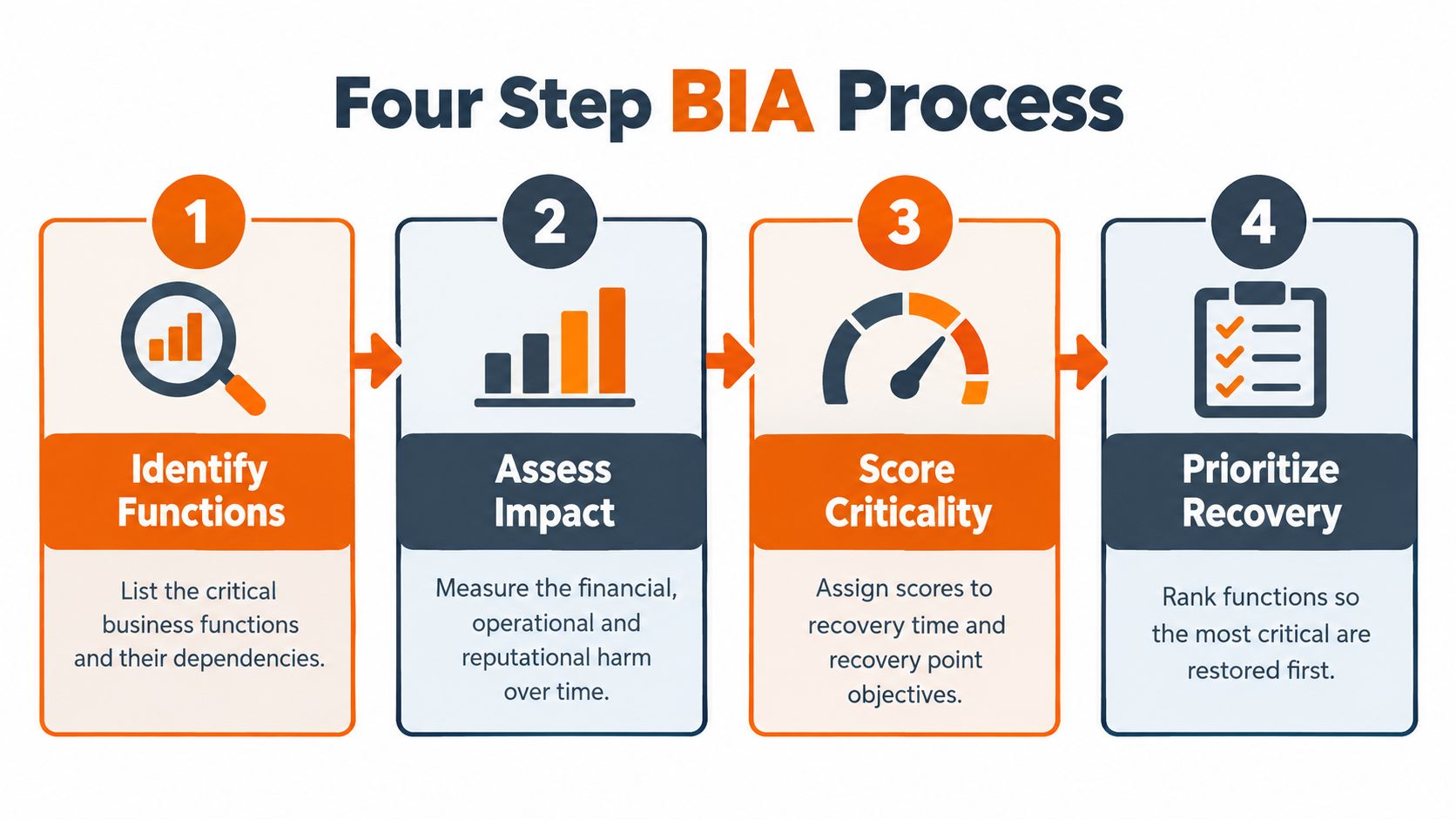
Begin with customer journeys and revenue-generating activities, not infrastructure diagrams. Name the business owner, the outcome, and the point at which failure becomes visible to customers or regulators.
For each function, record:
Use dependency maps to expose shared failure points. Two apparently separate products may rely on the same identity provider, data pipeline, deployment system, or specialist team. A practical risk assessment framework can provide structure, but the map must reflect how work really flows.
Don't ask whether a function is “critical.” Ask what happens after disruption begins, then revisit the answer as time passes.
Assess at least four dimensions:
| Impact dimension | Questions to answer |
|---|---|
| Financial | Which revenue, margin, cash-flow, recovery, or contractual effects appear? |
| Operational | Which services stop, slow down, or require manual capacity? |
| Regulatory | Which reporting, privacy, safety, or contractual duties become exposed? |
| Reputational | Which customers, partners, or markets may lose confidence? |
Separate fact from assumption. If the organization lacks reliable loss data, state the uncertainty instead of disguising it with false precision. The output should support a budget decision, not merely create a neat score.
Translate impact into recovery requirements. Set the MTPD first, then define an RTO that allows realistic recovery, and define an RPO based on acceptable data loss. Test whether the proposed target is achievable with current architecture, staffing, suppliers, facilities, and operating procedures.
A function with tight recovery requirements may need redundancy, tested failover, stronger data protection, alternate suppliers, or cross-trained operators. Another function may need a documented manual workaround rather than expensive active-active infrastructure.
Rank functions by economic exposure, dependency concentration, recovery difficulty, and confidence in the evidence. Then assign owners, funding decisions, testing requirements, and deadlines.
A good result tells leaders what not to fund yet. It may recommend hardening the shared identity layer before adding redundancy to an individual application. It may favor supplier diversification over another monitoring tool. It may delay a feature launch until the platform can tolerate a failure mode that the BIA shows is financially unacceptable.
The analysis becomes valuable when someone can use it during a budget meeting and answer, “Why this investment, now?”
AI changes the economics of delivery. It can accelerate dependency analysis, generate draft process maps, inspect code, propose test cases, document recovery procedures, and help engineers explore migration paths. That speed is valuable, especially when a BIA has been delayed by fragmented documentation and overloaded subject-matter experts.
AI does not change the engineering standard. An agent can produce a plausible recovery plan that misunderstands a data dependency, misses a security boundary, or recommends an unsafe restoration sequence. Fast output can increase risk when nobody owns the result.
NIST's AI Risk Management Framework identifies accountability and transparency, explainability and interpretability, privacy enhancement, safety, security and resilience, and validity and reliability as characteristics of trustworthy AI. It also calls for governance responsibilities, domain expertise, consultation with affected users where appropriate, and lifecycle evaluation. NIST's AI Risk Management Framework gives the right standard for AI-native resilience work.
An AI-native BIA workflow can help with:
The accountable owner must still approve architecture, data flows, security controls, test evidence, deployment, and production behavior. Treat generated analysis as an input requiring verification, not as an executive decision.
The right objective is faster delivery with controlled risk. Counting generated code or completed tickets says little about business value. Track whether the initiative improves capacity, cycle time, quality, cost, revenue, or risk, then connect those measures to the BIA's exposure model.
McKinsey's 2025 global survey found that 39 percent of respondents reported any level of AI-related EBIT impact at the enterprise level, while most of those respondents said less than 5 percent of organizational EBIT was attributable to AI. The survey also found that 51 percent of organizations using AI had experienced at least one negative consequence, with nearly one-third of all respondents reporting consequences related to AI inaccuracy. McKinsey's 2025 State of AI analysis supports a disciplined conclusion: deployment is not the same as value.
For additional context, teams evaluating regulated environments may benefit from exploring AI risk controls for banks. Companies should also establish explicit governance roles and review gates through a practical AI governance framework.
The same BIA vocabulary produces different decisions in different operating models. A SaaS company, a legacy modernization program, and a nearshore delivery partnership don't fail in the same way, so they shouldn't use identical recovery assumptions.
| Context | Primary exposure | What the BIA must reveal | Typical decision |
|---|---|---|---|
| High-growth SaaS | Customer access, transactions, support, contractual commitments, and trust | Which customer journeys stop generating or retaining revenue, and which shared services create concentration risk | Invest in resilient customer paths, tested recovery, data integrity, and clear service ownership |
| Legacy modernization | Undocumented dependencies, fragile interfaces, migration windows, and inconsistent data | Which old behaviors and records the business still relies on, including dependencies nobody documented | Sequence modernization around business tolerance, preserve reconciliation, and run controlled parallel operations |
| Nearshore delivery | Knowledge concentration, partner continuity, cross-border obligations, and operating resilience | Whether delivery can continue if a location, supplier relationship, key person, or data-transfer route becomes unavailable | Build ownership redundancy, explicit documentation, alternate communication paths, and compliant operating arrangements |
For SaaS, an application's uptime is only a proxy. Map onboarding, authentication, core workflow execution, billing, support, exports, and administrative controls. A platform may appear available while a dependency prevents customers from completing the action that creates value.
The BIA should distinguish a degraded experience from a complete service failure, then connect each condition to contractual exposure, support load, renewal confidence, and operational workarounds. The result should guide architecture and commercial decisions together.
Legacy systems often contain rules that exist nowhere except in code, operator habits, spreadsheets, and customer expectations. A migration plan that inventories components but misses those behaviors can preserve infrastructure while breaking the business.
Assess data integrity, reconciliation, interface timing, batch dependencies, manual approvals, and rollback options. Recovery isn't complete when the new platform starts. It's complete when the business can trust the results.
A partner can provide valuable capacity and expertise, but the BIA must test whether the company retains decision rights and operational knowledge. Identify who can approve a production change, investigate a security incident, restore service, and explain the system when the usual team is unavailable.
The practical test is simple. If the relationship ended suddenly, could the company continue safely? If the answer depends on a few undocumented individuals, the risk belongs in the investment plan.
A BIA earns its place when it changes the roadmap. The output should be a short set of decisions with owners, costs, dependencies, evidence, and deadlines. Avoid presenting a technical risk register that asks executives to translate architecture into business consequences themselves.
Use a board-ready format:
McKinsey's analysis found that workflow redesign had the greatest effect among the organizational attributes tested on an organization's ability to achieve EBIT impact from generative AI. It also found that tracking well-defined KPIs for generative-AI solutions had the greatest bottom-line impact overall, while CEO oversight of AI governance was particularly associated with higher self-reported EBIT impact at larger organizations. The detailed McKinsey survey analysis points to a broader rule: changing the tool without changing the work won't produce a reliable outcome.
Your technology partner should challenge weak assumptions, expose dependency gaps early, and own the result beyond its assigned tickets. That means senior architects remain accountable for architecture and production quality, engineers validate generated output, delivery leaders surface bad news quickly, and business owners decide which exposure the company accepts.
Document recovery expectations as precise, testable requirements. A practical set of sample non-functional requirements can help translate business tolerance into requirements for availability, recovery, security, data integrity, observability, and operational ownership.
Treat the BIA as a living decision framework. Revisit it when the company changes its product, suppliers, geography, data flows, operating model, or AI capabilities. The best analysis doesn't predict every incident. It ensures the next investment discussion starts with business viability instead of technical anxiety.
Rite NRG helps SaaS companies and enterprises turn business impact analysis into resilient architecture, modernized platforms, AI-native delivery, and accountable technology operations. Its senior architects and engineers use agentic AI to accelerate analysis, development, testing, documentation, and migration while retaining responsibility for security, data, architecture, and production quality. Visit Rite NRG to connect your continuity priorities with a practical delivery plan.
/ about the author
Written by the RITE NRG editorial team — the architects, engineers and delivery leads who build and operate AI-era software for our clients.
Strategy & Transformation
A practical, finance-ready framework for comparing AI and modernization investment with the current-state cost, realistic benefits, delivery risk and time to value.
AI Consulting & Automation
A practical framework for choosing and deploying transport or logistics AI agents around real exceptions, reliable data and controlled operational authority.
Industry Solutions
A practical roadmap for improving manufacturing systems and introducing AI without destabilising production, data integrity or operational control.
More guidance: all insights articles
Tell us about the system or idea behind this article. We tell you honestly if it is a fit — and what a fixed-scope delivery could look like.