

Strategy & Transformation
How to Calculate ROI for AI and Software Modernization
A practical, finance-ready framework for comparing AI and modernization investment with the current-state cost, realistic benefits, delivery risk and time to value.
operationalwrocław--:-- cet
∕ insights / delivery-consulting.md
Delivery Consulting
A practical delivery consulting guide covering services, Agile and DevOps frameworks, pricing models, and a checklist for choosing the right consulting partner.
>_article.meta

A product launch slips by three quarters. The budget is gone, revenue targets are missed, and the executive team is still debating whether the problem was strategy, product scope, or engineering capacity. Usually, the answer is less dramatic and more expensive: decisions weren't converted into shipped value reliably.
That failure affects more than a release calendar. It raises the cost of delay, increases churn risk when teams miss customer commitments, and creates engineering rework that consumes capacity the next product needs. The Standish Group's CHAOS report found that only 16.2% of software projects were completed on time and on budget, while 31.1% were canceled and 52.7% were challenged. Those figures make delivery a business issue, not an internal process complaint. (Standish Group CHAOS report)
Consider a SaaS company with a sound market thesis and a product customers want. The leadership team approves a launch plan, sales starts making commitments, and engineering begins work across several teams. Then dependencies surface late, priorities change without a decision owner, environments drift, and the release train slows to a crawl.
By the time the launch moves three quarters, the company has burned its planned budget without producing the expected commercial result. The product strategy may be unchanged, but the business has paid through delayed revenue, lost sales momentum, strained customer relationships, and rework. That's why a delivery review must begin with business outcomes, not a list of ceremonies or a new project-management tool.
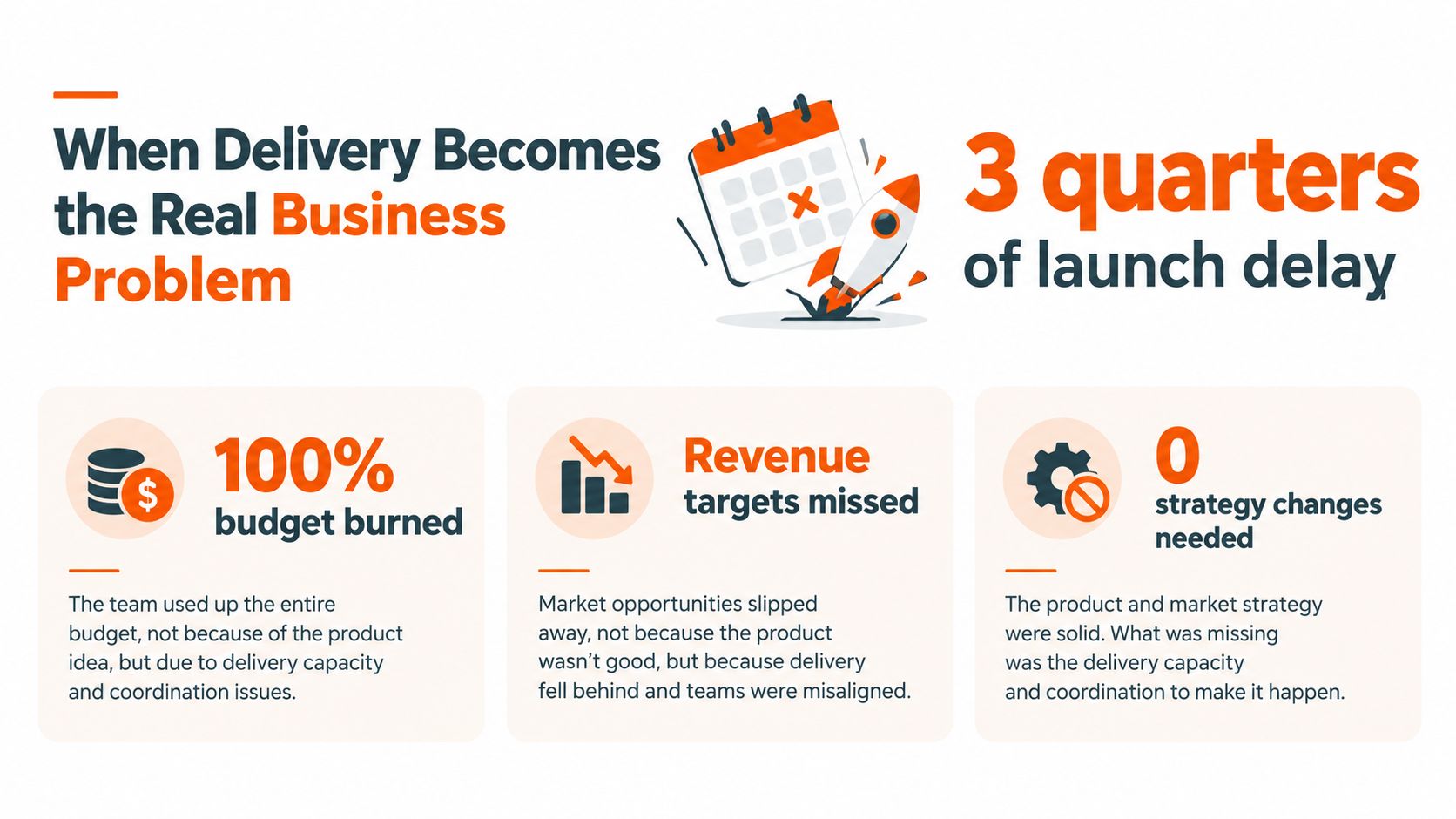
Delivery is the operating system between a decision and its commercial impact. It coordinates scope, people, architecture, testing, vendors, releases, and production support. If that system is weak, every strategic choice becomes harder to monetize.
A CTO should therefore ask four questions before approving a delivery intervention:
Practical rule: If a consultant can't connect delivery activity to revenue protection, cost control, risk reduction, or customer commitments, you're buying motion rather than value.
The history of delivery consulting explains why this judgment matters. The field developed alongside major computing shifts, from commercially usable computers in the early 1950s and the mainframe breakthrough in 1956, through PCs and open standards in the early 1980s, Internet commercialization in the 1990s, and today's cloud and AI systems. By 1999, the IT services market had reached about USD 250 billion, with IT consulting and systems integration accounting for more than USD 135 billion, according to historical industry research. (Software Consulting Market Report)
That evolution has one consistent lesson. Delivery requires engineering judgment, integration discipline, and production reliability. The commercial value appears only when those capabilities turn plans into working systems.
For another useful perspective on the tension between promises and executable delivery, listen to the Vertrieb vs. Delivery Podcast, which examines what happens when delivery realities challenge sales expectations.
Delivery consulting is a fixed-scope, accountable partnership to get a defined result shipped reliably. The consultant doesn't stop at recommendations. The engagement includes diagnosis, intervention, decision support, execution leadership, measurement, and handover.
That definition separates delivery consulting from three models that buyers often confuse.
Staff augmentation adds people to your existing structure. You still own prioritization, architecture decisions, coordination, risk management, and the final outcome. Extra hands can help when the system works and capacity is the only constraint. They won't fix unclear ownership or a broken decision path.
Pure strategy advisory produces analysis, options, and a roadmap. It can be valuable for major choices, but a slide deck isn't a release. If the advisor leaves before dependencies are resolved and production behavior is verified, the client still carries the delivery risk.
Software-vendor implementation services often focus on configuring and extending the vendor's platform. That may be appropriate for a product-led rollout, but the vendor's incentives typically center on adoption of its license and implementation pattern, not on the full health of your technology estate.
| Model | Scope | Accountability | Primary Output |
|---|---|---|---|
| Delivery consulting | Defined business or technology outcome | Partner shares responsibility for the shipped result | Working release, reduced risk, measurable delivery improvement |
| Staff augmentation | Assigned roles or capacity | Client owns coordination and outcome | Additional delivery capacity |
| Strategy advisory | Analysis and recommendations | Client owns execution | Options, recommendations, roadmap |
| Vendor implementation | Configuration around a vendor product | Vendor owns its implementation scope | Implemented platform or product capability |
A credible engagement usually has three phases.
Judge the partner by shipped outcomes, cycle time, risk reduction, and capability transfer. If the proposal measures attendance, workshops, or hours but doesn't name the result, it isn't accountable delivery consulting.
The four service families that matter are delivery strategy, process improvement, vendor and capability handover, and delivery risk management. Together, they cover the decisions, flow, ownership, and controls required to protect revenue and predictability.
The delivery consulting market is large, but buyers still encounter plenty of polished filler. One independent market estimate values software consulting at USD 380.26 billion in 2026, up from USD 327.59 billion in 2025, and projects USD 801.43 billion by 2031 at a 16.08% CAGR from 2026 to 2031. Another study estimates the 2026 market at USD 123.3 billion and forecasts USD 218.3 billion by 2033 at an 8.5% CAGR. The definitions differ, but both estimates point to substantial and expanding demand for delivery-oriented consulting. (Software consulting market analysis)
The buyer's job is to pay for outputs that change delivery economics.
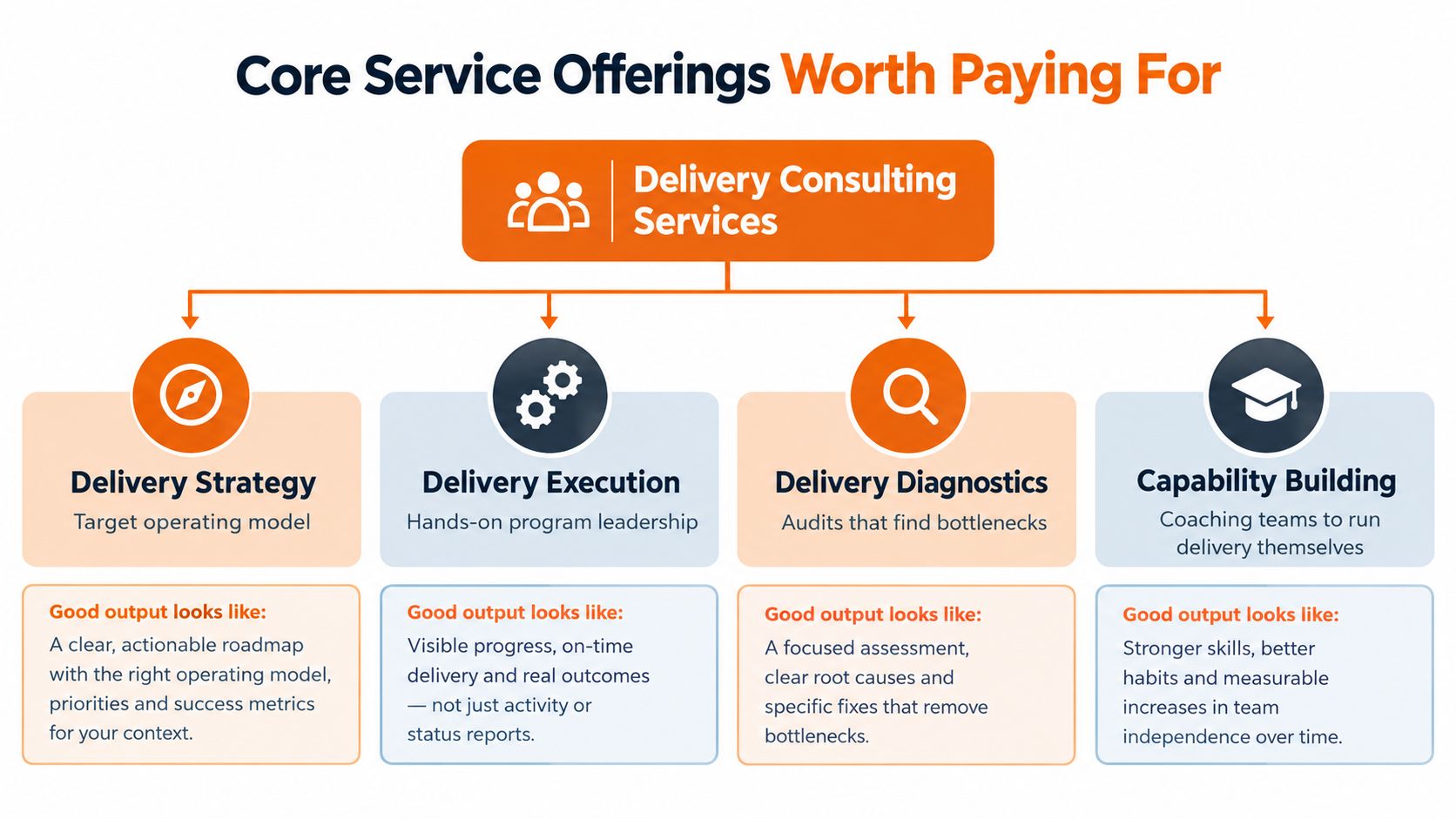
Good delivery strategy creates a target operating model, portfolio priorities, decision rights, and a roadmap tied to business outcomes. It should show what gets done first, what waits, what dependencies matter, and how leadership will know whether the plan is working.
Reject a roadmap that just sequences features by quarter without naming capacity constraints or commercial consequences.
Ask: Which business outcome does each priority protect, and what will we stop doing to make room for it?
Good process improvement uses value stream mapping, sensible work-in-progress limits, and flow metrics to change team behavior. It identifies where work waits, why approvals accumulate, and which handoffs create rework.
Reject ceremony expansion. More meetings, boards, and status reports don't equal better flow.
Ask: Which constraint will change first, how will we observe the change, and who owns the resulting decision?
A strong handover includes transition architecture, knowledge-transfer sessions, operational documentation, ownership mapping, and measurable exit criteria. It leaves the client less dependent, not more entangled.
Reject consultants who describe knowledge transfer as a final presentation. Your team needs to operate, troubleshoot, release, and evolve the system after the engagement.
Ask: What must our team demonstrate before you consider the handover complete?
Good risk management tracks dependencies, release-readiness gates, production constraints, and contingency plans against commercial exposure. A risk register matters only when it changes a decision or triggers an action.
Reject color-coded dashboards that don't show an owner, deadline, consequence, and response.
Ask: Which current risk could miss a customer, revenue, or compliance commitment, and what decision removes it?
Hands-on execution, diagnostics, and capability building become practical rather than decorative here. The delivery consulting service overview offers another useful reference point when you're mapping tools to the operating problems they should solve.
Frameworks are tools, not maturity badges. Choose one because it addresses a known delivery problem, not because a board presentation expects the latest label.
Aggle addresses uncertain scope and changing priorities. Scrum can provide a planning cadence, Kanban can expose flow constraints, and scaled approaches such as SAFe can coordinate larger portfolios when the organization actually needs that structure. Agile improves prioritization, feedback, work in progress, and usable increments. Misapplied, it becomes a calendar of ceremonies that produces no sharper decisions.
DevOps addresses slow movement from code commitment to production. It connects development, operations, testing, security, and release automation so teams can reduce handoff friction and obtain feedback earlier. Its strongest measures focus on delivery flow and deployment stability. Misapplied, DevOps becomes a tooling migration with no ownership change.
SRE addresses unstable production and the conflict between release velocity and reliability. It uses service-level objectives, observability, incident practices, and error budgets to make reliability trade-offs explicit. Misapplied, SRE becomes an operations layer that blocks releases or tracks availability without improving customer experience.
| Framework | Core Delivery Problem | Best For | Key Risk When Misapplied |
|---|---|---|---|
| Agile | Uncertain scope and shifting priorities | Product teams that need rapid feedback and disciplined prioritization | Ceremony without decisions or usable increments |
| DevOps | Slow, fragmented movement to production | Teams constrained by handoffs, manual releases, or weak automation | Tools change while accountability stays fragmented |
| SRE | Unstable production and unclear reliability trade-offs | Business-critical services requiring explicit reliability management | Reliability controls become release bureaucracy |
DORA metrics provide a practical way to separate throughput from stability. Deployment frequency and lead time for changes measure speed. Change failure rate and failed-deployment recovery time measure reliability. DORA defines lead time for changes as the time from a code commit to successful production deployment, with elite performance typically involving multiple deployments per day and lead time under one hour to less than one day. Low performers are measured at monthly to biannual deployment frequency, with lead times of one to six months. (DORA metrics guide)
Use a simple decision lens:
Don't adopt all three at once unless you can name the business problem each one will solve.
Outside help pays when the cost of inaction is already visible and internal leadership lacks the capacity or independence to correct it. It shouldn't be a prestige purchase or a substitute for making difficult decisions.
A partner is justified when slow releases are delaying revenue. If sales commitments depend on a capability that keeps slipping, measure the exposure in delayed contracts, customer churn risk, and the cost of keeping commercial teams waiting. The right consultant should establish the baseline, remove the bottleneck, and connect release progress to those commitments.
Hiring also makes sense when technical debt blocks a product or modernization program. The issue isn't that the code is old. The issue is that architecture, integration, testing, or deployment constraints prevent the business from launching, scaling, or meeting security expectations.
A delivery partner is the wrong answer for a very early-stage company that really needs a CTO. It's also excessive when a stable team only lacks one or two specialists. Finally, no consultant can compensate for leadership that refuses to change decision rights, scope, or investment priorities.
For agencies evaluating scalable delivery arrangements, RapidNative's 2026 playbook provides a useful comparison point for white-label app delivery. The key buying question remains the same: who owns the complete result, and how does the client regain control?
A partner pays when it removes a business constraint, not when it adds an impressive team chart.
Pricing determines where delivery risk sits. Don't choose a model because its label sounds modern. Choose it based on scope clarity, outcome measurability, and the cost visibility you can maintain while work is in progress.
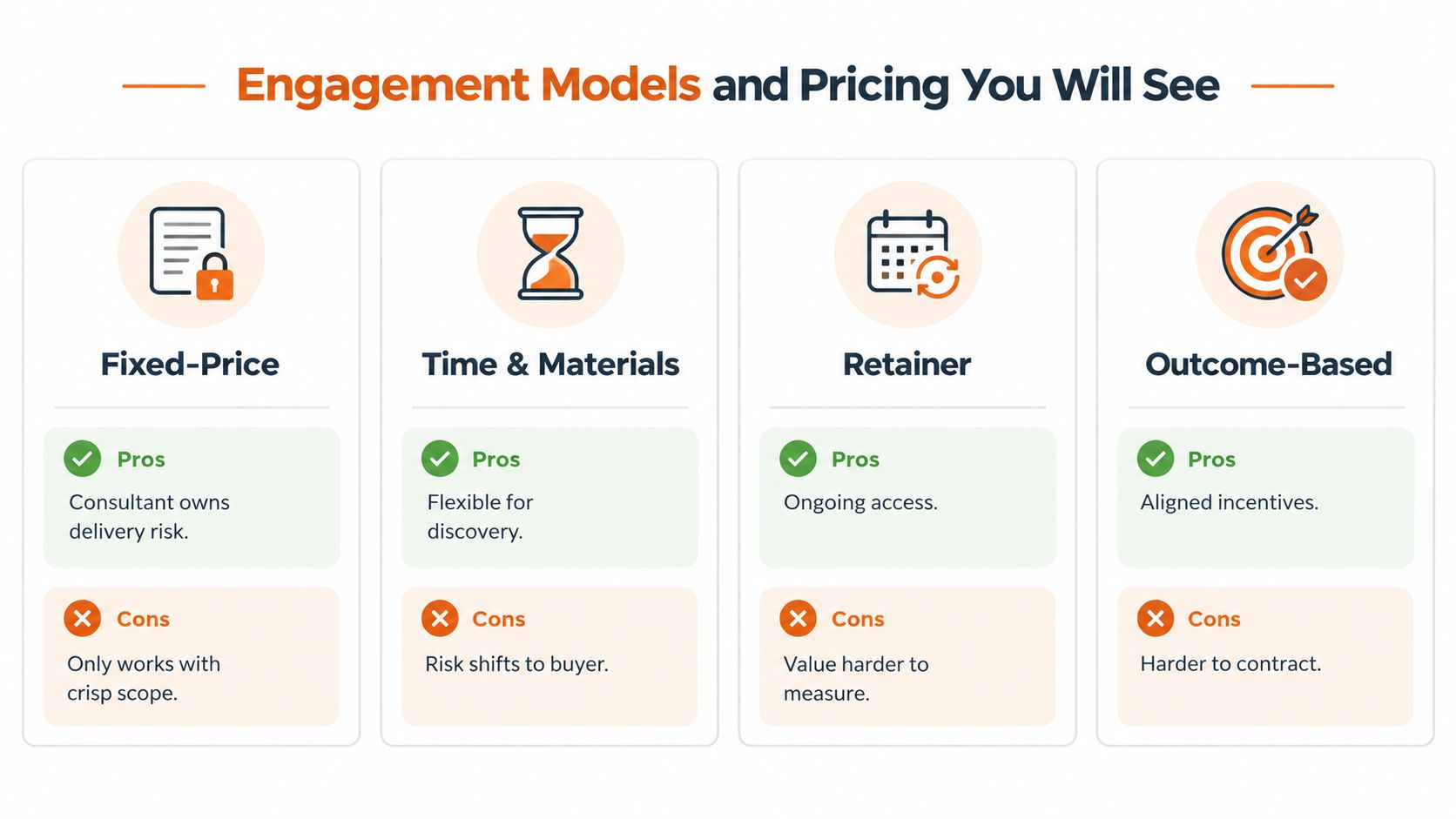
Fixed-price works when the scope, deliverables, acceptance criteria, and decision process are crisp. The consultant owns more delivery risk, while the client gains budget predictability.
The danger is predictable too. If scope is fuzzy, the consultant either protects margin through exclusions or absorbs uncontrolled work until the engagement becomes adversarial. Require change-control rules, named assumptions, and an outcome that can be accepted objectively.
Time and materials suits genuine discovery and evolving requirements. It gives the client flexibility, but it shifts cost risk to the buyer and can reward inefficient delivery.
Set a scope boundary, a budget ceiling or review gate, weekly burn transparency, and a decision log. “We'll true it up later” isn't governance.
A retainer fits ongoing advisory work, a transformation office, fractional delivery leadership, or continuous improvement. It provides access and continuity, but value becomes harder to measure when the scope expands informally.
Define included capacity, response expectations, rollover rules, excluded work, and monthly evidence of value. A retainer without boundaries becomes permanent availability with unclear accountability.
Outcome-based pricing links fees to a measurable result, such as a completed release, reduced delivery risk, or an agreed operational improvement. It aligns incentives, but it requires a baseline, reliable attribution, and a payment mechanism both sides trust.
Don't accept “value” as an unmeasured promise. Name the metric, its owner, the measurement window, and what happens if external factors affect the result.
AI-native delivery changes the economics behind all four models. AI can shorten diagnostic work, accelerate artifact production, and allow smaller senior teams to cover more analysis and execution. That makes fixed-scope and outcome-tied fees more realistic, but it also makes hourly billing a weaker proxy for value. A product development outsourcing guide can help compare delivery structures when the engagement spans discovery, build, and ongoing ownership.
Measure delivery in two layers. The first layer shows whether the delivery system is healthier. The second shows whether that health protects revenue, cost, customer trust, or strategic commitments.
DORA's four core metrics provide a useful foundation:
Add one AI-era measure that fits your workflow, such as AI-assisted defect detection rate or prompt-to-production cycle time. Keep human review explicit. AI may accelerate analysis and code production, but architects and engineers remain responsible for architecture, data, security, testing, and production quality. Deloitte frames software quality through requirements and user expectations, including stability, reliability, efficiency, simplicity, security, and dependability. (Deloitte on software quality in the age of generative AI)
ISO's catalog includes ISO/IEC TS 25058:2024, which provides guidance on quality evaluation of AI systems, and ISO/IEC 25059:2023, which defines a quality model for AI systems. Those standards reinforce a practical point: faster generation doesn't remove the need for measurable engineering governance. (ISO AI quality standards catalog)
| Evaluation Criteria | What To Ask | What Good Looks Like |
|---|---|---|
| Baseline measurement | Which current delivery and commercial metrics will you establish? | A dated baseline with data access and metric definitions |
| Contracted outcome | What result appears in the statement of work? | Named acceptance criteria, owners, and review points |
| Delivery method | How will you identify and remove the main constraint? | A diagnostic followed by targeted intervention |
| Comparable evidence | Which references match our scope and risk? | References that can discuss outcomes and handover |
| Data access | What systems and records will you inspect? | Direct access to delivery, incident, product, and commercial evidence |
| Exit plan | How does ownership return to our team? | Documented capability uplift and explicit exit criteria |
Use this checklist in a short vendor screen. The delivery management resource offers additional context for the operating layer behind these measures.
Choose a partner as if you're hiring an executive delivery leader, not filling a temporary skills gap. The engagement should have a defined scope, an accountable owner, a measurable baseline, and a clear path from intervention to internal ownership.
Disqualify a vendor quickly when any of these three conditions applies:
The #riteway approach reflects this operating discipline through Extreme Ownership, high energy, proactive problem-solving, transparent communication, and senior engineering accountability. In an AI-native model, agentic AI can accelerate analysis, development, testing, documentation, and migration work. Senior architects and engineers still own architecture, data, security, testing, integrations, and production quality. AI changes delivery economics. It doesn't lower the standard for what you ship.
Shortlist two or three firms against the checklist. Ask each to run a paid two-week diagnostic against a real delivery problem, with access to the evidence required to establish a baseline. Then commit to a longer engagement only if the diagnostic produces a credible intervention plan, measurable outcomes, and a handover path.
Use this sentence in your next vendor brief:
“We need a fixed-scope delivery partner to diagnose one material delivery constraint, ship a defined outcome, measure the commercial and delivery impact, and hand ownership back to our team.”
Rite NRG helps companies plan, build, modernize, and operate business-critical technology through accountable software engineering, AI consulting, delivery governance, and managed technology services. Visit Rite NRG to discuss a delivery problem that needs a measurable path from scope to shipped result.
/ about the author
Written by the RITE NRG editorial team — the architects, engineers and delivery leads who build and operate AI-era software for our clients.
Strategy & Transformation
A practical, finance-ready framework for comparing AI and modernization investment with the current-state cost, realistic benefits, delivery risk and time to value.
AI Consulting & Automation
A practical framework for choosing and deploying transport or logistics AI agents around real exceptions, reliable data and controlled operational authority.
Industry Solutions
A practical roadmap for improving manufacturing systems and introducing AI without destabilising production, data integrity or operational control.
More guidance: all insights articles
We can help you apply this thinking to the systems and teams you actually have.