

Strategy & Transformation
How to Calculate ROI for AI and Software Modernization
A practical, finance-ready framework for comparing AI and modernization investment with the current-state cost, realistic benefits, delivery risk and time to value.
operationalwrocław--:-- cet
∕ insights / product-development-outsourcing.md
Product Development Outsourcing
Master product development outsourcing from models to KPIs, costs and compliance. Learn how to choose a partner and ship your MVP faster.
>_article.meta
Your product roadmap is full, customers are waiting, and your internal team is already choosing between shipping the next release and fixing the platform underneath it. Hiring senior engineers could solve the capacity problem, but recruitment takes time, onboarding takes longer, and the market window won't wait. Meanwhile, a low-cost development supplier may offer plenty of hands without giving you the product judgement, ownership, or delivery control your roadmap requires.
That tension is why product development outsourcing has become a growth lever rather than a simple staffing choice. The right partner gives you product discovery, engineering, quality assurance, delivery leadership, and continuous improvement as one coordinated system. The outcome isn't a larger ticket queue. It's a clearer path from customer problem to reliable release.
A SaaS founder may launch a thin MVP, then find that paying customers require stronger security, clearer onboarding, dependable integrations, and architecture ready for growth. A scale-up CTO may have a capable core team, yet lack the senior capacity to modernise a legacy platform while continuing feature delivery. In both cases, the business has a timing and control problem: what the company needs next is moving faster than what the team can safely deliver now.
The UK already has a mature external delivery market. Its IT outsourcing market was valued at about £19.6 billion in 2024 and is projected to grow roughly 7% to 9% annually through the end of the decade, with one forecast placing it near £41.6 billion by 2033. UK outsourcing market data shows the scale of that shift. Outsourcing now supports internal teams with software engineering capacity, specialist skills, and faster routes from product decision to release.
The useful question is, “How do we increase delivery speed without losing ownership?” A well-run partner acts like an additional control system for the product. It makes priorities visible, exposes dependencies early, records decisions, and connects delivery activity to customer and business outcomes. Leaders should be able to explain what will ship, why it matters, what may block it, and who owns the response.
Nearshore dedicated teams can add stable capacity while keeping collaboration close to the product organisation. AI-powered delivery can help identify risks, improve analysis, and reduce repetitive work, provided human product judgement remains accountable. Build-Operate-Transfer offers another path: a partner establishes and runs the capability, then helps the client take ownership when the internal operating model is ready.
At Rite NRG, the #riteway Methodology applies Extreme Ownership, high energy, and proactive delivery to that control system. A partner should raise a product concern before it becomes rework, challenge weak assumptions, surface dependencies, and stay responsible for the outcome rather than treating completed code as the finish line.
The result is a practical route from MVP to scale, with speed supported by clear ownership and predictable decisions.
Product development outsourcing means engaging an external team to help shape, build, test, launch, and improve a digital product. The work can include product discovery, UX, architecture, software engineering, QA, DevOps, data, AI features, platform modernisation, and post-launch support. The defining question is not which tasks leave your building. It's whether the external team understands the outcome those tasks must create.
The model has changed significantly in the UK. Outsourcing began taking hold in government and enterprise IT during the late 1980s, moving beyond simple contract staffing towards strategic sourcing. Later public-sector arrangements, including HM Revenue & Customs' Aspire contract, reached about £600 million per year, demonstrating how external delivery evolved into large, multi-year technology partnerships. UK IT services outsourcing market context provides the historical and market background.
A useful analogy is the difference between hiring a mechanic for one repair and adding an experienced pit crew to your racing team. A staff augmentation supplier gives you individual specialists. A strategic product partner helps the team decide what to repair, prepares the tools, tests the result, and watches performance after the vehicle returns to the track.
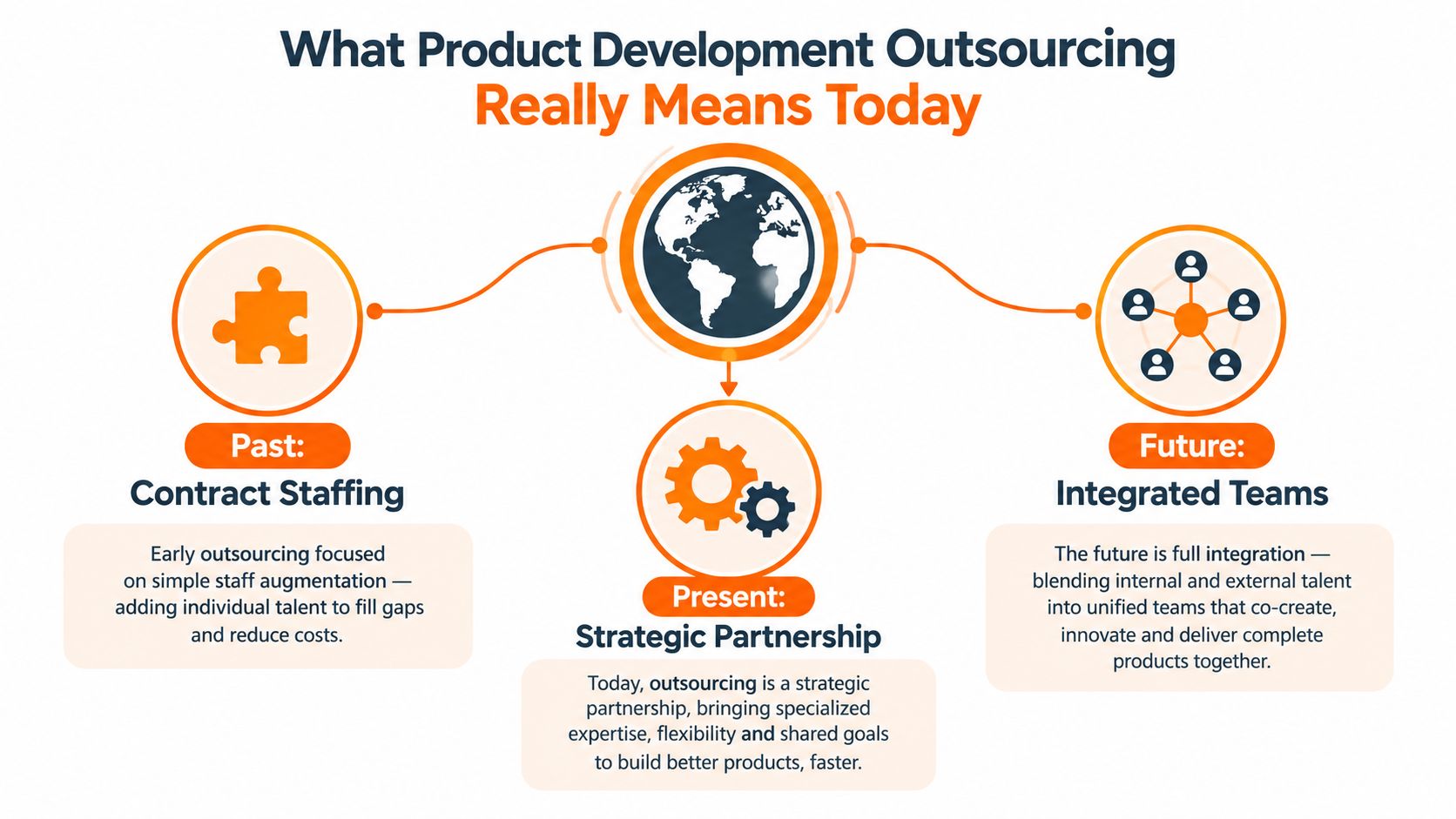
Staff augmentation is the narrowest option. You retain product management, architecture, prioritisation, and delivery accountability, while the partner supplies specific roles. It works when your internal leadership is strong and the problem is a temporary skills or capacity gap.
Managed delivery gives the partner responsibility for a defined stream or outcome. You agree scope, acceptance criteria, governance, and quality expectations, while the external team manages execution. This fits a feature area, a platform migration, or an MVP with a clear product owner on your side.
Full product ownership extends that responsibility across discovery, design, build, release, and iteration. You still own the business strategy and final decisions, but the partner operates as an integrated product engineering function. This is useful when you need a complete delivery capability without creating every role internally.
The right model depends on your internal decision-making, the uncertainty of the product, your compliance obligations, and how much ownership you want the partner to carry. A nearshore versus offshore comparison can help clarify the geographic choice, but geography alone won't create a reliable operating model.
Practical rule: If a partner can describe its team only by job titles, keep asking. You need to hear how those people will improve a business result.
The engagement model determines how quickly you can act, how much control you retain, and where accountability sits. Rate cards matter, but they shouldn't lead the decision. A cheaper team that creates rework, delayed decisions, and weak documentation can cost more in lost momentum than a senior team with a higher day rate.
Nearshore delivery places the team in a nearby country or region with useful time-zone overlap and closer working practices. For UK SaaS companies, nearshore Europe can provide real-time collaboration, access to specialist engineering talent, and a practical balance between cost and control. Poland is particularly relevant for buyers seeking European product engineering capacity, though the proposed team's seniority and continuity matter more than its location alone.
Offshore delivery can provide broad access to engineering capacity and extended working coverage. It can suit well-documented work with strong internal architecture and disciplined asynchronous communication. The trade-off is greater coordination effort, especially when product decisions require rapid discussion.
Dedicated teams create a stable, cross-functional group aligned to one product or portfolio. They suit scale-ups that need continuous delivery, want to retain product ownership, and expect the team to become familiar with their domain, codebase, customers, and operating practices.
Build-Operate-Transfer is designed for organisations that want to establish their own long-term capability. A partner helps create a delivery centre, recruit the team, establish operations, and then transfer the capability into the client's organisation. For more detail on this route, see this guide to the Build-Operate-Transfer model.
Independent UK-focused industry coverage reports that nearshore software development can reduce labour costs by 30% to 50% versus domestic hiring, with Eastern Europe averaging about 40% annual savings and sometimes reaching 70% per employee. The same coverage says typical developer fees in Poland can run about 40% below comparable UK contractors. Nearshore software development trends for UK buyers makes the financial case, but those figures should be evaluated alongside quality, speed, retention, management overhead, and security.
| Engagement Model | Control and Collaboration | Speed and Scalability | Best Fit Scenario |
|---|---|---|---|
| Nearshore team | Strong collaboration through geographic and cultural proximity, with your product leadership retained | Fast ramp-up and practical scaling | UK SaaS teams needing senior capacity and frequent product interaction |
| Offshore team | Effective with explicit documentation, architecture ownership, and structured handovers | Broad access to capacity, but coordination can require more discipline | Stable, well-defined workstreams with mature governance |
| Dedicated team | High continuity and strong domain familiarity, with shared ownership across the product | Scales around a product roadmap rather than isolated tickets | Scale-ups building or extending a product over time |
| Build-Operate-Transfer | Starts with partner-led setup, then moves towards client-owned capability | Useful for establishing a lasting R&D centre | Enterprises or growing companies planning a strategic engineering presence |
| Staff augmentation | Maximum internal control, but your team manages all coordination and delivery | Quick access to individual skills | Short-term gaps, specialist work, or an established delivery organisation |
Choose nearshore when decision speed and collaboration are central. Choose offshore when the work is structured and your governance can absorb the coordination. Choose a dedicated team when the product needs continuity. Choose Build-Operate-Transfer when outsourcing is a deliberate route to building an internal centre, not just a way to complete the next release.
Outsourcing creates value when it improves a business constraint. It can help a team release a validated product sooner, access senior expertise for an architectural decision, reduce the queue for customer-facing work, or modernise safely without overloading internal staff. More pull requests do not prove progress. A useful outcome connects delivery activity to a business decision.
With external delivery now a standard operating model, the priority shifts from market size to predictability. Leaders need to see whether an outsourced team is reducing uncertainty, protecting quality, and building enough product knowledge to keep ownership inside the business.
A capable partner can provide senior product engineering judgement, specialist skills, flexible capacity, and AI-supported delivery. AI can review requirements for ambiguity, identify dependency patterns, support test coverage, summarise delivery signals, and surface risks earlier. It works like an early-warning system, not a substitute for accountable product or engineering leadership. The leadership team still makes the trade-offs. It gets better information sooner.
Nearshore dedicated teams can strengthen this control through frequent collaboration and shared product context. A Build-Operate-Transfer approach can extend it further by establishing delivery capability that eventually sits with the client. In both cases, the aim is a faster route from MVP to scale without turning ownership into a vendor dependency.
The risks require the same operational clarity:
Before signing, use this resource to compare outsourcing risks and rewards. Convert each identified risk into an owner, a control, and a review point.
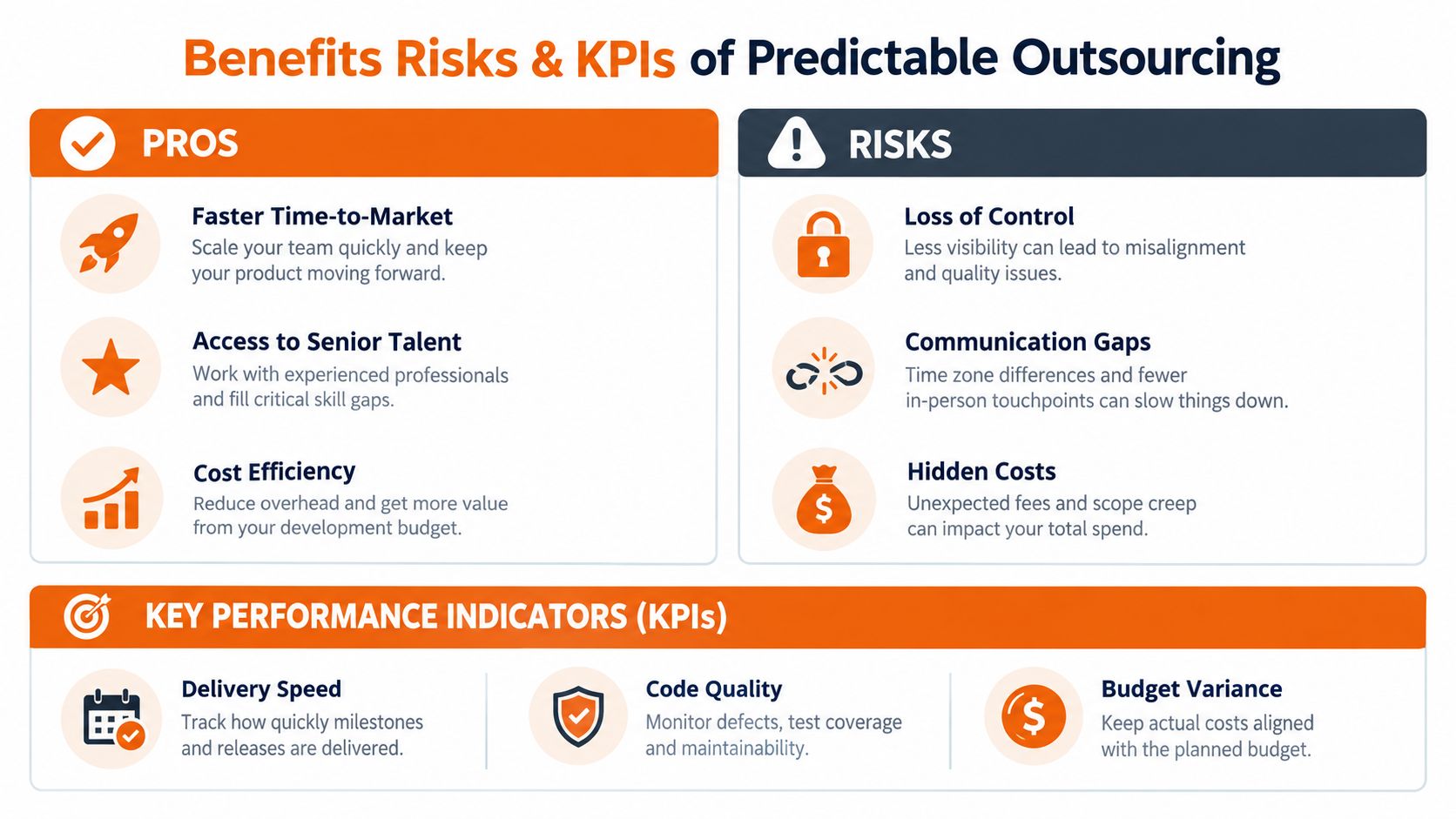
Use a compact scorecard that combines early warnings with delivery outcomes:
Review delivery signals frequently, product outcomes at roadmap checkpoints, and commercial performance against the agreed model. The software delivery metrics guide can help the team choose measures that prompt action instead of decorative dashboards.
A predictable team does not hide uncertainty. It makes uncertainty visible early enough for leaders to act.
Selection should start with the business need, not a supplier shortlist. A UK government G-Cloud listing for an outsourcing consultancy describes services including Business Needs Analysis, Strategy Development, Business Case creation, Procurement, and Implementation. This government marketplace service description reflects the right sequence: establish value and delivery design before choosing execution capacity.
Define the outcome. State the customer or business problem, the target users, the product constraints, the decisions your team owns, and what evidence will show progress. “Build the platform” is not a useful brief. “Enable a customer to complete the core workflow reliably and measure where they abandon it” gives the team a direction.
Test product thinking. Ask shortlisted partners to challenge the scope. Look for questions about user behaviour, release sequencing, architectural risk, supportability, and commercial value. A partner that accepts every assumption without investigation may be easy to hire and difficult to manage.
Inspect the actual team. Meet the proposed product lead, technical lead, engineers, designer, and QA specialists. Review examples of comparable work, but focus on how the team made trade-offs, handled failure, documented decisions, and responded to changing evidence.
Model total cost. Compare more than day rates. Include discovery, management, onboarding, security reviews, tools, environments, travel, handover, maintenance, and the cost of internal time spent coordinating the engagement. Ask which assumptions would change the price and how scope changes will be approved.
Make ownership contractual. Specify IP ownership, confidentiality, access rights, security responsibilities, acceptance criteria, team continuity, exit assistance, documentation, and decision rights. If your agreement doesn't explain what happens when delivery goes off track, it isn't finished.
During onboarding, give the team a product narrative, customer evidence, architecture overview, environments, repositories, delivery history, and a named decision-maker. Establish one shared backlog, one definition of done, a demo rhythm, an escalation route, and a written decision log. The partner should contribute to these working agreements rather than merely receive them.
The first delivery cycle should validate collaboration as well as software. The team needs to show that it can clarify ambiguity, raise risk, produce a usable increment, respond to review, and leave behind evidence another engineer can understand. That is where Extreme Ownership becomes observable behaviour, not a slogan.
A partner such as Rite NRG can support dedicated teams, end-to-end platform development, technology and delivery consulting, and Build-Operate-Transfer R&D centre setup in Poland. Its model also includes AI-supported recruitment, delivery, and operational workflows, with team integration described as taking 1 to 2 weeks in the publisher information. Treat that as a capability to validate during your own discovery, not as a substitute for clear scope and governance.
Speed is useful only when the product can operate safely in its target market. Outsourced development therefore needs a control framework that covers who owns the work, who can access the data, where processing occurs, and how acceptance is proved.
UK public-sector policy has moved towards tighter controls over offshore development and data processing. Central government standard security schedules published on 1 October 2024 added stronger requirements for data offshoring, greater buyer transparency about where data is hosted and processed, and stronger remedies when suppliers ignore location or security constraints. The parliamentary record on public procurement and data offshoring shows why data-flow mapping must happen before development begins.
Map each category of data through development, testing, support, analytics, and production. Decide which information can be used by developers, whether test data must be anonymised, where cloud services process it, and which subcontractors can access environments. Record those decisions in architecture and security documentation, then attach them to contractual controls.
Protect intellectual property through clear assignment language, confidentiality terms, repository access rules, invention ownership, and exit obligations. Founders who need a practical starting point can use this guide on IP protection for founders alongside advice from qualified legal counsel.
For complex public-sector work, the Digital, Data and Technology Playbook defines four delivery models, insource, bridge, borrow, and outsource. The Model Services Contract is intended for high-risk or complex services contracts and is used for contracts over £20 million. The government DDaT Playbook connects procurement choice with governance, milestones, and formal accountability.
Apply the same discipline to private-sector product work at an appropriate scale. Define acceptance criteria that can be tested, create security gates before sensitive access, review supplier changes, and maintain a practical exit plan. Governance shouldn't slow delivery. It should prevent late discovery of problems that would stop delivery altogether.
A SaaS founder with a validated idea may use a nearshore dedicated team to combine product discovery, UX, engineering, and QA around one measurable MVP outcome. The founder retains customer and commercial ownership, while the partner supplies the senior capacity needed to make sound technical decisions and release in focused increments.
A scale-up modernising a legacy platform may keep architecture and domain leadership internally, then use a dedicated external stream for migration, automated testing, and new service development. The critical success pattern is transparent collaboration. The team agrees what can move independently, what needs approval, and how it will protect customers during the transition.
An enterprise planning a longer-term engineering presence may choose Build-Operate-Transfer. The partner establishes the R&D centre, supports local hiring and operations, creates delivery routines, and prepares the capability for transfer into the client's organisation. That route turns outsourcing into a controlled path towards internal ownership.

Start by writing one outcome-led brief, then test it with partners that can challenge your assumptions. Choose the engagement model that preserves the control your product needs, validate collaboration through an early delivery cycle, and track speed, quality, predictability, and customer value together.
Rite NRG provides senior nearshore dedicated teams, end-to-end product development, technology and delivery consulting, AI-powered delivery processes, and Build-Operate-Transfer R&D centre services in Poland. Visit Rite NRG to discuss the product outcome you need to deliver and design a delivery model that keeps ownership and speed together.
/ about the author
Written by the RITE NRG editorial team — the architects, engineers and delivery leads who build and operate AI-era software for our clients.
Strategy & Transformation
A practical, finance-ready framework for comparing AI and modernization investment with the current-state cost, realistic benefits, delivery risk and time to value.
AI Consulting & Automation
A practical framework for choosing and deploying transport or logistics AI agents around real exceptions, reliable data and controlled operational authority.
Industry Solutions
A practical roadmap for improving manufacturing systems and introducing AI without destabilising production, data integrity or operational control.
More guidance: all insights articles
We can help you apply this thinking to the systems and teams you actually have.