

Strategy & Transformation
How to Calculate ROI for AI and Software Modernization
A practical, finance-ready framework for comparing AI and modernization investment with the current-state cost, realistic benefits, delivery risk and time to value.
operationalwrocław--:-- cet
∕ insights / fixed-price-software-development.md
Fixed Price Development
Learn how fixed price software development works, from scope and pricing to risks, delivery models and when it fits your project.
>_article.meta

You have a number. Not a range, not a spreadsheet with three scenarios, one approved figure. There's a launch date your investors already know about, and a product that has to work when it lands.
That's the position most SaaS founders and product leaders are in when they start looking at fixed price software development. The budget isn't a negotiating stance. It's what exists.
The trouble is that most fixed-price conversations start with the price and never reach the outcome. What you're buying is a production release that behaves in a specific way, on a specific date, with evidence that it works. Everything else is detail that decides whether the number holds or grows.
Say you're a SaaS founder with a term sheet in progress and one constraint you can't argue with. The MVP needs to be live, in front of real users, before the next funding conversation. You have one number to work with, and you need somebody to commit to it.
Fixed price software development means the client and the supplier agree a defined scope, a fixed sum and written acceptance criteria before development starts, so the supplier carries the cost risk if the work takes longer than planned. You buy a finished outcome, not a stack of hours.
Think about building a house to agreed plans for a set sum, compared with renovating room by room and paying a builder for every hour on site. The first gives you a date and a number. The second gives you flexibility and a bill you can't forecast. Neither is wrong. They answer different questions, and confusing them is how budgets break.

Most of these decisions get made exactly there, at a desk with a proposal open and a laptop beside it.
The price covers the agreed features, the quality bar you signed off (performance, security, accessibility, test coverage), the environments the release runs in, handover of code and documentation, and the warranty window written into the agreement.
It does not automatically cover new requirements, discovery questions nobody resolved before signing, third-party outages in systems you own, or post-launch feature requests. Those are separate conversations with separate prices.
The three questions that decide your project: what does done mean in testable terms, what's excluded from the scope, and how is a change priced and approved?
Get clear answers to those three and you can say in one sentence what you're buying. Anything still fuzzy is a decision you own, not a discount you've negotiated.
Delivery models compared
| Criterion | Fixed Price | Time and Materials | Dedicated Team |
|---|---|---|---|
| Budget certainty | High once scope is agreed | Low, varies with hours | Medium, set by team capacity |
| Who carries overrun risk | Supplier | Client | Client |
| Scope flexibility | Low, changes go through change control | High | High |
| Best fit | Clear, bounded release | Discovery and evolving products | Long product roadmap with ongoing priorities |
| Typical pricing | Fixed sum per agreed release | Hourly or daily rates by role | Monthly fee by role and time |
| Client effort | Upfront specification and sign-off | Ongoing prioritisation | Ongoing product ownership |
Read the table as a map of who holds the risk, because that's the only column that changes your life. Fixed price moves overrun risk to the supplier. Time and materials keeps it with you and pays for that freedom in budget variance. A dedicated team spreads it across a longer relationship, where your own prioritisation decisions drive the outcome.
Our own formats follow that logic. Rite NRG works through a Technology or Modernization Assessment at a fixed fee, defined software delivery at fixed scope and price, and a transformation program run as successive valuable releases. They're engagement formats, not productized packages, and we commonly price client-managed teams by role and time while managed teams may be priced by team capacity, service level, milestone, or a combination of stable capacity and outcome measures.
The strongest sequence for a fast-moving product is rarely one model for everything. Start with a fixed-fee assessment or roadmap so the unknowns get priced, not guessed. Then run the bounded release at a fixed price once scope is observable. Then treat the wider transformation as successive releases, each with its own fixed commercial boundary.
If you want the deeper comparison of when each of the two headline models wins, we've written about fixed price versus time and materials in more detail.
Warning sign for each model: fixed price on a product still being invented is a mismatch. Time and materials with no spending cap or review rhythm drifts. A dedicated team without a product owner generates activity instead of direction.
Pick one model for the release in front of you, not for the next three years.
Here's the mistake that sinks fixed-price projects before development starts. The scope is written as a list of screens or feature labels. "Invoice module. Dashboard. User settings." Each label looks precise and contains dozens of unstated decisions. Build starts, the gaps surface, and suddenly both sides are arguing about whether the missing behaviour was included.
That's structural, not bad luck. An empirical study of software contracts found that requirement specifications contain gaps in nearly every project, requiring customers and suppliers to exchange information during development to resolve ambiguity. The study's practical conclusion is that fixed price works when the contract controls requirements uncertainty instead of merely stating a lump sum.
Replace the feature label with a testable outcome. Instead of "invoice module", write "users can export up to 10,000 invoices to PDF in under three seconds on the standard environment". One sentence, one observable behaviour, one acceptance test that either passes or fails.
Change control isn't paperwork, it's the mechanism that keeps the price honest. Name one decision-maker on your side. Set a response-time target for clarifications so the team isn't blocked for days. Require a written impact statement with cost and schedule effect for every change. Then add a swap rule: adding scope means removing or deferring work of similar size.
Practical rule: set a formal requirements baseline before implementation, and treat every post-baseline request as a priced decision rather than a favour.
When discovery shows a requirement is technically impossible, legally constrained, dependent on an undocumented legacy system or materially harder than expected, the fixed price still guarantees the acceptance criteria you agreed. It never guaranteed an open-ended feature label. Your response is one of three: keep the outcome and change the implementation, defer the item under the swap rule, or re-baseline the release. Teams that also formalise how changes get approved and verified tend to catch the expensive ones early, and this write-up on reducing failed changes and cloud drift is a useful companion for that discipline.
Every fixed-price quote contains a forecast, and forecasts are wrong in predictable ways. The useful question is which parts are wrong more often.
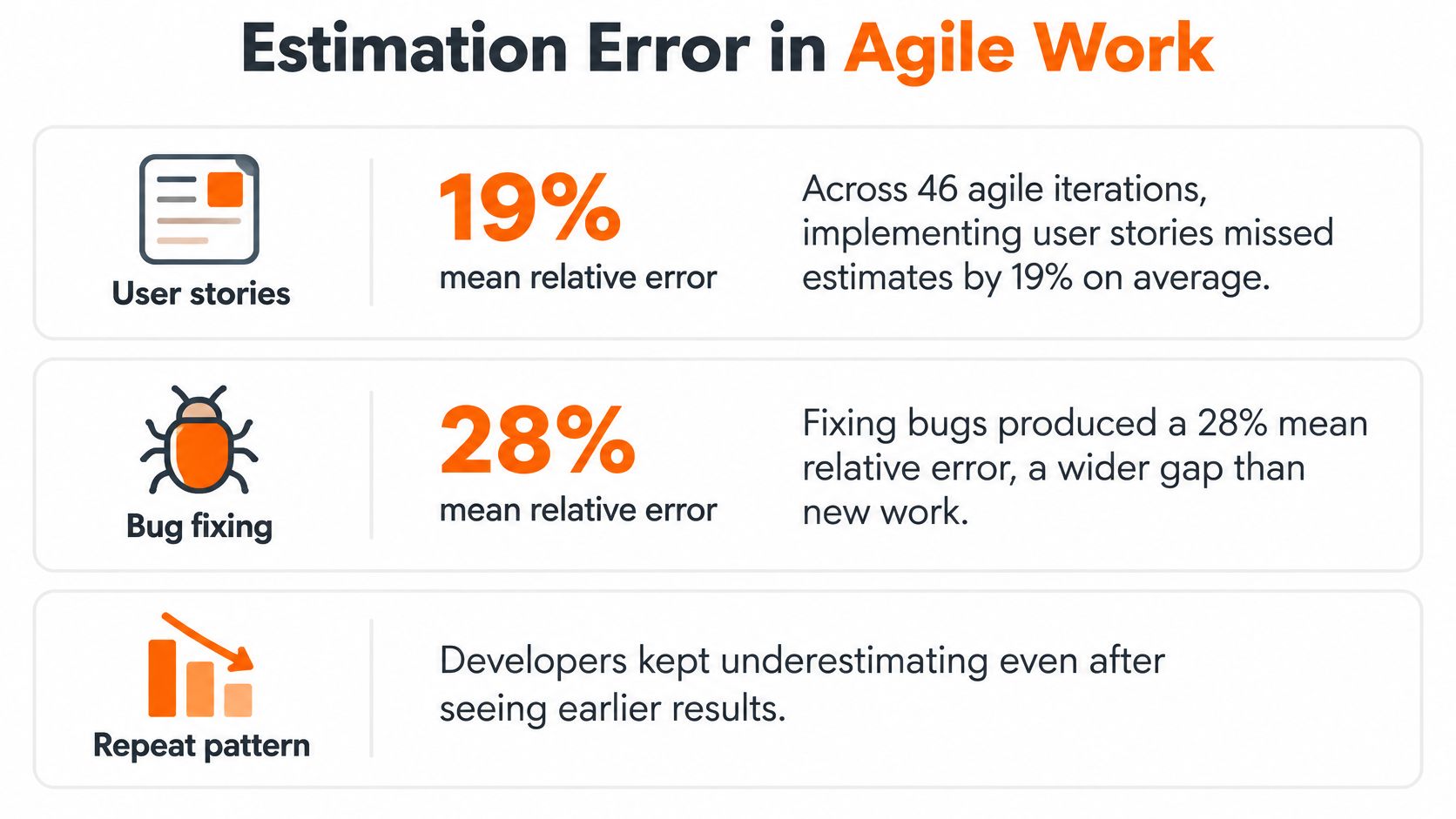
An empirical study of 46 agile iterations found the mean magnitude of relative error was 19% for implementing user stories but 28% for fixing bugs. The same study found developers kept underestimating effort, and that accuracy didn't automatically improve as they gained experience.
That single finding should change how you read a quote. New feature work and defect remediation have different uncertainty distributions, so a single undifferentiated fixed price hides the wider error bars in the bug column.
Estimate each capability separately, so the price reflects what each part requires. Reserve contingency for integration and defect correction, and put that reserve on its own line in the quote. A visible reserve is a professional signal. A reserve buried inside feature prices is a surprise waiting to happen.
Then define, in writing, whether these are included:
If you're weighing how suppliers build their numbers, the mechanics of a cost-plus approach explained by Chartsy are worth understanding, because a fixed price is a cost-plus model with the risk transferred and the margin set before the work begins.
Automated unit and integration tests, static analysis, API contract tests, threat modelling and staged demonstrations all expose rework while it's still cheap to correct. They also give you evidence to inspect at acceptance instead of a demo and a promise.
Here's how that discipline looks in practice on a delivery we run.
Three questions for any supplier: how did you split the estimate, where is the contingency and what's it for, and which tests prove the acceptance criteria before I pay?
A quote with the lowest number, no assumptions list, no visible reserve, no warranty terms and no test plan isn't a bargain. It's an unpriced risk with your name on it.
Order of work decides where the money goes. A peer-reviewed analysis of 5,392 IT projects completed between 2002 and 2014 across 66 countries, with a combined estimated value of roughly $56.5 billion, found that among the 4,677 projects with both estimated and final costs available, the median actual-to-estimated ratio was 1.0. Half finished at or below estimate. The mean ratio was 1.8, meaning the average project cost about 80% more than estimated, with a standard deviation of 8.5 and one project reaching around 280 times its original figure.
That spread isn't an argument against fixed price. It's an argument for sequencing the work properly, because when the supplier carries the overrun, every unresolved unknown becomes expensive.
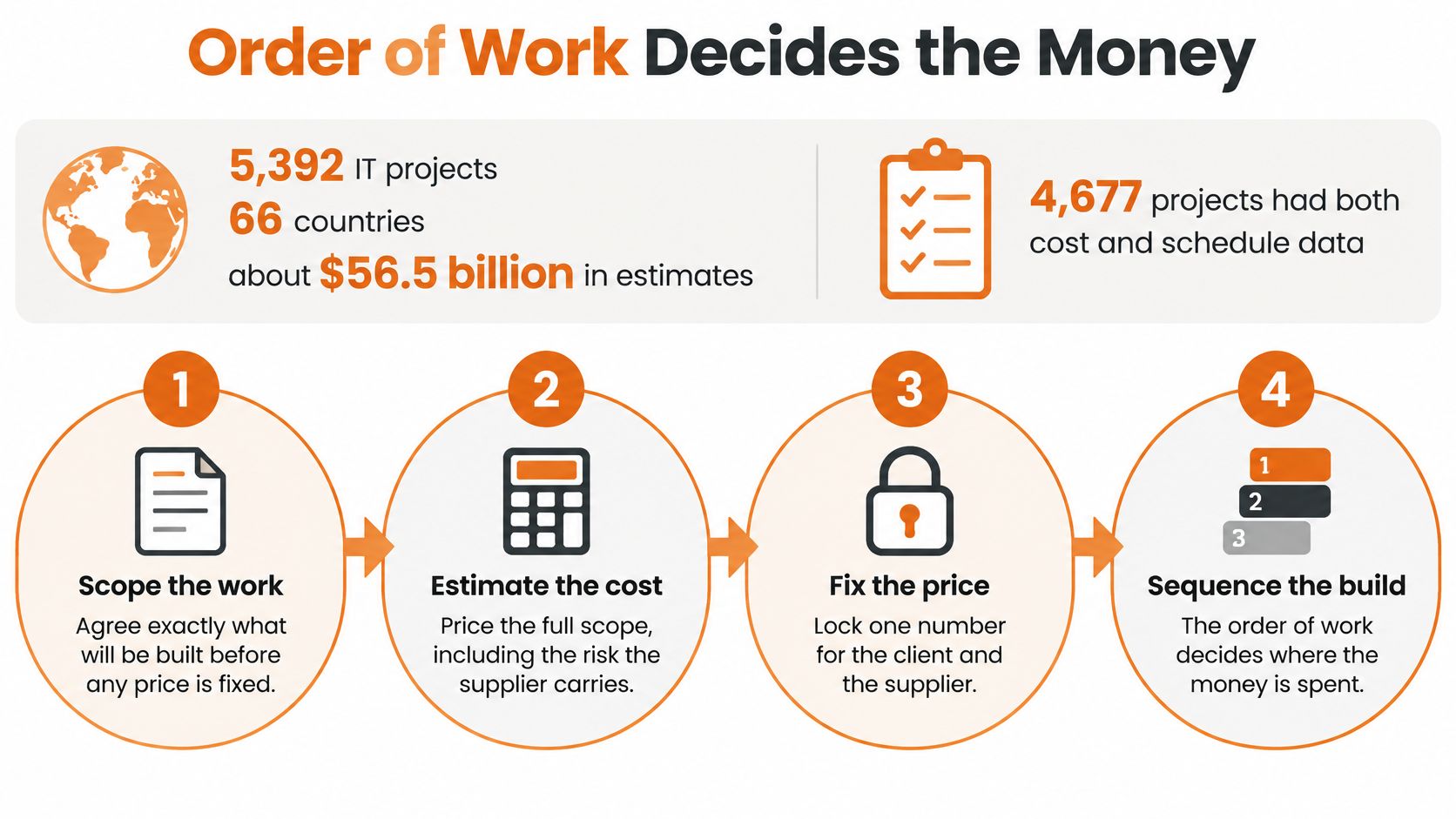
Run the sequence below only after the commercial model, the scope sheet and the price lines are settled.
Defined software delivery is exactly this packaged as a commercial commitment, fixed scope and fixed price against acceptance criteria. For qualified scopes, Rite NRG delivers the agreed production release within 45 working days, with fixed scope, fixed price and engineering for handover.
The evidence that this works sits in the discovery step. On an AI-powered SaaS built with Swedish founders, a three-month discovery phase trained a custom model that reached 80% accuracy recognising water pipes from 2D drawings, cutting construction installation estimates from weeks to minutes. The discovery wasn't overhead. It was the reason the delivery could be priced and committed.
A fixed price is useful when the outcome can be tested, the unknowns are contained, and both sides agree what counts as acceptance. Use the readiness test below before treating a quote as a reliable commitment. A low price cannot compensate for unresolved requirements or decisions that arrive too late.
Fixed-price readiness test
| Readiness Area | Ready for Fixed Price | Red Flag to Fix First |
|---|---|---|
| Requirement maturity | Core workflows written and agreed | Ideas still changing every week |
| Integration unknowns | Systems documented and access confirmed | Undocumented legacy system or unknown APIs |
| Decision latency | Named decision-maker who answers within agreed days | Decisions wait on several committees |
| Acceptance evidence | Testable criteria for each feature | Works as expected with no test defined |
| Contingency ownership | Reserve and exclusions written into the contract | No one owns the risk after signing |
| Post-launch plan | Support, warranty and handover agreed | Launch is treated as the end of the contract |
Score yourself row by row. One or two red rows are manageable, but if three or more come back red, run a discovery phase or a phased engagement before negotiating the price. A paid modernization assessment can establish the current architecture, data, integrations, risks and business objective, then recommend what to retain, refactor, rebuild or replace.
When the fit is right, fixed price gives the buyer a known budget and a supplier clear responsibility for an agreed outcome. It also rewards careful planning before code is written. Launch dates become easier to discuss when they follow from a defined scope rather than being announced before the work is understood.
The trade-offs are just as real. Flexibility drops once scope is signed, and a change request can bring extra cost and delay. If the supplier cannot assess a material risk, the quote may include a premium to cover uncertainty. Give both sides better information instead. Unfamiliar technology in the stack can increase uncertainty, so assess it before committing to a fixed outcome.
A historical analysis by the U.S. Department of Defense records that Congress used Section 8118 of the Defense Appropriations Act to bar fixed-price contracts above $10 million for development of major systems, reflecting the problem of treating uncertain development as a fully specified purchase. The same principle applies at smaller scales: fixed price suits a bounded release, not an unscoped transformation. Larger transformations can run as successive fixed-scope phases, while sustained delivery capability can be provided by a managed team on a monthly fee.
AI makes the boundary even more important. McKinsey estimated that generative AI could create productivity value equivalent to 20% to 45% of current annual software-engineering spending, mainly by reducing time spent on drafts, correction, refactoring and system design. The gains are uneven, falling below 10% on tasks developers consider highly complex, such as work in unfamiliar frameworks. Treat possible AI speed as room for stronger analysis and testing, not as a reason to promise more scope.
Use AI when it creates measurable value, and conventional software when that is simpler, safer or more economical. The quote should also state who owns the system after launch, including security review, test maintenance, documentation, observability, dependency management and technical-debt remediation. The 2025 Stack Overflow Developer Survey reports that 84% of respondents are using or planning to use AI tools, up from 76% the previous year. Those obligations are part of a maintainable outcome, not optional extras.
A release date alone cannot prove that a fixed-price project succeeded. Check whether the software reached production, whether it works reliably, and whether your team can maintain it after handover. A team can ship frequently and still create risk if each release needs emergency fixes.
Delivery measures to track on a fixed-price release
| Metric | Elite performers | Low performers | What it signals |
|---|---|---|---|
| Change lead time | Shorter time from commit to production | Longer time from commit to production | How quickly a code change reaches production |
| Change failure rate | Fewer deployments require intervention | More deployments require intervention | How often a deployment needs a rollback or hotfix |
| Change-failure band | Stronger production stability | Weaker production stability | Whether releases are reaching users without disrupting service |
DORA defines change lead time as the time between a code change being committed to version control and its successful production deployment. It defines change failure rate as the share of deployments that require immediate intervention, such as a rollback or hotfix. These definitions focus the conversation on how changes move into production and what happens when they get there. DORA research also compares software delivery performance across different levels, without making a single benchmark a substitute for your own baseline. See the 2021 DORA report.
Set a baseline at kickoff, then review both measures during each sprint. If lead time rises, inspect the delivery pipeline and decision process for delays. If change failures rise, check whether testing or release controls are being skipped. Agree who will investigate, what evidence they will review, and how changes to the delivery plan will be handled. A metric is useful only when it prompts a decision.
Set a baseline at kickoff and review it every sprint. A team that meets the release date by deferring tests has not delivered the outcome you paid for.
Treat understandable code, documentation, deployment assets and knowledge transfer as delivery work, not closing administration. For an AI-enabled system, agree on controls before development begins. These can include security boundaries and access control for models and data, human approval steps with explicit exception handling, and auditability of decisions, prompts and actions. Include evaluation, monitoring and model operations after launch as well.
Choose a business measure alongside the technical measures, and define how the team will assess it. This keeps the discussion tied to the reason for the project, not just whether the software was delivered. The guide to measuring project success can help align business and technical measures.
Do this while the scope is still yours to shape. A change made before signing is easier to assess and agree than one made after delivery has started.
A fixed price is only as dependable as its scope, acceptance criteria and decision speed. Rite NRG aligns scope, architecture and commercial responsibility, with production ownership and maintainability built into its software consulting and engineering services. For a straight answer on whether your project is ready for a fixed-scope release, visit Rite NRG and book the free 30-minute scoping call.
/ about the author
Written by the RITE NRG editorial team — the architects, engineers and delivery leads who build and operate AI-era software for our clients.
Strategy & Transformation
A practical, finance-ready framework for comparing AI and modernization investment with the current-state cost, realistic benefits, delivery risk and time to value.
Technology Talent & Teams
A decision-maker's guide to IT partnership models: what each model actually transfers to the partner, what it costs beyond the rate card, and how to match the model to your situation.
AI Consulting & Automation
A practical framework for choosing and deploying transport or logistics AI agents around real exceptions, reliable data and controlled operational authority.
More guidance: all insights articles
Tell us about the system or idea behind this article. We tell you honestly if it is a fit — and what a fixed-scope delivery could look like.