

Strategy & Transformation
How to Calculate ROI for AI and Software Modernization
A practical, finance-ready framework for comparing AI and modernization investment with the current-state cost, realistic benefits, delivery risk and time to value.
operationalwrocław--:-- cet
∕ insights / fixed-price-vs-time-and-materials.md
Fixed Price Vs Time And Materials
Fixed price vs time and materials: see which contract protects budget, speed and flexibility, and when a phase-based hybrid is the safer software choice.
>_article.meta

You have a release date on the board, a budget your board already approved, and a product that will look different in eight weeks once real users touch it. Two partners send proposals. One is fixed price. One is time and materials. The hourly rates land close enough that cost isn't what separates them.
What separates them is who pays when the work runs long, who carries the cost-control job, and how fast you're allowed to change your mind. Choose badly and you either lock a moving target into a number that gets renegotiated anyway, or you hand your finance team an open invoice with no ceiling and a polite promise of weekly reports.
The contract should follow the uncertainty of the work, phase by phase. Fixed price where the outcome can be specified and tested. Capped time and materials where discovery, legacy systems or shifting priorities make a fixed number a guess. That's how we price at Rite NRG, and it's why we turn down scopes that can't survive a fixed number.
Buyers rarely arrive with a contract preference. They arrive with a date, a ceiling and a product that may still move. The commercial model decides whether those three facts hold together or pull apart. Pick a model that assumes stability you don't have, and every change becomes a negotiation that stalls delivery. Pick one that assumes nothing is knowable, and finance loses the ceiling it needs to release the funds.
Fixed price fits a bounded production release. Scope, interfaces, dependencies and acceptance tests are clear enough that an engineer can price the work and a lawyer can define done. Time and materials fits discovery, unknown legacy integration, incident work and a backlog that will be reprioritized after feedback. Most real programs need a hybrid, because both conditions exist in the same quarter, sometimes in the same team.
Fixed price versus time and materials at a glance
| Decision point | Fixed price | Time and materials |
|---|---|---|
| Scope certainty required | Stable scope, interfaces and acceptance tests | Unresolved or evolving requirements |
| Cost predictability | Agreed ceiling for the defined result | Open unless a cap or ceiling is added |
| Who bears overrun risk | Supplier, within the agreed scope | Buyer, above efficient use of hours |
| How change is handled | Formal change, repriced and approved | Reprioritized backlog inside the cap |
| Payment trigger | Milestone or accepted deliverable | Labor hours at agreed rates plus materials |
| Best-fit work | Bounded release with testable done | Discovery, modernization, incidents, moving product |
Where does the balance of practice sit? In U.S. federal procurement, fixed price is the default whenever requirements can be specified. The Government Accountability Office analysis found federal agencies used fixed-price contracts for an average of 63% of total contract obligations in each fiscal year from 2011 through 2015. In fiscal year 2015, defense agencies committed about 14% of obligations to cost-reimbursement, time-and-materials or labor-hour contracts, while civilian agencies committed about 8%.
Read those figures as a market signal, not a mandate. Buyers reach for fixed pricing when they can describe the result, and they pay for uncertainty inside the bid when they can't. That is precisely the trade you're making.
If you're still deciding what kind of relationship you want alongside the contract type, our guide to IT partnership models maps the shapes those relationships take.
Before anyone negotiates a rate card, name the row your next release sits in. If you can't name it, you're not ready to negotiate.
Two suppliers quote the same release and come back with very different numbers. The gap sits in how each contract type rewires the supplier's incentive to estimate well, to refuse bad scope early and to absorb surprises without drama. Under fixed price, the supplier's margin swings with estimation error. Unresolved technical risk doesn't disappear. It reappears as contingency, as narrowed scope, or as a change order six weeks into delivery.
Research on large enterprise-resource-planning programs points the same way: vendor profitability is substantially more sensitive to project conditions under fixed-price contracts than under time-and-materials work. Fixed price makes estimation quality and execution conditions matter more, and suppliers price that sensitivity into the bid.
That is the case for buying fixed price properly, with teeth in the contract.
The test we apply before quoting a fixed price: if nobody in the room can write the acceptance test, a fixed number is theater pretending to be budget control.
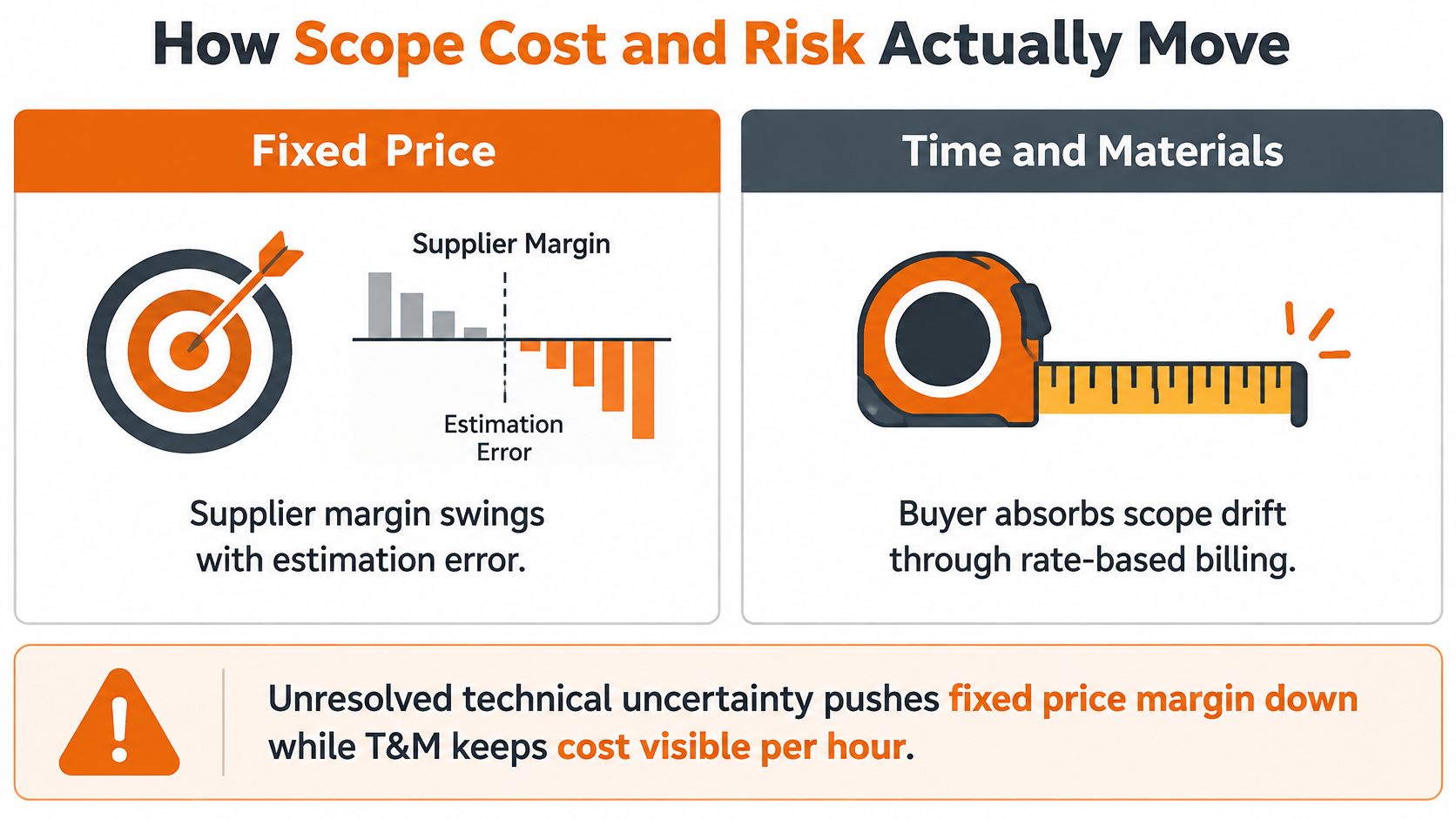
Flip the model and the responsibility flips. Time and materials removes the supplier's exposure to estimation error, and it makes stopping or replacing an underperforming team far easier. It also hands the buyer the cost-control job. 18F's agile software development solicitation guidance recommends time-and-materials or labor-hour contracting when requirements can't be defined well enough for firm-fixed-price procurement, and only alongside continuous quality measurement and a total-spend ceiling.
Federal buyers treat that flexibility as a selective tool rather than a default. GAO reporting on contract types shows civilian agencies relying on time-and-materials obligations at markedly higher rates than the Department of Defense, where this contract form stayed rare.
If you want a clean way to model what a delivery costs to carry, including the cost of financing an under-estimated fixed-price project, the AmbitionCFO cost model explainer separates cost structure into components you can compare side by side.
The performance difference is simple. Fixed price optimises cost predictability for a defined outcome. Capped time and materials optimises adaptability and learning when the outcome can't yet be specified precisely. Choose the one that matches what you're shipping.
The useful question isn't "fixed price or time and materials" for the whole program. It's which phase you're buying this quarter. Discovery, architecture, unknown legacy integration and early evaluation all carry unresolved uncertainty. Repeated delivery of a bounded component does not.
Phase-level pricing has official backing. The UK government agile contracting guidance recommends fixing price at the sprint or phase level rather than for the entire product, because time-boxed increments preserve budget control while letting priorities change after feedback. The same guidance is honest about the other side: time and materials supports reprioritization, but only with measurable outcomes, regular inspection and acceptance, transparent burn reports and preferably a not-to-exceed ceiling.
Contract model by delivery phase
| Phase | Commercial model | Evidence to enter | Done means |
|---|---|---|---|
| Assessment or discovery | Fixed fee | Question and access to systems are bounded | Roadmap, architecture, risks and budget assumptions |
| Bounded production release | Fixed scope and fixed price | Interfaces, dependencies and acceptance tests are written | Accepted production increment |
| Changing validated backlog | Capped time and materials | Outcome and ceiling are agreed | Inspected increments inside the cap |
| Sustained delivery capability | Monthly capacity fee | Leadership, capacity and notice are defined | Prioritized throughput and service levels |
A technology or modernization assessment, roadmap or architecture review is bought at a fixed fee, and it should end with the artefacts a fixed-price release needs: goals, roadmap, system architecture, tech stack, team composition, QA scope and the assumptions behind the budget. That document is what lets the next phase be priced accurately.
A defined software release is then bought at fixed scope and fixed price against agreed acceptance criteria. A larger transformation runs as successive fixed-scope phases, each one valuable on its own. For work that stays valuable but keeps changing priority, a managed team on a monthly fee fits better, with daily delivery leadership, hiring and replacement, and the quality system owned by the partner while the client keeps product priorities and business acceptance.
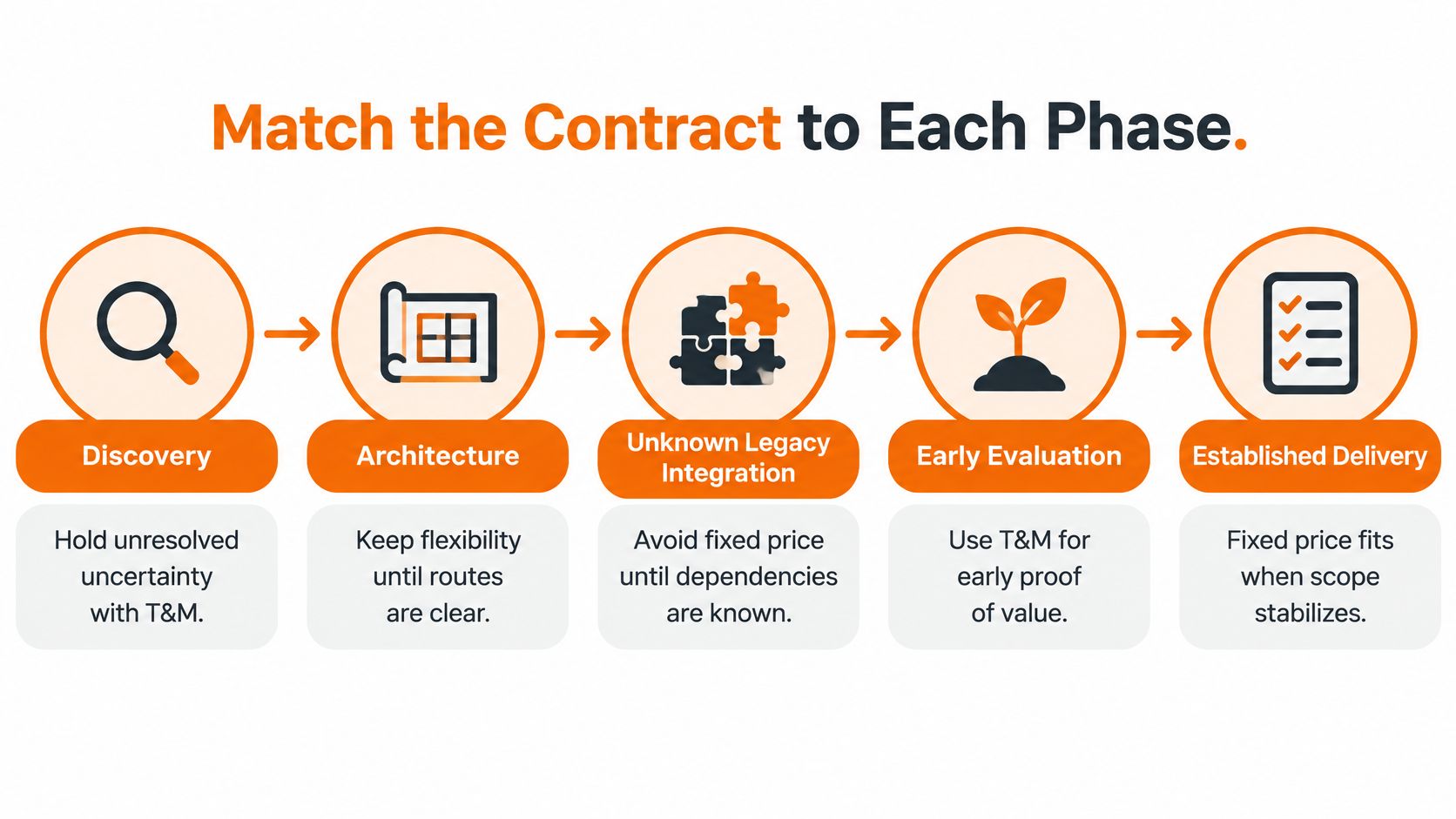
These are engagement shapes, not productized packages. The shape follows the uncertainty, not a catalogue.
The graduation test between phases is concrete: written acceptance criteria, owned dependencies and a documented set of assumptions that survived review. When those three exist, a fixed number is real. When they don't, you're buying an estimate dressed as a commitment.
Abstract comparisons get you nowhere. Five situations cover most buying decisions, and each one carries a clear recommendation and a single outcome worth protecting.
The SaaS founder with a known MVP surface. Integrations are stable, the core flows are mapped, and a launch date has already been announced to investors. Buy a fixed-scope production release. The outcome to protect is launch timing under a cost ceiling that does not move. Rite NRG prices this as a production release delivered within 45 working days, at fixed scope and fixed price, for scopes that pass qualification. It works because the scope is qualified before it is quoted.
The scale-up modernizing a legacy platform. Data quality and undocumented interfaces are the central risk, and nobody sees them until work starts. Buy capped time and materials rather than one fixed bid over an estate you cannot inspect. The cap governs spend while the team follows what the code does. The outcome to protect is reduced operational risk with a hard limit on the exposure.
The enterprise production rescue. The backlog is the incident itself. You need senior engineers inside the system this week, authorized to fix and ship. Buy time and materials with weekly acceptance and a named owner for each severity level. The outcome to protect is the restoration window, and every day spent writing a specification extends it.
The team that has validated the product. Stop rebidding every sprint. What they need is steady senior capacity, delivery leadership and predictable throughput, so move to a managed monthly team. In that shape the partner runs daily delivery leadership, hiring and replacement, and the quality system, while the client keeps product priorities and business acceptance. The outcome to protect is sustained capacity, which no milestone-based contract was designed to deliver.
The public-sector portfolio. Comparative research on public-sector software projects keeps surfacing the same pattern: time-and-materials engagements succeed far more often than fixed-price ones. Read that correctly. Fixed price fails when the scope was never fixed, so the finding warns against fixed pricing applied to unfixed scope. It does not prove open-ended billing is safer.
Copying another company's contract is the most expensive shortcut in procurement. Their uncertainty isn't yours, their dependencies aren't yours, and their acceptance tests were written for a different system.
The pattern across all five: name the business outcome first, then pick the mechanism that protects it. Faster time to market, lower total cost, learning speed, reduced operational risk or sustained capacity. For AI delivery, add one more outcome to the list: a verified result, priced on what the system proves rather than the hours it consumed. The contract serves the outcome.
Flexibility survives only when cost control is operational. A capped arrangement without a cadence is an open invoice with good intentions, and a fixed price without change mechanics is a dispute waiting for a date.
Start with mechanics already tested in federal contracting. Under FAR 16.601, a time-and-materials contract pays direct labor hours at specified fixed hourly rates that include wages, overhead, general and administrative expenses and profit, plus actual material cost. It must carry a ceiling price, the contractor exceeds that ceiling at its own risk, and the regulation requires surveillance so someone verifies efficient methods and effective cost controls are in use.
Copy that structure into a software statement of work.
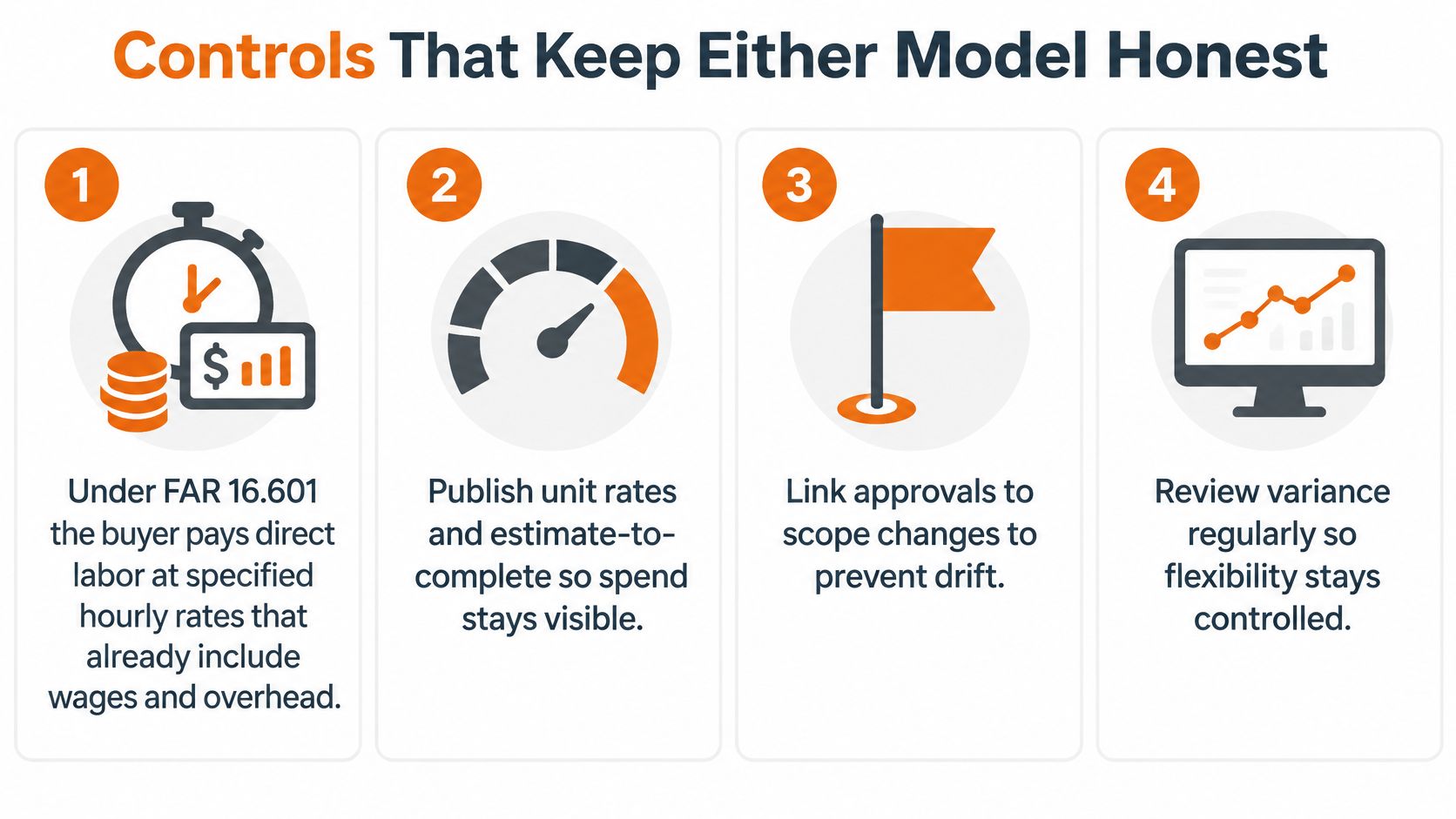
Fixed-price work needs the same discipline pointed at change instead of burn. Decide who proposes and approves a change, how changed work gets priced, how long a decision can take before the schedule shifts, which data the estimate relied on, and what happens if that data turns out wrong. Before signature, review the standard essential commercial contract clauses covering termination, liability and change, because those are where delivery arguments get settled.
On a capped engagement, weekly sprint planning is where the burn conversation belongs: what was accepted, what it cost, and what the remaining ceiling still buys. Keep uncertainty priced per phase, with named artefacts and acceptance tests for anything AI touches. One checklist before signature covers both models: ceiling, 85% trigger, acceptance owner, change approver, assumptions and the test that defines done.
AI changed the economics of delivery. It didn't change the standard of engineering, and it didn't remove uncertainty from the work. That distinction decides how you price it.
AI is now a normal operating condition rather than an experiment. The 2025 DORA research describes it as nearly universal in developers' toolkits (DORA report 2025). Which means every serious delivery partner is using it, and the interesting question is no longer whether AI is involved.

Here's the commercial problem. Generated code and documentation can expand faster than a team can review, secure, test and integrate it. Effort-based pricing assumes value tracks human hours, which stops being true when agents do the first pass. Volume-based pricing assumes value tracks output, which is worse, because unreviewed volume is a liability you'll pay to remove later.
Price named, testable artefacts instead. An evaluated model. A production integration. A migration tranche. A security-hardened release. Each one gets acceptance criteria and a fixed price, and each one is verifiable. Experiments where the data and the evaluation criteria are still moving stay on capped capacity, because a fixed number there just funds a guess.
The contract language matters as much as the number. Require human review responsibility to be named, not implied. Require security boundaries and access control for models and data, human approval steps with explicit exception handling, and auditability of decisions, prompts and actions. Require evaluation, monitoring and model operations after go-live, plus defect remediation obligations and clear ownership of reusable prompts or agent workflows.
Architects and engineers stay accountable for architecture, data, security, testing and production quality while agentic AI accelerates analysis, build, test and documentation. That accountability is what makes a fixed price safe to offer. We contract defined automation or AI system delivery as fixed scope and fixed price against agreed acceptance criteria, and we scope the proof work first, which is exactly what a structured proof of value is for.
One rule covers the whole category. Price verified outcomes. Buy flexible capacity only for the research still around them.
Decide the commercial model for the work in front of you, not for the whole program forever. Three questions settle it.
Can you write the acceptance test today? If the interfaces, dependencies and tests exist, buy that slice at fixed scope and fixed price. The date and the ceiling stay visible, and the supplier carries the estimation risk.
Is the rest discovery, modernization, incidents or a backlog that will move after feedback? Then cap the time and materials and name the outcome the cap protects. A cap without a stated outcome is just a slower overrun.
Does the need continue after the first accepted release? If you want ongoing senior capacity rather than another procurement cycle, move to a managed team on a monthly fee, but only once leadership, service levels, ownership and escalation routes are written down.
Refuse engagements that can't work. If a promised date can't survive the uncertainties you already know about, the honest answer during qualification is no. We'd rather say it in week one than discount a path into the wrong shape and explain it in month four. Extreme ownership means raising the risk the moment it becomes visible, and staying accountable for the whole result: readable code, documentation, deployment assets, handover and production quality, not only the tickets that got closed.
One more practical note before you sign. If your legal and finance teams are comparing redlines across proposals, this breakdown of data types for contract review workflows is a useful reference for structuring the comparison instead of arguing about formatting.
If you're weighing fixed price vs time and materials for your next release, bring us the business outcome you need, the uncertainties you already suspect and any date you've promised. In a free 30-minute scoping call we'll tell you whether it's a fit, which commercial shape we'd recommend for the next slice and what a fixed-scope delivery could look like, and we'll say so plainly if the timing or the project shape doesn't work. Start the conversation at Rite NRG.
/ about the author
Written by the RITE NRG editorial team — the architects, engineers and delivery leads who build and operate AI-era software for our clients.
Strategy & Transformation
A practical, finance-ready framework for comparing AI and modernization investment with the current-state cost, realistic benefits, delivery risk and time to value.
Technology Talent & Teams
A decision-maker's guide to IT partnership models: what each model actually transfers to the partner, what it costs beyond the rate card, and how to match the model to your situation.
AI Consulting & Automation
A practical framework for choosing and deploying transport or logistics AI agents around real exceptions, reliable data and controlled operational authority.
More guidance: all insights articles
Tell us about the system or idea behind this article. We tell you honestly if it is a fit — and what a fixed-scope delivery could look like.