
Strategy & Transformation
How to Calculate ROI for AI and Software Modernization
A practical, finance-ready framework for comparing AI and modernization investment with the current-state cost, realistic benefits, delivery risk and time to value.
operationalwrocław--:-- cet
∕ insights / documentation-best-practices.md
Documentation Best Practices
Documentation best practices for engineering and SaaS teams. Learn doc-as-code workflows, ownership, versioning, AI-assisted upkeep, and metrics that work.
>_article.meta
Teams rarely lose money because an engineer failed to write another page. They lose money because people can't trust the pages they already have. A stale runbook slows incident recovery, an incorrect API example creates failed integrations, and an undocumented architectural decision turns a small change into a risky investigation. The business result is predictable: slower delivery, more support work, lower engineering capacity, and greater production risk.
The popular advice about documentation best practices usually starts with templates, tools, headings, or information architecture. That advice is incomplete. Documentation is a reliability and delivery-control system. It needs an owner, a source of truth, a review gate, a version boundary, and evidence that it still matches the software.
AI makes this more urgent. Agents can draft documentation quickly, but they can also spread a plausible falsehood through every workflow that consumes it. Senior engineers still own architecture, data, security, testing, and production quality. The right operating model uses AI to increase delivery capacity while keeping engineering standards intact.
More documentation can increase risk when stale guidance remains searchable and appears authoritative. A wrong runbook is more dangerous than an explicit gap because an engineer may follow it with confidence during an incident. The same applies to an API example that no longer authenticates, an architecture decision that describes a retired dependency, or an onboarding page that sends a new engineer toward the wrong repository.
The central failure is usually cadence. Engineering teams may release weekly or faster, while documentation updates happen during a quarterly cleanup that never receives enough priority. The result is a growing archive of pages with no clear status, owner, or retirement rule. A knowledge base can look substantial while becoming less useful with every release.
An IEEE Software study of 323 IBM software professionals identified ambiguity, incompleteness, and incorrectness as the most severe API-documentation problems. Six identified problems were considered blockers that could make practitioners abandon an API, as documented in the IEEE Software study of API documentation failures. That finding should change how leaders fund documentation. The question isn't how many pages a team publishes. It's whether developers can rely on those pages to make correct decisions.
A documentation program needs capacity after launch. Someone must review public interfaces, test examples, update operational procedures, remove obsolete decisions, and answer questions about ownership. If the budget covers only initial writing, the organization is paying to create future confusion.
Use a knowledge-base guide such as this SubmitMySaas knowledge base guide to compare organizational approaches, but don't mistake platform selection for governance. A new tool won't fix a workflow that excludes documentation from pull requests or leaves stale content visible without warning.
Practical rule: If a page can influence production behavior, assign it an owner and a freshness policy before publishing it.
The first step is a blunt inventory. Identify which pages are normative, which are drafts, which describe historical context, and which should be archived. Then connect each critical document to the engineering change that can invalidate it. A migration plan should trigger updates to architecture decisions, deployment instructions, support guidance, and access responsibility maps in the same delivery stream.
This is also technical debt reduction. Teams should treat documentation drift as part of the wider technical debt reduction process, not as a separate editorial concern. When documentation contradicts executable behavior, engineers infer the system through experimentation or source inspection. That adds integration friction and increases the chance of incorrect client implementations.
The fix is not “write more.” The fix is to make documentation changes visible, reviewable, testable, and owned. Every page should answer four questions: Who maintains it? What system is authoritative? Which change invalidates it? What happens when it becomes obsolete?
Teams make poor documentation decisions when they classify everything as a “wiki page.” Different documents serve different readers, depend on different sources, and decay in different ways. Start with a taxonomy before choosing a repository or publishing tool.
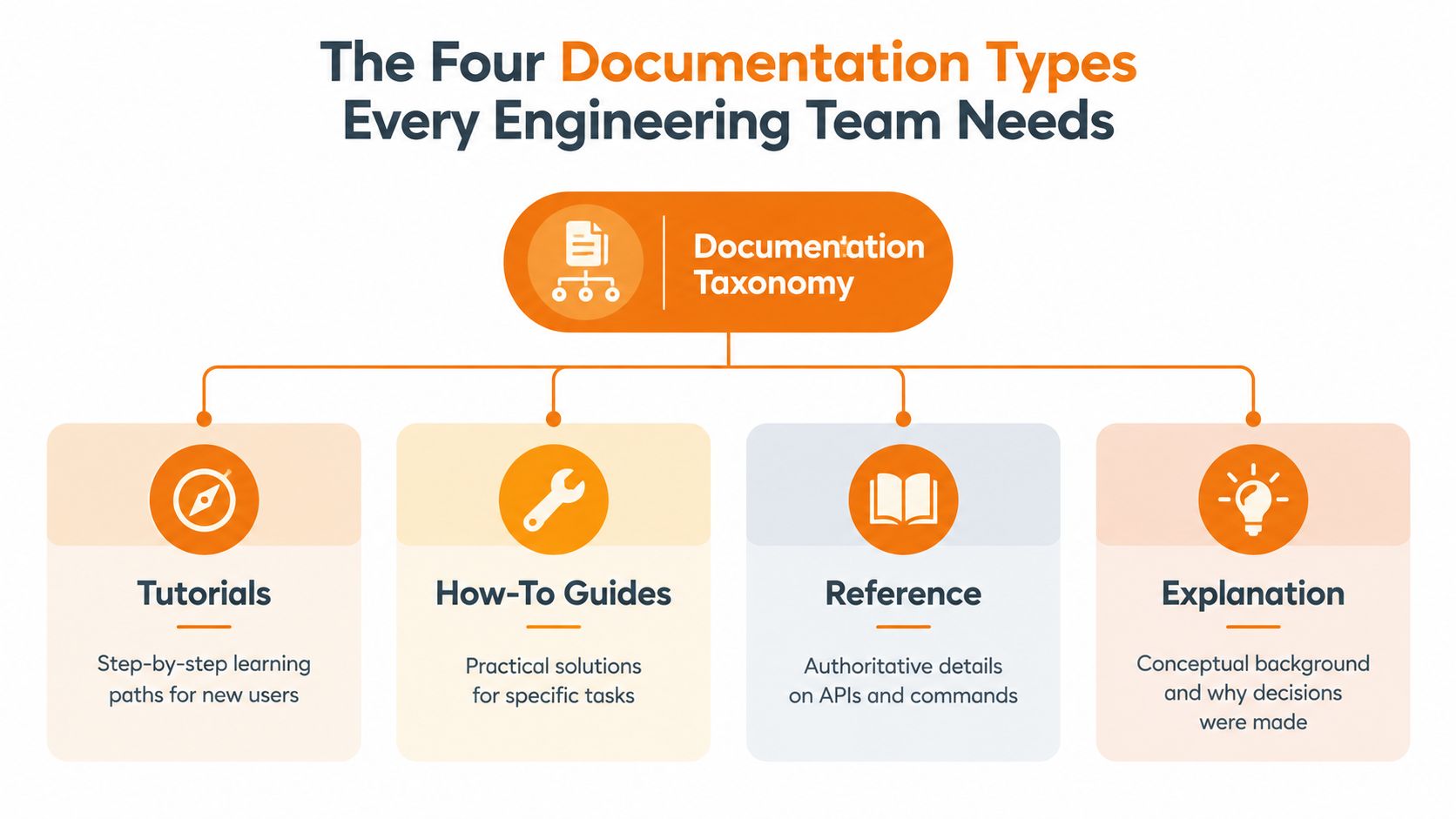
Product documentation helps customers accomplish outcomes. It includes tutorials for first use, how-to guides for specific tasks, conceptual explanations, troubleshooting content, and accessibility or security guidance. The product team owns the experience, but engineering must validate technical behavior when the content describes integrations, limits, permissions, or failure states.
Its source of truth is the product itself, supported by tested workflows and approved product decisions. Accuracy and findability matter most. Product documentation decays when interface changes ship without updating screenshots, navigation instructions, terminology, or expected results.
API references serve developers who integrate with your platform. They should describe endpoints, parameters, schemas, authentication, permissions, error semantics, rate behavior, version scope, and runnable examples. Generate reference material from an authoritative interface definition wherever possible. Manual prose belongs around the contract, not in place of it.
The API team owns the contract and its reference output. The most damaging decay pattern is contradiction, an example that looks valid but fails against the current service. Source code may be readable, but it isn't a substitute for a stable, explicit interface contract.
Runbooks guide production teams through diagnosis, mitigation, recovery, escalation, and verification. They need clear prerequisites, safe commands or actions, rollback conditions, ownership boundaries, and links to monitoring or incident records. The operations or platform team owns them, while service owners approve procedures that affect their systems.
Runbooks decay after infrastructure changes, ownership transfers, security updates, and incident learnings. A runbook that lacks a last-validation signal shouldn't be treated as authoritative during an outage.
Onboarding documentation helps new engineers understand how to work in the system. It should cover local setup, repository structure, deployment paths, testing expectations, domain concepts, team boundaries, and the decisions that explain unusual constraints. Architecture decision records belong here because new engineers need to know not only what the system does, but why it does it that way.
The relevant engineering group owns the content, with senior engineers accountable for accuracy. Its common failure is institutional memory loss. A page may explain the current design but omit migration hazards, data ownership, security assumptions, or the reason a seemingly simpler approach was rejected.
For teams that handle structured technical material, data type specifications for professionals can help establish precise terminology and consistent reference patterns. The ownership rule is simple: the team that can invalidate the document owns its maintenance.
Doc-as-code works when it borrows the useful discipline of software delivery without pretending every paragraph is executable. Put documentation in version control, review it beside the change it describes, and automate the checks that can detect factual drift.
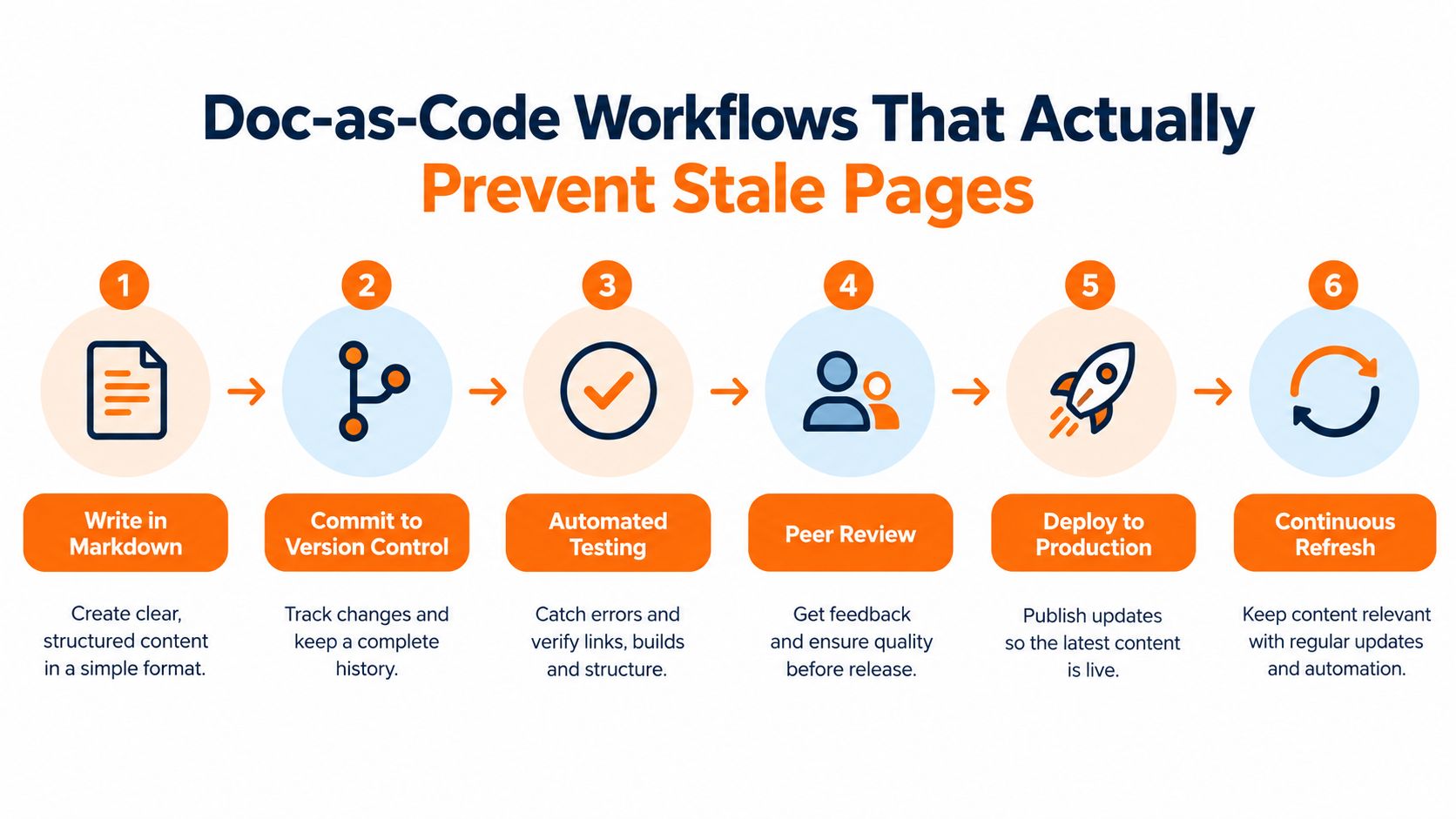
Start with a repository structure that makes ownership obvious. Separate product guidance, API reference, operations, and engineering decisions. Store versioned content with the product or service version it describes. Keep drafts distinguishable from normative material, and make archival status visible rather than redirecting every old page to a current one without explanation.
For API references, generate what can be generated from OpenAPI or another authoritative interface definition. Keep manually written explanations for behavior that the schema cannot express, such as workflow sequencing, business rules, error recovery, and security assumptions. Critical examples should run against a test environment or contract suite.
Documentation changes should travel in the same pull request as the implementation change whenever both are affected. That rule gives reviewers one place to inspect the code, interface, test evidence, release notes, and user impact. It also prevents the familiar failure where an engineer says the docs will be updated after release and nobody owns that follow-up.
Documentation CI should test more than spelling. Build checks around actual failure modes:
A stale page shouldn't remain authoritative without notice. Mark it as under review, attach a replacement, or archive it. The correct choice depends on the risk of continued use, but invisibility is not an acceptable policy.
Documentation CI should validate links, schemas, examples, authentication flows, and version alignment before release.
The delivery platform matters less than the controls. Your software delivery tools should make these checks easy to run beside tests and deployment validation, whether the documentation is published through a static site, an API portal, or an existing knowledge platform.
A useful workflow looks like this:
For teams adopting AI-assisted delivery, add one more gate. Reviewers must compare generated prose with executable behavior and tests. Plausible language is not evidence.
Documentation is a reliability control, not a writing exercise. AI-readable pages need explicit signals that separate current policy from historical context, normative instruction from discussion, and approved procedure from an unreviewed draft. Without those signals, an agent can retrieve convenient text instead of authoritative guidance.
Google Cloud's 2025 DORA research found that 64% of surveyed software professionals use AI for writing documentation, as reported in IBM's overview of AI-assisted code documentation. Stack Overflow's 2025 survey reported that 24.8% mostly use AI and 27.3% partially use AI to create or maintain documentation, according to the same source. AI lowers the cost of drafting. It does not establish ownership, accuracy, or approval.

Every document exposed to an AI system should include metadata that supports a reliable answer:
Atlassian's 2025 developer-experience research reported that 50% of developers lose more than 10 hours per week to inefficiencies, with finding information ranked as the top friction area. The Atlassian report also identifies fragmented repositories and permissions as contributing factors. Better retrieval can help, but uncontrolled retrieval can expose secrets or amplify obsolete instructions at higher speed.
AI can draft an API explanation, summarize an incident, or propose an onboarding page. Approval remains a human responsibility for security controls, production procedures, architecture standards, compliance decisions, and access instructions.
NIST's AI Risk Management Framework emphasizes stakeholder responsibilities and accountability, with human involvement for high-risk applications. Apply that principle to documentation. Name the architect, product owner, security lead, data owner, agent owner, approver, and production operator when content affects material system behavior.
For relevant AI systems, document testing procedures, trustworthiness measures, security tests, anomalous events, downtime, incident-response time, human oversight, operator overrides, reported errors, complaints, exceptions, escalations, and go or no-go decisions. These records give reviewers evidence instead of confidence based on fluent prose.
The engineering standard is direct: agents accelerate production, humans approve consequences. If generated documentation cannot be traced to executable behavior, tests, or an authoritative decision, label it as draft and exclude it from normative retrieval.
Documentation collapses when ownership is implied. A page may have three contributors and still have nobody responsible for correcting it after a release, a reorganization, or a service transfer.
A single dedicated owner creates consistency. One person controls standards, navigation, publishing, and review reminders. This works for a small product with a concentrated knowledge domain, but it fails when the owner lacks authority over engineering changes or becomes a bottleneck for specialist content.
A federated model assigns each domain team its own documentation. Platform owns deployment guidance, the payments team owns its API, and support owns customer workflows. This scales subject expertise, but it can produce inconsistent terminology, duplicated explanations, and gaps between domains.
A hybrid model combines central standards with distributed authors. A documentation lead defines metadata, publishing rules, accessibility expectations, archival policy, and CI requirements. Domain teams remain responsible for factual content. For most SaaS organizations with multiple services and an active AI program, this is the strongest default because it preserves accountability without centralizing every edit.
Use four decision criteria:
| Decision criterion | Single dedicated owner | Federated model | Hybrid model |
|---|---|---|---|
| Small team | Strong fit | Can be excessive | Useful when complexity is growing |
| Fast release cadence | Bottleneck risk | Strong domain response | Strong with shared CI |
| Regulatory exposure | Needs specialist review | Can fragment evidence | Clear standards plus accountable owners |
| Heavy AI usage | Central controls help | Retrieval governance may vary | Best balance of controls and expertise |
The choice must include funding. Maintenance belongs in team planning, release work, and operational ownership. It cannot depend on volunteer effort after the product ships.
A practical governance package contains:
ISO/IEC/IEEE 12207 identifies traceability across lifecycle artifacts, decisions, and deliverables as a core quality attribute, alongside configuration management and systematic documentation of decisions and designs. Apply that standard practically. A requirement should connect to a decision, implementation change, test evidence, deployment result, and operational owner.
RITE NRG includes architecture decision records, test evidence, deployment and operating runbooks, access and responsibility maps, technical documentation, and knowledge transfer in its technology consulting handover process. That model is useful when a consultancy, vendor, or internal team transfers responsibility because ownership becomes an explicit deliverable rather than an assumption.
The handoff test is simple. A new owner should be able to identify what is current, what is risky, what needs approval, and whom to contact without reconstructing the system from scattered conversations.
Page count is a vanity metric. A large documentation set can still leave engineers unable to deploy safely, resolve incidents, or understand a service boundary. Measure whether documentation improves the delivery outcomes leadership already cares about.
The DORA framework uses four outcomes: deployment frequency, lead time for changes, mean time to restore service, and change-failure rate. Documentation should help teams interpret and improve those outcomes, not create a parallel reporting exercise.
A delivery record can capture the release intent, affected services, test evidence, deployment owner, rollback condition, and observed result. Release notes can explain user impact and operational changes. Incident records can preserve what failed, how the team restored service, and which runbook or control must change. Architecture decisions can record the trade-off behind a shortcut before its consequences disappear from memory.
| Documentation artifact | Delivery outcome | Primary metric | Owner |
|---|---|---|---|
| Release record | Lead time for changes | Time from approved change to production | Delivery owner |
| Deployment runbook | Deployment frequency | Successful production releases over the chosen period | Platform owner |
| Incident runbook and review | Mean time to restore service | Time from detection to restoration | Service owner |
| Architecture decision record | Change-failure rate | Deployments requiring rollback or hotfix within the defined window | Principal engineer |
| API contract and examples | Integration quality | Failed example or contract checks | API owner |
Use the same definitions, measurement period, and ownership every time. A metric without those details invites misleading comparisons. Documentation should also preserve the decision context, so leaders can see why a team accepted a risk and whether the result matched the expectation.
The engineering efficiency measurement model is useful as a prompt to connect engineering activity with business capacity. The point isn't to pressure teams into shipping faster at any cost. It's to expose trade-offs early.
Faster delivery isn't a business win if change-failure rate or recovery time gets worse.
A platform team should review a small set of signals:
If the answer to the last question is yes, documentation should make that visible before the shortcut becomes normal practice.
A documentation improvement program needs exit criteria, not enthusiasm. Run it as an engineering initiative with named owners, visible risks, and a clear definition of done.
Start with an inventory of product documentation, API references, runbooks, and engineering onboarding material. Mark each artifact as current, uncertain, draft, or obsolete. Assign a named owner and reviewer to every critical document, then publish a freshness and archival policy.
Turn on basic CI checks for broken links, malformed schemas, missing version markers, and invalid documentation builds. The first exit criterion is visibility: leadership and engineering can identify the highest-risk pages, their owners, and the checks that protect them.
Generate API references from authoritative interface definitions. Add executable tests for critical examples, authentication flows, and schemas. Require documentation changes in the same pull request as relevant code or infrastructure changes.
Define AI-readable rules at this stage. Separate normative sources from drafts, attach provenance and effective dates, enforce access controls, and require human approval for security, architecture, compliance, and production-operation content. The exit criterion is a working path from change to reviewed, validated, version-aligned documentation.
Connect documentation artifacts to deployment frequency, lead time for changes, mean time to restore service, and change-failure rate. Review broken examples, unresolved TODOs, outdated version markers, and public-interface changes without corresponding documentation updates.
Archive or rewrite the pages with the highest operational risk. Publish the ownership table, RACI, freshness policy, and retirement rules. Review the first measurement period with engineering and business leaders, then choose the next improvement based on delivery evidence rather than page volume.
Start on Monday with one service, one owner, and one critical workflow. Build the controls around real changes, prove that the checks catch drift, and expand only after the operating model works.
Rite NRG helps SaaS and enterprise teams modernize systems, establish accountable documentation and handover processes, and use agentic AI without lowering standards for architecture, security, testing, or production quality. Visit Rite NRG to discuss a documentation and delivery-control program that fits your platform, team, and next release.
/ about the author
Written by the RITE NRG editorial team — the architects, engineers and delivery leads who build and operate AI-era software for our clients.
Strategy & Transformation
A practical, finance-ready framework for comparing AI and modernization investment with the current-state cost, realistic benefits, delivery risk and time to value.
AI Consulting & Automation
A practical framework for choosing and deploying transport or logistics AI agents around real exceptions, reliable data and controlled operational authority.
Industry Solutions
A practical roadmap for improving manufacturing systems and introducing AI without destabilising production, data integrity or operational control.
More guidance: all insights articles
Tell us about the system or idea behind this article. We tell you honestly if it is a fit — and what a fixed-scope delivery could look like.