

Strategy & Transformation
How to Calculate ROI for AI and Software Modernization
A practical, finance-ready framework for comparing AI and modernization investment with the current-state cost, realistic benefits, delivery risk and time to value.
operationalwrocław--:-- cet
∕ insights / technical-debt-reduction.md
Technical Debt Reduction
A practical guide to technical debt reduction for SaaS leaders. Measure debt, prioritize fixes with proven frameworks, and reduce delivery risk.
>_article.meta
Technical debt reduction is often treated as a cost center. That framing is wrong. CAST's 2025 analysis of more than 10 billion lines of code across 17 countries associated technical debt with 61 billion days of repair time, covering countries that represent 51% of global GDP. Deloitte's summary of the CAST analysis makes the business implication clear: even a modest reduction in repair work can release significant engineering capacity for product delivery, modernization, and reliability.
For SaaS companies, that capacity determines how quickly you can launch, respond to customers, pass security reviews, and support growth without multiplying operational costs. The practical question isn't whether your platform has technical debt. It does. The question is whether you manage it as a deliberate delivery strategy or allow it to dictate your roadmap.
This playbook takes a firm position: technical debt reduction belongs in product planning, financial decisions, AI governance, and executive accountability. The right operating model combines rigorous measurement, targeted modernization, AI-native engineering, nearshore capacity, and Extreme Ownership from senior technical leaders.
Technical debt is a delivery strategy problem, not a developer hygiene task. It consumes capacity that should produce customer value. Engineers decipher brittle integrations, repeat manual deployment work, compensate for weak data models, and avoid system areas that may fail under load. Product managers see slower releases, finance sees rising technology costs, and customers receive delayed or inconsistent service.
McKinsey reported that CIOs estimate technical debt at 20% to 40% of the value of their entire technology estate before depreciation. The same research found that 30% of CIOs believe more than 20% of the budget intended for new products is diverted to fixing debt-related issues. McKinsey's analysis of the technical-debt cycle puts debt alongside capital allocation, product investment, and modernization risk.
A SaaS leadership team should stop asking, “Can we afford a refactor?” Ask instead, “What does this system cost us every time we change it?”
Debt rarely arrives as one large invoice. It appears as recurring friction:
McKinsey's analysis of 220 companies across five geographies and seven sectors found that companies in the 80th percentile for Technical Debt Score had revenue growth 20% higher than companies in the bottom 20th percentile and 10% higher than average. The published analysis links software quality with commercial performance. Clean code does not automatically create revenue. Reliable systems give teams more capacity to deliver, adapt, and respond to customers.
Practical rule: Fund debt reduction where it increases delivery capacity, lowers material risk, or enables a strategic product move. Do not fund cleanup for aesthetic reasons.
Some debt is stable, isolated, and inexpensive to carry. Other debt sits on the path to revenue, customer data, security, or AI adoption. Manage the first category deliberately. Build a business case and assign an owner to the second.
That distinction changes the leadership conversation. “Give us two sprints to improve code quality” is weak. “Remove the architecture bottleneck delaying a major integration, unreliable releases, and senior engineering capacity” is concrete.
DXC's survey of 750 C-suite information and technology executives found that the top desired modernization outcomes were improving operating margins at 69% and increasing revenue at 68%. The DXC modernization report reinforces the business case. Modernization earns executive support when it connects to margin, revenue, resilience, and speed.
RITE NRG applies this model through senior accountability and proactive risk management. Architects and delivery leaders own the complete result, from architecture and data flows through security, testing, deployment, and operation. AI can accelerate implementation and nearshore teams can add delivery capacity, but Extreme Ownership remains with leadership. The accountable owner must make trade-offs visible, set the remediation target, and measure whether the work improves business performance.
Technical debt reduction needs an operating baseline, not a collection of opinions. “The platform feels fragile” may be accurate, but it does not tell a CFO what to fund, a product leader what to delay, or an accountable engineering owner what to fix first. Measurement turns architectural concern into a comparable business signal.
McKinsey's “gold standard” benchmarking approach measures debt as a share of IT spend, classifies applications by deployment type, and collects application metadata to build debt cost curves. McKinsey's technical-debt research also reports that about 30% of CIOs believe more than 20% of new-product budget is diverted to fixing technology debt. Use this approach to establish a baseline before proposing major remediation. The goal is business control, including the ability to see whether AI-native delivery, nearshore capacity, or additional tooling is reducing delivery friction.
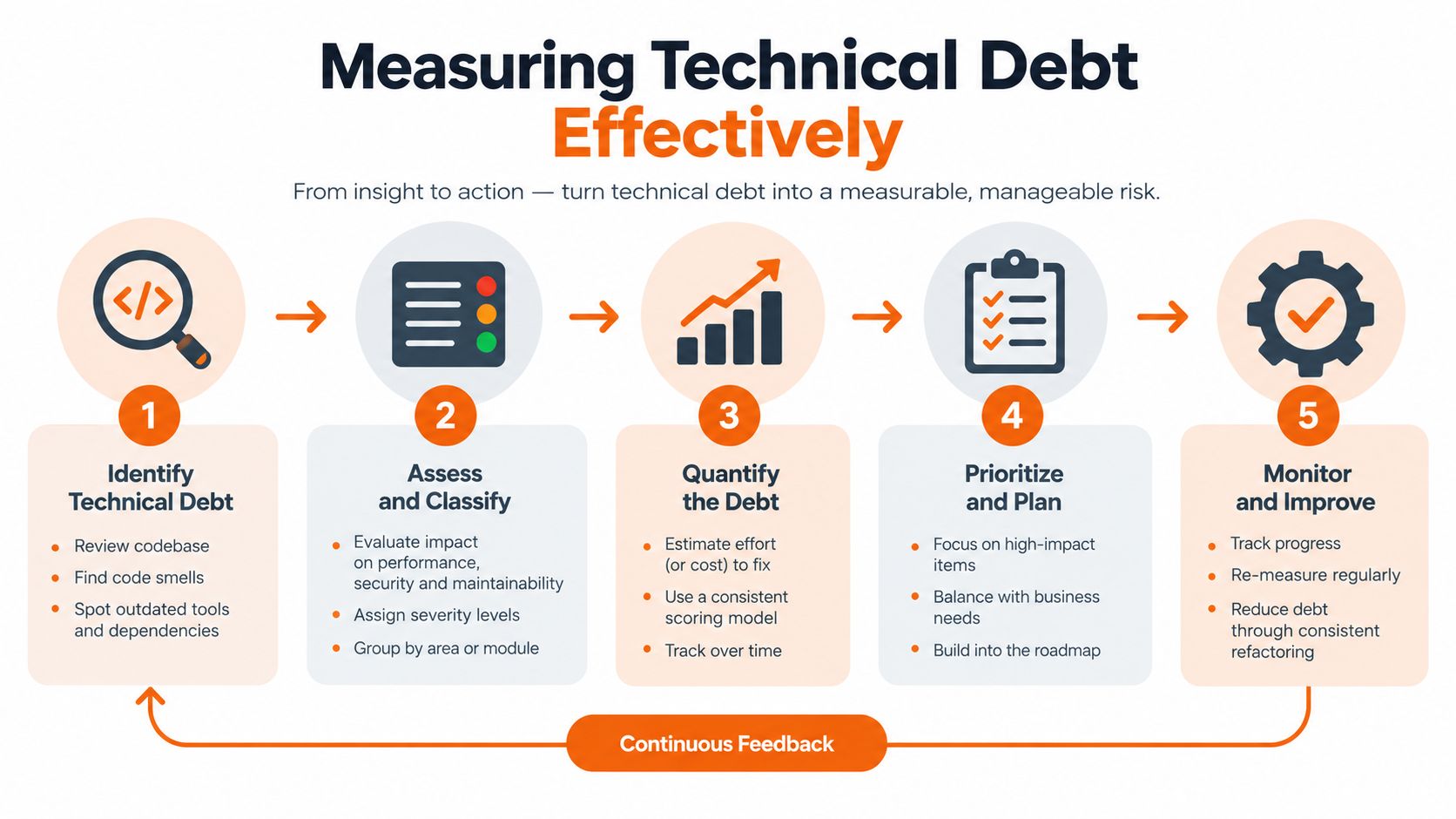
Identify the estate. Create a service and application inventory. Record ownership, business capability, deployment model, dependencies, data domains, support status, and customer impact. Include infrastructure, automation, integrations, security exposure, and documentation, not only application code. Without ownership, a measurement system becomes a report that nobody acts on.
Assess the debt categories. Separate code quality, architecture, infrastructure lifecycle, vulnerability, test, automation, data, and documentation debt. Credit Suisse, referenced in the SEI-linked technical-debt measurement paper, tracked code quality, infrastructure lifecycle, vulnerability, and automation debt. Its infrastructure lifecycle measure counted days without vendor support, showing how an abstract concern can become an observable indicator.
Quantify the cost. Estimate remediation effort, recurring maintenance effort, incident exposure, delayed delivery, and specialist dependency. Estimates do not need false precision. Apply consistent assumptions, record confidence levels, and compare applications using the same method. Include the cost of waiting, particularly when debt slows AI integration or forces nearshore engineers to spend capacity on avoidable maintenance.
Prioritize the portfolio. Rank systems by business criticality, change frequency, risk, strategic relevance, and remediation economics. A low-value internal tool with stable usage should not outrank an authentication service or the data pipeline behind a core product.
Monitor the trend. Track whether debt is growing faster than the organization can address it. A healthy program does not require every metric to improve at once. It requires clear ownership, visible movement in high-value areas, and an Extreme Ownership habit of verifying results rather than merely reporting activity.
A useful dashboard combines financial and engineering views. The executive layer should show debt as a share of IT spend, remediation capacity, blocked initiatives, risk exposure, and movement by application. The engineering layer should show mean time to resolution, duration open, recurrence rate, and density, metrics recommended by the Software Engineering Institute's field guidance.
Use a simple table to force decisions:
| View | Question it answers | Owner |
|---|---|---|
| Cost curve | Which systems consume disproportionate capacity? | Engineering finance partner |
| Risk | Which debt could create a security, reliability, or compliance event? | CTO and security lead |
| Delivery | Which debt blocks roadmap commitments? | Product and engineering leadership |
| Trend | Is new debt arriving faster than remediation? | Platform or architecture owner |
| Accountability | Who decides, funds, and verifies the result? | Executive sponsor |
The measurement system must expose trade-offs. If leaders accept debt, record the decision, reason, owner, and review condition. Managed debt can support a deliberate delivery strategy. Invisible debt cannot.
A technical-debt backlog becomes valuable only when it directs scarce delivery capacity toward business outcomes. Rank remediation by its effect on business change, AI adoption, reliability, and security. Do not let repository size or static-analysis warnings set the agenda.
IBM reports that 81% of executives believe technical debt already constrains AI success, while 69% say it can make initiatives financially untenable by adding 15% to 22% to delivery timelines. IBM's research on brownfield application modernization supports a clear priority rule: address debt on AI-critical paths before cleaning up lower-impact code.
Score each debt area against four questions:
Architecture generally outranks cosmetic code cleanup. A duplicated helper function may be inconvenient. A tightly coupled domain model that prevents independent releases directly limits delivery capacity.
A field study reported that 65% of 1,831 participants had no defined technical-debt management process, while an industrial survey of 653 practitioners identified time pressure or deadlines as the most cited cause of debt. The same field study identified architecture as the most important source of technical debt. Treat those findings as an operating warning: without explicit ownership, urgent delivery work will keep creating tomorrow's constraints.
Decision test: If this debt remains untouched, which specific business decision becomes slower, riskier, or more expensive?
Use three categories:
This sequence prevents broad cleanup from consuming capacity without improving the product. It also prevents indefinite postponement that leaves AI and modernization initiatives dependent on unstable foundations.
Nearshore staffing can add capacity or specialist depth, but the squad must own an outcome rather than process tickets. Give it system context, access to a decision forum, and responsibility for a result such as isolating a domain, stabilizing a migration path, or improving data readiness.
AI-native engineering can shorten execution time. Agentic tools can analyze dependencies, draft migration steps, generate tests, document interfaces, and identify repetitive remediation work. Architects and engineers must still approve designs, validate generated code, protect data, test failure paths, and own production quality. Extreme Ownership applies to the result, not the tool output.
Before committing to a rebuild, refactor, or replatform, use this legacy rebuild, refactor, or replatform guide to compare business impact, delivery risk, and operating constraints.
Refactoring succeeds when the pattern matches the operational problem. A legacy monolith with valuable but tangled business logic needs a different approach from a modular service that only lacks clear boundaries. Choosing the wrong pattern can increase coordination overhead, create duplicate data flows, and put production reliability at risk.

The Strangler Fig pattern places new capabilities around an existing system and gradually redirects traffic away from the legacy implementation. It fits organizations that need to keep shipping, can't tolerate a large cutover, or must preserve a functioning product while replacing parts of the platform.
Use it when:
The cost is coexistence. Teams must manage duplicated behavior, data synchronization, observability across boundaries, and a clear retirement plan for each replaced component.
Modularization keeps the existing application or deployment boundary but creates stronger internal modules. The team defines domain ownership, interfaces, dependency rules, and test boundaries without immediately splitting everything into independently deployed services.
Use it when:
Modularization usually reduces coordination complexity sooner. It won't solve every infrastructure or release problem, but it can expose boundaries without introducing the operational burden of distributed systems.
| Decision factor | Strangler Fig | Modularization |
|---|---|---|
| Production change | Incremental routing and coexistence | Controlled internal restructuring |
| Best fit | Legacy replacement and phased modernization | Tangled monolith with viable runtime |
| Main risk | Dual systems and data inconsistency | Boundaries remain theoretical |
| Team requirement | Migration, platform, and product coordination | Strong architecture and code ownership |
| Retirement signal | New path handles the required capability | Module can evolve with limited coupling |
Start with characterization tests around behavior that customers and downstream systems rely on. Add observability before moving traffic. Define rollback criteria, data ownership, and an explicit end state. Don't call a component modernized because its code moved to a new repository.
Automation helps reviewers focus on architectural and business risk. Teams evaluating a more systematic workflow can use this guide to code review automation as a reference for integrating checks into the pull request process. Automated checks don't replace senior review. They prevent predictable defects from consuming senior attention.
A migration also needs an operating model. The team responsible for the old system must coordinate with the team building the replacement, and one accountable leader must own the customer result. If a migration fails, “that was another team's service” isn't an acceptable answer.
For CTOs dealing with a broader estate, the legacy system modernisation guide for CTOs provides a useful lens for connecting technical choices with business continuity, ownership, and long-term operation.
Use one media element to establish the physical reality of staged renovation, then use the following technical walkthrough to examine how incremental replacement works in practice.
The pattern matters less than the discipline around it. Establish seams, measure behavior, communicate risk early, and retire what the new system replaces. A modernization program should leave behind a simpler operating model, not a permanent archaeological layer of old and new.
Technical debt grows when delivery targets reward feature output while ignoring the cost of shortcuts. Engineers make rational trade-offs under deadline pressure. Leaders must provide protected remediation capacity, quality gates, and clear ownership, or temporary compromises will become permanent operating costs.
The field evidence is direct. A study of 1,831 participants found that 65% had no defined technical-debt management process, while research involving 653 practitioners identified deadlines or time pressure as the most cited cause of debt. The SEI field study supports a practical conclusion: quality needs an operating mechanism, not another reminder to “do things properly.”
Start with the pull request. Every change should pass checks matched to its risk, including unit and integration tests, security scanning, dependency checks, static analysis, migration validation, and deployment verification. Keep the gates focused. A noisy pipeline trains engineers to bypass it.
Use this sequence:
CI/CD is a feedback system, not a maturity badge. It should tell engineers quickly whether a change is safe to continue and give leaders evidence about where the system remains fragile. Measure bypasses and recurring failures as operating problems, then assign owners to remove their causes.
Agentic AI can accelerate code analysis, test creation, documentation, dependency mapping, migration preparation, and repetitive implementation. It can also generate plausible code that violates architecture, mishandles data, omits failure behavior, or introduces insecure patterns. Speed has value only when the shipped result remains supportable.
Set explicit controls:
Nearshore teams can expand delivery capacity when they operate as integrated owners rather than remote hands. Give them shared product context, overlapping decision time, direct access to senior architecture, and responsibility for measurable outcomes. A partner such as Rite NRG can provide senior software, AI, data, and delivery specialists through nearshore teams, while its architects remain accountable for architecture, security, testing, and production quality.
Operational knowledge must stay accessible. Curated help desk guides can support consistent triage and documentation, but they do not replace a maintained service catalog, runbooks, ownership map, or incident review practice.
Extreme Ownership connects these practices. Raise risks before they become surprises. Explain trade-offs plainly. Move blocked decisions forward. Own the result across planning, implementation, release, and operation. Quality and speed improve together when accountability covers the full delivery system, not just the code merged today.
Leadership will continue funding technical debt reduction when the program demonstrates business movement. Track engineering metrics, but translate them into outcomes that product and finance understand.
The SEI recommends measuring mean time to resolution, duration open, recurrence rate, and density, alongside technical indicators that provide system-level context. Those measures show whether the team is resolving problems faster, preventing repetition, and reducing concentrated risk.
Independent research reported that 70% of respondents saw better system performance after debt reduction, 65% reported lower maintenance costs, 60% reported increased system agility, and 55% reported improved customer satisfaction. McKinsey's research on technical debt provides evidence that remediation can affect operational and customer outcomes, not only code quality.
Build the business case around a before-and-after baseline:
Use the AI software modernization ROI guide to structure assumptions around modernization and AI initiatives. Don't claim savings before measuring them. Establish the baseline, record the remediation investment, and review the result with the same discipline used for product performance.
Technical debt reduction is successful when the company can make important changes with less friction, less risk, and more predictable ownership. Start with one critical path, quantify its drag, assign a senior owner, and fund the smallest remediation program that can prove meaningful movement.
Rite NRG helps SaaS and enterprise teams assess technical debt, modernize legacy platforms, build AI-native delivery workflows, and add accountable nearshore engineering capacity. Visit Rite NRG to discuss the system slowing your roadmap and define a practical path from technical drag to predictable delivery.
/ about the author
Written by the RITE NRG editorial team — the architects, engineers and delivery leads who build and operate AI-era software for our clients.
Strategy & Transformation
A practical, finance-ready framework for comparing AI and modernization investment with the current-state cost, realistic benefits, delivery risk and time to value.
AI Consulting & Automation
A practical framework for choosing and deploying transport or logistics AI agents around real exceptions, reliable data and controlled operational authority.
Industry Solutions
A practical roadmap for improving manufacturing systems and introducing AI without destabilising production, data integrity or operational control.
More guidance: all insights articles
Tell us about the system or idea behind this article. We tell you honestly if it is a fit — and what a fixed-scope delivery could look like.