

Strategy & Transformation
How to Calculate ROI for AI and Software Modernization
A practical, finance-ready framework for comparing AI and modernization investment with the current-state cost, realistic benefits, delivery risk and time to value.
operationalwrocław--:-- cet
∕ insights / difference-between-security-testing-and-penetration-testing.md
Security Testing
Learn the difference between security testing and penetration testing, including scope, methods, timing, deliverables, risk, and when each is right.
>_article.meta
Your release gate is green. Automated scans passed, code review found nothing blocking, and the customer demo went well. Then a prospect asks for your latest penetration test, your CTO asks whether a tenant could reach another tenant's data, and nobody can answer from the scan results. That's the moment when terminology becomes a business risk.
You're about to ship a SaaS API change that adds a new admin role and a partner integration. Your pipeline ran static analysis, dependency checks, secrets scanning, and an authenticated dynamic scan. Everything came back clean enough to release, so product wants to move fast and capture the revenue window.
The unanswered question isn't whether individual checks passed. It's whether an attacker with a low-privilege account can combine a permissive API rule, a misconfigured storage bucket, and a weak password reset flow into meaningful unauthorized access. Your broad checks weren't designed to prove or disprove that chain.
Security testing supports the release decision every sprint. It tells you whether controls are present, code follows your standards, dependencies aren't introducing known exposure, and configurations match policy. It's continuous assurance across the delivery process, and it reduces production surprises because defects get caught before they compound.
Penetration testing supports a different decision. It tells you whether an authorized tester, acting like an attacker within agreed boundaries, can exploit what you built and reach something that matters. That's evidence about real-world exploitability, not just control presence.
If your scan says a lock exists, a penetration test tells you whether someone can pick it, climb through the window next to it, or both.
Treat these as interchangeable and you get two expensive failure modes. You either delay every release waiting for an adversarial exercise you can't run weekly, or you ship confidently on automated evidence that never proved impact. Both hurt time to market, and the second one hurts far more when a customer, auditor, or attacker finds the chain first.
The outcomes leaders need are concrete. You need reduced exposure before release, clearer risk acceptance when you ship anyway, faster remediation because findings map to real impact, and fewer emergency fixes after launch. None of that comes from picking one label.
My recommendation is a layered model from day one. Run broad security testing continuously, and schedule targeted penetration tests at defined milestones and after material changes. The difference between security testing and penetration testing isn't academic. It's the difference between knowing your controls exist and knowing they hold.
Both activities pursue the same goal, which is to keep attackers from turning weaknesses into loss. They differ in coverage, timing, evidence, and who acts on the results. Classify work by its objective, not by the tool on someone's laptop.
Security testing is the broader discipline. NIST Special Publication 800-115, published on September 30, 2008, describes information-security testing as a process for planning and conducting technical tests, analyzing findings, and developing mitigation strategies, including finding vulnerabilities and verifying compliance with policies or other requirements. That publication lists documentation and log reviews, network sniffing, file-integrity checking, network discovery, vulnerability scanning, password cracking, and penetration testing among its techniques.
In practice, your program includes security-requirements validation, threat modeling, source-code review, static and dynamic analysis, dependency and container scanning, configuration review, fuzzing, and cloud-control validation. Teams looking to formalize that breadth often start by mapping controls through an app security assessment with DevArmor, which helps structure what to test before anyone simulates an attack.
The diagram below maps those foundations so you can see where each activity sits.
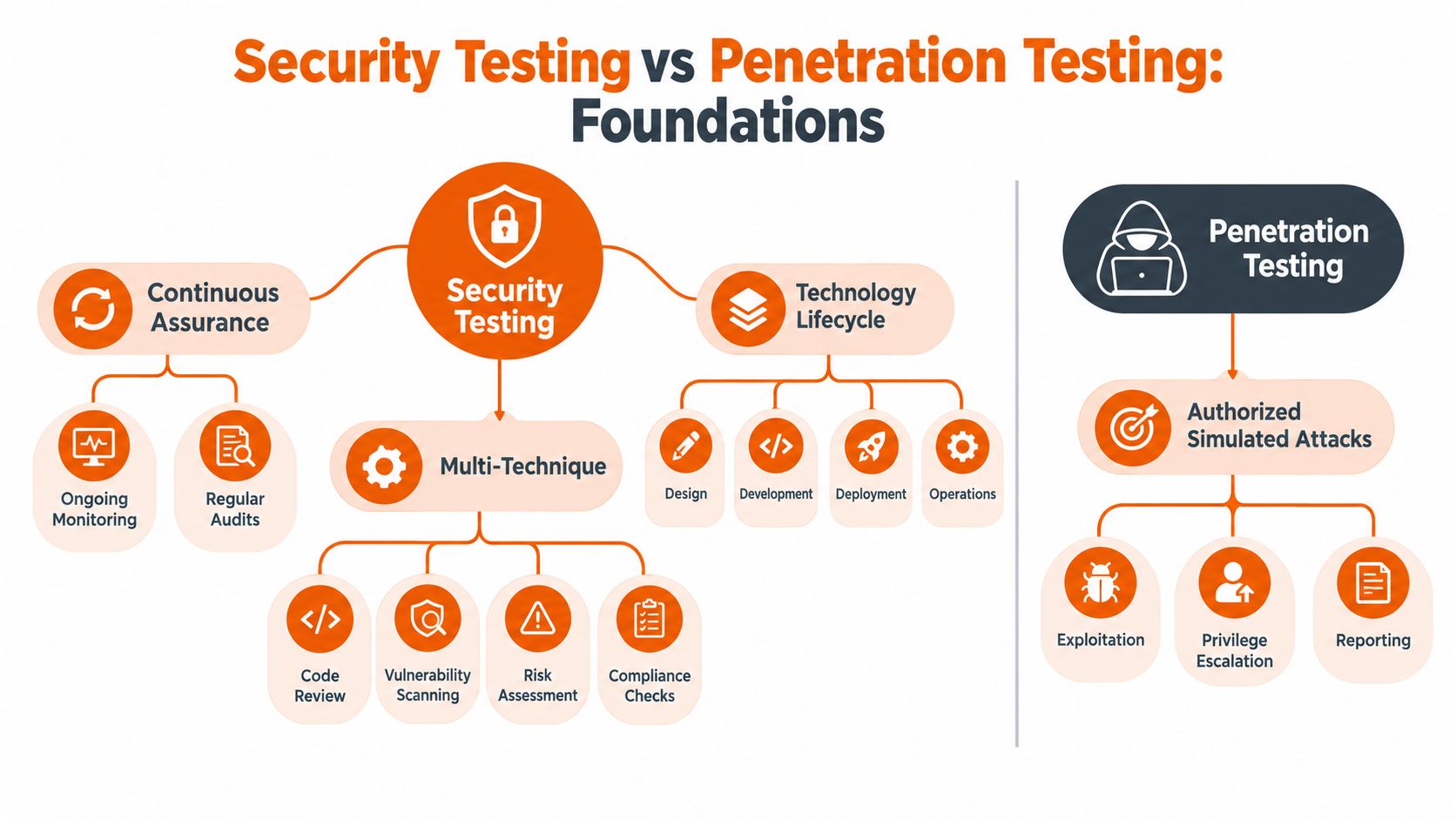
Penetration testing is narrower and deliberately adversarial. NIST defines it as security testing in which assessors mimic real-world attacks to discover ways to circumvent the security features of an application, system, or network. Testers attempt exploitation, chain weaknesses, escalate privilege, and demonstrate what data or functions they can reach within a defined scope and time window.
Core distinction: Penetration testing is one specialized technique within security testing, not a synonym for it.
That definition gives you a fast classification test. A Snyk or Dependabot dependency check in your pipeline is security testing. A cloud configuration review against your baseline is security testing. An authenticated tester using Burp Suite to bypass tenant isolation and export another customer's records, under signed authorization, is penetration testing.
Broad testing produces defect inventories and control-validation results. You learn what's weak, missing, or drifting. Penetration testing produces demonstrated attack paths, maximum privilege achieved, and business impact you can prioritize without guessing.
Don't let overlapping tools confuse you. The same scanner can support both activities. What changes is the mandate, the permission to exploit, and the proof you're allowed to demand at the end.
The fastest way to waste budget is to buy a penetration test that delivers a scanner report, or to call a scanner report a penetration test for a customer questionnaire. Use the table below when you're approving spend, setting a release gate, or answering a prospect.
| Criterion | Security Testing | Penetration Testing | Leadership Implication |
|---|---|---|---|
| Primary objective | Find weaknesses and verify controls work as intended | Prove whether weaknesses can be exploited into unauthorized access | Fund both, judge them on different evidence |
| Lifecycle coverage | Requirements through operations, continuously | Testing and validation against a running, representative target | Don't wait for a pen test to catch design flaws |
| Scope | Broad across code, dependencies, config, and process | Scoped assets, accounts, and attack paths | Broad coverage finds more, narrow depth proves more |
| Attacker perspective | Mostly defender and auditor viewpoint | Adversarial, mimics real-world attacks | Only the second validates your assumptions |
| Authorization | Often routine and internal | Explicit authorization and rules of engagement required | No signed scope, no exploitation |
| Methodology | Reviews, scanning, analysis, compliance checks | Structured phases from pre-engagement to reporting | Demand a method, not ad hoc hacking |
| Typical evidence | Findings list, severities, control results | Exploit chains, privilege gained, data reached | Prioritize fixes by proven impact |
| Automation | Highly automatable in CI/CD | Tool-assisted but human-led exploitation | Automate breadth, staff the depth |
| Operational risk | Low, designed not to disrupt | Higher, may launch real attacks on real systems | Set windows, rate limits, and stop conditions |
| Compliance relevance | Supports ongoing control verification | Separately required under some standards | A scan doesn't satisfy a pen test requirement |
| Cost profile | Steady tooling and engineering time | Concentrated specialist effort per engagement | Budget continuous plus periodic, not either or |
| Core limitation | May never prove combined impact | Samples paths in one window, misses later drift | Neither result stays true forever |
Compliance makes the separation explicit. The PCI Security Standards Council separates Requirement 11.2 vulnerability assessments from Requirement 11.3 penetration testing, because a vulnerability assessment identifies and reports vulnerabilities while a penetration test attempts to exploit them to determine whether unauthorized access or malicious activity is possible. The same PCI guidance calls for penetration testing at least annually and after significant infrastructure or application changes, such as installing new system components, adding a subnet, or adding a web server. If you're weighing the scanner layer specifically, this breakdown of vulnerability scanning versus pentest explained is a useful companion for your team.
A credible penetration test follows structure. The Penetration Testing Execution Standard lists seven phases covering pre-engagement interactions, intelligence gathering, threat modeling, vulnerability analysis, exploitation, post-exploitation, and reporting. If a provider jumps straight to scanning and sends a PDF, you didn't buy that.
NIST notes that penetration tests may launch real attacks against real systems and data and can chain multiple vulnerabilities to obtain greater access than any single flaw would permit. That's exactly the value, and exactly why it carries more operational risk than routine testing. Plan for it instead of pretending it's a heavier scan.
Automated breadth can't reliably establish whether chained weaknesses produce a meaningful compromise. You'll get volume, repeatability, and fast regression detection, and you should want all three. You won't get proof that your crown-jewel data is unreachable.
A clean penetration test proves the tested paths held during that window. It doesn't prove your next deploy, your new integration, or your untested admin console is safe.
Retention of assurance is where leaders get caught. Security testing evidence decays as code and infrastructure drift, which is why it runs continuously. Penetration test evidence decays faster because it was always a sample, so you repeat it at milestones and after material change.
Judge reporting accordingly. From broad testing, expect repeatable findings, owners, and trend lines. From penetration testing, expect reproducible exploit steps, evidence of impact, and retest results. If either report can't drive a fix decision, it's shelfware.
Timing determines value. Run the right activity too late and you pay for rework. Run it too early, against something that doesn't resemble production, and you pay for theater.
The timeline below shows where each activity earns its keep.
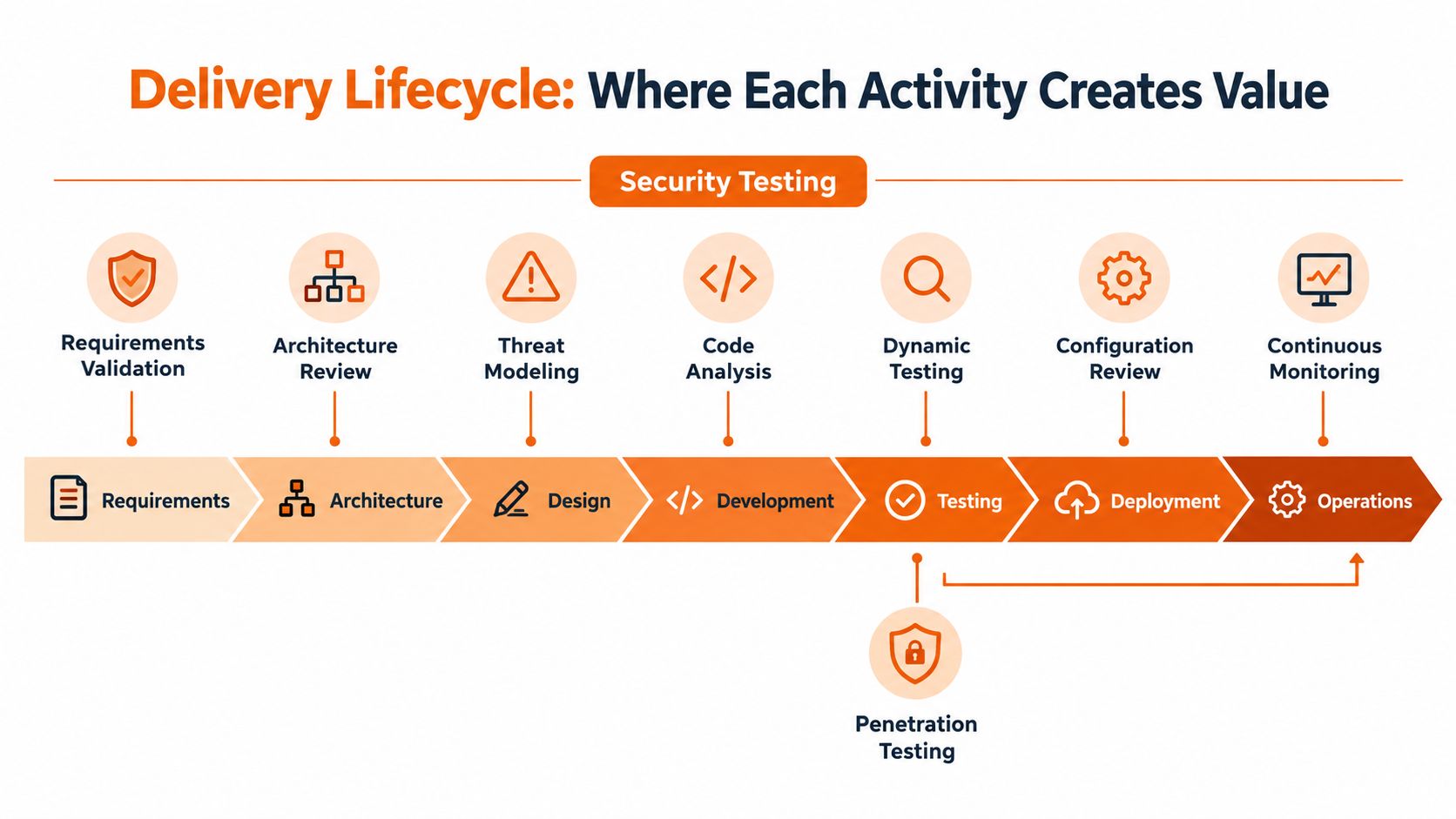
OWASP places threat modeling and secure-code analysis earlier in development, while penetration testing is used during testing or validation. That sequencing is sound. At requirements and design, validate security requirements, model threats against tenant boundaries and identity flows, and review architecture decisions that are cheap to change on paper.
During development, put static analysis, dependency scanning, secret detection, and targeted code review in your pipeline and pre-release gates. A disciplined approach to structured software quality assurance keeps those gates consistent instead of relying on whoever remembers to run a tool. Catching an authorization regression here costs hours, not an incident review.
Penetration testing needs a production-like target, realistic accounts, and data shapes that mirror production without exposing real customer records. Point it at exposed APIs, identity and session flows, privileged workflows, and new trust boundaries. That's where chaining reveals what isolated checks miss.
The short video below walks through offensive validation in practice, which helps non-specialist leaders picture the workflow.
After deployment, keep broad testing running to detect drift, new dependencies, and configuration changes between engagements. Verizon's 2025 DBIR found vulnerability exploitation in 20% of breaches, up 34% year over year, a figure noted alongside NIST's glossary definition of penetration testing. Attackers don't pause between your annual tests, so your detection can't either.
AI can accelerate analysis, test generation, triage, and documentation across this lifecycle. It doesn't own the risk decision. Senior engineers still own architecture, test design, severity judgment, and production quality, and that's a strength, not a bottleneck.
Abstract comparisons don't ship products. Match the activity to the asset, the plausible threat, and the decision deadline in front of you.
Your worst day is cross-tenant exposure. Run continuous authorization testing, code and dependency checks, and configuration review on every change. Then commission targeted penetration testing of tenant isolation, object-level authorization on APIs, and privileged support workflows with real low-privilege test accounts.
Broad testing tells you checks exist on each endpoint. Adversarial testing tells you whether a tester can enumerate identifiers, replay tokens, or abuse an export feature to cross the boundary. For enterprise deals, that second answer is often the one that unblocks procurement.
You're splitting a monolith, adding event streaming, or exposing partner APIs. Threat model the new trust boundaries early, test each component broadly, and validate the combined system adversarially once it's integrated. New boundaries are where assumptions collide, and components that pass in isolation fail together.
Document both layers separately. Keep vulnerability assessment and control evidence current, and schedule penetration testing on the cadence your commitments require, including after significant change. Don't present either artifact as complete assurance, because auditors and customers will spot the gap.
Governance is what separates legitimate work here. OWASP's Web Security Testing Guide notes its techniques can support internal testing, third-party penetration tests, and coordinated disclosure, with authorization, rules of engagement, and remediation workflows determining how the work is governed. Same techniques, very different accountability, so write the rules down.
If you have no asset inventory, unpatched known issues everywhere, and secrets in repositories, don't buy an adversarial engagement yet. You'll pay specialists to rediscover what a week of broad testing and remediation would surface cheaper. Fix the obvious, establish your gates, then challenge the system.
Sequencing rule: Earn the penetration test by clearing known weakness first, so specialist time goes toward attack paths you couldn't find yourself.
The opposite error is just as common. A mature team with clean scans assumes it's resilient, yet nobody has tested whether a compromised support account plus a permissive internal API reaches billing data. Mature pipelines still need periodic adversarial challenge.
Weigh acceptable operational disruption too. If you can't tolerate any production risk this quarter, scope the test to a faithful staging environment and say so plainly in the report. Honest scoping beats a production claim nobody validated.
Stop asking for more testing. Start asking what evidence a specific decision requires, then route the work accordingly.
The framework below turns that into four questions your team can answer in one working session.
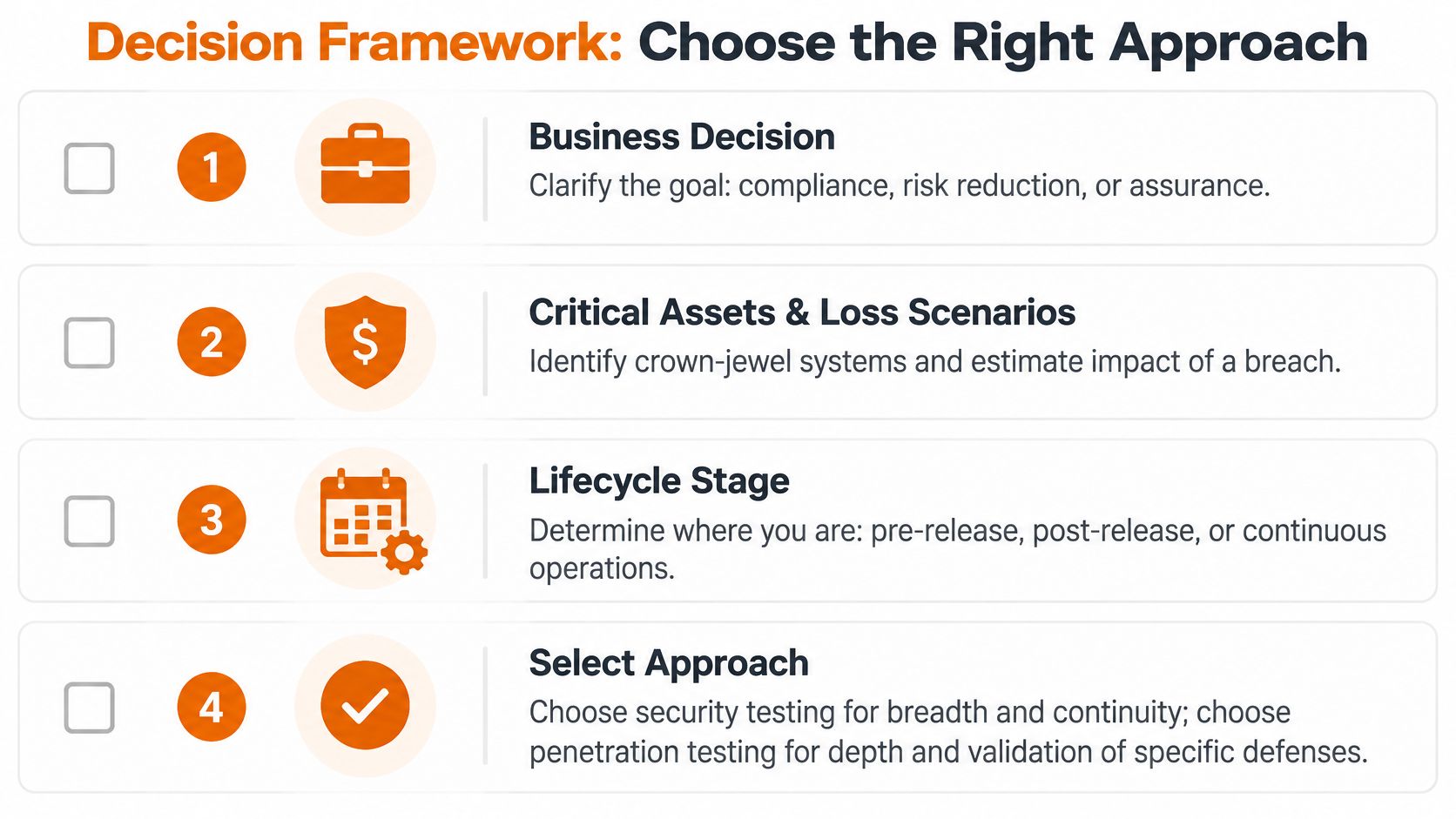
OWASP describes penetration testing as active analysis simulating an attack to uncover technical weaknesses, referencing NIST assessment techniques across review, target identification and analysis, vulnerability validation, planning, execution, and post-testing activities. Use that arc to judge provider proposals. Missing planning or post-testing usually means missing value.
Explicit authorization isn't paperwork for its own sake. It's what protects your customers, your testers, and your production systems when someone is intentionally trying to break in.
Build an operating rhythm, not a calendar of one-off projects. Your customers and your board care about sustained control, and sustained control comes from cadence plus ownership.
Set recurring security-testing gates in delivery for code, dependencies, secrets, and configuration. Track repeat defects, escaped findings, regression detection, and control drift, and review trends with engineering leadership. Rising repeat defects mean your architecture or training needs attention, not just more scanning.
Set penetration-test milestones for major releases, new exposed surfaces, and material architectural change. Organizations that have scaled this discipline, as shown in this SecureOps implementation in a global media enterprise, treat findings as engineering work with named owners, not as audit artifacts.
For adversarial engagements, measure exploitable attack paths, maximum achieved privilege, sensitive-data exposure, and retest closure rate. Add the time needed to contain any test-induced impact. A short list of proven paths to critical data matters more than a long list of low-impact noise.
Close every cycle the same way:
That's the #riteway in practice, applied to security. Extreme Ownership, transparent communication, and senior accountability for the complete result, not just a delivered report. Map your next three material business changes to this combined cadence this week, and you'll stop debating labels and start reducing exposure.
If your team is shipping fast but can't yet prove how your controls hold under real attack, Rite NRG can help you build the layered testing program, senior engineering ownership, and AI-accelerated delivery rhythm to close that gap without slowing releases. Talk to our consultants about mapping your next release to the right evidence and fixes by visiting Rite NRG today.
/ about the author
Written by the RITE NRG editorial team — the architects, engineers and delivery leads who build and operate AI-era software for our clients.
Strategy & Transformation
A practical, finance-ready framework for comparing AI and modernization investment with the current-state cost, realistic benefits, delivery risk and time to value.
Technology Talent & Teams
A decision-maker's guide to IT partnership models: what each model actually transfers to the partner, what it costs beyond the rate card, and how to match the model to your situation.
AI Consulting & Automation
A practical framework for choosing and deploying transport or logistics AI agents around real exceptions, reliable data and controlled operational authority.
More guidance: all insights articles
Tell us about the system or idea behind this article. We tell you honestly if it is a fit — and what a fixed-scope delivery could look like.