

Strategy & Transformation
How to Calculate ROI for AI and Software Modernization
A practical, finance-ready framework for comparing AI and modernization investment with the current-state cost, realistic benefits, delivery risk and time to value.
operationalwrocław--:-- cet
∕ insights / authentication-and-authorization.md
Authentication And Authorization
Authentication and authorization decide who gets in and what they can do. A practical SaaS guide to protocols, tokens, risk, and rollout.
>_article.meta
Your first enterprise customer is ready to launch, but a contractor needs production access, an integration token is sitting in a shared channel, and nobody can confidently answer which tenant's data each account can reach. The login screen works. The access model doesn't yet give your team a safe, repeatable way to ship.
That uncertainty costs more than engineering time. It can slow security reviews, complicate support, and put customer trust at risk just as you're trying to grow. Authentication and authorization are growth controls: they help you move faster by making access rules explicit and keeping a compromised credential from becoming a path to every customer's data.
The release is close, and the team is making the final enterprise-readiness decisions. The product manager wants to add the first customer's users. An engineer needs temporary production access to troubleshoot an integration. A machine credential still grants broad access because narrowing it would require someone to decide which service calls it needs.
That isn't a missing-login-page problem. It's uncertainty about who can reach customer data, what happens after a valid login, and who owns the outcome if an account or token is misused. When those questions surface late, teams delay launches, add manual approval steps, and spend support time untangling permissions that should have been designed into the product.
The risk is measurable. Verizon's 2025 Data Breach Investigations Report analyzed more than 22,000 security incidents, including 12,195 confirmed breaches, and found that compromised credentials were the initial access vector in 22% of breaches, the leading category. The same report's analysis of single sign-on provider logs found credential-stuffing attempts represented a median 19% of daily authentication attempts, reaching 25% in enterprise-sized organizations and 12% in small businesses (Verizon's 2025 DBIR findings). A successful login, then, isn't proof that the request is safe.
For a SaaS company, weak access design also makes growth harder. Adding tenants means more opportunities to expose the wrong customer's records if tenant checks are implicit or inconsistent. Enterprise buyers may ask for a clear access model before approving a launch, while founders need confidence that each new feature won't inherit a dangerous default.
The business test: Can your team show who may access each resource, under what conditions, and how that access is removed?
Treat access control as part of product readiness, not a security task to postpone. Explicit permissions help new features inherit safe rules, give engineers a clearer basis for testing, and make security reviews easier to answer. For a perspective on operational security at enterprise scale, see Rite NRG's work enabling secure operations in a global media enterprise. The outcome to pursue is straightforward: reduce avoidable exposure while making releases and tenant growth more predictable.
Every request needs two decisions. Authentication checks whether a user, process, or device controls an authenticator associated with the identity it claims. Authorization uses that verified identity, along with relevant attributes, to decide what the requester may access or do. NIST draws this distinction clearly: authentication doesn't determine permissions or access privileges (NIST's digital identity guidance).
Use a building analogy. Authentication proves you hold the right key. Authorization is the floor plan that says which doors the key opens, for how long, and under what conditions. A key that proves who you are shouldn't automatically open every room.
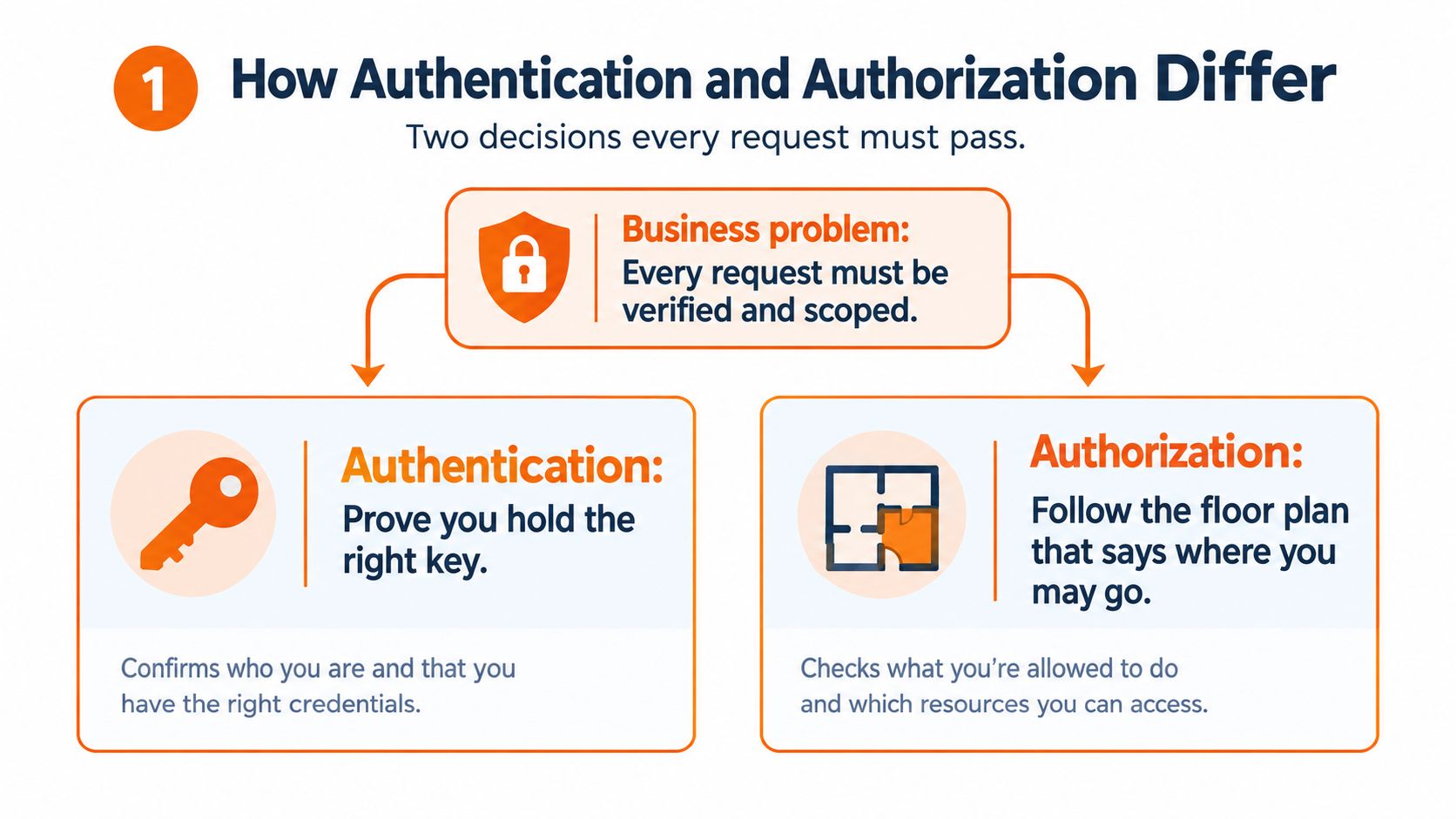
Consider a support agent who signs into your SaaS product successfully. That identity may allow the agent to access a customer support workspace, but it shouldn't imply permission to view another tenant, export billing data, or call an administrative API. Each of those is a separate authorization decision, based on the agent's role, the tenant, the specific resource, and the action requested.
For every feature, engineers should define what a permitted request looks like and what must be denied. A tenant administrator may manage users in their own organization, for example, but shouldn't be able to change another tenant's settings. A support role may see approved account details without gaining access to unrestricted exports.
Test both outcomes:
Teams planning fine-grained policies across larger systems may also find it useful to manage enterprise permissions with AI. The design principle remains the same: a login proves identity, while a separate policy grants narrowly defined access.
Architects own the complete access-control design, not just the login screen. Make every feature ship with an explicit allow rule, a tenant boundary, and a tested denied path. That gives developers clear rules to implement and gives product leaders a defensible basis for expanding what the platform can do.
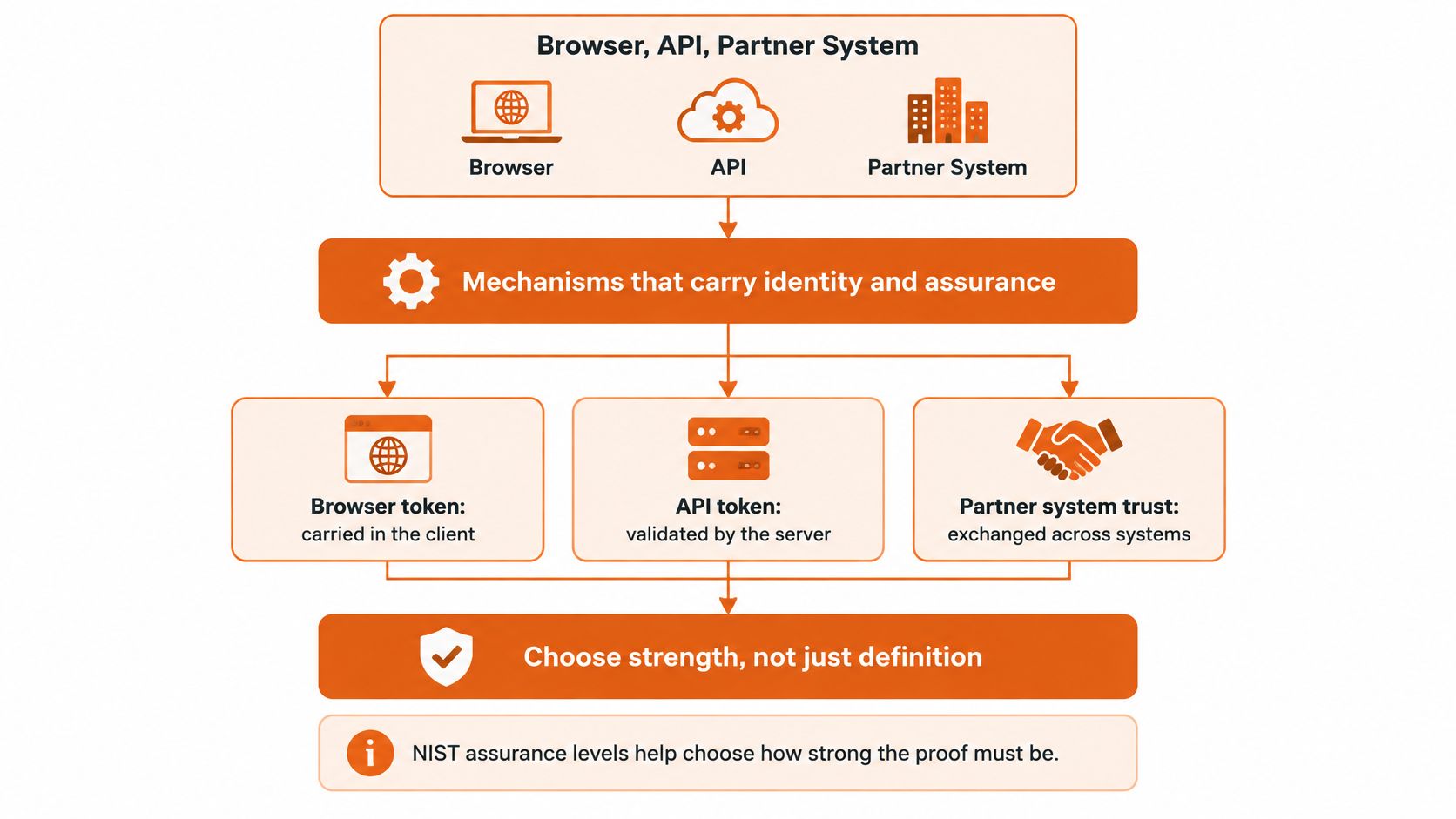
Choose authentication strength based on the impact of the account or workload, not on a desire for one policy everywhere. NIST's Digital Identity Guidelines give teams a shared vocabulary for making that decision. NIST first issued SP 800-63 in 2003, revised it in 2017 as SP 800-63-3, and published SP 800-63-4 in July 2025 (NIST SP 800-63-4).
The framework separates identity proofing, authentication, and federation. Authorization remains a distinct policy decision that limits what an authenticated identity may do. That separation matters when a browser login leads to an API call, or when an employee's identity is trusted through a customer or partner identity provider.
The NIST model defines three Authentication Assurance Levels, or AALs:
Use these levels to structure a risk conversation, not to apply the same friction to every account. A lower-risk customer workflow may need a different assurance level than an employee account with access to internal tools. An administrator or production workload deserves the strongest practical protections the product can support.
Single sign-on and federation let systems rely on identity assertions exchanged across organizational boundaries. Browser tokens carry identity and session authority into client requests. API tokens authorize a specific caller or workload, while service accounts represent non-human access that needs its own scope and lifecycle. A short-lived user-session token is not the same risk as a long-lived machine key: the latter can keep granting access unless someone scopes, rotates, and revokes it deliberately.
For teams integrating with services that use API credentials, this API key authentication reference for crypto platforms offers a practical example of where machine credentials fit. Map each identity flow, token type, and assurance choice to the business impact of the access. That gives your team a protocol map it can explain in a security review without confusing proof of identity with permission to act.
A visual walkthrough can help teams discuss identity mechanisms across clients and systems:
The access model you choose determines where tenant boundaries live and how hard they are to operate. A single-tenant deployment can make isolation easier to reason about because each customer has a separate environment, but it requires the team to manage separate deployments and changes. A shared multi-tenant platform can make product delivery more consistent, but every request must carry the right tenant context and enforce it at the resource boundary.
The same decision applies to identity. A B2C product typically owns customer identities and self-service account flows. A B2B product needs organization membership, invitations, and roles that apply within a customer's tenant. Delegated sign-in lets an enterprise customer authenticate its users through its identity provider, but it doesn't outsource your product's authorization decisions. Their identity provider can confirm who signed in; your application still decides what that person can do in your tenant.
| Pattern | Best fit | Main trade-off | Authorization focus |
|---|---|---|---|
| Single tenant | Customers requiring dedicated environments | Clearer isolation, more deployment and operating work | Enforce access within the customer's environment |
| Shared multi-tenant | SaaS teams building one shared product | Consistent delivery, higher need for rigorous tenant checks | Scope every request to the correct tenant and resource |
| B2C self-service | Products where individuals create and manage accounts | Low-friction onboarding, more customer identity lifecycle work | Tie each account to permitted personal data and actions |
| B2B organization accounts | Products sold to teams and businesses | Organization controls add complexity to invitations and roles | Apply role and object permissions within each organization |
| Delegated sign-in | Enterprise customers that require their own identity provider | Easier alignment with customer sign-in policies, more federation coordination | Map the verified external identity to the right tenant and product permissions |
A shared admin role plus social login may look like the quickest route to an MVP. It's also a shortcut that can make every authenticated user trusted everywhere. A global role doesn't tell your application which tenant owns a record, whether a user was invited into the right organization, or whether a particular action should be allowed.
Start with explicit tenant and object checks even when the first release is small. Keep human single sign-on separate from service credentials so machine access doesn't inherit a person's permissions. If enterprise buyers already mandate their own identity provider, prefer delegated authentication, then map the resulting identity to your application's tenant and authorization policy.
Choose a pattern your team can operate, test, and revoke access within. The right design doesn't remove trade-offs; it makes them visible before they become a costly migration.
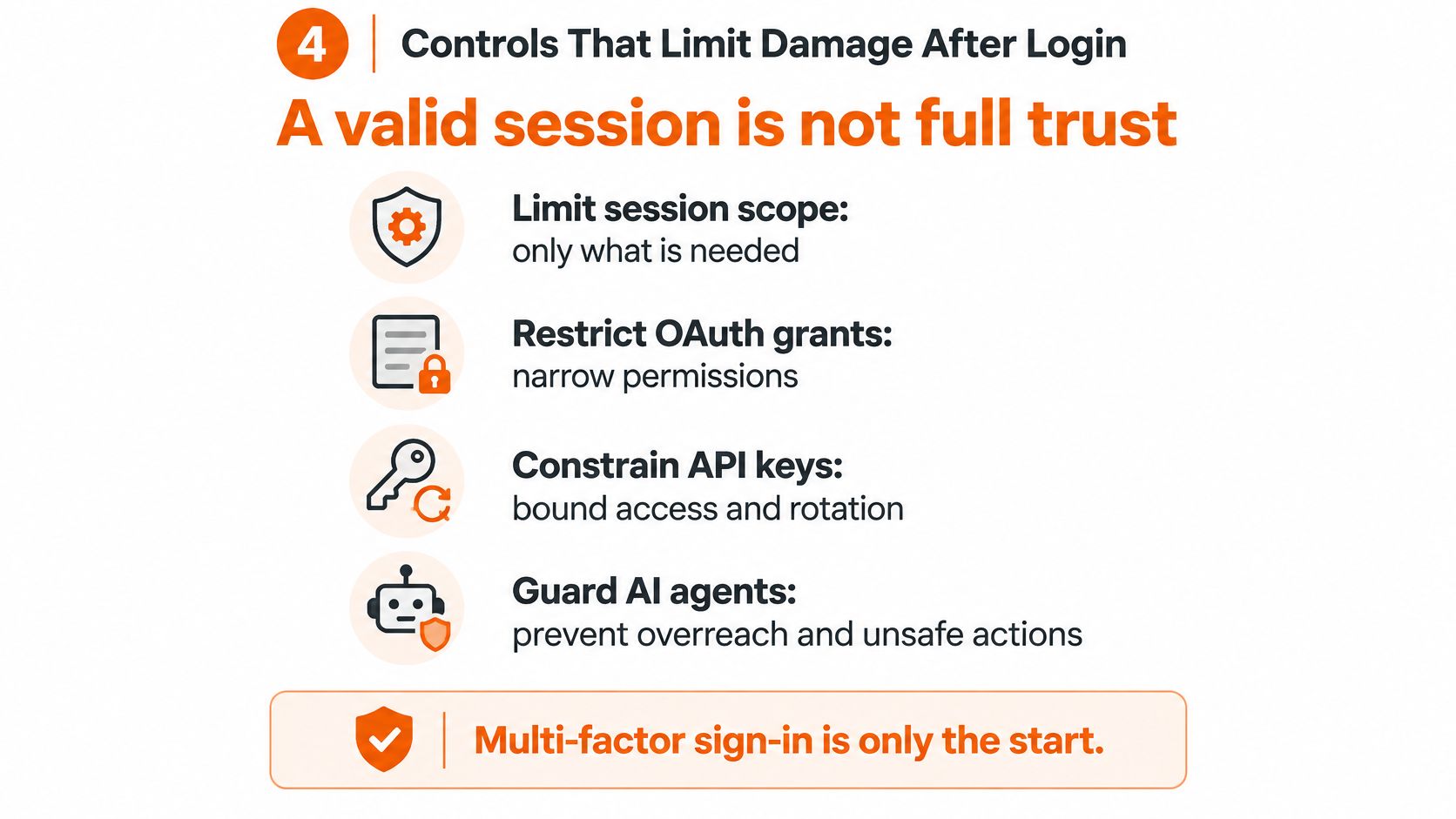
Multifactor authentication helps, but it doesn't finish the job. A valid session, OAuth grant, API key, or agent identity can still have excessive permissions. The useful question isn't only how to verify the login. It's what that identity can do after the system accepts it.
Phishing resistance is a property of the authentication protocol, not just a stronger password or another verification prompt. SMS codes and one-time passwords can be relayed by a phishing site to the legitimate service. FIDO2 and WebAuthn use public-key cryptography to bind a credential to the relying party's origin, sign a server challenge, and keep the private key from being disclosed. NIST identifies one-time-password authentication as non-phishing-resistant and requires approved cryptographic algorithms with at least 112 bits of security strength where phishing resistance is required (NIST's current authentication guidance).
Require phishing-resistant authentication for administrators, support staff, developers with production access, and users handling regulated or high-value data. Make sure recovery doesn't downgrade protection to SMS. For more context on security practices in a customer-facing travel business, see this overview of tour operator platform security.
Then apply the same discipline to machine access. A 2025 identity analysis reports that 97% of non-human identities are exposed to third-party vendors, and that more than 70% aren't rotated within recommended timeframes, with an average rotation cycle of 627 days (TeleTrusT and FIDO Alliance's 2025 identity analysis). Treat service accounts, API integrations, and AI agents as principals that need named owners, narrow permissions, short-lived credentials where possible, and a tested revocation path.
A practical lifecycle review asks:
A second login factor can't make an overpowered token safe. Reduce standing privilege and make revocation work.
Use the same standard in security testing: verify that allowed behavior works and that denied behavior stays blocked. A useful starting point is understanding the difference between security testing and penetration testing. Your goal is to constrain the session and each downstream grant, not to mistake a successful login for lasting trust.
Modernizing identity and permissions is an ownership decision. Your internal team knows the product and customer workflows, but may not have the senior identity experience or delivery capacity to resolve architecture questions quickly. A staff-augmentation provider can add engineers, yet the model may leave key decisions waiting for your team to define every task.
A consulting engineering partner should do more than implement tickets. The partner should challenge a global-role design, identify tenant-boundary risks early, explain the trade-offs, and take responsibility for the full result across architecture, data boundaries, security, testing, and production behavior.
Ask any team you're considering to show how it will work across the lifecycle:
Rite NRG is an AI-native technology consultancy based in Poland that works with international clients. Its teams bring together architects, engineers, AI specialists, data experts, and delivery leaders; agentic AI accelerates analysis, development, testing, documentation, and migration work, while senior engineers remain responsible for architecture, data, security, and production quality. For qualifying projects, the company can deliver an agreed production release in 45 working days at fixed scope and fixed price.
That's one delivery option, not a substitute for a partner scorecard. Ask for transparent decisions, proactive threat analysis, and evidence that access rules have been tested before release. AI can change the economics of engineering work. It doesn't lower the standard, transfer accountability to a model, or make uncontrolled code generation a sound security strategy.
Start by understanding what has access. Inventory human users, administrators, service accounts, API integrations, and AI agents. Include credentials that live outside the main login flow, such as partner connections and deployment workloads. A useful list of sample non-functional requirements can help teams make security, availability, and operational expectations explicit.
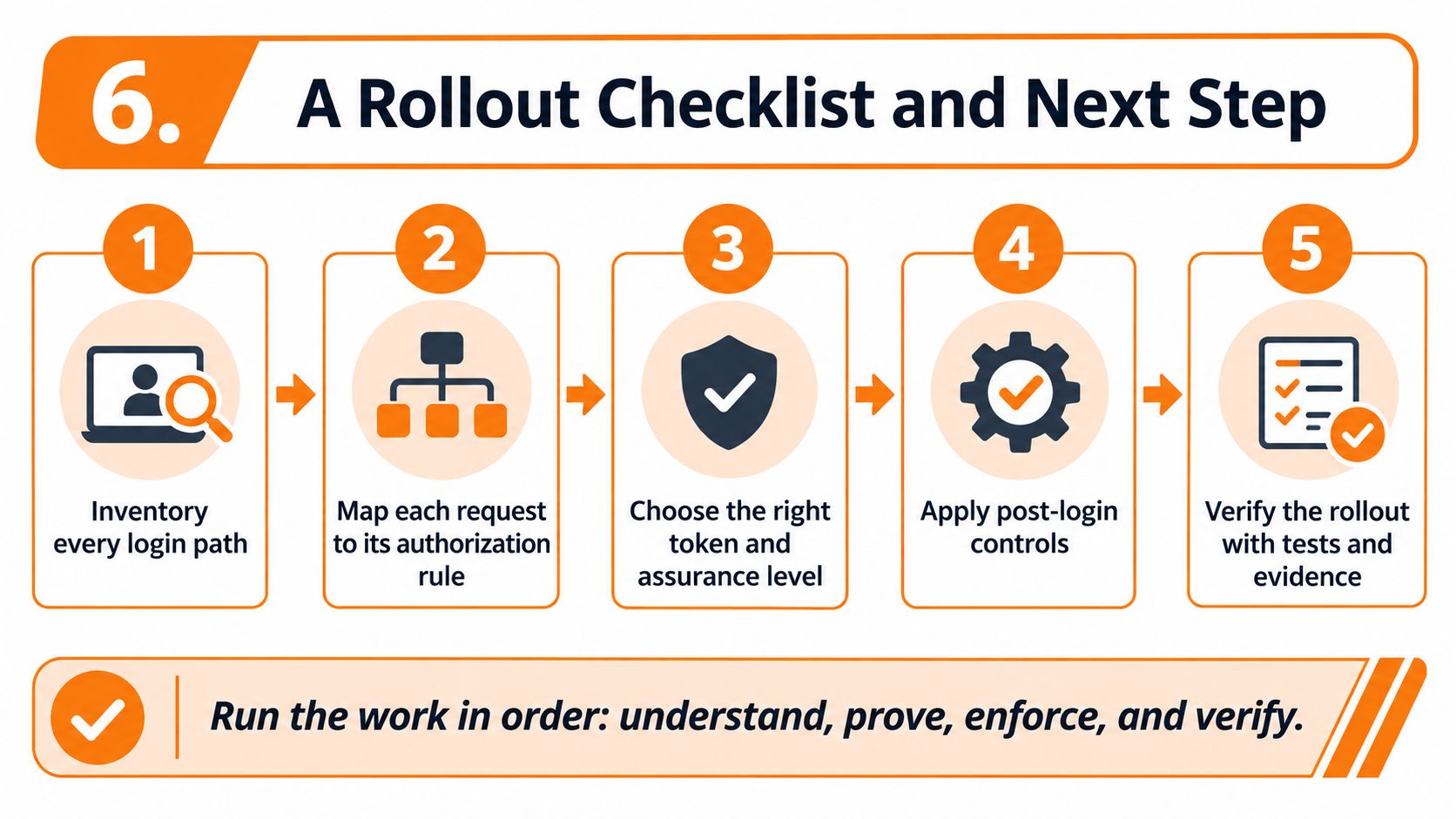
Then work from rules to proof:
Agentic AI can help draft test cases, documentation, and migration plans faster. Architects and engineers still need to review the rules, validate the evidence, and accept the release. The standard is not “the code was generated” or “the login works.” It's that the right identities can perform approved actions, unauthorized requests fail, and the team knows how to respond when access needs to change.
Bring your current login flow, tenant model, and list of machine credentials to a working session with Rite NRG. Decide what to fix first, what needs proof, and what can ship safely.
Rite NRG helps SaaS teams plan, modernize, and deliver business-critical software with senior engineering ownership across architecture, security, testing, and production. Bring your access model and current risks to Rite NRG to agree on the next safe, practical step.
/ about the author
Written by the RITE NRG editorial team — the architects, engineers and delivery leads who build and operate AI-era software for our clients.
Strategy & Transformation
A practical, finance-ready framework for comparing AI and modernization investment with the current-state cost, realistic benefits, delivery risk and time to value.
Technology Talent & Teams
A decision-maker's guide to IT partnership models: what each model actually transfers to the partner, what it costs beyond the rate card, and how to match the model to your situation.
AI Consulting & Automation
A practical framework for choosing and deploying transport or logistics AI agents around real exceptions, reliable data and controlled operational authority.
More guidance: all insights articles
Tell us about the system or idea behind this article. We tell you honestly if it is a fit — and what a fixed-scope delivery could look like.