

Strategy & Transformation
How to Calculate ROI for AI and Software Modernization
A practical, finance-ready framework for comparing AI and modernization investment with the current-state cost, realistic benefits, delivery risk and time to value.
operationalwrocław--:-- cet
∕ insights / ai-agent-guardrails.md
AI Agent Guardrails
AI agent guardrails explained: permissions, human approval, monitoring and testing that keep agents safe in production. Includes a starter checklist.
>_article.meta
85% of executives said their organizations needed better procedures to detect errors or failures in AI tools, according to PagerDuty's 2025 AI Resilience Survey of 1,500 executives across six major markets. That's a delivery problem, not just a security concern. If your team can't detect mistakes, explain decisions, or stop unauthorized actions, faster automation can mean faster incidents rather than greater capacity.
An agent that can read customer records, send emails, and trigger refunds can remove substantial administrative work. Without boundaries, it can also expose customer information, make unauthorized commitments, or move money incorrectly. The business objective isn't maximum autonomy. It's more completed work within an acceptable risk boundary.
In Gartner's 2025 survey, 74% of surveyed IT application leaders said AI agents represented a new attack vector, while only 13% strongly agreed their organizations had the right governance structures. For a CTO, that gap means unresolved release decisions, incident exposure, and customer trust at risk.
AI agent guardrails are the technical and operational limits that decide what an agent may see, decide, and do, and when a person must intervene. They belong in the system's architecture, not just its instructions.
A chatbot that produces text leaves execution to someone else. An agent can select tools and carry out a sequence inside your systems. Reviewing its final answer won't undo a payment or retrieve an exported customer file.
Think of a car's brakes, seatbelts, and lane sensors. They don't exist because driving is bad. They exist because speed makes control essential. Agent guardrails serve the same purpose: they let teams delegate useful work without treating every model decision as trustworthy.
Guardrail decisions also belong to people, not an unnamed governance committee.
The ownership discussion should happen alongside workflow design.

A useful design makes three decisions explicit: which layers enforce the boundaries, which actions require approval, and how the team will measure safety without destroying usefulness. If those answers aren't clear, the agent isn't ready for production, regardless of how convincing the demo looks.
Don't buy the idea that a stronger system prompt is a security architecture. Instructions help the agent interpret its assignment. They shouldn't have the authority to grant access, approve payments, or excuse a failed check.
Build independent controls around the model. Each layer needs its own enforcement mechanism, a named owner, and a defined failure response. A classifier outage, for example, must not disable authorization.
The layered view below is a useful starting point for reviewing coverage.
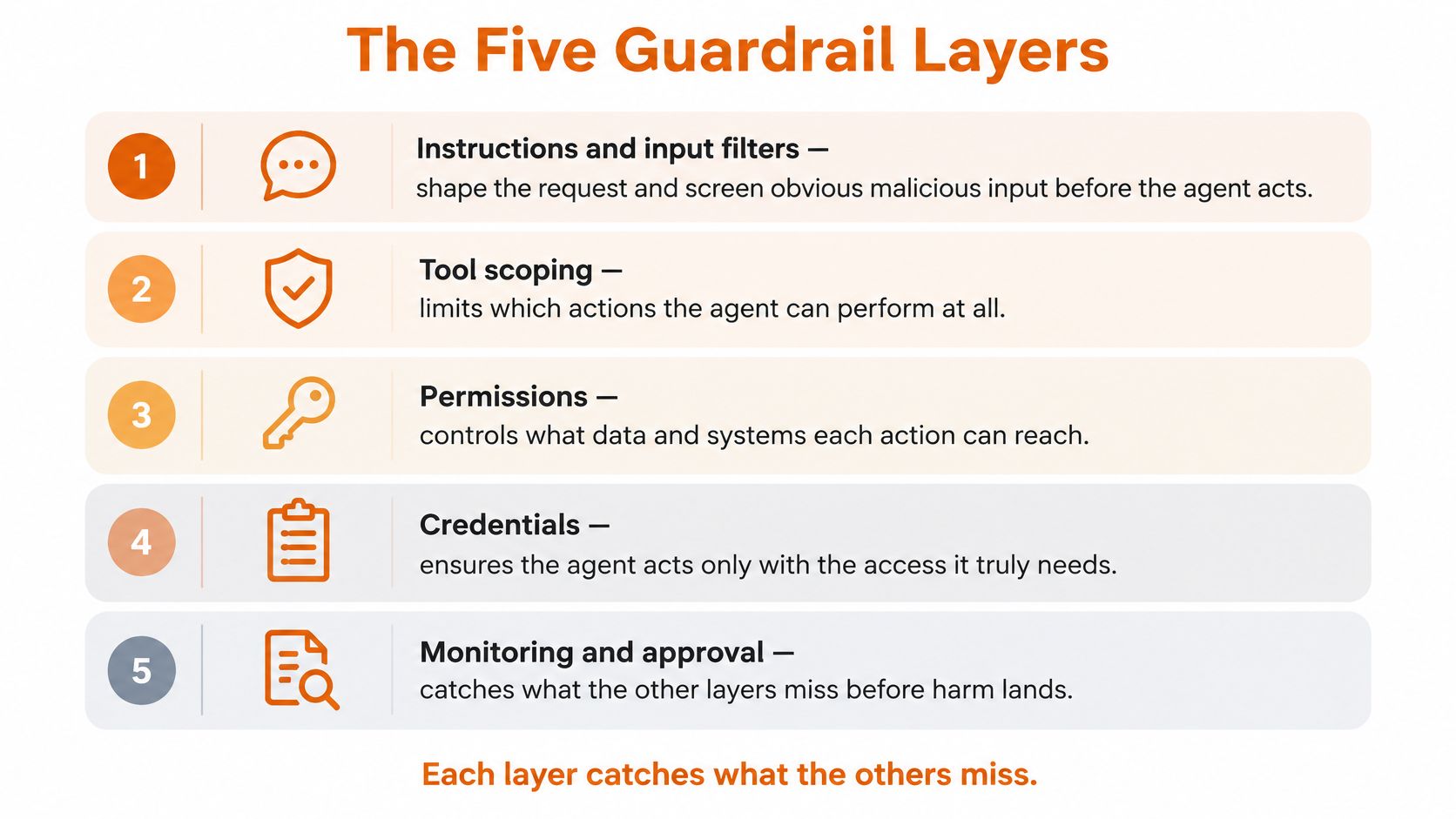
| Layer | What It Controls | Example | Failure It Prevents |
|---|---|---|---|
| Instructions and input filters | Shape the request and screen obvious malicious input | Block requests to reveal internal system prompts | Careless or obvious misuse, not determined attacks |
| Tool gateway | Allowlisted operations, constrained parameters, rate and transaction limits | A refund tool that caps the amount an agent can issue | Plans that exceed permitted actions, even after prompt injection |
| Identity and credentials | Least-privilege, short-lived, task-scoped access | Read access to one tenant's orders, revoked when the task ends | Access to data or systems beyond the task |
| Human approval gates | Explicit sign-off for irreversible or high-impact actions | A finance lead approves every outbound payment | Unrecoverable mistakes reaching customers or money |
| Monitoring and audit logs | Immutable records of agent identity, arguments, results and approvals, plus anomaly alerts | An alert when call volume spikes far above the normal pattern | Silent failures, and no evidence of what happened |
For every row, ask: Does it exist, who owns it, and what would it catch? Then ask whether the agent can bypass it through another tool or downstream integration. A blocked export endpoint is little protection if an unrestricted messaging tool can send the same records externally.
Our controls cover security boundaries and access control for models and data, human approval with explicit exception handling, and auditability of decisions, prompts, and actions. Evaluation, monitoring, and model operations continue after go-live. That's an operating commitment, not a configuration task.
Practical rule: The agent may propose an action. A separate control decides whether it may execute.
Use the following video as a discussion aid, then inspect your actual execution paths rather than assuming a diagram proves coverage.
The trade-off is additional integration work and runtime checks. Accept that cost where it protects meaningful business risk; keep low-impact paths lightweight.
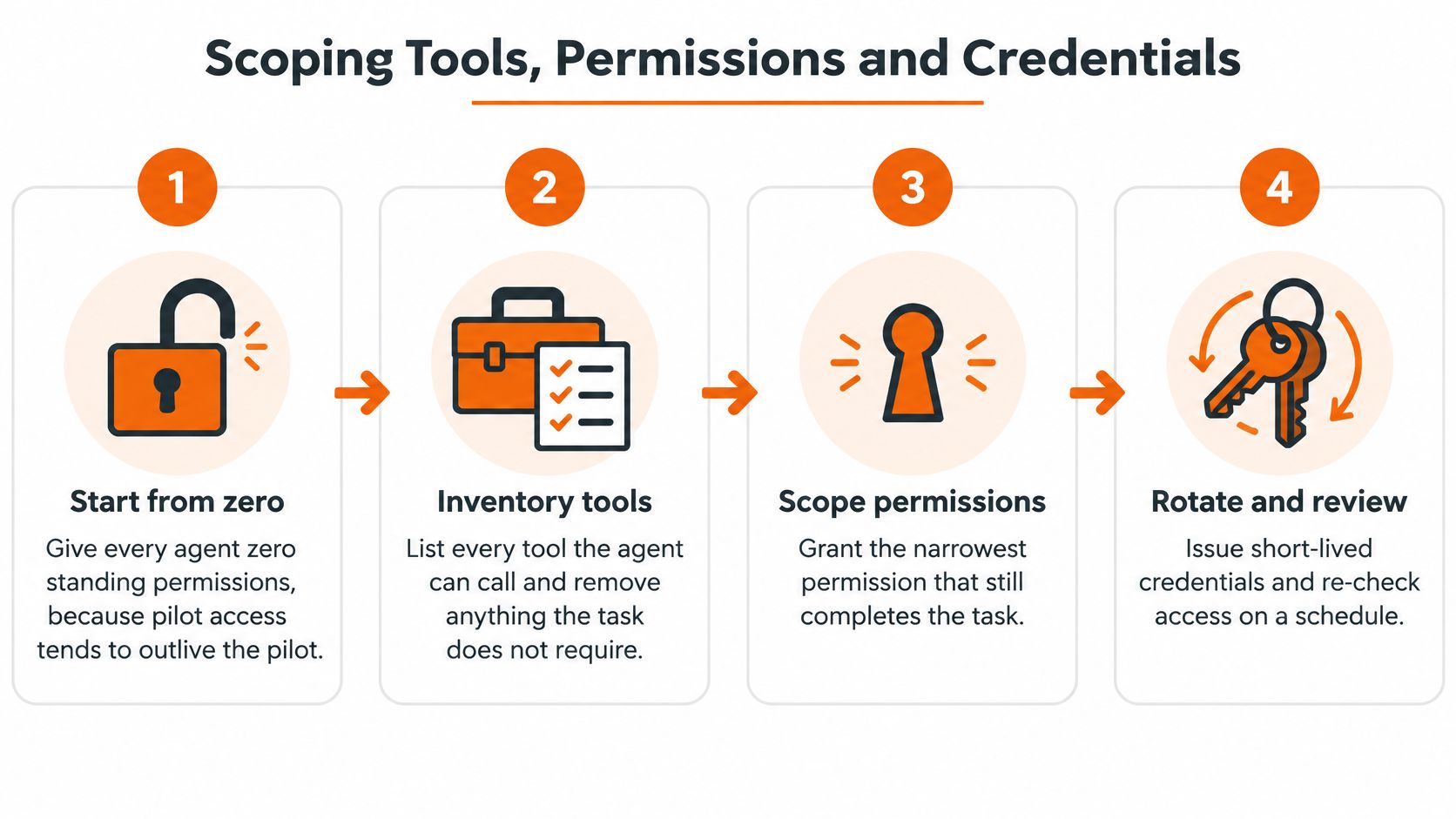
A broad service account is not a pilot shortcut. It is a standing grant that outlives the task, the approver, and often the person who created it. Scope access as part of the task lifecycle, starting from zero standing permissions.
Least-privilege controls belong in the tool layer. A manipulated plan must still hit permission and parameter boundaries that the model cannot rewrite. Those boundaries cover the whole action trajectory: which tools exist, which arguments they accept, which workflow may call them, and whether the risk tier allows the agent to act alone.
Begin with no access. Name the approved task, then issue only the permissions that task needs. Drop the administrator role that made the demo easier. It is not a temporary exception.
Inventory every callable tool. Count inherited connectors, delegated agents, and operations exposed through shared gateways. Delete unused operations. An instruction that says "do not call this" is not a control.
Replace open-ended operations with granular ones. Expose update_order_status with approved state transitions. Do not hide an unrestricted query executor behind a reassuring tool name.
Validate parameters outside the model. Enforce amount caps, recipient allowlists, tenant identifiers, and permitted values in the gateway or the downstream service. Derive the tenant from trusted session context, never from a model-supplied argument.
Separate read and write APIs. Investigation workflows get read access. Writes appear only where the business process requires them, and only on the risk tier that allows that action without a human. A combined role makes an accidental mutation harder to contain.
Issue short-lived, task-scoped credentials. Revoke them when the task finishes, fails, or is cancelled. A timeout is not enough if an abandoned task can keep refreshing its token.
Keep secrets out of model context. Trusted execution infrastructure attaches credentials without putting their values in the prompt or the tool result. Run generated code in a sandbox with restricted network access and no production mounts.
Bind confirmation to the exact action. Record the approver, resource, arguments, and approved operation before an irreversible step. If the amount or destination changes, invalidate that approval. A generic "yes" does not travel to the next call.
The engineering team should be able to see which credential is live, which tool it can reach, and when it dies.
Identity and permission are different decisions. Knowing which agent called is not the same as allowing the call. Our guide to authentication and authorization separates those two checks so a valid identity cannot inherit a wider role by accident.
Recheck authorization immediately before execution, including after a pause or an approval wait. Entitlement, task status, or resource ownership may have changed while the agent waited.
Finish with one test. If an attacker controlled the model's plan, could this tool still cause unacceptable damage? If yes, narrow the capability, harden the gateway, or remove the tool. Another sentence in the prompt will not fix an authorization hole.
Autonomy should match reversibility and impact, not how confident the model sounds. Let agents complete routine work without constant interruption. Be firm when an action affects money, identity, sensitive information, or production infrastructure.
OWASP's guidance on excessive agency identifies excessive functionality, excessive permissions, and excessive autonomy as controllable design choices. Its recommendations include granular capabilities, user authorization, human approval for high-impact actions, and downstream logging.
Use this policy as a starting point, then classify actions against your actual business consequences.
| Risk Tier | Example Actions | Control |
|---|---|---|
| Low | Summarizing a ticket, looking up order status | Autonomous, with silent filtering and logging |
| Medium | Drafting an internal reply, tagging a record | Autonomous, with sampled human review and a rollback path |
| High | Refunds, password resets, data exports, external messages | Human approval required before execution |
| Critical | Infrastructure changes, destructive database operations, credentials | Hard denial for the agent; human-led execution in a controlled workflow |
These are action categories, not permanent labels for entire agents. A support agent may look up an order autonomously but must pause before issuing a refund. A normally harmless tag update should move into a stricter tier if that tag triggers account suspension downstream.
An approval request should show the proposed change, affected customer or resource, evidence, expected consequence, and recovery options. Don't ask a reviewer to approve a vague instruction such as resolve the account issue.
When the approver is unavailable, the request waits in a queue. It never gains permission through a timeout. Define a backup reviewer or expiry path without weakening the gate.
Reduce unnecessary approvals, not scrutiny of consequential actions.
Approval fatigue turns careful review into habitual clicking. Move reversible work into sampled review, group related context, and keep high-impact execution subject to explicit approval. For publishing workflows, Mallary.ai on agent publishing safety offers a focused companion resource for separating content preparation from public release.
Feedback also needs an owner. A closed-loop AI workflow should turn rejected proposals and corrected outcomes into evaluation cases and policy improvements.
Finally, challenge whether the step needs AI at all. RITE NRG uses AI when it creates measurable value and conventional software when that's simpler, safer, or more economical. Fixed eligibility rules and payment calculations don't become better because an agent performs them.
A control that blocks legitimate work can undermine the automation you're trying to deliver. An evaluation discussed in a Springer chapter on guardrail effectiveness found attack success fell from 85% to 0% in some configurations, while false refusals reached 25%. Those are benchmark results, not a production guarantee, but they expose the trade-off clearly.
Build a regression suite around representative business workflows. Run it whenever the model, prompts, tools, retrieval sources, or policies change. Include direct prompt injection and indirect instructions embedded in documents, email, web pages, and retrieved records.
Say an agent retrieves a sensitive record, summarizes it, sends the summary externally, and attempts to delete the audit trail. Testing each call separately won't establish whether the complete sequence violates your information-handling policy.
A security analysis of multi-agent systems identifies behavioral containment, identity, capability control, provenance, and end-to-end observability as unresolved challenges. Translate that into trajectory-level policy: preserve task identity, data sensitivity, recipients, approvals, and action history across the workflow.
The test passes only when enforcement stops the sequence before the business rule is broken. Sensitive-source labels should survive summarization, and audit storage must sit beyond the agent's delete permissions.
| Metric | What It Tells You | How to Read It |
|---|---|---|
| Attack success rate | Share of adversarial tests that get through | Should fall with each release |
| Unsafe-tool invocation rate | How often the agent calls a tool it should not | Should approach zero for actions that are blocked |
| False-refusal rate | Legitimate tasks wrongly blocked | Read it alongside attack success to find the balance |
| Task completion rate | Share of real workflows finished end to end | Should hold steady as controls tighten |
| Detection latency | Time from a risky action to an alert | Shorter is better; measure it during drills |
| Runtime overhead | Added time and cost from checks | Compare against the business value of the workflow |
Define whether an unsafe invocation means an attempted call or a successfully executed action. Track both so a gateway blocking an attack doesn't conceal repeated attempts.
Use AI agent observability to connect workflow outcomes with execution evidence. Our model operations monitor model behavior, prompts, data quality, cost, exceptions, and human escalation.
Agree release thresholds before testing. Run a timed kill-switch and rollback drill, verify credential revocation, and check that queued jobs stop too. Investigate employee workarounds: copying data into an unsanctioned tool signals that the approved workflow needs attention.
The EU AI Act turns agent controls into an enterprise-risk problem with a price attached. The European Commission's AI Act FAQ sets maximum administrative penalties for prohibited AI practices at €35 million or 7% of total worldwide annual turnover from the preceding financial year, whichever is higher, alongside the other ceilings below.
| Violation Category | Maximum Penalty | Rule |
|---|---|---|
| Prohibited AI practices | €35 million or 7% of worldwide annual turnover | Whichever is higher |
| Non-compliance with other requirements, including high-risk systems | €15 million or 3% of worldwide annual turnover | Whichever is higher |
| Supplying incorrect, incomplete or misleading information to regulators | €7.5 million or 1% of worldwide annual turnover | Whichever is higher |
These are maximum ceilings, not automatic fines for every agent defect. Confirm the rules that apply to your organization, including provisions for smaller enterprises, with qualified legal counsel.
Authorities can request information, access models for evaluation, require risk mitigation, and restrict, withdraw, or recall systems. For an agent that takes actions, compliance reaches past output quality into permissions, approval evidence, security testing, monitoring, and incident response. Build that as architecture. A risk-tier model decides where the agent may act alone, where a workflow must stop for a named approval, and which full action trajectories stay blocked even when each individual step looks acceptable.
The European Commission's implementation timeline phases obligations across 2 February 2025 for prohibited practices, 2 August 2025 for general-purpose AI and governance, 2 August 2026 for transparency and Annex III high-risk systems, and 2 August 2027 for high-risk AI embedded in regulated products.
As of November 2026, the transparency and Annex III dates have both passed. The remaining scheduled date, for high-risk AI embedded in regulated products, is 2 August 2027. Do not wait for that date before putting relevant controls in place. Determine your role, the system's intended use, and its classification first. Only some agents fall into a high-risk category.
Companies serving European customers may need applicable controls even when development happens outside the EU. Put legal, product, security, and engineering owners in the same assessment. Geography is not an exemption.
Keep accurate, complete records of what the agent did, under whose authority, and on what evidence.
Preserve policy versions, approvals, test results, and incident decisions, with access restrictions and retention rules that match the risk tier. Those records support audits, operational recovery, and disputes. A team should be able to show the action trajectory without reconstructing it from chat history.
An agent rarely fails on one tool call. It fails on a trajectory: a permitted read, a workflow step, then a write the risk tier never allowed. Map permissions, workflows, approvals, and that full action path before production, while the release is still a decision.
NIST's Generative AI guidance calls for documented testing and response planning, adversarial testing, and periodic review of security and safety guardrails as operating circumstances change.
Complete this review before you call the release done:
The risk tier decides where the agent may act alone. A low-tier read can proceed under the scoped credential. A trajectory that chains that read into a high-tier write still needs a human gate, even when each step looked acceptable on its own.
Use the evidence to decide what ships, what stays disabled, and who owns the remaining work. Ship the smaller release when the boundaries are clear. Keep broad autonomy off until those assumptions are closed.
RITE NRG works as a strategic engineering partner at this transition. RITE NRG assesses a pilot against architecture, data, security, evaluation, monitoring, and ownership requirements, then delivers the gap as a bounded release with acceptance criteria.
Our RiteWay approach combines architecture before generation, AI-accelerated execution, human approval gates and production evidence. Named architects and engineers stay responsible for architecture, data, security, testing, and production quality. Agentic AI speeds analysis, implementation, testing, and documentation. Ownership of the production result stays with them.
Rite NRG offers a fixed-fee AI readiness review, priced by complexity, to assess your agent's permissions, workflows, evaluations, and production ownership before a full build. Visit Rite NRG to discuss your pilot and define a bounded release with clear guardrails and acceptance criteria.
/ about the author
Written by the RITE NRG editorial team — the architects, engineers and delivery leads who build and operate AI-era software for our clients.
Strategy & Transformation
A practical, finance-ready framework for comparing AI and modernization investment with the current-state cost, realistic benefits, delivery risk and time to value.
Technology Talent & Teams
A decision-maker's guide to IT partnership models: what each model actually transfers to the partner, what it costs beyond the rate card, and how to match the model to your situation.
AI Consulting & Automation
A practical framework for choosing and deploying transport or logistics AI agents around real exceptions, reliable data and controlled operational authority.
More guidance: all insights articles
Tell us about the system or idea behind this article. We tell you honestly if it is a fit — and what a fixed-scope delivery could look like.