

Strategy & Transformation
How to Calculate ROI for AI and Software Modernization
A practical, finance-ready framework for comparing AI and modernization investment with the current-state cost, realistic benefits, delivery risk and time to value.
operationalwrocław--:-- cet
∕ insights / closed-loop-ai.md
Closed Loop Ai
Learn how closed loop AI uses feedback, monitoring and human controls to stay accurate, safe and improving after launch.
>_article.meta
Your AI budget can grow while your delivery bottleneck stays exactly where it was. In McKinsey's 2025 global survey, only 39% of respondents attributed any level of EBIT impact to AI. Buying capability isn't the same as improving a business outcome.
Closed loop AI addresses that gap by connecting decisions to their consequences. But a feedback loop isn't proof of progress. Without measured evidence and named human owners, teams can automate bad decisions just as efficiently as good ones. The business objective is faster validated delivery, lower operating cost, and better quality, not more autonomous activity.
A support-routing model assigns tickets instantly. The dashboard looks impressive, but customers still wait because urgent cases land in the wrong queues. If nobody connects those assignments to resolution outcomes, the team has accelerated sorting without improving service.
Closed loop AI connects sensing, deciding, acting, and measuring in a recurring cycle. The system uses observed results to inform subsequent decisions rather than stopping at a prediction. That adjustment might involve a routing rule, a prompt, a workflow, or a model update. It doesn't require retraining the model after every action.
Think of a thermostat. It reads the room temperature, compares it with the target, adjusts the heating, and reads again. The defining feature isn't intelligence. It's the connection between an action and the next measurement.
The underlying principle has a long history. AI Future School's industrial automation overview describes a float regulator for a water clock attributed to Ctesibius around 270 BCE, an early feedback-controlled device. Modern control theory later formalized feedback, while reinforcement learning introduced ways to improve action policies through experience.
The same operating pattern applies to business software. This diagram shows where the result returns to the decision process.
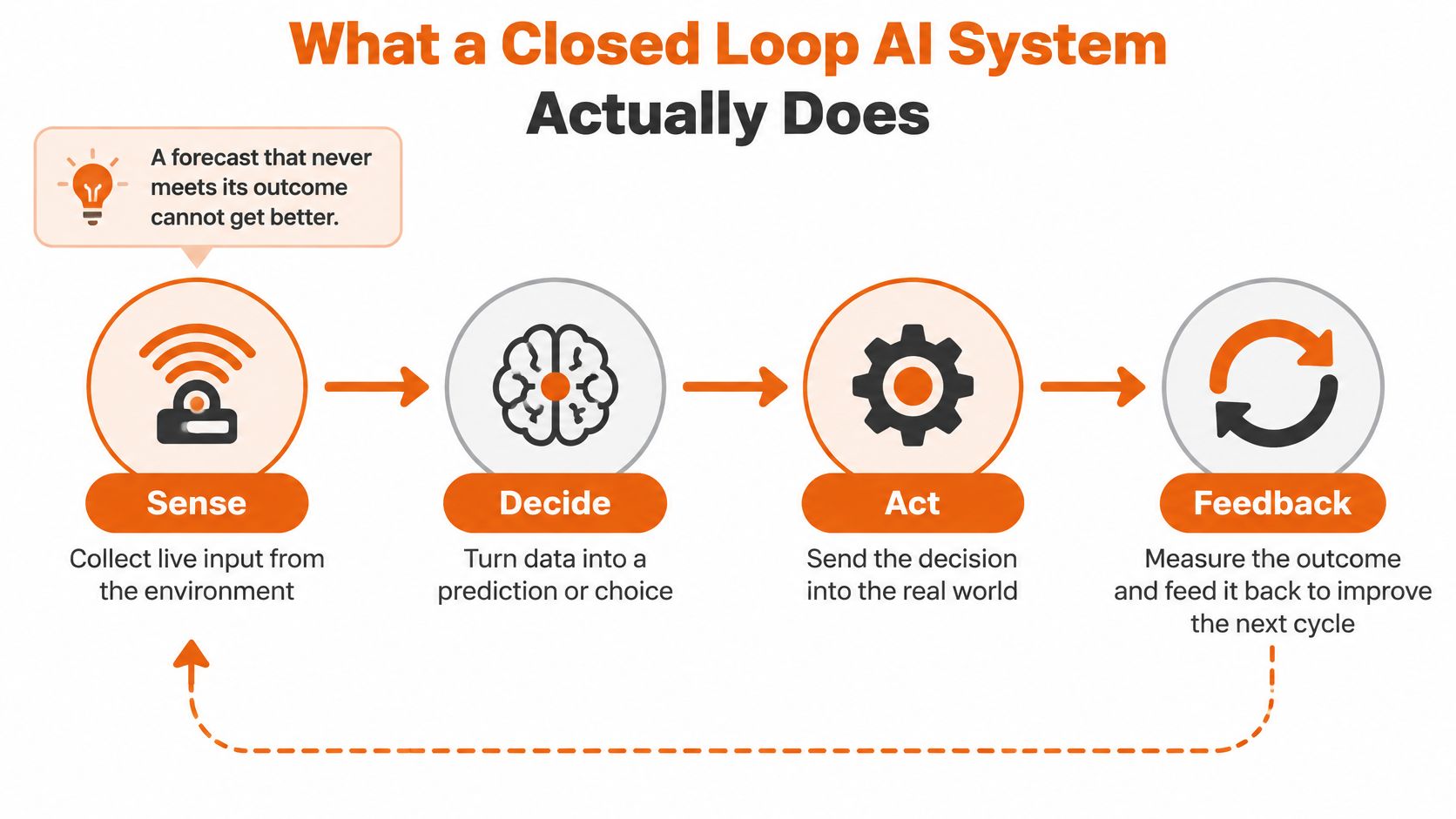
The four stages of a closed loop with a business example
| Stage | What Happens | Business Example | What to Record |
|---|---|---|---|
| Sense | Live data about the process is collected | New support tickets arrive with text, channel and customer tier | Input volume and data quality |
| Decide | The model chooses or recommends an action | Assigns a priority and a queue to each ticket | Model version, confidence and rule applied |
| Act | The system executes or proposes the action | Routes the ticket or drafts a reply for approval | Action taken and who approved it |
| Measure | The outcome is compared with a target | Resolution time, reopen rate and customer rating | Result against the agreed baseline |
An open loop recommendation ends on a screen. A manager might use it, ignore it, or correct it, but the system doesn't systematically capture what happened.
In a closed loop, the support team connects the assignment to the eventual outcome. If a ticket bounces between queues, that failure becomes evidence for changing routing behavior. The team tests the change before exposing more customers to it.
Apply this quick test to any proposed AI system:
If those answers aren't clear, you have an automation proposal, not a complete operating loop.
Shipping an AI feature doesn't freeze the business around it. Customers change their language, product teams change policies, and integrations return unexpected results. Staff start overriding recommendations, then stop trusting them.
The visible costs are familiar: rework, manual checking, customer-facing errors, and slower decisions. The less visible cost is paying to operate a system whose usefulness nobody can demonstrate.
LangChain's State of Agent Engineering report reports that 89% of organizations have some agent observability, but only 52.4% conduct offline evaluations on test sets. Seeing what an agent did isn't the same as proving it performed well enough to release.
Human review doesn't automatically close that gap. Reviewers can disagree, tire, or focus on unusually obvious failures. If a team records approvals without recording why reviewers approved them, it creates a weak learning signal.
Practical rule: A trace tells you what happened. An evaluation tells you whether it was acceptable.
Look for warning signs: nobody owns outcome data, performance appears only in monthly reports rather than release decisions, and retraining requires a special initiative instead of following an established operating process.
More feedback won't fix a badly chosen objective. Reward ticket closure speed and the system may close cases prematurely. Reward approval volume and reviewers may become a bottleneck the team tries to bypass. Optimize quick satisfaction scores and unresolved problems can remain hidden.
Ask the product owner, engineering lead, and operations owner to answer these questions together:
Don't accept activity counts as answers. Executed actions, generated responses, and logged traces describe workload. They don't establish value.
Treat evaluation as part of delivery, not a report produced after launch. Establish the current baseline before changing anything: task success, completion time, customer-impacting errors, and operating cost. Otherwise, a different workload can look like a better model.
Use complementary layers. Offline evaluation checks controlled examples before release. Online monitoring catches behavior under real conditions. Evidence-gated changes determine whether a prompt, policy, integration, or model update deserves production exposure.
The evaluation-driven operations paper recommends connecting detected failures to traceable remediation, combining controlled tests with production monitoring. Put that into practice through a clear failure-to-fix path:
Version prompts, tools, policies, evaluation sets, and model releases together. Without that record, engineers can't reliably attribute a performance change to a specific intervention.
For workflow design, Yellow.ai's resource on building effective continuous improvement cycles provides useful context. Connect that operating discipline to the delivery lifecycle, including acceptance criteria and release gates, rather than maintaining a separate AI experiment; our AI software development lifecycle guide explores that connection.
Metrics that show whether a closed loop is improving
| Metric | What It Tells You | Warning Sign |
|---|---|---|
| Intervention rate | Share of actions that need a person | Rising share after a release |
| Escalation latency | How long exceptions wait for a decision | Queues growing overnight or across weekends |
| False-approval rate | Bad actions a reviewer let through | Any upward trend after a model or prompt change |
| Manual correction rate | Share of outputs that staff edit | Edits increasing while volume stays flat |
| Cost per successful task | Total spend divided by correct, completed outcomes | Cost rising while success stays flat |
| Segment performance gap | Whether one region, language or customer group is quietly worse | Gap widening after an update |
Define the denominators carefully. Cost per successful task should include retries, verification, and human correction, not just model inference. Segment comparisons should use comparable tasks so differences in workload don't masquerade as quality differences.
AI model operations must monitor model behavior, prompts, data quality, cost, exceptions, and human escalation. Assign owners to alerts and specify the action each alert requires.
Write rollback criteria before launch. Decide which permission failure stops execution immediately, which quality decline blocks expansion, and who restores the previous version. Incident response is a poor time to negotiate acceptable risk.
Separate the actor from the checker. The actor performs the task; an independent verification step checks evidence, calculations, permissions, and expected side effects before commitment. An agent shouldn't approve its own database mutation merely because its explanation sounds convincing.
A production-enterprise-agent verification study describes this execute, observe, compare, and correct pattern. The useful engineering lesson is to budget explicitly for verification, particularly around tool calls and consequential actions.
Set retry limits and escalation rules. Repeated self-correction consumes time and money without guaranteeing a correct result. When the agent exhausts its budget, it should preserve context and hand the problem to a person, not improvise wider permissions.
In production research covering 306 practitioners across 26 domains, 68% of deployed agents executed no more than 10 steps before requiring human intervention, while 74% relied primarily on human evaluation. That's a practical challenge to the assumption that adding feedback creates dependable autonomy.
Separate the human responsibilities:
For customer support, standardize routine responses before expanding agent authority. SignalZen's guidance on using templates to streamline customer service is useful for defining that repeatable work. Templates still need clear limits for account changes, financial commitments, and sensitive disclosures.
How much autonomy each task type can safely get
| Task Type | Reversibility | Human Role | Example |
|---|---|---|---|
| Low risk, easy to undo | Easy to reverse | Automatic execution with sampled review | Tagging support tickets |
| Customer-facing, moderate cost | Partly reversible | Auto-execute within set limits, then post-action review | Issuing refunds under a fixed amount |
| High risk or irreversible | Hard or impossible to reverse | Permanent approval gate | Deleting customer data or sending contract terms |
| Regulated decisions | Reversal follows the applicable rule | Approval plus a full audit trail | Credit or eligibility decisions |
These are starting policies, not permission to automate a regulated decision without checking the applicable requirements.
The NIST AI Risk Management Framework organizes governance through Govern, Map, Measure, and Manage. In business terms: set owners and policy, define context and risks, test and monitor, then apply controls.
Our practical AI governance framework translates that responsibility into operating decisions. We design private or local deployments where data sensitivity, regulation, or cost requires them, with clear boundaries between the client environment and external services.
Controls include access restrictions for models and data, explicit approval and exception paths, audit trails for decisions, prompts, and actions, plus evaluation and monitoring after go-live. Senior engineers remain accountable for data, security, integration, and production quality.
For high-risk actions, human approval can be the permanent control, not a temporary obstacle to autonomy.
Every outcome reaching production needs a named owner with authority to intervene.
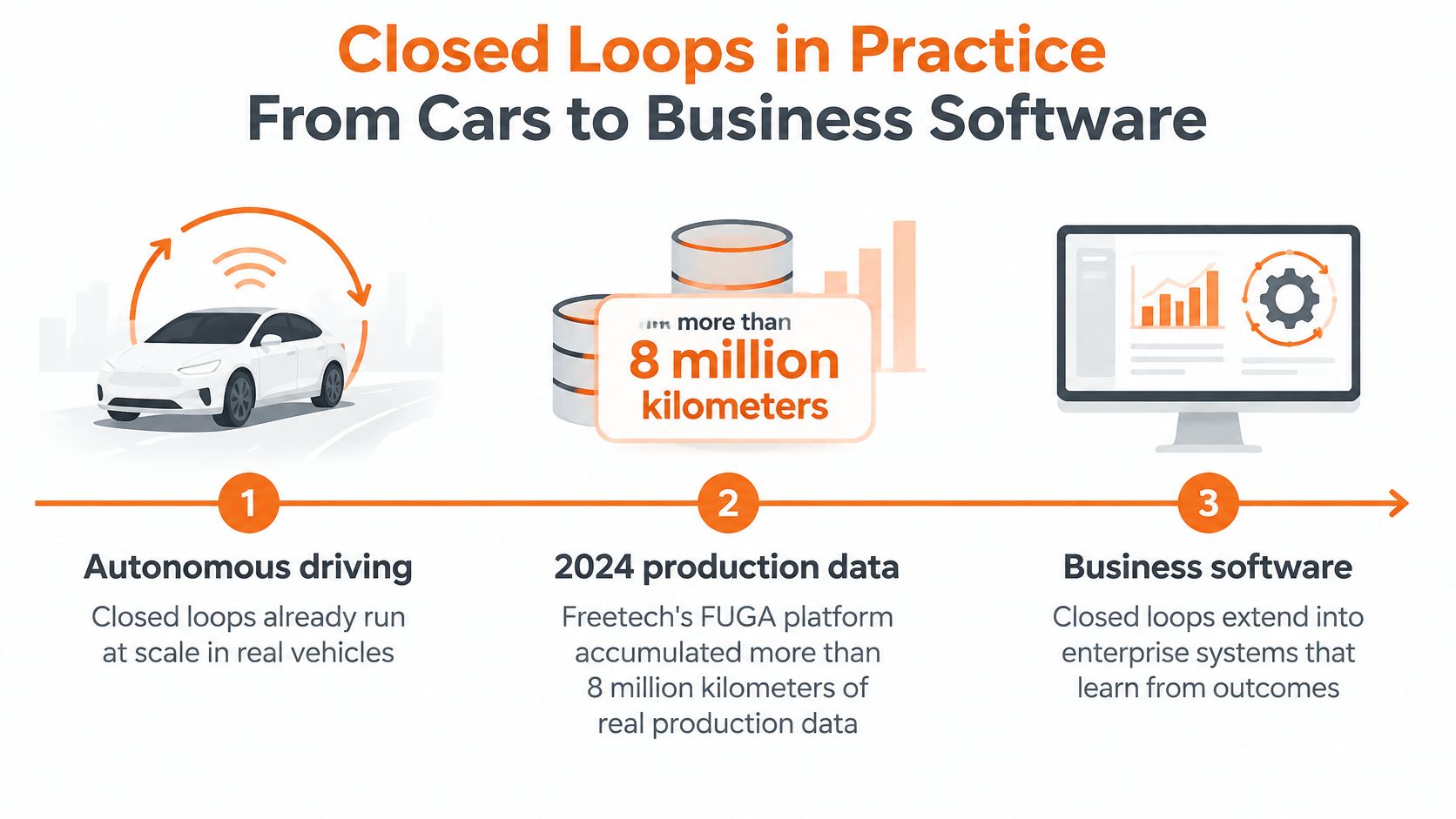
Autonomous-driving teams demonstrate the scale at which feedback can operate. A 2024 autonomous-driving data closed-loop report stated that Freetech's FUGA platform had accumulated more than 8 million kilometers of real production data and supported closed-loop iteration across more than 100 production models.
The progression from vehicle feedback to enterprise workflows is easier to see visually.
A separate 2024 ResearchInChina industry estimate expected Li Auto's end-to-end driving model to learn from more than 5 million kilometers of data by the end of 2024. That was an expectation, not confirmation of the final result.
A 2025 ResearchInChina report described synthetic data increasing from 20–30% in 2023 to 50–60% in 2025 in the autonomous-driving data context. Synthetic scenarios offer a way to address coverage gaps, but teams still need to validate whether those scenarios represent the failures they care about.
Better experiment selection is the objective in scientific discovery. A Frontiers article on closed-loop scientific AI describes linking hypothesis generation, experiment design, data acquisition, and model updating, while people retain responsibilities including data curation and interpretation.
For another view of the topic, the following video provides additional context.
Consider a hypothetical support team targeting shorter resolution times without increasing reopened cases. It reviews those outcomes weekly and turns each meaningful failure cluster into a regression test before releasing routing changes.
Business applications also show why outputs need domain-specific checks:
These projects illustrate AI applications, not proof that every workflow automatically learns in production. Whether the mechanism regulates water, guides experiments, or routes software work, someone must define the acceptable result and own the decision to change it.
Bad labels, skewed samples, and outdated customer behavior can make a larger dataset less useful. If reviewers approve plausible but incorrect answers, collecting more approvals reinforces the wrong lesson.
Replacement belief: Better evidence matters more than more feedback. Before approving the next iteration, ask: Which feedback have we rejected as unreliable, and why?
Autonomy is a permission decision, not a maturity badge. Letting an agent categorize a ticket doesn't justify allowing it to delete the underlying customer record.
Replacement belief: Match authority to consequence. Ask: Which action must remain blocked until an accountable person approves it?
Google's 2024 DORA research associated a 25% increase in AI adoption with improvements of 7.5% in documentation quality, 3.4% in code quality, and 3.1% in code-review speed, but also declines of 1.5% in delivery throughput and 7.2% in delivery stability. These are associations, not a guarantee that AI causes either outcome.
Generating code faster doesn't remove integration work, review queues, or release risk. Keep changes small and test them thoroughly rather than creating larger batches that senior engineers must untangle.
Replacement belief: Measure validated delivery and production quality together. Ask: Did customers receive the improvement sooner without an increase in defects or recovery work?
Count successful releases and durable customer outcomes, not generated code.
Approve the next loop only when the team can answer those questions with evidence. If it can't, improve the workflow before increasing automation.
A loop that scales before it is measured does not scale results. It scales whatever behavior it already has, and bad behavior compounds just as fast as good. Run this checklist with the people responsible for product, engineering, and operations before widening any loop's authority:
An AI opportunity assessment from Rite NRG is delivered for a fixed fee priced by complexity. Data reality, quality, and access are assessed early, and risk, regulation, and operating ownership are defined up front, so the workflow you scale is the one you understand.
The route to production runs through four stages: Discover, Design, Build and prove, and Operate. AI goes where it creates measurable value; conventional software wins wherever it's simpler, safer, or more economical. That distinction matters more than the model you pick.
AI changes the economics of delivery. The engineering standard stays the same. When AI accelerates implementation, senior engineers remain accountable for data, security, integration, and production quality.
Your next decision is specific: choose the workflow whose baseline, risk, and ownership you can establish before you scale it.
Rite NRG offers a practical assessment of your proposed closed loop AI workflow, covering business value, data readiness, evaluation, and operating controls. Visit Rite NRG to discuss the process you want to improve and define the evidence you'll need before committing to production.
/ about the author
Written by the RITE NRG editorial team — the architects, engineers and delivery leads who build and operate AI-era software for our clients.
Strategy & Transformation
A practical, finance-ready framework for comparing AI and modernization investment with the current-state cost, realistic benefits, delivery risk and time to value.
Technology Talent & Teams
A decision-maker's guide to IT partnership models: what each model actually transfers to the partner, what it costs beyond the rate card, and how to match the model to your situation.
AI Consulting & Automation
A practical framework for choosing and deploying transport or logistics AI agents around real exceptions, reliable data and controlled operational authority.
More guidance: all insights articles
Tell us about the system or idea behind this article. We tell you honestly if it is a fit — and what a fixed-scope delivery could look like.