

Strategy & Transformation
How to Calculate ROI for AI and Software Modernization
A practical, finance-ready framework for comparing AI and modernization investment with the current-state cost, realistic benefits, delivery risk and time to value.
operationalwrocław--:-- cet
∕ insights / ai-software-development-life-cycle.md
AI SDLC
Learn every phase of the AI software development life cycle, from discovery to monitoring, with governance checks, metrics and a clear next step for your team.
>_article.meta
Your team builds an AI prototype over a weekend, and everyone applauds the demo. Then the release stalls for weeks because nobody owns the data pipeline, the failure cases, or the checks needed to put it in front of customers.
That's not a coding problem. It's a delivery problem, and generating more code won't fix it.
The AI software development life cycle is the familiar process of planning, building, testing, releasing, and running software, extended with discovery, data collection and labeling, model development, integration, behavioral testing, deployment, monitoring, and governance.
The business stakes are straightforward: get useful features to customers sooner without paying for that speed through rework, incidents, or growing support costs. Discovery, data, evaluation, and accountability determine whether a promising prototype becomes a dependable product.
Adoption makes this urgent: in 2025, 84% of developers said they were using or planned to use AI tools in their development process, according to Stack Overflow's 2025 Developer Survey.
A successful demonstration is a useful starting point, not evidence that a feature is ready to operate.

Think of traditional software delivery as a kitchen following a fixed recipe. An AI feature is closer to a dish whose ingredients keep changing: customer inputs, retrieved documents, and model behavior can all affect the result. You need to taste at every station, not just before serving.
Ownership rule: Every generated artifact needs someone who remains responsible for it after release, not merely someone who approved its creation.
Use a phase map, explicit checks, a delivery scorecard, and a governance checklist to make that responsibility concrete. The payoff to pursue is faster time to market, less rework, fewer production incidents, and no ambiguity about who fixes what.
Eight AI SDLC phases compared with traditional delivery
| Phase | Traditional SDLC equivalent | What AI changes | How agents accelerate it | What engineers keep owning |
|---|---|---|---|---|
| Discovery | Requirements and scope | Must test whether AI fits the problem at all | Draft options, summarize research, analyze backlog | Business constraint and go or stop decision |
| Data collection and labeling | Data preparation for reports | Data becomes part of the product and needs quality and rights checks | Draft labeling guides and flag gaps | Data quality, provenance, and consent |
| Model development | Feature coding | Outputs are probabilistic and need evaluation sets | Scaffold experiments and evaluation harnesses | Evaluation criteria and model choice |
| Integration | API and system integration | Model calls, tool permissions, and fallbacks need explicit design | Write adapters and integration tests | Architecture boundaries and permissions |
| Testing | QA cycles | Behavior must be checked, not only code paths | Generate test cases and mutation checks | Acceptance criteria and coverage judgment |
| Deployment | Release pipeline | Model, prompt, and data versions ship together | Prepare configurations, release notes, and rollout scripts | Release approval and rollback triggers |
| Monitoring | Operations and incidents | Quality, drift, and cost need ongoing observation | Triage alerts and summarize incidents | Incident response and quality review |
| Governance | Compliance review | Risk tiers, audit logs, and oversight apply throughout | Maintain inventories and audit trails | Accountability sign-off and retirement decisions |
Discovery determines whether AI is appropriate. Data work establishes reliable inputs, model development compares candidate approaches, and integration connects the chosen approach to real systems. Testing challenges behavior before deployment exposes it to users.
Monitoring isn't the end. When an operations engineer finds a new failure pattern, the team may need better labels, different retrieval, revised prompts, or a narrower product scope. Governance applies across that loop rather than appearing as a final approval meeting.
The visual map makes the feedback path easier to follow.
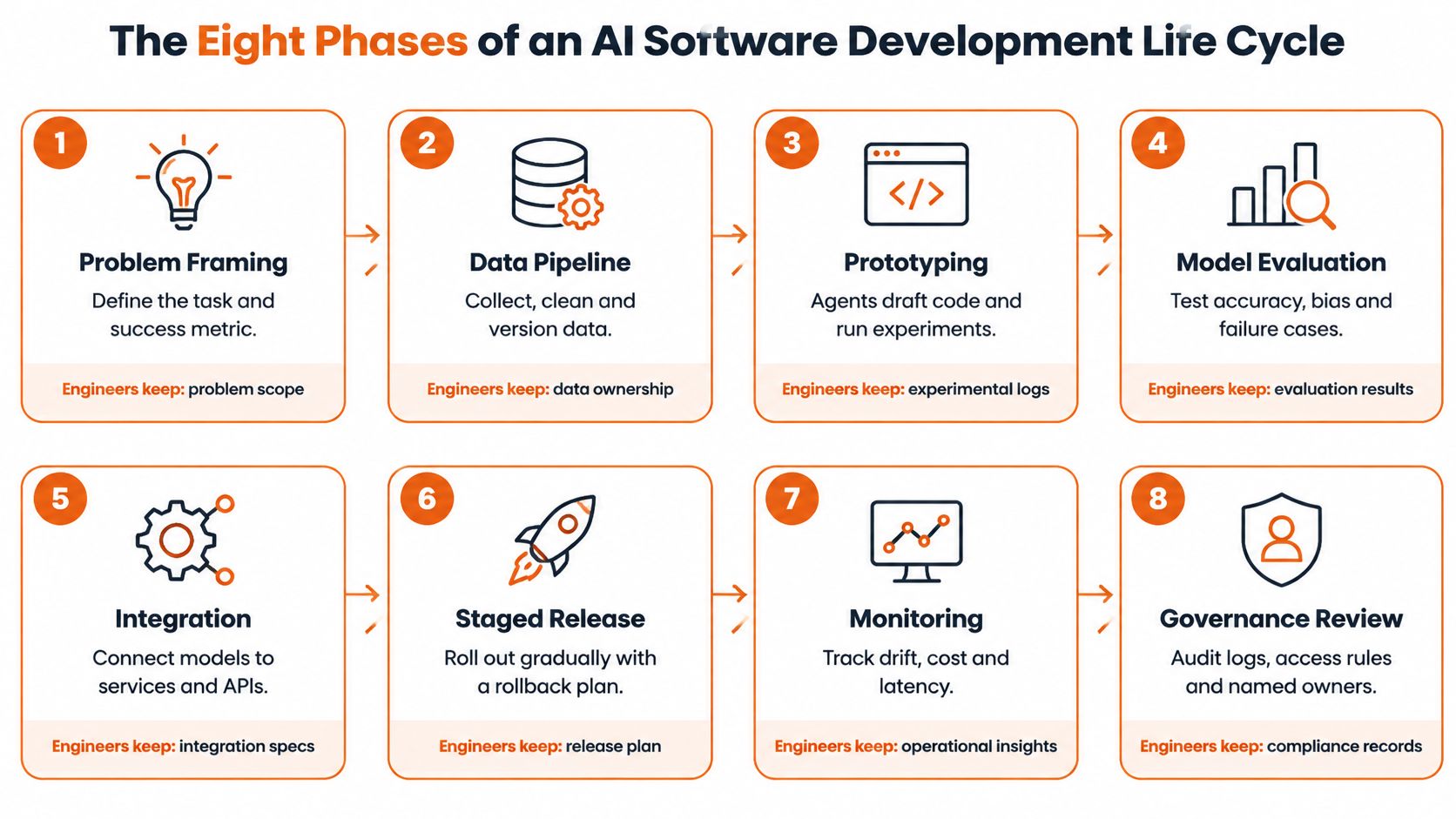
Translate the table's responsibilities into actual names. The product lead owns discovery decisions after launch; the data steward owns source corrections and label changes; the technical lead owns model and prompt behavior; and the service owner owns integrations.
The QA lead maintains acceptance evidence, the release lead maintains recovery readiness, and the operations lead owns incident response. The capability owner remains responsible for governance and eventual retirement. People can hold several roles, but a shared team mailbox isn't an accountable owner.
An agentic delivery model helps throughout: agents draft analysis, scaffold implementation, prepare migration work, and maintain documentation. Architects retain sign-off on architecture, data, security, and release quality.
AI accelerates each phase. It doesn't replace the accountable owner.
Start with the economic constraint, not a model shortlist. Are customers waiting too long for a feature, engineers drowning in repetitive work, or support costs rising because employees can't find reliable answers?
A founder asking for an autonomous assistant may in fact need better search and a predictable workflow. Challenge that assumption before committing to a technically impressive solution with expensive operating requirements.
Name the business constraint and baseline it. Record the current task completion time, handling cost, quality, and review effort relevant to the use case. Without a baseline, the team can demonstrate activity but can't establish improvement.
Write the job the AI must do and the failure it must avoid. Ask whether the task is bounded, whether someone can verify the output, and what a wrong answer costs the business. These answers determine whether to automate, assist a human, or use deterministic rules instead.
Inventory data sources and their rights. Identify source owners, permitted uses, personal data, retention obligations, and deletion paths. Access to a document doesn't automatically grant permission to use it for training or retrieval.
Draft labeling guidelines and test them on a sample. Have two reviewers independently assess a small gold set, reconcile disagreements, and check for missing languages, unusual cases, and underrepresented groups. Disagreement usually means the instructions need work before labeling expands.
Set go or stop criteria before development starts. Define acceptable behavior, prohibited outcomes, and an operating-cost ceiling. Include estimated monthly model calls, hosting, and human review hours so the decision accounts for ongoing cost, not just the build.
Say a logistics team wants an assistant to handle delivery exceptions. Ticket review reveals repeatable categories that support automated triage, while disputed charges and conflicting delivery evidence still require people. The first release classifies and routes tickets rather than making commercial decisions.
For document-heavy workflows, Head of Agents offers a useful way to explore AI-powered enterprise knowledge bases. Evaluate that pattern against your access controls and source quality before deciding that a custom model is necessary.
The data steward should document ingestion failures, source refresh rules, deletion propagation, and how corrected labels reach evaluation sets. A practical data pipeline architecture makes those responsibilities visible instead of hiding them inside scripts.
Don't start model work while the team is still arguing about what a correct label means.
After launch, the product owner retains responsibility for scope decisions. The data steward retains responsibility for freshness, provenance, and corrections, including when an upstream department changes its documents without warning.
Generated work is an input to review, not finished work. Use a layered test strategy that checks both implementation and behavior.
Testing layers for AI features
| Test layer | What it catches | AI-specific addition |
|---|---|---|
| Unit tests | Logic errors in code | Fixtures for prompts and tool calls |
| Integration tests | Broken links between model, data, and systems | Replayed model responses and failure cases |
| Evaluation sets | Wrong, unsafe, or off-tone outputs | Golden examples, rubric scoring, and holdout data |
| Mutation testing | Tests that pass without checking meaningful behavior | Confirmation that generated tests fail when logic breaks |
| Adversarial security tests | Prompt injection, data leakage, and permission misuse | Red-team prompts and tool-permission checks |
| Regression suite | Behavior changes after a model or prompt update | Fixed evaluation set run on every version change |
| Human review sampling | Subtle quality issues that metrics miss | Scheduled expert review of sampled outputs |
An agent that writes implementation and tests can repeat the same mistaken assumption in both. Generate tests from independently reviewed requirements, keep holdout examples outside the implementation context, and use mutation tools such as Stryker or PIT to check whether tests detect deliberately broken logic.
The production concern is concrete: an IDC 2025 survey of 511 respondents found that 72% said their organizations had experienced a production incident tied to AI-generated code, as reported by TechTarget. That's a survey finding, not a forecast for your system, but it supports treating validation as a release responsibility rather than an optional cleanup task.
For legacy modernization, start with characterization tests. Say an older billing service applies a special rounding rule to historical contracts. An agent could replace it with cleaner arithmetic and produce matching tests, while silently changing customer invoices.
Capture observed behavior first. Then have the business owner decide which quirks are contractual requirements and which are defects to remove.
Compare prompting, retrieval, fine-tuning, and custom model development against the same evaluation criteria. Choose the approach that meets the quality target at the lowest sustainable operating cost, including maintenance and review effort.
Integration needs explicit timeouts, bounded retries, rate limits, and fallback behavior. If the model can't support an answer, route to a person or return a clear limitation. Don't let repeated retries create duplicate actions; use idempotency controls around writes.
Keep tool authorization outside model-generated text. A plausible request to issue a refund is still only a request until the application verifies the user, account, amount, and permitted action.
Agents can prepare fixtures, test scaffolds, adapters, and migration checks quickly. Engineers decide whether those checks prove anything. After release, the technical lead owns prompt and model changes, the service owner owns integration failures, and the QA lead owns the evaluation suite's continued relevance.
Treat deployment as a controlled experiment, not a switch. Increase exposure only when the release owner has evidence that the next stage is justified.
Set rollback triggers before launch: unacceptable quality drops, error spikes, cost per request above budget, and safety flags. Route safety flags to immediate containment and human review rather than allowing the system to keep acting while someone investigates.
An AI release includes code, model version, prompt, retrieval index, tool permissions, and configuration. Version the release as a manifest and test restoration of a compatible combination. Restoring code alone won't undo a changed retrieval source or an expanded permission.
The distinction between an AI proof of concept and a production system is operational: someone must be able to explain, support, and safely reverse what shipped.
DORA's metrics guide defines four operational measures: deployment frequency, change lead time, change failure rate, and failed-deployment recovery time.
Four DORA measures for AI-assisted delivery
| Measure | What it tells you | Warning sign with AI assistance |
|---|---|---|
| Deployment frequency | How often validated changes reach users | Frequent releases while failures climb |
| Change lead time | How quickly committed changes reach production; track approved-decision waiting time separately | Faster coding but longer review queues |
| Change failure rate | Share of releases causing production problems | Rising after model or prompt updates |
| Failed-deployment recovery time | How fast service is restored | Incidents that are hard to trace to a prompt, model, or data change |
More frequent releases alongside more failures aren't evidence of useful acceleration. Read the measures together and connect them to the customer outcome: successful task completion, reduced handling effort, or dependable access to a feature.
Monitor expert-sampled output quality, input and output drift, latency, cost, refusal and error rates, and misuse patterns. Investigate context as well as averages: a healthy overall score can conceal poor performance for a particular language or customer workflow.
Operational test: If the on-call engineer can't identify the active prompt, model, and retrieval version, the release isn't supportable.
The operations owner handles containment and escalation. The capability owner decides whether recurring failures require data corrections, model changes, narrower scope, or retirement.
Governance protects delivery speed by making approvals and boundaries predictable. Treat it like building permits and fire inspections: plan them into construction instead of discovering the requirements when people are ready to move in.
The same principle applies to software architecture and release planning.

NIST's secure development guidance for AI recommends maintaining security requirements throughout development and extending secure development practices to AI systems. Treat agents as governed software supply-chain participants, not exceptions to your engineering controls.
Start with an inventory of every agent, model, tool, prompt, retrieval source, and generated artifact. Assign a named owner and record its purpose, access, dependencies, and retirement conditions.
Give each agent a managed identity and only the repository, pipeline, data, API, and infrastructure access its task requires. Authenticate and authorize actions continuously. A coding agent preparing a pull request shouldn't also have unrestricted production deployment authority.
The higher the cost of a wrong answer, the stronger the review and evidence should be. Internal tooling isn't automatically low risk, particularly if it can access sensitive data or change infrastructure.
For a platform-team evidence checklist, Agentable's AI audit guidance for platform teams is a useful starting point. Adapt it to the capability's actual permissions rather than treating audit preparation as a document-collection exercise.
Use this discussion as a checkpoint for your team's control decisions.
Build logging, human oversight, and post-release monitoring into the operating model so teams can respond to regulatory expectations across markets without rebuilding controls for every release. Legal counsel should determine the obligations that apply to the system and jurisdiction.
A practical AI governance framework for growing companies should clarify decisions, not create an approval maze. Every material capability needs a named owner, an escalation path, and a tested way to stop unsafe behavior.
Faster coding means a faster project.
A shorter implementation step can leave reviewers facing a longer queue. Measure the time from an approved decision to a safe production outcome, including clarification, review, rework, and release delays. The delivery lead owns that end-to-end measure; the maintainer owns the generated code after it ships.
AI makes senior engineers optional.
Generated output still needs senior judgment. Set architecture sign-off and review capacity before increasing generation, or maintainers will spend their time explaining code they did not choose to create.
The post-generation accountability gap appears in a 2025 study of open-source projects: Copilot adoption increased productivity primarily among less-experienced contributors, while code written after adoption needed more rework to meet repository standards. Experienced maintainers reviewed 6.5% more code and saw a 19% decline in their own original-code productivity. Assign a maintainer to each generated change before it enters the codebase, and keep that ownership after release.
A successful pilot proves the model will hold at scale.
A pilot can show that a task is feasible, but it does not prove the team can maintain the resulting system. Broader use brings unfamiliar inputs, concurrent actions, source changes, and support demands. Require operational evidence before expanding scope, and name the owner responsible for the feature in production.
Governance can wait until after launch.
Late discovery means revisiting permissions, data handling, and release architecture while customers already depend on the feature. Assign decision ownership during design, when the team can still shape the system without incident pressure.
Treat these signals as delivery problems, not cosmetic issues. Reserve a technical-debt budget, record architecture decisions, retain provenance notes for generated code, and include maintainability thresholds in the definition of done. The engineering owner should keep those records current after release; the product owner should confirm that the implemented behavior still serves the intended use.
Make the thresholds concrete: another engineer can explain the behavior, each dependency has an owner, the runbook covers failure, and evaluation evidence accompanies changes. The delivery lead raises constraints early, states the trade-off plainly, and gets a decision before operations inherits the consequences.
Set a clear delivery gate for the next two weeks. Give one person authority to make the go, revise, or stop decision.
RITE NRG can support teams across the AI delivery lifecycle. Its AI consulting and automation work covers roadmaps and production-ready agentic systems. Software engineering covers new products and legacy modernization. For qualifying projects, RITE NRG can deliver an agreed production release within 45 working days at fixed scope and fixed price. Talent and dedicated-team services include complete R&D centers built and operated in Poland. Managed services cover hosting, monitoring, and support.
Keep ownership explicit when a partner contributes. AI agents accelerate analysis, development, testing, documentation, and migration, while senior architects remain accountable for architecture, data, security, and production quality. Before work starts, name who approves generated code, maintains prompts, and handles corrections after release. That keeps faster drafting from leaving production work without an accountable owner.
Start with a scoping conversation about the constraint, evidence, and ownership. RITE NRG offers AI consulting, software engineering, dedicated teams, and managed services to take an AI feature from discovery into supported production. Visit Rite NRG to scope your first delivery gate and agree what evidence will make the release ready.
/ about the author
Written by the RITE NRG editorial team — the architects, engineers and delivery leads who build and operate AI-era software for our clients.
Strategy & Transformation
A practical, finance-ready framework for comparing AI and modernization investment with the current-state cost, realistic benefits, delivery risk and time to value.
Technology Talent & Teams
A decision-maker's guide to IT partnership models: what each model actually transfers to the partner, what it costs beyond the rate card, and how to match the model to your situation.
AI Consulting & Automation
A practical framework for choosing and deploying transport or logistics AI agents around real exceptions, reliable data and controlled operational authority.
More guidance: all insights articles
Tell us about the system or idea behind this article. We tell you honestly if it is a fit — and what a fixed-scope delivery could look like.