

Strategy & Transformation
How to Calculate ROI for AI and Software Modernization
A practical, finance-ready framework for comparing AI and modernization investment with the current-state cost, realistic benefits, delivery risk and time to value.
operationalwrocław--:-- cet
∕ insights / agentic-ai-workflow-automation.md
Agentic Ai Workflow Automation
Agentic AI workflow automation explained: how it works, where it pays off, and how to deploy governed, production-ready agents in your business.
>_article.meta
Your onboarding process looks fine on a diagram. A deal closes, finance raises an invoice, delivery creates a workspace, IT provisions access, support gets a handover note. Then you watch what happens on a Tuesday: a coordinator copies account data from the CRM into the ERP, opens four tickets by hand, pastes the same values into a spreadsheet, and messages someone to confirm the welcome email went out.
None of those steps is hard. Every one of them is expensive anyway, because each handoff adds delay, adds a place where a field gets typed wrong, and adds a person whose main job is moving data between systems that should already talk to each other. Hiring a fifth coordinator doesn't fix it. You get the same queue with more people watching it.
What leaders want is unglamorous and measurable: shorter cycle time from signature to live customer, lower cost per case, more throughput without new headcount, and fewer compliance misses when an auditor asks who approved what and when.
A workflow that needs three people to shuttle a record between two systems isn't a people problem. It's an architecture problem wearing a people costume.
Agentic AI workflow automation is the first wave of tooling that attacks the handoff itself rather than each individual task. McKinsey's 2025 Global Survey reported that 23% of respondents said their organizations were scaling at least one agentic AI system, meaning they were expanding deployment within at least one business function, while another 39% had begun experimenting with AI agents.
Read the fine print, because the concentration matters more than the headline number. Among organizations scaling agents, most were doing so in only one or two functions, and no individual business function had more than 10% of respondents reporting scaled agent use. Companies have clearly left the demo stage. What keeps them from going enterprise-wide is integration, reliability, governance and the operating-model questions nobody wants to answer during a proof of concept.
That's the tension this guide works through. How agentic systems differ from RPA and copilots, which architecture and controls make them safe to run unattended, which process to pick first, how to measure value beyond hours saved, and the gates that separate a pilot that impressed everyone from a system that holds up in production.
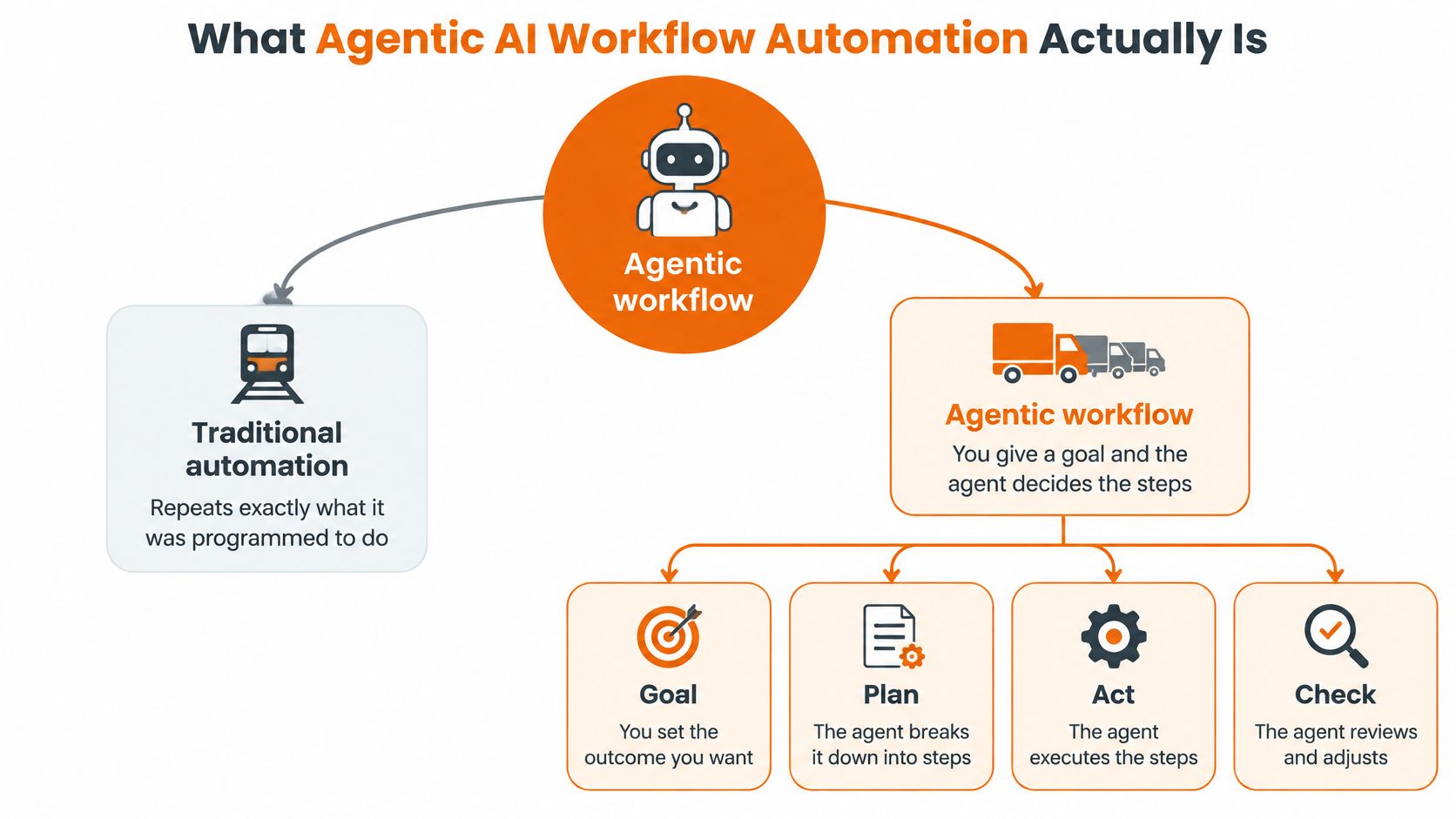
The easiest way to feel the difference is to compare a train with a dispatch fleet. Traditional automation is a train on fixed rails: same route, same stops, same timetable, and anything on the track stops the service until an engineer clears it. Agentic workflows behave more like a dispatch fleet. You give each driver a destination and a set of policies, and the driver plans the route, works around the closed road, and reports back when the delivery is done.
Under the hood, an agentic workflow is a small set of parts working together:
Follow one run end to end. A customer emails a change of billing entity. The orchestrator opens a case, the planner decomposes the request into verification, record update and notification, and worker agents call the ERP, the billing platform and the document store. A validator checks that the tax ID matches the uploaded certificate. Everything matches, so the workflow posts the update, writes an audit entry and sends the confirmation. If the certificate is unreadable, the same run parks the case in a review queue with the reason attached instead of guessing.
That model didn't appear from nowhere. Enterprise automation was already everywhere: IBM's 2023 Global AI Adoption Index found that 42% of surveyed IT professionals reported their organizations were actively deploying AI, another 40% were actively exploring it, and among organizations exploring or deploying AI, 55% used automation tools to reduce manual or repetitive work. Agentic systems take that installed base and move it from predefined steps to goal-driven execution.
Here's how the three generations of tooling compare when you have to choose one on a Monday morning.
| Dimension | Traditional automation (RPA) | AI copilot or chatbot | Agentic AI workflow automation |
|---|---|---|---|
| How it is instructed | Fixed rules and recorded scripts | Prompts answered one turn at a time | Goals plus policies, and the agent plans the steps |
| Steps per outcome | Predefined and linear | One response with no execution chain | Multi-step, conditional and cross-system |
| Exceptions | Breaks or routes to a person | Offers advice, then the user acts | Detects, retries, adapts or escalates by policy |
| System integration | UI or API scripting | Usually none beyond the conversation | Native tool and API calls with validation |
| Autonomy | None without re-scripting | Low, because a human does the work | Bounded autonomy with approval gates |
| Best fit | High-volume tasks that never change | Drafting, search and Q&A support | Cross-system processes with judgment and volume |
The same pattern is spreading well beyond back office. Revenue teams now run agentic outbound at scale, and the Franchise Foundry guide to AI SDRs is a useful reality check on where autonomy helps and where a human still has to own the relationship. The mechanics are identical: a goal, a set of tools, a policy boundary and a person accountable for the outcome.
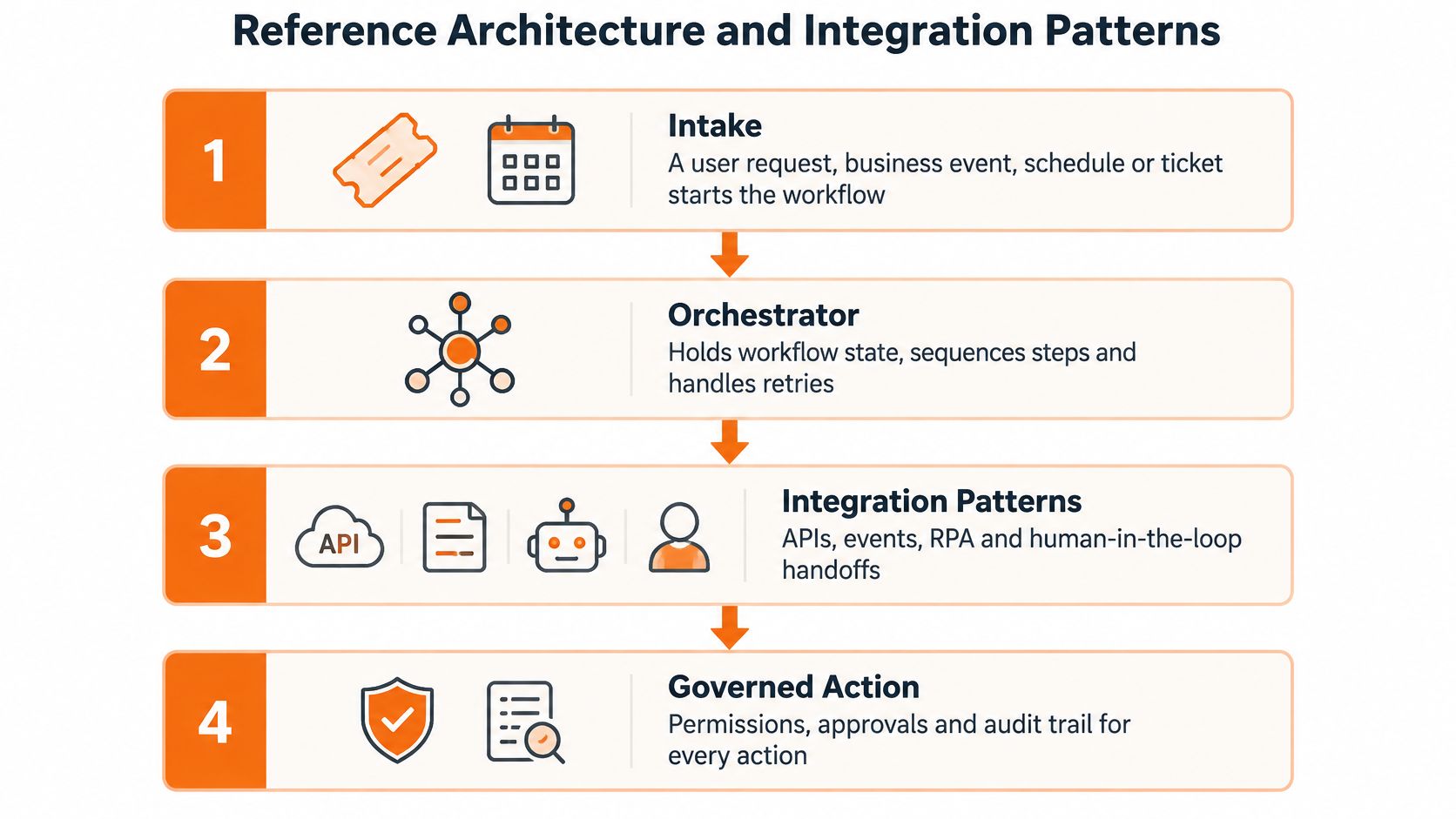
A production agentic workflow needs seven named layers, each with a clear owner. The model is only one part of the system. Architecture determines what the agent can access, how work proceeds, and where a person must review or take over.
Integration choices shape how reliably these layers work together. Prefer API-first connectors to screen scraping, and treat scraping as a last resort with monitoring. Use event-driven triggers when work starts outside the agent. Keep sandbox and production credentials separate, and give each agent its own identity rather than relying on a shared service account. Design external actions to be reversible or compensable, so an incorrect step can be undone or handled through a defined recovery process. These concerns align with common system integration challenges, including data access, system boundaries and operational ownership.
Multi-step reliability deserves attention before a workflow runs without human oversight. The AgentArch benchmark defines success as making all expected tool calls with correct parameters and producing the correct final decision. The strongest reported model reached 70.8% success on a relatively simple time-off request, but 35.3% on complex customer-routing tasks.
Those results show why a convincing single-step demonstration is not enough. Each planning, tool-selection, state-management and decision dependency adds another point where the workflow can fail. Map these dependencies before setting autonomy levels, and keep human review at points where an error could affect a consequential action.
Reusable structure can improve consistency. In a web-automation benchmark covering 15 tasks with three variations each, agents guided by synthesized reusable workflows reached a 70.1% success rate, compared with 24.2% when given only the task description, according to research on reusable workflow structure. Compile recurring processes into versioned workflows, constrain tool arguments with schemas and policy checks, validate intermediate outputs, and pause at predefined risk boundaries. Test both repeatability on known tasks and behavior when a record, permission or API response changes.
Connector design also needs to account for the business process around the technology. For example, tools that automate tutoring operations depend on the systems and records used to coordinate work. The same integration principle applies to agentic workflows: define which system owns each record and how updates reach the other systems, rather than allowing separate copies to drift.
This walkthrough shows how the agent loop works in practice.
Operating principle: AI can accelerate implementation, but it does not replace engineering accountability. Senior engineers remain responsible for data, security, integration and production quality. Set review requirements according to risk, and preserve approval gates, evaluation and operational ownership as autonomy grows.
A workflow is a strong first candidate for agentic automation when it has sustained volume, combines rules with judgment, and has a baseline the team can measure. Those conditions make it possible to test business value without lowering engineering standards: autonomy should expand only as fast as architecture, controls and measured outcomes allow.
Software delivery has some of the clearest published evidence, though results vary by task and worker experience. Stanford's 2025 AI Index summarizes a field experiment involving 4,867 developers, where AI assistance increased task completion by an average of 26.08%. A natural experiment of 187,489 developers found a 12.4% increase in core coding activity and a 24.9% reduction in time spent on project development. One study reported larger gains for lower-skilled workers, 21 to 40%, than for higher-skilled workers, 7 to 16%. Start with release preparation, test generation or incident triage, and track cycle time rather than lines of generated code.
IT service management is a practical fit for onboarding, offboarding and access requests. An agent can interpret a ticket, check entitlements and prepare provisioning steps, while a person approves privileged actions. The target is increased capacity, not an assumed headcount reduction. RITE NRG automated 37 critical IT processes for a global media enterprise, including onboarding and offboarding, DLP monitoring and endpoint compliance, cutting manual process tracking workload by 60%.
Finance operations calls for tighter boundaries. Invoice handling, reconciliation and reporting packs combine high volume, explicit rules and auditable records. Bounded autonomy can handle routine steps, with a review gate before payments.
Customer operations can benefit from case triage, routing and self-service fulfillment. Measure cost per completed case, and check that faster processing does not weaken service quality. For a fast-growing fintech, RITE NRG built an AI assistant that saves financial advisors around 75% of the time spent on ongoing advice administration and 80% on meeting notes.
Compliance review can reduce time spent finding information while keeping verification central. RITE NRG built a B2B AI platform for a major global law firm that reads trust deeds and graphical family trees, then answers natural-language questions with cited sources. The value is in making source checking more direct, not removing it.
The wider evidence supports choosing use cases carefully. Stanford's AI Index economy analysis reports cost savings concentrated at the use-case level: 49% of organizations using AI in service operations, 43% in supply-chain management and 41% in software engineering, with most reported savings below 10%. The figures point to a distinction that matters in planning: measurable workflow gains do not automatically add up to enterprise-level transformation.
Selection filter: prioritize a process with meaningful volume, a mix of rules and judgment, a measurable baseline, and containable error costs. If it misses two of those conditions, choose a better starting point.
Healthcare revenue cycle work illustrates the same principle. The automation guide for anesthesiology billing describes claim scrubbing rules running first, with human review placed where financial and compliance risk concentrate.
Governance gets framed as the brake on autonomy. In practice it's the thing that lets you take the brake off. The failure evidence is blunt: a 2025 G2 survey recorded security, compliance, hallucination and data-leakage incidents among respondents, with more than 25% of incidents classified as major severity. The same source reports Blue Prism's 2025 survey finding that 78% of organizations did not always trust agentic systems, while 69% of AI projects failed to reach live operational use.
Those numbers don't argue for waiting. They argue for building the control set before you scale, not after the first incident review.
NIST's Generative AI Risk Management Profile makes continuous governance an operational requirement rather than a one-time approval. It calls for evaluation and response policies before deployment, regular monitoring, published reports on performance, feedback and improvements, and additional human review, tracking and documentation where a generative workflow warrants it. Different agents can carry different oversight levels, which is exactly the flexibility a portfolio needs.
Autonomy and safety aren't opposites. Trust is a scoreboard. An agent earns broader permissions by holding a measurable reliability record under supervision, and loses them the same way.
Monitoring is where investment often falls short. The practice of AI agent observability turns governance from a policy document into a running system: SLOs per workflow, incident playbooks, version control on prompts and tools, and a dashboard a business owner reads.
Hours saved is easy to count and easy to overstate. It also assumes the work disappears. In an agentic workflow, decisions trigger downstream actions, while review and correction still consume time. Labor savings alone cannot show whether the process earns more than it costs.
Adoption expectations help explain why teams reach for simple measures. IBM's survey of 2,900 executives found respondents expected AI-enabled workflows to rise from 3% to 25% by the end of 2025, and 83% expected agents to improve process efficiency and output by 2026. The same study identified data concerns, trust issues and skills shortages as significant barriers affecting 49%, 46% and 42% of respondents. Expectations are moving faster than measurement discipline.
Set a baseline before launch: cycle time, cost per case, error rate, exception share and hours spent. Track them weekly after deployment, alongside the metrics that expose whether autonomy is holding up in real operating conditions.
| Metric | What it tells you | Danger sign |
|---|---|---|
| Automation rate | Share of cases completed without human touch | Rising only because exceptions are hidden |
| Cost per completed case | Unit economics, including model, infrastructure and review costs | Labor cost falls while total cost rises |
| Exception rate | How often the agent needs escalation or correction | Exceptions grow as volume scales |
| Rework rate | Cases returned, corrected or rerun after completion | The agent appears fast, but people redo its output |
| Cycle-time variance | Consistency of end-to-end duration, not just the average | Occasional runs take far longer or fail |
| Error severity and customer impact | The business cost of a failure | Rare, high-impact mistakes reach customers |
| Human-approval load | Senior review time required per case | Approvals become the new bottleneck |
| Per-step tool-call accuracy and rollback behavior | Whether multi-step reliability holds beyond demonstrations | Strong demo results, poor unattended completion |
Count the less visible costs too: model spend, infrastructure, observability tooling and incident response. Lower labor cost does not make a workflow profitable if rework and expensive errors erase the savings. A semi-automated process with a focused review step may deliver better economics than full autonomy.
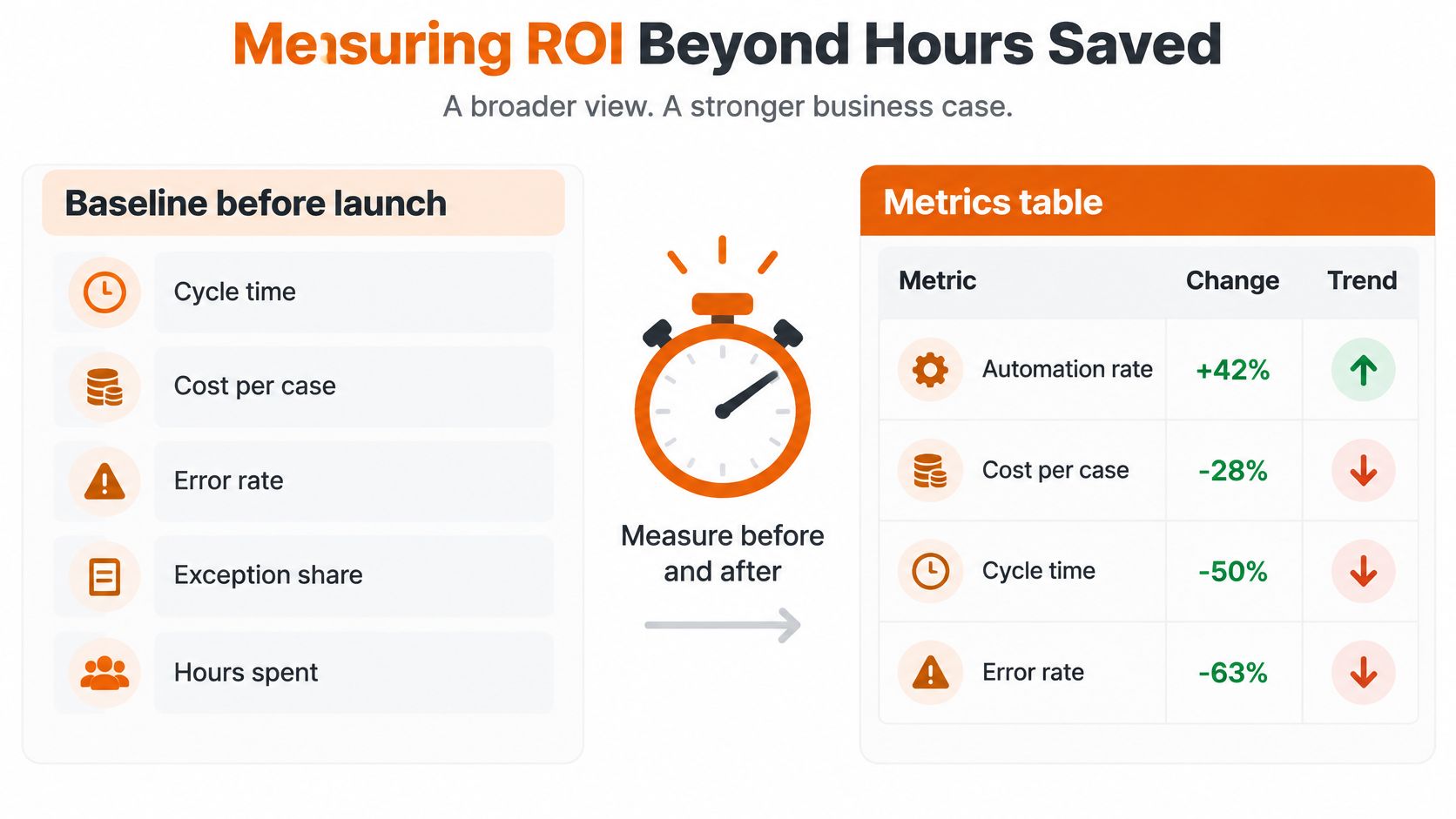
The contrarian read: a highly autonomous workflow can reduce nominal labor cost and still lose money. If exceptions rise with volume, each additional case can cost more than the process it replaced.
Measure value at the workflow level before combining results across the business. Agree acceptance criteria for one workflow before build, then give finance a clear basis for auditing the result. A proof of value centered on a single workflow can help frame that evaluation, but the decision should rest on measured process outcomes, not hours saved alone.
A workflow that looks finished in a demo still has no owner, no acceptance criteria and no record of what it did once it could touch live systems. The first irreversible step, a payment, a permission change or a customer commitment, is then the incident.
Each gate below needs an owner, written acceptance criteria and production evidence.
Autonomy should widen only as fast as architecture, governance and those measured outcomes allow. A new connector without a fresh baseline is a new system, not a scale-up.
DORA's 2024 research found that a 25% increase in AI adoption was associated with a 7.5% improvement in documentation quality, a 3.4% improvement in code quality and a 3.1% increase in code-review speed, alongside an estimated 1.5% decrease in delivery throughput and a 7.2% decrease in delivery stability. Small batch sizes and thorough testing are what keep speed from turning into rework.
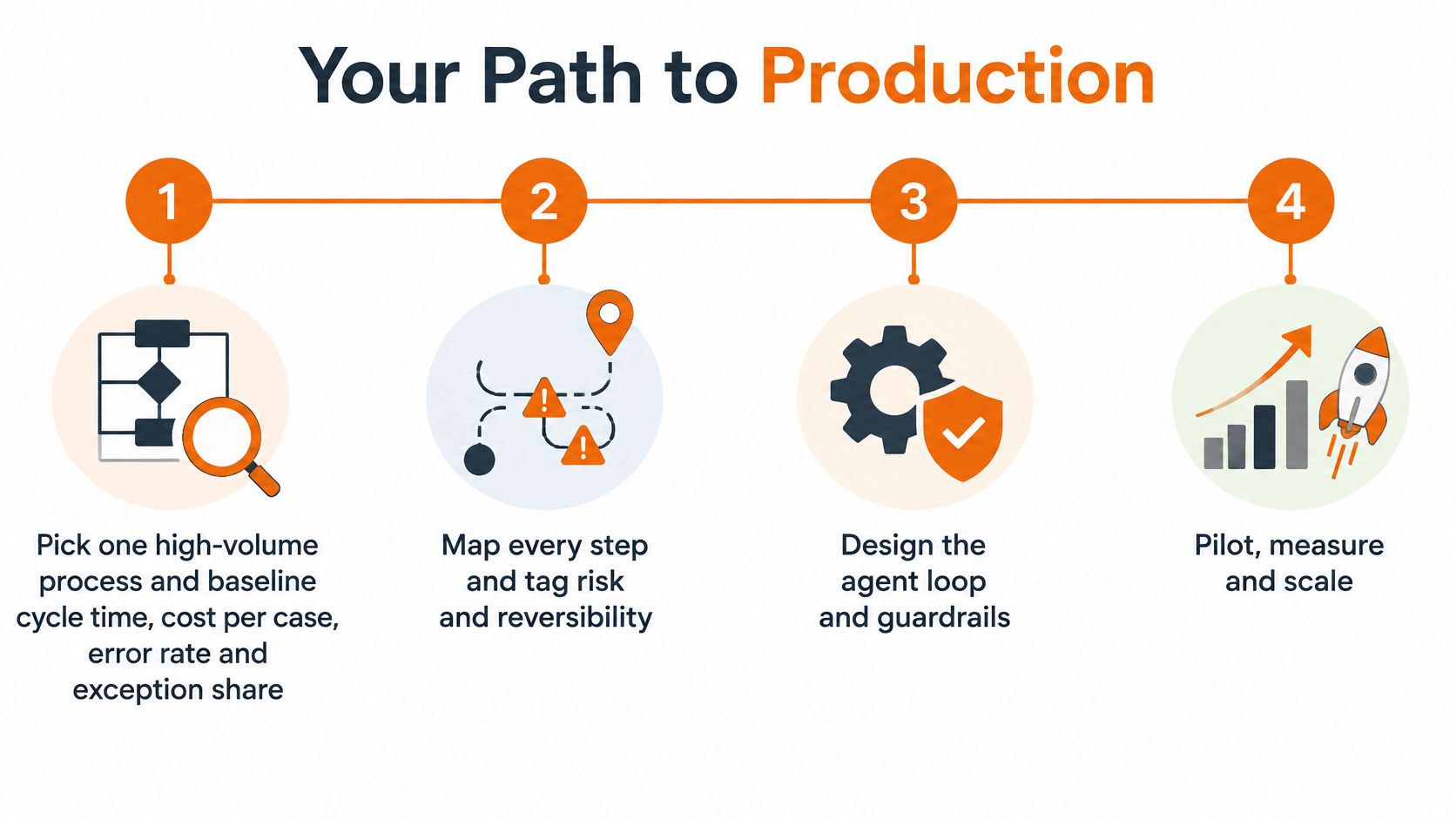
Rite NRG's RiteWay approach sequences the work as architecture before generation, AI-accelerated execution, human approval gates and production evidence. Senior engineers remain accountable for data, security, integration and production quality, while AI agents accelerate analysis, development, testing and documentation. The result you want is a shorter path you can defend in a post-incident review: named people, recorded decisions, and a rollback that runs.
The right next step is a readiness review that names the first workflow, its baseline numbers, its acceptance tests and the person accountable when it misbehaves. That review is a fixed-fee engagement priced by complexity. Defined automation or AI system delivery that follows is fixed scope and fixed price against agreed acceptance criteria, so the decision to proceed is a business decision rather than an open-ended commitment.
Rite NRG helps SaaS founders, product leaders and CTOs take agentic AI workflow automation from a promising pilot to a production system with named owners, approval gates and evidence that survives an audit. Work starts with process economics and data reality, then architecture and controls, then delivery against agreed acceptance criteria with senior engineers accountable for what reaches production. Visit Rite NRG to book a readiness review and pick your first workflow.
/ about the author
Written by the RITE NRG editorial team — the architects, engineers and delivery leads who build and operate AI-era software for our clients.
Strategy & Transformation
A practical, finance-ready framework for comparing AI and modernization investment with the current-state cost, realistic benefits, delivery risk and time to value.
Technology Talent & Teams
A decision-maker's guide to IT partnership models: what each model actually transfers to the partner, what it costs beyond the rate card, and how to match the model to your situation.
AI Consulting & Automation
A practical framework for choosing and deploying transport or logistics AI agents around real exceptions, reliable data and controlled operational authority.
More guidance: all insights articles
Tell us about the system or idea behind this article. We tell you honestly if it is a fit — and what a fixed-scope delivery could look like.