

Strategy & Transformation
How to Calculate ROI for AI and Software Modernization
A practical, finance-ready framework for comparing AI and modernization investment with the current-state cost, realistic benefits, delivery risk and time to value.
operationalwrocław--:-- cet
∕ insights / technical-writing-services.md
Technical Writing Services
Technical writing services explained: deliverables, pricing models, a hiring checklist for nearshore teams, and how docs speed up SaaS releases.
>_article.meta
Your feature is ready, but the launch still feels unfinished. Sales can't explain the setup, support is asking engineers for answers, and a new developer can't change the billing service without chasing someone in chat. The code shipped. Customers and colleagues still can't use it confidently.
That's the business case for technical writing services: remove the information gaps that delay adoption, consume engineering capacity, and make changes harder to release safely. Buy documentation against those outcomes, not against a page count.
Treat documentation as a release-speed control, not a finishing task. Every feature that ships without clear answers creates unpaid work downstream: sales improvises a demo path, support pings engineers mid-sprint, and operators guess at rollback steps when the new behavior fails.
When those answers live only in engineers' heads, founders face an uncomfortable trade-off. Pull developers away from the next release to explain the last one, or leave customer-facing teams to improvise. Either way, the debt grows with every sprint that leaves the gap in place.
Technical writing services provide dedicated capacity to close that gap. That might mean a senior writer embedded in product development, or a fixed-scope project covering a launch, migration, or handover.
AI drafting tools change what that capacity buys. A model can produce a plausible first draft of release notes or a procedure from a commit diff. What it cannot do is confirm the steps against a live system, decide what belongs in scope, or keep the page accurate six months later. Pay for verification and ownership. Drafting is no longer the scarce part.
Use these questions in a short conversation with support and engineering:
Then inspect the answers, not just the totals. Repeated authentication questions suggest an integration-documentation gap. Engineers repeatedly asking who owns a service points to missing architecture and ownership records.
Practical rule: Commission documentation for the decision or task people can't complete, not for the document your organization thinks it ought to have.
Documentation won't repair a confusing pricing model, unstable software, or an unnecessarily complex workflow. It can expose those problems early enough for the right people to fix them. Start by separating missing explanations from missing product decisions.
A technical writer translates between the people who build a system and the people who must use, integrate, maintain, or operate it. Think of a flight manual developed alongside the aircraft, not a description assembled after the first flight.
That's more than copywriting. A persuasive landing page helps someone choose a product; a technical procedure helps them perform a task correctly under specific conditions.
ISO/IEC/IEEE 26514:2021 treats user information as a software-life-cycle deliverable, addressing information needs, structure, presentation, availability, and the development process. Use that distinction when buying services: assess usable artifacts and review evidence, not a promise of clear prose.
| Deliverable | Main reader | Problem it solves | Typical format |
|---|---|---|---|
| API reference | Developers integrating your product | Failed integrations and repeated support questions | Endpoint pages, OpenAPI specs and working code samples |
| User guide | End users and administrators | Support tickets for routine tasks | Task-based articles with screenshots and permission notes |
| Release notes | Customers, support and sales teams | Surprises after each update | Versioned changelog entries with impact and migration steps |
| Onboarding docs | New customers and new hires | Slow time to first value | Quickstarts, setup checklists and first-task walkthroughs |
| Inline help | Users working inside the product | Abandoned flows and mistakes at key steps | Tooltips, contextual panels and short error explanations |
| Architecture and runbooks | Engineers and operators | Slow incident response and knowledge loss | Decision records, data-flow diagrams and recovery procedures |
These artifacts need different acceptance tests. An API example should work against the supported environment. A user procedure should identify required permissions. A recovery runbook should tell an operator how to recognize success, not merely list commands.
For editorial review, STE Guide's practical techniques for clearer writing offer a useful resource. Apply clarity checks after confirming the underlying behavior, because polished instructions can still be technically wrong.
My recommendation for product-led SaaS is to examine onboarding and API documentation first. If prospects can't reach a useful result or integration partners can't authenticate, a full administrator manual isn't the immediate priority.
For legacy modernization, start with architecture decisions, integration contracts, and operating procedures. Before rewriting customer guidance, establish what the new team must understand to change and run the system safely.
Specify boundaries, too. A public API reference shouldn't expose internal secrets, and a customer quickstart shouldn't become a substitute for an internal deployment guide. Different readers need different levels of detail.
A release ships on Friday. By Monday, support is relaying engineer answers to customers because nobody approved the setup guide before deployment. That delay is the cost documentation is supposed to prevent. So start with launch readiness: give sales an accurate demonstration path, support the known limitations, and customer success the setup requirements before customers encounter the change. Otherwise engineers become the explanation layer after deployment.
For developer-facing products, documentation belongs in the adoption discussion. In a secondary analysis of Stack Overflow's developer survey data, Cherryleaf reports that 84% of surveyed developers use technical documentation to learn, and that 90% of that documentation-using group rely on the documentation packaged with APIs and SDKs. Read those figures as one blog's interpretation of survey data, not a controlled study. Even so, the direction is clear enough to act on: don't make an interested developer reverse-engineer authentication before they can evaluate your product.
Maintenance deserves particular attention. In an empirical software-maintenance study, developers performing development tasks consulted documentation in roughly 37% of observed cases and source code in 39%. Among developers performing maintenance tasks, documentation use fell to 18% of cases while source code use rose to 50%. The two populations differ, so compare within each task type rather than across them. The practical read: maintainers lean on code because documents rarely carry what they need, and that gap is where undocumented systems extract their price.
That is reason to commission data-flow records, configuration dependencies, failure modes, and change-impact guidance alongside launch material. Don't spend the whole budget welcoming people into a system while leaving them unable to maintain it.
A technically correct page has little operational value if nobody can find it or determine which deployed version it describes.
Start tracking time to first safe change and support tickets per release. Define both consistently, record product complexity and release context, and investigate the causes behind movement. Neither measure proves documentation caused an improvement by itself.
Price the risk you transfer. Page count is the weakest proxy. A provider that owns verification, release timing and update discipline reduces launch risk; a provider that only returns files sells effort.
Use employment cost as context, not as a rate card. Check the BLS Occupational Outlook Handbook for technical writers for current employment and wage figures, then add what salary comparisons miss: recruiting effort, tools, management attention, product-learning time and internal review.
An external engagement changes how you buy capacity. Your engineers still need to confirm architecture claims, permissions behavior, examples and failure notes before publication.
| Model | How it is billed | Best fit | Watch out for |
|---|---|---|---|
| Time and materials | Per hour or per day | Ongoing updates with uncertain scope | Spend grows without acceptance criteria |
| Fixed-price project | Agreed price for a deliverable set | Launch documentation for a defined release | Scope changes are costly, so the spec must be firm |
| Monthly retainer | Fixed monthly capacity | Continuous release cadence | Unused hours when the release pace slows |
| Dedicated embedded writer | Monthly rate per person | Deep product knowledge built over many releases | Key-person risk, so plan a backup |
| Fixed-scope audit, then build | Fixed fee for assessment, then a project quote | Unknown documentation state before a launch or migration | Audit findings can expand the build |
Fixed price gives budget certainty only when product behavior, document set and review obligations are clear. If engineering is still deciding how permissions work, the provider must price that uncertainty or push it into change requests.
Time and materials is more flexible, and flexibility needs control. Agree on a prioritized backlog, review completed artifacts regularly and stop work that no longer reduces release risk.
AI can cut drafting time. It should not cut acceptance standards. Pay for evidence of control: named reviewers, tested samples, access boundaries and versioned ownership.
For a retainer, establish what happens to unused capacity and urgent release work. For an embedded writer, require shared repositories, review coverage and a handover plan so product knowledge does not accumulate with one person.
If documentation sits inside a broader engineering engagement, compare staff augmentation, dedicated teams, and project delivery before selecting the commercial structure. Buying an individual contributor is different from assigning responsibility for a completed launch package.
Give providers the same written deliverable list, audience definitions, source-access assumptions and acceptance requirements. Ask whether the quote includes technical interviews, testing examples, accessibility checks, publishing and maintenance.
Choose the model that makes one named owner accountable for a launchable, maintainable documentation package.
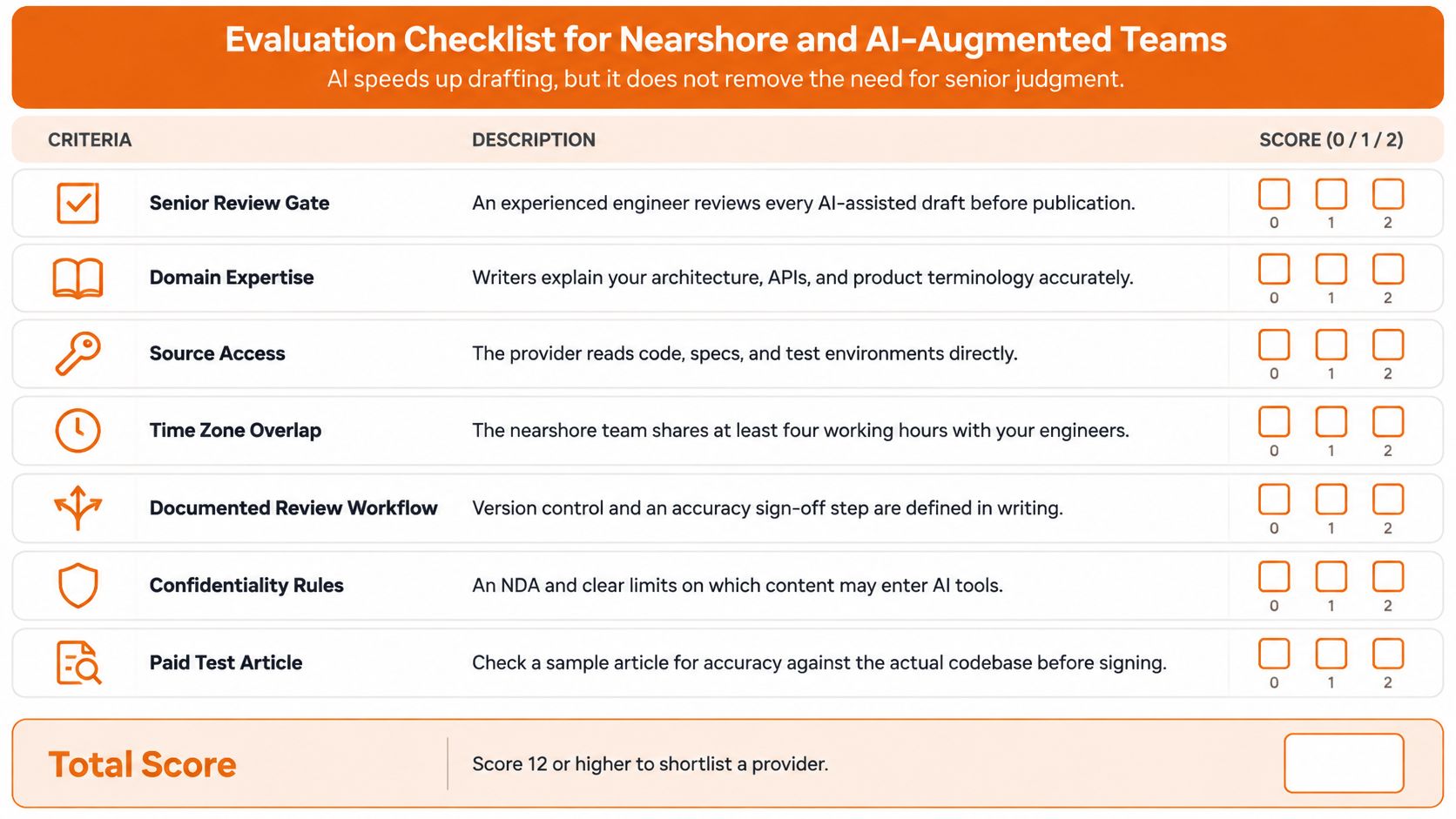
AI speeds up drafting, but it doesn't remove senior judgment. Ask who checks an architecture statement, who tests a sample, and who can stop publication when the evidence is missing.
That approach follows NIST's AI Risk Management Framework, which calls for defined, assessed, and documented human-oversight processes. A reviewer's name matters only if they have access, time, and authority to challenge the output.
Use this checklist to structure the provider conversation.
| Criterion | Strong signal | Warning sign |
|---|---|---|
| Engineering collaboration | Writer joins design and release reviews | Writer works only from finished features |
| AI use and human review | Named reviewer checks every AI-assisted draft | AI output published without technical sign-off |
| Confidential code and data | Access controls, NDA and private model options | Vague answer about where source code is processed |
| Accessibility and localization | Screen-reader checks and terminology control | Accessibility treated as a last-minute polish step |
| Relevant proof of work | Samples from API or B2B SaaS products | Only generic brochures or blog posts |
| Outcome measurement | Agreed baseline for support, release and onboarding metrics | Success reported as number of pages delivered |
| Ownership after handover | Versioned docs kept with the code and a maintenance plan | Knowledge stays with the writer |
| Time-zone overlap | Daily overlap with your core working hours | Asynchronous only, with weekly updates |
Treat the infographic's scoring threshold as a screening aid, not evidence of delivery quality. Confidentiality failures or absent technical review should stop selection regardless of the total.
For Central European nearshore teams, verify actual calendars rather than assuming geography guarantees availability. European clients can arrange shared daytime reviews; US clients should explicitly agree a review window that fits both teams. The practical considerations in nearshore agile development matter most when engineers must resolve a blocker before release.
An internal writer, specialist documentation agency, or engineering consultancy can fit, depending on the work. RITE NRG combines senior architectural accountability with AI agents that accelerate analysis, drafting, testing, and migration, while connecting documentation to releases.
AI changes delivery economics, not engineering standards. Architects and engineers remain responsible for architecture, data, security, testing, and production quality. Writers increasingly contribute through information modeling, verification, and ownership of the publishing process, not just initial composition.
Ask these questions on the first call:
Require concrete answers and a relevant work sample before discussing a long engagement.
Documentation should work for people using different languages, devices, and assistive technologies. Don't assume a readable page is an accessible procedure.
The 2025 State of Docs report found that 42% of respondents expected AI to enable documentation that adapts intelligently to user needs. Adaptive delivery still needs reliable, accessible source content.
Translation started after launch from an already-changing source is a warning sign. You're buying rework and risking conflicting instructions.
Acceptance check: Ask someone to complete a real task using the localized, accessible procedure, not merely approve its appearance.
Track accessibility defects per release and the share of localized pages aligned with the current source. Documentation can record compliance decisions and communicate obligations; it cannot establish legal compliance by itself.
Documentation belongs in the definition of done, not in a task someone opens after launch. Give writers access to the decisions and working software they need to explain.
The workflow below shows where that collaboration belongs.
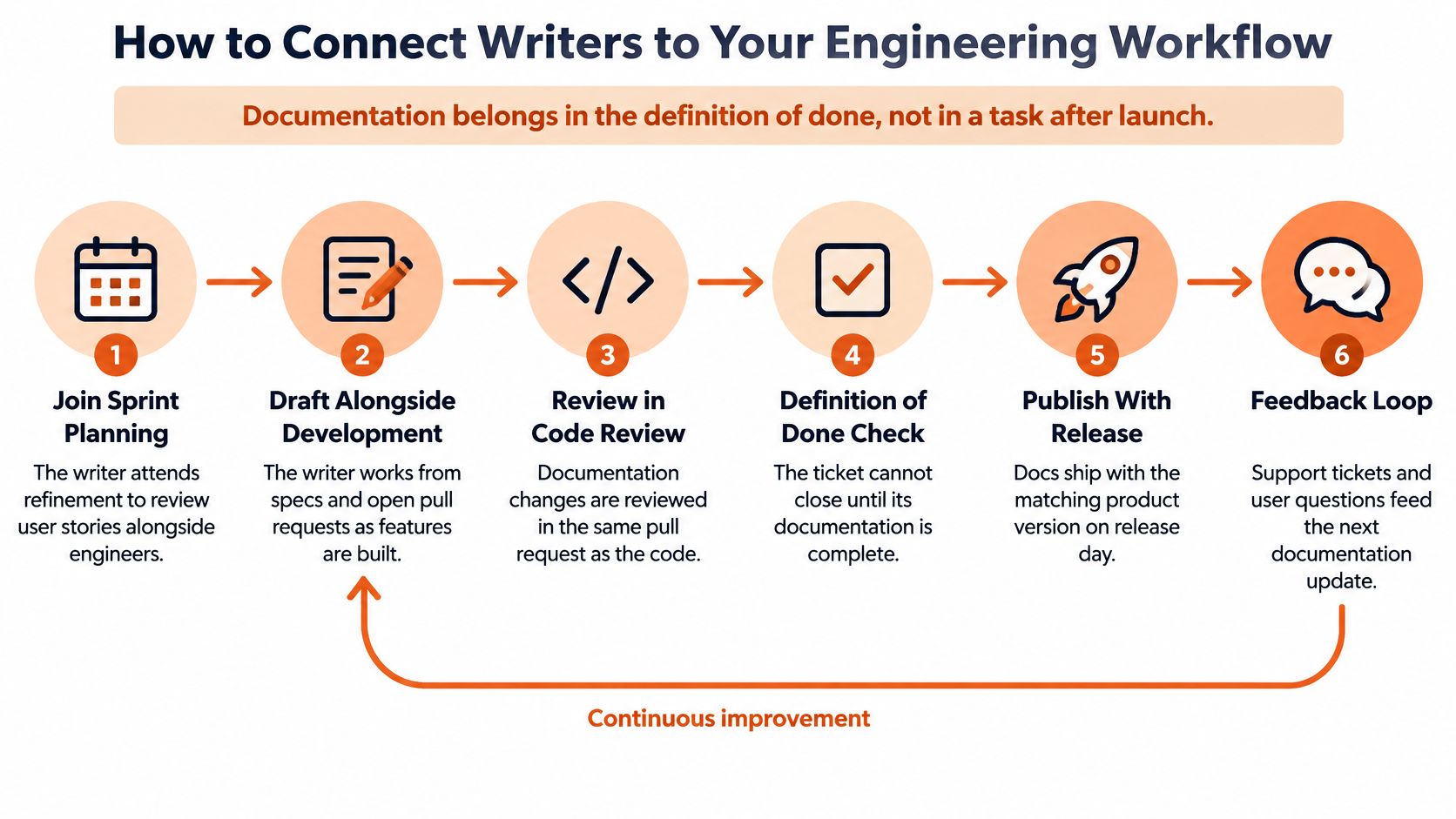
Add a documentation field to relevant tickets and pull requests. Require the author to identify changed user-facing or operational behavior. If no update is needed, record why.
Assign ownership before drafting. Name the engineer accountable for technical accuracy and the writer responsible for structure and clarity. Make the publication owner explicit so shared responsibility doesn't become nobody's responsibility.
Include the writer in requirements and design reviews. Let them identify missing permissions, prerequisites, and error paths while decisions are still inexpensive to change. Procedures should follow user tasks rather than internal code organization.
Draft from specifications and a working build. Agree terminology before parallel teams invent conflicting names. Validate what users can really do, including constraints the specification leaves unclear.
Require subject-matter approval. The named engineer checks behavior and examples before publication. Unresolved uncertainty becomes a visible delivery issue, not an editorial guess.
Connect release notes to the release checklist. Confirm that guidance matches the version being shipped and that the right audience can access it. Include operational and migration implications, not just feature descriptions.
Review results monthly. Bring support questions, onboarding obstacles, stale pages, and release incidents into the same discussion. Reprioritize based on observed friction.
These documentation best practices work only when delivery leaders reserve review capacity. A writer waiting indefinitely for approval is a planning problem, not a writing problem.
AI drafting tools change where the effort sits. They can produce a first draft quickly, which means verification becomes the constraint. Schedule the engineer's review time before the draft, not after it. The writer's real value in this workflow is checking the text against a running build and owning what ships.
Use DORA's operational measures: deployment frequency tracks how often changes reach production; change lead time covers commit to deployment; change failure rate tracks deployments requiring immediate intervention; and failed-deployment recovery time tracks restoration after a failed deployment.
More pages aren't success if release failures rise. Establish a baseline and investigate documentation alongside architecture, test coverage, staffing, and release practices rather than claiming it controls every outcome.
The walkthrough below runs the same workflow end to end and works well for onboarding a writer into an existing team.
Senior engineers own the release outcome, and that includes the documentation that ships with it. Invite the writer to the release review, not only the planning meeting. When a behavior question surfaces at review time, the person who wrote the procedure should be in the room.
Run this check at your next release: pull the attendee list from the last three release reviews and confirm the published guidance matched the shipped version. If no writer attended, or the pages still describe the previous release, your workflow stops at approval and never reaches verification. Fix the invitation before you fix the writing.
These are illustrative scenarios, not client results. Each shows a documentation intervention and a measurement hypothesis, not a promised performance improvement.
A B2B SaaS team has working endpoints, but integration partners keep asking how authentication expires and what happens when they reach a rate limit. The engineer answering those questions is also responsible for the next release.
The team must still fix inconsistent API behavior. A clear explanation doesn't make an unreliable contract acceptable.
An incoming engineering team can read the repository but can't explain how billing events move between services. The outgoing vendor holds the operational context.
A writer and architect map data flows, record integration contracts, and prepare runbooks before cutover. The incoming operators then rehearse an incident using those materials.
| Decision point | What to observe |
|---|---|
| Readiness | Can the incoming team explain dependencies and escalation paths? |
| Metric | Time needed to diagnose a representative operational problem |
| Expected direction | Less reliance on the outgoing vendor |
The useful artifact is the tested handover package, not a diagram nobody reviews.
A product-led company gives new hires repository access but no dependable route through local setup, test data, and deployment safeguards. Questions interrupt experienced developers throughout onboarding.
The team commissions a setup guide and sandbox walkthrough, then observes a newcomer following them without informal rescue. It tracks time to first safe change, expecting a shorter path as missing prerequisites are resolved.
That expectation must be tested. If access approvals or fragile environments remain the constraint, improve those systems rather than expanding the guide.
Run a two-week decision process before committing to ongoing capacity. You need evidence of the gap, a bounded first deliverable, and someone accountable for keeping it useful.
List the 20 questions support, sales, and new engineers ask most often. Mark which questions current documentation answers accurately and which still require someone's intervention.
Inspect the last three releases for undocumented behavior changes. Choose a baseline measure, such as tickets per release, time to first safe change, or change failure rate, and record its current value and definition.
Match the gaps to the deliverables and engagement models above. Choose a first deliverable that removes a meaningful blockage without requiring a wholesale documentation rebuild.
Ask each provider for:
For a startup or scaleup preparing an MVP or release, begin with an architecture and documentation gap review. Book a scoping call with a senior architect, bring your gap list and baseline metric, and ask to leave with a written scope and measurement plan.
Rite NRG offers architecture reviews, software engineering, and release-linked documentation for teams building or modernizing SaaS products. Bring your unanswered customer questions and engineering handover gaps to a scoping call so we can define the first deliverable, its technical owner, and how you'll measure whether it helped.
/ about the author
Written by the RITE NRG editorial team — the architects, engineers and delivery leads who build and operate AI-era software for our clients.
Strategy & Transformation
A practical, finance-ready framework for comparing AI and modernization investment with the current-state cost, realistic benefits, delivery risk and time to value.
Technology Talent & Teams
A decision-maker's guide to IT partnership models: what each model actually transfers to the partner, what it costs beyond the rate card, and how to match the model to your situation.
AI Consulting & Automation
A practical framework for choosing and deploying transport or logistics AI agents around real exceptions, reliable data and controlled operational authority.
More guidance: all insights articles
Tell us about the system or idea behind this article. We tell you honestly if it is a fit — and what a fixed-scope delivery could look like.