
Strategy & Transformation
How to Calculate ROI for AI and Software Modernization
A practical, finance-ready framework for comparing AI and modernization investment with the current-state cost, realistic benefits, delivery risk and time to value.
operationalwrocław--:-- cet
∕ insights / software-development-modeling.md
Software Development Modeling
Learn how software development modeling drives faster SaaS delivery and lower risk. Compare UML, DDD, and architectural models for MVP teams.
>_article.meta
A 2024 survey found that 75.1% of respondents use system modeling, and 56.3% say it streamlines development. Software development modeling gives SaaS and MVP teams a practical way to move quickly without turning speed into rework, security exposure, and architectural drift.
A founder I worked with once chose the fastest possible route to market. The team skipped meaningful domain modeling, treated architecture as a conversation rather than a decision, and relied on developers to keep the whole system in their heads. The MVP launched, users arrived, and the business immediately discovered that billing, permissions, tenant isolation, and reporting had never shared the same definition of “customer.”
The team hadn't failed because it lacked effort. It failed because nobody had made the important relationships visible before implementation. Every new feature forced another round of interpretation, and the founder paid for early speed through slower releases, production risk, and difficult technical decisions.
The right model isn't a document created to satisfy a process. It's a risk-control mechanism, a shared language, and a way to connect engineering decisions to business outcomes. The strongest nearshore teams use just enough structure to expose uncertainty early, protect quality, and keep delivery moving. That approach reflects the Rite NRG method, built on Extreme Ownership, proactive problem-solving, transparent communication, and senior accountability for the complete result.
A product team under pressure usually makes a reasonable choice: remove anything that doesn't appear to ship customer value immediately. Design workshops get shortened, architecture diagrams become optional, and the backlog becomes the main source of truth. For a narrow prototype, that can work. For a product expected to support multiple customers, integrations, permissions, and operational commitments, the same choice creates hidden liabilities.
A SaaS founder may believe the team is building one feature, while engineering is implementing several unspoken systems: identity, tenancy, billing, notifications, auditability, data retention, and failure handling. If those boundaries remain implicit, each developer fills the gaps differently. The first release may look fast, but the next release inherits conflicting assumptions.
Practical rule: If a decision can change data ownership, security boundaries, integration behavior, or operational responsibility, make it visible before coding.
Software development modeling makes those assumptions discussable. A context diagram can reveal which external systems the product depends on. A sequence model can expose a missing failure path. A state model can show that an order, subscription, or user invitation has more meaningful states than the product brief acknowledges.
The business benefit is not “having diagrams.” It is reducing decision latency and late-stage redesign. A model gives product managers, architects, engineers, and security owners a common object to challenge. That creates faster alignment because the team debates the structure once, rather than rediscovering it through pull requests and incidents.

A model shouldn't attempt to describe every class, endpoint, and implementation detail. That approach creates ceremony without control. The useful question is narrower: which uncertainty could make the release slower, more expensive, or unsafe?
For an MVP, model the high-risk paths first:
A long-term industry dataset covering more than 10,000 IT projects and over 1.2 billion source lines of code shows how software delivery has changed across decades. Projects in the early 1980s typically took over a year, while most projects since 2000 have been completed in the 7 to 8-month range. The dataset, available through the long-term software project analysis, illustrates why delivery cadence matters, but it doesn't prove that less structure creates speed.
The practical lesson is sharper: model the decisions that protect the release. Leave low-risk implementation details to the engineers closest to the code, and give the team a shared structure for the choices that affect the entire business.
Software development modeling is a family of techniques, not a single diagramming exercise. Each model answers a different question, and the right combination depends on the product's risk profile.
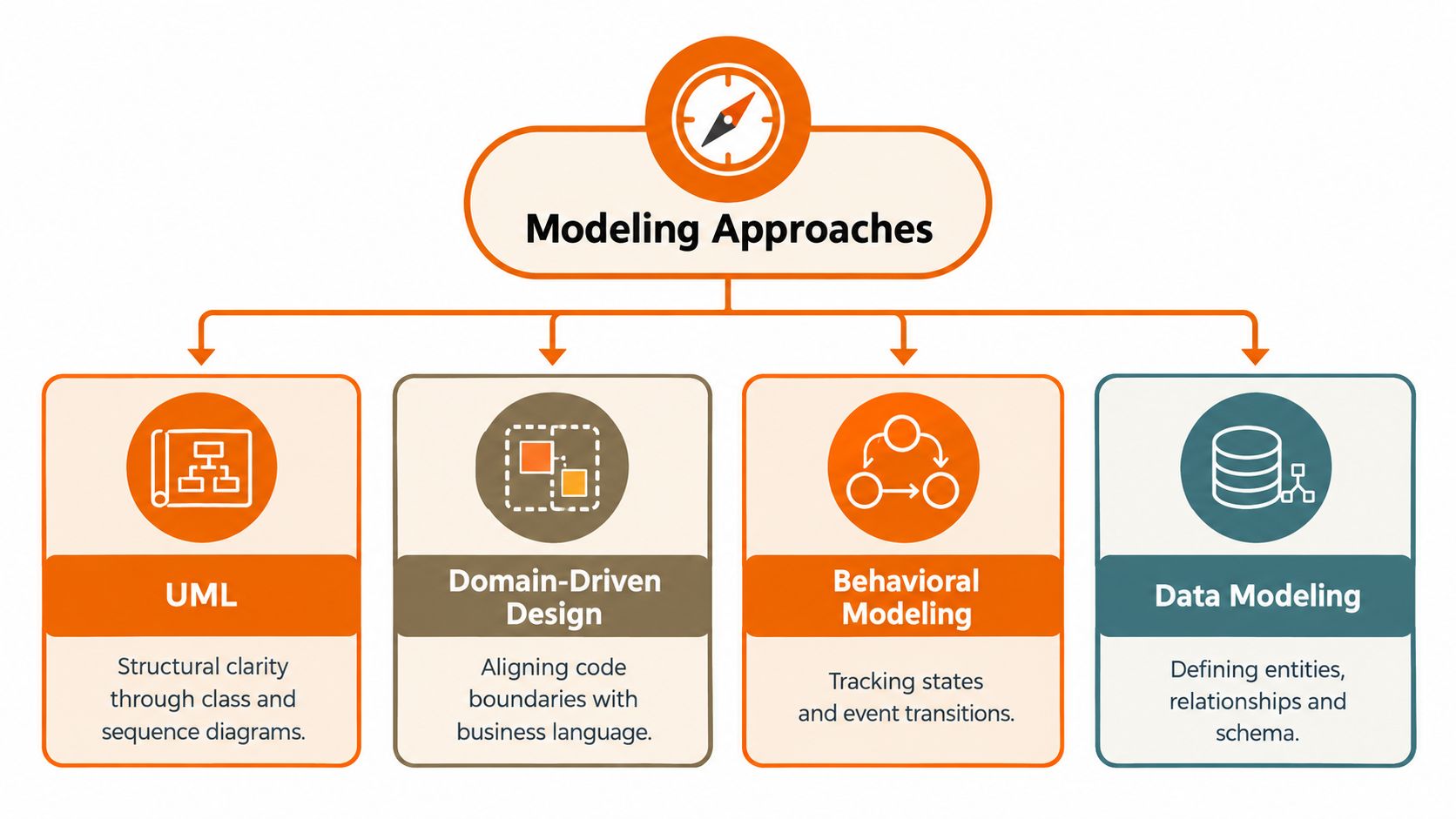
UML helps teams express structure through class, component, activity, and sequence diagrams. Use a class or component model when developers need to understand ownership and dependencies. Use a sequence diagram when the question is how services, users, and external systems interact over time.
A sequence diagram for subscription activation might expose a problem that a feature list hides. Does the payment provider confirm before access is granted? What happens when the webhook arrives twice? Who records the audit event? Those questions belong in the design conversation before they become production defects.
UML works best when it stays focused on decisions. A diagram that attempts to mirror every implementation detail becomes expensive to maintain and difficult to review.
Domain-driven design starts with the language and rules of the business. It helps a team distinguish concepts that sound similar but behave differently, such as an account, organization, workspace, customer, or subscription.
The key value is boundary clarity. A billing context may own invoice status, while an access context owns entitlement. If both contexts manipulate the same concept without an explicit contract, changes become risky. The domain-driven design architecture guide provides a useful reference for aligning code boundaries with business boundaries.
Behavioral models show how a system responds to events. State machines work well for orders, claims, subscriptions, support tickets, and user invitations because they make permitted transitions explicit.
This model often finds the edge cases that product requirements omit. A subscription may move from trial to active, but can it move from payment failure back to active? Can a cancelled account be reactivated? Who can trigger each transition? The value lies in forcing the team to define behavior, not merely naming states.
Data modeling defines entities, relationships, ownership, constraints, and lifecycle decisions. It matters early for products with reporting, integrations, compliance obligations, or multi-tenant storage.
Architecture models separate a system's overall structure, including components and their interconnections, from internal component detail. Cambridge's architecture modeling excerpt describes UML-based model-driven architecture as an approach that develops architecture models before implementation. That front-loaded design control improves communication and specification quality when multiple teams must build against the same system intent.
Use the four types selectively. A simple internal workflow may need a domain sketch and a data model. A multi-tenant SaaS platform usually needs architectural, behavioral, and data views as well. The model should match the risk, not the preferences of the person holding the marker.
A static document records what the team believed at a particular moment. A synchronized artifact helps the team make decisions as the system changes. That distinction determines whether modeling continues to reduce risk after the first sprint.
A PDF architecture pack may satisfy an approval gate, then become irrelevant when the team changes an integration, splits a service, or introduces an asynchronous workflow. A synchronized artifact remains connected to code, decisions, tests, ownership, and operational evidence. It doesn't need to update itself perfectly, but the team must have a defined path for keeping it trustworthy.
| Criteria | Static Documentation | Synchronized Artifacts |
|---|---|---|
| Maintenance cost | Updates happen manually and often depend on individual memory | Changes are linked to delivery activities, reviews, or automated generation |
| Team alignment | Readers interpret an old snapshot differently | Product and engineering review a shared representation of current behavior |
| Architectural consistency | Drift appears when implementation diverges from the document | Deviations become visible and can trigger a decision or exception |
| Change ownership | Nobody may know who is responsible for accuracy | Named owners maintain the model at defined decision points |
| Use in delivery | The document is consulted mainly during onboarding or audits | The artifact informs planning, testing, security review, and operations |
A 2025 software architecture survey identified keeping documentation up to date as the biggest pain point, ahead of standards and choosing the right level of detail. The same survey reported that 44% of respondents used AI or LLMs for documentation and 65% used a modeling tool, evidence that adoption hasn't solved maintenance by itself. Those findings are summarized in the 2025 state of software architecture survey.
Don't assign “update the architecture” as an undefined task at the end of a sprint. Tie model changes to concrete events:
This is why software delivery tools and their engineering role should be evaluated beyond ticket management. The toolchain should help teams connect decisions, code, tests, environments, and ownership. A model that nobody uses is still documentation. A model that shapes delivery becomes an engineering control.
The right model depends on the cost of being wrong. A small internal tool with one data source doesn't need the same design effort as a multi-tenant platform handling payments and regulated information.

Use this decision process before choosing a modeling standard or tool.
Ask what happens if the team misunderstands the design. If the result is a minor interface adjustment, use a lightweight sketch. If the result could expose tenant data, corrupt financial records, block onboarding, or force a platform rewrite, create a durable model and assign ownership.
List the areas where the team lacks confidence:
The answers determine the model type. Domain ambiguity calls for domain modeling. Unclear interactions call for sequence or behavioral models. Data ownership concerns call for a schema and lifecycle model. Cross-cutting reliability or security concerns call for an architecture view supported by explicit quality scenarios.
Product managers need business concepts, workflow outcomes, and trade-offs. Engineers need boundaries, contracts, dependencies, and failure paths. Security and operations teams need trust boundaries, data flows, controls, observability, and recovery responsibilities.
Don't force every audience into one enormous diagram. Create a small set of views with clear purposes, then connect them through shared names and ownership. A model has earned its place when a team uses it to make a decision faster or prevent a misunderstanding.
A simple internal tool may need only a domain sketch and a focused data model. A complex SaaS platform needs more rigorous architectural and data modeling because the cost of an incorrect boundary rises with every integration and customer-facing workflow.
The video below offers another way to think about selecting a delivery model in relation to project uncertainty and business constraints.
AI changes the economics of delivery. It can draft code, generate diagrams from repositories, summarize decisions, identify dependencies, and propose changes across a large system. It doesn't change who is accountable when the design is unsafe, the data model is wrong, or the release damages production.
A 2025 research paper states that integrated support for interweaving model-driven artifacts with LLM-generated artifacts is still missing. That gap matters because AI-generated implementation can move faster than a team's ability to verify whether the implementation still matches architecture, business rules, and security constraints.
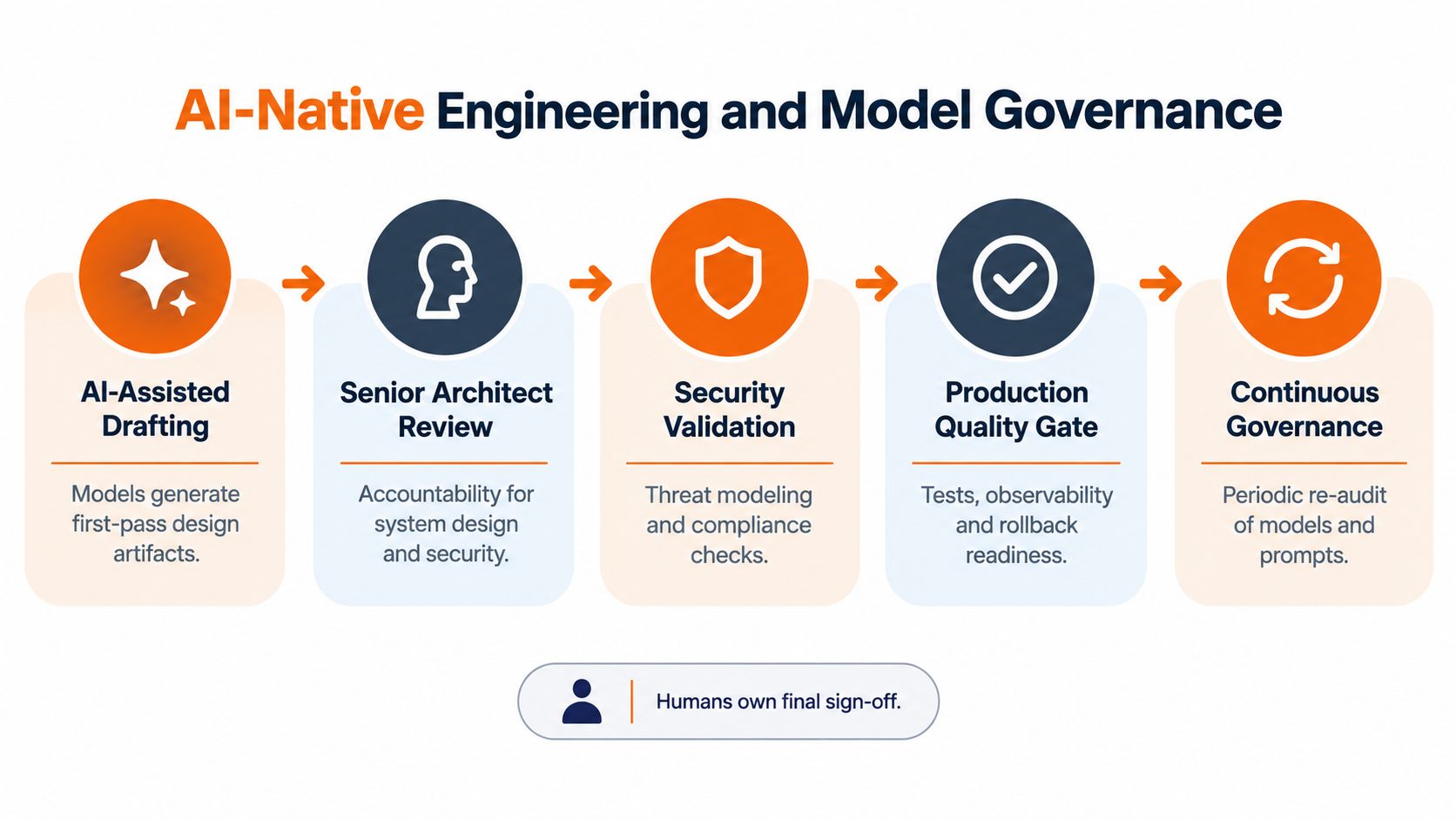
Agentic AI works well when the team gives it bounded tasks and authoritative inputs. It can produce a first-pass sequence diagram from code, compare a proposed service boundary with existing dependencies, or flag a model element that no longer appears in the repository.
It should not approve its own output without review. Developers must check generated code for correctness, and senior architects must own decisions involving architecture, data, security, and production quality.
A practical governance loop looks like this:
Teams building this capability can use an actionable AI governance roadmap from SpecStory, Inc. as a practical starting point for defining controls and responsibilities. The important principle is simple: AI accelerates the work, while humans sign off on the consequences.
Every AI-assisted change should leave enough evidence for another engineer to understand what happened. Record the source context, the human reviewer, the decision, the tests performed, and any accepted exception. A production AI role blueprint emphasizes documentation, traceability, SDLC controls, peer reviews, human-in-the-loop design, explainability, and risk reviews as continuing engineering responsibilities. Those responsibilities don't disappear because an agent completed the first draft.
The AI governance framework for growing companies is useful when a team needs to turn that principle into operating practice. Governance shouldn't block useful automation. It should make the boundaries clear enough that engineers can move quickly without confusing generated output with verified design.
A model is valuable only when it improves the result the business cares about. Lines of code, completed tickets, and story points describe activity. They don't prove that customers adopted the product, that revenue improved, or that the system can operate reliably.
Business-focused product development measurement should include launch outcomes such as adoption, revenue, margin, reliability, customer satisfaction, returns, production yield, service burden, and strategic-objective attainment. The product development effectiveness playbook makes the central point clearly: output isn't the same as value.
Connect each modeling decision to a business or operational outcome:
Quality needs its own operational view. Useful indicators include escaped defects, automated test coverage, test run times, technical debt, performance, and downtime. A product metrics guide that goes beyond velocity also distinguishes velocity as story points completed per sprint and explains how total story points divided by sprint velocity can estimate the sprints needed to release a defined scope. Use that estimate as a planning aid, not as proof of customer value.
Extreme Ownership means the team doesn't stop at “my component works.” Someone owns the complete result, including the trade-offs between speed, security, maintainability, and operating cost.
Name owners for architecture policy, security exceptions, platform standards, and product trade-offs. Independent guidance on technology strategy consulting and decision governance stresses that ownership must support real-time trade-off management and connect governance decisions directly to business risk.
At Rite NRG, this principle fits AI-native delivery as well. AI agents may accelerate analysis, development, testing, documentation, and migration, but senior engineers remain responsible for the architecture and production outcome. The team should be able to answer who approved the model, who accepted the risk, who validates the release, and who owns the system after launch.
The most persistent objection is that modeling slows Agile teams down. That objection is valid when modeling becomes a heavyweight approval ritual, a document factory, or a demand to predict every future requirement. It doesn't hold when the team uses small, decision-focused models during discovery, planning, implementation, and review.
Agile delivery depends on learning. Modeling makes the learning explicit. A state diagram can expose an incomplete workflow before a sprint begins. A context map can reveal that two teams own the same business concept. A data model can show that an apparently simple feature requires a migration that changes the release risk.
The useful alternative isn't “model everything.” It's model what can hurt the outcome.
Modeling also supports continuous integration when artifacts are treated as reviewable engineering assets. Automated checks can compare interfaces, dependencies, schemas, and documented ownership. Human review remains necessary, but it can focus on decisions that require judgment instead of rediscovering basic structure.
The core trade-off is not modeling versus speed. It is deliberate speed versus accidental complexity. A few minutes spent clarifying a boundary can prevent days of disagreement, rework, and emergency correction. That is why modeling belongs in an MVP workflow, provided the team measures it by the risks it removes and the decisions it accelerates.
Rite NRG helps SaaS founders, scale-ups, and enterprises model, build, modernize, and operate business-critical software with senior architecture accountability and AI-assisted delivery. Visit Rite NRG to discuss your product boundaries, delivery risks, and a practical engineering plan that keeps speed aligned with production quality.
/ about the author
Written by the RITE NRG editorial team — the architects, engineers and delivery leads who build and operate AI-era software for our clients.
Strategy & Transformation
A practical, finance-ready framework for comparing AI and modernization investment with the current-state cost, realistic benefits, delivery risk and time to value.
AI Consulting & Automation
A practical framework for choosing and deploying transport or logistics AI agents around real exceptions, reliable data and controlled operational authority.
Industry Solutions
A practical roadmap for improving manufacturing systems and introducing AI without destabilising production, data integrity or operational control.
More guidance: all insights articles
Tell us about the system or idea behind this article. We tell you honestly if it is a fit — and what a fixed-scope delivery could look like.