

Strategy & Transformation
How to Calculate ROI for AI and Software Modernization
A practical, finance-ready framework for comparing AI and modernization investment with the current-state cost, realistic benefits, delivery risk and time to value.
operationalwrocław--:-- cet
∕ insights / software-development-good-practices.md
Software Development
Software development good practices for faster, safer delivery: testing, CI/CD, security and documentation that hold up in AI-accelerated teams.
>_article.meta
You shipped the feature. The demo looked sharp, the board clapped, and then the login path broke for a week. Investors asked why the release slipped, support tickets piled up, and the team spent the next month on rework instead of the next customer problem. That gap is the cost of skipping software development good practices. Speed only pays when quality, recovery, and ownership stay in the same system.
A founder ships a feature in a week with an AI coding tool. The next month goes to fixing login bugs, rolling back releases, and explaining outages to investors. The code was never the business problem. The delay, the rework, and the lost trust were.

AI changes the economics of software delivery. It does not change the engineering standards. Architects and senior engineers stay accountable for architecture, data, security, testing, and production quality. Agents draft, test, and document faster. They don't get to own the outcome. Review intensity follows risk: senior eyes on anything touching security, money, data or integrations, lighter gates on everything else.
Start with the business process, the opportunity, and the process economics. Pick models and architecture last, on evidence, not because a demo looked fast.
McKinsey reports that high-performing organizations using generative AI in software development observed improvements of 16–30% in team productivity, customer experience, and time to market, while software quality improved by 31–45%. Those organizations tracked outcome measures such as quality improvements, reported by 79% of outperformers, and speed gains, reported by 57%. The same research treats the percentage of AI-generated code as a weak proxy for value.
Practical rule: Define success before the first prompt: cycle time, release quality, customer satisfaction, production defects, and delivery capacity.
Eight practices follow, from delivery measurement to handover-ready documentation, and each one is tied to a business outcome you can watch. Score yourself against all eight, then fix the weakest one first. Often that turns out to be review discipline or release discipline, and closing that single gap does more for throughput than hiring two more engineers.
A healthy delivery system rests on eight practices that work together. Each one protects a specific business outcome. Treat the table as your scorecard, not a poster.
| Practice area | What it looks like | Business outcome it protects | Where to start |
|---|---|---|---|
| Delivery measurement | Speed and stability tracked together | Predictable delivery | Track lead time and change failure rate |
| Small reviewed changes | One behavioral or architectural change per pull request, around 20 files or fewer | Clear reviews and fewer surprises | Add a size limit to the pull request template |
| Automated quality gates | Unit, integration, security and regression tests block merges | Fewer production incidents | Make the pipeline a hard gate |
| Risk-tiered review | Senior review for security, data, money and integrations | Lower risk from AI-generated code | Write the tiers on one page |
| Secure development | Design reviews, dependency updates and vulnerability scanning | Fewer recurring defect classes | Scan dependencies on every build |
| Modular architecture | Bounded modules with clear interfaces and domain-driven design | Systems that grow without costly rewrites | Map the business domains before coding |
| Release discipline | Small releases, a rollback path and progressive delivery for risky changes | Faster recovery when something breaks | Keep the main branch releasable |
| Handover-ready documentation | Runbooks, decision records and an access map | The team can operate the system after handover | Write the runbook before launch |
Delivery measurement and small reviewed changes reveal trouble first. If you can't see lead time and failure rate, you can't tell whether AI output is progress or noise. A size limit on the pull request template stops the "one giant branch" habit before it becomes culture.
Automated quality gates and risk-tiered review stop bad changes at the door. A green pipeline is a decision, not a suggestion. Written tiers stop the team from treating a payment change like a copy tweak.
Secure development cuts the defect classes that keep coming back. Scanning dependencies on every build is cheaper than a surprise CVE the week of a launch.
Modular architecture and release discipline pay off more slowly, and they are the most expensive to repair late. Map domains before you code. Keep main releasable so a rollback is a button, not a war room.
Handover-ready documentation is how the product survives the people who built it. A runbook written before launch beats a wiki nobody updates after the incident.
The same idea shows up in understanding collaborative software development: shared standards, visible review, and clear ownership beat heroics.
Score each row from 0 to 2. A 0 is a risk with a named owner, not a backlog wish. The highest-impact fix is usually the row that matches your last production incident, not the one that sounds most impressive in a slide.
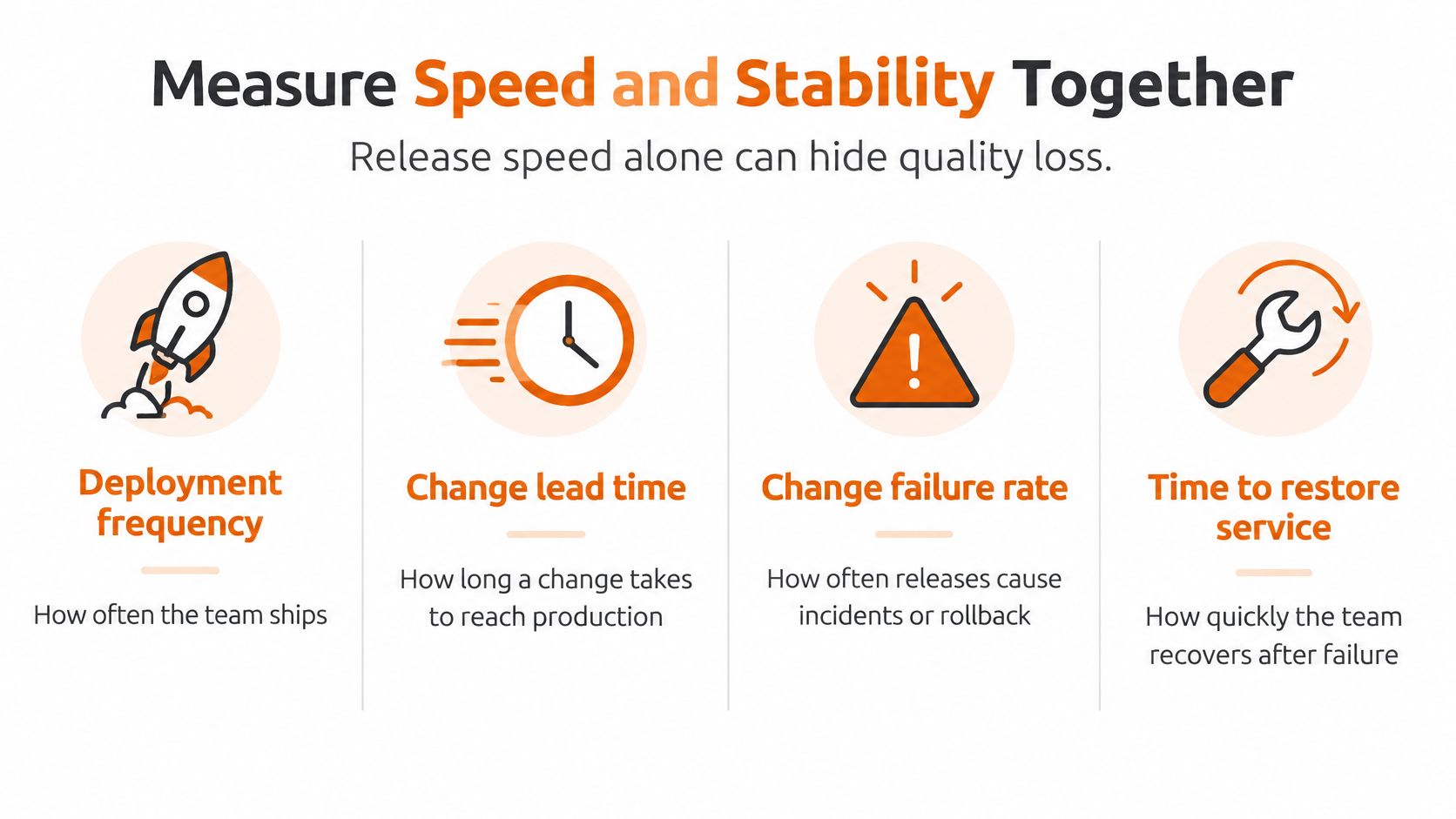
A team ships every day. Incident tickets double. The release chart looks excellent, and the product is getting worse. That is what happens when you track speed without stability.
Run throughput and instability as one system. Read deployment frequency and change lead time next to change failure rate, failed deployment recovery time and deployment rework rate. A team with high deployment frequency and a rising failure rate is not fast. It is borrowing time from the next incident.
DORA's metrics history established four measures, then added a fifth in 2024. Deployment frequency is how often the team releases. Change lead time is the period from committing code to a successful deployment. Change failure rate is the share of deployments that need immediate intervention, such as a rollback or hotfix. Failed deployment recovery time is how quickly service is restored after a failed release. Deployment rework rate is the share of delivery work spent on unplanned fixes.
| Metric | What it measures | Signal |
|---|---|---|
| Change lead time | Time from commit to successful production deployment | Speed |
| Deployment frequency | How often changes reach production | Speed |
| Change failure rate | Share of deployments needing immediate intervention such as rollback or hotfix | Stability |
| Failed deployment recovery time | Time needed to restore service after a failed deployment | Stability |
| Deployment rework rate | Share of delivery work spent on unplanned corrective work | Stability |
For every production change, record commit-to-deployment time, deployment count, a classification for every failed deployment, and time to restore service. Segment by product or service, and put the five metrics on one dashboard. An organization-wide average hides the service that is on fire and lets a healthy platform mask a broken checkout flow. Read the numbers by risk tier too, because a failing internal admin tool and a failing payment flow are different business events.
Lines of code and pull-request volume are weak signals. They reward volume, including unsafe volume. The 2025 DORA research, a survey of nearly 5,000 technology professionals, found that more than 80% believed AI increased productivity and 59% observed improved code quality, while AI adoption remained negatively associated with software delivery stability.
Faster coding is not a good practice. AI amplifies the delivery system you already have.
If rework or change failure rate rises, slow output and fix the system. More generated code will not rescue a fragile pipeline. For a worked view of how these signals map to delivery capacity, see engineering efficiency connects to delivery capacity.
Large, vague changes are hard to review, slow to merge, and good at hiding defects. AI makes that worse, because generation is cheap and comprehension is not.
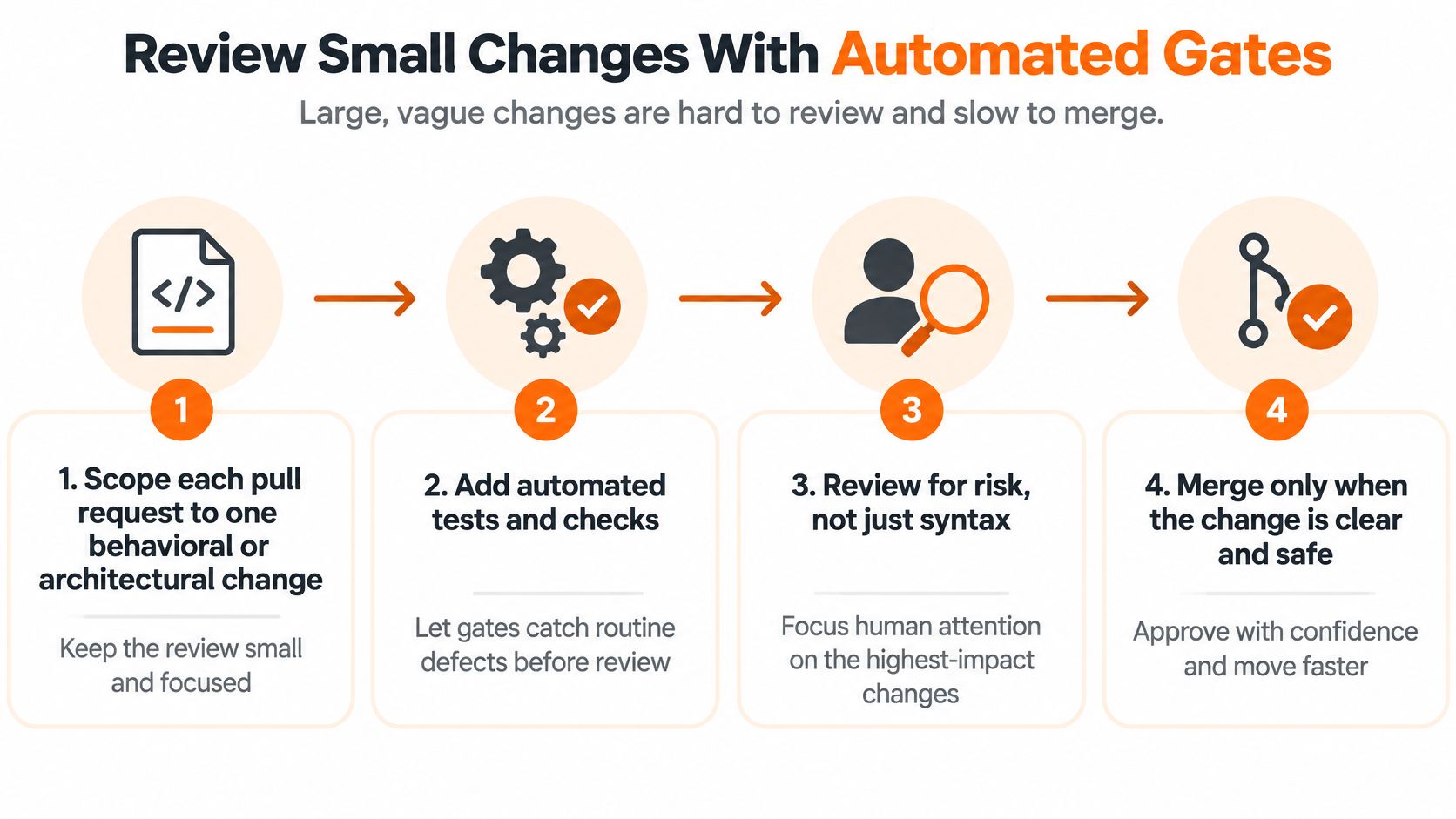
Comments are small and specific. The cycle is predictable, often same day for a focused change. Reviewers spend their attention on behavior and risk. A practical set of practical pull request review checklists helps a team agree on that bar so it doesn't depend on who is online.
Generated code raises the volume of changes a human must understand. Size limits, explicit acceptance criteria, and hard gates are how you keep that volume honest.
Tangled code taxes every feature. A small request touches five folders, a shared table, and three teams. The rewrite shows up right when the product needs to grow.
Modular design keeps change local. You pay a bit of design time up front so later changes stay cheap.
Modular design adds upfront design time and some interface overhead. Don't split a small product into a crowd of services. Use domain-driven design where the business rules are complex, and keep simple areas simple. A three-person MVP with twelve deployable services is not mature. It's expensive.
Warning signs are blunt. One feature needs edits across five folders. Unrelated modules share tables. No one owns a module. Those are the places AI speed is most dangerous, because generated code copies the first pattern it sees, including the messy one.
We architect systems on domain-driven design so a product can grow with the user base without a rewrite. If you want the decision criteria in more depth, read what software architecture actually decides.
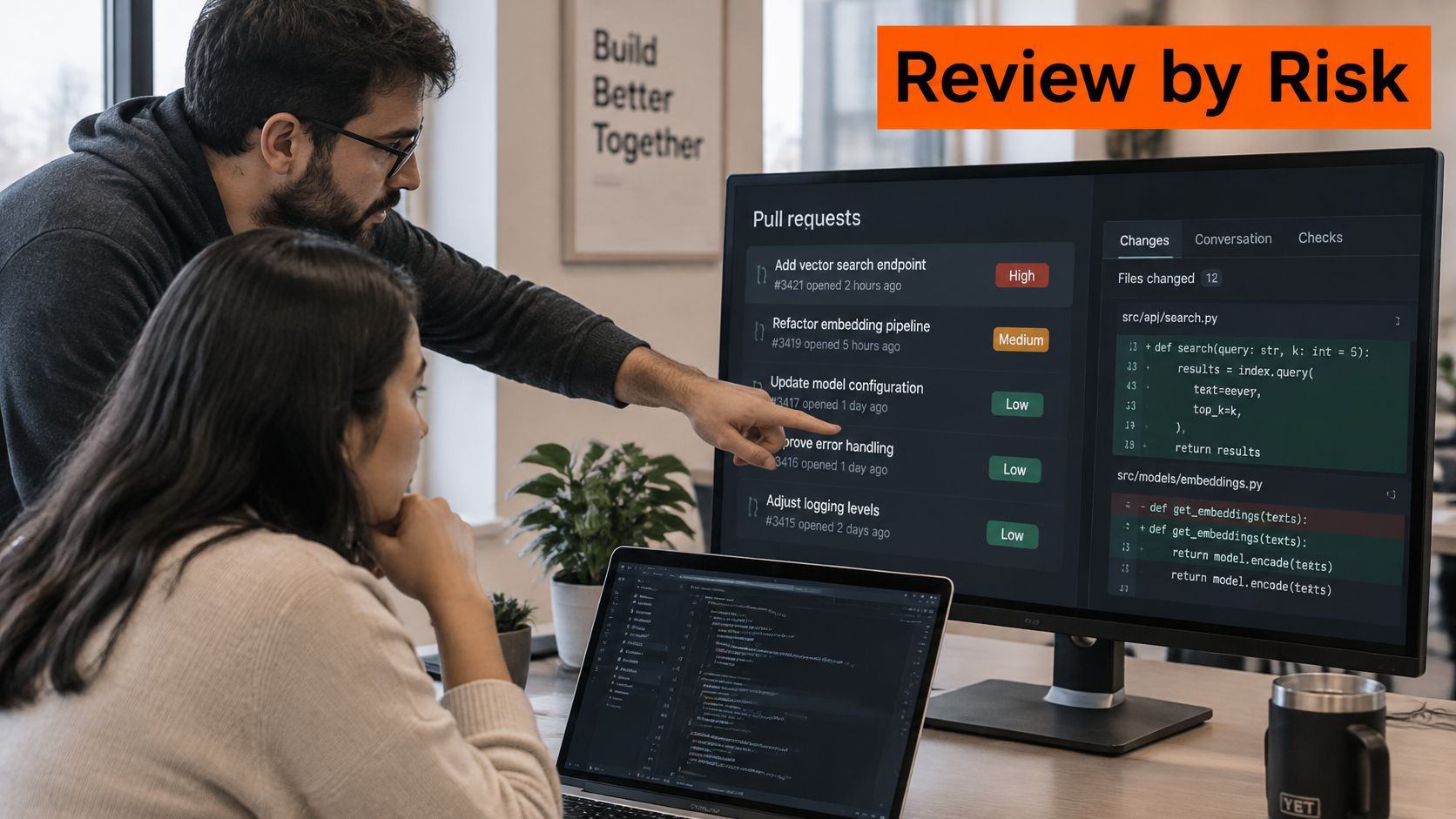
AI makes writing code cheap. The review load moves to humans who must understand more changes in less time. Blanket rules fail in both directions: reviewing every diff the same way burns senior time, and trusting the tests lets plausible garbage through.
The 2025 DORA report announcement notes that 30% of respondents reported little or no trust in AI-generated code. That tension is the point. Perceived speed and trust do not move together.
| Risk tier | Examples | Required review | Automated checks |
|---|---|---|---|
| Security and access | Authentication, permissions and secrets handling | Mandatory senior review | Security scan and access tests |
| Data and financial logic | Schema changes, pricing and payment calculations | Mandatory senior review | Data validation and reconciliation tests |
| Integrations and concurrency | Third-party APIs, queues and race-prone code | Mandatory senior review | Contract tests and load checks |
| Architecture | New modules and service boundaries | Architect review with a decision record | Dependency rules enforced in the pipeline |
| Routine changes | Copy changes and refactors inside one module | Peer review plus named architect sign-off | Unit tests and static analysis |
Walk the tiers from the top. Security, data, money, integrations, concurrency, and architecture get mandatory senior review. Routine changes still get peer review and named architect sign-off, with unit tests and static analysis as the gate. At Rite NRG, every change must pass architecture review by a named architect, automated tests, a security review, observability, and a documented runbook and decision record.
Set the tier by the cost of failure and the blast radius, not by how clever the prompt was. The outcome you want is fewer senior hours on low-risk diffs and more senior hours on the diffs that can hurt customers.
When AI speeds implementation, senior engineers stay accountable for data, security, integration, and production quality. Name owners for four things: prompts, generated artifacts, exceptions, and rollback. If nobody owns the prompt that produced a payment function, you don't have a system. You have a lucky diff.
The failure mode to watch is code that looks correct, follows an inconsistent pattern, and still passes basic tests. It copies yesterday's shortcut into today's module. SaaS teams modernizing legacy systems see this in migrations: scaffolding arrives fast, and the odd coupling comes with it.
Developers still lose meaningful time to technical debt, debugging, and poorly documented code. AI assistants have not removed that burden, and they can add to it when reviewers must sort plausible output from correct output. Governance has to shrink the toil, not add a second review layer.
Quick test for any reviewer: if this change failed in production, would it touch money, customer data, or access? If yes, move it up a tier.
AI adoption needs more engineering governance, not less: boundaries, observability, test coverage, and maintainability.
A short walkthrough of how risk shows up in a real review is worth fifteen minutes before you rewrite your template.
Most security failures repeat known weakness patterns. A late audit finds them after the feature is already in customers' hands. Treating security as a final gate is how teams buy the same incident twice.
A National Institute of Standards and Technology study published in 2021 analyzed Common Vulnerabilities and Exposures data and Common Vulnerability Scoring System metrics from 2005 through 2019. The software vulnerability environment was dominated by only a small number of vulnerability types and changed relatively little over that period. The study does not claim every vulnerability is predictable or equally severe. Recurring patterns are stable enough to justify systematic controls. Higher development speed, including AI-generated code, does not retire those classes.
Planning. Run a secure design review of data flows and access paths before tickets are estimated. If you can't draw who can read customer data, you aren't ready to code.
Development. Review against a security checklist, and update dependencies on a fixed cadence, not "when someone has time."
Every build. Run static application security testing, software composition analysis, and secrets detection. A 2025 survey reported that 53% of participants had access to automated security tools such as those. Nearly half did not. That is a pipeline gap, not a talent gap.
After release. Track each vulnerability to remediation with a named owner and a deadline. An open ticket with no date is a decision to accept the risk. Say that out loud, or close it.
For AI features, add boundaries around models and data, human approval for risky actions, and audit trails for decisions, prompts, and actions. After go-live, evaluate and monitor. Our Protect work on managed services covers security and access control, patching and dependency management, and backup, recovery, and reliability controls, because those don't end at launch.
Three warning signs: secrets sitting in repositories, no scanner in the pipeline, and security tickets that never close. Email authentication belongs in the same habit. You can validate your DMARC record before a spoofed sender burns a customer domain.
If you want the pipeline version of this, not a policy PDF, start with security as code.
A failed deployment at the wrong moment means lost revenue, an emergency weekend, and customers who stop trusting the product. Release discipline is a revenue control, not a DevOps hobby.
DORA research treats lead time for changes, deployment frequency, change-failure rate, and recovery time as core indicators, and reports that continuous integration, loosely coupled architecture, and fast code reviews improve delivery and operational performance. The mechanism is practical. Small, independently deployable changes shrink merge pain and blast radius. Automated build and test gates catch regressions before production. Frequent deployments shorten the feedback loop, so failures are easier to isolate and recover from.
Instrument each production change with commit-to-deployment timestamps, deployment counts, failed-deployment classification, and time to restore service. Segment by product or service, not a single company average. Tie every release decision to the scorecard: if failure rate or rework is climbing, you don't add scope.
A system isn't finished until someone who didn't build it can run it. Our delivery treats understandable code, documentation, deployment assets, and knowledge transfer as part of the work, not a closing admin task.
The package includes:
The test is blunt. Could a new engineer deploy, roll back, and debug this system in their first week? If not, the job isn't done.
Run a 30-day audit of the eight practices. Fix first the weakest one that threatens revenue or customers. Don't boil the ocean, and don't start with the practice that looks best in a conference talk.
Score each scorecard row from 0 to 2. Pick the lowest score that touches your product's most important outcome, whether that's checkout, onboarding, or the API your biggest customer depends on. Set a baseline on speed and stability before you change anything. If you skip the baseline, you'll argue about feelings in week four.
Assign one accountable owner per practice. Name who reviews the numbers each week. Extreme ownership means that person follows the result into production, not just to a merged ticket. They raise the risk early so the decision moves, instead of waiting for the incident review.
If neither the operating system nor the mission is clear, begin with discovery before you commit to a long-term team. Building on a foggy goal just produces expensive code. Our engagement formats are a fixed-fee technology or modernization assessment, defined software delivery at a fixed scope and price, and a transformation program of successive valuable releases. They aren't productized packages. A fixed-fee assessment is the right shape when you want a second set of senior eyes before you staff a squad.
A team with clear practices ships faster and sleeps better. This week, score the eight rows and put a name on the worst one.
Rite NRG plans, builds, and operates business-critical software with senior architects accountable for architecture, security, testing, and production quality, while agentic AI speeds the work without lowering the bar. If you want a practice audit, a fixed-fee assessment, or a team that owns the result through handover, start at Rite NRG. Bring your last incident and your current lead time, and we'll tell you which practice to fix first.
/ about the author
Written by the RITE NRG editorial team — the architects, engineers and delivery leads who build and operate AI-era software for our clients.
Strategy & Transformation
A practical, finance-ready framework for comparing AI and modernization investment with the current-state cost, realistic benefits, delivery risk and time to value.
Technology Talent & Teams
A decision-maker's guide to IT partnership models: what each model actually transfers to the partner, what it costs beyond the rate card, and how to match the model to your situation.
AI Consulting & Automation
A practical framework for choosing and deploying transport or logistics AI agents around real exceptions, reliable data and controlled operational authority.
More guidance: all insights articles
Tell us about the system or idea behind this article. We tell you honestly if it is a fit — and what a fixed-scope delivery could look like.