

Strategy & Transformation
How to Calculate ROI for AI and Software Modernization
A practical, finance-ready framework for comparing AI and modernization investment with the current-state cost, realistic benefits, delivery risk and time to value.
operationalwrocław--:-- cet
∕ insights / llm-evaluation-framework.md
LLM Evaluation Framework
Learn how to build an LLM evaluation framework with clear criteria, benchmarks, judge checks and monitoring that keep production AI reliable.
>_article.meta
Many engineering groups evaluate a model the way they'd buy a car from a spec sheet. They check the leaderboard, find the model at the top, and ship it. Then the assistant tells a customer about a refund policy that doesn't exist, or a claims bot approves a payout it was never allowed to approve, and everyone learns an expensive lesson about what a benchmark score measures.
Here's the uncomfortable part. A leaderboard rank tells you how a model performs on somebody else's tasks, in somebody else's conditions, at somebody else's cost envelope. None of those are yours. It says nothing about whether the same workflow succeeds on the fifth run, what a completed task costs you at volume, or whether the model can trigger an action nobody approved without anyone noticing.
So treat the llm evaluation framework as a release gate and an ownership system, not a metric list. It's a repeatable process with defined criteria, representative test cases, a validated judging method, hard gates before release, and monitoring after launch, and every gate ties back to a business outcome: fewer escalations, lower cost per resolved ticket, a launch your security team signs off on. Get this right and you ship faster with less risk. Get it wrong and you'll spend the next two quarters explaining an incident.
Say a support team picks the model sitting at the top of a public leaderboard. It launches as a customer-facing assistant. Within three weeks a customer quotes a refund policy the assistant invented, and the finance team has to honor it or explain why not. Nobody did anything careless. They just flew on one instrument reading.
Pilots don't take off because the altimeter looks good. They run a pre-flight checklist: fuel, hydraulics, weather, weight, systems. Evaluation works the same way. One number is not a pre-flight check, it's a single gauge.
Three ways a single score misleads. First, benchmark contamination can inflate results, because models have often seen the test items during training. Second, a general-task score ignores your specific workflow, your data, your policies and your users. Third, accuracy alone hides cost, latency and reliability, which are exactly the things that decide whether a system survives contact with production traffic.
The fix isn't a better benchmark. It's a framework that measures validity and reliability over time. NIST's AI Risk Management Framework frames validation as confirmation, through objective evidence, that requirements for a specific intended use have been fulfilled, and reliability as the ability to perform as required without failure for a given time interval and set of conditions. It goes further with Measure 2.5, which requires a deployed AI system to be demonstrated valid and reliable, and it notes that both are often assessed through ongoing testing or monitoring after deployment.
That reframing matters commercially. A one-time score can conceal operational risk. A lifecycle view connects model quality to fewer incidents, more predictable service and safer production decisions.
The rule we work to: if you can't state the intended use, the acceptance criteria and the monitoring owner, you don't have an evaluation framework. You have a demo.
A complete framework covers five layers: task quality, reliability, cost and speed, safety and actions, and governance. Each one answers a different question and each one gets its own gate. The next section lays out the scorecard.
Five layers, five questions, five gates. Print this and put it on the wall before your next model decision.
| Layer | Question it answers | Example measures | Release gate |
|---|---|---|---|
| Task quality | Does it complete the business task correctly? | Task success rate, groundedness, expert review score | Meets the acceptance threshold on the representative test set |
| Reliability | Does it succeed every time, not just once? | Pass rate across repeated runs, variance between runs | Stable across repeated runs, with no single lucky run counted |
| Cost and speed | Can we afford to run it at volume? | Cost per successful task, p95 latency | Within the budget and latency target agreed with the product owner |
| Safety and actions | Can it cause harm or trigger an unapproved action? | Policy violations, unsafe tool calls, escalation rate | Zero unapproved high-impact actions in the test suite |
| Governance | Can we prove what was tested and decided? | Versioned test evidence, logs, decision records | Every release has evidence, an owner and a documented rollback |
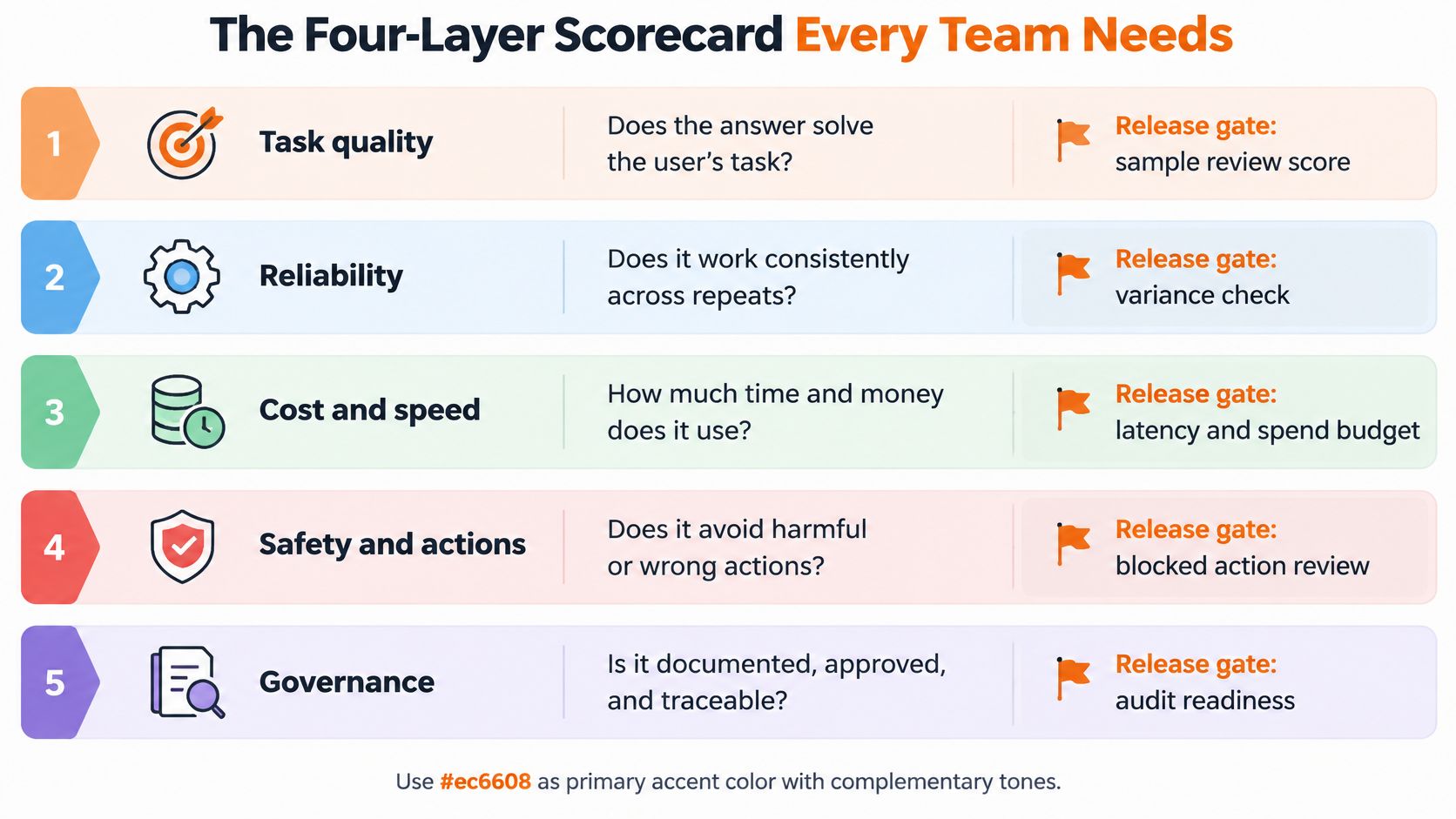
A model that writes beautiful answers and fails half its repeated runs does not ship. A model with perfect task success and a cost per task that eats your margin does not ship. A model that never says anything harmful but wires a refund through without approval does not ship. Each gate stands alone, and that's the point. Averaging five layers into one composite number is how teams talk themselves into a launch they shouldn't do.
The product owner sets the business threshold, because they own the outcome the workflow exists to produce. A named architect owns architecture and the cost trade-offs, and signs the decision record. Security owns the safety layer and can block a release on their own authority. The engineering lead signs the governance evidence: versioned tests, logs, rollback plan, monitoring. If a layer has no owner, it has no gate.
Sequencing rule: define the business process and its economics first. Choose the model and the architecture last, on evidence.
That ordering is how we run AI work: the process, the opportunity and the process economics come first, and model and architecture decisions come last, on evidence. It's also why we tell clients plainly when a custom model or a local LLM isn't needed. Sometimes a well-prompted hosted model with a tight test set beats a fine-tuned one on every measure that matters.
Say a claims-triage assistant clears the task quality gate on the test set. Great news. Then the cost layer fails: cost per successfully triaged claim is triple the budget, because the workflow calls a large model three times per claim and re-runs on validation errors. The wrong move is to lower the cost bar. The right move is to change the model size for the first-pass classification, route only ambiguous claims to the large model, and cut the retry loop. Accuracy holds, cost drops, and the gate passes on evidence.
The economics are moving fast in your favor. The Stanford 2025 AI Index reports that the inference cost of a system performing at the level of GPT-3.5 fell more than 280-fold between November 2022 and October 2024. Cheaper inference makes previously uneconomic workflows viable, but it doesn't remove the need for architecture, data controls, security review and testing. Compare cost per completed business task, not leaderboard position. If cost is your constraint, our notes on LLM cost optimization cover the routing and caching patterns that move the number in practice.
One more useful input for the safety and reliability layers: how other teams measure quality on live conversational systems. Dograh's insights on agent QA is a practical reference for turning call-level observations into metrics you can track.
Can you name the owner and the gate for all five layers, for one workflow, right now? If you stumble on any layer, that's your next piece of work.
Your test set is the asset. Models change, prompts change, vendors change. A versioned set of cases drawn from your actual business is the thing that keeps quality honest across all of it.
Here's where the cases come from, and what each source is good for.
| Source | Strength | Main risk | Best use |
|---|---|---|---|
| Public benchmarks such as MMLU, HellaSwag and HumanEval | Standard comparison across models | Likely contamination in training data | Sanity check and cross-model comparison only |
| Anonymized real user workflows | Matches actual demand and mix | Privacy handling and skew toward common cases | Core regression set |
| Expert-written cases | Covers edge cases and policy rules | Slow and costly to write | Safety and high-stakes scenarios |
| Synthetic generated tasks | Controllable difficulty and hidden test cases | Can drift from real usage | Stress tests and tool-call variation |
| Private held-out set | Hard to leak into training data | Needs regular refresh | Final release decision |

Scores on widely used datasets get inflated when a model has already seen the test items. A 2024 ACL Findings study measured contamination across multiple widely used benchmarks and reported rates ranging from 1% to 45%. The worst cases were academically sourced test sets, with 29.1% of MMLU examples and 45.8% of C-Eval examples flagged as contaminated. The effect on reported performance was real: accuracy inflation of up to 14 percentage points on contaminated C-Eval data and up to 7 percentage points on HellaSwag.
For code generation, question answering and domain assistants, inflated offline scores translate directly into unreliable production estimates. Public benchmarks stay useful as sanity checks and cross-model comparisons. They should not make the release decision.
Release rule: your private, refreshed set decides the release. Everything else is context.
Building that set gets faster with tooling, and our notes on AI test case generation cover how to scale it without losing the expert judgment that makes the cases meaningful.
An LLM judge is a noisy measuring instrument, not ground truth. Teams that forget this end up optimizing for the judge instead of for the customer.
The evidence is blunt. A large evaluation of 21 judges across MT-Bench, JudgeBench and RewardBench, covering roughly 541,000 individual judgments, found judge rankings could shift by as many as 14 positions across benchmarks. It also found that test-retest reliability above 0.95 can coexist with position bias exceeding 0.10, which means a judge can be extremely consistent while systematically favoring the first answer it reads. Consistency is not accuracy.
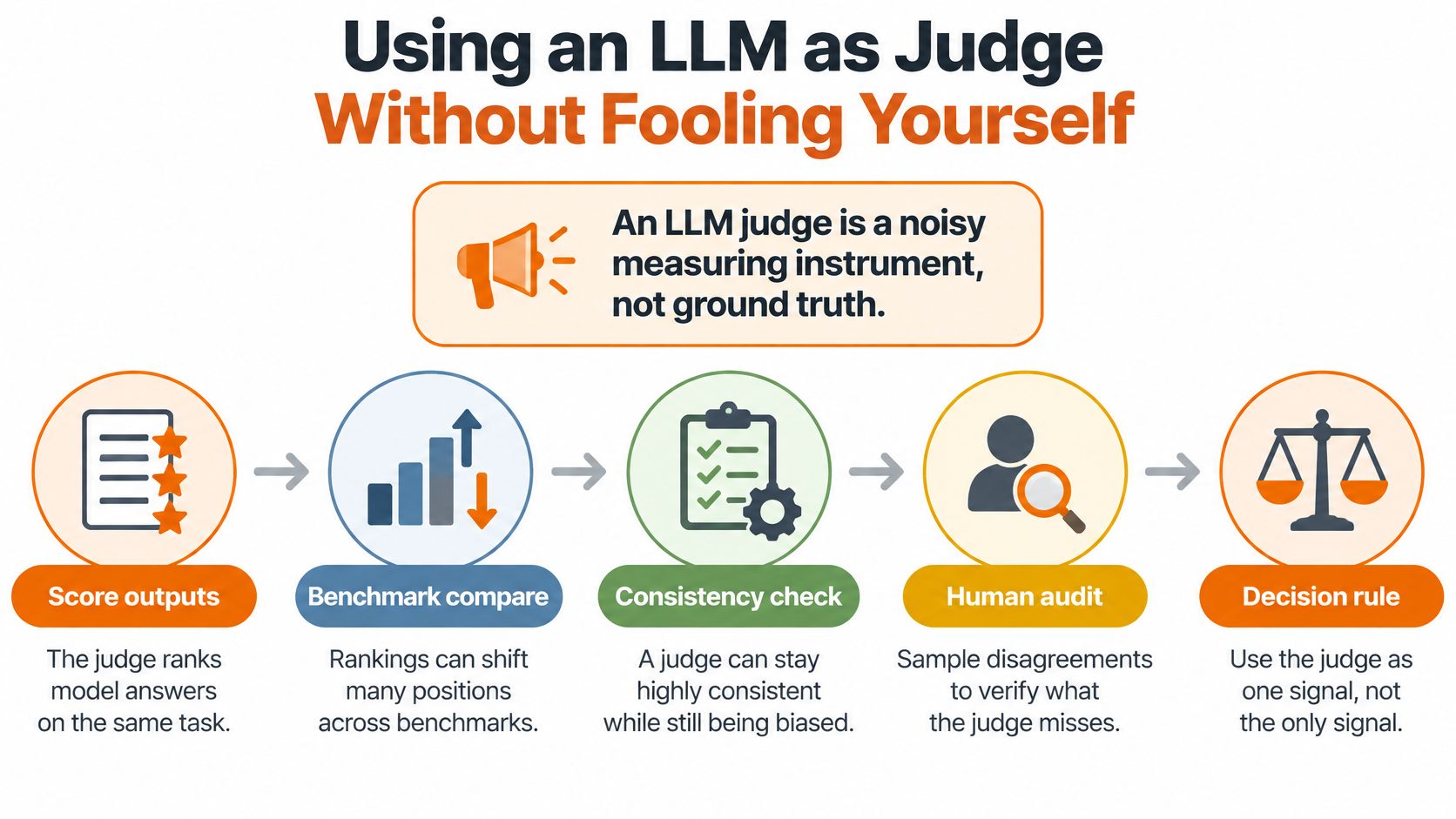
Stacking three judges doesn't average out bias, it can amplify shared preferences. One judge, calibrated against humans, with a documented false-positive and false-negative rate, beats a panel of unvalidated graders every time.
Report agreement and bias on separate dashboard lines. A single "quality score" hides the fact that your judge is confidently wrong.
Text quality is the easy part. The expensive failures happen when a model triggers an action.
Consider a refund assistant. A customer asks for their money back on an order outside the policy window. The assistant writes a polite, accurate reply explaining the policy, and calls the refund tool anyway, because the tool was available and the request sounded reasonable. Your text-based evaluation passes with flying colors. Finance loses the money.
OWASP's Top 10 for LLM applications calls this excessive agency: a vulnerability where unexpected, ambiguous or manipulated model outputs enable damaging actions. It names three root causes, excessive functionality, excessive permissions and excessive autonomy, and notes the impact spans confidentiality, integrity and availability depending on what the model can reach.
Research on agentic evaluation points the same way. FuncBenchGen generates synthetic, controllable, contamination-free multi-step function-calling tasks, so evaluators can vary tool selection, argument construction, execution order and recovery independently. Record trajectory-level metrics, because an agent can produce a correct final answer while making an unsafe intermediate call, or fail on a malformed argument despite picking the right tool.
Every change then has to clear the same bar: architecture review by a named architect, automated tests, a security review, observability, and a documented runbook and decision record. That's not bureaucracy. It's the difference between a demo and a system you can defend in an audit.
Launch is where measurement starts, not where it ends. The pre-launch suite tells you whether you're allowed to go live. Production tells you whether you should stay there.
| Metric | How to calculate it | Alert when |
|---|---|---|
| Task success rate | Passed tasks divided by sampled tasks, scored by judge plus human audit | Drops below the release baseline in two review cycles in a row |
| Run-to-run variance | Spread of pass rates across repeated runs of the same workflow | Spread widens after a model, prompt or data change |
| p95 latency | 95th percentile response time for each workflow | Exceeds the latency target agreed with the product owner |
| Cost per successful task | Total inference and tooling cost divided by successful tasks | Rises faster than transaction volume |
| Escalation rate | Tasks handed to a human divided by total tasks | Rises after a release or a model change |
| Policy violations | Flagged outputs or unapproved actions per 1,000 tasks | Any unapproved high-impact action |
Research on enterprise agent benchmarks found measured performance fell from 60% on a single run to 25% when evaluated across eight runs. The same analysis reported cost differences of up to 50-fold between systems achieving similar precision, while security, latency and policy compliance were often left out of benchmarks entirely.
Read that again in business terms. A model that wins a one-off test can be the wrong production choice if it's expensive, nondeterministic or operationally fragile. Your single-run pass rate is a best case, not a forecast.
Track the spread, not just the average. A workflow whose pass rate swings wildly between runs is a support queue waiting to happen.
A cheaper model passes the single-run suite comfortably. Two weeks after launch, run-to-run variance climbs, escalations rise, and the support team starts routing around the assistant. Because the dashboard tracks variance and escalation rate, not just mean accuracy, the team catches it in the first review cycle and rolls back one routing change. Without those two metrics, the same story ends with a churn problem nobody can explain.
Lifecycle discipline pays. A pilot becomes a production capability only when evaluation, approvals, monitoring and ownership are designed in, and that means naming the owner of every alert before go-live. Keep the pipeline itself maintained, too, because drift in prompts, data and dependencies degrades evaluation just as fast as it degrades the product; automation maintenance and support is a useful reference for the ongoing upkeep side. For the observability mechanics, our notes on AI agent observability cover what to log and how to trace multi-step runs.
For high-risk systems, Article 15 of the EU AI Act requires appropriate accuracy, resilience and cybersecurity, consistent performance throughout the lifecycle, declared accuracy metrics in the instructions for use, and resilience against attempts to alter outputs or performance by exploiting vulnerabilities. Your alert thresholds are part of that record. They let you show regulators and customers what was measured, and when it was investigated.
Don't build a framework for the whole estate. Pick one workflow and prove the model works.
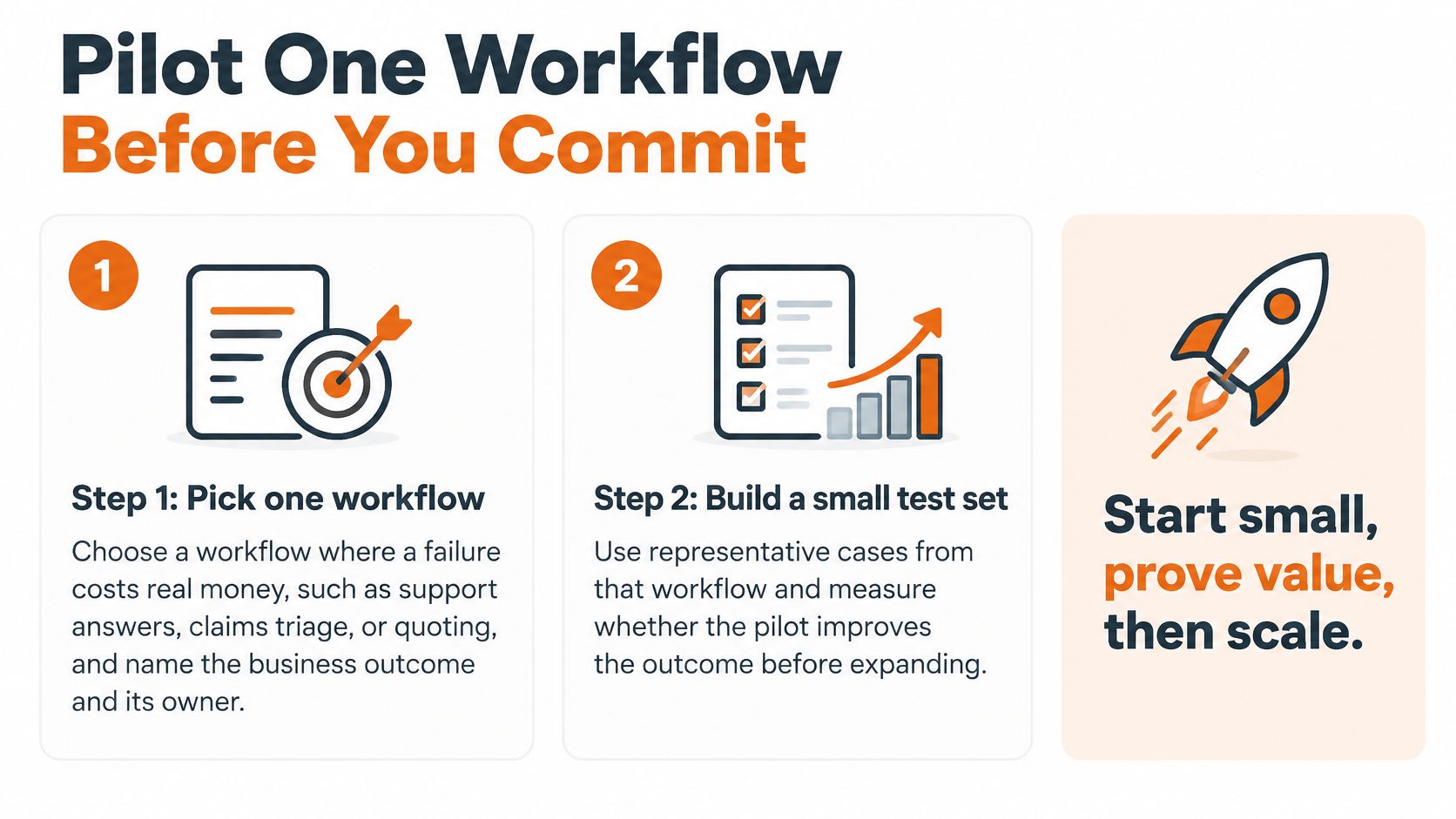
A senior partner shortens this. Our technical and operational assessment reviews the architecture, dependencies, security position, observability and operational risk, then agrees what must be corrected first, and it's offered at a fixed fee. To move a pilot into production, we assess it against architecture, data, security, evaluation, monitoring and ownership requirements, then deliver the gap as a bounded release with acceptance criteria. AI makes that work faster. Senior engineers still own the standard.
Bring one workflow and its scorecard to a short discovery conversation. You'll leave knowing whether it's ready to ship.
Rite NRG helps SaaS and enterprise teams turn model selection into a release decision they can defend, with evaluation, acceptance criteria, monitoring and model operations designed in from the start. If you're sitting on a pilot that looks good in a demo but hasn't been tested for reliability, cost or action safety, we'll assess it against architecture, data, security and ownership requirements and deliver the gap as a bounded release. Visit Rite NRG to start that conversation.
/ about the author
Written by the RITE NRG editorial team — the architects, engineers and delivery leads who build and operate AI-era software for our clients.
Strategy & Transformation
A practical, finance-ready framework for comparing AI and modernization investment with the current-state cost, realistic benefits, delivery risk and time to value.
Technology Talent & Teams
A decision-maker's guide to IT partnership models: what each model actually transfers to the partner, what it costs beyond the rate card, and how to match the model to your situation.
AI Consulting & Automation
A practical framework for choosing and deploying transport or logistics AI agents around real exceptions, reliable data and controlled operational authority.
More guidance: all insights articles
Tell us about the system or idea behind this article. We tell you honestly if it is a fit — and what a fixed-scope delivery could look like.