

Strategy & Transformation
How to Calculate ROI for AI and Software Modernization
A practical, finance-ready framework for comparing AI and modernization investment with the current-state cost, realistic benefits, delivery risk and time to value.
operationalwrocław--:-- cet
∕ insights / ai-test-case-generation.md
Test Case Generation
Learn how AI test case generation cuts release risk, what to measure beyond coverage, and how to keep AI-written tests trustworthy before you scale.
>_article.meta
The most repeated advice about AI test case generation is to point it at your least-covered files and watch the percentage climb. That advice is expensive. Coverage records which lines executed. It never tells you whether a single test would have caught the pricing bug that reached a customer last quarter.
A generated test earns its place by killing a fault, not by touching a line. Get that criterion into your release gate and the program gets simpler: fewer tests, sharper assertions and a much smaller maintenance bill every sprint.
A green pipeline can still ship a pricing bug. If generated tests execute annual billing logic but never check the returned discount, coverage rises while the defect stays invisible.
Coverage measures which code ran. It does not show whether a test would catch incorrect behavior. For teams evaluating AI-generated tests, that distinction separates a useful suite from a growing maintenance burden.
A 2025 study of Meta software platforms reported that engineers generated 571 additional unit tests through mutation-guided LLM testing. 277 would have been discarded if line coverage were the only adequacy criterion (mutation-guided LLM testing study). The result shows why execution alone is a weak release gate: some tests add value by detecting faults without adding line coverage.
A green coverage number measures execution. It does not prove that tests detect incorrect results.
Test quality has several independent dimensions: syntactic validity, compilation correctness, behavioral correctness, coverage and mutation-based defect detection. The TestBench study evaluated GPT-4-generated tests across 108 functions from nine projects and reported 92.51% line coverage alongside a 26.10% mutation-kill rate. High coverage can coexist with weak fault detection.
Compare measures instead of treating one percentage as a verdict.
| Measure | What It Reveals | TestBench GPT-4 | ULT Benchmark Average |
|---|---|---|---|
| Line or statement coverage | Code that ran, not whether its result was checked | 92.51% line | 45.10% statement |
| Branch coverage | Decision paths exercised | Not reported | 30.22% branch |
| Assertion accuracy | Whether tests check the expected result | Not reported | 41.32% accuracy |
| Mutation score | Whether tests catch injected faults | 26.10% kill rate | 40.21% mutation score |
The ULT benchmark study, using 3,909 curated Python functions, reported 41.32% accuracy, 45.10% statement coverage, 30.22% branch coverage and a 40.21% mutation score. On the same four measures, the easier TestEval benchmark reported 91.79%, 92.18%, 82.04% and 49.69%. Benchmark choice changes the story, so a polished demo on utility functions is poor evidence for tests of authorization, integrations or malformed inputs.
For a pilot, choose one module and record its baseline mutation score with a tool supported by your stack: PIT for Java, Stryker for JavaScript or C#, or mutmut or Cosmic Ray for Python. Then assess generated tests for assertion accuracy, mutation score, branch coverage and stability across three runs. A software quality assurance approach should treat those measures as evidence for a release decision, not as a scoreboard to maximize.
Treat AI test case generation as a fast junior tester who will only ever read the spec you hand over. Hand it a vague ticket and you get vague tests that pass. Hand it acceptance criteria, security controls and a bounded scope and the output changes character. Spec quality is the whole game, and no tool fixes it for you.
Four decisions come before the first prompt. Pick the features that carry revenue, customer data or regulatory exposure, because those are where a missed assertion costs real money. Write the requirements and expected behaviour as checkable statements, not prose paragraphs. Settle architecture and test strategy first, so the generator doesn't mirror a structure you'll reshape next sprint. Then generate for one bounded module or the changed code in a single pull request.
We run AI work to production through four stages: Discover, Design, Build and prove, then Operate. Generation belongs inside Build and prove, after the first two stages have produced something a machine can be held to.
The principle we work by: architecture before generation, frequent production evidence, and a named human accountable for what reaches production.
In practice that means every change passes architecture review by a named architect, automated tests, a security review, observability, and a documented runbook and decision record. Generated tests sit inside that control set. They don't replace any of it.
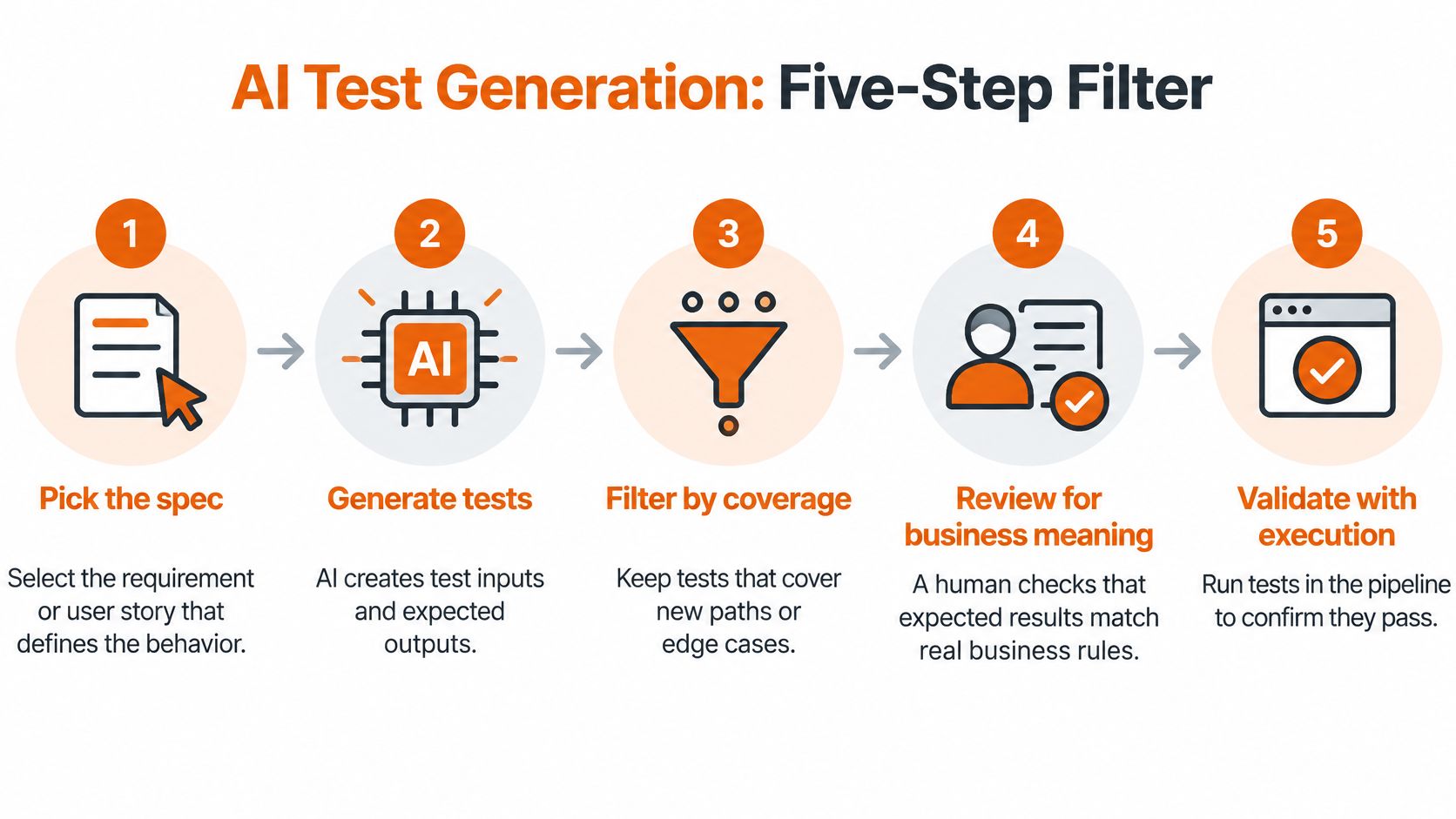
The loop from requirement to retained test looks like this.
Three conditions, no exceptions. Every kept test traces to a written requirement, kills at least one meaningful mutant, and carries a reviewer's name. Anything short of that stays a candidate.
Map one high-risk module through all five stages before you scale. One module tells you the actual cost per retained test, and that number decides whether the program is worth funding.
An AI-generated test can report 100% coverage and still approve a pricing bug. If a subscription should receive a 20% annual-billing discount, and a promo code must not stack with it, a test that copies the implementation's incorrect combined discount only makes the defect harder to change.
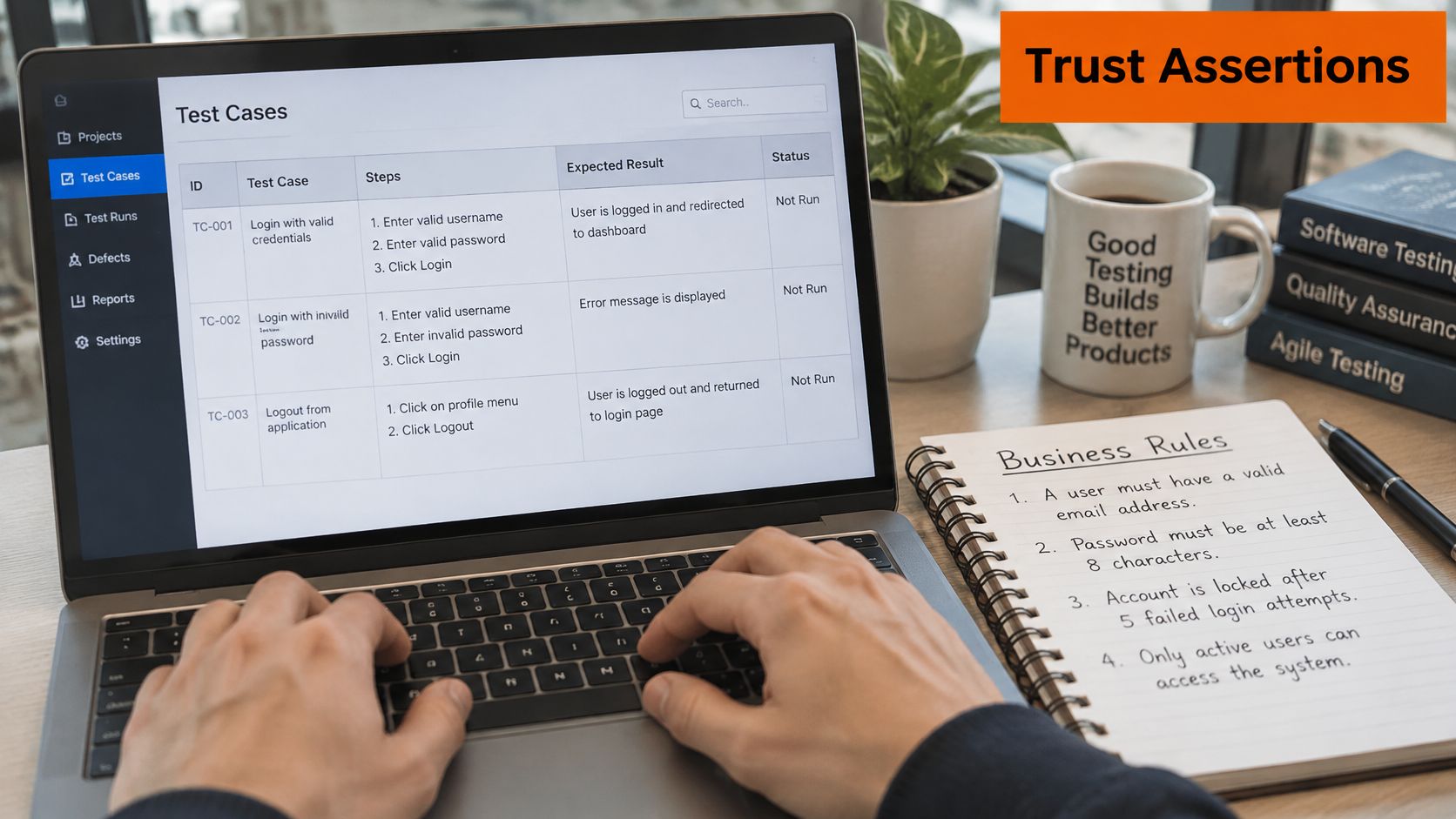
Generating inputs is straightforward. The expected result requires a business rule the test can trace to an approved source. Treat every generated assertion as a candidate, then ask whether it checks the requirement or merely repeats the current code.
A 2025 study of the AsserT5 assertion-generation model found that suggested assertions matched ground-truth assertions precisely in up to 59.5% of cases. On real Defects4J bugs, the model produced fault-finding assertions for only 33 of 138 assertion-detectable bugs. A separate study of 13,866 test oracles from 135 Java projects found that LLM-generated oracles could improve mutation scores, while complex oracles remained a limitation.
That gap calls for a release gate, not more generated assertions. OWASP's SAMM guidance on AI-assisted development recommends supplying security controls and expected behaviour, using consistent prompts, and deriving unit and integration tests from requirements. The practical rule is simple: approve an assertion only when a reviewer can connect its expected result to an explicit business rule.
Pricing tests need that rule written down first. Define eligibility, stacking and expiry in terms reviewers can check against the expected outcome. A guide to coupon API endpoints and rules can help with the vocabulary, but it cannot decide what a business policy should be.
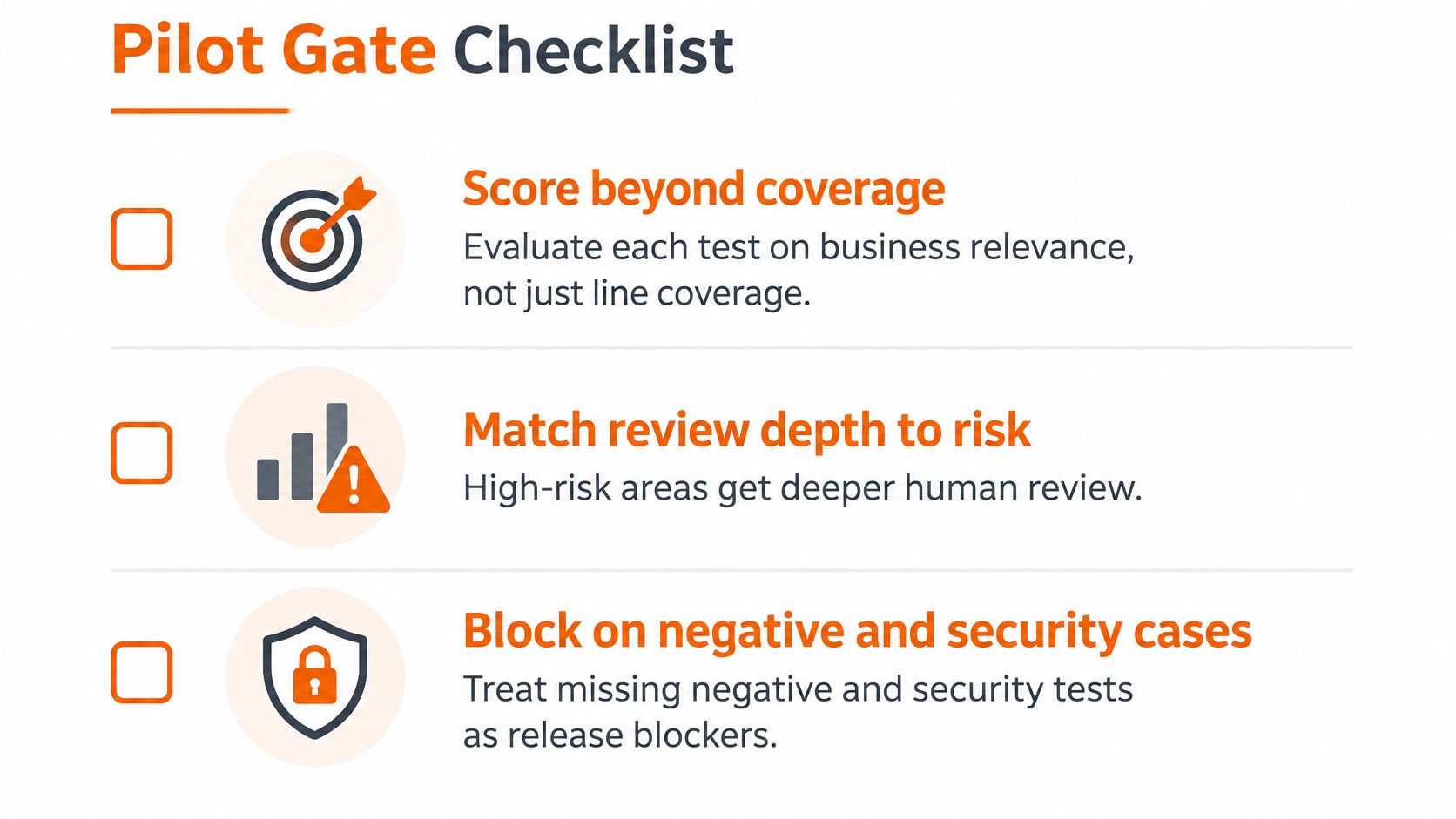
Set review depth by the consequence of a wrong result. A mutation check can show whether an assertion catches a changed condition; it cannot establish that the expected business outcome is correct.
| Risk Level | Typical Code | Required Review |
|---|---|---|
| Low | Formatting, pure helpers, internal utilities | Engineer review and a mutation check |
| Medium | Integrations, data transforms, reporting | Contract tests and a spot check by the code owner |
| High | Payments, pricing, permissions, migrations | Domain-owner approval, property-based or metamorphic tests, and a traceable requirement |
For release-blocking assertions, require two accountable approvals: an engineer for the test and a domain owner for the rule. Keep the requirement alongside the test in source control. If the assertion cannot kill a meaningful mutation or its expected result has no approved source, it is not ready to gate a release.
A generated test proves a user can open an invoice. Nothing in the batch checks that a user from another tenant is refused. That second case is the one that reaches production, opens the security review and turns launch week into incident week.
Generators favour the happy path because the happy path is what the ticket and the code describe. OWASP is blunt that passing tests are not sufficient evidence of secure behaviour, and asks teams to add the adversarial cases AI tends to omit: invalid inputs, expired tokens, malformed payloads, boundary conditions and concurrent access (OWASP Secure Coding with AI Cheat Sheet). Its verification guidance adds qualified human review of AI-generated code, automated security testing on every relevant pull request, and merge blocking for critical findings at CVSS 9.0 or higher unless an authorized human approves a written exception.
A software security review is the right home for these cases, because they need an owner and a schedule rather than an occasional sweep before an audit.
Write one short negative-case checklist per service. Keep tenant isolation and token expiry on it as release-blocking checks. Those two catch more real incidents than any coverage target you'll ever set.
A green test suite is only useful if its tests detect defects and behave consistently. Give every generated test a named owner who can explain what it checks, review its assertions, and decide whether it belongs in a release gate.
Flaky tests weaken those gates by making real failures harder to distinguish from noise. Researchers at Google studied flaky tests across 428 projects and reported that their automated technique identified the code locations causing flakiness with 82% accuracy. They also found that adoption depends on fitting developer workflows, providing straightforward debugging help, and automating fixes (De-Flake Your Tests research at Google).
Quarantine rule: If a test fails twice without a code change, remove it from the blocking set that day. Restore it only after fixing the cause, correcting the assertion, or documenting its deletion.
Start diagnosis with the source of instability: locators tied to layout, fixed sleeps, shared test data, or network timeouts and retries. Fix timeout and retry behavior structurally before changing the suite; repeated reruns only conceal the failure. For UI tests, a Page Object Model for organizing page interactions can reduce locator churn. If the issue lies in network retry or proxy behavior, review retry and proxy handling reliability as a separate operational concern.
Track maintenance time each sprint. Record the effort spent pruning, updating, and quarantining tests so the team can see the cost of keeping the suite reliable.
A green coverage number can hide tests that never catch a broken rule. Scale AI-generated tests only when they demonstrate useful failure detection, have named owners and meet release gates.
A controlled study of developers building an HTTP server in JavaScript found that participants using an AI pair programmer finished 55.8% faster than the control group, with a 95% confidence interval of 21% to 89%. The study did not examine code quality (AI pair programmer productivity study). Faster test authoring matters only if the resulting assertions detect failures that matter to the product.
Before scaling, agree on one pilot module and record the evidence the team will use to make its decision:
A generator without a clear owner produces tests the team may stop trusting. If a pilot is taking a prototype to production, its tests need accountable owners, release gates and evidence that holds beyond a demo.
RITE NRG offers an AI opportunity assessment, readiness review or roadmap for a fixed fee priced by complexity. To move a pilot toward production, RITE NRG assesses it against architecture, data, security, evaluation, monitoring and ownership requirements, then defines a bounded release with acceptance criteria.
Start with one high-risk module. Agree on the gate, assess the gaps and scale only when the release meets its criteria. Visit Rite NRG to start the conversation.
/ about the author
Written by the RITE NRG editorial team — the architects, engineers and delivery leads who build and operate AI-era software for our clients.
Strategy & Transformation
A practical, finance-ready framework for comparing AI and modernization investment with the current-state cost, realistic benefits, delivery risk and time to value.
Technology Talent & Teams
A decision-maker's guide to IT partnership models: what each model actually transfers to the partner, what it costs beyond the rate card, and how to match the model to your situation.
AI Consulting & Automation
A practical framework for choosing and deploying transport or logistics AI agents around real exceptions, reliable data and controlled operational authority.
More guidance: all insights articles
Tell us about the system or idea behind this article. We tell you honestly if it is a fit — and what a fixed-scope delivery could look like.