

Strategy & Transformation
How to Calculate ROI for AI and Software Modernization
A practical, finance-ready framework for comparing AI and modernization investment with the current-state cost, realistic benefits, delivery risk and time to value.
operationalwrocław--:-- cet
∕ insights / bespoke-mvp-development-services.md
Bespoke MVP
Discover how bespoke MVP development services accelerate time-to-market and reduce risk for SaaS founders. Learn the process, pricing, and partner selection.
>_article.meta
Are you building code for investors, or a business asset? Bespoke MVP development services can launch in about 5.9 weeks on average, compared with 9.8 weeks for a generalist freelancer and 18.3 weeks for a full-service agency, while specialist builders convert 47% of projects to a first paying user within 60 days, compared with 19% for a full-service agency.
That comparison points to the underlying business question. A minimum viable product isn't successful because it contains fewer features or reaches a demo quickly. It succeeds when it produces validated learning, reduces the risk of building the wrong solution, and gives the business a credible path to revenue, capacity, or market entry.
Many founders still treat MVP delivery as a race to generate code. That approach can produce an impressive investor demo while leaving behind unclear assumptions, fragile integrations, and a product nobody needs. A stronger approach combines focused scope, senior engineering accountability, and a delivery partner willing to challenge decisions before they become expensive.
Speed and quality aren't opposing goals, but undisciplined speed creates a costly choice between them. A bespoke MVP focuses the team on the smallest complete user journey that can test a commercial assumption, rather than on the largest possible feature list.
The term MVP has a documented history. Frank Robinson introduced “minimum viable product” through his firm's methodology in 2001, Steve Blank expanded the concept through Customer Development in 2005, and Eric Ries popularized it through The Lean Startup in 2011. The practical principle remains useful: launch a testable version, learn quickly, and reduce the risk of building the wrong solution. The history of the minimum viable product provides that context.
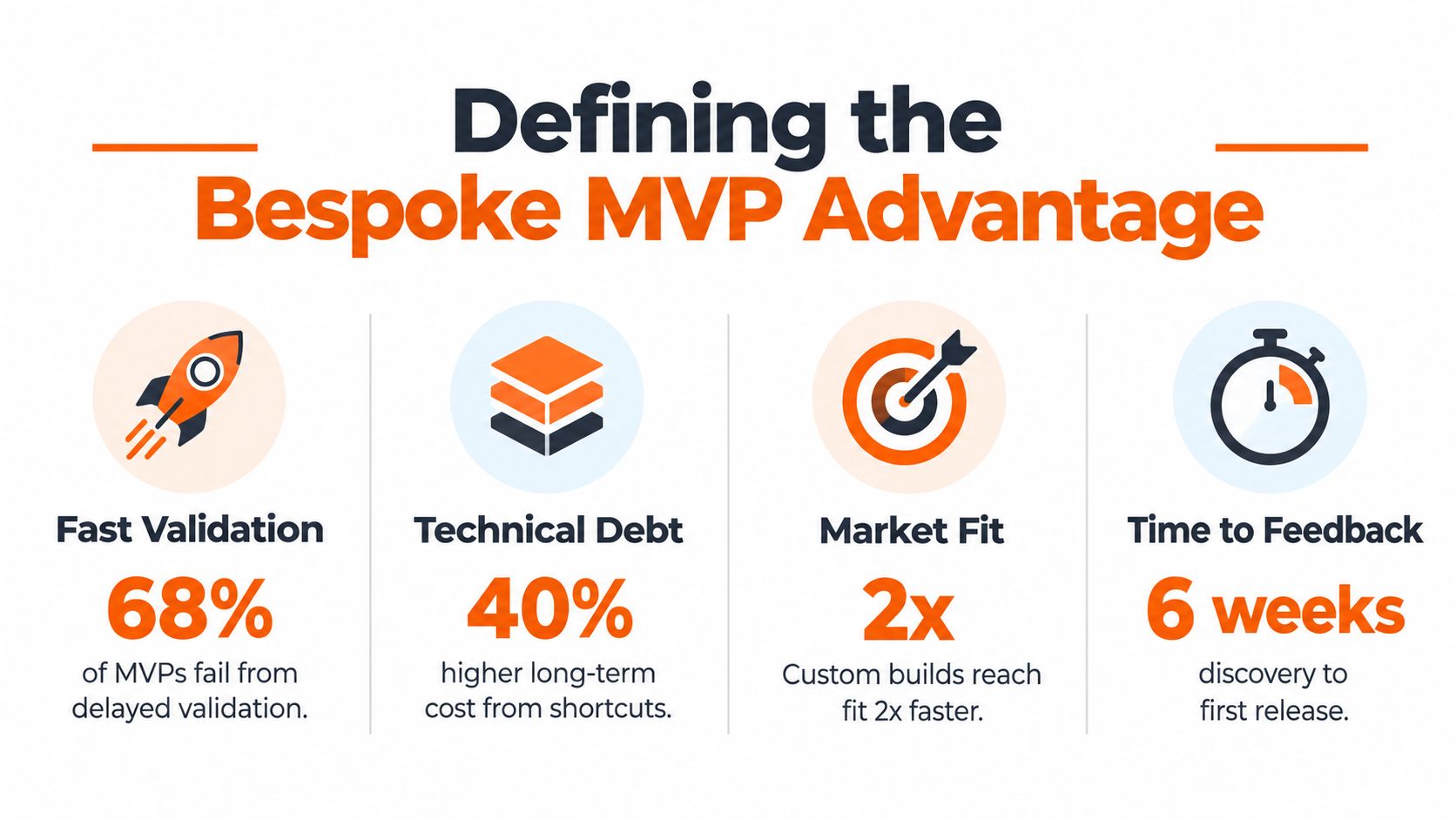
Template-based products and freelancer-heavy builds can work for a narrow experiment, especially when the workflow is simple and disposable. They become risky when the MVP needs proprietary logic, sensitive data, third-party integrations, or a credible path to expansion.
Bespoke MVP development services tailor the product around the business model. That usually means:
The trap is “vibe coding”, where generated code and improvised decisions create the appearance of progress without a shared architecture or test strategy. AI can help produce software faster, but it can't decide whether a workflow is commercially meaningful or whether a shortcut will block the next release.
Practical rule: Reduce scope aggressively, but never reduce accountability for security, data integrity, testing, or production behavior.
Bespoke delivery turns software from a cost center into a learning and growth asset. The right team doesn't promise to build everything. It commits to proving the most important business assumption with a product that can be maintained, measured, and extended.
The cheapest hourly rate rarely represents the lowest delivery cost. Founders also pay for misunderstood requirements, delayed decisions, duplicated management, handoff friction, and rework. A nearshore partner changes that equation by keeping collaboration closer in time and operating context while giving the business access to a broader technical market.
Poland is a strong example. The country has an estimated 295,000 professional developers, roughly 25% of the regional developer population, while Polish software-market revenue is projected to reach €2.1 billion in 2024 and €2.6 billion by 2028, with annual growth of 4.0%. The same European software development services market analysis projects the global software development outsourcing market to grow at an 11.5% CAGR from 2023 to 2028.
Those figures matter because an MVP requires more than a coder. Product discovery, architecture, UX, quality assurance, delivery management, and release operations all affect the time between an idea and useful evidence. Poland's concentrated engineering capacity gives startups and scaleups access to those capabilities without forcing every specialist role into an internal hiring plan.
A fixed-scope engagement can make the commercial conversation clearer. The partner and client agree on the workflow, acceptance criteria, assumptions, dependencies, and release outcome before work begins. That doesn't eliminate uncertainty, but it exposes it early and gives both parties a method for managing change.
A dedicated team offers a different trade-off. It gives the client more flexibility as the backlog evolves, but the client must provide stronger product ownership and accept that the final cost depends on the work selected. Fixed scope suits a defined validation target. A dedicated team suits a product that already has changing priorities and an internal leader ready to make daily decisions.
Nearshore delivery also reduces the hidden tax of long timezone gaps. Shared working hours allow an engineer to clarify a requirement while the product owner is available, rather than waiting for the next overlap. That supports the proactive communication expected from a serious partner, not just a ticket-based supplier.
For a practical comparison of operating models, review this guide to nearshore software development. The point isn't that Poland makes every project cheaper. The point is that a capable nearshore team can make delivery more predictable by combining talent density, communication access, and structured accountability.
The highest-value MVP work often happens before development starts. A discovery phase should identify the smallest complete user journey, test the riskiest technical dependency, and establish what evidence will justify the next investment.
Custom software estimates also depend heavily on productivity, not only on the price of individual effort. A custom software cost study treats productivity as a more important variable than unit effort price, which explains why early feasibility work can materially change the budget curve. A productive team that removes uncertainty early may cost more per hour and still deliver a better commercial result.
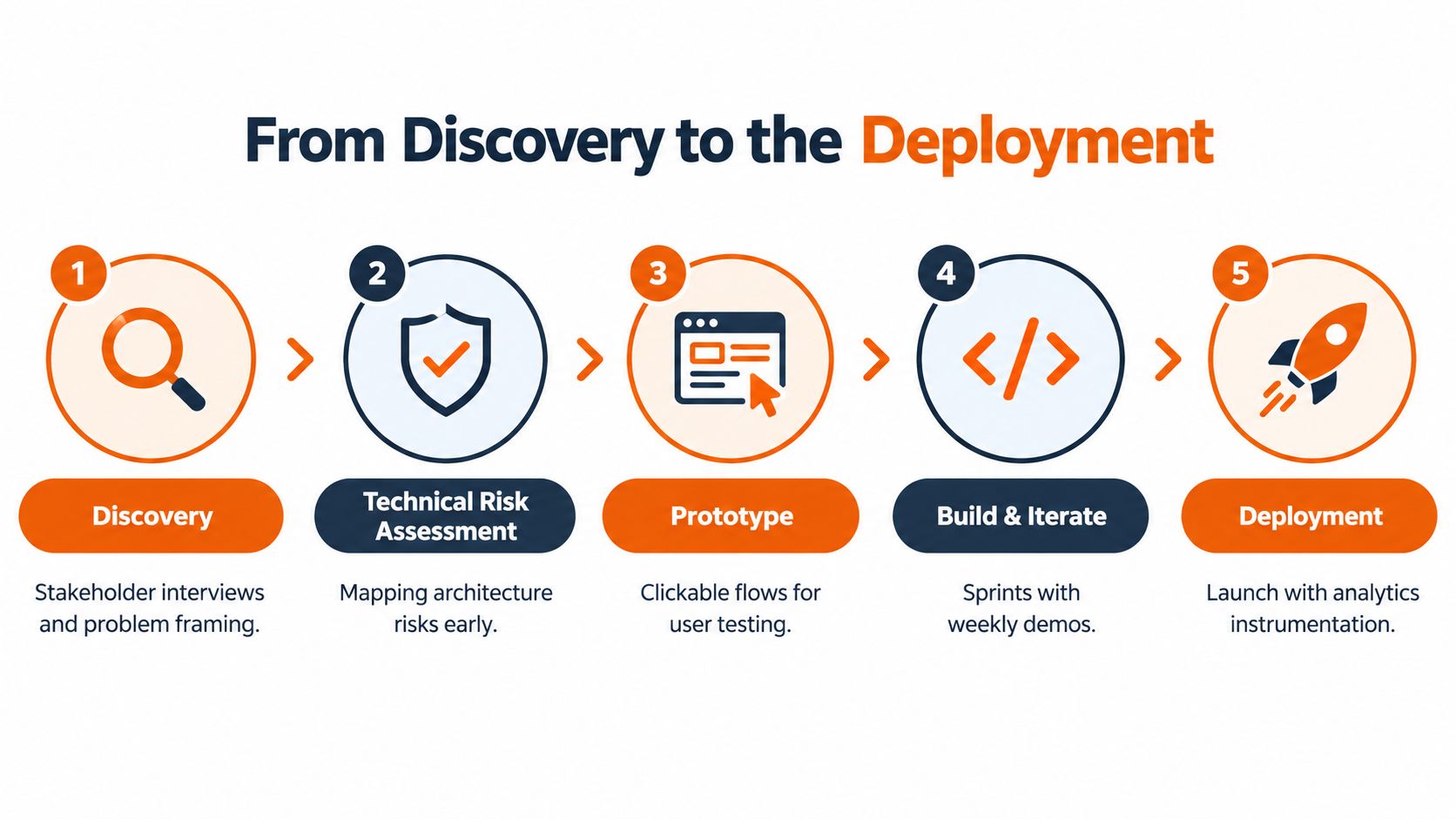
Discovery frames the problem. Interview stakeholders, define the target user, map the current behavior, and identify the business outcome the release must influence. Useful customer interview methods for SaaS can help the team separate observed pain from founder assumptions.
Technical risk assessment tests the weak point. Map integrations, authentication, data flows, hosting constraints, and compliance needs. Build a proof of concept for the dependency most likely to invalidate the plan.
The prototype makes the journey visible. A clickable flow in Figma or a comparable design tool allows users and stakeholders to react before engineering effort hardens the wrong interaction.
Build and iterate around evidence. Short delivery cycles, weekly demonstrations, automated tests, and a visible decision log keep the team aligned. Each cycle should produce something that can be reviewed, not just a report about activity.
Deployment instruments learning. Release the core workflow with analytics, error monitoring, access controls, backup procedures, and a clear feedback route. A launch without measurement is only a handoff.
The team should also define what will not be built. Multi-tenant capabilities, complex permissions, additional payment flows, and multiple external integrations can turn a validation product into platform engineering. The right question is whether each capability is required to test the business assumption or can wait until evidence supports it.
A practical release review should cover ownership, rollback, support, documentation, and the first post-launch decisions. This prototype-to-production software delivery checklist gives teams a useful reference for that transition.
AI changes the economics of delivery, but it doesn't remove engineering responsibility. The question isn't whether an AI tool can generate a component quickly. The question is whether the team can review, test, secure, integrate, and operate what it generates.
Google's 2025 DORA report says 90% of software professionals now use AI and more than 80% report productivity gains. Faros AI found no significant correlation between AI adoption and company-level improvements in throughput, DORA metrics, or quality KPIs, while bugs per developer rose 9% and average pull-request size increased 154%. These findings come from the evidence summarized in Google's 2025 DORA report, and they point to a gap between individual acceleration and system-level performance.

The operating environment matters too. 50% of developers report losing 10 or more hours per week to non-coding work, while 90% lose 6 or more hours to organizational inefficiencies, according to the same evidence base. If requirements remain unclear, reviews are slow, and ownership is fragmented, generating more code won't fix the bottleneck.
An agentic AI delivery model can accelerate analysis, scaffolding, test generation, documentation, migration work, and repetitive investigation. It works best when senior engineers define boundaries and review the result. The team can then redirect time toward architecture, product decisions, risk reduction, and user feedback.
AI-native delivery still requires:
Enterprise AI guidance recommends established coding standards, architecture reviews, peer reviews, automated testing, continuous integration, and deployment pipelines. It also recommends evaluating grounding accuracy, hallucination frequency, security, latency, scalability, business outcomes, and user satisfaction through the AI SDLC framework.
A separate AI-native development and vibe coding comparison is useful when deciding which tasks to automate and which decisions must stay with experienced engineers. The principle is simple: AI is a multiplier for a disciplined team, not a substitute for one.
A development partner should start with the business problem, not the preferred framework. Before anyone debates React, Python, Flutter, or a model provider, the team needs clear answers to three questions:
That problem-first approach aligns with guidance on software development partnerships. It also changes the relationship. A vendor waits for requirements. A strategic partner tests the requirements, identifies missing decisions, and explains the consequences of each option.
At Rite NRG, the methodology centers on Extreme Ownership, high energy, proactive problem-solving, transparent communication, and senior engineering accountability. The useful part isn't the label. It's the behavior.
An accountable partner raises a risk when the risk is still manageable. The team says that an integration is unproven, a security decision is incomplete, a feature doesn't belong in the release, or the requested timeline depends on an assumption that hasn't been tested. It doesn't hide behind a task boundary when the overall result is at risk.
A strong partner doesn't merely complete assigned tickets. It takes responsibility for whether the product can reach users, produce evidence, and remain safe to operate.
Founders should evaluate this mindset through working behavior. Ask a prospective partner to show how it handles a scope conflict, a failed technical assumption, a delayed decision, and a production defect. Listen for ownership of outcomes rather than explanations about why the issue belongs to someone else.
The same standard applies to AI. Capco's guidance on AI in the software development lifecycle emphasizes that AI-generated artifacts must fit the architecture, meet security standards, use data correctly, include test evidence, and be production-ready. Engineers should review specifications, edge cases, test strategy, data assumptions, architecture, and coding standards before major changes are generated.
The commercial result is a tighter feedback loop. The partner uses technology to shorten delivery, people to make sound decisions, and process to keep risk visible.
Don't select a partner by hourly rate alone. Compare the team you will work with, the decisions it owns, and the evidence it can produce before launch.
A fixed-scope model is appropriate when the user journey, acceptance criteria, and release boundary are clear. A dedicated team is more suitable when priorities will evolve and your product owner can make frequent decisions. A freelancer may fit a small, low-risk experiment, but a business-critical MVP usually needs broader accountability across design, engineering, QA, and delivery.
| Criterion | What to Look For |
|---|---|
| Product judgment | The team narrows the feature set and connects decisions to a measurable business outcome. |
| Technical depth | Architects can explain data, integrations, security, testing, deployment, and future ownership in plain language. |
| Delivery model | The proposal states scope, assumptions, dependencies, acceptance criteria, and change handling clearly. |
| Communication | You receive transparent progress, visible risks, decision records, and direct escalation when needed. |
| AI governance | AI accelerates analysis and implementation while senior engineers review output and retain accountability. |
| Nearshore fit | Working hours, language, location, and collaboration habits support fast decisions. |
| Post-launch ownership | The partner can support monitoring, maintenance, iteration, or a clean handover. |
Ask for a walkthrough of a real project that changed direction. A polished portfolio shows presentation quality. A candid explanation of a difficult trade-off shows how the team behaves under pressure.
Going live is an event, not a business result. Define the evidence you need before development starts, then instrument the release to collect it.
For a SaaS MVP, that evidence might include completion of the core workflow, repeat usage, qualified conversations, paid conversion, or a reduction in manual operational effort. The exact measures depend on the business model, but the principle is consistent: connect product behavior to a commercial decision.
Track four categories:
Custom-coded MVPs commonly sit in a materially wider delivery envelope than no-code or low-code alternatives. Neutral 2026 market data estimates custom-coded MVPs at $30K to $100K or more and 8 to 16 weeks, while moderate SaaS MVPs with payments, dashboards, and API integrations cluster around $80K to $150K and 15K to 35K build cost bands in the same research set. The MVP development cost and delivery guide supports the practical conclusion: constrain the first release to one workflow when possible.
After launch, keep the same accountable team close enough to interpret evidence and protect the product's technical health. If the release validates demand, move into a deliberate roadmap. If it doesn't, use the learning to pivot before platform-level spending locks you into the wrong direction.
Rite NRG helps startups, scaleups, and established companies plan, build, modernize, and operate business-critical technology through senior nearshore engineering and AI-native delivery. Visit Rite NRG to discuss a focused MVP scope, technical risk assessment, and delivery model built around measurable business outcomes.
/ about the author
Written by the RITE NRG editorial team — the architects, engineers and delivery leads who build and operate AI-era software for our clients.
Strategy & Transformation
A practical, finance-ready framework for comparing AI and modernization investment with the current-state cost, realistic benefits, delivery risk and time to value.
AI Consulting & Automation
A practical framework for choosing and deploying transport or logistics AI agents around real exceptions, reliable data and controlled operational authority.
Industry Solutions
A practical roadmap for improving manufacturing systems and introducing AI without destabilising production, data integrity or operational control.
More guidance: all insights articles
Tell us about the system or idea behind this article. We tell you honestly if it is a fit — and what a fixed-scope delivery could look like.