
Strategy & Transformation
How to Calculate ROI for AI and Software Modernization
A practical, finance-ready framework for comparing AI and modernization investment with the current-state cost, realistic benefits, delivery risk and time to value.
operationalwrocław--:-- cet
∕ insights / software-development-partnership.md
Software Development Partnership
Find the right software development partnership to accelerate your roadmap. This guide covers models, risks, KPIs, and a vendor checklist for SaaS leaders.
>_article.meta
Your roadmap is slipping, your next release is carrying too much risk, and every status meeting ends with a new explanation instead of a reliable date. The developers may be talented, but talent alone won't rescue a delivery model that hides dependencies, delays decisions, and treats business priorities as tickets in a queue.
A software development partnership should do more than add engineers. It should create a predictable delivery engine, connect technical decisions to commercial outcomes, and leave your internal organisation stronger than it was before. That requires a consulting mindset, visible governance, and the high-energy discipline of #riteway, built around Extreme Ownership.
You approved the feature because it supported a clear business goal. Perhaps it was meant to improve activation, reduce support demand, strengthen retention, or help sales close larger accounts. Then the deadline moved. A dependency surfaced late, the integration proved harder than expected, testing became a separate phase, and the team stopped discussing the outcome because everyone was focused on completing tasks.
That pattern isn't a developer problem. It's a delivery-model problem.
A UK Parliamentary POST report found that only about one-third of IT projects were successful, while nearly 70% were challenged or failed. The same report records an earlier cross-sector finding that only 13% of IT projects succeeded on time, to specification, and to cost, with development projects succeeding at less than 1%. You can read the UK Parliamentary POST report on IT project performance for the underlying evidence.
The hard question: Is your partner accountable for shipping code, or for helping your business achieve the result that justified the investment?
A conventional outsourced team waits for requirements, estimates tickets, reports activity, and escalates only after a problem has become expensive. That arrangement can look efficient at procurement stage, but it leaves you carrying product risk, integration risk, prioritisation risk, and operational risk.
A real partnership works differently. The team understands why the work matters, challenges assumptions before they become rework, and makes delivery health visible while there's still time to act. It treats a release date as a business commitment, not a hopeful line on a roadmap.
That's the shift behind the #riteway approach. Extreme Ownership means taking responsibility for the whole path from decision to outcome. High energy means maintaining momentum when requirements change. Proactivity means surfacing the uncomfortable issue early, then arriving with options rather than excuses.
You don't need another supplier that can fill seats. You need a strategic delivery partner that makes progress measurable, risks discussable, and value impossible to confuse with code volume.
A transactional vendor is like a contractor following a blueprint without checking whether the foundations can support the building. A genuine partner reads the blueprint, asks who will use the building, checks the constraints, and challenges the design when it threatens the intended result.
That difference appears in behaviour long before it appears in a contract.
A partner asks questions such as:
Those questions aren't a distraction from delivery. They protect delivery from work that is technically complete but commercially irrelevant.
Extreme Ownership also changes how the team handles bad news. A weak vendor softens a risk until the deadline is too close to recover. An accountable partner states the risk, explains its impact, recommends a response, and keeps ownership until the decision is made.
A software development partnership should include advisory capability across product, architecture, security, delivery, and operations. Your partner should be able to explain why a proposed approach affects time to market, maintainability, compliance, and future hiring.
That doesn't mean the partner overrides your product leadership. It means they make your decisions better by bringing informed challenge. They might recommend reducing scope to protect a launch, replacing a fragile integration, introducing a discovery activity before committing to build, or sequencing a migration around customer risk.
Practical rule: If a partner never disagrees with your plan, they probably aren't examining it deeply enough.
Predictability comes from shared ownership of decisions. Establish one accountable product owner, one delivery lead, a visible backlog, agreed acceptance criteria, and a clear escalation path. Record architecture decisions and operational assumptions instead of relying on conversations that disappear into chat.
The right relationship feels like an extension of your leadership team. You still own the business direction, but your partner actively protects the route from strategy to shipped value. That's what separates a software development partnership from staff supplied against a purchase order.
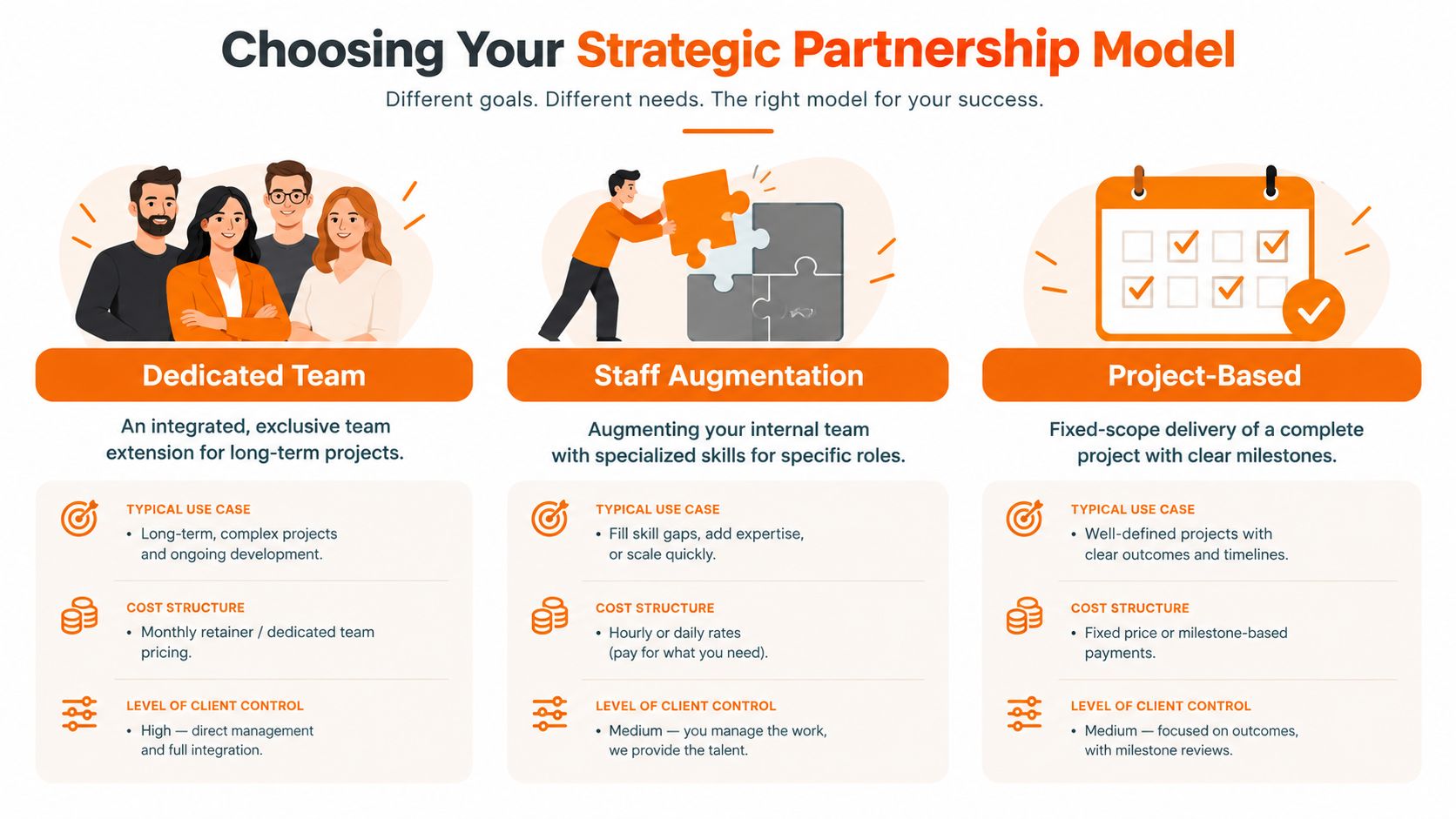
The right model depends on the capability your business needs, not the pricing label a vendor prefers. Start with the business problem. Do you need a cohesive product team, a specialist for a defined gap, a complete delivery with a fixed boundary, or a long-term engineering organisation that can eventually operate independently?
The UK market shows why this decision matters. Software development outsourcing has been projected to grow from £19.6 billion in 2024 to £41.6 billion by 2033, according to UK software development outsourcing market data. A survey of 3,000 UK startups found that 56% had outsourced development work, including SaaS builds, API integrations, and internal CRM systems. External engineering is now a mainstream growth model, not an emergency cost-cutting measure.
Nearshore teams work in a closer time zone and cultural context, which supports rapid feedback and regular collaboration. This model suits SaaS companies that need senior engineering capacity without creating a separate communication layer.
Choose nearshore when product decisions change quickly, your internal leaders need daily access to the team, or integration with an existing UK organisation matters more than maximising nominal rate differences.
Offshore partnerships can provide access to broader talent pools and specialised capabilities. They require stronger written communication, deliberate overlap, explicit documentation, and disciplined escalation.
Choose this model when the partner can demonstrate operational maturity and when your organisation is prepared to manage asynchronous decisions rather than relying on informal conversations.
A dedicated team is an integrated, exclusive extension of your organisation. It suits a core product roadmap where continuity, domain knowledge, and team cohesion matter.
The team should share your backlog, product rituals, quality standards, and delivery goals. You're not buying isolated roles. You're establishing a product capability with a stable mandate.
Build-Operate-Transfer, or BOT, is the strategic option for companies that want to establish a long-term R&D capability. A partner helps recruit, organise, and operate the centre before transferring responsibility to the client.
This model makes sense when you want lasting control, local capability, and an internal engineering organisation, but don't yet have the infrastructure or market knowledge to build it alone. It must include a transfer plan from the beginning, otherwise “transfer” becomes an indefinite promise.
| Model | Best For | Level of Control | Time to Productivity |
|---|---|---|---|
| Nearshore partnership | Fast collaboration and integrated product delivery | High, with close working alignment | Fast |
| Offshore partnership | Access to specialised capacity and distributed delivery | Variable, dependent on governance | Moderate |
| Dedicated team | Long-term product development and continuous improvement | High | Fast after onboarding |
| Build-Operate-Transfer | Establishing a durable internal R&D capability | Increases through the operating period | Gradual, with planned transition |
Don't select a model because it looks cheapest on a spreadsheet. Select the one that gives your business the control, speed, continuity, and capability required for the next stage of growth.
A partnership becomes predictable when both sides can see the system clearly. That means measuring how work moves from decision to customer value, not how busy the team appears.
Lines of code, story points, and ticket counts can describe activity without proving progress. A team can close many tickets while leaving the most commercially important risk untouched. Your dashboard should connect delivery flow to the result the business needs.
Track Lead Time for Changes, from approved work to production. Track Cycle Time, from active development to completion. Track Deployment Frequency to understand whether the team can release in small, controlled increments rather than accumulating a risky batch.
Pair those measures with outcome indicators:
Use these measures as conversation starters, not weapons. A falling cycle time with rising defects isn't success. A lower deployment frequency may be sensible during a high-risk migration if the team is protecting reliability.
British businesses have been estimated to waste £37 billion annually on failed agile projects. The same IT project failure analysis links 32% of failures to geographically dispersed teams and 34% to insufficient planning. That evidence makes governance a delivery mechanism, not administrative overhead.
Run a practical cadence:
Document decisions in a shared workspace such as Confluence, Notion, or an architecture decision record repository. Give stakeholders access to delivery boards in Jira or Azure DevOps. A high-trust team doesn't hide complexity. It makes complexity legible and acts on it.
Technical competence is the entry requirement. It isn't the selection decision.
A partner can know your stack and still fail to understand your product, your customers, or the commercial consequence of delay. Evaluate the team across technical excellence, cultural alignment, and delivery mindset, then demand evidence for each claim.
Ask the proposed engineers to explain an architecture relevant to your product, including trade-offs, failure modes, testing strategy, and operational ownership. Review how they handle code review, automated testing, CI/CD, observability, data protection, and legacy integration.
Don't accept a sales presentation from people who won't work on the account. Meet the actual delivery lead and senior engineers. Ask them to identify the hardest part of your roadmap. Their answer will reveal more than a list of frameworks.
Your partner must communicate in the way your organisation makes decisions. Check whether they can work across time zones, document important discussions, give direct feedback, and involve the right people without creating bureaucracy.
Look for curiosity. Strong teams ask clarifying questions, challenge scope, and explain consequences. Passive agreement feels pleasant in a pitch and becomes expensive during delivery.
Ask for a sample risk register, release plan, definition of done, escalation process, and knowledge-transfer approach. The partner should explain what happens when a dependency slips, a requirement changes, or a key engineer becomes unavailable.
Test their response to a deliberately difficult scenario: a launch date is fixed, the integration is uncertain, and the requested scope exceeds available capacity. A mature partner will propose choices and state what each choice protects or sacrifices.
Selection standard: Choose the team that makes risk visible earliest, not the team that promises the smoothest interview.
Security and intellectual property need direct verification. Confirm who owns the code and documentation, how access is controlled, how incidents are handled, and how the partner separates your information from other client work.
Over half of UK digital transformation projects have been reported to run over schedule, often by 3 to 6 months, while 1 in 10 projects slipped by up to a year. UK digital transformation delivery research identifies compliance and security concerns, data quality, and legacy technology constraints among the leading causes of delay. Your selection process must therefore test integration planning and security-by-design before work begins.
Finally, ask for references that resemble your context. Speak to clients about missed commitments, leadership behaviour, handover quality, and what happened when the project became difficult. Rite NRG is one example of a nearshore provider offering dedicated teams, platform development, consulting, and Build-Operate-Transfer support, but the same evidence-based checklist should apply to every candidate.
A VC-backed SaaS company with a committed launch window doesn't need a collection of freelancers. It needs a Dedicated Team that can work inside the product operating model, make architecture decisions quickly, and keep the founder informed about trade-offs.
The team starts by translating the launch objective into a thin, testable release. Product and engineering agree what must be true for launch, what can follow later, and which technical risks deserve early investigation. The partner supplies senior delivery leadership, integrates with the company's existing rituals, and reports progress through customer and release outcomes.
The result isn't merely a completed MVP. The company gains a repeatable way to prioritise, build, test, release, and learn.
A scale-up establishing a European R&D hub may choose Build-Operate-Transfer instead. The partner sets up hiring, compliance, leadership, delivery processes, and operational routines, while the client gradually develops direct ownership of the centre.
The handover starts on the first day. It shouldn't be a final meeting after the vendor has finished billing.
The strategic risk is dependency. UK demand for software professionals is projected to rise by 25% over the next decade, according to the Skills England annual skills report. A partnership that only adds external capacity may leave you exposed when priorities change.
Measure success by capability gained. If your internal team understands the system, owns the decisions, and can maintain delivery without constant vendor interpretation, the partnership has created durable value.
A software development partnership is not a commodity purchase. It's an investment in the system that turns product strategy into customer value.
The wrong partner gives you activity, optimistic forecasts, and a growing backlog of explanations. The right partner gives you clearer decisions, earlier risk visibility, stronger engineering capability, and a delivery rhythm that leadership can trust.
That requires more than technical skills. It requires Extreme Ownership, proactive consulting, high energy, and a refusal to confuse “built” with “valuable”. The #riteway methodology puts those behaviours at the centre of the relationship, so the partner shares responsibility for the outcome rather than waiting for instructions.
Choose the model that matches your strategic need. Set governance before the first sprint. Measure flow and business impact. Plan the handover before dependency takes root.
Then stop searching for a vendor that says yes to every ticket. Find a partner willing to challenge the plan, own the difficult decisions, and help your team build and ship with confidence.
Rite NRG provides nearshore dedicated teams, full-lifecycle SaaS development, technology and delivery consulting, and Build-Operate-Transfer R&D support for companies that need predictable outcomes. Visit Rite NRG to discuss the delivery capability your product needs next.
/ about the author
Written by the RITE NRG editorial team — the architects, engineers and delivery leads who build and operate AI-era software for our clients.
Strategy & Transformation
A practical, finance-ready framework for comparing AI and modernization investment with the current-state cost, realistic benefits, delivery risk and time to value.
AI Consulting & Automation
A practical framework for choosing and deploying transport or logistics AI agents around real exceptions, reliable data and controlled operational authority.
Industry Solutions
A practical roadmap for improving manufacturing systems and introducing AI without destabilising production, data integrity or operational control.
More guidance: all insights articles
We can help you apply this thinking to the systems and teams you actually have.