

Strategy & Transformation
How to Calculate ROI for AI and Software Modernization
A practical, finance-ready framework for comparing AI and modernization investment with the current-state cost, realistic benefits, delivery risk and time to value.
operationalwrocław--:-- cet
∕ insights / benefit-of-online-selling.md
Benefit Of Online Selling
Discover the top benefit of online selling for your business in 2026 and learn how digital commerce drives real growth and revenue.
>_article.meta

Companies want more revenue and wider market access, but physical expansion adds stores, staff, inventory, and operational complexity. The popular advice says the benefit of online selling is convenience. That undersells the opportunity. The strongest benefit is operational scale, the ability to reach more buyers and test more demand without increasing every physical input at the same rate.
The scale is already foundational. UNCTAD reports that business-to-business and business-to-consumer ecommerce sales across 43 economies approached US$25 trillion in 2021, then were estimated at almost US$27 trillion in 2022. Separate estimates put global online shopping revenue at about $3.64 trillion in 2025, with a projection above $5.05 trillion by 2030. The commercial question isn't whether online selling works in theory. It's whether your architecture, margins, data, and ownership model can convert reach into dependable profit.
The eight highest-impact benefits move from market access and cost control through validation, retention, data, brand ownership, supply-chain risk, and scalable growth. Technology enables each one, but responsible architecture, security, testing, compliance, and production ownership determine whether the benefit survives contact with real customers. For teams exploring AI-assisted commerce, AI model outfit e-commerce offers a relevant example of how digital experiences can support online buying decisions.
Expansion used to require leases, local hires, and inventory in every target market. An online storefront replaces that fixed-cost ladder with a commercial system that can serve multiple regions and time zones from one codebase, provided engineering teams control localization, reliability, and transaction flow.
The opportunity is measurable. Statista's ecommerce analysis shows U.S. ecommerce rising from 8.0% of total retail sales in 2012 to 15.5% in 2019, then reaching 19.1% in 2020. U.S. online spending reached $870.78 billion in 2021, up from $762.68 billion in 2020. For SaaS, broader reach can increase qualified pipeline without adding a local sales operation for every region. For product businesses, it can extend demand beyond the home market while physical distribution catches up.
Cross-border demand makes the opportunity larger. AUSFF global markets illustrate how sellers route international orders, while DHL reports that 70% of global shoppers buy from retailers outside their home country, and 45% do so at least once a month. Those figures support testing regions where customer acquisition cost, lifetime value, delivery feasibility, tax, and compliance can produce a viable contribution margin. A structured market entry strategy helps teams rank opportunities before committing capacity.
A reliable expansion plan should include:
Practical rule: A market is attractive when demand, delivery, compliance, and contribution margin work together, not simply when traffic is available.

Online selling can remove the fixed costs attached to physical retail, including store rent, utilities, local staffing, and duplicated inventory. But lower overhead doesn't automatically mean higher profit. Shipping, payment processing, returns, and advertising can absorb the apparent savings if leaders track only revenue.
The economics need a contribution-margin view. A recent ecommerce benchmark places shipping at about 8% to 12% of revenue, payment processing near 2.9%, returns at 6% to 10%, and advertising at 20% to 30%. The same benchmark cites an online-only returns rate of 19.3% of sales, based on an NRF 2025 returns study. These figures aren't a promise of what any seller will experience. They're a warning that gross sales can conceal weak unit economics.
For SaaS, the cost pattern differs. Once the product, hosting, support, and security foundations are in place, additional customers may require less incremental delivery effort than physical products do. That advantage disappears when poor architecture creates excessive cloud usage, manual onboarding, support load, or incidents.
Track profitability at order, customer, product, and channel level. Include:
The engineering checkpoint is simple. Your finance team should be able to trace a sale from acquisition source through payment, fulfillment, return, refund, and retained margin. If it can't, the business isn't measuring the benefit yet.

Online selling can shorten the path from an untested proposition to evidence that customers will pay. The commercial advantage comes from controlled exposure: a team can publish an offer, observe behavior, collect feedback, and revise the proposition without building a complete physical distribution system first.
For SaaS, a landing page can test positioning before engineering commits to a feature. For product businesses, a limited release can test price, fulfillment, support demand, and repeat interest. An MVP may show that the original idea needs repositioning while the cost of changing direction remains manageable. A disciplined minimum viable product approach keeps that experiment focused without treating unfinished work as production-ready.
Speed becomes a business asset only when learning has operating controls. Define five checkpoints:
The outcome model differs by business type. SaaS teams should connect acquisition to activation, retained usage, and expansion. Product teams should connect acquisition to paid orders, contribution margin, fulfillment reliability, and repeat demand.
Clicks, signups, and favorable interviews indicate interest. Paid transactions, sustained usage, repeat orders, and successful delivery test commitment. AI-native delivery can accelerate discovery, code generation, testing, and documentation, while senior engineers remain accountable for authentication, payments, privacy, observability, and release safety. Fast learning matters only when the system can produce trustworthy evidence.
The first order validates demand. Profitability depends on what happens after it. Online selling gives businesses direct control over post-purchase communication, recommendations, loyalty mechanics, subscriptions, and service recovery, so retention becomes an operating system rather than a campaign outcome.
A useful model connects customer value to repeat revenue, gross margin, fulfillment or implementation cost, support effort, returns, discounts, and churn. For ecommerce, order updates, review requests, replenishment reminders, and relevant offers can reduce the effort required to buy again. For SaaS, onboarding signals should connect to activation, renewal, expansion, and cancellation risk. More messages do not create value by themselves. Easier, timely next actions do.
Retention also changes acquisition economics. After the first customer is acquired, later orders or renewals can improve contribution, provided service costs and incentives do not consume the margin.
Cohort analysis should segment customers by acquisition month, product, region, plan, and channel. Review the timing of the second purchase or renewal, onboarding actions associated with continued use, products linked to returns or support, and the point where repeat behavior plateaus. Test whether loyalty incentives create profitable retention or subsidized orders.
SaaS teams should connect lifetime value to churn, gross margin, implementation effort, and expansion revenue. Product teams should include shipping, returns, and support in repeat-order economics. A recommendation system that increases basket size while adding fulfillment complexity may reduce contribution margin.
Personalization requires operating controls. Use consented data, explain relevant recommendations, protect account information, and test recommendation quality. Monitor repeat rate, renewal rate, expansion, churn, contribution margin, return rate, and support volume.
A failed message is a marketing issue. An incorrect renewal, price, or account decision is an engineering and governance issue, requiring ownership of data quality, billing logic, permissions, and observability.
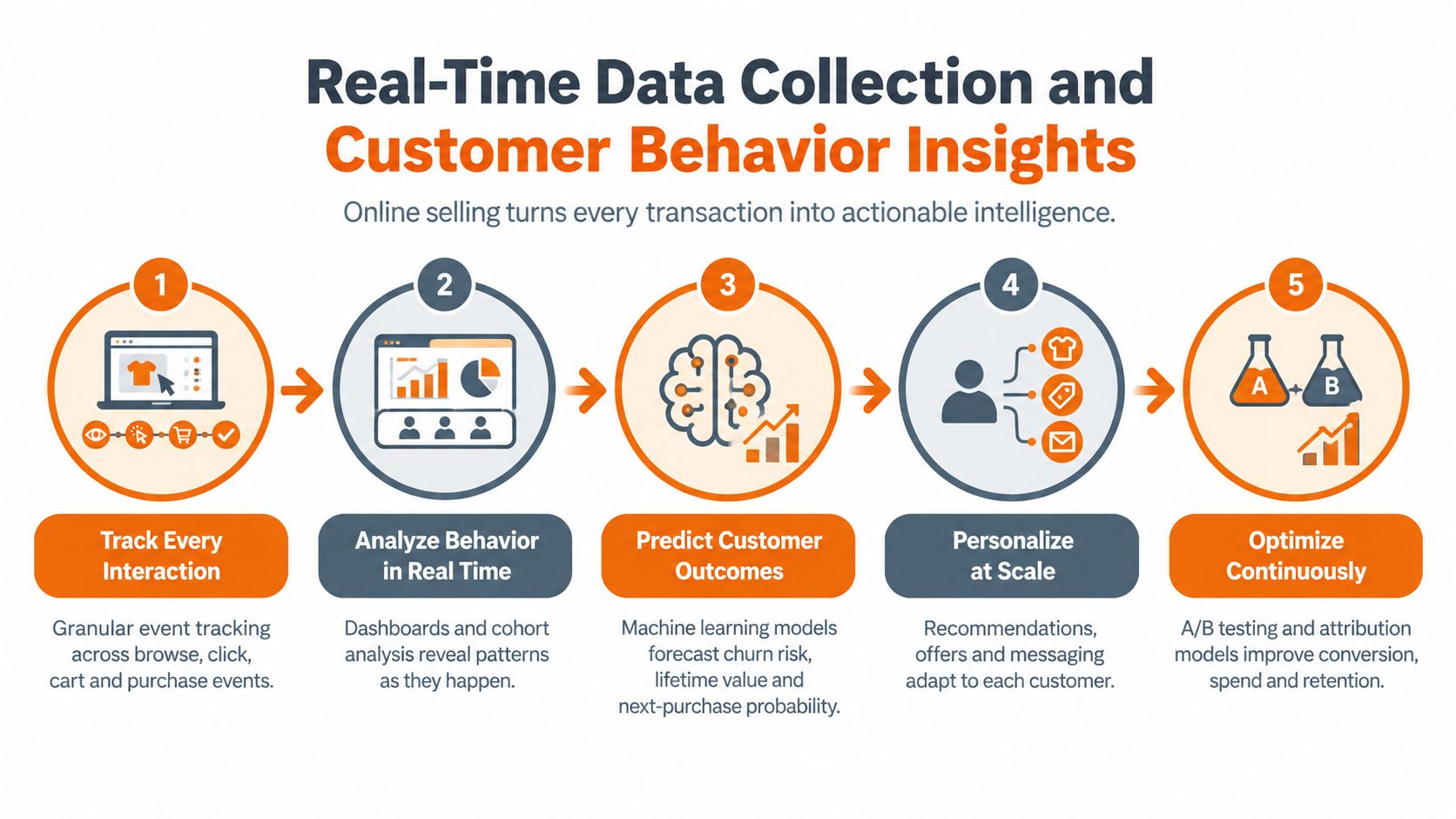
Online selling creates a live behavioral record: customers view, search, compare, abandon, buy, return, renew, and request support. Its commercial value depends on connecting those events to decisions, owners, and measurable outcomes. Raw volume alone does not improve conversion, retention, or margin.
Mastercard Strive's marketplace research reports that 90% of respondents viewed marketplaces as cost-effective, 85% said marketplaces reduced expenses, 92% said they reached customers more easily, and 90% valued analytics for launching new product lines. The findings indicate strong demand for marketplace data and reach, while leaving implementation quality to each seller.
Build an event taxonomy around the commercial journey:
Assign an owner to each critical metric. Alerts should surface conversion declines, payment failures, unusual cart abandonment, fulfillment delays, and churn changes before a scheduled dashboard review. Cohorts should be compared by channel, geography, product, and plan, rather than reduced to blended averages.
For SaaS, connect behavioral signals to activation, renewal, expansion, support effort, and gross margin. For product businesses, connect them to order value, fulfillment cost, returns, and service volume. The outcome model is simple: event quality enables better decisions, better decisions change operations, and measured outcomes determine whether the change is worth keeping.
Agentic AI architecture for ecommerce can support recommendations, approved actions, and reversible workflows within defined limits. Let AI classify catalog content or draft support responses. Keep refunds, pricing changes, customer-data access, and irreversible actions under human-approved policies.
Data quality is a commercial control. Missing, duplicated, delayed, or disconnected events can send teams toward the wrong funnel decision. Monitor event completeness, latency, identity matching, conversion, activation, renewal, return rate, and support volume.
The operating loop should show event capture, decision, action, and measured outcome in one view.
Direct customer access can create more business value than reach alone, provided the company can operate the channel responsibly. Marketplaces offer discovery and demand testing, while their interfaces, policies, rankings, and data boundaries limit control. An owned channel lets a business shape product education, pricing logic, service design, and relationship management.
The commercial outcome depends on what that control changes. Direct feedback can reach product, engineering, merchandising, and lifecycle teams without waiting for a distributor's report. For SaaS, the model links onboarding experience, feature adoption, support quality, renewal, and expansion to the company's own roadmap. For product businesses, it connects presentation and service decisions to conversion, repeat orders, refunds, and support effort.
Channel choice should follow margin, category behavior, acquisition economics, and operating capacity. A marketplace may test demand efficiently; an owned storefront may retain continuity and richer customer context. Compare both channels by contribution margin, repeat behavior, refund rates, customer acquisition cost, and service workload.
Brand control requires operating discipline, not only visual consistency. Use one governed system for catalog facts, policies, product education, support answers, consent, and customer feedback. Route recurring problems into product and engineering prioritization, then measure whether those changes reduce service demand or improve retention.
Reviews and user-generated content can strengthen credibility when moderation, consent, and removal rules are explicit. Community features should serve customer questions and product learning without collecting data the business cannot govern.
Treat customer information with the same care as payment information. Enforce least-privilege access, retention limits, encryption, audit trails, and incident response. Audit whether teams can identify the customer, verify what was promised, and respond when a transaction or service fails. Direct ownership creates differentiation only when the company can protect the relationship and prove its effect on margin, retention, and product decisions.
Inventory risk begins with a commitment, not a failed sale. Products can move slowly, become obsolete, require markdowns, or arrive in the wrong region while capital remains tied up. Online selling improves the evidence available before the next purchasing or production decision, provided engineering connects demand signals to operational systems.
Use pre-orders, backorders, limited releases, print-on-demand, and made-to-order workflows where the product and customer expectation support them. Digital products and SaaS remove physical stock, but introduce capacity, uptime, security, and service-delivery exposure. The operating principle is proportional commitment: increase supply, infrastructure, or staffing as evidence improves.
A practical control model links five measures:
The system of record must remain consistent across storefronts, warehouses, marketplaces, and customer service. Otherwise, overselling creates refunds and support work, while unsupported delivery promises erode trust. Reconciliation rules, audit logs, exception queues, and ownership for stale stock give teams a way to detect and correct failures.
Implementation should match business maturity. A small product company may begin with pre-orders and manual approval. A retailer may require event-driven stock synchronization, forecasting, and exception management. A SaaS business can use usage telemetry to plan infrastructure and support capacity. In each model, track forecast variance, stockout frequency, aging inventory, fulfillment accuracy, and cash tied up in supply. Online selling reduces risk when commercial, operations, finance, and engineering teams act on one governed source of truth.
Scale is not the same as automation. A storefront becomes scalable when demand, catalog complexity, traffic, and transaction volume can grow without adding operational work at the same rate. That requires engineering ownership of the paths that convert reach into reliable revenue.
The opportunity spans both SaaS and product businesses. Ecommerce adoption continues to expand, while mobile usage makes storefront performance, checkout design, and retention flows central to growth. A Shopify benchmark cites an average global ecommerce conversion rate of 2.69%, or roughly 27 purchases per 1,000 visitors. Capacity planning therefore belongs beside conversion optimization. More traffic can raise infrastructure cost and incident exposure if the funnel remains inefficient.
For SaaS, the outcome model is recurring revenue without matching increases in support and infrastructure effort. For product businesses, it is higher order volume without proportional fulfillment and service complexity. The checkpoints differ, but both require defined service limits, cost-per-order or cost-per-account tracking, and alerts for conversion, latency, errors, and support load.
Engineering controls should cover:
AI-native delivery can reduce the time required for analysis, implementation, testing, documentation, and migrations. Production accountability remains with the engineering team. Agentic systems need permission boundaries, approval steps, auditability, and safeguards that distinguish reversible changes from actions affecting customers, payments, or data. The scale benefit is measurable only when growth, reliability, and unit economics improve together.
| Item | 🔄 Implementation Complexity | ⚡ Resource Requirements | ⭐ Expected Outcomes / 📊 Impact | 💡 Ideal Use Cases | Key Advantages |
|---|---|---|---|---|---|
| Expanded Market Reach and Revenue Growth Without Geographic Constraints | 🔄 Medium–High: platform + localization, compliance, logistics integration | ⚡ Moderate–High: e‑commerce stack, CDN, payments, global logistics | ⭐⭐⭐⭐⭐ High scale potential; 📊 global revenue %, CAC by region | 💡 SaaS, e‑commerce, D2C targeting multiple countries | Global availability; scalable revenue with low physical overhead |
| Reduced Operational Costs and Improved Profit Margins | 🔄 Medium: centralize fulfillment, integrate 3PL, automation | ⚡ Low–Moderate: fulfillment partners, inventory systems, automation | ⭐⭐⭐⭐ Clear margin improvement; 📊 lower OpEx, fulfillment cost/order | 💡 DTC brands, retailers migrating online, high-volume sellers | Reduced rent/staffing, better gross margins, variable cost structure |
| Faster Time to Market and Product‑Market Fit Validation | 🔄 Low–Medium: rapid listings, A/B testing, feedback loops | ⚡ Low: no‑code/low‑code platforms, analytics, small team | ⭐⭐⭐⭐ Fast validation to revenue; 📊 shorter time‑to‑first‑sale & pivot | 💡 Startups, MVP launches, VC‑backed experiments | Rapid iteration, capital efficiency, early traction for funding |
| Improved Customer Lifetime Value and Repeat Purchase Economics | 🔄 Medium: CRM, automation, personalization systems | ⚡ Moderate: marketing automation, recommendation engines, data | ⭐⭐⭐⭐⭐ Higher LTV and repeat rate; 📊 improved LTV:CAC, retention cohorts | 💡 Subscriptions, consumables, loyalty‑focused brands | Higher repeat revenue, predictable recurring income, personalized CX |
| Real‑Time Data Collection and Customer Behavior Insights | 🔄 Medium–High: tracking, analytics, ML, governance | ⚡ Moderate–High: analytics stack, engineers, data governance | ⭐⭐⭐⭐ Better decisions & personalization; 📊 conversion lift, churn prediction | 💡 Data‑driven commerce, personalization, inventory optimization | Actionable analytics, improved ROI, predictive optimization |
| Competitive Differentiation Through Direct Customer Relationships and Brand Control | 🔄 Medium: brand build, platform customization, owned channels | ⚡ Moderate: content, marketing, community management | ⭐⭐⭐⭐ Stronger brand equity; 📊 NPS, organic/direct traffic gains | 💡 D2C premium products, community‑led businesses | Full margin capture, proprietary customer data, brand moat |
| Reduced Risk Through Inventory Optimization and Demand‑Driven Supply Chain | 🔄 Medium: supplier integration, forecasting, reorder automation | ⚡ Low–Moderate: supplier partnerships, inventory/ERP tools | ⭐⭐⭐⭐ Lower working capital & obsolescence; 📊 improved turnover, cash conversion | 💡 Startups, seasonal/trend products, print‑on‑demand sellers | Reduced inventory risk, improved cash flow, flexible fulfillment |
| Scalability Without Proportional Cost or Complexity Growth | 🔄 High (design requirement): architect for horizontal scale early | ⚡ Moderate: cloud infrastructure, auto‑scaling, monitoring | ⭐⭐⭐⭐⭐ High operating leverage; 📊 revenue per infra cost improves | 💡 SaaS, platforms, marketplaces planning rapid growth | Exponential revenue potential with sub‑linear cost growth; capital efficient |
Online selling creates value when a company converts digital access into a reliable operating system. Reach without margin creates unprofitable volume. Data without ownership creates dashboards nobody trusts. Automation without controls creates faster failure. Scale without testing creates more customers exposed to the same defect.
Use a focused decision model:
A useful checklist includes:
RITE NRG approaches this work as a strategic technology partner, not an order-taking development team. Its architects and engineers take responsibility for architecture, data, integrations, security, testing, and production quality, while agentic AI accelerates analysis, development, documentation, testing, and modernization. That combination supports faster decisions without lowering engineering standards.
For a SaaS founder, the priority may be a secure MVP and an onboarding funnel that produces usable retention evidence. For an ecommerce operator, it may be regional checkout, contribution-margin visibility, or inventory synchronization. For an established business, it may be modernizing a legacy platform without disrupting revenue. The right answer depends on the constraint, the evidence, and the organization's ability to own the result after launch.
Rite NRG helps SaaS and product businesses plan, build, modernize, scale, and operate the technology behind online selling, including ecommerce platforms, AI workflows, data systems, and production operations. Visit Rite NRG to discuss your growth constraint and turn it into an accountable delivery plan.
/ about the author
Written by the RITE NRG editorial team — the architects, engineers and delivery leads who build and operate AI-era software for our clients.
Strategy & Transformation
A practical, finance-ready framework for comparing AI and modernization investment with the current-state cost, realistic benefits, delivery risk and time to value.
AI Consulting & Automation
A practical framework for choosing and deploying transport or logistics AI agents around real exceptions, reliable data and controlled operational authority.
Industry Solutions
A practical roadmap for improving manufacturing systems and introducing AI without destabilising production, data integrity or operational control.
More guidance: all insights articles
We can help you apply this thinking to the systems and teams you actually have.