

Strategy & Transformation
How to Calculate ROI for AI and Software Modernization
A practical, finance-ready framework for comparing AI and modernization investment with the current-state cost, realistic benefits, delivery risk and time to value.
operationalwrocław--:-- cet
∕ insights / market-entry-strategy.md
Market Entry Strategy
Master your market entry strategy with a practical SaaS playbook. Compare entry modes, navigate compliance, and scale predictably
>_article.meta

Most market entry advice starts in the wrong place. It tells you to size the market, localise the website, appoint a distributor, and launch a campaign. That checklist can look complete while your billing, compliance, product architecture, engineering capacity, and customer support remain unready for the pressure of a new region.
A serious market entry strategy is an operating model for turning local demand into reliable revenue. It connects market selection to distribution, product decisions to compliance, and engineering velocity to cash runway. For SaaS founders, the central question isn't whether customers want the product. It's whether your team can deliver, learn, and adapt quickly enough to earn those customers without breaking the business.
The UK illustrates both the opportunity and the discipline required. The country had 5.6 million private sector businesses on 1 January 2023, up 0.8% from 2022, and its business population had grown by 60%, from 3.5 million in 2000 to 5.6 million in 2023. Yet the total remained 7.1% below January 2020 levels, according to the UK Parliament briefing on private sector businesses. The addressable market is substantial, but recovery and demand aren't uniform. Your wedge matters.
Product-market fit doesn't travel automatically. A SaaS product that wins in one country may meet different procurement expectations, payment preferences, data requirements, support standards, and competitive conditions elsewhere. Treating expansion as a translation project is how teams spend heavily before discovering that their sales cycle, onboarding model, or architecture can't support local buyers.
A winning strategy starts with operational readiness. Before localising code, align four decisions:
The UK offers a useful warning against broad assumptions. Its trade profile is concentrated in identifiable markets. In 2025, the United States took 15.5% of total UK goods exports, followed by Germany at 8.7% and the Netherlands at 6.9%, as reported in the UK government Trade and Investment Core Statistics Book. The lesson for a SaaS team isn't to copy those destinations. It's to map external demand, partner feasibility, sector fit, and market-access friction before committing to a generic rollout.

The #riteway methodology puts Extreme Ownership, high energy, and proactive delivery at the centre. That means your technology partner doesn't wait for a ticket while commercial assumptions decay. The team identifies risks, clarifies trade-offs, and keeps product, engineering, finance, and sales moving towards the same business result.
Use an evidence-led process such as de-risk market entry with data and AI to sharpen market hypotheses. Then convert those hypotheses into delivery milestones, not presentation slides. If the first objective is qualified pipeline, build the product and analytics needed to support that pipeline. If the objective is enterprise conversion, prioritise procurement readiness, security evidence, onboarding, and reliable implementation.
Practical rule: Don't approve localisation work until you can name the customer, the commercial trigger, the owner, and the evidence that will justify the next investment.
Entry mode determines how quickly you can learn, how much capital you expose, and how much control you retain. SaaS leaders often default to direct entry because software appears easy to distribute. That assumption fails when buyers rely on trusted partners, procurement is complex, or established platforms benefit from data advantages and ecosystem lock-in.
The UK Competition and Markets Authority identified entry barriers in online platforms and digital advertising linked to network effects, economies of scale, access to user data, and ecosystem lock-in in its Online Platforms and Digital Advertising study. A later UK cloud decision also described significant fixed infrastructure investment for IaaS entry, with much of that investment irrecoverable on exit and economies of scale raising the minimum efficient scale. For a platform business, that evidence supports a narrow, data-light wedge before a broad infrastructure commitment.
| Entry Mode | Speed to Market | Capital Requirement | Operational Control |
|---|---|---|---|
| Direct export or remote selling | Fast for testing, slower for complex accounts | Low to moderate | High over product, limited over local distribution |
| Local partnership | Fast when the partner has relevant access | Moderate | Shared, dependent on governance |
| Joint venture | Moderate, with shared market capability | Moderate to high | Shared and contract-dependent |
| UK or local entity | Slower to establish and operate | Higher ongoing commitment | High, with greater administrative responsibility |
Direct export works when the product is self-serve, implementation is light, and customers can buy without local procurement support. Keep the initial team small, but make ownership explicit. Remote selling isn't a substitute for local insight, so interview prospects and lost deals continuously.
A local partnership can compress the route to trusted buyers. It only works when the partner has a real incentive to sell your product and can support implementation to an agreed standard. A logo on a partner page isn't distribution. Require named accounts, enablement milestones, lead ownership, and a clear escalation process.
A joint venture makes sense where local relationships, licences, or operating expertise are central to the offer. It also introduces governance overhead and potential deadlock. Don't choose this route because the market feels intimidating. Choose it when the partner contributes an asset you can't efficiently build.
A local entity gives greater control over contracts, hiring, billing, and customer confidence, but it creates recurring operational responsibility. Model the cost of finance, tax, employment, compliance, and administration before incorporation.
A strong competitive assessment should connect competitor positioning to your delivery advantage. Use this competitive analysis framework to identify where incumbents are strong, where customers remain underserved, and which product promise your team can deliver faster or more reliably.
A market entry plan fails in delivery long before it fails in strategy. Move through evidence gates, and release investment only when the team has proved the next assumption. Build regional features after identifying a buyer, and prevent sales from creating implementation debt that engineering must later absorb.
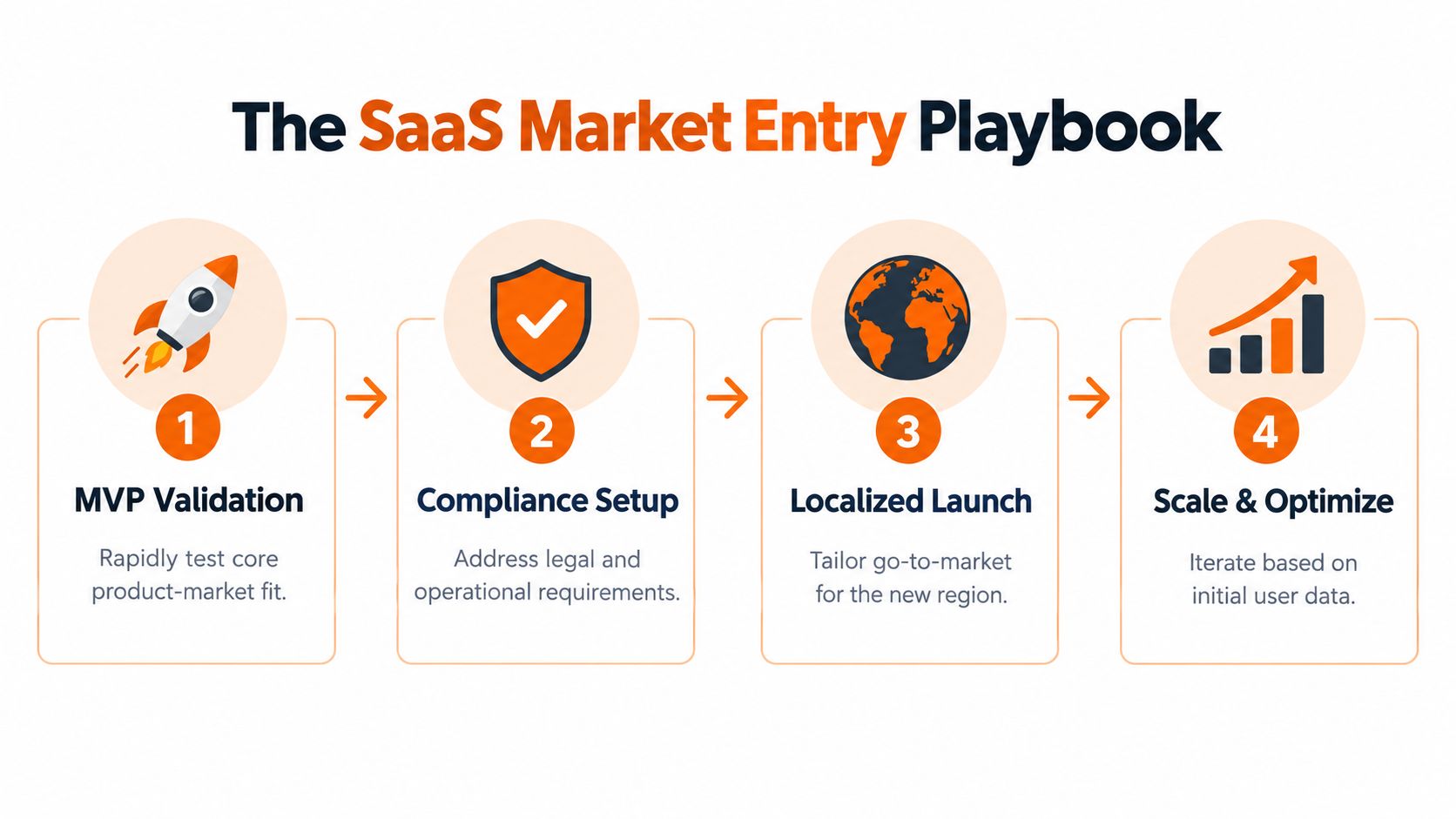
Start with a focused MVP that tests the problem, buyer, and distribution path. Keep the core architecture reusable, and isolate regional variation through configuration and feature flags. Document the assumptions under test, then define the evidence that will trigger a pivot, pause, or broader build.
Bring prospect feedback into the backlog before expansion. Sales, product, and engineering should work from the same customer notes, objections, and acceptance criteria. That shared record keeps engineering focused on buyer value rather than attractive features with no commercial proof.
Compliance and finance shape the product from the start. Design local billing, tax handling, contract workflows, support ownership, and reporting before customer volume turns routine work into manual effort.
For multi-tenant SaaS, make data residency an architectural decision. Set tenant-level policies, access controls, audit trails, backup behaviour, and the response required when a customer needs another hosting arrangement. Regional feature flags should support controlled releases without splitting the product into separate codebases.
Founders who need an administrative base before creating a permanent local operation can review options such as use a ready-made Irish company for the European market-entry process. Validate the structure against legal, tax, hiring, and commercial requirements with qualified advisers. Treat it as an operating decision, not an assumed shortcut.
Release to a defined customer cohort and measure behaviour from the first interaction. Track activation, onboarding completion, support demand, sales-stage conversion, and product usage. Hold a weekly operating review that turns customer evidence into named actions, owners, and deadlines.
AI can classify support themes, surface delivery risks, summarise interviews, and flag unusual usage or churn signals. Keep accountability with a human owner who decides what ships, what stops, and what requires escalation. Automation should shorten the feedback loop, not blur responsibility.
Scale after the team can explain why customers buy, how they activate, what implementation requires, and which channel supports sustainable economics. Increase localisation, partner coverage, automation, and hiring in sequence, tied to evidence rather than ambition.
Engineering velocity determines how quickly the company can test each market assumption. When assessing a nearshore partner, ask for delivery results against a measurable baseline, including cycle time, defect rates, release frequency, and ownership during incidents. Rite NRG's model includes senior nearshore teams, product-focused delivery, and AI-supported processes, with a stated ability to help clients ship up to 50% faster without sacrificing quality or control. Assess that claim against your own baseline and acceptance criteria, rather than treating a headline improvement as proof of fit.
Expansion plans often stall after demand has been proven. The trouble appears in VAT decisions, entity setup, sector regulation, procurement, billing, payment collection, and customer support. Those issues belong in the entry thesis from the start because each unresolved dependency can delay revenue while the team continues spending.

UK businesses expanding internationally report three leading barriers: lack of knowledge of local laws and regulations at 28%, lack of understanding of the best financial solution at 26%, and complex trade logistics at 25%, according to Santander's research on international expansion. The same source says 31% of firms faced rising operating costs and 20% identified difficulty finding adequately skilled staff as a growth challenge. Those figures make finance operations and talent planning core entry decisions, not back-office details.
Create one owner-backed register covering:
The Department for Business and Trade recorded 323 market access barriers in FY2026, down from 356 in FY2025, in its market access barrier statistics. The decline doesn't make friction immaterial. It confirms that cross-border barriers remain tracked and active, particularly for regulated and infrastructure-heavy sectors.
A useful process is to report a specific problem through the UK government's trade barrier reporting service. The service asks exporters to describe what is stopping the export, whether the problem remains active, and the relevant trade barrier code where one exists. It aims to email the business within five working days about whether help is available.
Use vendor diligence to test suppliers and partners before they become launch dependencies. This vendor due diligence guide can support a structured review of capability, security, resilience, ownership, and delivery risk.
The BDO survey of 500 UK mid-sized business leaders found that exporting products or services overseas was the top challenge for 34% of firms, driven by delayed deliveries and stock shortages, as reported in BDO's international growth coverage. Hardware-enabled SaaS teams should therefore connect product launch planning to fulfilment, stock visibility, service-level commitments, and customer communication. Software-only companies still need the same discipline for implementation capacity and payment operations.
Once the entry mode is clear, delivery capacity becomes the constraint. Local hiring can work, but it takes time to source, assess, onboard, and integrate people who understand both your product and your operating standards. Traditional offshore outsourcing can reduce cost while creating time-zone gaps, hand-off delays, and accountability problems.
A strong nearshore partner gives SaaS teams closer working hours, cultural alignment, senior expertise, and a delivery rhythm that fits the existing organisation. Poland is particularly relevant for European teams seeking engineering depth without building a complete local operation from scratch. The commercial benefit isn't more developers. It's faster decisions, fewer hand-offs, and a team that can own outcomes across discovery, build, release, and support.
The Build-Operate-Transfer model lets a company establish a dedicated R&D capability with support for recruitment, operating processes, compliance, and cultural integration, then take ownership when the centre is ready. It suits founders who want long-term control but don't want the initial expansion to become an administrative project.
Rite NRG offers this model alongside Dedicated Teams, Platform Development, and technology and delivery Consulting. Its stated delivery footprint includes offices in Wrocław, Malmö, and London, and its company information describes support for Build-Operate-Transfer R&D centres in Poland. Evaluate the model against your required hiring profile, ownership timeline, governance needs, and expected product roadmap.
Use the guide to choosing a nearshore partner to test practical fit rather than relying on headcount promises. Ask how the partner handles technical discovery, delivery reporting, incident ownership, architecture decisions, recruitment quality, and knowledge transfer.
For teams that need collaboration with North American stakeholders, review options offering nearshore talent with U.S. time-zone overlap. Time-zone compatibility won't fix weak leadership, but it makes live collaboration and rapid escalation easier.
The partner you choose should own a business result, not just a sprint backlog.
Set a measurable first engagement. Define the product milestone, quality threshold, release date, decision rights, and communication cadence. If the team can't explain how its work affects activation, revenue, retention, or implementation capacity, you're buying output instead of delivery.
A launch dashboard should tell you whether the market is becoming more repeatable, not whether activity is increasing. Track commercial traction, unit economics, product behaviour, and operational load together. A growing pipeline means little if every customer requires bespoke engineering or payment collection consumes the team's attention.
The following metrics can form a practical operating set:
A metric without an owner is decoration. Assign each measure a decision rule. If CAC rises while activation remains weak, change the segment or onboarding motion before increasing spend. If engineering velocity falls because regional work is consuming the core roadmap, isolate the work through configuration, flags, or a dedicated team. If operational friction rises, pause scaling and clear the highest-impact dependency.
Cash discipline deserves equal attention. Recent UK coverage reports that 32% of founders say forecasting or cash-runway mistakes have disrupted growth, while 25% say cross-border payments have slowed expansion, according to UK Entrepreneur's coverage of operational friction. Build a market-specific cash view that includes billing timing, failed payments, tax obligations, partner costs, support demand, and contingency capacity.
Create communication loops before trouble appears. Product, engineering, finance, sales, and leadership should review the same evidence, record decisions, and escalate blockers quickly. In hardware-enabled SaaS, add delivery dates, stock availability, supplier dependencies, and customer notifications to the same review because BDO's findings show that execution disruption can become the expansion constraint.
A confident expansion doesn't begin with a large launch budget. It begins with a narrow customer problem, a clear route to distribution, an architecture that can absorb regional variation, and owners who will act when evidence contradicts the plan.
Before approving the next market, confirm that:
The #riteway methodology turns those principles into behaviour: Extreme Ownership, high energy, proactive communication, and relentless focus on outcomes. Your technology team should challenge weak assumptions, surface risk early, and ship the smallest valuable change that creates learning or revenue. That is how engineering becomes a delivery engine for expansion rather than a vendor function waiting for requirements.
Rite NRG helps SaaS companies validate MVPs, build scalable platforms, add senior nearshore delivery teams, and establish Build-Operate-Transfer R&D centres in Poland with technology and delivery advisory. Visit Rite NRG to discuss your market entry assumptions, delivery risks, and the team structure needed to turn expansion into measurable progress.
/ about the author
Written by the RITE NRG editorial team — the architects, engineers and delivery leads who build and operate AI-era software for our clients.
Strategy & Transformation
A practical, finance-ready framework for comparing AI and modernization investment with the current-state cost, realistic benefits, delivery risk and time to value.
AI Consulting & Automation
A practical framework for choosing and deploying transport or logistics AI agents around real exceptions, reliable data and controlled operational authority.
Industry Solutions
A practical roadmap for improving manufacturing systems and introducing AI without destabilising production, data integrity or operational control.
More guidance: all insights articles
We can help you apply this thinking to the systems and teams you actually have.