

Strategy & Transformation
How to Calculate ROI for AI and Software Modernization
A practical, finance-ready framework for comparing AI and modernization investment with the current-state cost, realistic benefits, delivery risk and time to value.
operationalwrocław--:-- cet
∕ insights / agile-software-product-development.md
Agile
Master agile software product development for SaaS teams. Learn how nearshore delivery and AI-augmented engineering drive faster time
>_article.meta

Most SaaS founders are told to “move fast” by shipping more tickets, shortening sprints, and adding AI coding tools. That advice confuses activity with progress. Agile software product development only creates business value when it helps you reach the market sooner, reduce rework, protect production quality, and learn what customers need before your budget is committed to the wrong product.
The hard part isn't writing code faster. It's creating a delivery system that turns uncertain product assumptions into validated releases without allowing technical debt, security gaps, or coordination overhead to consume the gains. Nearshore execution adds another test: distributed teams need sharper ownership, clearer decisions, and better operating evidence than a colocated team can sometimes get away with.
AI raises the stakes. Agentic tools can accelerate analysis, implementation, testing, documentation, and modernization, but they don't own architecture or production risk. The partner accountable for the result still must.
Agile functions as a business control loop for SaaS delivery: form a product assumption, build the smallest useful increment, expose it to customers or operations, measure the result, and adjust before the next investment. This approach gives a SaaS company a disciplined way to reduce uncertainty while continuing to release.
The commercial objectives are clear:
Agile's history supports this product-focused interpretation. In February 2001, 17 software practitioners met in Snowbird, Utah, and produced the Agile Manifesto. It established four value preferences and 12 supporting principles focused on iterative delivery, customer collaboration, responsiveness to change, and working software. The meeting consolidated earlier iterative and incremental practices, including ideas associated with the Plan–Do–Study–Act cycle from the 1930s and software approaches used before the 1970s. The HICSS research reference traces that development and supports treating Agile as a product-development approach rather than a collection of ceremonies.
Story points do not create revenue. A completed sprint does not prove that users value a feature. A high deployment count can indicate weaker engineering performance when releases fail or require rework.
Connect every increment to a business hypothesis:
Practical rule: If a backlog item cannot connect to a customer, revenue, cost, capacity, quality, or risk outcome, challenge its priority.
Nearshore execution can reinforce this discipline, provided distance does not create a handoff between “the business” and “the developers.” Give the team direct access to product decisions, written context, rapid feedback, and senior engineering ownership. AI can accelerate implementation and analysis, but governance must keep product intent, architecture, and production risk visible. Without those controls, Agile moves misunderstood requirements into production faster.
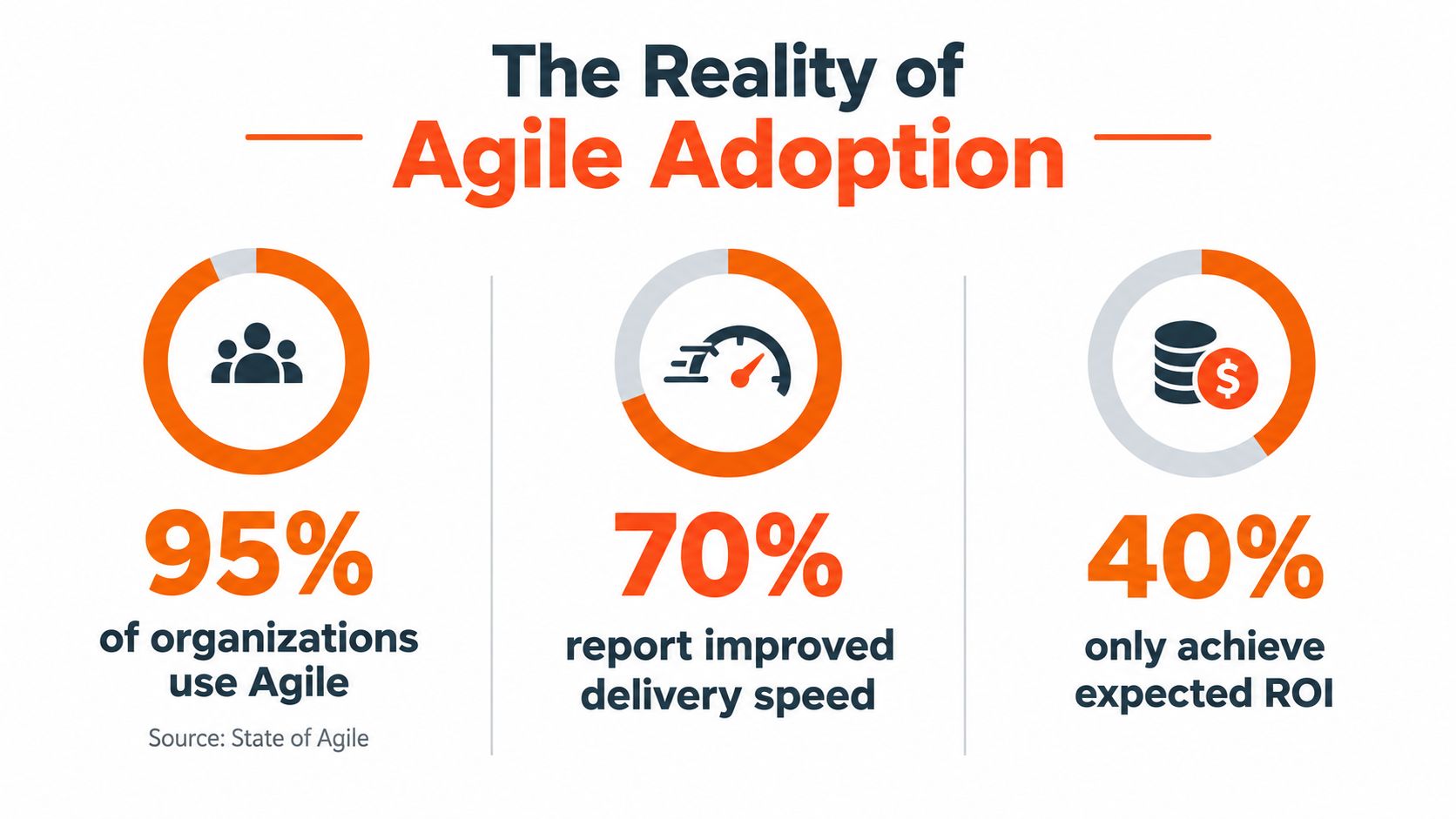
Agile became mainstream because software products operate under uncertainty. Its academic footprint shows that the movement developed into a serious research and management discipline. A bibliometric study covering publications from 2001 through 2014 identified 827 Agile-related articles across 394 journals and 690 different first authors, while another review identified 1,551 Agile software-development research papers between 2001 and 2010. Agile belongs to a longer history of empirical learning, not a temporary management fashion.
Adoption still does not guarantee effectiveness. Digital.ai's 17th annual State of Agile survey, reported in January 2024, gathered responses from 788 software-development professionals and found that 71% used Agile somewhere in their software-development life cycle. The sample covered organizations of different sizes. Just over 30% of respondents worked at companies with more than 20,000 employees, while 29% worked at organizations with 1,000 or fewer employees. Digital.ai's survey coverage demonstrates broad adoption across the market.
The survey reported improved collaboration for almost 60% of respondents, better alignment with business needs for 57%, and higher software quality for approximately one-quarter. Yet only 11% of Agile users were very satisfied with how Agile worked in their organization, while 33% were somewhat satisfied. Smaller, more nimble organizations also viewed enterprise Agile as more effective. 52% said it worked very or somewhat well, compared with 43% at larger companies.
The gap points to structural failure, not a flaw in iterative development. Teams can attend every prescribed meeting while product managers remain unavailable, architecture decisions stay implicit, quality gates arrive late, and executives keep changing priorities without explaining trade-offs. The ceremonies exist, but the feedback loop never reaches the decisions that control investment.
Nearshore execution makes this gap visible quickly. A distributed team needs direct access to product decisions, written context, rapid feedback, and senior engineering ownership. AI can accelerate implementation and analysis, but governance must keep product intent, architecture, and production risk visible. Without those controls, Agile moves misunderstood requirements into production faster.
Look for these symptoms:
Your remedy is not more ceremony. Give one cross-functional team a clear product outcome, authority over its delivery path, access to customer evidence, and responsibility for production behavior. Then measure whether the system improves. Agile earns its place when it changes business decisions, not when it fills a calendar.
An MVP team needs fewer role boundaries and more explicit accountability. The Product Owner owns the backlog and product priority, the Scrum Master facilitates the process and removes impediments, the Development Team designs, builds, tests, and operates the increment, and Stakeholders provide feedback and make consequential decisions. These roles can be staffed by different people, but responsibility can't disappear between them.
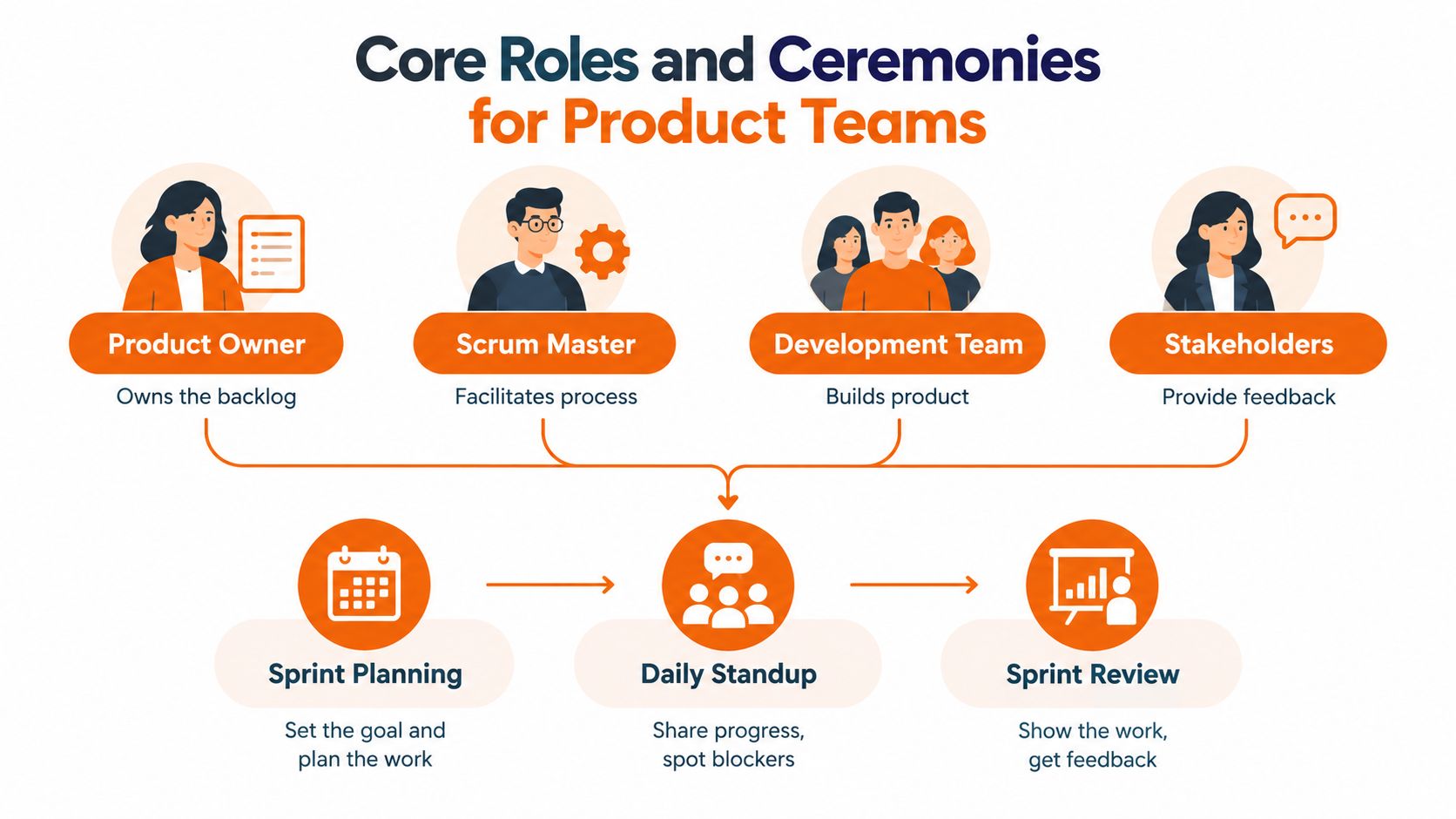
Start with product intent. The Product Owner defines the target customer, problem, business outcome, and constraints. A backlog item should explain the user behavior or operational result it supports, not merely name a technical task.
Refine before commitment. Engineers and product leaders examine assumptions, dependencies, data needs, security implications, and acceptance evidence. Split items until the team can complete and evaluate them without hiding unknowns inside a large epic.
Use Sprint Planning to make a trade-off. The team selects work around a sprint goal, not a random collection of tickets. A useful sprint planning guide for agile teams can help teams structure that conversation, but no template can replace a clear decision about what matters most.
Run a focused Daily Standup. Each person should surface progress toward the goal, a decision needed, or an obstacle threatening delivery. Status reporting belongs in the board. The meeting exists to coordinate action.
Demonstrate working value in the Sprint Review. Show the product increment to stakeholders and, where possible, customer representatives. Ask whether the result changes the product hypothesis, priority, or release decision.
Turn the Retrospective into an operating commitment. Choose a small number of improvements with an owner and a review point. “Communicate better” isn't an action. “Record an architecture decision before implementation begins” is.
Definition of Done should include more than code merged. It should cover automated tests appropriate to the change, security review where relevant, observability, documentation of material decisions, and a deployable state. If testing or operational readiness happens after the sprint, the team hasn't delivered the increment. It has created work in progress.
For a nearshore MVP team, add explicit collaboration rules: overlapping working hours for decisions, a single source of truth for product and architecture context, written acceptance criteria, and a named owner for unanswered questions. Senior engineers should join refinement when a choice can create future migration cost. Speed comes from resolving uncertainty early, not from pretending it isn't there.
If you measure only velocity, you can reward a team for producing more unfinished work. If you measure only deployment frequency, you can reward unsafe releases. Agile delivery performance is a joint throughput-and-stability system, and DORA gives product leaders a practical language for managing both.
The five operational metrics are:
DORA's metrics guide explains the definitions and the relationship between delivery speed and stability. High-performing teams generally do well across the measures. A faster pipeline that produces more failures isn't a capability improvement.
Record timestamps from commit through production deployment. Classify failed changes consistently, and review results by service and value stream rather than hiding weak performance inside an organization-wide average. Connect the dashboard to product decisions:
| Signal | Question for the team |
|---|---|
| Lead time | Where does work wait after engineers finish it? |
| Deployment frequency | Can the team release small increments safely? |
| Change-fail rate | Which quality or review gaps create production risk? |
| Recovery time | Does ownership extend into operations? |
| Rework rate | How much capacity is being consumed by avoidable incidents? |
The metric review should produce action, not theatre. If lead time is high, inspect queueing, approval delays, test execution, and dependency handoffs. If change-fail rate is high, reduce batch size, strengthen automated tests, improve observability, and make rollback practical. If rework consumes capacity, treat reliability work as backlog capacity rather than as an interruption that must wait behind feature development.
DORA also provides performance categories that make “fast” more concrete. Elite organizations deploy on demand, potentially multiple times per day, with change lead time under one hour, change-fail rate from 0% to 15%, and recovery time under one hour. High performers deploy between once per month and once per week, with lead times from one week to one day, change-fail rates from 15% to 30%, and recovery in less than one day. Low-performing organizations deploy less than once every six months, have lead times from six months to one month, change-fail rates from 60% to 46%, and recovery from one month to one week, as summarized in this DORA metrics overview.
Use those thresholds diagnostically, not as a quota. Your product's risk profile determines the right cadence. For a broader operating perspective, connect delivery measures to the practices discussed in engineering efficiency, especially where coordination, quality, and ownership affect throughput.
AI changes the economics of delivery, but it doesn't lower the standard for an architecture decision, a database migration, a security control, or a production release. The useful comparison isn't “AI versus engineers.” It's traditional nearshore execution versus AI-augmented nearshore execution with accountable senior engineering leadership.
A traditional model often assigns work to specialists, coordinates handoffs, and uses engineers primarily for implementation. An AI-native model gives engineers agentic tools across analysis, code generation, test creation, documentation, migration research, and defect investigation. The second model can move faster, but only when experienced engineers validate the output and preserve system coherence.

Stack Overflow's 2025 Developer Survey reports that 84% of developers use or plan to use AI tools, while 76% of AI-tool users still won't ship suggested code without human review. The same verified data shows that among developers reporting productivity gains, 81% of those using AI-assisted code review reported improved quality, compared with 55% relying on manual review. The survey results support a clear operating position: AI can increase throughput, but review and evidence remain essential.
The senior architect remains accountable for:
The agent can draft a pull request. It can't accept responsibility for an outage. A product owner can ask an agent to generate acceptance criteria, but the team still needs a human to verify that the criteria represent the customer problem and the commercial intent.
AI governance belongs inside Agile work. Require every AI-assisted story or pull request to identify its source context, assumptions, tests executed, known limitations, security considerations, and human reviewer. Track escaped defects, rework, security findings, technical debt, and DORA outcomes alongside velocity. This creates an auditable path from generated work to production behavior.
For a deeper explanation of this operating model, see how AI-accelerated software development works.
A practical AI-native workflow looks like this:
AI makes weak governance faster. Build the controls before you scale generation.
Your developers may have faster coding tools and still deliver slowly because the surrounding organization makes every decision expensive. Atlassian's 2025 research across 3,500 developers and managers in six countries found that 90% lose at least six hours per week to non-coding work, while 50% lose ten or more hours. The leading time drains include finding information, adapting to new technology, and switching between tools. Atlassian's developer experience research makes the constraint visible: coding is only one part of the delivery system.
JetBrains found that 66% of developers don't believe current performance metrics reflect their true contributions, and identified communication, transparency, and clarity of goals as central performance factors. The JetBrains research reference reinforces why story points are a poor substitute for an operating model. A developer who resolves a dependency, documents a risky decision, or prevents an incident may create more product capacity than someone who closes a simple ticket.
Start with information flow:
Nearshore teams need this structure because distributed work magnifies ambiguity. A product leader who gives vague requirements at the end of a local day can create a full cycle of waiting for a remote team. Replace informal escalation with response expectations, decision logs, and a shared planning rhythm. For managers building those habits, this guide for managers offers a useful framework for improving cross-functional collaboration.
The answer isn't to add bureaucracy. It's to remove recurring questions. Give engineers stable interfaces, accessible product context, reliable environments, and authority to resolve decisions within agreed boundaries. Then measure retrieval time, blocked work, dependency age, and rework as operating signals. AI can generate code quickly, but it can't compensate for an organization that has forgotten why the code is being built.
A nearshore partner earns trust during ambiguity, not during a polished demo. Test that capability before signing. Give the team an incomplete MVP requirement, a fixed 30-minute refinement session, and access to a small set of product constraints. Require them to identify the riskiest assumption, propose a thin first slice, name what they would exclude, and record the decisions they made.
The exercise should produce evidence, not impressions. Ask for the resulting decision log, acceptance criteria, dependency map, and release risks. Then ask how the proposed slice would appear in the team's DORA dashboard. A credible partner connects product trade-offs to delivery signals instead of treating refinement as ticket writing.
Use the same scenario to test difficult moments:
Request concrete records during evaluation. Ask for the last three ADRs, the change-fail rate by service for the last 30 days, and the rollback procedure used in the last incident. Ask who approved each decision and what changed afterward. Vague answers signal order-taking. A partner that cannot show its working record will struggle to make delivery predictable.
For a broader view of how nearshore teams can support product work across delivery stages, review this nearshore software development approach. Rite NRG describes a model combining architects, engineers, AI specialists, data experts, and delivery leaders in a Poland-based nearshore technology consultancy. Its listed services include software development, legacy modernization, AI consulting, technology teams, and managed technology services.
Before signing, require written answers to these questions:
Predictable delivery comes from visible choices. The partner must expose uncertainty early, limit work to a testable increment, record why scope changed, and preserve a recovery path when production behavior differs from expectations.
Rite NRG helps SaaS founders and technology leaders plan, build, modernize, and operate business-critical software through nearshore teams and AI-augmented delivery. Visit Rite NRG to discuss an Agile product delivery model focused on speed, maintainability, and controlled production risk.
/ about the author
Written by the RITE NRG editorial team — the architects, engineers and delivery leads who build and operate AI-era software for our clients.
Strategy & Transformation
A practical, finance-ready framework for comparing AI and modernization investment with the current-state cost, realistic benefits, delivery risk and time to value.
AI Consulting & Automation
A practical framework for choosing and deploying transport or logistics AI agents around real exceptions, reliable data and controlled operational authority.
Industry Solutions
A practical roadmap for improving manufacturing systems and introducing AI without destabilising production, data integrity or operational control.
More guidance: all insights articles
Tell us about the system or idea behind this article. We tell you honestly if it is a fit — and what a fixed-scope delivery could look like.