The claims team is waiting on a batch job. The broker has already chased twice. The underwriter wants a clean answer, the finance lead wants to know why the cost per policy keeps creeping up, and someone in operations is still asking whether the overnight fix fixed anything. That's the true shape of IT support for insurance companies in 2026, not a tidy help desk queue, but a business problem that shows up in claims delays, frustrated partners, and fragile resilience.
UK insurers can't afford to treat support as a back-office utility anymore. Reuters reported in 2023 that insurers in the UK and Europe were increasing spending on automation, cloud migration, and data analytics to improve claims handling and customer service, while EY and Gartner forecast global insurance IT spending rising to $213.5 billion in 2023 and IT services growing to $138.6 billion by 2027 in a 9.4% CAGR projection, with overall spending up 7.2% in 2023 (EY and Gartner insurance IT spending outlook). The message is blunt. Support is now part of operational strategy, not a cost you hide in the run rate.
A serious insurer should judge its support partner on whether it shortens claims cycle time, protects regulated service during incidents, and improves broker experience. If a supplier talks only about tickets closed and devices patched, they're missing the point. If they can't explain how they reduce technical debt and keep underwriting moving during change, they're not a delivery partner, they're an expensive interruption.
Why IT Support for Insurance Companies Is a Business Outcome Problem
A claims team loses half a day because a nightly process failed. The service desk may see a ticket. The business sees delayed customer payments, brokers chasing updates, and manual rework piling onto people who should be handling risk and service.
Measure support by business friction, not activity
IT support earns its place when it removes friction from the operating model. That means fewer handoffs, faster restoration, cleaner audit trails, and less time spent reconciling systems that should already agree with one another. In property and casualty insurance, analysts at HG Insights found that the share of IT in total operating costs rose by 22% over seven years, while top-tier insurers' operating cost per policy was at least half that of bottom-tier firms. That is why support quality shows up in the numbers, not just in the service desk log (HG Insights insurance industry report).
Practical rule: if a support decision does not improve cost per policy, resilience, or speed to serve, it is probably a local optimisation dressed up as strategy.
UK insurers also operate in one of Europe's largest insurance hubs, so the pressure on service continuity is higher than in a small regional market. EY and Gartner forecast global insurance IT spending rising to $213.5 billion in 2023 and IT services growing to $138.6 billion by 2027 in a 9.4% CAGR projection, with overall spending up 7.2% in 2023 (EY and Gartner insurance IT spending outlook). The message is blunt. Support is part of operational strategy, not a cost line to hide in the run rate.
A consulting mindset helps here. A vendor says, “We'll support the environment.” A partner says, “We'll stabilise the environment, protect the business service, and help you modernise without stopping revenue.” That distinction matters, because insurers do not buy uptime for its own sake, they buy continuity, trust, and the ability to operate under pressure.
Cost control and resilience belong in the same conversation
Good support reduces avoidable spend in the most expensive parts of the stack. Benchmarks from HG Insights show 47% of insurance IT spending goes to IT services, 31% to software, 13% to hardware, and 9% to communications, with the industry projected to spend $291 billion on IT globally over the next 12 months (HG Insights insurance industry report). That split tells you where the waste hides. It is in keeping complex systems alive, not in flashy new tools.
The right question is simple. What business outcome does your support function own, and how will it prove it every month? If nobody can answer that, the insurer is paying for activity, not value.
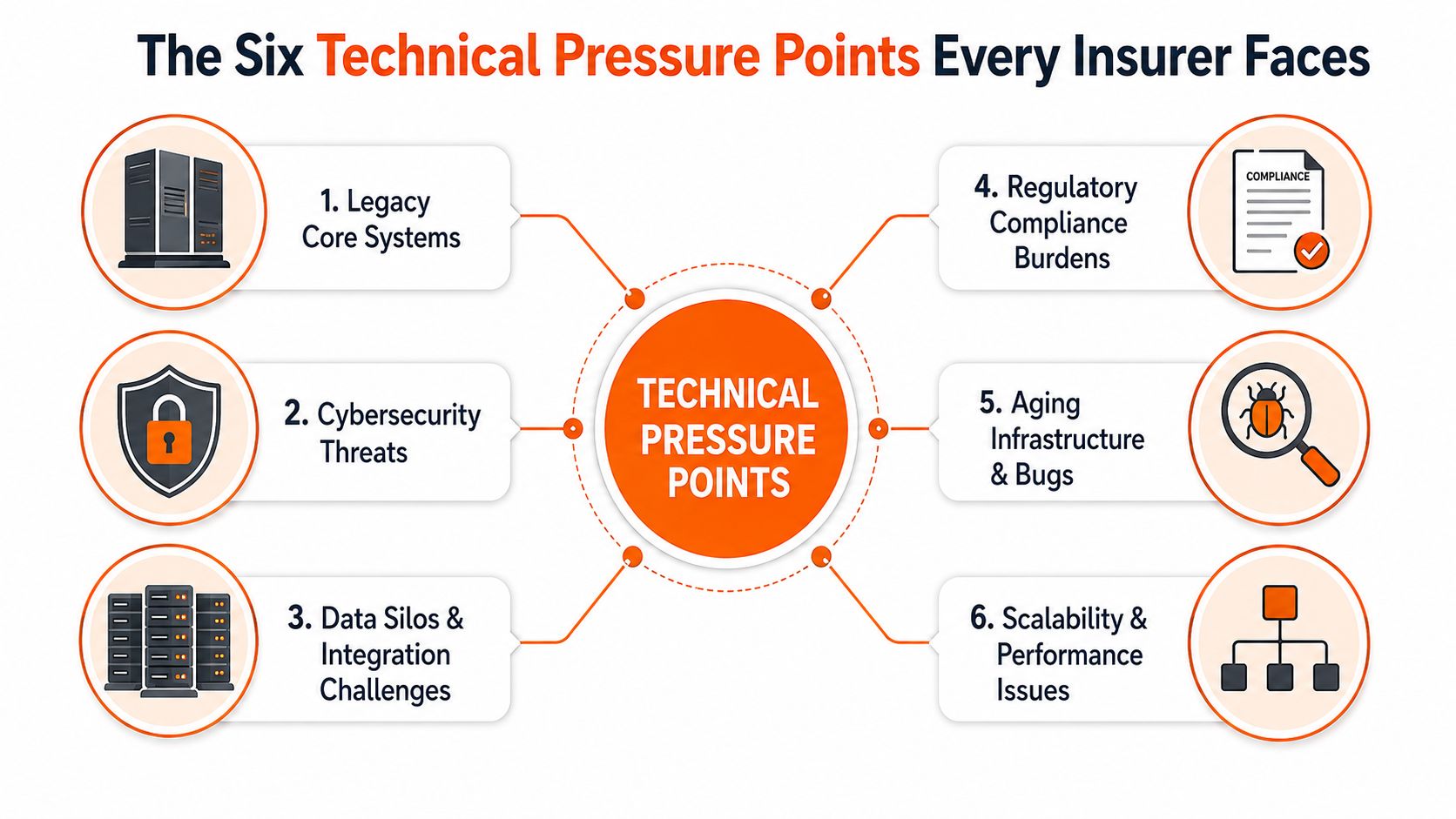
The Six Technical Pressure Points Every Insurer Faces
Insurance technology stacks usually fail in the same places, even if the vendor logos change. The pattern is predictable, legacy core systems, fragmented tools, compliance overhead, integration pain, cyber exposure, and performance bottlenecks. Those are the pressure points that drive cost-per-policy up, slow underwriting, and make resilience harder to prove when the business is under strain.
1. Legacy cores act like a locked engine room
Aging mainframe and COBOL estates still sit under a lot of insurance operations, and they are hard to change without specialist skills. The business cost is slower change delivery, higher operational continuity risk, and more time spent protecting systems instead of improving them (DSS on insurance IT challenges). If the core cannot change safely, every product tweak turns into a controlled incident.
2. Fragmentation turns people into integration middleware
UK insurers often run dozens of overlapping IT systems, and that fragmentation pushes work back onto manual controls such as email, phone, Office tools, and printed records for compliance reporting and coordination (Gain Compliance on insurance compliance challenges). That is labour covering for architecture. Every manual workaround adds delay, and every delay shows up in claims, underwriting, or finance.
3. Cyber risk is an operations problem
A perimeter control does nothing if claims, underwriting, or finance cannot resume after an outage or attack. Recovery speed matters more than another layer of tooling. The insurers that get this right have tested scripts, clear ownership, and a recovery model that gets people back to work without waiting for heroics.
4. Compliance work gets heavier when systems do not talk
When data lives in separate tools, teams create duplicate checks, duplicate reports, and duplicate sign-offs. Control environments become brittle fast. Support has to fix the flow of information, not just the endpoint devices, or compliance teams end up spending their time reconciling their own records.
5. Integration tax slows every external interaction
Brokers, partners, and customer channels all depend on clean handoffs. Weak API integration slows quote-to-bind, delays claims updates, and erodes confidence with intermediaries. That cost is quiet, but it lands in lost time, rework, and poor service experience.
6. Scaling and performance issues hit at the worst time
Insurers do not need peak speed every day, they need predictable speed when volumes spike or a platform comes under stress. The wrong support model treats performance as an infrastructure metric. The right one treats it as a service promise tied to underwriting capacity, claims throughput, and customer response times.
For a useful view of how newer tooling can sit alongside technical debt instead of pretending it has gone away, the note on Agentic AI and technical debt is worth reading. The point is simple. Unowned complexity keeps growing until support becomes firefighting.
Comparing Service Models That Actually Work for Insurers
The support model you choose matters as much as the people in it. Insurers usually end up in one of three places, traditional managed services with co-managed SLAs, dedicated nearshore teams that work inside the insurer's delivery rhythm, or a Build-Operate-Transfer arrangement that creates a longer-term engineering base. Each one works, but for different reasons.
| Model | Best For | Control | Speed to Start | Long-Term Fit |
|---|---|---|---|---|
| Managed services with co-managed SLAs | Stable environments that need disciplined operations | Medium | Fast | Good for steady-state support |
| Dedicated nearshore teams | Ongoing product, platform, and support work with strong collaboration needs | High | Fast to medium | Strong for regulated change and modernisation |
| Build-Operate-Transfer | Firms building a durable engineering capability in a nearshore location | Very high | Medium | Strong when leadership wants lasting ownership |
Managed services are fine when the estate is boring
Use traditional managed services when the main problem is service discipline, not organisational transformation. They're effective for standard coverage, endpoint support, and predictable operational routines. The downside is obvious, they can become procedural and detached from business priorities if the SLAs only track response times.
Nearshore dedicated teams fit the insurer that needs judgement, not just coverage
A dedicated team works best when you need people who sit close to the product, know the claims workflow, and collaborate daily with in-house leaders. That model keeps knowledge in the operating rhythm instead of throwing it over the fence. If you want a clear view of partnership structures, this overview of partnership models is a useful reference point.
Build-Operate-Transfer suits firms planning for ownership
BOT is the right answer when leadership wants to create a durable engineering base without absorbing all the setup risk on day one. It works when you're serious about talent retention, governance, and long-term control. It's not a shortcut, and it shouldn't be sold as one.
Choose this when: managed services for stability, nearshore teams for active change, BOT for building internal capability with external help.
A lot of insurers get this wrong by buying the cheapest model for the first six months, then paying for it for years. That's weak governance, not savings. The right model is the one that survives audit cycles, change windows, and claims pressure without turning the business into a permanent escalation meeting.
Modernising Legacy Core Systems Without Stopping the Business
“Lift and shift” reads well in a board deck and poorly in a live insurer. It often means relocating an old problem to new infrastructure and calling that progress. Technical debt stays in place, and transition risk stays in place with it.
Phase the change or accept the outage
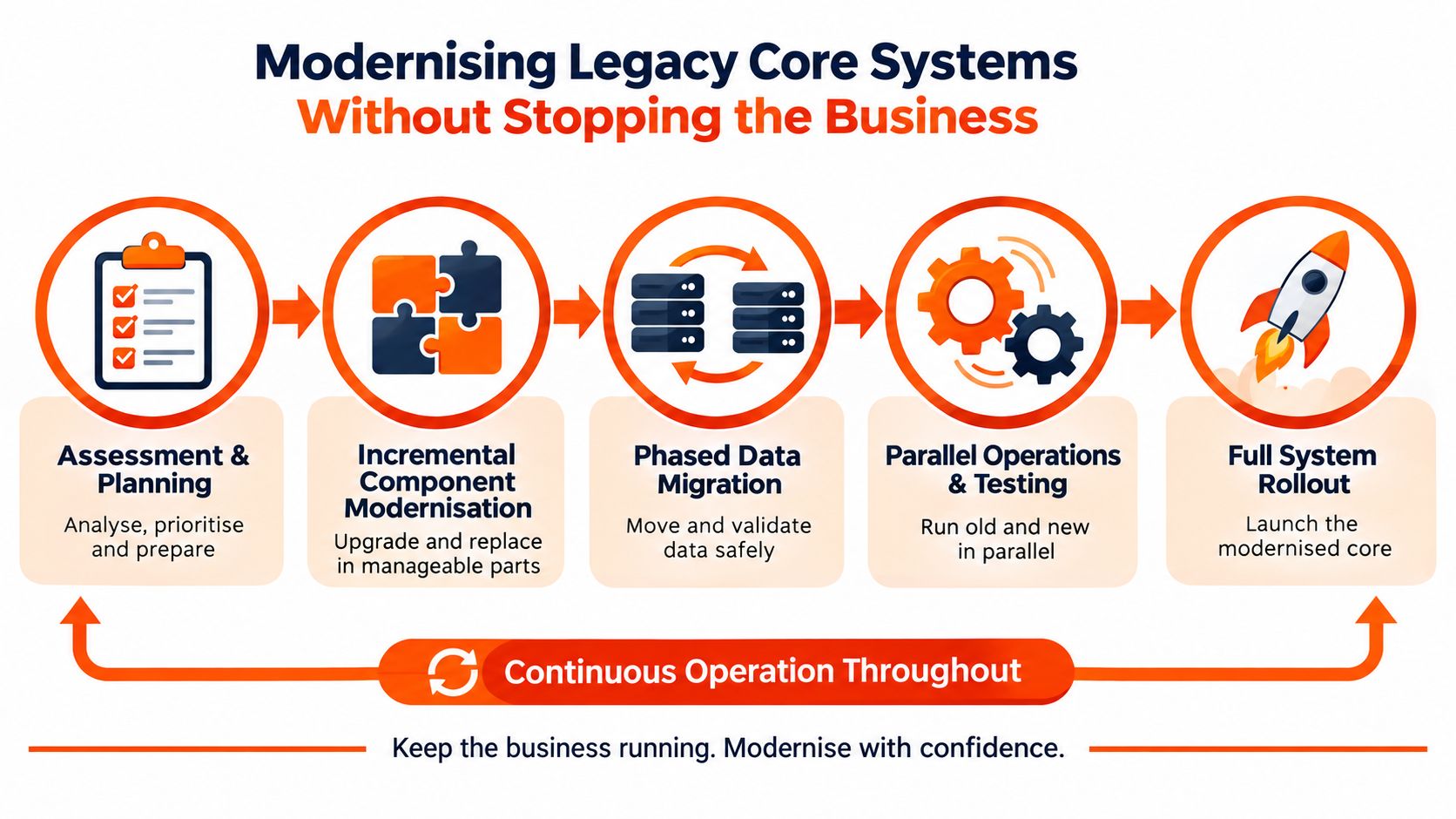
Modernisation works when the legacy core is stabilised first, then exposed through APIs, then replaced in controlled slices. The plane-engine analogy fits because the business keeps flying while the engine is being changed. Try to do it all at once, and underwriting, claims, and broker integrations all take the hit.
The operational constraint is familiar to any insurer running aging mainframe and COBOL estates with scarce specialist skills and complex API integration requirements. That combination raises continuity and cybersecurity risk while slowing digital-channel delivery. It also means incident response, change management, and platform support have to be built around coexistence, not heroics. The insurer that plans for parallel systems keeps serving customers while the target state is still being built.
Use regulated sign-off as a delivery gate
The phased pattern should look like this. Stabilise the legacy core, expose critical functions through integration layers, run parallel policy environments, and retire components only after the business, brokers, and compliance teams have signed off. It is slower than the glossy pitch, but it is the only sensible way to avoid destabilising regulated workflows.
The UK regulatory context matters too. The FCA's operational resilience agenda keeps the focus on preventing harms from disrupted services, and the Bank of England's resilience and stress-testing agenda reinforces the need to prove critical business services can absorb shocks. That means modernisation evidence matters as much as the technology itself. If you cannot show the path to resilience, the board will treat the programme as a risk transfer exercise.
A practical delivery partner can own the parallel run while in-house teams keep the lights on. That split of responsibility is healthy. It stops internal teams from being pulled into every technical decision and lets the insurer keep control of the customer-facing service.
Rule of thumb: if a modernisation plan cannot explain how claims, underwriting, and broker operations keep running during change, it is not a plan, it is a hope.
For a deeper view of staged change, the article on legacy system modernization strategies maps well to the realities insurers face. The point is simple. Modernisation is a delivery programme, not a product purchase.
The Recovery Playbook Most Insurers Never Write Down
Prevention gets all the budget conversations. Recovery is where insurers either preserve trust or lose it. The most expensive support failures are usually the days after the incident, when claims, underwriting, and broker operations stall while people improvise.
Write for recovery, not just for defence
The urgency is real. The FCA says 69% of medium and large UK firms identified a cyber attack in the last 12 months in its 2024 Financial Lives survey, and the UK Government's 2024 Cyber Security Breaches Survey found 50% of businesses and 32% of charities experienced a cyber breach or attack in the previous 12 months (integricom on managed IT services for insurance companies). Those figures should push insurers to ask a better question. How fast can we restore regulated service?
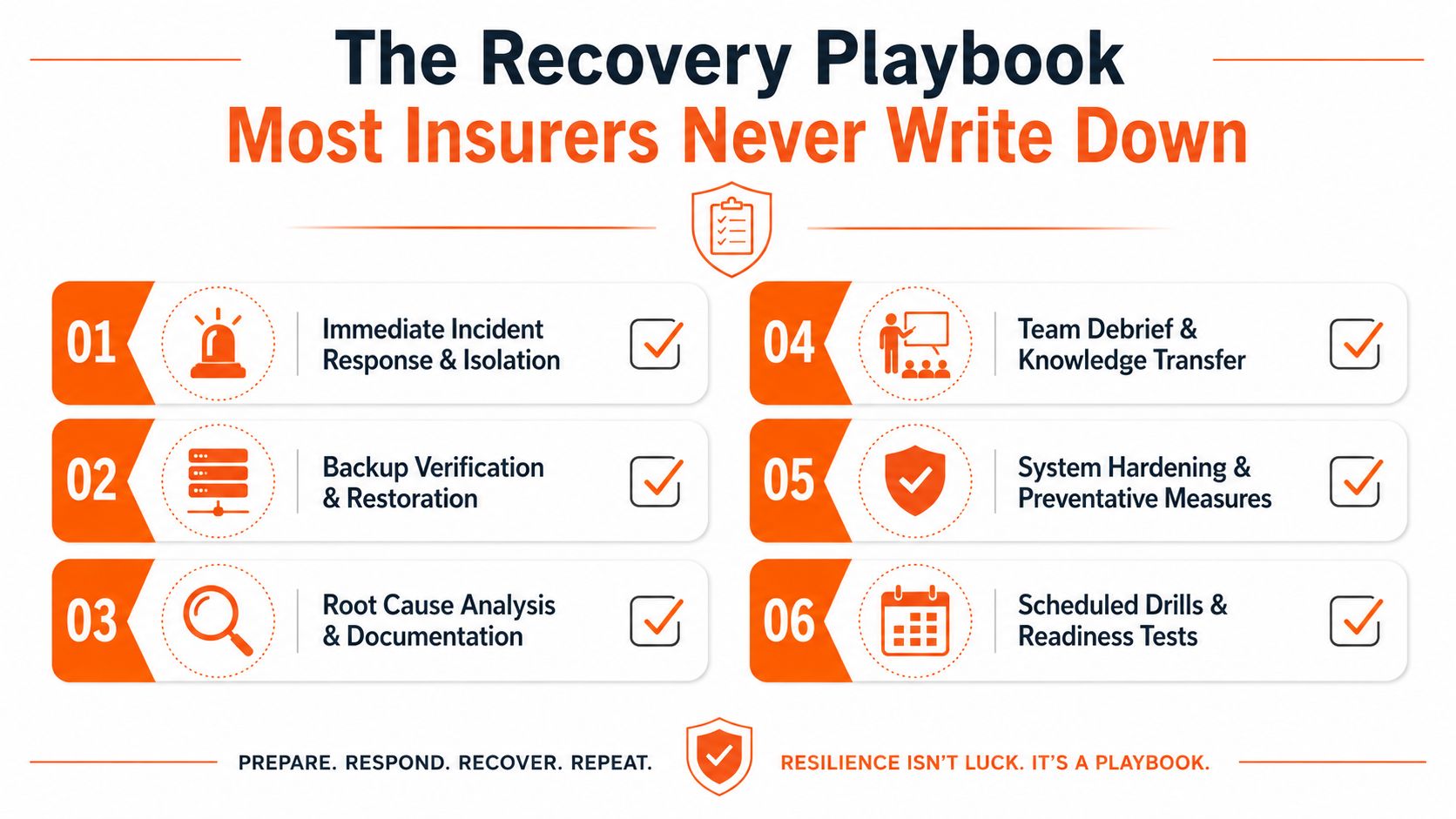
The recovery playbook should include prioritised claims-critical systems, tested manual workarounds, communication scripts for brokers and regulators, rehearsed failover to secondary sites, and evidence trails that satisfy audit. If a supplier says they “do backup”, that's not enough. You need to know who declares the incident, who owns each communication channel, and how the business keeps processing work while systems recover.
Demand artefacts, not assurances
A serious MSP should be able to show these items without scrambling.
- Priority service map: which claims, underwriting, billing, and broker functions come back first.
- Manual workaround pack: how staff process work if the policy admin platform is unavailable.
- Communication templates: what gets sent to brokers, regulators, and internal leaders.
- Failover evidence: proof that recovery sites or backup environments have been exercised.
- Audit trail: logs and documentation that show what happened, what changed, and when.
If a provider can't produce those artefacts, they don't have a recovery model, they have a pitch deck.
The business logic is straightforward. Insurers who can keep paying claims during an outage earn trust that marketing can't buy. The support partner should help you rehearse that, document that, and prove it under pressure. If they only talk about patching and endpoint protection, they're stopping at prevention and ignoring the part that protects the brand.
For broader continuity planning, business continuity strategies should be read alongside incident recovery, not instead of it. One without the other leaves a dangerous gap.
The Vendor Selection Checklist That Separates Partners from Providers
Procurement often rewards polished answers and punishes awkward questions. That's exactly backwards for insurance IT support. You want the supplier who can show how they run the estate, not the one who knows how to talk about transformation.
Test the ten service areas, not the sales deck
A complete managed IT plan for an insurance agency should include at least 10 core service areas, including help desk support, proactive monitoring, patch management, cybersecurity, Microsoft 365 administration, backup and disaster recovery, employee onboarding and offboarding, vendor coordination, technology planning, and performance reporting (911 IT on managed IT support for an insurance agency). That list is useful because it gives you a hard scope, not vague “support” language.
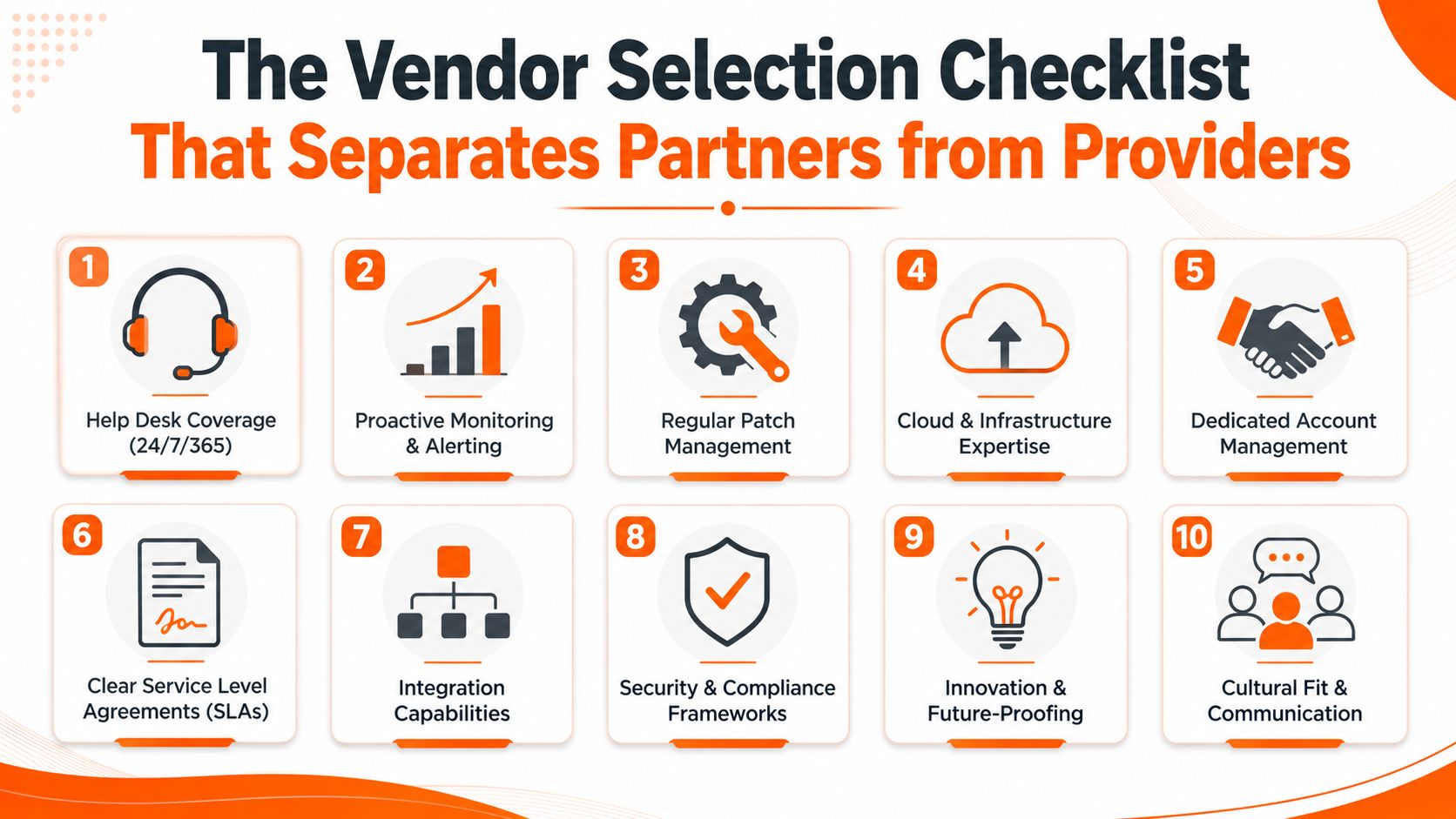
Ask sharp questions in each area.
- Help desk coverage: Who answers when claims operations needs help outside office hours?
- Proactive monitoring: What alerts are acted on automatically, and what gets escalated?
- Patch management: How do you prioritise patches on systems that can't afford unplanned downtime?
- Microsoft 365 administration: Who owns permissions, retention, and user recovery?
- Backup and disaster recovery: How often do you test restoration, not just backup completion?
- Onboarding and offboarding: How fast can access be granted or removed without breaking audit controls?
- Vendor coordination: Who manages dependencies across telecoms, cloud, and software providers?
- Technology planning: How do you support phased modernisation instead of ad hoc fixes?
- Performance reporting: Which KPIs reach leadership, and which ones stay buried?
- Cybersecurity posture: How does the provider support resilience after an incident, not just prevention?
The contract matters just as much. Push for outcome-based SLAs tied to claims workflows, exit and knowledge-transfer rights, regulator cooperation duties, and clear cybersecurity liability allocation. Those clauses separate a genuine partner from a provider who disappears when things get uncomfortable.
If you want a one-line test, use this one. Can this supplier explain how they will keep underwriting, claims, and broker service working while the estate changes underneath them? If not, walk away.
KPIs and Cost Considerations That Prove IT Support Is Working
Boards do not need another dashboard full of vanity metrics. They need a short list of measures that show whether IT support is lowering friction, protecting revenue, and keeping the insurer recoverable after disruption. Treat the reporting pack as a business control, not a technical scorecard.
Start with cost per policy and service continuity
The cleanest financial lens is cost per policy, because it ties support spend to the actual economics of the book. A practical benchmark to watch is the industry ratio of around 4.2% of annual written premium for core IT work, which gives leadership a way to judge whether spend is improving efficiency or just drifting upward (Datos Insights on property and casualty insurer IT budgets). Track that ratio over time, and set it beside service continuity, not in isolation.
Then judge the support model against a small set of operational KPIs.
- Claims cycle time: Is support helping claims move faster, or creating pauses?
- Broker service responsiveness: Are intermediaries getting answers before they escalate?
- Recovery readiness: Have backup and restoration tests been completed?
- Change success rate: Are upgrades and fixes landing without avoidable incidents?
- Security posture: Are incidents contained, recovered, and documented cleanly?
The trend matters more than any single monthly number. If recovery readiness improves while claims cycle time gets worse, the organisation has shifted risk rather than reduced it. A board member should ask a simple question, does the support report show the insurer is more stable, easier to serve, and less expensive to run?
Read spend by category, not by headline
Insurance IT spend usually sits across services, software, hardware, and communications, and the services line takes the largest share in the benchmark data already cited (HG Insights insurance industry report). That should make leadership cautious about any support proposal that ignores labour mix, vendor dependency, or the amount of money trapped in keeping old systems alive.
A support model that appears inexpensive on paper can still be costly in practice. It conceals the true cost in overtime, repeat incidents, delayed claims handling, and longer recovery after cyber events. That is where insurers lose money, lose trust, and continue paying for the same problem twice.
Board-level question: are we buying more tools, or are we reducing the cost of running the business?
The answer should be visible in the month-end pack. If it is not, the support model is too weak to govern.
Your 30-Day Action Plan for Better IT Support
Better support doesn't start with a big transformation programme. It starts with disciplined ownership over the next 30 days. If you want the insurer to feel different by the next steering committee, the sequence matters.
Week one, baseline the real environment
Assign the CIO or IT director, an operations lead, and a claims representative to map current pain points. Capture the top recurring incidents, the systems that cause manual workarounds, and the places where brokers or customers feel delay. Produce a one-page service baseline, a current support map, and a list of the five most business-critical applications.
Week two, score the existing support model
Use the vendor checklist from earlier and score your current partner, or internal team, against the ten service areas. Ask for proof, not promises. The artefacts should include SLA reports, escalation logs, patch records, and recent recovery test evidence.
Week three, pressure-test recovery
Run a tabletop exercise with claims, underwriting, compliance, and communications in the room. Test what happens if a claims-critical platform goes down, who speaks to brokers, and how manual workarounds are used. Capture gaps, decisions, and follow-up owners in writing.
Week four, lock KPIs and a 90-day runway
Agree the monthly scorecard, the reporting owner, and the modernisation priorities for the next quarter. If legacy systems are holding the business back, define the first coexistence or API wrapping step, not a fantasy big-bang replacement. That's where serious delivery starts.
Ownership beats optimism. If nobody owns the next action, nothing changes.
If you need a partner that can help with nearshore dedicated teams, build-operate-transfer setups, legacy support, and delivery governance, Rite NRG works in that space with insurance-adjacent engineering and consulting capability. Visit Rite NRG and start a conversation if you want support that's measured by business continuity, not just closed tickets.