Most advice about partnership models starts in the wrong place. It obsesses over cost, team size, or whether you should buy a project, rent a squad, or build a long-term alliance. That framing is lazy. The difference between a partnership that ships business value and one that drains time is governance, accountability, and who owns the outcome when things go sideways.
UK partnership law gives us a useful reminder here. The Partnership Act 1890 still anchors the default rules for ordinary partnerships, defining a partnership as people carrying on business in common with a view to profit, and that legal shape still matters because it affects liability, profit-sharing, and management rights in practice (OECD overview of the Partnership Act 1890). Modern software deals may look different on paper, but the same question decides whether they work, who decides, who pays, and who carries the risk.
Why Most Partnership Model Comparisons Miss the Point
The usual comparison chart is a trap. It tells you which model is cheaper or faster, then leaves out the mechanics that determine whether your product ships. A model is only useful if it lines up the delivery outcome, the decision rights, and the escalation path. If those three are vague, even the most polished engagement turns into a slow vendor relationship.
Ownership beats labels
A founder can call something a dedicated team, but if the client still makes every product call and the supplier still refuses to challenge bad priorities, that is not partnership. It is labour with a nicer slide deck. The better question is simple, who owns the result, who changes course when reality shifts, and who gets blamed when dependencies slip?
Practical rule: if no one has been named as the single point of accountability for outcome delivery, the model is not ready.
That is why so many software deals fail during the handoff between strategy and execution. Teams often debate whether to use staff augmentation or a dedicated team, when the more important issue is whether the engagement has a real operating model. You need clear ownership of scope, data, approvals, and change control before anyone writes a line of code.
For a useful counterpoint on how teams weigh build, buy, and hybrid approaches, see this build versus buy analysis. That decision often exposes the same hidden issue, whether your organisation wants capability, capacity, or just temporary output.
Governance is the product
The partnership model is not the spreadsheet. It is the set of rules that govern decisions under pressure. In strong engagements, leaders know who can approve a release, who can block a scope change, and what happens when commercial interests clash with product reality. In weak ones, everybody “aligns” until the first deadline slips.
The #riteway Methodology matters. Extreme Ownership is not a slogan, it means the delivery partner raises issues early, proposes the fix, and stays on the hook until the business outcome is met. High energy and proactivity matter because a passive team never rescues a failing plan.
If you want a partnership that performs, stop asking which model sounds most attractive. Ask which one creates accountability you can enforce.
The Six Software-Delivery Partnership Models Explained
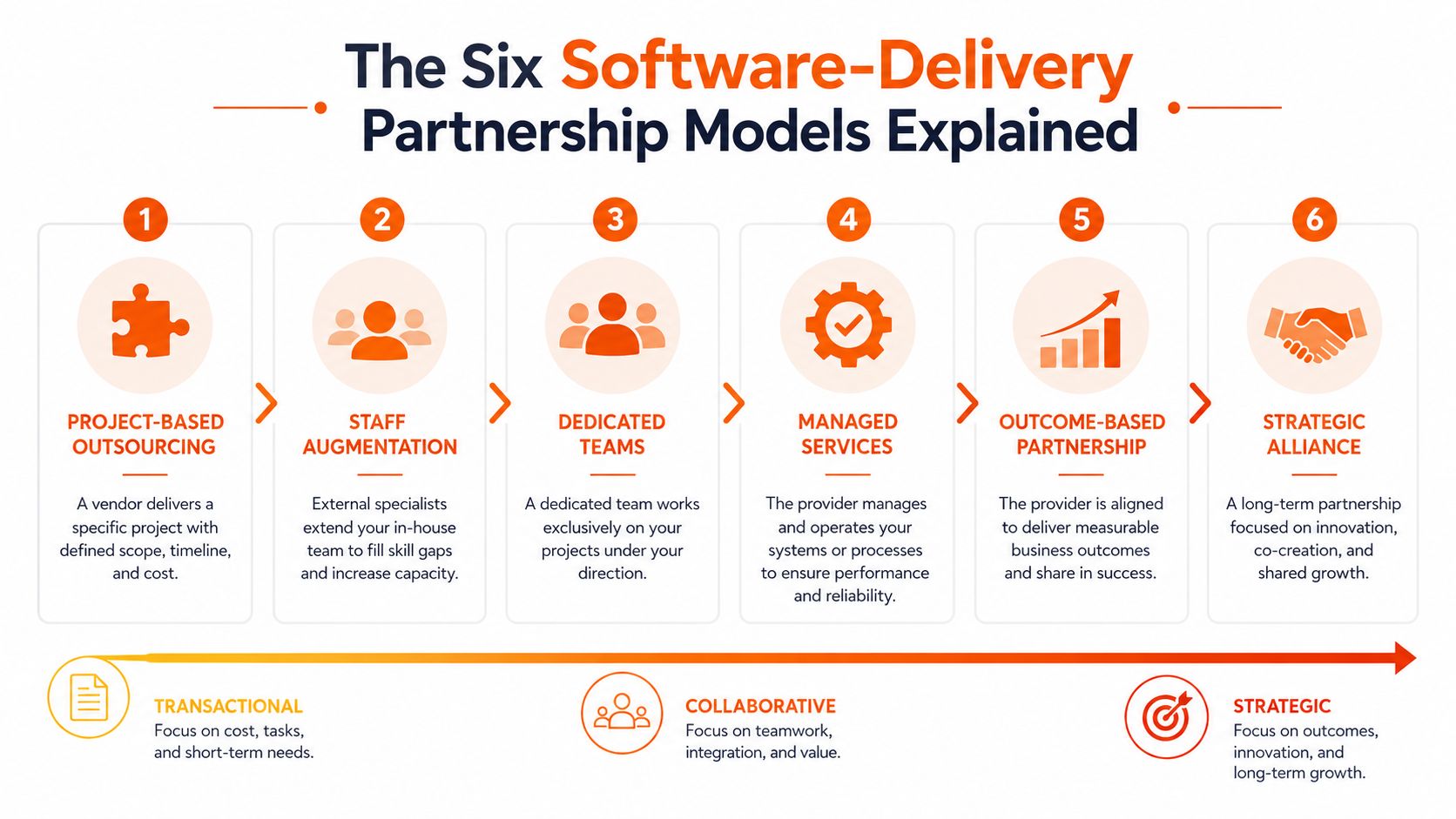
Each model solves a different problem. The mistake is treating them as if they sit on the same shelf. They do not. Some are built for speed, some for control, some for capability transfer, and some for long-term advantage. If you pick one for the wrong reason, you pay for it later in management overhead, lost context, or a team that nobody fully owns.
From transactional to strategic
Project-based outsourcing works when the scope is narrow and the deliverable is clear. You hand off a defined piece of work, the supplier executes, and the relationship ends when the output is delivered. It suits a fixed MVP slice, but it also creates the most distance between the client and the technical team.
Staff augmentation is closer to hiring a contractor. You add individual specialists into your own team and keep product ownership in-house. It can solve a skills gap fast, but if your internal leadership is weak, the augmented people become expensive passengers.
Dedicated teams look more like embedding a specialist squad. The client still owns the product direction, but the team gains continuity, shared context, and real delivery rhythm. This model fits longer platform work where speed and trust matter more than transactional control.
Managed services shift responsibility for a defined operational outcome to the provider. You buy a service level and a managed result, not just headcount. It works when the business wants stability and low day-to-day burden.
Build-Operate-Transfer (BOT) is a stronger structural play. You let a partner build the team and operating model, run it for a period, then transfer it into your control. It's the right fit when you need capability, not just delivery, and when you can absorb the team later. This BOT model guide is useful if you're weighing long-term ownership against short-term speed.
Strategic alliances sit at the top end of collaboration. Two organisations align around market access, product integration, or shared delivery objectives, and the payoff is usually broader than a single project. If you need a more advisory-led relationship, AI-powered software consulting is a useful reference point for how consulting and delivery can be connected without losing commercial discipline.
Which model serves which outcome
- Project-based outsourcing: best for a bounded output, with the risk sitting mainly on the client if requirements drift.
- Staff augmentation: best when you already have product leadership and just need execution capacity.
- Dedicated teams: best when you want continuity, faster delivery, and a partner that can own day-to-day progress.
- Managed services: best for steady operations where uptime, support, or process consistency matters more than innovation.
- BOT: best when you want to create a permanent capability without building everything from scratch.
- Strategic alliances: best when the business result depends on shared market access, platform integration, or ecosystem expansion.
The choice is not about prestige. It is about how much responsibility you want to share, and how much control you can manage. The wrong model creates drift. The right one creates momentum.
Cost, Time, and Risk Tradeoffs Across Models
Every model trades off cost predictability, speed to market, and risk ownership. Ignore one of those and you'll make the wrong call. A pre-seed startup, a scale-up migrating a monolith, and an enterprise launching a new digital line all need different answers because their tolerance for uncertainty is different.
The three scenarios that expose the tradeoff
A pre-seed founder usually wants an MVP fast, with minimum waste. That leans towards project-based delivery or a small dedicated team, but the founder must stay close enough to make decisions quickly. If the internal product leadership is absent, even the fastest model stalls.
A scale-up modernising legacy systems usually needs continuity and technical depth. Dedicated teams or managed services make more sense because they reduce context loss and keep delivery moving across multiple releases. The risk is hidden dependence, so governance has to be tighter, not looser.
An enterprise starting a new product line usually cares about control, compliance, and long-term ownership. BOT can be the right answer if leadership wants a controlled path to internal capability. If the organisation can't absorb the transferred team later, the model becomes a costly staging ground.
For a practical view of how delivery budgets are being evaluated in the market, find app pricing insights from AppLighter. That kind of pricing comparison is useful because it forces the same discipline this article is pushing for, outcome first, not optimistic estimates.
Partnership Model Tradeoff Matrix
| Model | Cost Structure | Timeline | Risk Owner | Best Fit |
|---|---|---|---|---|
| Project-Based Outsourcing | Fixed or tightly scoped | Fast for defined work | Client on scope drift | MVP slices, short engagements |
| Staff Augmentation | Variable by specialist | Fast to start | Client on delivery leadership | Skills gaps inside an existing team |
| Dedicated Teams | Recurring, capacity-based | Fast to ramp and steady over time | Shared, but client holds product direction | Platform builds, ongoing delivery |
| Managed Services | Service fee or retainer | Depends on operating maturity | Provider on the managed function | Support, ops, and steady-state delivery |
| BOT | Higher upfront investment | Slower to establish, stronger later | Shared early, then client after transfer | Capability creation and regional centres |
| Strategic Alliances | Structured around mutual value | Depends on shared objective | Shared across organisations | Market expansion, ecosystem plays |
The pattern is blunt. If you want the lowest apparent cost, you usually accept more outcome risk. If you want speed with control, you pay for stronger governance and better leadership. BOT gives you more lasting capability, but only if you commit to the transfer path from day one.
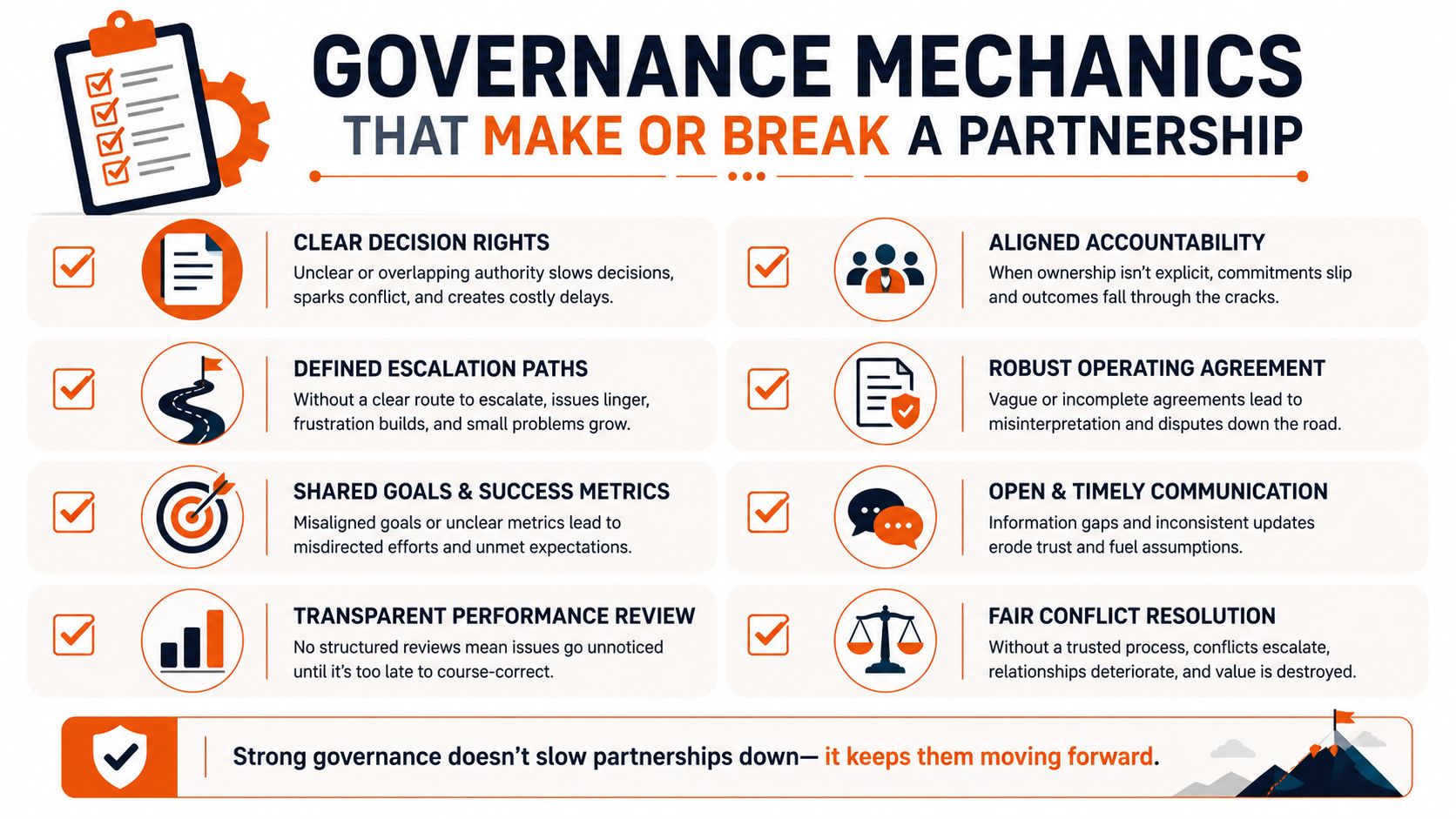
Governance Mechanics That Make or Break a Partnership
Most delivery failures do not start with code. They start with fuzzy authority, overlapping approvals, and nobody willing to make the hard call. The legal language around partnerships is useful because it distinguishes real partnerships from loose cooperation. In formal public-sector guidance, a true partnership involves shared responsibilities, shared costs, shared benefits, and shared control (National Research Council guidance). That logic maps directly to software delivery.
Put the operating model in writing
Start with role clarity. Name who owns product decisions, who owns technical architecture, and who owns commercial change requests. If those roles live in meetings instead of documents, they will collide the moment pressure rises.
Then write decision rights into the contract. Who can approve scope changes, who can accept a release, and who can veto a deployment? If you cannot answer those questions in one sentence each, the partnership is under-designed.
Data ownership needs the same treatment. Client data, logs, analytics, and access controls should be explicitly assigned. In regulated UK environments, vague data language becomes a procurement and compliance problem very quickly.
Measure behaviour, not just output
Sprint-level SLAs should reflect delivery behaviour, not vanity metrics. Track things like deployment cadence, defect leakage, response time on blockers, and how fast the partner escalates risk. These are not decoration. They are the operating signals that show whether the team is moving or pretending.
Use this test: if a metric does not force an honest conversation about progress, it is probably the wrong metric.
Compensation should also match the model. Fixed-fee deals punish change and encourage over-documentation. Time and materials can drift if accountability is loose. Milestone-based structures work better when outcomes are clear, but only if the milestones are tied to business value, not just activity.
Build escalation before you need it
Escalation paths should name the people, the time window, and the fallback action. A strategic partnership that waits three weeks to escalate a blocked dependency is already broken. You do not need more optimism. You need a route to resolution.
This is also where mutual benefit matters. UK health and public-collaboration guidance stresses that trust and shared purpose are prerequisites, not decorations. If one side owns all the voice and the other side absorbs all the pressure, the structure is not a partnership. It is a dependency with branding.
Real-World Constraints for UK Businesses Outside London
A lot of partnership advice assumes every company sits in a major tech hub with deep hiring pools and easy capital. That is not how most UK businesses operate. Outside London, leaders often have to balance funding constraints, tighter access to senior engineering talent, and the need to build capability without locking themselves into heavy fixed costs.

Coalitions beat single-point dependency
When funding is tight, a multi-party delivery coalition can be smarter than a single deep vendor relationship. You might use one partner for delivery, another for local compliance, and a third for capital or sector expertise. That looks messier on paper, but it spreads risk and provides capability a lone supplier can't cover.
This logic is visible in UK-facing work on underserved lending and community finance, which shows how effective models can combine banks, CDFIs, public bodies, and philanthropic capital to reach businesses that traditional lenders underserve (community finance research). The same principle applies to software delivery. Sometimes the best partner is a coalition.
Integration is a product decision, not a buzzword
For SaaS and digital product teams, integration partnerships are often the most practical way to extend capability. Two systems connect through APIs or embedded workflows, and the value comes from reducing manual handoffs and friction. That only works if API depth, maintenance overhead, and governance are all reviewed up front.
The hidden mistake is choosing an integration partner because they look impressive. Prestige won't save you from brittle contracts or weak ownership. The technical fit has to match the business objective.
For teams evaluating regional delivery options, how to choose a nearshore partner is a sensible reference point, especially when you need proximity without paying London-level overheads. Rite NRG also offers EU development centre setup and Build-Operate-Transfer capability, which fits organisations that want structured capacity outside their own entity.
The right answer outside London is rarely “one vendor, one relationship, one contract”. It is usually a better mix of delivery depth, local understanding, and governance that doesn't depend on one person remembering everything.
Your Partnership Model Selection Checklist
Choosing the right model gets easier when you stop asking which one sounds most impressive. Ask what you need to own, what you can absorb internally, and how much process maturity you already have. Then match the structure to the business problem, not to the pitch.
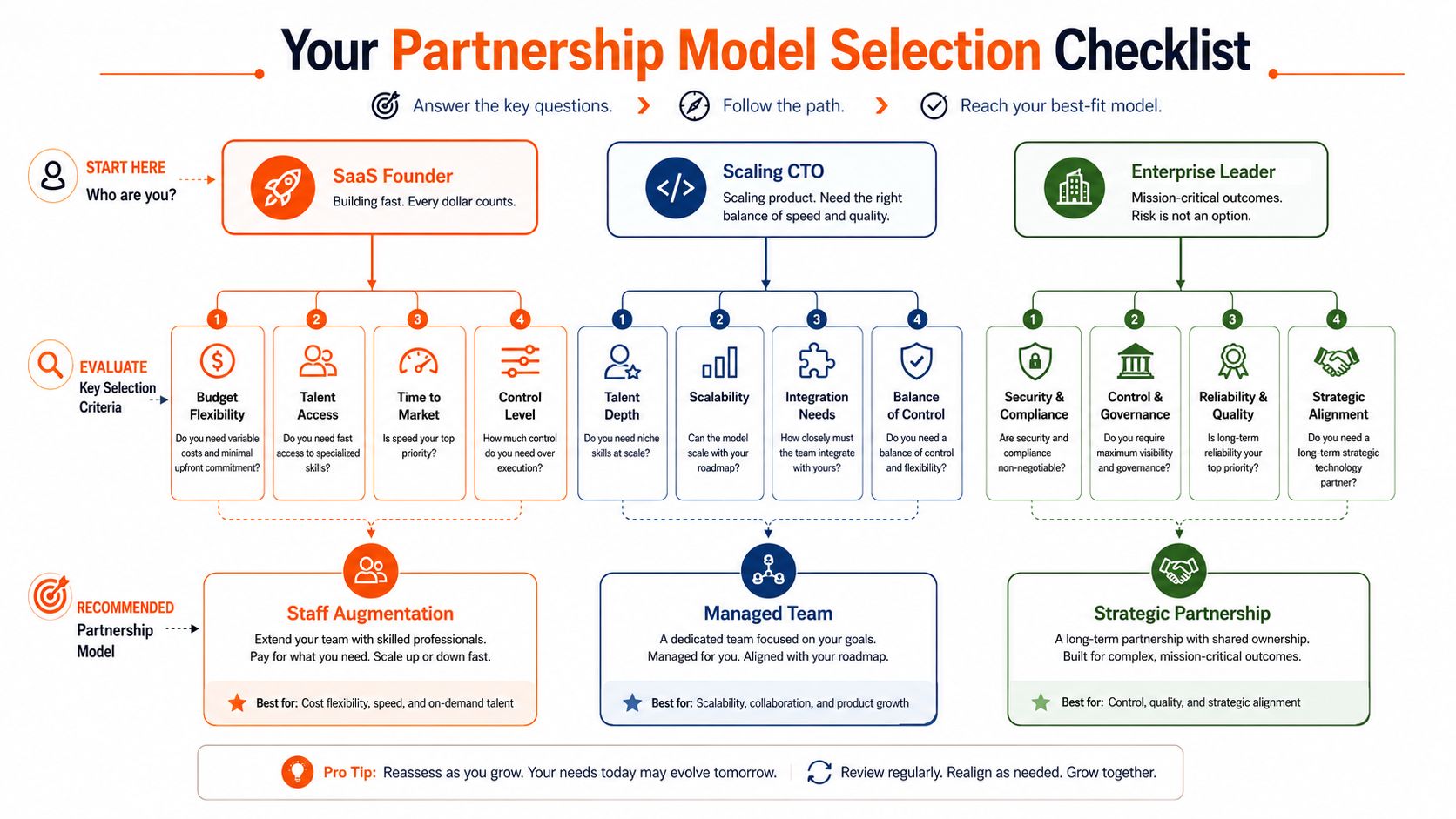
Five questions that narrow the field
Who owns the outcome? If your internal team owns the product, staff augmentation can work. If you need a partner to carry the delivery burden, dedicated teams or managed services usually fit better.
How deep should integration go? If the team needs to work inside your rituals, tools, and roadmap, do not choose a transactional model. If the work is isolated and bounded, keep the structure simple.
Can you govern the relationship properly? If you do not have strong decision-makers, a BOT or strategic alliance will probably stall. A lighter model may be safer until leadership is ready.
How flexible is the budget? Fixed budgets push you towards tighter scope and stronger definitions. Flexible budgets let you buy more continuity and capability, but they also demand more discipline.
What is the time horizon? Short-term delivery needs different controls from a multi-year platform build. Do not force a long-term structure onto a short-term problem.
Persona-specific paths
SaaS founders should lean towards the smallest model that can still own delivery. If the goal is an investor-ready MVP, a dedicated team with strong product oversight is often more practical than staff augmentation, because the founder needs momentum, not coordination overhead.
Scaling CTOs should look at dedicated teams or managed services when the problem is throughput, platform stability, or migration work. If the team already has product leadership, augmentation can fill gaps, but only when the CTO can keep architectural control tight.
Enterprise leaders should be more disciplined. If the aim is lasting capability, BOT deserves serious attention. If the aim is ecosystem expansion or joint go-to-market, a strategic alliance may be the better shape, provided governance is written down properly.
The easiest way to avoid a bad fit is to reject any model that depends on hope instead of management.
Building Partnerships That Deliver Measurable Outcomes
The right partnership model is the one that ties delivery accountability to measurable business results. Not activity. Not code volume. Results. The UK Government Digital Service's Service Standard makes that principle explicit, teams must define user needs, iterate through testing, and prove the service meets those needs before it passes assessment (Collaboration for Success). That is the standard every serious partnership should follow, whether it's public sector or SaaS.
Set outcome metrics from day one
If you do not measure the business result, the partner will optimise the work they can see. That often means more tickets closed and more meetings attended, not better product performance. Build your agreement around the outcomes that matter, such as time to market, adoption, reliability, or reduced operational bottlenecks.
The same logic applies to commercial delivery, advisory work, and build-transfer models. When the contract rewards ownership, the partner acts differently. They ask better questions, escalate earlier, and stop hiding behind status reports.
Demand ownership, not just capacity
Strong partners stand apart. They do not just provide people. They take responsibility for progress, bring options when reality changes, and keep pressure on the outcome until the business sees value. That is the culture we build with Extreme Ownership and proactive delivery discipline.
If you are selecting a partner, stop asking for headcount and start asking for accountability. Ask who owns the plan, who owns the risk, and what happens if the original route stops working. That one shift will eliminate most bad fits before they start.
Rite NRG works with SaaS teams, CTOs, and enterprise leaders who need delivery that is structured around outcomes, not theatre. If you want a partner who can help shape the model, the governance, and the operating rhythm, visit Rite NRG and start the conversation with the business result you need.